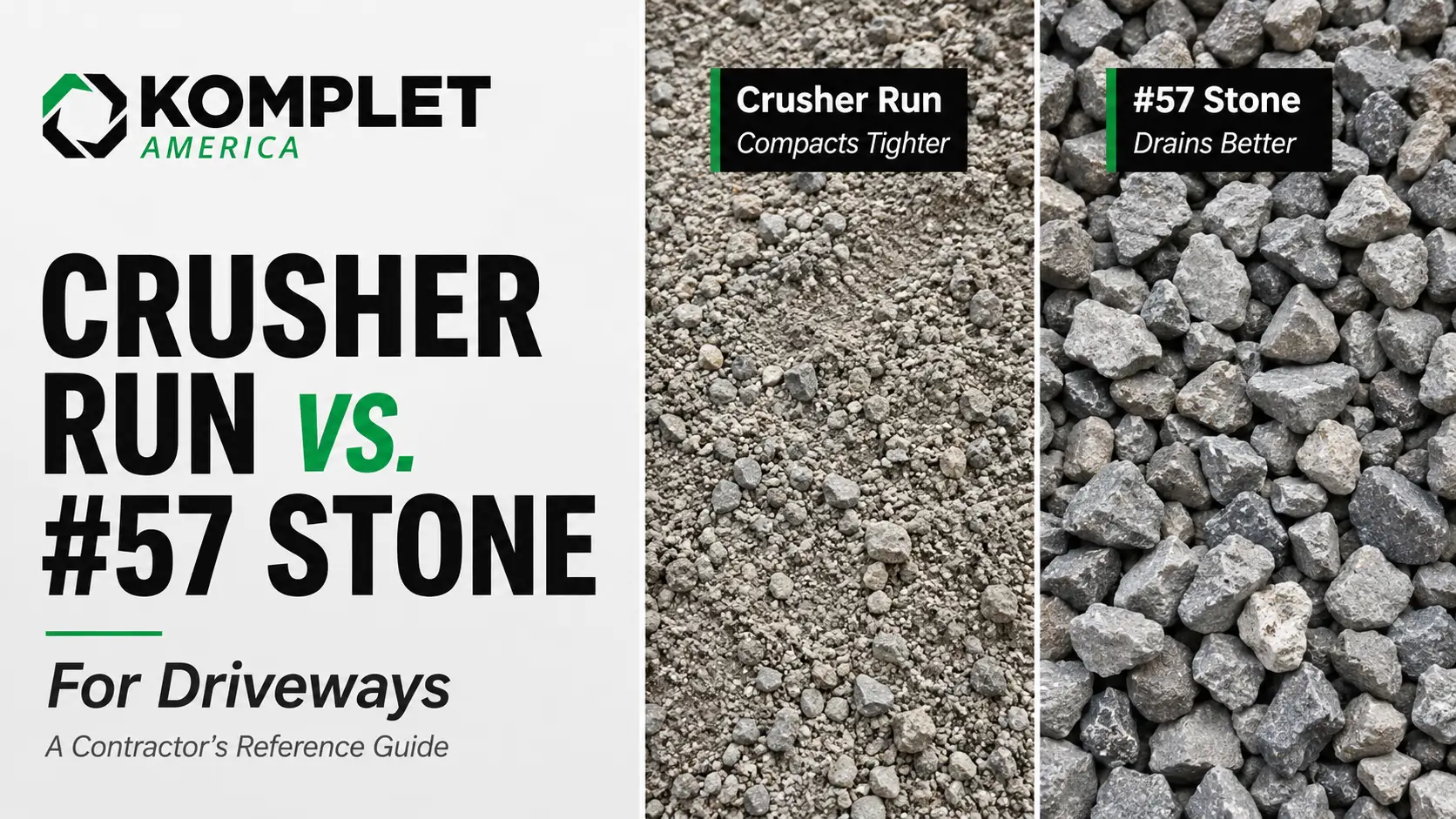

Crusher run and #57 stone are the two most-asked-for driveway aggregates in North America. Both show up on residential and light commercial driveway specifications, both are produced by quarries and recyclers across the country, and both are used by hardscape contractors, paver installers, site contractors, and demolition firms producing material on-site from their own concrete tear-out work. The two products solve different engineering problems — and the contractor or recycler who treats them as interchangeable is the one whose driveways rut, pump, or migrate within the first season.
The short answer: use crusher run when the driveway needs a tight, compacted surface that resists rutting under traffic. Use #57 stone when drainage is the priority — wet sites, lower structural lifts above poor subgrade, perimeter drainage along the driveway edge, retaining wall backfill behind the driveway, and hydrostatic relief layers under garage slabs and approach pads. The strongest residential and light commercial driveway sections use both, in different layers, doing different jobs.
This guide is written for the contractor or recycler making one of two decisions: what aggregate to specify on a driveway project they are bidding, or what aggregate to produce on-site from concrete demolition rubble using a compact mobile crusher. The technical detail covers AASHTO and ASTM gradations, where crusher run and #57 stone fit on the broader crushed stone grade spectrum, layered driveway section design, common failure modes, and the on-site production workflow that lets a contractor turn driveway tear-out concrete into the base material for the new driveway in the same week.
Komplet America has been the U.S. distributor of Komplet S.p.A. compact crushers, screeners, and shredders since 2018, and the Conti family construction legacy behind Komplet America stretches back to 1906. Most of the contractors running our equipment use it to produce driveway base products on jobsites and in yards — concrete patio rubble crushed into crusher run, screened into #57 and #67, and stockpiled for the next project. The technical detail that follows is the same content of the conversations we have with first-time buyers and experienced operators alike.
Why the Crusher Run vs. #57 Choice Matters
Driveways fail for predictable reasons. Water gets trapped in the section because the layer that should drain doesn’t. The base pumps fines up into the surface stone under repeated tire loading. The surface migrates because the stones never lock together and there is nothing holding them in place. The owner keeps adding fresh gravel, but the rut comes back because the new stone does not match the layer it is being placed on.
Almost every one of those failure modes traces back to a wrong-aggregate-in-wrong-layer decision. Crusher run and #57 stone are designed for different jobs. Used in the right job, both are excellent. Used in the wrong job, both fail predictably.
The general framework — open-graded versus dense-graded aggregate — is covered in detail in our companion article, Crushed Stone Grades: A Komplet Basic Guide to Aggregate Size and Use Cases. The summary that matters here: crusher run is dense-graded, meaning it includes a continuous gradation from a defined top size all the way down through stone dust. The fines lock up under compaction, the voids close, and the layer becomes a tight, smooth-rolling surface that sheds water laterally. #57 stone is open-graded, meaning it has no fines — the gradation runs from a nominal one-inch top size down to about a No. 4 sieve (roughly three-eighths of an inch), with the smaller fractions removed by clean screening. The voids stay open, water flows aggressively through the layer, and the stones interlock under load through angularity rather than through fines-driven compaction.
Both behaviors are useful. Both behaviors are wrong for some applications. The contractor who understands the distinction can specify either material correctly; the contractor who treats both as “driveway gravel” eventually has to come back and fix one or the other.
What Crusher Run Is
Crusher run is the umbrella term for any dense-graded aggregate produced by running quarried rock or concrete demolition material straight through a primary crusher with no clean screening step. Every fraction from the largest particle down through stone dust is in the load. The product mixes coarse stone, intermediate sizes, and fines in a continuous gradation curve. State and regional names vary substantially:
Regional Names for Crusher Run
- DGA — Dense Graded Aggregate. Common in the Northeast. New Jersey’s DGABC (Dense Graded Aggregate Base Course) is the standard NJDOT-approved version.
- ABC — Aggregate Base Course. Common in the Southeast.
- GAB — Graded Aggregate Base. Common in DOT specifications across multiple regions.
- Item 4 — common in New York. Specifically, NYSDOT Type 2 Subbase.
- 411, 21AA, 21A — regional Pennsylvania, Michigan, and adjacent state designations.
- Quarry Process (Q.P.) — older Northeast term, still used colloquially.
- 2A modified — Pennsylvania PennDOT designation.
Typical Gradation
Crusher run gradation envelopes vary by spec and producer, but the typical North American crusher run product has:
- Top size: three-quarters of an inch to one and a quarter inches, depending on regional spec. Some heavy-base products go up to two-inch top size.
- Intermediate fractions: continuous gradation between top size and the No. 4 sieve.
- Fines: 5 to 15 percent passing the No. 200 sieve, depending on spec. The fines are the binder that locks up the surface.
How Crusher Run Behaves Under Load
When crusher run is placed in lifts and compacted with a vibratory plate or roller, the fines fill the voids between coarser particles. The layer densifies — typical compacted dry density runs around 130 to 140 pounds per cubic foot for limestone-source crusher run, slightly less for sandstone or recycled concrete. The surface becomes tighter, smoother, and substantially more resistant to rutting than a clean stone layer would be at the same depth. The lock-up is the advantage.
The trade-off is drainage. Because the fines close most of the voids, water does not move through compacted crusher run as freely as it does through clean open-graded stone. Surface water sheds laterally off a properly crowned crusher run driveway and runs to the ditches; vertical drainage through the layer is much slower. On wet sites or where hydrostatic pressure is a concern, this can be a meaningful disadvantage.
What #57 Stone Is
#57 stone is a clean, open-graded aggregate defined by AASHTO M 43 (and the parallel ASTM D448). The number does not refer to inches or to a specific screen size — it refers to a defined gradation envelope with a nominal one-inch top size graded down to the No. 4 sieve, with no fines passing through. The gradation requires the stone to be washed (or screened cleanly) so that the fines below the No. 4 are removed.
Standard AASHTO #57 Gradation
- 100 percent passing the 1-1/2 inch sieve.
- 95 to 100 percent passing the 1-inch sieve.
- 25 to 60 percent passing the 1/2-inch sieve.
- 0 to 10 percent passing the No. 4 sieve.
- 0 to 5 percent passing the No. 8 sieve.
How #57 Stone Behaves Under Load
#57 stone resists load through aggregate interlock — the angular faces of the crushed particles wedge against each other under compression and distribute force across the layer. There are no fines binding the matrix together; load transfer happens through point-to-point particle contact. The voids between particles remain open, which means water flows aggressively through the layer and out the bottom or sides.
On a properly designed section, this is a substantial advantage. #57 stone in the lower lift of a driveway over wet or marginal subgrade lets water drain away from the structure rather than pooling under the surface. #57 in a French drain along the driveway edge, behind a retaining wall on a sloped lot, or as the drainage layer under a garage slab provides the hydrostatic relief that prevents the driveway from heaving or pumping.
The trade-off is surface stability. #57 stone alone, used as the only or top-most layer of a driveway, will roll under turning tires and migrate at the edges over time. The angular interlock is strong under compression but provides limited resistance to lateral shear loads from steered tires. On a dedicated #57 surface, the result is loose-feeling driveway, stones tracked into garages and yards, and progressive thinning of the surface layer.
Crusher Run vs. #57 Stone: Head-to-Head Comparison
The technical differences between the two products show up clearly in head-to-head comparisons across the criteria that drive driveway design decisions.
Drainage
- Crusher run: poor through-layer drainage. Surface water sheds laterally if the driveway is properly crowned. Subsurface water moves slowly. Not suitable as the primary drainage layer in a section where water must move vertically through the structure.
- #57 stone: aggressive through-layer drainage. Water moves freely through the open voids. The default product for any layer where vertical drainage is the engineering requirement.
Compaction and Surface Stability
- Crusher run: compacts to a dense, tight surface. Resists rutting under repeated tire loading. The standard surface course material for residential driveways, gravel parking lots, equipment laydown areas, and farm and estate roads.
- #57 stone: does not compact to a tight surface. Stones can roll under steered tires. Best used confined within a structural section rather than as a final driving surface.
Load Distribution
- Crusher run: distributes load through dense matrix behavior. Fines and coarse stone work together to spread point loads across the layer.
- #57 stone: distributes load through angular particle interlock. Strong under uniform compression, less resistant to concentrated point loads or lateral shear.
Cost (Typical Regional Pattern)
- Crusher run: generally lower per-ton cost than washed #57 in most U.S. markets, because crusher run does not require the clean-screening or washing step that adds cost to the production process. Specific pricing varies substantially by region — see Construction & Demolition Tipping Fees by Region: A Contractor’s 2026 Reference for the broader regional cost picture.
- #57 stone: typically higher per-ton cost due to the screening or washing step, but commands the price because of the engineering performance in drainage applications.
On-Site Production Difficulty
- Crusher run: easiest to produce on-site. A single-pass jaw crusher run on demolition concrete with no downstream screening step produces a usable crusher run product. The product is typically called “jaw run” or “crusher run” interchangeably when produced this way.
- #57 stone: requires both a crusher and a screener with appropriately-sized deck openings. The crusher reduces material to a top size at or above the #57 specification; the screener captures the gradation envelope and routes oversize back to the crusher.
When Crusher Run Is the Right Driveway Material
Crusher run is the right choice when the driveway needs a tight, compacted surface that resists rutting under traffic and the site does not require aggressive vertical drainage through the layer. Specific applications:
Residential Driveways on Stable Subgrade
On a residential driveway built over compacted, well-drained subgrade — sandy or gravelly soils, properly graded and compacted — crusher run is the default surface course. Place 4 to 6 inches over the prepared subgrade, compact in lifts, crown the surface for lateral drainage, and the result is a long-lasting driveway that resists rutting and feels firm under tires. This is the configuration most homeowners think of when they think of “a gravel driveway.”
Driveway Resurfacing
On an existing driveway that has thinned, rutted, or developed surface irregularities, crusher run is generally the right resurfacing material. The fines bond with the existing surface during compaction, the lift restores the crown, and the driveway returns to a smooth, firm finish. Critical step: regrade and restore the crown before placing fresh material. Placing new stone over a sunken crown traps water in the rut and the new stone fails the same way the original did.
Gravel Parking Areas, Farm Roads, and Equipment Laydown
Wherever the surface has to bear continuous traffic and resist rutting under truck or equipment loads, crusher run is the workhorse. A 6 to 8 inch lift of crusher run over compacted subgrade produces a parking surface that handles delivery trucks, contractor vehicles, and routine equipment movement with minimal maintenance over multi-year life cycles.
Driveway Top Course Over a Drainage Layer
On wet sites where #57 has been placed below for drainage, crusher run is the right top course. The combination — clean stone below for vertical drainage, crusher run on top for surface stability — is the strongest layered driveway section design available, and is the approach most engineers recommend for residential driveways on marginal subgrade.
When #57 Stone Is the Right Driveway Material
#57 stone is the right choice when the application requires aggressive drainage, when the layer is buried beneath a structural cap, or when the engineering requirement is hydrostatic relief rather than surface stability.
Lower Base Lift on Wet Sites
On a driveway being built over wet, silty, or otherwise marginal subgrade, the lower lift of the structural section needs to drain water away from the layer rather than holding it under the surface. Place non-woven geotextile over the prepared subgrade to prevent fines migration; place 4 to 6 inches of #57 (or coarser #3 or #5 in extreme cases) directly over the geotextile; place the surface lift on top. The clean stone layer drains laterally and into the surrounding soil, keeping the section dry.
French Drains Along the Driveway
A perimeter French drain along the uphill edge of a driveway captures surface water from the surrounding lot and routes it around the driveway rather than through it. The standard configuration: trench at the edge of the driveway, non-woven geotextile lining the trench, perforated pipe at the bottom, and #57 stone filling the trench to within 6 inches of the surface. The clean stone provides the void volume for water flow; the geotextile prevents fines from clogging the system. Detail covered in depth in our companion piece on French drain stone selection once that article is live.
Retaining Wall Backfill Behind Driveways
Driveways on sloped lots frequently require a retaining wall on the uphill side. The first 12 inches behind the wall — the hydrostatic relief zone — should be #57 stone. Surface water that reaches the wall drains down through the clean stone and exits through weep holes or a drainage pipe, preventing water pressure from building up behind the wall. Compacted soil or crusher run placed directly against a retaining wall traps water and is one of the most common causes of wall failure.
Permeable Driveway Sections
On commercial or HOA-driven projects with stormwater management requirements, permeable driveway designs may require a stacked open-graded section: #2 stone in the storage layer (typically 12 inches), #57 in the choker (typically 4 inches), and #8 in the bedding (typically 2 inches) under permeable pavers or porous asphalt. The full open-graded design is engineered for stormwater retention as well as vehicle support, and #57 plays the choker role bridging the deep storage layer up to the smaller bedding stone.
Garage Slab and Approach Pad Base
Concrete approach pads, garage slabs, and structural transitions at the head of a driveway typically use #57 or #67 stone as the immediate base under the slab, providing both drainage and load distribution. 4 to 6 inches of compacted #57 over a stable subgrade — with vapor barrier between the stone and the slab where required — is the standard configuration for most residential and light commercial slab work.
The Layered Driveway: Combining Both Materials
For most new residential driveway construction on anything other than ideal subgrade, the strongest section is layered. Each layer has a defined job, and the materials match the job. The contractor who specifies a layered section instead of trying to make one product do everything builds driveways that last.
A Standard Residential Driveway Section
- Subgrade preparation. Strip topsoil and organics. Compact the native subgrade to specification — typically 95 percent of standard Proctor density. Confirm subgrade stability before placing any aggregate.
- Geotextile (where needed). On wet, silty, or marginal subgrade, place non-woven geotextile over the prepared subgrade to separate the soil from the stone above. Geotextile prevents fines from migrating up into the aggregate and the aggregate from sinking into the soil — the failure mode known as pumping.
- Drainage / structural lift. 4 to 6 inches of #57 stone directly over the geotextile, or coarser #3 or #5 stone where the subgrade is particularly poor. This layer drains laterally and provides the structural foundation for everything above.
- Intermediate or transition layer (optional, for thicker sections). 2 to 3 inches of #67 stone bridges the size gap between the coarse drainage layer and the surface course. Useful on heavy-duty driveways but optional on most residential applications.
- Surface course. 2 to 4 inches of crusher run, compacted in two lifts. Crown the surface for lateral drainage. The crusher run locks up under compaction and provides the firm, smooth driving surface.
- Drainage features. Driveway crown of approximately 2 percent (a quarter inch per foot from centerline). Roadside ditches sized for the drainage area uphill of the driveway. Cross drains where the driveway crosses a natural drainage path.
Why Layering Beats Single-Material Design
A single-material driveway forces one product to do two contradictory jobs: drain water and provide a tight surface. Crusher run alone drains poorly. #57 alone provides poor surface stability. Increasing the depth of either single material does not solve the underlying problem; it just shifts the failure point.
Layered design separates the jobs. The drainage layer drains. The surface layer provides surface stability. Each material is in its correct application, and the section as a whole performs both jobs simultaneously. The cost of a layered section is typically 20 to 40 percent more than a same-depth single-material section, but the service life is meaningfully longer and the maintenance cost is lower over the driveway’s lifecycle.
Producing Crusher Run and #57 Stone On-Site from Concrete Rubble
For contractors who do their own demolition — patio tear-outs, driveway replacements, sidewalk and walkway removal, pool deck demolition — the concrete rubble generated by the demolition is the input for the new driveway’s base material. Compact mobile crushing equipment turns the rubble into either crusher run or sized #57 stone, eliminating both the dump fee on the rubble and the aggregate purchase for the new driveway in the same workflow. This is the demolition-side economics covered in detail in The Hardscape Contractor’s Guide to On-Site Stone Production and Construction & Demolition Tipping Fees by Region.
Producing Crusher Run from Concrete Rubble
Crusher run is the easiest product for a hardscape or driveway contractor to produce on-site. The workflow:
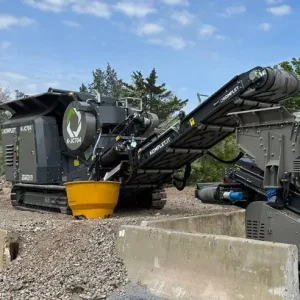
- Pre-break the rubble. Excavator-mounted hydraulic breaker reduces slabs to feed-size pieces — for the K-JC 503 or K-JC 604, that means rubble pieces no larger than about 12 to 15 inches in their longest dimension.
- Set the closed-side setting (CSS). For a paver-base or driveway-base crusher run product, set the CSS to roughly three-quarters of an inch to one and a quarter inches. The CSS controls the top size of the output and is hydraulically adjustable from the wireless remote control.
- Run the crusher. Feed the broken rubble into the hopper with an excavator or skid steer. The integrated vibrating feeder controls flow into the jaw. The output discharges onto the conveyor as an undifferentiated minus-CSS product — that is, crusher run.
- Manage rebar (on K-JC 604, K-JC 704 PLUS, K-JC 805). The integrated hydraulic magnetic belt lifts ferrous metal off the discharge conveyor into a separate clean pile during crushing. No manual rebar removal required.
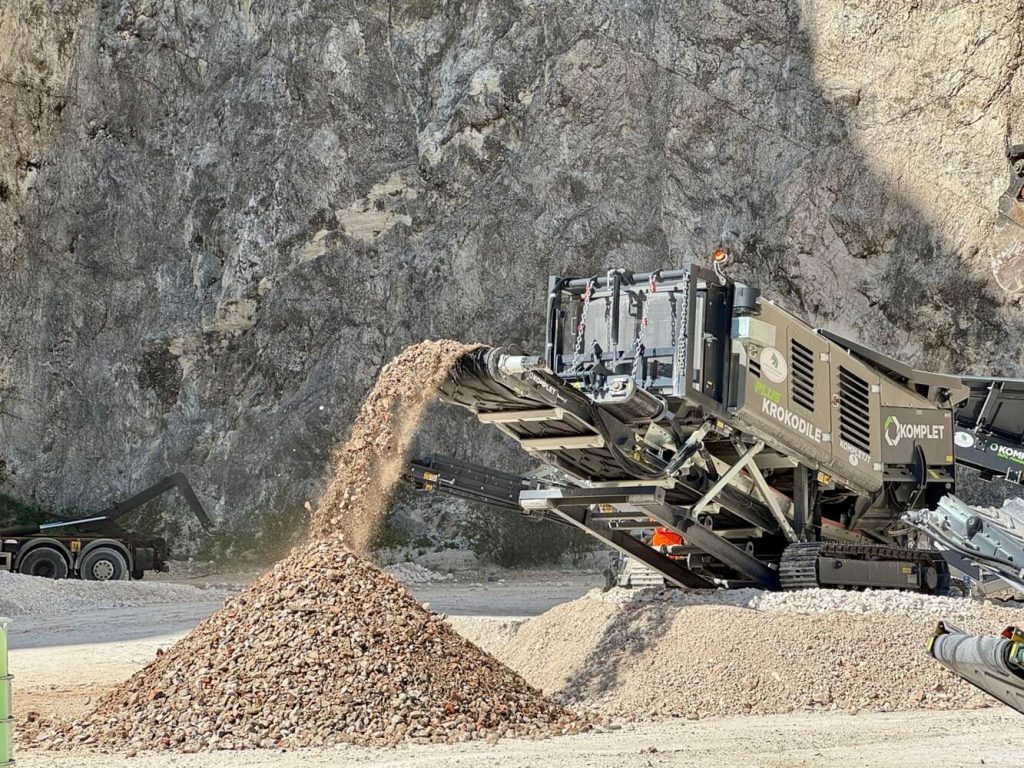
- Stockpile the output. The discharge conveyor builds the stockpile. The product is ready for use as driveway base on the next project, or for resale to other contractors as a low-cost alternative to quarry-supplied DGA.
Producing #57 Stone from Concrete Rubble
Producing #57 from concrete rubble requires a screening step in addition to the crushing step. The crusher reduces material to a top size at or above the #57 specification; the screener captures the gradation envelope. The workflow:
- Pre-break and primary crush. Same as crusher run, except the CSS is typically set wider — closer to one and a quarter inches — to leave room for the screening step to define the final product.
- Screen the crusher output. The crusher discharge feeds a vibrating screener — typically a Kompatto 221 for compact operations or a Kompatto 5030 for higher-volume work — fitted with deck openings sized to capture the AASHTO #57 envelope. The top deck removes oversize (returned to the crusher); the bottom deck removes fines (stockpiled separately as stone dust); the middle deck captures the #57 product.
- Stockpile cleanly. The K-TC 460 tracked mobile conveyor extends stockpile reach and prevents cross-contamination between #57, oversize, and stone dust streams.
- Quality control. Periodic gradation testing against the AASHTO #57 envelope (or the relevant state DOT spec) confirms that the product meets specification. For state DOT supply, additional source documentation and stockpile approval requirements apply — covered in State DOT Specs for Recycled Concrete Aggregate: A Contractor’s Reference.
The Two-Product Operation
A hardscape or driveway contractor running a K-JC 604 or K-JC 704 PLUS with a Kompatto screener on a typical residential project can produce both crusher run and #57 from the same demolition feed. Run the crusher with the screener bypassed for crusher run; run with the screener engaged for sized products. The flexibility means the same equipment supplies both layers of a layered driveway section, eliminating both the aggregate purchase and the dump fee on the demolition rubble.
Common Mistakes Contractors Make
Using Crusher Run Where Drainage Is the Priority
The most common failure mode. The contractor places 6 inches of crusher run directly over wet, silty subgrade without geotextile or a drainage layer. Surface water shed by the crown collects at the bottom of the section and saturates the subgrade. The subgrade pumps. Fines migrate up into the crusher run. The driveway ruts within a season. The fix — strip back the failed section, install geotextile and a #57 drainage layer, replace the surface course — costs substantially more than building it correctly the first time.
Using #57 Alone as a Driveway Surface
The opposite failure mode. The contractor places 6 inches of #57 over compacted subgrade as the only layer, expecting the angular interlock to provide enough surface stability for daily driving. The stones roll under steered tires. The driveway tracks into the garage and yard. The surface progressively thins and the underlying subgrade becomes exposed. The driveway needs additional surface material — typically crusher run — within a year or two of original construction.
Skipping Geotextile on Marginal Subgrade
Geotextile is the cheapest insurance available on a driveway project. Non-woven geotextile fabric costs a small fraction of the aggregate cost and prevents the most common driveway failure mode: pumping. On any subgrade that is not visibly clean, well-drained, and stable, geotextile under the first lift of stone is essentially mandatory. Contractors who skip geotextile to save a few hundred dollars on a project frequently come back to redo the section within a season.
Placing Fresh Stone Over a Failed Section
Driveway repair without grade and drainage correction is the road to a recurring repair contract — pleasant for the contractor’s annual revenue, less pleasant for the customer relationship. When a driveway has rutted or developed surface irregularities, the underlying problem is almost always grade or drainage. Adding fresh material on top of the failed section without correcting the underlying problem produces the same failure within months. Restore the crown, fix the drainage, then place fresh material.
Mixing Stone Sizes on the Way Down
In a layered section, the size of the aggregate should generally decrease from bottom to top. Coarse stone below, finer stone in the middle, and the surface course on top. Reversing this — placing finer stone below coarser stone — creates a separation problem where the coarser stone migrates down into the layer below over time. This is one of the structural reasons crusher run is the typical surface course over a #57 base, rather than the other way around: crusher run’s continuous gradation locks up at the surface, and the coarser drainage stone below stays in place under the dense matrix.
Equipment Sized for Driveway-Material Production
Komplet’s compact crusher and screener lineup is sized for exactly the kind of demolition and aggregate production that hardscape and driveway contractors do. The right machine depends on annual project volume and target product mix:
K-JC 503 — The Driveway Contractor Starter
The K-JC 503 mini mobile jaw crusher is the entry point for a hardscape or paver contractor adding on-site crushing for the first time. 19-inch by 12-inch jaw, output adjustable from three-quarters of an inch to three and a quarter inches, production up to 34 US tons per hour. Towable behind a standard truck. Right-sized for the contractor doing 25 to 75 residential paver and driveway projects per year.
K-JC 604 — The Workhorse
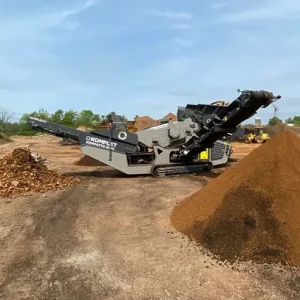
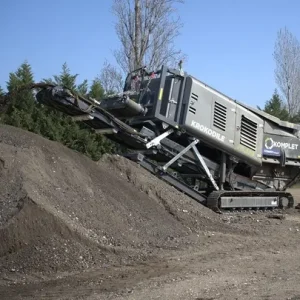
The K-JC 604 mobile jaw crusher steps up to 23-inch by 16-inch jaw, hydraulically adjustable CSS, integrated hydraulic magnetic belt for rebar separation, and production up to 55 US tons per hour. Right-sized for higher-volume hardscape and driveway operations or those handling reinforced concrete demolition. Most driveway contractors crushing their own demolition output land on the K-JC 604 once the operation is steady-state.
Kompatto Screeners — For Sized Products
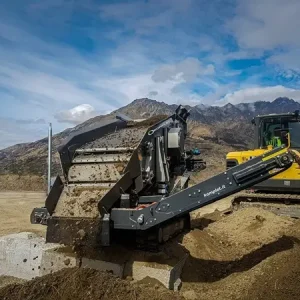
Producing sized #57 stone in addition to crusher run requires a screening step. The Kompatto 221 vibrating screener pairs naturally with the K-JC 503 or K-JC 604 for compact operations producing two or three sized products from one feed stream. The Kompatto 5030 handles higher-volume production for operations supplying multiple contractors or producing for state DOT projects.
Pre-Owned and Financing Options
Komplet America offers pre-owned compact crushers and screeners with typical capital savings of 40 to 70 percent versus new, factory-supported by the same Komplet America service network. Equipment financing through Komplet Capital — 24-hour approvals, terms from 36 to 72 months, 100 percent financing available — covers both new and pre-owned equipment for first-time buyers entering the market.
Frequently Asked Questions
Is crusher run or #57 stone better for a driveway?
Crusher run is generally better for the driveway surface. #57 stone is generally better for drainage and lower base layers. The strongest residential and light commercial driveways use both — #57 below for drainage and crusher run on top for surface lock-up. Treating the choice as either-or is the most common cause of driveway failures we see in the field.
Can #57 stone be used as a driveway surface?
It can, but it will feel looser than crusher run and the stones can roll under steered tires. #57 works as a driveway surface only when the driveway has good edging containment and the owner accepts a less-tight surface in exchange for the drainage benefit. Most residential driveways perform better with crusher run as the surface course.
Does crusher run need to be compacted?
Yes. Crusher run depends on compaction to develop its strength. Place it in lifts (typically 2 to 3 inches per lift, with the final lift compacted last) and compact each lift with a vibratory plate or roller sized for the driveway scale. Without compaction, crusher run does not develop the dense matrix that gives it surface stability.
Should I put crusher run over #57 stone?
Yes, this is the standard layered driveway section design. Clean #57 stone below provides drainage; crusher run on top provides the firm surface course. The combination is stronger than either material alone at equivalent depth.
How thick should the crusher run layer be on a driveway?
For most residential applications, 4 to 6 inches of crusher run is the typical surface course depth, placed in two lifts and compacted. Deeper sections (6 to 8 inches) apply to heavy-traffic driveways, equipment laydown areas, and farm or estate roads. Thinner sections (2 to 4 inches) apply only when crusher run is the surface course over a thicker drainage layer below.
Can I produce both crusher run and #57 stone from concrete demolition rubble?
Yes. A compact jaw crusher (K-JC 503, K-JC 604, K-JC 704 PLUS) produces crusher run directly from the chamber output. Adding a Kompatto vibrating screener separates the same crusher output into sized streams — typically #57, smaller bedding products, and stone dust. The two-product operation lets a contractor supply both layers of a layered driveway section from the same demolition feed, eliminating both dump fees and aggregate purchase costs.
What’s the difference between crusher run and “jaw run”?
Generally, the same product. “Jaw run” is industry shorthand for the unscreened minus-CSS output of a jaw crusher, which is dense-graded and behaves like crusher run. Some quarries and recyclers use the terms interchangeably; some use “crusher run” specifically for the spec-blended product and “jaw run” for the unblended chamber output. The performance is essentially identical for driveway applications when the gradation is appropriate.
Is recycled concrete crusher run as good as virgin stone crusher run?
For driveway applications, properly produced recycled concrete crusher run performs comparably to virgin stone crusher run. Recycled material is typically 30 to 60 percent cheaper depending on regional quarry pricing and tipping fees. The cementitious fines in recycled material can leach lime in the first season, raising soil pH adjacent to the driveway — not generally a concern for residential driveways but worth noting for landscape-sensitive applications. State DOT specifications increasingly accept recycled concrete in base course applications; details in our companion article on State DOT RCA specs.
Final Thoughts
Crusher run and #57 stone are not competing products. They are complementary materials that solve different engineering problems on the same kind of project. The contractor who specifies them based on the engineering requirement — drainage versus surface stability, structural support versus hydrostatic relief — builds driveways that last. The contractor who treats them as interchangeable “driveway gravel” builds driveways that fail.
For a hardscape, paver, or driveway contractor doing residential and light commercial work, both products can be produced on-site from concrete demolition rubble using compact mobile crushing equipment. The economics are favorable in most U.S. markets — eliminating both the dump fee on demolition material and the aggregate purchase for the new construction in the same workflow. The same equipment that produces the surface course also produces the drainage layer below it. Done well, the operation supplies most or all of a residential driveway project’s aggregate from in-house production at meaningfully lower cost than buying both products from a quarry.
For the contractor weighing the first compact crusher purchase, this kind of dual-product capability is one of the strongest practical arguments for owning the equipment. Driveway and patio projects are the bread and butter of most hardscape operations. The aggregate cost on those projects is meaningful. The dump fee on the demolition rubble is meaningful. Putting a crusher in the operation reduces both at once.
For broader context across the cluster of compact crusher topics this article connects to, see Crushed Stone Grades: A Komplet Basic Guide to Aggregate Size and Use Cases, The Hardscape Contractor’s Guide to On-Site Stone Production, State DOT Specs for Recycled Concrete Aggregate: A Contractor’s Reference, and Construction & Demolition Tipping Fees by Region: A Contractor’s 2026 Reference.
Ready to Produce the Right Driveway Aggregate On-Site?
- Talk to a Komplet specialist about the right crusher and screener combination for your project mix and target product gradations. Call 908-369-3340 or visit com/contact-us.
- Browse the full Komplet equipment lineup — crushers, impact crushers, screeners, conveyors, and shredders sized for compact contractor and recycling operations.
- Explore equipment financing through Komplet Capital — 24-hour approvals, terms from 36 to 72 months, 100% financing available.
- Consider a pre-owned Komplet machine — typical capital savings of 40 to 70 percent versus new, factory-supported by the same Komplet America service network.
Never enough.
Disclaimer: Stone sizes, gradation envelopes, layer depths, and approved uses vary by supplier, region, and DOT or project specification. AASHTO and ASTM gradations are reproduced from publicly available standards current as of late 2025 and early 2026; specific state DOT and project specs may modify these envelopes. Always confirm the gradation report, project spec, engineer requirements, and local code before ordering, selling, or producing material. Cost figures and percentage savings ranges are illustrative and based on typical regional patterns; actual results in any specific operation vary substantially. Operating, maintenance, and service guidance is general in nature. Always refer to the official Komplet operator’s manual for the specific machine model and serial number, and follow OEM intervals and procedures. For warranty-protected work, contact Komplet America at 908-369-3340 or your authorized Komplet dealer. Improper service or non-OEM parts may void warranty coverage and create safety hazards.