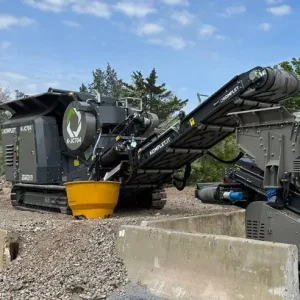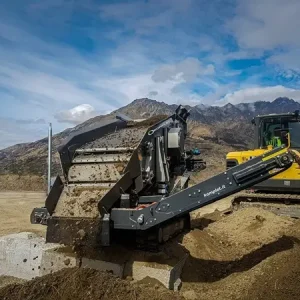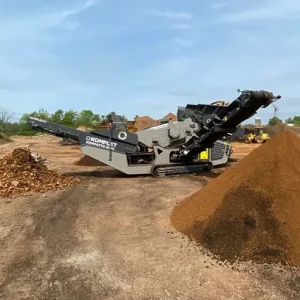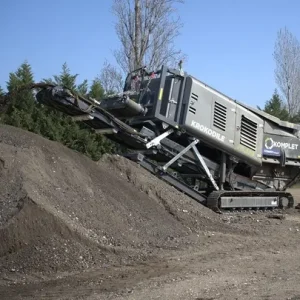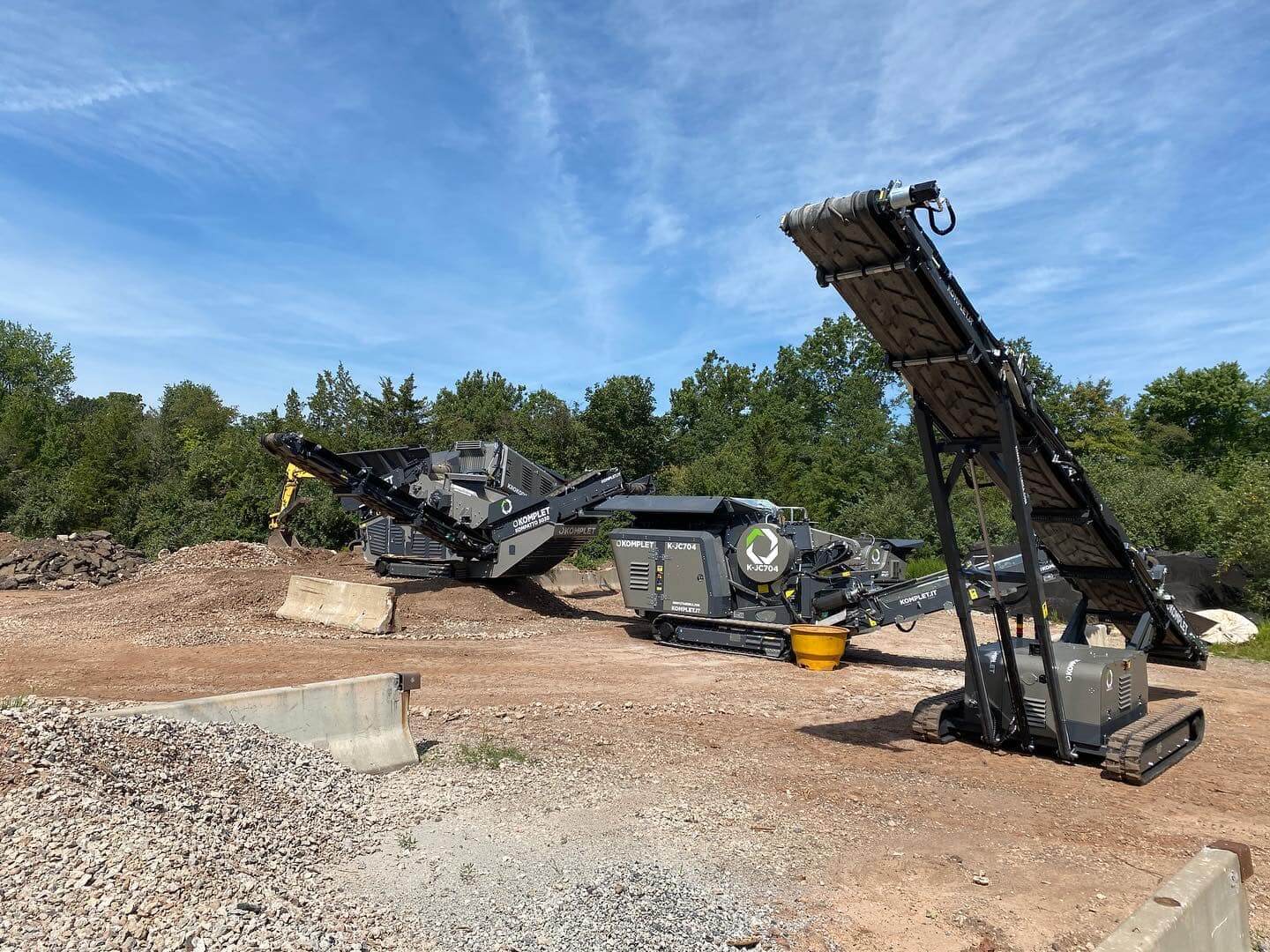

Tracked conveyors reduce environmental impact on aggregate, recycling, and construction sites by replacing repeated loader and truck cycles with a single continuous belt — cutting diesel consumption, lowering tailpipe emissions, reducing dust at material transfer points, and enabling on-site recycling that diverts material from landfills and reduces hauling miles. On a Komplet jobsite, a K-TC 460 tracked mobile conveyor runs on a 25 hp Tier 4 Final diesel engine, walks itself into position on rubber tracks without a tow vehicle, and clears crusher or screener discharge at up to 132 US tph — replacing the loader hours, truck transfers, and ground disturbance that drive most of a compact jobsite’s environmental footprint.
This guide explains the environmental case for tracked conveyors in plain operating terms — what’s actually happening on the jobsite, where the emissions and dust reductions come from, what role the K-TC 460 plays alongside Komplet crushers, screeners, and the Krokodile PLUS slow-speed shredder, and how the environmental gains line up with the operational and cost gains contractors already understand.
Environmental compliance is a moving target — air quality rules, dust suppression requirements, hauling restrictions, and landfill diversion mandates vary widely by state, county, and jobsite. The point of this guide isn’t to make compliance claims for any specific jurisdiction. The point is to explain the operating mechanisms by which a tracked conveyor changes the environmental picture on a compact jobsite, so contractors can build their own case for the right region, the right material stream, and the right project.
What Is a Tracked Conveyor and Why Does It Change the Environmental Math?
A tracked conveyor is a self-propelled belt conveyor that travels on rubber tracks under wireless remote control. It is not a wheeled or towable stacker. It does not need a loader, telehandler, or pickup to push it into position. Once on site, the conveyor walks itself — across uneven yard surfaces, around stockpiles, into tight urban setups — and the operator runs it from the same wireless remote used for the rest of the spread.
On a compact crushing or screening operation, the tracked conveyor sits at the discharge of a crusher or screener and carries finished material away from the machine, building a stockpile at a controlled height and angle. That single change — replacing repeated loader passes with a continuous belt — is where most of the environmental gain comes from. Loader cycles burn diesel, generate emissions, kick up dust at every drop point, and require operator labor. A continuous belt does the same job at a fraction of the energy cost per ton.
The Three Categories of Site Conveyor
- Stationary conveyors. Bolted to the ground or skid-mounted. Reliable but immobile. Used in fixed plants, not on contractor jobsites that move between projects.
- Wheeled or towable stackers. Reposition with help — they need a loader, telehandler, or tow vehicle. Each repositioning means another machine running, another diesel cycle, another set of dust-raising movements across the site.
- Tracked mobile conveyors like the K-TC 460. Walk on their own rubber tracks under wireless remote. Reposition during production without a second machine in motion. The environmental footprint of repositioning is the conveyor’s own engine — and nothing else.
The Environmental Benefits of Tracked Conveyors
Five mechanisms drive the environmental case for tracked conveyors on aggregate, recycling, and construction sites. Each one is an operating reality, not a marketing claim — and each one is measurable in diesel gallons, truck miles, dust generation, or landfill tonnage avoided.
1. Lower Fuel Burn Per Ton of Material Moved
A wheel loader pushing or carrying material across a yard burns diesel at a rate that scales with bucket capacity, cycle length, and operator habit. A continuous belt carries the same tonnage at a fraction of the energy cost. The K-TC 460’s 25 hp Tier 4 Final diesel engine runs the entire conveyor — track movement, belt operation, hydraulic functions — on substantially less fuel per ton than a typical wheel loader cycle covering the same distance.
On a single-loader spread, replacing loader-to-stockpile cycles with a tracked conveyor often eliminates several gallons of diesel per shift, depending on cycle length, material density, and stockpile height. Across a season, that compounds into real fuel savings — and the fuel saved is fuel not burned, with the corresponding reduction in tailpipe emissions.
2. Fewer Truck and Loader Cycles, Fewer Tailpipe Emissions
On a jobsite without a discharge conveyor, the loader is the only way to move crusher or screener output to its final stockpile. Every cycle is a diesel cycle, with the corresponding emissions. A tracked conveyor moves the material continuously — no loader cycle required for the discharge move itself.
On a project where the alternative is hauling demolition or processing material off-site to a transfer station or recycling facility, the math is even more dramatic. Each truckload off-site is a round-trip diesel cycle, often through congested urban routes. On-site processing with a Komplet crusher or shredder, paired with a tracked conveyor that builds saleable stockpiles in place, eliminates the entire round-trip hauling cycle.
3. Reduced Dust Generation
Dust is generated at every material transfer point — every loader bucket dump, every truck unload, every drag of a bucket across loose material. A tracked conveyor with a controlled discharge angle drops material onto a stockpile in a continuous stream rather than a series of impacts, which reduces the velocity and volume of fugitive dust at the discharge point.
Dust reduction matters more in some applications than others. On urban demolition projects, dust is a regulatory and neighborhood concern. On topsoil and compost operations, fugitive dust represents lost product. On dry aggregate processing, dust suppression is part of the air quality permitting picture. In all of those cases, fewer transfer points means less dust to suppress, and the dust that is suppressed gets controlled with smaller water volumes.
Komplet pairs the K-TC 460 with crushers that have dust suppression standard on the K-JC 503 and K-IC 70, and as an option on the larger jaw crushers — giving operators a coordinated dust-control approach across the spread.
4. Less Ground Disturbance and Site Damage
Loaders working continuously across a yard or jobsite chew up ground. Soft ground gets rutted, paved surfaces get scuffed by tire chains and bucket teeth, and natural terrain takes repeated impact damage from heavy axles. A tracked conveyor on rubber tracks distributes its 7,000-pound transport weight across a much larger ground contact area than a wheel loader’s tires, with less localized pressure.
On greenfield sites, sensitive habitat areas, or projects with strict reclamation requirements, that lower ground disturbance translates directly into a smaller restoration burden at project end. On urban jobsites, it means less repair work to surrounding pavement, curbs, and grass strips.
5. Enabling On-Site Recycling and Landfill Diversion
The single largest environmental contribution a tracked conveyor makes is indirect: it makes high-volume on-site processing practical, which is what enables landfill diversion in the first place. Crushing, screening, and shredding demolition material on site only works if the saleable product can be stockpiled efficiently. Without a tracked conveyor, the stockpile becomes the bottleneck — operators run out of pile room, choke out the crusher, and default to hauling material off-site.
With a tracked conveyor building 15-foot stockpiles, on-site processing scales. The recycled aggregate, processed RAP, screened topsoil, or shredded wood waste stays on the project — used as backfill, base material, or saleable product — instead of being hauled to a landfill or transfer station. Every ton processed on-site is a ton not hauled, and a ton not landfilled.
K-TC 460 Tracked Mobile Conveyor: Environmental Specifications
The K-TC 460 is the tracked mobile conveyor in the Komplet lineup. Its environmental profile starts with the engine and the drivetrain:
- Engine: 25 hp Tier 4 Final diesel — meeting current EPA Tier 4 Final emissions standards for non-road diesel engines.
- Drive: Self-propelled on rubber tracks — no tow vehicle, no loader assist, no second engine running to reposition the conveyor.
- Belt: 25 inches × 393 inches, 3-ply Chevron — the steep belt angle that produces 15-foot pile heights.
- Production: up to 132 US tph — clearing crusher and screener discharge continuously, eliminating loader cycles for the discharge move.
- Pile height: 15 feet — denser stockpiles per square foot of yard, less ground footprint per ton stored.
- Working dimensions (L × W × H): 32’8″ × 7’5″ × 15′
- Transport dimensions (L × W × H): 16’7″ × 7’5″ × 6’9″
- Weight: 7,000 lb — towable behind standard work trucks, no permitted move, no heavy-haul tractor.
- Control: Wireless remote — single-operator setup, no second person required for repositioning.
Tier 4 Final Compliance
Tier 4 Final is the current EPA emissions standard for non-road diesel engines. It requires substantial reductions in particulate matter and nitrogen oxides compared to earlier engine standards. Every Komplet machine sold in the United States meets Tier 4 Final — including the K-TC 460. For contractors working in jurisdictions with non-road diesel restrictions, low-emission zone requirements, or municipal procurement standards that reference current EPA tiers, Tier 4 Final compliance is the baseline.
Right-Sized Engine
The 25 hp engine on the K-TC 460 is sized for the conveyor’s actual workload. It is not an oversized engine running at a fraction of capacity — which is the most common cause of poor fuel efficiency on heavy equipment. A right-sized engine running near its design load burns less fuel per operating hour and produces less per-ton emissions than an oversized engine burning fuel to spin a partially loaded drivetrain.
DEF, DPF, and Maintenance Realities
Tier 4 Final compliance comes with diesel exhaust fluid (DEF) and diesel particulate filter (DPF) requirements that operators should plan for. DEF must be kept topped off, DPF regeneration cycles should be allowed to complete, and the after-treatment system requires routine inspection. None of that is unique to the K-TC 460 — it is standard practice for any current-generation diesel equipment — but it is a real operating requirement and should be incorporated into daily walk-arounds.
On-Site Recycling: The Highest-Leverage Environmental Use Case
The strongest environmental case for tracked conveyors is in C&D recycling, recovered asphalt processing, and concrete recycling — applications where the alternative to on-site processing is hauling material off-site, paying tipping fees, and importing virgin aggregate back to replace it.
Construction and Demolition Debris
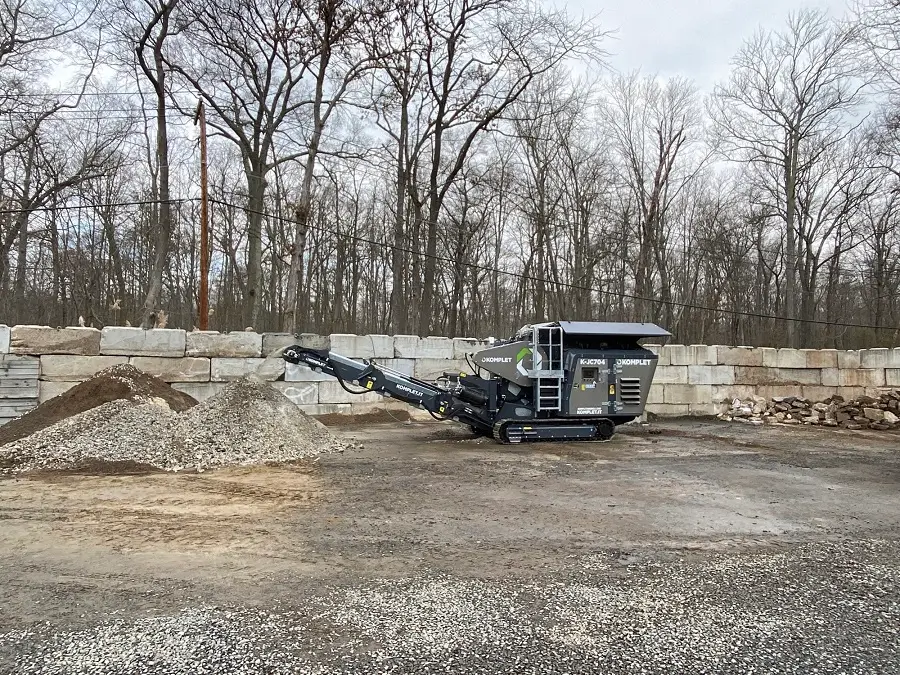
On a demolition or renovation project, concrete, brick, block, asphalt, and rubble are typically the largest waste streams by weight. Hauling that material off-site to a landfill or transfer station means truck miles, tipping fees, and material being permanently removed from the construction supply chain. Crushing on site with a K-JC 704 PLUS portable jaw crusher or K-IC 70 compact impact crusher — paired with a K-TC 460 to build the recycled-aggregate stockpile — turns the same material into a usable product.
The recycled aggregate becomes backfill, base course, drainage material, or saleable product. The hauling miles disappear. The tipping fees disappear. The corresponding virgin aggregate that would have been imported also doesn’t need to be quarried, processed, and trucked in. The environmental savings stack across the entire material lifecycle.
Recovered Asphalt Pavement (RAP)
Asphalt recycling is one of the highest-leverage environmental applications in construction. Recovered asphalt pavement reduced to spec-compliant aggregate goes back into new asphalt mixes, displacing virgin aggregate and binder. The K-IC 70 compact impact crusher reduces RAP to fine material suitable for new asphalt production; a K-TC 460 builds the processed RAP stockpile in place. On a paving contractor’s yard, the whole loop — milling, crushing, stockpiling, blending — happens on-site, with no off-site hauling between stages.
Concrete Recycling
Concrete recycling facilities and demolition contractors processing concrete debris use a similar model: a jaw crusher reduces broken concrete to aggregate; a screener separates the product cuts; a tracked conveyor stockpiles each cut. The Kompatto 5030 vibrating screener or Kompatto 124 mobile screener handles the screening; the K-TC 460 handles the stockpiling. The result is recycled concrete aggregate suitable for non-structural concrete, road base, drainage, and fill — replacing virgin aggregate one ton at a time.
Wood, Drywall, and Mixed C&D Waste
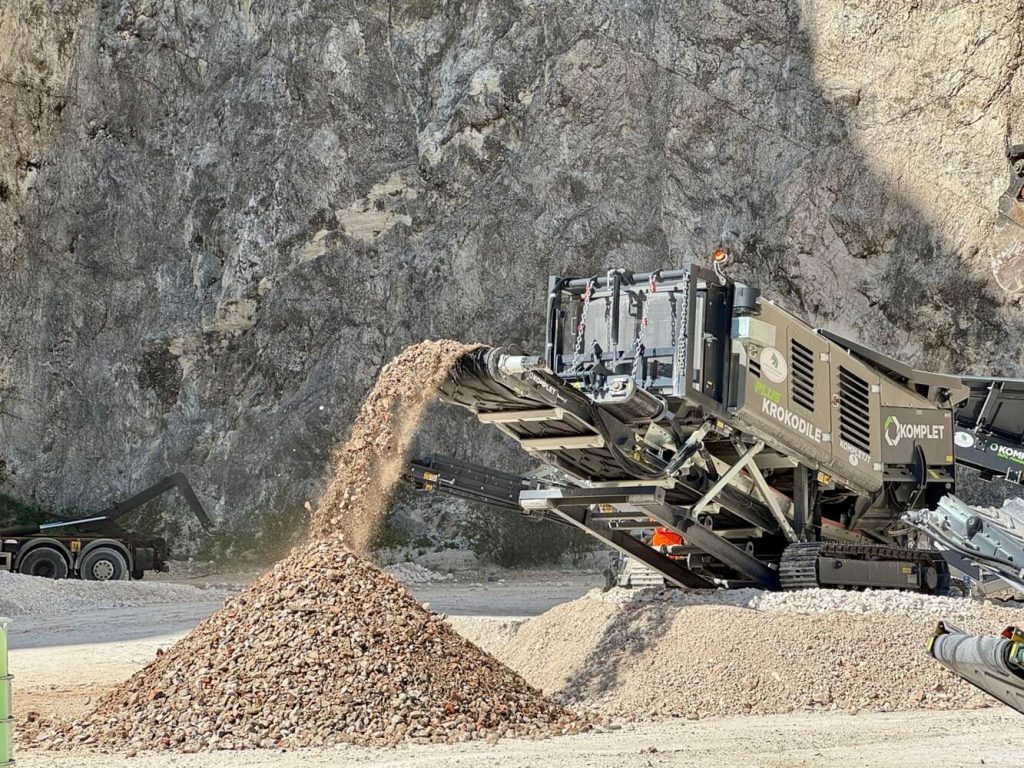
For C&D recycling streams that include wood, drywall, plastics, garbage, and mixed waste, the Krokodile PLUS slow-speed shredder reduces the input with the wood/lightweight waste shaft configuration, and the K-TC 460 stockpiles the shredded output. The Krokodile PLUS uses interchangeable shafts: a C&D/asphalt shaft for concrete, asphalt, brick, block, and rubble, and a wood/lightweight waste shaft for wood, drywall, plastics, garbage, mixed waste, and green compost material. With the right shaft, the same machine handles most of the C&D waste stream — reducing the share of debris that ends up in a landfill.
Compost and Green Material
On composting facilities, green-waste yards, and municipal organics operations, a K-TS 30 compact trommel screener or K-TS 40 portable trommel screener separates finished compost from oversize, contaminants, and unfinished material. The K-TC 460 stockpiles the finished compost. The whole process happens on-site, with the finished product going directly to landscape, agricultural, or municipal end users — closing the organics recycling loop without intermediate hauling.
Where Tracked Conveyors Earn Their Environmental Keep
Aggregate Processing Yards and Rock Quarries
Yard-based aggregate operations and small rock quarries run multiple Komplet machines simultaneously. The K-TC 460’s tracked mobility means a single conveyor can be redeployed across the yard during the day — clearing different machines on different shifts, building separate product stockpiles in sequence. That redeployment happens on the conveyor’s own engine, with no second machine running to move it. The environmental cost of yard logistics drops substantially compared to a wheeled-stacker workflow.
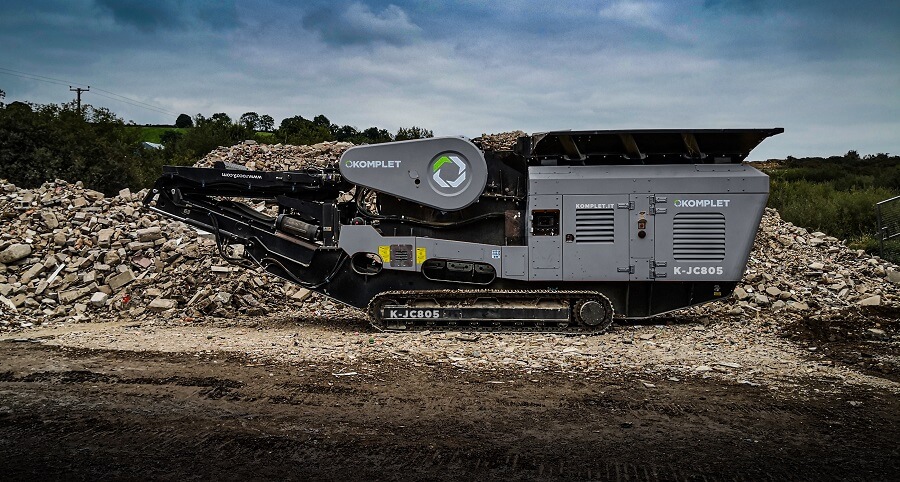
Komplet does not compete in large-scale industrial mining. The K-JC 805 mobile jaw crusher is the largest jaw crusher in the lineup and serves rock quarry applications — but Komplet’s positioning is compact, mobile equipment for yard-scale and project-scale work. The environmental case for tracked conveyors in this segment is about yard efficiency and stockpile management, not industrial-scale ore extraction.
Civil, Road, and Bridge Construction
Civil contractors processing on-site rock, concrete, or RAP use the K-TC 460 to build temporary stockpiles next to active work zones. On a road or bridge project, that turns demolition debris into reusable base material without ever leaving the project boundary. Hauling miles, tipping fees, and import-aggregate trucking all drop. The carbon footprint of the project drops with them.
Demolition Specialists
Demolition contractors increasingly run on-site processing as part of their core service offering. A compact spread — typically a K-JC 704 PLUS or K-JC 805 paired with a screener and a K-TC 460 — turns a demolition into a recycled-aggregate operation in the same site footprint. The environmental benefit (less hauling, less landfill, less imported virgin aggregate) is also a competitive advantage when bidding on projects with sustainability requirements or LEED-related credit targets.
Recycling Facilities
Permanent recycling facilities use Komplet equipment as flexible processing capacity inside a fixed yard footprint. The K-TC 460 builds and rebuilds stockpiles as material moves through the facility, freeing loaders for truck loading, hopper feeding, and material grading. Throughput per loader hour goes up; diesel per ton processed goes down.
Composting Facilities and Municipal Yards
Composting facilities, municipal public works yards, and landfill diversion operations use trommel screeners with tracked conveyors to separate finished compost, screen topsoil, and process green material. The K-TC 460’s electric-friendly behavior on cohesive and damp material — combined with its small environmental footprint — makes it the standard pairing for compost yard work and municipal organics handling.
Landscaping, Hardscaping, and Topsoil Operations
Plant nurseries, landscaping contractors, and topsoil yards run the K-TC 460 with trommel screeners or vibrating scalpers to build clean stockpiles of screened topsoil, compost, and decorative aggregate. On these operations, fugitive dust is lost product; reducing transfer points with a tracked conveyor reduces both the dust and the product loss simultaneously.
What Tracked Conveyors Don’t Fix (Honest Framing)
Tracked conveyors are not a sustainability silver bullet. They reduce specific environmental impacts in specific operating contexts, and they don’t make a jobsite carbon-neutral or eliminate the underlying environmental footprint of construction and aggregate processing. Honest framing matters more than overclaim:
- A diesel engine still burns diesel. The K-TC 460 has a Tier 4 Final 25 hp diesel engine that produces emissions during operation. Tier 4 Final reduces particulate matter and NOx substantially compared to older tiers — it does not eliminate them.
- Wear parts and consumables still exist. Belts wear, idlers replace, pulleys rebuild. Filters, fluids, and DEF need replenishment. The lifecycle environmental footprint of any equipment includes its maintenance materials, not just its operating fuel.
- On-site processing isn’t always the lowest-impact answer. On very small jobs, the emissions of mobilizing a crusher and conveyor to the site can outweigh the hauling savings. On-site processing wins on volume; for one-off small loads, off-site recycling at a permanent facility may have a lower per-ton footprint.
- Komplet doesn’t process all waste streams. The lineup handles concrete, asphalt, brick, block, rubble, rock, gravel, sand, dirt, soil, compost, wood, brush, debris, garbage, domestic waste, and C&D. Komplet does not compete in hazardous materials, glass and ceramic specialty recycling, e-waste, plastic recycling beyond what the Krokodile PLUS handles, or large-scale industrial mining.
- Site-specific compliance still applies. Air quality permits, dust control plans, hauling restrictions, noise ordinances, and stormwater requirements vary by jurisdiction. A tracked conveyor helps the operating profile; it does not replace the compliance analysis for any specific project.
Operating Practices That Maximize the Environmental Benefit
Refer to the user manual prior to operating any Komplet machinery. Beyond that, the operating practices that actually deliver the environmental gains promised by tracked conveyor technology:
- Run the conveyor instead of running the loader. Operators sometimes default to loader-handled material movement out of habit, even with a tracked conveyor on site. The environmental case depends on actually using the conveyor for the discharge job — not running it idle while the loader does the work.
- Reposition with the tracks, not with a tow vehicle. The whole point of tracked mobility is moving the conveyor without a second machine in motion. Operators who default to towing the conveyor short distances are paying the environmental cost of two machines instead of one.
- Coordinate dust suppression across the spread. The K-JC 503 and K-IC 70 ship with dust suppression standard; the larger jaw crushers offer it as an option. A coordinated dust plan — suppression at the crusher, controlled discharge at the conveyor — keeps fugitive dust to a minimum across the whole operation.
- Maintain the after-treatment system. DEF top-offs, DPF regeneration cycles, and after-treatment inspections aren’t optional on a Tier 4 Final engine. A neglected after-treatment system loses the emissions advantage that Tier 4 Final compliance is supposed to deliver.
- Keep belts and idlers in spec. A misaligned belt, a dragging idler, or a slipping drive pulley turns a continuous belt into a high-friction, high-energy-loss drivetrain. The fuel efficiency of a tracked conveyor depends on belt and drivetrain condition.
- Plan stockpile geometry to minimize rehandling. A pile placed where the next-day truck loadout can’t reach it has to be moved a second time — by loader, with the corresponding diesel cost. Spending a few minutes mapping the pile location before pointing the boom keeps the rehandle count down.
- Track operating hours and fuel consumption. The environmental case is measurable in gallons per ton, hours per shift, and tons hauled vs. tons processed on-site. Operators who track these metrics can quantify their actual environmental performance instead of estimating it.
The Lifecycle Argument: Pre-Owned and Long-Service Equipment
The greenest piece of equipment is the one already built. Manufacturing a new machine has a substantial embedded carbon footprint — steel, aluminum, copper, plastics, and the energy required to fabricate, ship, and commission the unit. Extending the service life of an existing machine deferrals that embedded footprint indefinitely.
Komplet America’s pre-owned equipment program inspects every unit before listing, and pre-owned tracked conveyors typically deliver 40 to 70 percent capital savings versus new — with the same OEM parts and service support. For contractors weighing the environmental and financial case together, a pre-owned K-TC 460 paired with a pre-owned crusher or screener can be the lowest-impact and lowest-cost path into on-site processing simultaneously.
Beyond pre-owned, the second lifecycle lever is service depth. Komplet stocks belts, idlers, drive components, jaw plates, blow bars, screens, and routine maintenance parts for every current model. The Komplet America parts and support team is staffed by factory-certified technicians, and the standard 1-year / 1,000-hour warranty (whichever is earlier) is backed by a Komplet Certified Technicians Network across North and Central America. A machine kept in service for 15 or 20 years is a machine whose embedded manufacturing footprint is amortized over a much longer operating life — which is itself a lifecycle environmental gain.
Frequently Asked Questions
Are tracked conveyors more environmentally friendly than wheeled stackers?
Tracked conveyors generally have a smaller per-ton environmental footprint than wheeled stackers in mobile applications, because they reposition under their own power instead of requiring a second machine (loader, telehandler, or tow vehicle) to move them. That eliminates one set of diesel cycles per repositioning. On a yard or jobsite where the conveyor is repositioned multiple times per day, the cumulative emissions difference is meaningful. For permanent installations where the conveyor never moves, the difference is smaller.
Is the K-TC 460 EPA Tier 4 Final compliant?
Yes. The K-TC 460 runs a 25 hp Tier 4 Final diesel engine, meeting current EPA emissions standards for non-road diesel engines. Every Komplet machine sold in the United States meets Tier 4 Final, including all crushers, screeners, the Krokodile PLUS slow-speed shredder, and the K-TC 460 conveyor.
How much fuel does a tracked conveyor save vs. loader-handled discharge?
Fuel savings depend on cycle length, material density, stockpile height, loader size, and operator efficiency, so there is no universal number. The mechanism is consistent: a 25 hp continuous belt running near design load burns less fuel per ton than a wheel loader making repeated cycles to the same pile. Operators who track fuel consumption typically see meaningful per-shift diesel reductions after adding a tracked conveyor to the spread.
Do tracked conveyors reduce dust on the jobsite?
Yes, indirectly. Dust is generated at every material transfer point. A tracked conveyor with a controlled discharge angle drops material in a continuous stream rather than a series of bucket dumps, reducing fugitive dust at the discharge point. Combined with dust suppression on the crusher (standard on the K-JC 503 and K-IC 70; optional on the larger jaw crushers), a tracked conveyor reduces both the volume of dust generated and the water required to suppress it.
How do tracked conveyors support on-site recycling?
Tracked conveyors enable high-volume on-site processing by clearing crusher and screener discharge continuously and building tall, dense stockpiles. Without efficient discharge handling, on-site processing chokes out and contractors default to hauling material off-site. With a tracked conveyor, recycled aggregate, processed RAP, screened topsoil, and shredded C&D waste stay on the project — used as backfill, base material, or saleable product instead of being hauled to a landfill or transfer station.
What is the engine size and emissions tier of the K-TC 460?
The K-TC 460 has a 25 hp Tier 4 Final diesel engine. The engine is right-sized for the conveyor’s actual workload, which delivers better fuel efficiency than an oversized engine running at partial load.
Can a tracked conveyor be used with composting and trommel screening?
Yes. The K-TC 460 pairs with the K-TS 30 compact trommel and K-TS 40 portable trommel screeners for composting, topsoil, and green-material applications. Composting facilities, plant nurseries, and municipal yards typically run a trommel screener feeding a tracked conveyor to build clean finished-compost or screened-topsoil stockpiles.
Does Komplet equipment work in industrial-scale mining?
No. Komplet’s positioning is compact, mobile equipment for yard-scale and project-scale work. The K-JC 805 is the largest jaw crusher in the lineup and serves rock quarry applications, but Komplet does not compete in large-scale industrial mining or ore extraction. For aggregate quarries, recycling facilities, civil and demolition projects, and yard-based aggregate operations, Komplet equipment is sized appropriately. For industrial mining, it is not.
Final Thoughts
The environmental case for tracked conveyors comes down to operating mechanics, not marketing. Continuous belt movement replaces repeated diesel cycles. Self-propelled tracks eliminate the second machine that wheeled stackers require. Controlled discharge geometry reduces dust at the transfer point. Tall, dense stockpiles enable the on-site processing volume that makes landfill diversion practical. Each mechanism is measurable, and each one delivers a real reduction in fuel, emissions, dust, hauling, or landfill tonnage.
None of those gains turn a construction or aggregate site into a zero-impact operation. They do, however, move the operating profile in a direction that lines up with where environmental compliance, customer sustainability requirements, and project economics are heading. For contractors and yard operators making capital decisions today, that alignment is the case for tracked conveyor technology.
Komplet America builds compact crushers, screeners, the Krokodile PLUS slow-speed shredder, and the K-TC 460 tracked mobile conveyor for contractors who need real production in tight footprints — and a smaller environmental footprint along the way. To see the full lineup, explore the crusher, screener, shredder, and conveyor categories. To talk financing or pricing, contact the Komplet Capital team through equipment financing, visit the contact page, or call 908-369-3340.
Ready to reduce the environmental footprint of your spread?
- Review the K-TC 460 tracked mobile conveyor specs, pricing, and pairing guide.
- Explore the full conveyor lineup alongside Komplet crushers, screeners, and the Krokodile PLUS shredder.
- Talk to Komplet Capital about 100 percent financing, 24-hour approvals, and 36/48/60/72-month terms — including Section 179 deduction eligibility for qualifying equipment purchases.
- Save 40–70 percent and extend lifecycle value with a pre-owned K-TC 460 or paired Komplet machine.
- Find your local Komplet dealer for rental availability.
Never enough.
Disclaimer: All operating, maintenance, and service guidance in this article is general in nature. Always refer to the official Komplet operator’s manual for the specific machine model and serial number, and follow OEM intervals and procedures. For warranty-protected work, contact Komplet America at 908-369-3340 or your authorized Komplet dealer. Improper service or non-OEM parts may void warranty coverage and create safety hazards.
Disclaimer: Environmental performance, fuel savings, emissions reductions, and landfill diversion outcomes referenced above are illustrative examples only. Actual results depend on jobsite material composition, local hauling and tipping rates, fuel and labor costs, equipment utilization, regional regulatory requirements, and operator efficiency. Komplet America makes no guarantee of specific environmental or financial outcomes. Customers should perform their own analysis based on local market and regulatory conditions, and consult applicable air quality, dust control, hauling, and waste-handling regulations for any specific project.