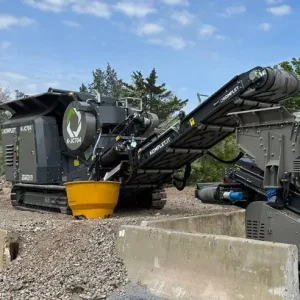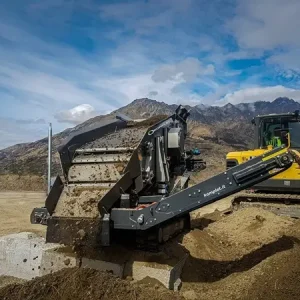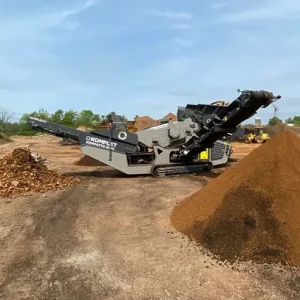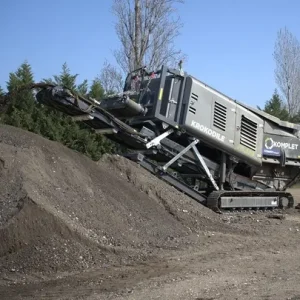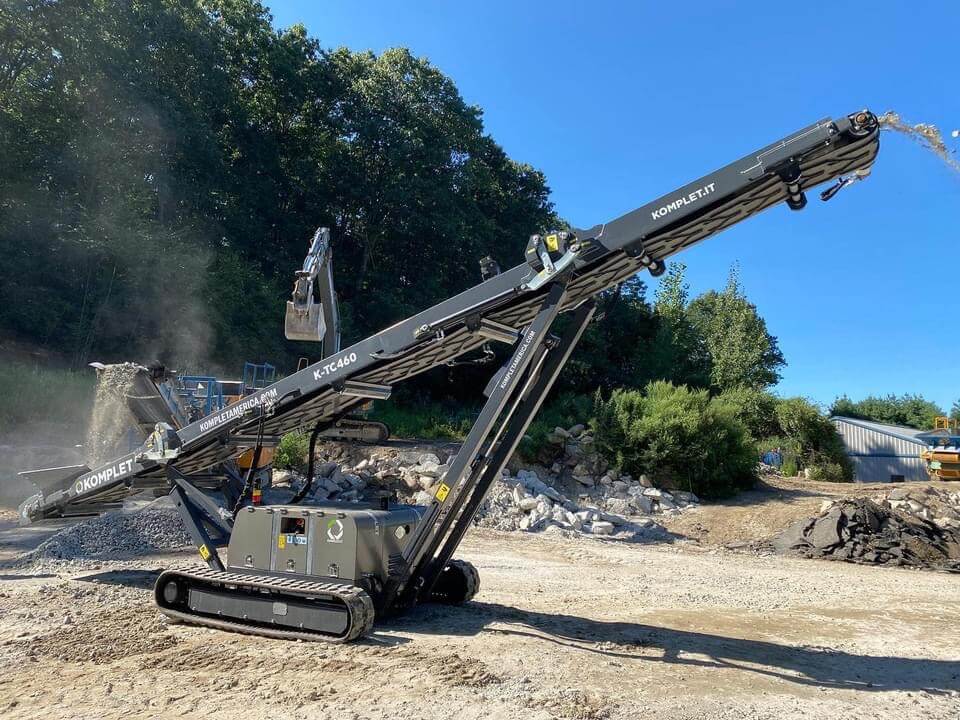

A tracked conveyor boosts crusher and screener productivity by maintaining continuous material discharge, eliminating loader-driven stop-start cycles, and building taller, cleaner stockpiles in tighter footprints. On a Komplet jobsite, a K-TC 460 tracked mobile conveyor repositions on its own rubber tracks alongside any compact crusher or screener — no tow vehicle, no loader assist, no dropped throughput. The result: fewer bottlenecks, lower fuel and labor costs per ton, and a layout that keeps the crusher fed and the screener running.
This guide explains how tracked conveyor integration changes the math on crushing and screening productivity — what they actually do on a jobsite, the production gains operators see, the buying considerations that matter for compact spreads, and how to deploy a K-TC 460 with Komplet crushers, screeners, and the Krokodile PLUS slow-speed shredder.
Whether you run an urban demolition spread, a yard-based recycling operation, a topsoil and aggregate yard, or a small quarry, the question is the same: how do you keep a 90-tph or 160-tph crusher loaded and clear without burying it in its own discharge pile or burning through loader hours? A tracked mobile conveyor is the answer most compact operators land on.
What Is a Tracked Conveyor?
A tracked conveyor is a self-propelled belt conveyor that travels on rubber tracks under its own power, controlled by a wireless remote. Unlike a wheeled or skid-frame stacker that has to be towed or pushed into position, a tracked mobile conveyor walks itself — across uneven yard surfaces, around stockpiles, into tight urban setups, and back out at the end of the shift.
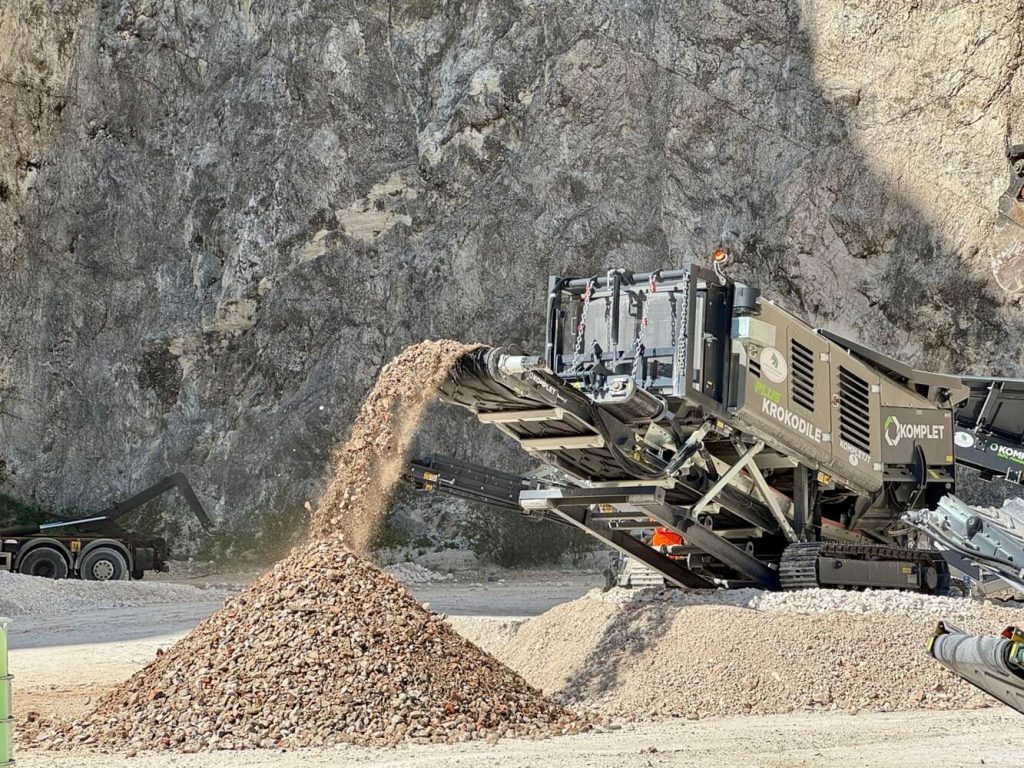
In a compact crushing and screening setup, the tracked conveyor sits at the discharge of a crusher or screener and carries finished material away from the machine, building a stockpile at a controlled height and angle. Because it moves on its own, the operator can reposition it during production — sweeping the discharge across an arc to spread a pile, walking it backward to extend material reach, or repositioning it entirely when the crusher moves to a new feed source.
Tracked Conveyor vs. Wheeled Stacker vs. Stationary Conveyor
Three categories of conveyor get used in compact crushing and screening, and they are not interchangeable:
- Stationary conveyors are bolted to the ground or skid-mounted. They move material reliably but can’t be repositioned during a job. They suit fixed plants, not mobile spreads.
- Wheeled or towable stackers reposition with help — they need a loader, telehandler, or pickup to push or tow them. Setup is slower, and during production they essentially function as stationary equipment.
- Tracked mobile conveyors like the K-TC 460 walk on their own rubber tracks, controlled by the operator’s wireless remote. They reposition during production without a tow vehicle and travel between work zones inside the jobsite under their own power.
For a compact crusher and screener spread that moves between sites, lives in a working yard, or operates inside an urban or limited-access footprint, the tracked option removes the loader from the conveyor-moving job. That single change is where most of the productivity gain comes from.
How a Tracked Conveyor Increases Crusher and Screener Output
Crusher and screener productivity is rarely limited by the machine itself. A K-JC 704 PLUS can produce up to 90 US tph. A K-JC 805 can produce up to 160 US tph. A Kompatto 5030 vibrating screener can move up to 280 US tph through its decks. The bottleneck is almost always what happens before and after the machine — how fast material is fed in, and how cleanly the discharge is moved out.
A tracked conveyor attacks the discharge side of that equation directly. Five mechanisms drive the gain:
1. Continuous Discharge Without Choke-Outs
Without a discharge conveyor, a crusher’s output piles directly under the machine. Within minutes — sometimes seconds, on high-output spreads — the pile reaches the discharge chute and begins to back up into the crusher. The operator must stop, move the pile with a loader, and restart. Every stop-start cycle costs production minutes and adds wear to the crusher.
A K-TC 460 carries discharge away at up to 132 US tph and stacks it at a 15-foot pile height. The crusher runs continuously. The choke-out cycle disappears.
2. Reduced Loader Hours Per Ton
Loader hours are one of the largest variable costs in a compact crushing operation. When a loader is dedicated to clearing crusher discharge, it isn’t feeding the hopper, isn’t loading trucks, and isn’t doing yard work. A tracked conveyor moves the discharge automatically, freeing the loader for revenue-generating tasks.
On a single-loader spread, adding a tracked conveyor often eliminates the need for a second loader entirely — a meaningful capital and operating cost avoidance, especially when the loader would otherwise be rented or financed.
3. Taller, Cleaner Stockpiles That Hold More Inventory
A loader-built pile is shaped by the loader’s reach and bucket — typically 8 to 10 feet high, with a wide base and a lot of footprint. A 15-foot pile from a tracked conveyor holds substantially more material in the same ground area, with cleaner separation between products.
For yards selling crushed concrete, recycled asphalt aggregate, screened topsoil, or sized gravel, that translates directly into more inventory turn per square foot of yard space — and cleaner cross-contamination control between product grades.
4. Less Material Spillage and Rehandling
Loader-handled discharge gets dropped, rehandled, and moved multiple times before it lands in its final stockpile. Each handling step loses fines, wastes fuel, and risks contamination. A tracked conveyor moves material once, in a controlled stream, from the crusher or screener directly to the pile.
5. Faster Setup and Teardown Between Sites
The K-TC 460 transports at 16 feet 7 inches long by 7 feet 5 inches wide by 6 feet 9 inches tall, and weighs 7,000 pounds — light enough to tow behind standard trucks. On site, it walks itself off the trailer and into position by wireless remote. Setup is measured in minutes, not the half-hour-plus required to position a wheeled stacker with a loader.
Optimizing Material Flow Between Crushers, Screeners, and Stockpiles
On a compact spread, material flow is the discipline of keeping every machine fed at its optimal rate without choking the next machine in the chain. The classic configurations:
Crusher → Tracked Conveyor → Stockpile
The simplest layout. The crusher produces sized aggregate; the tracked conveyor walks it to a stockpile away from the crusher footprint. This is the standard setup for a single-stage crushing operation — pool contractors, mason contractors, basement waterproofing contractors, and small site contractors typically run this configuration with a K-JC 503, K-JC 604, or K-JC 704 PLUS feeding a K-TC 460.
Crusher → Screener → Tracked Conveyor → Stockpile
A two-stage spread. The crusher sizes the input; the screener separates the crusher output into product cuts (3/4-inch minus, 1-1/2-inch, oversize, etc.); the tracked conveyor moves the primary product to its stockpile. Larger spreads use multiple conveyors — one per product cut — to build separate stockpiles simultaneously.
The K-JC 704 PLUS paired with a Kompatto 5030 or K-JC 805 paired with a Kompatto 124 are common two-stage configurations on civil, road and bridge, recycling, and quarry jobs.
Shredder → Screener → Tracked Conveyor → Stockpile
For C&D recycling, asphalt reduction, wood waste, and mixed waste streams, a Krokodile PLUS slow-speed shredder reduces input to a manageable size, the screener separates fines from oversize, and the conveyor stockpiles the saleable product. The Krokodile PLUS handles up to 175 US tph on C&D and asphalt streams with the appropriate shaft configuration.
Trommel Screener → Tracked Conveyor → Stockpile
For topsoil, compost, and green/cohesive material, a K-TS 30 or K-TS 40 trommel screener separates fines from contaminants, and the tracked conveyor builds a clean screened stockpile. Composting facilities, plant nurseries, and municipal yards run this configuration heavily.
K-TC 460 Tracked Mobile Conveyor: Specifications
The K-TC 460 is the tracked mobile conveyor in the Komplet lineup. It is engineered to pair with the full range of Komplet crushers, screeners, and the Krokodile PLUS shredder.
- Engine: 25 hp Tier 4 Final diesel
- Drive: Self-propelled on rubber tracks
- Belt: 25 inches × 393 inches, 3-ply Chevron
- Production: up to 132 US tph
- Pile height: 15 feet
- Working dimensions (L × W × H): 32’8″ × 7’5″ × 15′
- Transport dimensions (L × W × H): 16’7″ × 7’5″ × 6’9″
- Weight: 7,000 lb
- Control: Wireless remote
Two specs deserve a closer look in the context of compact-fleet productivity: the 7,000-pound transport weight, and the wireless-remote control.
Why 7,000 Pounds Matters
At 7,000 pounds, the K-TC 460 is towable behind a standard work truck or pickup with the right hitch and trailer rating. It does not require a heavy-haul tractor, a permit move, or a dedicated lowboy. For contractors running compact crushers and screeners between jobsites, that pairing matters: the K-JC 503 at 7,496 lb, the K-JC 604 at 19,400 lb, the K-JC 704 PLUS at 26,455 lb, and the K-TC 460 at 7,000 lb can all be moved with the same tow-and-trailer logistics most contractors already operate.
Why Wireless Remote Matters
The K-TC 460 is operated entirely from a wireless remote. The same operator running the crusher or screener can walk the conveyor into position, sweep the discharge across an arc, fold and unfold the boom, and reposition between stockpiles — without leaving the operating zone, without a second person, and without climbing onto the conveyor. On a compact spread where one or two operators run the entire fleet, removing every “second person” requirement is meaningful.
Which Komplet Machines Pair With the K-TC 460?
The K-TC 460 is designed to pair with the full Komplet lineup. The most common pairings:
Compact Crushers
- K-JC 503 mini jaw crusher (up to 34 US tph) — ideal for pool, mason, basement waterproofing, and landscaping/hardscaping contractors. The K-TC 460’s 132-tph capacity easily clears K-JC 503 discharge.
- K-JC 604 mobile jaw crusher (up to 55 US tph) — driveway, paving, and small site contractors. Standard pairing for municipal yard work.
- K-JC 704 PLUS portable jaw crusher (up to 90 US tph) — Komplet’s best-selling crusher. The K-TC 460 is the standard discharge conveyor on K-JC 704 PLUS spreads.
- K-JC 805 mobile jaw crusher (up to 160 US tph) — the largest jaw in the Komplet lineup. The K-TC 460 handles K-JC 805 discharge for quarry, civil, and recycling spreads.
- K-IC 70 compact impact crusher (up to 90 US tph) — for cubical aggregate, recovered asphalt pavement (RAP) reduction, and DOT-spec material.
Screeners
- Kompatto 221 vibrating screener (up to 90 US tph) — the smallest self-propelled scalper, paired with K-JC 503 or K-JC 704 PLUS for an integrated crush-and-screen workflow.
- Kompatto 5030 heavy-duty vibrating screener (up to 280 US tph) — best-selling screener; pairs with K-JC 704 PLUS, K-JC 805, or Krokodile PLUS.
- Kompatto 124 mobile vibrating screener (up to 350 tph) — the largest scalping screen in the lineup, for high-throughput recycling, civil, and quarry spreads.
- K-TS 30 compact trommel screener (up to 60 mch) — for green, cohesive, and wet material. Composting, topsoil, and municipal yard work.
- K-TS 40 portable trommel screener (up to 120 tph) — bigger trommel for varied compost, topsoil, and waste streams.
Slow-Speed Shredder
- Krokodile PLUS slow-speed shredder (up to 175 US tph on C&D and asphalt) — pair with the K-TC 460 to clear shredded output to a stockpile. Krokodile PLUS uses interchangeable shafts: a C&D/asphalt shaft for concrete, asphalt, brick, block, and rubble, and a wood/lightweight waste shaft for wood, drywall, plastics, garbage, mixed waste, and green compost material.
Where Tracked Conveyors Earn Their Keep: Industries and Applications
Construction & Demolition (C&D) Recycling
On C&D recycling sites, a tracked conveyor pairs with a jaw crusher or impact crusher to build clean stockpiles of crushed concrete, recycled asphalt aggregate, and processed brick or block. Demolition specialists, recycling facilities, and concrete recycling yards typically run a K-JC 704 PLUS or K-IC 70 with a K-TC 460 to keep the crusher fed and discharge moving.
Civil, Road, and Bridge Construction
Civil contractors processing on-site rock, concrete, or RAP use the K-TC 460 to build temporary stockpiles next to active work zones. Rather than hauling crusher discharge off-site, contractors stockpile reusable aggregate on the project itself — with hauling, tipping, and import-material costs all going down.
Aggregate Processing Yards and Small Quarries
Yard-based crushing and screening operations run multiple Komplet machines simultaneously. The K-TC 460’s tracked mobility lets a single conveyor be redeployed across a yard during the day — clearing the K-JC 805 in the morning, repositioning to clear the Kompatto 5030 in the afternoon, and moving again to build a finished-product stockpile before the day’s end. That flexibility is the core argument for tracked over wheeled stackers in yard environments.
Landscaping, Hardscaping, and Topsoil Operations
Plant nurseries, landscaping contractors, and topsoil yards run the K-TC 460 with trommel screeners or vibrating scalpers to build clean stockpiles of screened topsoil, compost, and decorative aggregate. The 15-foot pile height and 132-tph capacity match the production rate of a K-TS 30 or Kompatto 221 with substantial headroom.
Composting and Municipal Yards
Composting facilities, municipal public works yards, and landfill diversion operations use trommel screeners with tracked conveyors to separate finished compost from oversize, contaminants, and unfinished material. The K-TC 460’s electric-friendly behavior on cohesive and damp material — combined with its small environmental footprint — makes it the standard pairing for compost yard work.
Pool, Mason, and Basement Waterproofing Contractors
Specialty contractors running compact crushers like the K-JC 503 on residential and small commercial sites use the K-TC 460 to build a clean recycled-aggregate stockpile inside tight urban setups. The 7,000-pound transport weight matters here: the conveyor follows the crusher between jobs without a heavy tow rig.
The Productivity Math: How a Tracked Conveyor Pays for Itself
The case for adding a tracked conveyor to a compact crushing or screening spread comes down to four cost-and-revenue levers. None of them require a calculator to see — but quantifying them turns the conveyor from a “nice to have” into a clear capital-allocation decision.
Lever 1: Crusher Uptime
Every minute a crusher sits idle waiting for discharge to be cleared is a minute of crew, fuel, and capital sitting unproductive. On a typical compact spread, choke-out cycles can consume 10 to 30 percent of operating time before a tracked conveyor is added. Recovering even half of that translates directly into more billable tons per shift.
Lever 2: Loader Cost Avoidance
A loader running 6 to 8 hours a day clearing crusher discharge consumes diesel, wears tires, and blocks one operator’s time. Whether the loader is owned, financed, or rented, replacing that role with a tracked conveyor frees the loader for higher-value tasks — feeding the crusher hopper, loading trucks, doing yard work — or eliminates the need for a second loader on the spread entirely.
Lever 3: Hauling and Tipping Fee Avoidance
On C&D, civil, and recycling jobs, the alternative to on-site crushing is hauling demolition material to a transfer station or recycling facility, paying tipping fees, and importing aggregate back. Local hauling rates and tipping fees vary by region, but the math typically favors on-site processing once volume crosses a few hundred tons — and a tracked conveyor is what makes high-volume on-site processing practical.
Lever 4: Yard Throughput and Inventory Turn
For yard-based operators, the conveyor’s contribution shows up as higher daily throughput per acre — more tons processed, more product stockpiled, more inventory available for sale, all in the same yard footprint. A 15-foot pile height meaningfully outperforms a loader-built 8-to-10-foot pile in inventory density.
Komplet’s equipment financing team can structure the K-TC 460 with the rest of a compact spread on a single approval. With 100 percent financing available, 24-hour approvals, and 36/48/60/72-month term options through Komplet Capital, contractors typically size the conveyor’s monthly payment against the loader hours and choke-out time it eliminates.
Tracked Conveyor Buying Considerations
A handful of specs determine whether a tracked conveyor will work on a given spread. The questions to ask before buying:
Production Rate Match
The conveyor needs to clear discharge faster than the crusher or screener produces it. The K-TC 460’s 132-tph capacity covers the K-JC 503 (34 tph), K-JC 604 (55 tph), K-JC 704 PLUS (90 tph), K-IC 70 (90 tph), Kompatto 221 (90 tph), K-TS 30 (60 mch), and K-TS 40 (120 tph) without issue. For the K-JC 805 (160 tph), Kompatto 5030 (280 tph), and Kompatto 124 (350 tph), the spread runs the conveyor with appropriate operator pacing or, on the largest spreads, multiple conveyors.
Pile Height and Stockpile Geometry
Pile height drives inventory density. A 15-foot pile holds substantially more material per square foot of yard than a 10-foot loader-built pile. For yards with limited footprint, pile height is one of the most important specs.
Belt Width and Material Type
The K-TC 460’s 25-inch, 3-ply Chevron belt handles the typical Komplet material range — crushed concrete, recycled asphalt aggregate, brick, block, rubble, rock, gravel, sand, dirt, soil, compost, wood chips, and shredded C&D. The Chevron pattern is what allows the steep belt angle that produces the 15-foot pile.
Transport Logistics
Transport weight, length, width, and height determine how the conveyor moves between jobsites. The K-TC 460 at 7,000 pounds and 16’7″ × 7’5″ × 6’9″ travels under standard trailer rules in most U.S. jurisdictions. Heavier or larger conveyors require permitted moves, lowboys, or specialty hauling — adding cost and scheduling friction.
Mobility on Site
Self-propelled tracks vs. wheeled or skid frames — this is the core decision. For yards, urban jobsites, and operations that reposition the conveyor during production, tracked is the answer. For permanent installations where the conveyor sits in one place, a stationary or skid-mounted alternative may be appropriate.
Control System
Wireless remote control is what allows a single operator to run the crusher, screener, and conveyor as a coordinated spread. Conveyors without wireless remote require a second operator to run the conveyor independently — a meaningful labor cost over the life of the machine.
Service and Parts Support
Belt life, idler bearings, drive pulley wear, and track components are the maintenance items on any tracked conveyor. Komplet stocks belts, idlers, and drive components for the K-TC 460 through the Komplet America parts and support team. Confirming OEM parts availability before buying any tracked conveyor — Komplet or otherwise — is fundamental due diligence.
Operating a Tracked Conveyor Productively
Refer to the user manual prior to operating any Komplet machinery. The general operating practices that separate productive tracked-conveyor operation from poor practice:
- Position before starting. Walk the conveyor to its working position with the crusher or screener stopped, and confirm the discharge geometry matches the planned stockpile location.
- Sweep, don’t stack-and-stop. Use the wireless remote to sweep the discharge across an arc as the pile builds, rather than letting it cone and then repositioning.
- Walk back as the pile grows. The K-TC 460’s pile height is 15 feet; as the pile approaches that height, walk the conveyor back so the discharge clears the existing pile face.
- Coordinate with the loader operator. The conveyor builds the pile; the loader either feeds the crusher or loads finished product onto trucks. Define each operator’s zone before the shift starts.
- Inspect daily. Belt tension, idler condition, drive pulley wear, track tension, and chevron-pattern wear are the daily walk-around items.
- Train every operator. Wireless remote operation is intuitive but the failure modes — runaway belt, pile collapse, conveyor walking off-position during operation — are real. Komplet provides operator training at delivery.
Common Mistakes That Limit Tracked Conveyor Productivity
Undersizing the Conveyor
Pairing a high-output crusher or screener with a conveyor that can’t keep up turns the conveyor into the new bottleneck. The K-TC 460 at 132 tph is sized for the compact Komplet lineup; larger spreads (K-JC 805, Kompatto 5030, Kompatto 124, Krokodile PLUS) may run multiple conveyors in parallel for full production.
Stationary Operation of a Tracked Asset
Operators sometimes set up the K-TC 460 once, build a pile, and move on without ever using the tracked mobility during the day. That leaves productivity on the table. The whole point of a tracked conveyor is repositioning during production — sweeping the pile, walking back as the pile builds, redeploying to a different machine in the same yard.
Ignoring Stockpile Geometry
A poorly placed pile blocks loader access, mixes product grades, or sits where the next day’s truck loadout can’t reach it. The conveyor’s mobility is also a planning advantage — operators should spend a few minutes before each setup mapping where the pile needs to end up before pointing the boom.
Neglecting Belt Maintenance
Chevron belts, like all conveyor belts, wear at the splice, at idlers, and at the drive pulley. Skipping the daily walk-around to check belt tension, splice condition, and idler bearings is the most common cause of premature belt failure — and a failed belt mid-shift is hours of downtime.
Using the Conveyor as a Tow Vehicle
The K-TC 460’s tracks move the conveyor itself. They are not designed to push or tow other equipment. Using the conveyor to move other machines damages tracks, drive components, and the frame.
Pre-Owned and Rental Tracked Conveyors
Operators expanding a fleet often look at pre-owned tracked conveyors as a way to shorten payback. Komplet America’s pre-owned equipment program inspects every unit before listing, and pre-owned tracked conveyors typically deliver 40 to 70 percent capital savings versus new — with the same OEM parts and service support behind them.
For seasonal or project-specific demand, rental is the alternative. The Komplet authorized dealer network — which includes Century Equipment, The Groundworx Co, Rock and Recycling Equipment, RPM Equipment Sales & Rentals, RR Equipment, US Equipment Sales & Rentals, Westate Machinery, and Wilson Equipment — handles K-TC 460 rentals across most of North and Central America. Renting before buying is also a sound way to validate the productivity case on your own jobsite before committing capital.
Frequently Asked Questions
What is a tracked conveyor?
A tracked conveyor is a self-propelled belt conveyor that travels on rubber tracks under wireless remote control. Unlike a wheeled or towable stacker, a tracked conveyor repositions on its own without a loader or tow vehicle. It is used to move material away from a crusher, screener, or shredder discharge and build stockpiles.
How does a tracked conveyor improve crusher productivity?
A tracked conveyor improves crusher productivity by maintaining continuous discharge. Without a conveyor, crusher output piles directly under the machine and eventually backs up into the discharge, forcing the crusher to stop while a loader clears the pile. A tracked conveyor moves the discharge away continuously at up to 132 US tph (K-TC 460), eliminating choke-out cycles and freeing the loader for other tasks.
What is the difference between a tracked conveyor and a wheeled stacker?
A tracked conveyor moves on its own rubber tracks under wireless remote control. A wheeled stacker requires a loader, telehandler, or pickup to push or tow it into position. Tracked conveyors reposition during production without help; wheeled stackers function essentially as stationary equipment once placed. For mobile spreads, urban jobsites, and yards where the conveyor is repositioned during the workday, the tracked option removes the loader from the conveyor-moving job.
What is the K-TC 460 tracked mobile conveyor?
The K-TC 460 is Komplet’s tracked mobile conveyor. It runs a 25 hp Tier 4 Final diesel engine, has a 25-inch by 393-inch 3-ply Chevron belt, produces up to 132 US tph, builds 15-foot stockpiles, and weighs 7,000 lb in transport configuration (16’7″ × 7’5″ × 6’9″). It is operated by wireless remote and pairs with the full Komplet crusher, screener, and Krokodile PLUS shredder lineup.
What machines does the K-TC 460 pair with?
The K-TC 460 pairs with all Komplet crushers (K-JC 503, K-JC 604, K-JC 704 PLUS, K-JC 805, K-IC 70), all Komplet screeners (Kompatto 221, Kompatto 5030, Kompatto 124, K-TS 30, K-TS 40), and the Krokodile PLUS slow-speed shredder. Its 132-tph capacity comfortably clears the smaller and mid-range machines; for the largest machines (K-JC 805, Kompatto 5030, Kompatto 124, Krokodile PLUS), spreads may run multiple conveyors in parallel.
How tall a stockpile can a K-TC 460 build?
The K-TC 460 builds stockpiles up to 15 feet high. That pile height holds substantially more material per square foot of yard than a typical 8-to-10-foot loader-built pile, which improves inventory density for yards with limited footprint.
Can a tracked conveyor be towed between jobsites?
Yes. The K-TC 460 weighs 7,000 lb in transport configuration and measures 16’7″ × 7’5″ × 6’9″. It is towable behind a standard work truck or pickup with the right hitch and trailer rating, and travels under standard trailer rules in most U.S. jurisdictions — no permit move, no lowboy, no heavy-haul tractor required.
Is the K-TC 460 operated by wireless remote?
Yes. All K-TC 460 functions — track movement, belt operation, boom raise/lower, fold/unfold — are operated from a wireless remote. A single operator can run the crusher or screener and the conveyor together without leaving the operating zone, without a second person, and without climbing onto the conveyor.
Final Thoughts
On a compact crushing and screening spread, a tracked conveyor is rarely the most expensive machine — but it is often the one that determines how productive the rest of the fleet actually is. By eliminating choke-out cycles, freeing up loader hours, building denser stockpiles, and repositioning under its own power, a tracked mobile conveyor turns a crusher or screener’s nameplate production into actual billable tons per shift. For most compact-fleet operators, the productivity math justifies the conveyor before the warranty period is up.
The K-TC 460 is engineered specifically for that role inside the Komplet lineup — sized to clear the compact crushers and screeners, light enough to follow the fleet between jobsites, and built around the same wireless-remote control philosophy as the rest of the line. For operators already running a Komplet crusher or screener, adding a K-TC 460 is the most direct way to convert idle minutes into produced tons.
Komplet America builds compact crushers, screeners, the Krokodile PLUS slow-speed shredder, and the K-TC 460 tracked mobile conveyor for contractors who need real production in tight footprints. To see the full lineup, explore the crusher, screener, shredder, and conveyor categories. To talk financing or pricing, contact the Komplet Capital team through equipment financing, visit the contact page, or call (908) 369-3340.
Ready to add a tracked conveyor to your spread?
- Review the K-TC 460 tracked mobile conveyor specs, pricing, and pairing guide.
- Explore the full conveyor lineup alongside Komplet crushers, screeners, and the Krokodile PLUS shredder.
- Talk to Komplet Capital about 100 percent financing, 24-hour approvals, and 36/48/60/72-month terms.
- Save 40–70 percent with a pre-owned K-TC 460 or paired Komplet machine.
- Find your local Komplet dealer for rental availability.
Never enough.
Disclaimer: All operating, maintenance, and service guidance in this article is general in nature. Always refer to the official Komplet operator’s manual for the specific machine model and serial number, and follow OEM intervals and procedures. For warranty-protected work, contact Komplet America at (908) 369-3340 or your authorized Komplet dealer. Improper service or non-OEM parts may void warranty coverage and create safety hazards.
Equipment prices are subject to change based on dealer location, availability, and any additional features or customizations. Prices do not include taxes, shipping, or installation fees, which may apply depending on your region. Contact Komplet America at (908) 369-3340 or visit kompletamerica.com for current pricing.
Disclaimer: Any productivity gains, ROI figures, payback timelines, or cost savings referenced above are illustrative examples only. Actual results depend on jobsite material composition, local hauling and tipping rates, fuel and labor costs, equipment utilization, financing terms, regional regulatory requirements, and operator efficiency. Komplet America makes no guarantee of specific financial returns. Customers should perform their own analysis based on local market conditions before making purchase decisions.