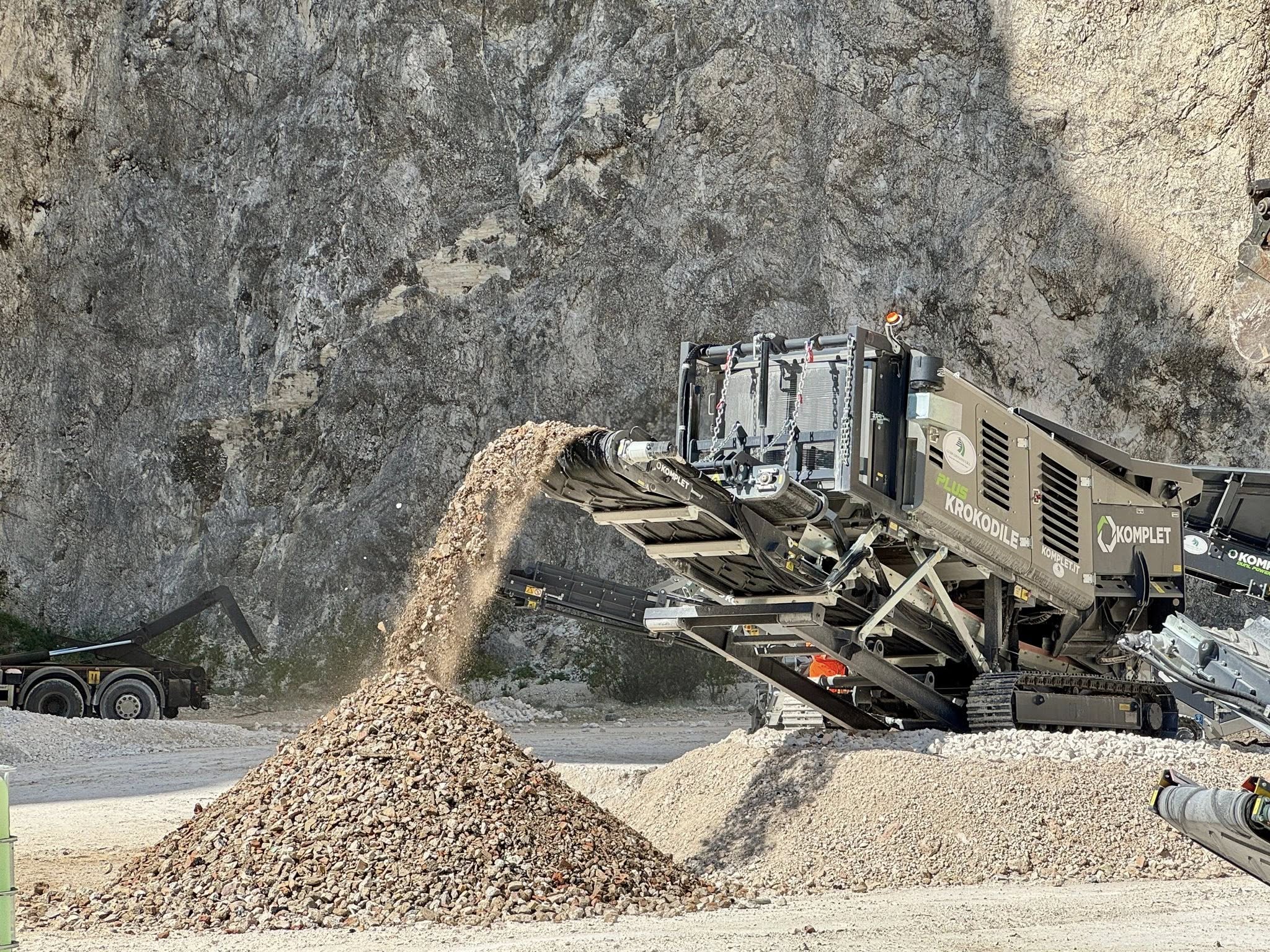

Construction and demolition contractors face a recurring economic problem: the waste from a project costs almost as much to dispose of as the work cost to perform. Hauling, tipping, scheduling, and downtime stack on top of every demolition or site-prep job. Mobile shredding is a category of equipment specifically designed to attack those costs at the source — by processing the waste on the jobsite where it is generated, instead of paying to move it somewhere else for processing.
This article explains why contractors who handle recurring C&D volume are moving toward mobile shredders, and how the Krokodile PLUS — Komplet America’s slow-speed mobile shredder — fits that economic case.
The Growing Cost of Construction and Demolition Waste
Three trends have made C&D disposal more expensive for contractors over the last decade:
- Tipping fees have risen in most U.S. markets, with bulky and unsorted C&D loads charged at premium rates
- Landfill capacity near urban areas has tightened, pushing haul distances longer and trucking costs higher
- Project sustainability requirements — LEED, Envision, and contract-required diversion thresholds — have made unprocessed disposal harder to justify on bid sheets
The contractor’s challenge is to manage waste in a way that protects bid margin without slowing the project. Mobile shredding addresses both halves of that challenge — it cuts the disposal cost line item, and it removes the hauling-schedule dependency that delays demolition crews.
What Mobile Shredding Solutions Are
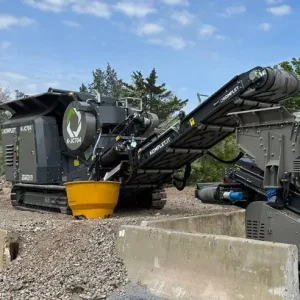
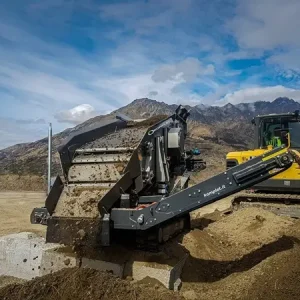
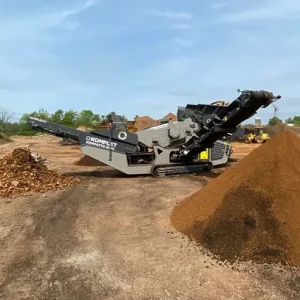
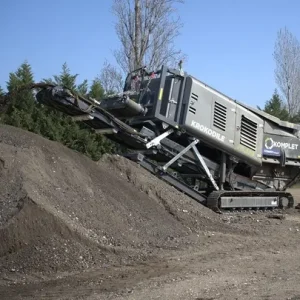
Mobile shredders are tracked or trailer-mounted material reduction machines designed to be brought to a jobsite, set up, and run on-site. Unlike stationary shredders that require a fixed processing facility with foundation, power infrastructure, and material delivery, mobile shredders use diesel-powered self-contained drivetrains and tracked or wheeled mobility.
In the slow-speed mobile shredder category, the equipment is operated by wireless remote control. Operators do not stand on or near the machine during shredding — feed is delivered by loader or excavator, and the operator directs the machine and manages the discharge from a safe distance. This is a fundamental difference from older or smaller fixed shredders that required hands-on operation.
Key Features That Drive the Cost Case
- Mobility — moves between jobsites and between active demolition zones at a single jobsite
- Self-contained power — no external electrical hookup, no foundation, no infrastructure
- Wireless remote operation — operator stands outside the active machine zone
- Multi-material capability — concrete, asphalt, wood, mixed C&D, drywall, plastics
- Integrated material handling — magnetic separation, hydraulic hopper, discharge belt all built in
The Cost Advantage of Mobile Shredders for Construction
The economic case for mobile shredding rests on four cost categories that compound on every C&D project: hauling, tipping, time, and material purchasing. Each can be measured against a baseline of off-site disposal.
Reduced Hauling and Transport Costs
Mobile shredders process demolition debris at the point of generation, which eliminates or substantially reduces the volume of unprocessed material that must be hauled off-site. Shredded output is denser and more uniform than raw debris, so the trucks that do leave the site carry more usable tonnage per haul. Fewer trucks, fewer trips, fewer billable hauling hours, lower fuel cost on the project.
Lower Disposal and Landfill Fees
Bulky, unsorted C&D loads are typically the most expensive disposal category at the landfill or transfer station. Shredded and sorted output qualifies for lower-cost disposal categories — or, in many cases, becomes a feedstock that recycling outlets accept at lower fees or even pay for. The Krokodile PLUS’s integrated magnetic separator captures ferrous metal (rebar fragments, embedded nails, banding) for separate scrap recycling, which adds revenue rather than disposal cost.
Turning Waste Into Reusable Resources
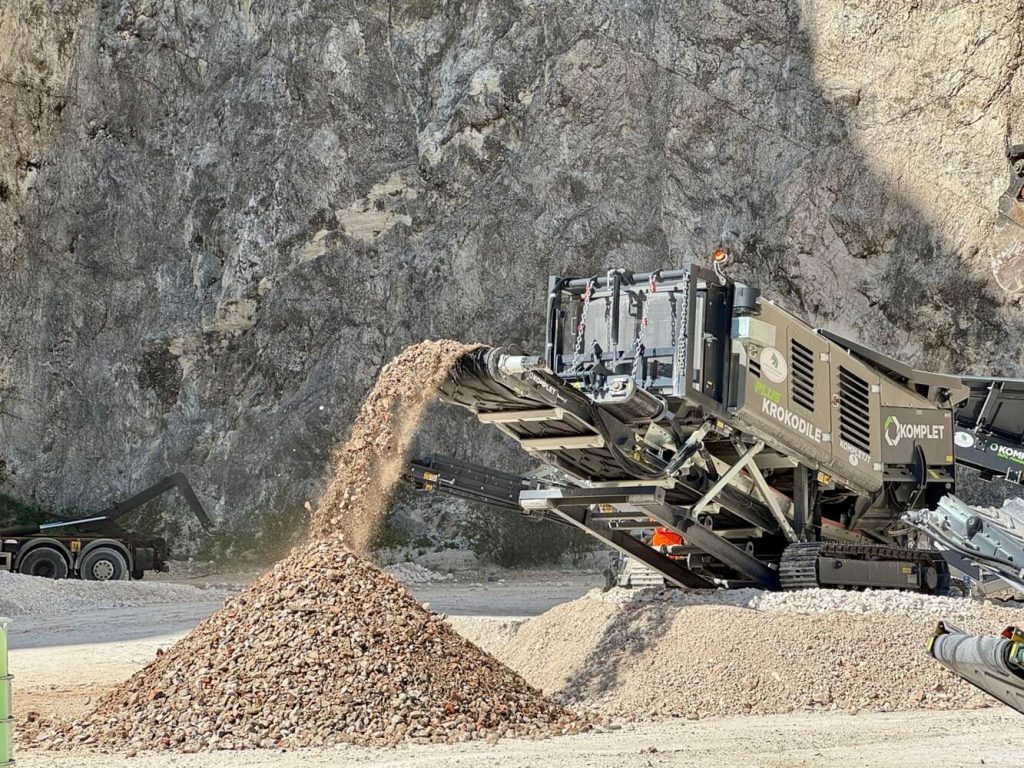
Concrete and asphalt shredded with the Krokodile PLUS C&D shaft can feed downstream into a Komplet jaw crusher or impact crusher, producing recycled aggregate suitable for road base, fill, or non-structural backfill. Wood and lightweight waste shredded with the wood/waste shaft can become mulch, biomass feedstock, or landscape material. Each pound of recovered material is a pound the contractor does not have to purchase as virgin aggregate or pay to dispose.
Improved Project Efficiency and Timelines
On-site shredding decouples the demolition crew from the hauling schedule. The crew is no longer waiting for trucks to return from the dump, no longer coordinating with off-site processors, and no longer losing crew-hours to truck logistics. The Krokodile PLUS can be repositioned through the day to keep the active workflow moving, which compounds into faster project completion and lower labor cost over the project.
Mobile Shredders vs. Traditional Off-Site Disposal
In the traditional disposal approach, demolition debris is collected on-site, loaded onto trucks, and hauled to a landfill or off-site recycling facility. Material is typically moved in mixed, unprocessed form — which means trucks carry significant void volume, disposal fees apply at the bulky-mixed rate, and the contractor relies on hauling availability to keep the demolition zone clear.
With mobile shredding on-site, debris is processed at the point of generation. Volume reduces, density improves, recyclable material gets sorted out (ferrous via magnetic separator, recoverable concrete/asphalt for downstream crushing, recoverable wood for mulch/biomass), and only the genuine disposal residue leaves the site. The economic difference compounds across the project.
There are real trade-offs to factor in:
- Initial investment — purchasing or renting a mobile shredder is a capital expense, financed against the recurring savings on hauling and tipping
- Operational costs — diesel fuel, OEM-scheduled maintenance, operator labor, and tooth/shaft wear are real ongoing costs
- Capacity matching — the machine should be sized to the operation’s typical volume, not the once-a-year peak
- Output specification — output sizing must match the downstream use case (recycled aggregate, mulch, disposal feedstock)
These are real costs and real considerations — they do not disappear just because the disposal cost line item shrinks. The cost case for mobile shredding works when recurring C&D volume justifies the investment over the equipment’s useful life.
Frequently Asked Questions
Is the Krokodile PLUS operated manually or by remote?
The Krokodile PLUS is operated by wireless remote control. Operators do not stand on or near the machine during shredding. All shredding modes, shaft direction, hopper position, and discharge belt operation are controlled wirelessly from outside the active machine zone.
How much does the Krokodile PLUS cost?
Specific configuration pricing is available on the Komplet America product page. The Krokodile PLUS is offered with multiple configuration options — base unit, integrated magnetic separator, and hydraulic hopper. Komplet Capital financing is available with terms up to 72 months. Call 908-369-3340 for current pricing on your specific configuration.
Does the Krokodile PLUS need a foundation or special site preparation?
No. The Krokodile PLUS is a tracked mobile machine that operates on a level, prepared work area. There is no fixed foundation, anchor pad, electrical hookup, or stationary infrastructure required.
Can the Krokodile PLUS handle concrete with rebar?
Yes. The C&D shaft handles concrete with light rebar contamination. The high-torque slow-speed shafts tear through and discharge the rebar fragments along with the concrete, and the integrated magnetic separator extracts the ferrous content from the discharge stream. Heavy structural rebar bundles or large steel members should be removed before feeding.
How long does ROI typically take on a mobile shredder?
ROI depends on the operation’s recurring C&D volume, local hauling and tipping costs, and what value the recovered material can command in the local market. Komplet America does not publish a single ROI number because the math varies dramatically by region and operation. Customers should perform their own analysis based on their specific situation — the Komplet sales team can help structure the analysis if useful.
What financing options are available?
Komplet Capital offers financing tailored to the equipment industry, with terms typically from 36 to 72 months and 100% financing available for qualified buyers. Section 179 deductions may apply for U.S. tax purposes (consult your tax advisor). For full financing details, see the Komplet America financing page or call 908-369-3340.
Is rental available instead of purchase?
Rental availability varies by region and is offered through Komplet’s authorized dealer network. To check rental availability in your area, find your local Komplet dealer or call Komplet America at 908-369-3340.
How does mobile shredding compare to bringing in a portable concrete crusher only?
A jaw crusher and a slow-speed shredder are different tools for different feed. A jaw crusher handles clean concrete and asphalt rubble well and produces sized aggregate output. A slow-speed shredder handles a much wider range of material — concrete, asphalt, wood, drywall, plastics, mixed C&D — but produces a coarser pre-processed output. Many contractors run both: shredder first for volume reduction across mixed feed, then crusher for finishing the recovered concrete to spec aggregate.
Final Thoughts
The cost case for mobile shredders comes down to a simple recurring decision: pay to move waste off-site at a steadily-rising cost, or invest in equipment that processes waste where it is generated and recovers value from material that would otherwise be disposal cost. For contractors with recurring C&D volume, the math typically favors on-site processing — and the operational benefit of decoupling crew schedules from hauling logistics tends to be larger than the disposal-cost savings alone.
The Krokodile PLUS is built for that recurring work — slow-speed mobile shredding, wireless remote operation, quick-change shaft system for mixed material days, integrated magnetic separation for ferrous recovery, and Tier 4 Final emissions compliance for current jobsites. It is sold and supported through Komplet America in Hillsborough, NJ and the authorized dealer network across North and Central America.
Learn more about the Krokodile PLUS slow-speed mobile shredder, explore Komplet’s complete equipment lineup, or review equipment financing options through Komplet Capital.
Ready to Cut Your Construction Waste Cost?
- Call Komplet America at 908-369-3340 to discuss your typical C&D volume and disposal costs
- Request a yard demonstration in Hillsborough, NJ — bring sample material to evaluate output before you buy
- Review Krokodile PLUS specifications and pricing
- Explore equipment financing through Komplet Capital — Section 179 eligible for U.S. tax purposes
- Find your local Komplet dealer for rental availability and regional support
Never enough.
Disclaimer: All operating, maintenance, and service guidance in this article is general in nature. Always refer to the official Komplet operator’s manual for the specific machine model and serial number, and follow OEM intervals and procedures. For warranty-protected work, contact Komplet America at 908-369-3340 or your authorized Komplet dealer.
Disclaimer: All financial illustrations, ROI references, and savings descriptions in this article are illustrative only. Actual financial returns vary based on operation type, material composition, local hauling and tipping costs, equipment utilization, financing structure, market conditions for recovered materials, and other factors. Komplet America makes no guarantee of specific cost savings, payback periods, or financial returns. Customers should perform their own analysis with appropriate financial and tax advisors before making purchase decisions. Komplet Capital financing terms and rates are subject to credit approval and may vary.