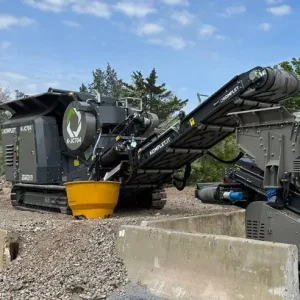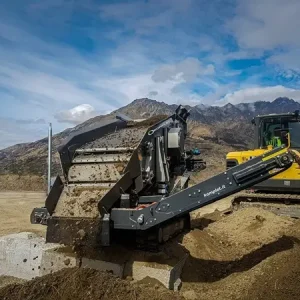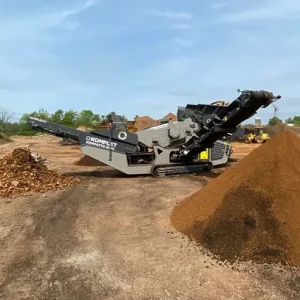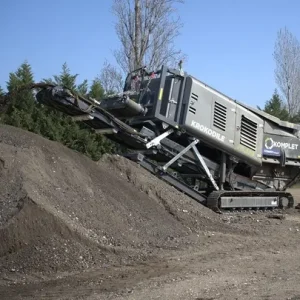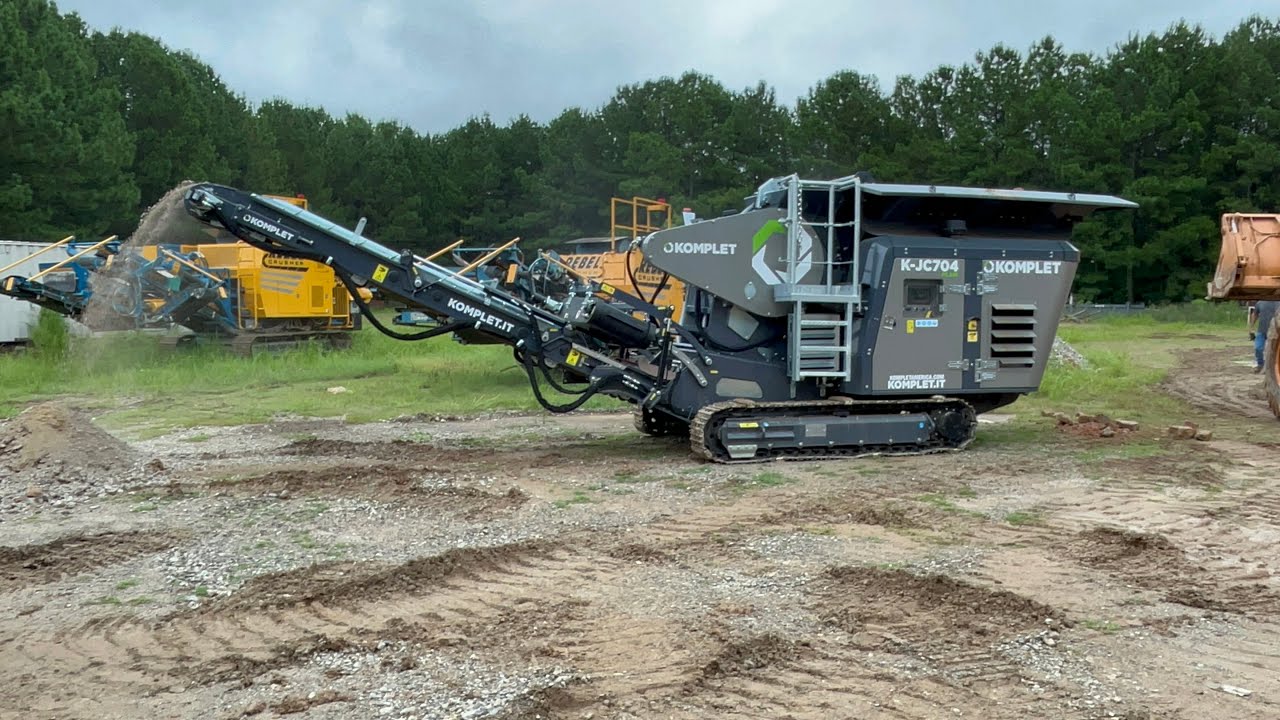

Construction operations face mounting pressure on sustainability — LEED-certified projects require documented material recycling, federal Buy Clean policies require lower-carbon material sourcing, state diversion mandates require measurable reduction in landfill-bound C&D waste, and project owners increasingly require sustainability documentation from contractors. Portable rock crushers — compact mobile jaw crushers that go to project sites and process demolition material on-site — sit at the intersection of these pressures, supporting operations that need to reduce environmental impact while maintaining project economics.
This basic guide walks through how portable rock crushers support green construction practices — landfill diversion, transportation emissions reduction, virgin aggregate displacement, Tier 4 Final emissions compliance, LEED and Buy Clean documentation support, and Komplet America’s CDRA membership alignment with the C&D recycling industry. Honest scope note: Komplet equipment is currently Tier 4 Final diesel-powered (not hybrid or electric); we’ll address industry direction on alternative power systems honestly later in this guide.
The Sustainability Pressures on Construction Operations
Multiple regulatory and market pressures drive construction operations toward sustainability practices:
LEED Certification Requirements
Leadership in Energy and Environmental Design (LEED) — the predominant green building certification in North America — includes Construction and Demolition Waste Management requirements for certified projects. LEED-certified projects must document material flow including diversion percentages, recycling pathway selection, and disposal documentation. Specific LEED credit requirements vary by version and project type — verify current requirements with applicable sustainability professionals.
Federal Buy Clean Policies
Federal Buy Clean policies require lower-carbon material sourcing on federal construction projects. Recycled concrete aggregate (RCA) typically has lower embodied carbon than virgin aggregate due to avoided extraction, processing, and transportation impacts. Operations bidding federal projects increasingly need to source RCA-compatible material to remain competitive on Buy Clean-eligible work.
State Diversion Mandates
Multiple US states have C&D diversion mandates requiring percentage-based diversion from landfill for project waste. California, Massachusetts, Washington, and other states have established mandates with varying specifics. Operations working in these jurisdictions need diversion strategies — including on-site processing — to maintain compliance.
Project Owner Sustainability Requirements
Major project owners (institutional, corporate, governmental) increasingly require sustainability documentation from contractors as part of project bidding and contract requirements. This documentation requirement extends sustainability practices beyond LEED-certified projects to broader market segments.
Tipping Fee and Disposal Cost Pressure
Regional tipping fees for C&D disposal have risen substantially in major US metros — typically $30-$200+/ton depending on regional market. Cost pressure on disposal-only pathways drives operations toward recycling alternatives that reduce per-ton handling costs.
How Portable Rock Crushers Support Green Construction
Compact mobile jaw crushers (portable rock crushers) deliver sustainability benefits through five mechanisms:
1. Landfill Diversion
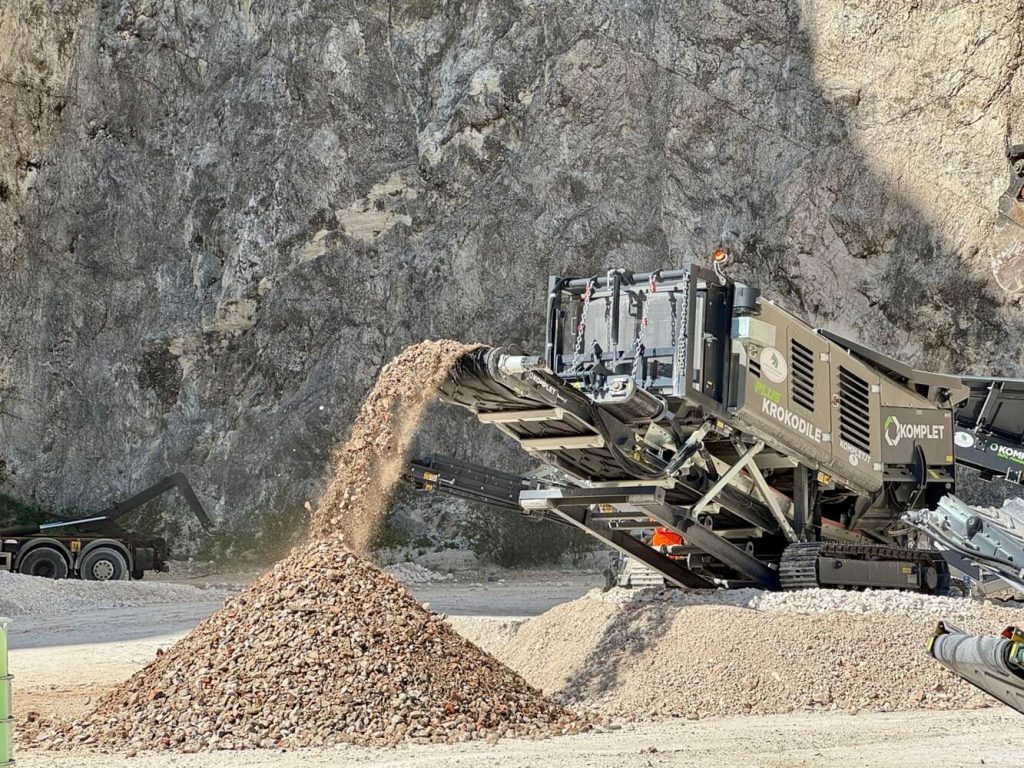
On-site crushing converts demolished concrete, asphalt, brick, and natural rock into recycled aggregate that stays out of landfills. Each ton of material processed on-site represents one ton diverted from landfill capacity. Operations that previously sent 100% of demolition material to landfill achieve substantial diversion rates (often 80-95%+ for clean concrete demolition operations) when on-site processing replaces disposal-only pathways. Diversion percentage directly supports LEED documentation, Buy Clean compliance, state diversion mandates, and sustainability reporting requirements.
2. Transportation Emissions Reduction
Disposal hauling generates substantial transportation emissions — diesel truck operations carrying material from project site to landfill or transfer station. On-site processing eliminates these hauling cycles for material that gets reused on the project or sold from the project site. The same ton of demolished concrete that previously required hauling to landfill (and possibly aggregate purchase requiring hauling from quarry) becomes project base material processed without transportation. Transportation emissions reduction varies by hauling distances and equipment fuel efficiency, but typically represents meaningful reduction in project’s total carbon footprint.
3. Virgin Aggregate Displacement
Virgin aggregate production has substantial embodied carbon — quarry extraction, processing, transportation. RCA produced from on-site crushing displaces virgin aggregate in subsequent project base material applications. Each ton of RCA used as project base material represents one ton of virgin aggregate not extracted, processed, and transported. Virgin aggregate displacement supports Buy Clean compliance for projects requiring lower-carbon material sourcing.
4. Recovered Material Beyond Aggregate
Reinforced concrete includes recoverable rebar and other ferrous metals. Komplet jaw crushers’ standard hydraulic magnetic belt (standard on K-JC 604+; optional on K-JC 503 included in base price) separates ferrous metals from crushed output during operation. Recovered scrap metal enters scrap recycling pathways with established environmental profile — reducing virgin steel production demand.
5. Project Schedule Compression
Eliminating disposal hauling cycles compresses project schedules. For tight-schedule projects (port operations during cargo windows, infrastructure projects with limited closure periods, urban projects with restricted operational hours), schedule compression has direct economic value beyond material handling costs — and indirect sustainability value through reduced equipment idle time, reduced labor hours, and reduced site impact duration.
Tier 4 Final Emissions Compliance
What Tier 4 Final Means
Tier 4 Final is the current EPA emissions standard for off-road diesel engines — covering nitrogen oxides (NOx), particulate matter (PM), hydrocarbons (HC), and carbon monoxide (CO). Tier 4 Final represents substantial emissions reduction versus earlier tiers (Tier 1-3 Interim). All current Komplet jaw crushers (K-JC 503 through K-JC 805) ship with Tier 4 Final compliant diesel engines.
Tier 4 Final Compliance Implications
- Federal contract eligibility — federal projects increasingly require Tier 4 Final equipment
- CARB compliance — California operations require equipment meeting California Air Resources Board requirements
- LEED-certified project equipment requirements — some LEED-certified projects include low-emission equipment requirements for site equipment
- Project owner equipment specifications — major institutional and corporate projects increasingly specify Tier 4 Final equipment
- State and local emissions requirements — some jurisdictions have local emissions requirements affecting older equipment access
How Tier 4 Final Works (Engine Technology)
Tier 4 Final compliance uses combination of engine design improvements (cleaner combustion through electronic controls and improved fuel injection), Diesel Particulate Filter (DPF) for particulate trapping, Selective Catalytic Reduction (SCR) for NOx reduction using DEF (Diesel Exhaust Fluid), and Diesel Oxidation Catalyst (DOC) for hydrocarbon and CO reduction. Combined system achieves Tier 4 Final emissions reductions while maintaining diesel engine power and durability characteristics.
Industry Direction on Alternative Power Systems
The Honest Picture
The construction equipment industry is exploring alternative power systems including hybrid diesel/electric configurations, fully battery-electric equipment, and other emerging technologies. Several manufacturers have announced or released hybrid and electric models for various equipment categories. Compact mobile crushing equipment specifically has seen limited but growing alternative power offerings, with several manufacturers exploring this space.
Komplet’s Current Position
Komplet equipment is currently Tier 4 Final diesel-powered. Komplet does NOT currently offer hybrid or electric variants of its compact mobile crushing, screening, shredding, or conveying equipment. Operations evaluating equipment based on alternative power requirements should verify current Komplet equipment specifications rather than assume availability of alternative power configurations. For alternative power equipment specifically, operations would need to evaluate manufacturers offering those configurations.
Why This Honest Framing Matters
Sustainability-focused buyers deserve accurate information about current equipment capability. Misrepresenting current diesel equipment as having hybrid/electric features risks losing buyer trust when actual equipment doesn’t match marketing claims. Komplet America’s approach: honest about current Tier 4 Final diesel lineup, supportive of operations that need different power configurations finding suitable equipment, and committed to clear specification documentation supporting buyer decisions.
Considerations for Operations Choosing Diesel Today
Tier 4 Final diesel equipment remains the dominant choice for compact mobile crushing operations across N&C America in current market conditions. Diesel power matches operational requirements (sustained high-power output for crushing operations, ability to operate without grid power infrastructure on remote sites, fuel availability across operational territory, established service infrastructure). Operations choosing Tier 4 Final diesel today align with current equipment availability while still capturing major sustainability benefits through landfill diversion, transportation emissions reduction, and virgin aggregate displacement — the primary sustainability mechanisms aren’t power-source-specific.
Komplet America’s Compact Mobile Jaw Crusher Lineup
All current Komplet jaw crushers ship with Tier 4 Final emissions-compliant diesel engines and self-propelled tracked mobility:
- K-JC 503 — up to 34 US tph, 19″ x 12″ jaw, 25 HP Tier 4 Final, ~7,496 lb. Tight-access urban work. Approximately $108,695.
- K-JC 604 — up to 55 US tph, 23″ x 16″ jaw, 55 HP Tier 4 Final, ~19,400 lb. Mid-range demolition. Approximately $205,030.
- K-JC 704 PLUS — up to 90 US tph, 27″ x 16″ jaw, 74 HP Deutz Tier 4 Final, ~26,455 lb. Komplet’s best-selling crusher. Approximately $241,255.
- K-JC 805 — up to 160 US tph, 31″ x 21″ jaw, 130 HP Tier 4 Final, ~49,600 lb. Largest jaw crusher in the lineup.
Standard Sustainability-Supporting Features
- Tier 4 Final emissions-compliant diesel engines supporting CARB, federal contract, and LEED-certified project requirements
- Standard dust suppression on all Komplet jaw crushers — supports air quality requirements at operational sites
- Magnetic separation for rebar recovery (standard on K-JC 604+; optional on K-JC 503 included in base price) — supports ferrous metals recovery into scrap recycling pathways
- Self-propelled tracked mobility for site-to-site movement supporting distributed project deployment without permanent fixed plant infrastructure
- Wireless remote control for operator distance from operational equipment supporting operational safety
- Hydraulic adjustment for output size flexibility supporting recovered material specification matching to project reuse requirements
Komplet America’s Industry Alignment
CDRA Membership
Komplet America is a member of the Construction & Demolition Recycling Association (CDRA) — the trade association supporting C&D recycling industry across North America. CDRA membership reflects Komplet America’s commitment to advancing C&D recycling infrastructure, policy support for recycling industries, and operational best practices development. Operations choosing on-site processing for sustainability benefits align with CDRA’s mission of expanding C&D recycling capacity and capability.
Other Industry Memberships
- AED (Associated Equipment Distributors)
- AEM (Association of Equipment Manufacturers)
- ARA (American Rental Association)
- NDA (National Demolition Association)
- USCC (United States Composting Council) — supports trommel screener applications in compost operations
Integrating Portable Rock Crushers Into Green Construction Projects
LEED Construction Waste Management
On-site processing supports LEED Construction Waste Management documentation through:
- Diversion percentage tracking — measurable material flow records (weight tickets, transfer documentation, processing records)
- Recycled material destination documentation — records of where recovered RCA, ferrous metals, and other material flow downstream
- Disposal documentation — records of residual material going to landfill (the percentage NOT diverted)
Buy Clean Compliance
Federal Buy Clean policies require lower-carbon material sourcing. RCA produced from on-site crushing typically has lower embodied carbon than virgin aggregate due to avoided extraction, processing, and transportation impacts. Specific embodied carbon comparisons vary by region, transportation distances, and operational profile — verify with applicable sustainability professionals for project-specific calculations.
State Diversion Mandate Compliance
State diversion mandates typically require measurable diversion percentages for project C&D waste. On-site processing achieves high diversion rates (often 80-95%+ for clean concrete demolition operations) that meet or exceed mandate thresholds. Operations should verify specific mandate requirements for jurisdictions where they operate.
Project Sustainability Reporting
Major project owners increasingly require sustainability reporting from contractors. On-site processing generates documented material flow records that support sustainability reporting requirements — diversion percentages, recovery rates, emission profiles, and equipment compliance documentation.
Frequently Asked Questions
Are Komplet jaw crushers electric or hybrid?
No — Komplet equipment is currently Tier 4 Final diesel-powered. Komplet does not currently offer hybrid or electric variants of its compact mobile crushing, screening, shredding, or conveying equipment. Tier 4 Final diesel meets current emissions requirements for federal contracts, CARB compliance, and most LEED-certified project equipment specifications. Operations specifically requiring electric or hybrid equipment would need to evaluate manufacturers offering those configurations.
Do portable rock crushers help with LEED certification?
Yes — on-site processing supports LEED Construction Waste Management documentation through measurable material flow records. Specific LEED credit requirements vary by version and project type. Komplet equipment with Tier 4 Final emissions compliance also supports LEED projects with low-emission equipment requirements. Verify current LEED requirements with applicable sustainability professionals for specific projects.
How much can on-site crushing reduce project carbon footprint?
Carbon footprint reduction varies significantly by project profile, hauling distances, and material types. The primary carbon reduction mechanisms — landfill diversion, transportation emissions reduction, and virgin aggregate displacement — apply to all on-site processing operations but specific magnitudes depend on operational specifics. For project-specific carbon analysis, work with sustainability professionals doing life cycle assessment (LCA) calculations for your specific operation.
What’s the difference between recycled concrete aggregate (RCA) and virgin aggregate environmentally?
RCA generally has lower embodied carbon than virgin aggregate due to avoided extraction, processing, and transportation impacts. Specific environmental comparison varies by region, transportation distances, processing efficiency, and other factors. RCA also avoids the land disturbance impacts of new quarry operations — a non-carbon environmental benefit. Specific environmental claims for project documentation should be verified through life cycle assessment by applicable sustainability professionals.
Does federal Buy Clean apply to my project?
Federal Buy Clean policies apply to federal construction projects with lower-carbon material sourcing requirements. State Buy Clean policies (California Buy Clean Act, others) apply to specific state projects. Operations bidding eligible projects need to verify specific Buy Clean requirements for the project. RCA production through on-site crushing typically supports Buy Clean compliance for material sourcing requirements; verify specific requirements with project documentation.
How can I document sustainability outcomes from my crushing operation?
Standard sustainability documentation includes: weight tickets for incoming material, weight tickets or volume measurements for produced output, scrap metal recovery records, residual disposal records (the percentage going to landfill), Tier 4 Final equipment documentation (engine compliance certificates), and operational records showing equipment hours, fuel consumption, and operational schedule. Operations supporting LEED-certified projects typically work with project sustainability consultants to format documentation appropriately.
Where can I see Komplet equipment in operation?
Komplet America offers equipment demos at the Komplet America yard in Hillsborough, NJ (749 Clawson Ave.) or through authorized Komplet dealers across N&C America. Komplet America does not transport equipment to prospect sites for demos. Call 908-369-3340 to schedule a yard visit, or contact your local authorized dealer for regional demo availability.
Are there sustainability grants or incentives for on-site crushing equipment?
Some state and federal programs provide grants or tax incentives for sustainability-supporting equipment investments. Programs change over time and vary by jurisdiction. Operations evaluating equipment investment should consult current state programs, federal Section 179 tax deduction (up to $1.22M, 2024 limit, for new and qualifying used equipment), and any industry-specific incentive programs in their operational territory. Komplet America’s Komplet Capital financing supports equipment financing but does not directly provide grants — those come from external programs.
Final Thoughts
Portable rock crushers (compact mobile jaw crushers) support green construction through five primary mechanisms — landfill diversion, transportation emissions reduction, virgin aggregate displacement, recovered ferrous metals beyond aggregate, and project schedule compression. Tier 4 Final emissions compliance supports current federal contract eligibility, CARB compliance, and LEED-certified project equipment requirements. Komplet equipment is currently Tier 4 Final diesel-powered (not hybrid or electric); industry direction includes growing alternative power offerings from various manufacturers, but Komplet’s current lineup focuses on Tier 4 Final diesel matching current operational requirements across N&C America. Operations evaluating crushing equipment for green construction projects should focus on the primary sustainability mechanisms (which apply to current Tier 4 Final diesel equipment) rather than waiting for alternative power equipment that may not yet match operational requirements. Komplet America’s CDRA membership and broader industry alignment (AED, AEM, ARA, NDA, USCC) reflects commitment to advancing recycling infrastructure across N&C America.
Browse Komplet America’s compact mobile jaw crusher lineup or call us to discuss equipment selection for your specific green construction or sustainability operation.
Ready to Talk Sustainable Crushing Equipment?
- Call 908-369-3340
- Email [email protected]
- Schedule a demo at the Komplet America yard or through your local authorized dealer
- Find your local Komplet dealer for rental availability
- Ask about our 1-year / 1,000-hour warranty and equipment financing options
Never enough — that’s how we approach service, support, and helping operations capture the operational AND environmental benefits of on-site rock crushing.
Disclaimer: All cost, ROI, payback, pricing, tipping fee, embodied carbon, and revenue figures in this article are illustrative examples based on sample assumptions about volume, regional pricing, material specifications, and market conditions. Actual results vary significantly by region, market, material type, equipment utilization, operator skill, financing terms, regulatory environment, and many other factors. Equipment pricing, tipping fees, RCA pricing, and disposal costs all change over time and by location. LEED credit requirements, Buy Clean policy requirements, and state diversion mandates are subject to update; consult applicable sustainability professionals for current guidance specific to your projects. Embodied carbon comparisons between RCA and virgin aggregate vary by life cycle assessment methodology, regional inputs, and operational profile; consult qualified sustainability professionals for project-specific calculations. Komplet America makes no guarantee, warranty, or representation of specific financial performance, sustainability outcomes, or compliance results for any particular operation. Komplet equipment specifications, including emissions compliance status, are subject to change; verify current specifications with Komplet America directly. For current pricing and discussion of equipment selection for your specific operation, contact us at 908-369-3340 to speak with our team.