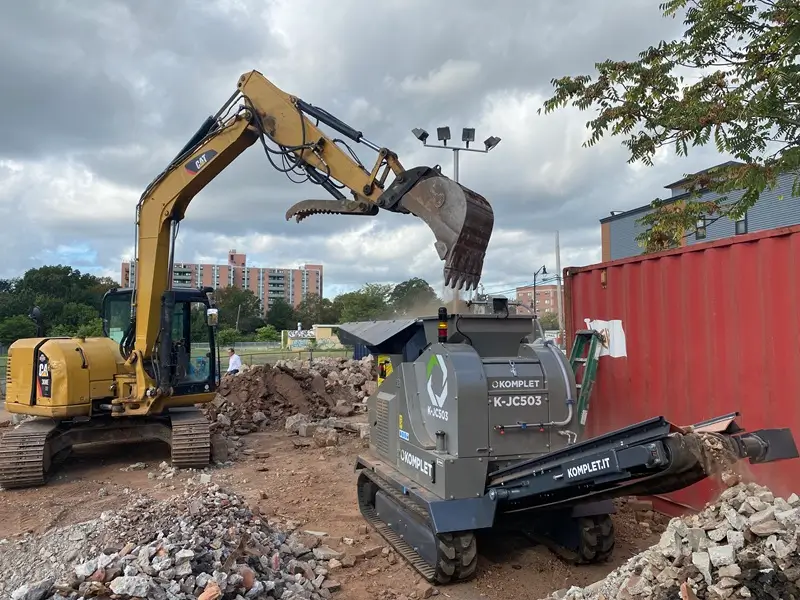

Urban construction operations face site constraints that exclude standard contractor equipment — narrow streets with limited turn radius for transport vehicles, small lots with no staging area, indoor demolition work in basement levels, alley access only for residential or commercial demolition, downtown areas with overhead obstructions limiting equipment height. These constraints create demand for genuinely compact crushing equipment sized to fit urban operating realities while still delivering the operational capability that makes on-site processing economically viable. Operations using oversized equipment in urban contexts pay through transport infrastructure costs, site staging logistics, and operational delays; operations using right-sized compact equipment capture project economics that haul-out alternatives can’t match.
This basic guide walks through compact crushers for urban construction — the specific operational challenges urban construction creates, the equipment dimensions and capabilities that address those challenges, on-site recycling economics for urban demolition projects, and how Komplet America’s K-JC 503 mini jaw crusher is specifically designed for tight-access urban demolition work.
The Specific Operational Challenges Urban Construction Creates
Urban construction differs from suburban or rural construction in measurable ways that affect equipment selection. Generic “compact equipment” framing misses the specific dimensional, logistical, and regulatory realities that drive urban equipment choices.
Site Access and Footprint
- Narrow street access — equipment must fit standard urban street widths and accommodate parked vehicles, traffic flow, and pedestrian zones during transport delivery
- Lot footprint constraints — urban demolition lots commonly run 25’x100′ or smaller, leaving minimal staging area for equipment, material stockpiles, and operations
- Indoor and basement work — interior demolition projects require equipment dimensions that fit through doorways, navigate level changes, and operate within building footprints
- Overhead clearance — urban canopies, building overhangs, utility lines, and parking structures all create overhead clearance constraints
- Alley access — some urban properties only have alley access with significantly restricted dimensions
Transport Infrastructure
- Standard equipment trailer access — equipment that requires specialized hauling permits and escort vehicles complicates urban delivery logistics
- Weight restrictions — some urban streets and bridges have weight restrictions that exclude heavy equipment
- Self-mobile deployment — equipment that can drive off the trailer under its own power simplifies tight-site delivery
- Permitted route planning — larger equipment may require specific permitted routes that add hauling distance and cost
Operational Considerations
- Population proximity — neighbors, businesses, and pedestrians directly adjacent to operations require attention to dust, noise, vibration, and traffic impact
- Operating hour restrictions — many urban municipalities restrict construction operating hours
- Permitting requirements — urban permits commonly require dust mitigation plans, noise mitigation, traffic management, and project-specific compliance documentation
- Project timeline pressure — urban projects commonly face tight schedules driven by neighbor relations, business operations of adjacent properties, and seasonal urban patterns
How Compact Crushers Address Urban Challenges
Site Footprint Match
Genuinely compact crushing equipment fits urban operational footprints in ways larger equipment can’t. Equipment dimensions matter:
- Working dimensions — space the equipment occupies during operation, including hopper, discharge belt, and operator clearance
- Transport dimensions — space the equipment occupies on the trailer for delivery, which determines what trailers can transport it and what site access works
- Operating weight — affects what trailers can transport it, what street infrastructure can accommodate it, and what site ground conditions can support it
Standard Trailer Transport
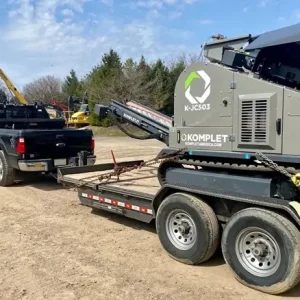
Equipment that fits standard equipment trailers without specialized hauling permits or escort vehicles deploys to urban sites efficiently. Self-propelled tracked mobility allows equipment to drive off the trailer under its own power, eliminating crane lifts or specialized unloading equipment for delivery.
Standard Dust Suppression
All Komplet jaw crushers ship with standard dust suppression systems — important for urban operations where population proximity makes dust mitigation a permit requirement and a community relations issue. Dust suppression systems are STANDARD on Komplet jaw crushers (NOT optional add-on).
Tier 4 Final Emissions Compliance
All current Komplet jaw crushers use Tier 4 Final emissions-compliant diesel engines — current EPA emissions standards. Urban operating environments increasingly require current emissions tier compliance for permit approvals and federal contract work.
Wireless Remote Operation
Wireless remote control allows the operator to manage crusher functions from outside the immediate work zone — useful for urban operations where the operator may need to coordinate with site logistics, traffic management, or ground crew.
Realistic Framing on Noise
Honest framing: compact mobile diesel-powered crushers generate significant operational noise — this is the nature of crushing equipment regardless of manufacturer or specific model. Operations in noise-restricted urban environments need to plan for noise impact through operational scheduling within permitted hours, distance buffers from sensitive receptors where feasible, and operational practices that minimize neighbor impact. Compact crushers don’t magically eliminate operational noise; they fit smaller operational footprints with shorter material handling cycles and faster project completion that minimize total noise exposure duration.
K-JC 503: Komplet’s Urban Tight-Access Hero
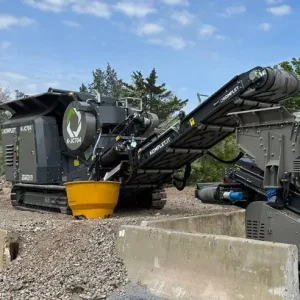
The K-JC 503 mini jaw crusher is specifically sized for urban tight-access operations:
Dimensional Specifications
- Working dimensions: approximately 15′ x 5′ x 6’6″ — operates within tight site footprints
- Transport dimensions: approximately 9’8″ x 5′ x 7’2″ — fits standard equipment trailers
- 5′ transport width — fits where standard contractor equipment can’t deploy
- Operating weight: approximately 7,496 lb — supports lighter transport infrastructure and lighter site ground conditions
Operational Specifications
- Throughput: up to 34 US tph
- Jaw opening: 19″ x 12″
- Recommended max feed: approximately 9-1/2″ minus
- Output range: 3/4″ to 3-1/4″ (hydraulically adjustable)
- Engine: 25 HP Tier 4 Final diesel
Standard and Optional Features
- Standard ultrasonic feed sensor — prevents overfeeding and supports consistent operation
- Standard dust suppression — important for urban population proximity
- Self-propelled tracked mobility — drives onto and off transport trailers under own power
- Wireless remote control — supports operation from outside immediate work zone
- Hydraulic jaw setting adjustment — output size flexibility without manual tooling
- Reverse jaw function — clears uncrushable material safely
- Optional magnetic attachment (included in base price) — recovers rebar from reinforced concrete
- Optional oversize scalper attachment
Larger Compact Crushers for Larger Urban Projects
Not all urban operations have the same access constraints. Larger urban demolition projects with adequate site staging may benefit from larger compact crushers that handle higher throughput while still fitting reasonable urban operating profiles:
- K-JC 604 — up to 55 US tph, 23″ x 16″ jaw, 55 HP, ~19,400 lb. Mid-range urban demolition where K-JC 503 capacity isn’t sufficient.
- K-JC 704 PLUS — up to 90 US tph, 27″ x 16″ jaw, 74 HP, ~26,455 lb. Komplet’s best-selling crusher. Larger urban projects with adequate staging area.
Match equipment size to specific urban project requirements. The smallest practical equipment minimizes site disruption; larger equipment delivers higher throughput where site conditions support it.
Urban Demolition Economics: Why On-Site Crushing Wins
Urban demolition project economics are dominated by tipping fees and hauling costs — the two largest cost components for off-site disposal. On-site compact crushing addresses both, plus generates revenue from recovered material.
Urban Tipping Fee Reality
Major US metro tipping fees commonly run $80-$200+/ton for C&D material — significantly higher than rural or smaller-metro markets. The economic swing from on-site crushing in high-tipping-fee urban markets is substantial:
- Avoided tipping fee: $80-$200/ton
- Avoided urban hauling cost: $10-$30/ton (urban congestion adds to hauling cost)
- Recovered RCA value: $10-$25/ton for base material; potential premium pricing for spec aggregate
- Recovered rebar scrap: $100-$300+/ton at scrap metal pricing
Project-Level Economic Impact
For a 1,000-ton urban demolition project with concrete: at $100/ton tipping + $20/ton hauling avoided, that’s $120,000 cost avoidance. Plus recovered RCA at $15/ton (1,000 tons) = $15,000 revenue. Plus recovered rebar scrap (perhaps 30-50 tons at $200/ton) = $6,000-$10,000 additional revenue. Total economic swing approaching $135,000-$145,000 vs. disposal pathway. Equipment rental for the same project might run $5,000-$15,000 depending on duration. The project economics work strongly for on-site crushing in urban high-tipping-fee markets.
Schedule Compression
Urban projects face tight schedules for permit window completion, neighbor relations, business operations of adjacent properties, and seasonal urban patterns. Eliminating disposal hauling cycles compresses project schedule. Fewer truck cycles means less traffic disruption, less urban operational impact, and faster project completion.
Urban Deployment and Operational Considerations
Site Survey Before Equipment Selection
Successful urban operations start with site survey before equipment selection. Measure available footprint, document overhead obstructions, verify transport route to site, identify staging areas for material stockpiles, document neighbor proximity and sensitive receptors, identify utility locations, document traffic management requirements during equipment delivery and operation. The site survey drives right-size equipment selection for the specific project.
Permitting and Compliance
Urban operations commonly require project-specific permits with dust mitigation plans, noise mitigation plans, traffic management plans, and operational hour compliance. Komplet equipment standard features (Tier 4 Final emissions, integrated dust suppression, wireless remote) support these compliance requirements. Specific permitting requirements vary by jurisdiction — work with permit consultants familiar with the specific city for jurisdiction-specific compliance guidance.
Operator Coordination
Urban operations require ongoing coordination — site logistics with adjacent properties, traffic management for delivery and material removal, neighbor relations during operating hours, and project schedule communication with relevant parties. This coordination overhead is part of urban operational cost and should be factored into project planning.
Material Handling for Urban Sites
Some urban sites benefit from the K-TC 460 portable mobile conveyor — up to 132 US tph, 25″ Chevron 3-ply belt, 25 HP Tier 4 Final, ~7,000 lb — for material transfer to stockpile locations or to truck loading positions where direct equipment positioning isn’t possible.
Frequently Asked Questions
How small can compact crushers go for urban work?
The Komplet K-JC 503 mini jaw crusher is approximately 7,496 lb operating weight with 5′ transport width and 9’8″ x 5′ x 7’2″ transport dimensions — among the most compact tracked mobile jaw crushers available for serious commercial urban work. Smaller crushers exist (excavator-mounted attachments, specialty mini equipment) for very specialized scenarios but typically with significantly reduced operational capability.
Are Komplet crushers low-noise equipment?
Honest answer: compact mobile diesel-powered crushers generate significant operational noise, regardless of manufacturer. Komplet equipment is professionally engineered industrial equipment, not specifically marketed as low-noise. Operations in noise-restricted urban environments need to plan for noise through operational scheduling within permitted hours, distance buffers from sensitive receptors, and operational practices that minimize neighbor impact. Compact crushers don’t eliminate operational noise; they fit smaller operational footprints with shorter project duration.
Do compact crushers handle urban demolition concrete?
Yes — concrete is the primary application. The compression action of jaw crushing handles reinforced concrete with rebar (the magnetic attachment recovers the rebar as scrap metal). Match jaw opening to your typical pavement chunk size: K-JC 503 (19″ x 12″ jaw) handles material to approximately 9-1/2″ minus; K-JC 604 (23″ x 16″ jaw) handles material to approximately 12-3/4″. Pre-process oversized chunks with excavator-mounted hydraulic breakers before feeding the crusher.
Can I rent a compact crusher for a single urban project?
Yes — Komplet America’s authorized dealer network includes rental partners across N&C America. Single-project rental typically pencils for urban demolition projects with 500+ tons of crushable material in markets with significant tipping fees ($80-$200+/ton typical for major US metros). Call (908) 369-3340 to discuss rental availability for your specific project.
What permits do I need for urban crushing operations?
Urban crushing permits typically include project-specific permits with dust mitigation plans, noise mitigation plans, traffic management plans, and operational hour compliance. Specific permitting requirements vary significantly by jurisdiction. Consult applicable city/county/state regulatory authorities and qualified permit consultants for jurisdiction-specific guidance. Komplet equipment standard features (Tier 4 Final emissions, integrated dust suppression, wireless remote) support compliance with common permit requirements.
How fast can compact crushers deploy to urban sites?
Typically hours, not days. Equipment arrives via standard equipment trailer, drives off the trailer under self-propelled tracked mobility, and begins production after operator pre-shift inspection per OEM operator’s manual. Compare this to fixed plant facility setup which involves construction, permitting, infrastructure development, and commissioning over months to years.
Does urban crushing equipment need special operator training?
Operator training is recommended for any equipment, urban or otherwise. Komplet America’s authorized dealers provide operator training as part of new equipment delivery and on-request training for additional operators. Wireless remote control and hydraulic functions support easier operator learning curve compared to manual operation.
What’s the warranty on Komplet equipment for urban operations?
All new Komplet equipment ships with 1-year / 1,000-hour warranty (whichever comes first) regardless of operating environment. Komplet America’s parts inventory is forecasted 12 months in advance, supporting fast wear-part availability. Authorized dealers across N&C America provide local service support including in major US metro markets where urban operations typically occur.
Final Thoughts
Compact crushers for urban construction address the specific operational challenges urban demolition and recycling work creates — tight site footprints, transport infrastructure constraints, population proximity, regulatory requirements, and project schedule pressure. The K-JC 503 mini jaw crusher is specifically sized for urban tight-access operations with 5′ transport width, ~7,496 lb operating weight, standard dust suppression, Tier 4 Final emissions compliance, and wireless remote control. Larger compact crushers (K-JC 604, K-JC 704 PLUS) fit larger urban projects with adequate site staging. Urban demolition economics favor on-site processing strongly in high-tipping-fee markets ($80-$200+/ton typical for major US metros) — the project economics swing of $100,000+ per 1,000-ton project from cost avoidance plus recovered material revenue typically dominates rental or ownership cost. Honest framing on operational noise: compact diesel-powered crushers generate significant noise regardless of manufacturer, so operations in noise-restricted urban environments need to plan operationally rather than relying on equipment to eliminate noise impact.
Browse Komplet America’s compact mobile jaw crusher lineup or call us to discuss equipment selection for your specific urban construction project.
Ready to Talk Compact Crushers for Urban Work?
- Call (908) 369-3340
- Email [email protected]
- Schedule a demo or request a quote
- Find your local Komplet dealer for rental availability
- Ask about our 1-year / 1,000-hour warranty and equipment financing options
Never enough — that’s how we approach service, support, and helping urban construction operations match the right compact crushing equipment to their specific project requirements.
Disclaimer: All cost, ROI, payback, pricing, tipping fee, and revenue figures in this article are illustrative examples based on sample assumptions about volume, regional pricing, material specifications, and market conditions. Actual results vary significantly by region, market, material type, equipment utilization, operator skill, financing terms, regulatory environment, and many other factors. Urban tipping fees, hauling costs, RCA pricing, scrap metal pricing, fuel costs, labor rates, and equipment pricing all change over time and by location. Komplet America makes no guarantee, warranty, or representation of specific financial performance, payback timelines, or business outcomes for any particular operation. Urban permit requirements vary significantly by jurisdiction; consult applicable regulatory authorities and qualified permit consultants for jurisdiction-specific compliance guidance. For current pricing and a payback estimate based on your specific volume, material, and local market, contact us at (908) 369-3340 to speak with our team.