
Crushing equipment in mining and crushing equipment in construction look superficially similar — both reduce material from larger sizes to smaller sizes, both run continuous heavy-duty operations, both face wear-part replacement and maintenance discipline. But the actual equipment, operational scale, technology choices, and economic realities are dramatically different. Buyers who understand the differences end up with equipment that fits their actual application; buyers who don’t either over-buy industrial mining equipment for construction work or under-buy compact construction equipment for mining-scale demands.
This guide walks through crushers in mining vs. construction — the meaningful differences in equipment scale and design, what each industry uses and why, the operational realities that drive different equipment choices, and where Komplet America’s compact mobile crusher lineup sits within this landscape (specifically: engineered for construction, demolition, and recycling — not mining).
Crushing in Mining: Industrial-Scale Fixed Installations
Mining operations crush extracted ore, mineral-bearing rock, and coal at industrial scale — typically thousands of tons per hour through continuous-duty fixed installations. The economic logic is dictated by extraction scale: mines extract enormous tonnages of relatively low-value rock to recover small percentages of valuable mineral, so crushing equipment must handle massive throughput at the lowest possible per-ton cost.
Typical Mining Crushing Equipment
Mining operations typically use combinations of large primary, secondary, and tertiary crushers in fixed installations near or at the extraction site. Primary equipment (the first stage handling the largest material) often includes large gyratory crushers or heavy-duty primary jaw crushers — fixed installations weighing hundreds of tons with throughput measured in thousands of tons per hour. Secondary and tertiary stages typically include large cone crushers and HPGRs (high-pressure grinding rolls) producing finer output for ore concentration processes.
These are major capital installations — multi-million-dollar fixed plants designed for decades of service at one location. The economic justification depends on the mine’s expected operating life and total tonnage to be processed.
Why Mining Equipment Stays Stationary
Mining-scale crushers don’t move. The equipment is too large, too connected to permanent infrastructure (electrical substations, structural foundations, conveyor systems extending miles to the processing plant), and too capital-intensive to relocate. Mining sites build the entire crushing operation around the planned extraction zone and run it for the life of the mine.
Mining Operational Realities
- Throughput target: typically thousands of tons per hour
- Operation duration: decades of continuous operation at one site
- Power source: typically electric motors connected to permanent grid infrastructure
- Material composition: homogeneous ore or rock from the extraction zone, predictable composition
- Maintenance approach: scheduled major service requiring extended planned shutdown
- Capital scale: multi-million-dollar fixed installations
Crushing in Construction: Compact Mobile Equipment for Project Work
Construction-side crushing serves an entirely different operational reality. Demolition contractors need to process concrete debris on residential and commercial demolition sites — measured in hundreds of tons per project, not thousands of tons per hour. Excavation contractors hit ledge rock that needs to become base aggregate for that specific project. Aggregate producers serve regional construction markets with mid-size operations. Recyclers convert demolition concrete into RCA for resale.
Typical Construction Crushing Equipment
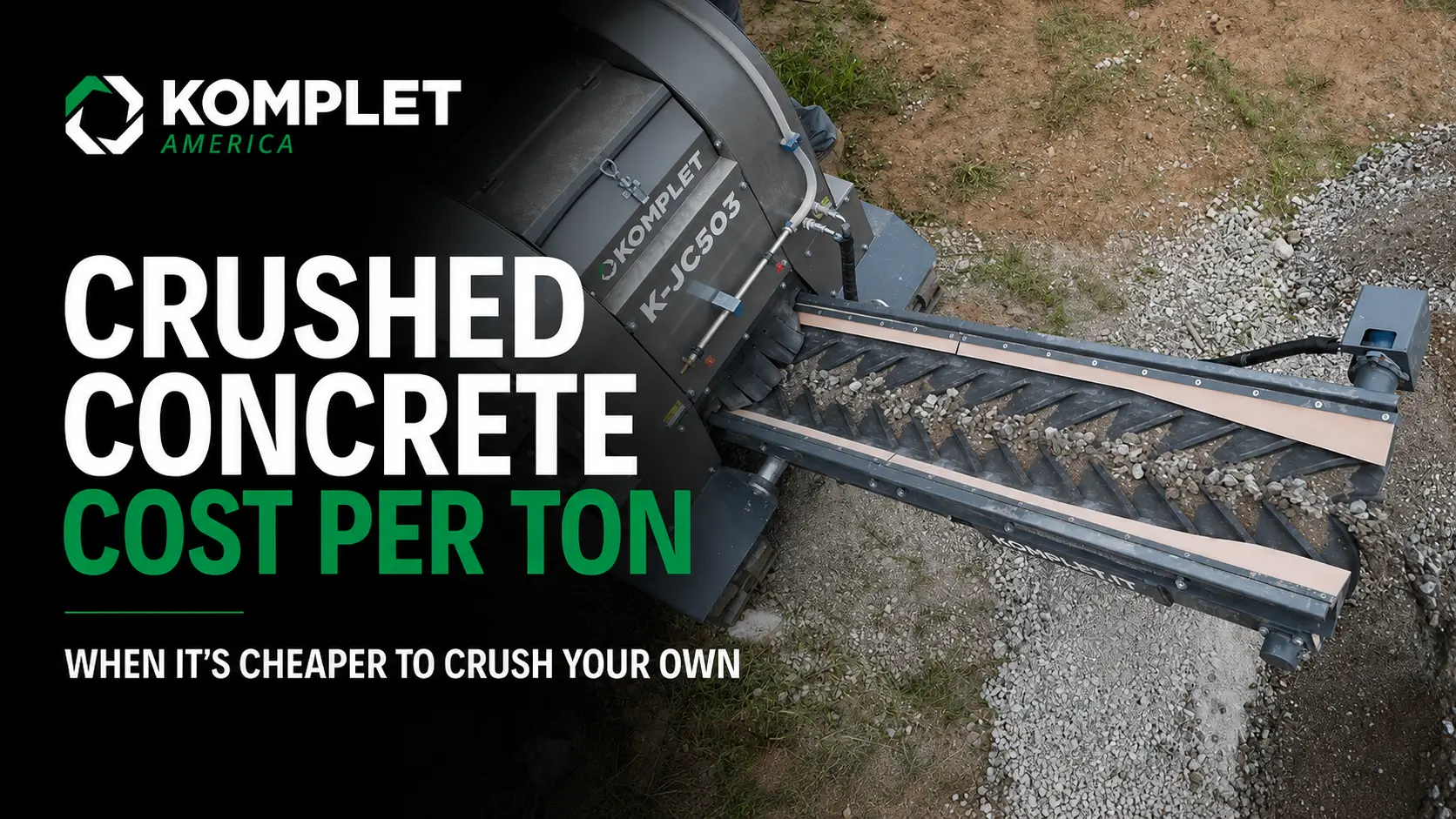
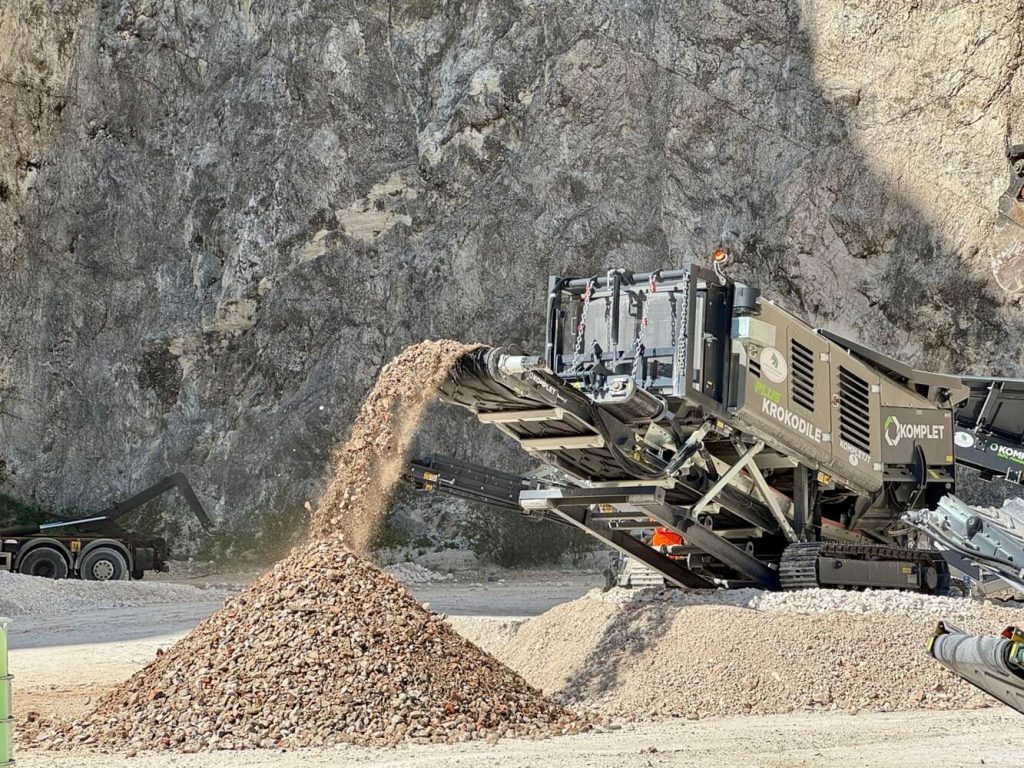
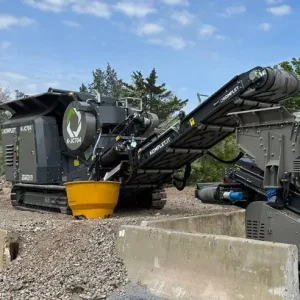
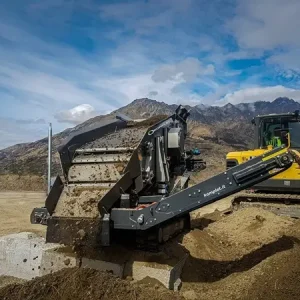
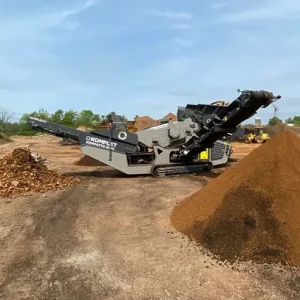
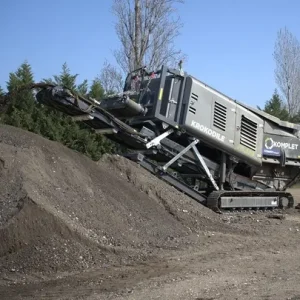
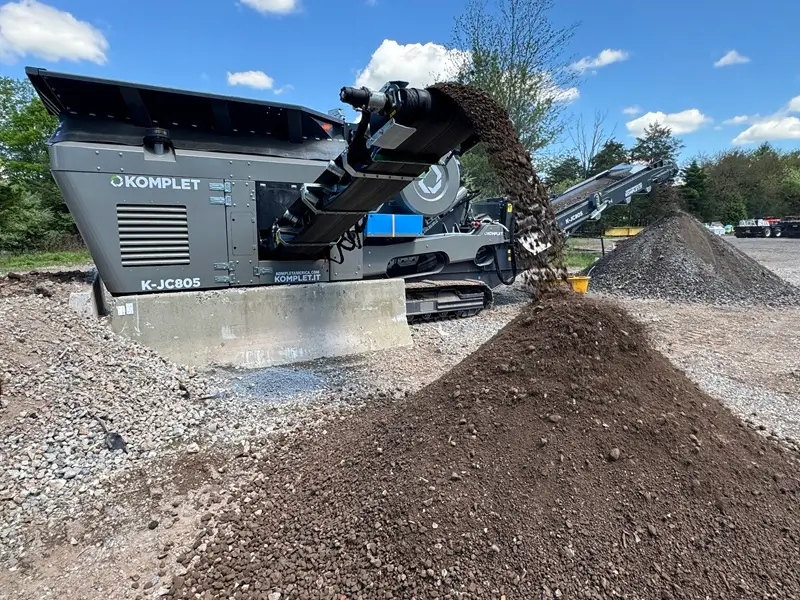
Construction operations typically use compact mobile equipment scaled appropriately to project work. Primary crushing handles the largest reduction step with compact mobile jaw crushers — Komplet’s K-JC 503 (up to 34 US tph), K-JC 604 (up to 55 US tph), K-JC 704 PLUS (up to 90 US tph, the best-seller), and K-JC 805 (up to 160 US tph, the largest in the lineup). Some operations add an impact crusher (Komplet’s K-IC 70 at up to 90 US tph) for premium cubical aggregate. Output goes through compact mobile screeners for spec-size separation.
These are typically self-propelled tracked machines that drive between job sites, deploy via wireless remote in under 30 minutes, and run on onboard diesel power without requiring grid infrastructure.
Why Construction Equipment Is Mobile
Construction work happens at the project site, which changes from project to project. A demolition contractor working a residential teardown this week will be working a commercial demolition next month and an excavation project after that. The equipment that fits this operational reality must move between sites at the same speed as the work — which means tracked self-propelled machines with onboard power, hydraulic conveyor folding for road transport, and wireless remote control for single-operator deployment.
Construction Operational Realities
- Throughput target: typically 30-160 US tph (compact mobile range)
- Operation duration: project-based, days to months at each site
- Power source: onboard diesel engines (Tier 4 Final), self-contained
- Material composition: variable — concrete with rebar, mixed C&D debris, asphalt, natural rock, recycled material
- Maintenance approach: daily walkarounds, scheduled service intervals, parts response time matters
- Capital scale: approximately $108,695-$268,070+ per machine; complete crusher-screener combinations $213,000-$500,000+
Key Differences in Crusher Applications
Scale of Operations
Mining handles thousands of tons per hour at fixed installations; construction handles tens to hundreds of tons per hour at variable sites. The scale difference drives every other equipment decision.
Material Composition
Mining typically processes homogeneous ore or rock from a known extraction zone. Construction processes highly variable material — demolition concrete with embedded rebar, mixed C&D debris with foreign objects, asphalt with surface contamination, natural rock from excavation, and recycled aggregates of varying quality. Construction equipment needs features (magnetic separation, reverse jaw function, dust suppression) specifically engineered for variable contaminated feed.
Mobility Requirements
Mining equipment stays put for the life of the mine. Construction equipment moves between projects multiple times per year. Mobility isn’t a nice-to-have for construction; it’s the foundation of the operational economics.
Setup and Deployment Time
Mining installations take months to commission. Construction equipment must deploy in 15-30 minutes from arrival to operating production — same-day deployment is the operational baseline.
Operator Coordination
Mining crushing typically involves multiple operators across separated work areas (mine, primary crusher, secondary crusher, processing plant). Construction operations typically run with single operators using wireless remote control, supported by loader operators and ground crew. The equipment design reflects these different operator-coordination realities.
Regulatory Environment
Mining operates under MSHA (Mine Safety and Health Administration) regulations specific to extractive industries. Construction crushing operates under OSHA (Occupational Safety and Health Administration) construction standards including the silica PEL of 50 ug/m3 over 8 hours. The compliance approaches differ — Komplet jaw crushers ship with standard dust suppression specifically engineered for OSHA construction-industry compliance.
Where Komplet America Fits: Construction, Demolition, and Recycling
Komplet America’s compact mobile lineup is engineered specifically for construction, demolition, and recycling applications — not mining. This isn’t a marketing claim; it’s a fundamental design choice that shapes every machine in the lineup. The compact tracked mobility, onboard diesel power, wireless remote control, hydraulic conveyor folding, and quick-deploy design all serve construction-side operational realities.
Komplet’s Customer Industries
- Demolition contractors processing concrete and mixed C&D waste at residential and commercial sites
- Concrete recyclers producing RCA from demolition concrete for resale
- Asphalt recyclers processing milled asphalt and full-depth pavement for RAP
- Aggregate producers serving regional construction markets at mid-size scale
- Excavation contractors converting on-site rock and soil into useful material
- Road builders processing crushed material for highway and infrastructure projects
- Landscape supply yards entering RCA and aggregate production
- Rental fleet operators serving construction, demolition, and recycling rental markets
Why Komplet Doesn’t Make Mining Crushers
Mining-scale equipment serves a fundamentally different operational reality than what compact mobile design optimizes for. Building large fixed gyratory crushers, large cone crushers, or HPGRs for tertiary mineral processing requires different engineering, different supply chain, different service network, and different customer relationships than what Komplet America has built. The construction-side market that Komplet serves is large enough and underserved enough that focusing on it serves customers better than spreading across both markets with compromise products. If your operation genuinely needs mining-scale equipment, you’re better served by manufacturers who specialize in that segment.
Komplet’s Construction-Side Crusher Lineup
Compact Mobile Jaw Crushers
- K-JC 503 — up to 34 US tph, 19″ x 12″ jaw, 25 HP Tier 4 Final, ~7,496 lb. Tight-access urban demolition.
- K-JC 604 — up to 55 US tph, 23″ x 16″ jaw, 55 HP, ~19,400 lb. Mid-range mobile crusher.
- K-JC 704 PLUS — up to 90 US tph, 27″ x 16″ jaw, 74 HP, ~26,455 lb. Komplet’s best-selling crusher and the workhorse for typical contractor and aggregate operations.
- K-JC 805 — up to 160 US tph, 31″ x 21″ jaw, 130 HP, ~49,600 lb. Largest jaw crusher in Komplet America’s lineup, for high-volume aggregate and demolition operations.
Compact Mobile Impact Crusher
- K-IC 70 — up to 90 US tph, 25″ x 20″ inlet, 100 HP, ~28,600 lb. Launched WOC 2024. For premium cubical aggregate (concrete and asphalt mix designs).
Construction-Specific Standard Features
Every Komplet jaw crusher ships with features specifically engineered for construction-side operational realities:
- Hydraulic magnetic belt (K-JC 604, K-JC 704 PLUS, K-JC 805) — automatically lifts rebar from demolition concrete
- Reverse jaw function — clears uncrushable jams in seconds via wireless remote
- Standard dust suppression — water-spray system for OSHA crystalline silica compliance
- Wireless remote control — single operator handles the full machine
- Self-propelled tracked mobility — deploys between job sites without specialized rigging
- Tier 4 Final diesel engines — current emissions compliance for construction operations
Frequently Asked Questions
Can a construction-side crusher handle mining work?
Compact mobile construction crushers like Komplet’s K-JC lineup are engineered for the throughput and material characteristics of construction, demolition, and recycling work — typically 30-160 US tph. Mining operations processing thousands of tons per hour need correspondingly larger equipment that compact mobile machines can’t physically deliver. For small-scale or remote mining (placer mining, exploration drilling sites, small-volume mineral recovery), compact mobile equipment may be appropriate; for industrial-scale mineral extraction, mining-specific equipment is the right answer.
Can a mining-scale crusher work for construction projects?
Technically possible, economically poor. Mining-scale fixed installations don’t move; can’t deploy to demolition sites; can’t access urban renovation projects; require massive grid power infrastructure. The capital cost would be impossible to justify for project-based construction work. Construction operations are far better served by compact mobile equipment specifically designed for the mobility and project economics of construction work.
Why don’t compact mobile crushers use cone crushers or gyratory crushers?
Cone crushers and gyratory crushers excel at very large primary crushing of mining-scale ore and at fine tertiary crushing in cement and mineral processing. Both are typically large fixed-installation equipment — the engineering doesn’t fit compact mobile design. For construction-scale primary crushing, jaw crushers are typically the right tool because they handle the variable contaminated material (rebar, mixed C&D, foreign objects) that defines construction feed. For premium cubical secondary output in construction, impact crushers (like Komplet’s K-IC 70) handle the role that cone crushers fill in larger fixed installations.
What’s the smallest scale where mining-style equipment makes sense?
Generally 500+ US tph sustained throughput at a single fixed location with multi-year operating life. Below that scale, the capital and operational economics typically favor compact mobile equipment — even for mineral extraction applications. Many small-scale mineral recovery operations run successfully with mid-size compact mobile equipment despite operating in mining-adjacent applications.
Why does Komplet specifically focus on construction over mining?
Construction, demolition, and recycling represent a large and underserved market for compact mobile equipment. Mining is well-served by manufacturers specializing in that segment with engineering, supply chain, and service models specifically tuned for industrial-scale extraction. Komplet’s compact mobile design philosophy serves construction-side customers better than a compromise product trying to serve both markets. This focus is the reason Komplet’s equipment includes features (magnetic separation, dust suppression, wireless remote, quick deployment) that mining-focused manufacturers typically don’t prioritize.
Are construction crushers tougher or weaker than mining crushers?
Different, not weaker. Construction crushers handle highly variable feed (rebar-laden concrete, mixed C&D debris, foreign objects) that mining crushers typically wouldn’t encounter — and include features (reverse jaw, magnetic separation) specifically engineered for that variability. Mining crushers handle higher tonnage per hour but more homogeneous material. Per-ton wear rates can actually be similar or higher in construction applications crushing reinforced concrete than in mining applications crushing softer ore. Calling either category ‘tougher’ oversimplifies the engineering.
How does maintenance differ between mining and construction crushers?
Mining maintenance typically uses scheduled major service requiring extended planned shutdowns (days to weeks), supported by on-site maintenance teams. Construction maintenance typically uses daily walkarounds, scheduled service intervals timed around project windows, and OEM dealer-supported major service. Komplet America’s parts inventory forecasted 12 months in advance and authorized dealer network across North and Central America specifically support construction-side maintenance economics.
Where does Komplet’s lineup fit if I’m somewhere between mining and construction scales?
Mid-volume aggregate operations and small mineral recovery applications often fit Komplet’s K-JC 805 (the largest jaw at up to 160 US tph) or paired equipment combinations. Quarry-scale aggregate work specifically fits the K-JC 805 + Kompatto 124 combination at the upper end of Komplet’s lineup. For applications truly in between mining and construction scales, contact us at 908 369-3340 to discuss whether Komplet’s lineup fits your specific operation.
Final Thoughts
Mining and construction both crush material, but the equipment that serves each industry is fundamentally different in scale, mobility, technology, and economic logic. Mining uses massive fixed installations engineered for thousands of tons per hour over decades of continuous operation. Construction uses compact mobile equipment engineered for project-based work with throughput in the 30-160 US tph range. Trying to fit one type of equipment to the other industry’s operational reality usually produces poor outcomes — over-buying industrial mining equipment for project work, or under-buying compact construction equipment for mining-scale demands.
Komplet America focuses specifically on construction, demolition, and recycling — the customer industries where compact mobile design philosophy serves the actual operational reality. From the K-JC 503 for tight-access urban demolition through the K-JC 805 for high-volume aggregate work, plus the K-IC 70 impact crusher and the Kompatto 221, 5030, and 124 vibrating scalping screens, the lineup covers commercial concrete recycling, asphalt recycling, demolition processing, aggregate production, and excavation soil recovery. Browse the complete equipment lineup or call us to discuss whether Komplet’s compact mobile equipment fits your specific operation.
Ready to Talk Construction-Side Crushing?
- Call (908) 369-3340
- Email [email protected]
- Schedule a demo or request a quote
- Find your local Komplet dealer for rental availability
- Ask about our 1-year / 1,000-hour warranty and equipment financing options
Never enough — that’s how we approach service, support, and helping construction, demolition, and recycling operations get the right equipment for the right job.
Disclaimer: Equipment prices are subject to change based on dealer location, availability, and any additional features or customizations. Prices do not include taxes, shipping, or installation fees, which may apply depending on your region. Contact Komplet America at (908) 369-3340 or visit kompletamerica.com for current pricing.
Disclaimer: Any production rate, utilization, fuel-economy, wear-part service life, or capital savings figures shown above are illustrative examples only. Actual results depend on rock type, hardness, abrasivity, jobsite conditions, operator skill, equipment configuration, local hauling and material costs, financing terms, regional regulatory requirements, and operational practices. Komplet America makes no guarantee of specific operational or financial returns. Customers should perform their own analysis based on their specific stone-processing conditions before making purchase decisions.
Disclaimer: All operating, maintenance, feed-size, jaw setting, wear-part, and service guidance in this article is general in nature. Feed size guidance in this article is a general operating guideline, not an absolute equipment limit — actual feed tolerance depends on material shape, hardness, embedded reinforcement, and operator practice. Always refer to the official Komplet operator’s manual for the specific machine model and serial number, and follow OEM intervals and procedures. For warranty-protected work, contact Komplet America at (908) 369-3340 or your authorized Komplet dealer. Improper service or non-OEM parts may void warranty coverage and create safety hazards. Transport, hauling, and permitting requirements vary by jurisdiction and equipment configuration — confirm with your transport provider before scheduling.