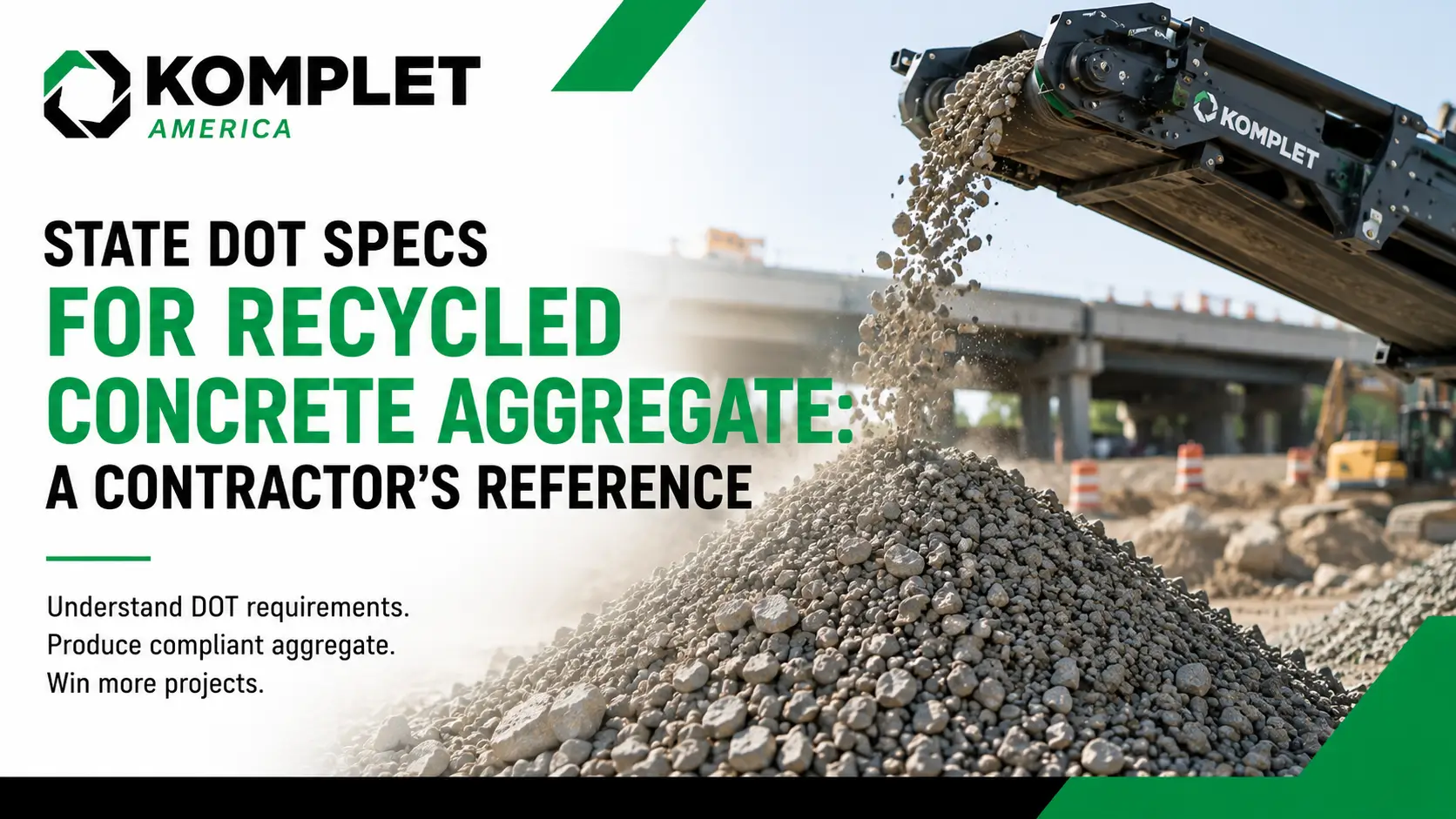

Recycled concrete aggregate is the largest construction-and-demolition recycling success story in North America. The U.S. Environmental Protection Agency reports that concrete and other C&D materials are recovered at high rates — much of that volume processed back into base course, subbase, and structural fill on the same kinds of road, bridge, and infrastructure projects that generated the original material. The economics are compelling, the environmental case is settled, and most state Departments of Transportation now have published specifications that allow RCA in defined applications under defined conditions.
The catch is that the specifications differ. New Jersey, Pennsylvania, New York, Florida, California, and Texas — six of the largest construction markets in the country — each treat RCA somewhat differently. Section numbers differ. Gradation envelopes differ. Source-documentation requirements differ. The list of restricted applications differs. A producer or contractor working in more than one state needs to know what each state requires before stockpiling material for a project, and an unprepared bid that calls out RCA without checking the binding spec is the kind of mistake that gets a load rejected at the gate.
This guide is a contractor-and-producer-focused reference to RCA specifications across the six representative states above, plus a section on the patterns that show up across most state DOT specs and a section on producing on-spec RCA from concrete demolition material with compact crushing and screening equipment. The information here is summarized from publicly available state DOT documents; it is intended as orientation, not as a substitute for the binding specification on any specific project. Always confirm against the current published spec at the state DOT before bidding, supplying, or placing material.
Komplet America has been the U.S. distributor of Komplet S.p.A. compact crushers, screeners, and shredders since 2018, and the Conti family construction legacy behind Komplet America stretches back to 1906. Most of the contractors and recyclers running our equipment are producing material for state DOT, county, municipal, or private projects where some version of these specifications applies. The notes below come from the same conversations we have on the phone and in the yard with customers sizing equipment for their specific RCA production targets.
How State DOT Specs Treat RCA: The General Framework
Before getting into individual state specs, it helps to understand the framework most of them share. State DOT specifications for aggregate are built around a small number of recurring questions: what is the source of the material, what is the gradation, what are the contamination limits, what testing is required, and where in the pavement section is the material allowed. RCA fits inside that framework with extra restrictions specific to its origins.
Where RCA Is Generally Allowed
- Base course and subbase under flexible (asphalt) and rigid (concrete) pavement, almost universally, with limits on coarse-fine ratio and contamination.
- Structural fill, embankment, and backfill behind retaining walls, almost universally.
- Pipe bedding, drainage layers, and porous granular fill, with state-specific gradation and washing requirements.
- Shoulder and shoulder backing material, generally allowed.
- Riprap-class erosion control, where source rock and gradation requirements are met.
Where RCA Is Generally Restricted or Not Allowed
- New structural Portland cement concrete (PCC) on highway and bridge work — most state DOTs do not allow RCA in new structural concrete, or allow it only under tightly controlled mix designs and engineering review. The reasons are durability-related: RCA carries higher absorption, lower density, and the residual mortar from the original concrete affects long-term concrete performance in ways that virgin aggregate does not.
- Asphalt mix design — RCA in hot mix asphalt is generally limited or not allowed, with reclaimed asphalt pavement (RAP) the preferred recycled component for new asphalt. RCA and RAP are different materials with different applications, and most state specs treat them in separate sections.
- Pipe bedding for sensitive utility runs (telecommunications, fiber, water main in some jurisdictions) where the source-control documentation requirements for RCA make it harder to qualify than virgin aggregate.
- Permeable pavement subbase storage layers in some states, where the cementitious fines in RCA can leach lime over time and clog adjacent geotextile or affect surrounding soil chemistry.
What State DOTs Almost Always Require
- Source documentation — where did the original concrete come from, who processed it, and is the producer registered with the state environmental agency.
- Contamination limits — bounds on asphalt content, deleterious materials, organic matter, glassy particles, asbestos (zero tolerance), and other foreign matter.
- Gradation testing — typically AASHTO or ASTM gradation envelope, with sampling frequency tied to volume placed.
- Strength and durability testing — varies by state, may include CBR (California Bearing Ratio), LBR (Limerock Bearing Ratio), R-Value, Sand Equivalent, soundness, and abrasion testing.
- Stockpile approval and quality control plans — most state DOTs require an approved producer and an approved stockpile before material can be delivered to a state project.
How to Read Your State’s RCA Spec — The Universal Logic
Every state DOT spec, regardless of section numbering, answers the same five questions in roughly the same order. Reading any state’s spec for the first time becomes much easier when you know what you are looking for.
- Where in the pavement section is RCA allowed? Look for sections titled “Subbase Course,” “Base Course,” “Aggregate Base,” “Granular Material,” or “Embankment.” Each of those sections lists allowed material types and allowed substitutions. RCA may be listed by name (“Recycled Portland Cement Concrete Aggregate” or “Recycled Concrete Aggregate”) or as a defined type (e.g., TxDOT Type D, NYSDOT Type 4 Subbase).
- What is the gradation? Each material type carries a gradation table: percentages passing each named sieve size. RCA gradation envelopes generally mirror the virgin aggregate envelope for the same application, with state-specific tolerances.
- What is the contamination limit? The spec will list maximum allowable percentages of asphalt, brick, deleterious material, organic matter, glassy particles, and other foreign matter. Asbestos is zero. Reinforcing steel must be removed.
- What testing is required and how often? Standard sieve analysis, plasticity index, sometimes wet ball mill or LA Abrasion, sometimes CBR or LBR. Sampling frequency may be per stockpile, per ton placed, or per project lot.
- What documentation is required for the source? Most state DOTs require RCA to come from a producer registered with the state environmental agency, with stockpile approval before delivery and per-load delivery tickets identifying source, stockpile, and contract number.
With those five questions answered for any specific state, the spec becomes a checklist a producer or contractor can run material against.
State-by-State Reference
New Jersey Department of Transportation (NJDOT)
Spec framework: NJDOT Standard Specifications for Road and Bridge Construction.
Key terms:
- DGABC — Dense Graded Aggregate Base Course, formerly known as “Q.P.” (Quarry Process) stone. The standard NJDOT base course product.
- RCA / RPCC — Recycled Concrete Aggregate / Recycled Portland Cement Concrete.
RCA acceptance:
- NJDOT accepts RCA as a substitute for, or blended with, virgin DGA in dense graded aggregate base course applications. NJDOT specifications historically have allowed up to a 50:50 RCA:virgin DGA blend for base course use, with research conducted by Rutgers University’s Center for Advanced Infrastructure and Transportation supporting the current allowances.
- NJDOT specifies a top size of 1.5 inches for RCA in DGA applications. Research conducted on increasing the top size to 2 inches showed improved permeability while maintaining bearing strength, but NJDOT has historically maintained the 1.5-inch top size.
- RCA must meet NJDOT contamination limits, summarized in the NJDOT specification for allowable contaminants in DGA. The specification covers maximum percentages for materials such as brick, asphalt, glass, and organic matter.
Restrictions:
- RCA is generally not allowed in new structural Portland cement concrete on NJDOT projects. Research published in FHWA-NJ-2008-002 evaluated this restriction and recommended allowing RCA in non-structural roadway applications, but the structural concrete restriction remains.
- Permeability is the principal performance concern for RCA in NJDOT base course applications — RCA exhibits lower permeability than virgin DGA, which is why the specification has evolved around blending with virgin DGA or with poorly graded sand to improve drainage.
Documentation:
- RCA producers supplying NJDOT projects must comply with state environmental and solid-waste handling regulations administered through NJDEP. Source documentation and stockpile approval are required. The producer must be registered with NJDEP for C&D processing.
Pennsylvania Department of Transportation (PennDOT)
Spec framework: PennDOT Publication 408, Specifications, Section 703 (Aggregate). PennDOT Bulletin 14 lists approved aggregate sources and producer-specific information.
Key terms:
- RPCC — Recycled Portland Cement Concrete (PennDOT’s term for RCA).
- 2A — A standard PennDOT base course aggregate. Top size 2 inches, 0–10 percent fines. Used as base under asphalt and concrete pavement, pipe bedding, and road fill.
- 2RC — A widely-graded base/fill product. Top size 2 inches, fewer restrictions than 2A. Often contains recycled materials. Lower-cost product used for pipe bedding and road fill. May contain recycled concrete, brick, or asphalt.
- DSA — Dense Surface Aggregate. Similar to 2A but with higher fine content (10–17 percent) and additional specifications for resistance to road-surface degradation.
- OGS — Open Graded Subbase. PennDOT subbase product with at least 75 percent crushed particles, three or more fractured faces. Used for sub-pavement drainage layers and underdrain applications.
RCA acceptance:
- PennDOT allows RCA (RPCC) as a substitute for virgin coarse aggregate in subbase applications when the original concrete was made using PennDOT-approved materials. The relevant language appears in Section 703 of Publication 408.
- RPCC for use in subbase must conform to PennDOT Tables B and C in Section 703.
- Soundness testing (PTM No. 510 — five-cycle sodium sulfate immersion) requirement is waived for acceptable RCA, on the basis that the cementitious material in the original concrete cannot be evaluated through the standard sulfate soundness test.
Restrictions:
- RCA generally is not allowed in new PCC on state projects without specific PennDOT approval. PennDOT publishes a Recycling Material Brief on RCA that summarizes acceptable applications and the engineering basis for the policy.
- RCA from sources where the original concrete was made using non-approved materials, including department, county, or municipal projects intended for use as 2A, may not be used in subbase under PennDOT specifications.
Documentation:
- Producers supplying PennDOT projects must be listed in Bulletin 14 or have approval from the appropriate Materials Testing Division (MTD) office.
- PennDOT Certified Aggregate Technicians perform required testing during production. Test results must be documented and made available to PennDOT upon request.
New York State Department of Transportation (NYSDOT)
Spec framework: NYSDOT Standard Specifications, Section 304 (Subbase Course) and Section 733 (Recycled Materials), with reference to Section 203 (Earthwork).
Key terms:
- RCA / RPCCA — Recycled Concrete Aggregate / Recycled Portland Cement Concrete Aggregate (used interchangeably in NYSDOT documents).
- Section 733-07 — The NYSDOT specification governing RCA as recycled material for earthwork and subbase.
- Type 1, Type 2, Type 3, Type 4 Subbase Course — NYSDOT’s four standard subbase types, defined in Section 304. Type 2 is commonly known to contractors as “Item 4” and is the most-used base product.
- Item 304.11, Item 304.12, Item 304.15 — Specific NYSDOT pay items for subbase course material.
RCA acceptance:
- NYSDOT Section 733-07 specifies that RCA used in subbase or earthwork must be at least 95 percent by weight Recycled Portland Cement Concrete Aggregate, free from organic and other deleterious material, with up to 5 percent by weight of other materials allowed.
- RCA can be substituted for or blended with virgin Type 2 (Item 4) subbase material, subject to the gradation, contamination, and source documentation requirements of Section 733-07 and the relevant Section 304 type.
- NYSDOT Stockpile approval is governed by Geotechnical Control Procedure GCP-17, “Procedure for the Control and Quality Assurance of Granular Materials.”
Restrictions:
- RCA is generally not allowed in new structural concrete on NYSDOT projects.
- If RCA is used and it comes from other than a NYSDOT project, the contractor must provide documentation showing the material was obtained from a NYSDEC-registered or -permitted construction and demolition (C&D) debris processing facility, as specified in 6 NYCRR Part 360 (NYSDEC’s solid waste regulations).
- RCA from a NYSDOT project source must include identifiers such as State Highway, Construction Contract, or Departmental Project Identification Number (PIN) on documentation.
Documentation:
- RCA from approved off-site stockpiles is accepted on the contract site by delivery ticket. Each ticket must identify the supplier name, supplier granular source number (GSN), date, NYSDOT contract number, stockpile number, and item number.
Florida Department of Transportation (FDOT)
Spec framework: FDOT Standard Specifications for Road and Bridge Construction. Section 901 covers aggregate materials. Section 911 covers aggregate base.
Key terms:
- RCA — Recycled Concrete Aggregate.
- Section 911-2.7 — The FDOT specification governing RCA composition for base material.
- LBR — Limerock Bearing Ratio. Florida’s primary strength test for base course materials. RCA used as FDOT-approved road base typically reports LBR values well above 200.
- Section 204 — Graded Aggregate Base specification.
RCA acceptance:
- FDOT allows RCA as base and subbase material under Section 911-2.7, subject to gradation, LBR, and contamination requirements. Top size is typically 1.5 inches.
- FDOT-approved RCA must consist of crushed concrete material derived from the crushing of hard Portland cement concrete.
- The 2026 FDOT specification revisions place increased emphasis on Limerock Bearing Ratio testing for high-traffic corridors and on flat-and-elongated particle counts for compaction performance.
Restrictions:
- RCA must be asbestos free.
- RCA generally is not allowed in new structural concrete on FDOT projects.
- Section 204 contains contamination limits on deleterious materials such as wood, metal, and other foreign matter.
Documentation:
- RCA suppliers must hold a Florida Department of Environmental Protection (DEP) permit under FAC 62-701.730, or qualify as a clean debris source under DEP rules.
- FDOT-approved producers participate in the Construction Training Qualification Program (CTQP) for Aggregates, which certifies the personnel performing required quality control testing on RCA.
- Source approval is not permanent. Sources can be suspended due to failed Independent Assurance (IA) tests. Verify source status at the start of each project phase.
California Department of Transportation (Caltrans)
Spec framework: Caltrans Standard Specifications, Section 26 (Aggregate Bases) and Section 25 (Aggregate Subbases).
Key terms:
- Class 2 Aggregate Base — Caltrans’s primary aggregate base material. Specified at either ¾-inch or 1½-inch maximum gradation.
- Class 3 Aggregate Base — Caltrans’s secondary base material, with looser gradation tolerances than Class 2.
- Class 1 through Class 5 Subbase — Caltrans’s five subbase types, with quality requirements (gradation, R-value, sand equivalent, durability index) varying by class.
- CMB — Crushed Miscellaneous Base. Term used in the Greenbook (Standard Specifications for Public Works Construction) common in Southern California.
- R-Value — Resistance Value, Caltrans’s primary stability/strength test for base materials. Class 2 base requires R-value of 78 minimum.
RCA acceptance:
- Caltrans Section 26 allows aggregate from untreated reclaimed processed AC (asphalt concrete), PCC (Portland cement concrete), LCB (lean concrete base), and CTB (cement treated base) to be used in Class 2 and Class 3 aggregate base, subject to the gradation, R-value, sand equivalent, and durability index requirements for the class.
- Recycled-content Class 2 base materials produced in California commonly contain 50 to 70 percent recycled content (a blend of crushed concrete, asphalt, sand, and gravel processed to meet the Caltrans Class 2 specification).
- In airport-relevant applications under FAA P-209 review, Caltrans Class 2 ¾-inch and 1½-inch maximum aggregate is recognized as suitable replacement for the FAA Item P-208 subbase course material.
Restrictions:
- RCA generally is not allowed in new structural Portland cement concrete on Caltrans projects without specific approval. California is one of a small number of states that has adopted limited specifications for RCA in PCC, but the general project case still uses virgin aggregate.
- Class 2 base must demonstrate consistent particle-size distribution and resistance to swelling, shrinking, and loss of resilient modulus when exposed to water — fines content must not be susceptible to these failures.
- Class 2 base materials must be free of trash, brick, porcelain, or other brittle debris that disintegrates under crushing.
Documentation:
- Producers supplying Caltrans projects must maintain a Quality Control plan and submit production materials testing per Caltrans Standard Specifications Section 6.
- Caltrans dual-certification with AASHTO Crushed Miscellaneous Base (CMB) standards is common for recycled Class 2 base producers in southern California.
Texas Department of Transportation (TxDOT)
Spec framework: TxDOT Standard Specifications, Item 247 (Flexible Base).
Key terms:
- Flexible Base — TxDOT’s standard term for granular, unbound aggregate base course.
- Type A — Crushed stone from a single naturally occurring source.
- Type B — Crushed or uncrushed gravel; multiple sources allowed.
- Type C — Crushed gravel with at least 60 percent of particles retained on a No. 4 sieve having two or more crushed faces.
- Type D — Type A material or crushed concrete. The TxDOT category that includes RCA. Crushed concrete containing gravel is also classified as Type D.
- Type E — As shown on the plans, including caliche or iron ore.
- Grades 1–2, 3, 4, and 5 — TxDOT flexible base grades defined by physical material requirements (gradation, plasticity, wet ball mill, compressive strength).
RCA acceptance:
- TxDOT Item 247 explicitly allows crushed concrete as a flexible base material under the Type D classification. Crushed concrete must meet the requirements of Section 247.2.1.3 (“Recycled Material”) and be managed in a way that provides for uniform quality.
- TxDOT may require separate dedicated stockpiles for recycled material to verify compliance.
- For recycled materials including crushed concrete, the liquid limit, plasticity index, wet ball mill, and compressive strength requirements are waived. The final blended product is subject to the gradation requirements of Table 1 for the grade specified.
Restrictions:
- Recycled materials must have a maximum sulfate content of 3,000 ppm when tested per Tex-145-E.
- Recycled materials must be free of reinforcing steel and other objectionable material, with no more than 1.5 percent deleterious material when tested per Tex-413-A.
- Contractor-furnished recycled materials must certify compliance with DMS-11000, “Evaluating and Using Nonhazardous Recyclable Materials Guidelines.”
- Type D crushed concrete is generally restricted from use in some asphalt and concrete pavement applications where Type A is specifically called out.
Documentation:
- Stockpile approval requires the engineer’s testing results to meet the material requirements shown in Table 1. Sampling is performed in accordance with Tex-100-A by personnel certified through the TxDOT-approved soils and base certification program.
- Contractor-owned recycled materials cannot be intermingled with Department-owned recycled material unless approved by the engineer.
Other States: A Brief Note
The six states profiled above represent a diverse cross-section of state DOT approaches to RCA, but every U.S. state has its own framework. Most state DOTs accept RCA in some form for base course, subbase, and structural fill applications, with the specific specifications and contamination limits varying by state.
The Federal Highway Administration’s Recycled Concrete Material User Guideline summarizes the broader U.S. context: properly processed RCA performs comparably to virgin crushed stone in granular base applications and is widely used across U.S. DOT projects. Massachusetts, Oklahoma, and California are noted in FHWA literature as among the small number of states with adopted specifications for RCA in new Portland cement concrete; most other states limit RCA to non-PCC applications. State-by-state acceptance patterns continue to evolve as more research data accumulates and as the cost of virgin aggregate continues to rise.
For any state not profiled here, the same five-question framework applies. Find the relevant section in the state DOT’s Standard Specifications, identify the gradation envelope, the contamination limits, the testing requirements, and the source documentation requirements. The binding spec lives at the state DOT website, not in summary articles like this one. Confirm against the current published version before bidding, supplying, or placing material.
Common Testing Requirements Across State Specs
Most state DOT RCA specifications converge on a similar list of required tests, with the specific test methods and acceptance thresholds varying by state. The summary below covers the tests a contractor or producer is most likely to encounter.
Gradation (Sieve Analysis)
AASHTO T 27 / ASTM C136 sieve analysis is the universal first test. Required for every grade and every type, sampled at frequencies that vary by volume placed and by state. The gradation envelope for RCA in base course applications generally mirrors the envelope for virgin aggregate in the same application, with state-specific tolerances. For the full breakdown of crushed stone grades and how they are defined under AASHTO and ASTM standards, see our companion article, Crushed Stone Grades: A Komplet Basic Guide to Aggregate Size and Use Cases.
Contamination and Deleterious Material Content
State-specific tests determine the percentage of deleterious material — wood, plastic, asphalt, glass, organic matter, brick, soft particles. TxDOT uses Tex-413-A with a 1.5 percent maximum deleterious limit. PennDOT has separate tests for friable particles (PTM No. 620), coal or coke (visual identification), and glassy particles. NJDOT specifies allowable contaminant percentages in DGA. Asbestos is a zero-tolerance contaminant in every state spec we are aware of.
Strength and Bearing Capacity
State approaches differ. NJDOT uses California Bearing Ratio (CBR), with research showing RCA typically reporting CBR values around 200, declining as RAP percentages are blended in. Florida uses Limerock Bearing Ratio (LBR), with FDOT-approved RCA road base typically reporting LBR over 200. Caltrans uses R-Value, with Class 2 base requiring R-value of 78 minimum. PennDOT Class 1 (Type A) and Class 2 (Type B) coarse aggregate use percent-absorption thresholds with AASHTO T 85. Texas waives compressive strength for recycled materials but applies it to non-recycled flexible base.
Soundness and Abrasion
Sodium sulfate or magnesium sulfate soundness testing (typically AASHTO T 104) is a common requirement for virgin aggregate. PennDOT explicitly waives soundness testing for acceptable RCA, noting that the cementitious material in the original concrete cannot be meaningfully evaluated by the standard sulfate soundness test. Most other state specs maintain soundness or abrasion (LA Abrasion, AASHTO T 96 / ASTM C131) requirements for the parent aggregate or for the final blended product.
Sand Equivalent and Plasticity
Sand Equivalent (AASHTO T 176 / ASTM D2419) measures the relative proportion of fine dust to clay-like fines and is used in California and several other states as a key acceptance test for base course. Plasticity Index (AASHTO T 90) measures the cohesive behavior of the fine fraction. TxDOT waives plasticity index for recycled flexible base materials but applies it to non-recycled materials. Other state specs vary.
Sulfate Content and Chemical Testing
TxDOT requires recycled materials to have a maximum sulfate content of 3,000 ppm (Tex-145-E). FDOT requires asbestos-free RCA. Other state-specific chemical testing requirements may apply for specific applications, particularly where adjacent groundwater protection or sensitive land use is a project consideration.
Producing On-Spec RCA with Komplet Equipment
The state DOT specifications above are the demand side of the equation. The supply side is the production process: how a contractor or recycler turns concrete demolition rubble into a clean, sized, on-spec product that survives state DOT testing and stockpile approval. Compact mobile crushing and screening equipment — sized for the typical recycler, demolition contractor, or aggregate producer — handles the production process at jobsite, in-yard, and small-quarry scales.
The Production Workflow
- Source control. The first step is supply-side: where does the concrete come from. State DOT specs require source documentation, and producers selling on-spec RCA need to maintain clean, traceable feed streams. Concrete from highway demolition is generally lower-contamination than mixed-source C&D feed, and the demolition contractor controls what arrives in the stockpile.
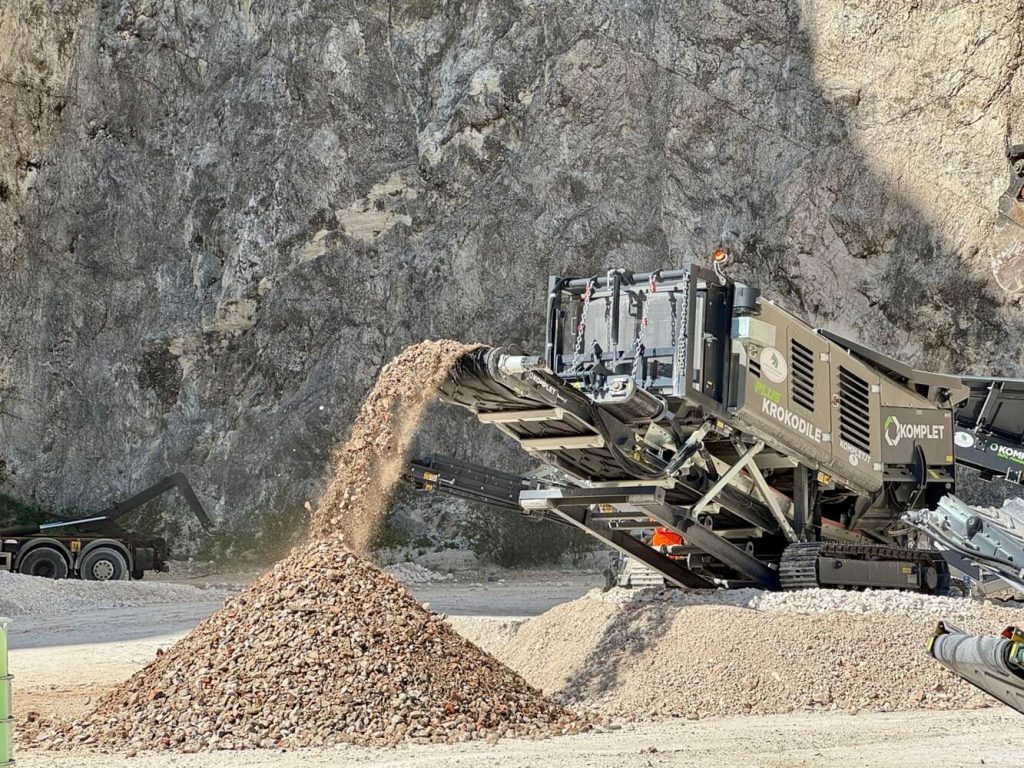
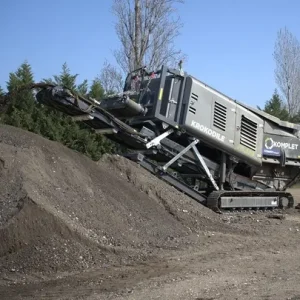
- Pre-reduction. Oversized rubble — slabs, footers, large structural sections — needs to come down to the feed size of the primary crusher. An excavator-mounted hydraulic breaker is the standard tool. For mixed C&D feed and large rubble streams, the Krokodile PLUS slow-speed shredder pre-reduces concrete, asphalt, brick, block, and rubble to a manageable feed size before the primary crusher.
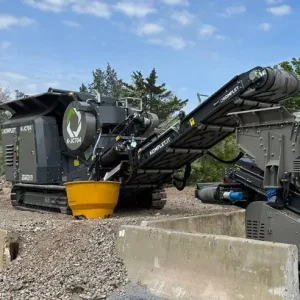
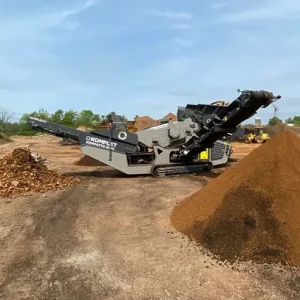
- Primary crushing. The K-JC 503, K-JC 604, K-JC 704 PLUS, and K-JC 805 cover compact jaw crushing from yard scale to small-quarry scale. The K-JC 704 PLUS is Komplet America’s best-selling jaw crusher and the workhorse for most RCA production operations. The K-JC 604, K-JC 704 PLUS, and K-JC 805 include integrated hydraulic magnetic belts that lift rebar off the discharge conveyor into a separate clean pile during crushing — eliminating the manual rebar removal that used to make RCA production so labor-intensive.
- Cubical aggregate, where required. State DOT specs that emphasize fractured-face count or particle shape (PennDOT 75 percent crushed particle minimum for OGS, FDOT flat-and-elongated particle restrictions) often benefit from a secondary impact crusher pass. The K-IC 70 compact impact crusher produces cubical aggregate suited to spec applications where particle shape is a binding requirement.
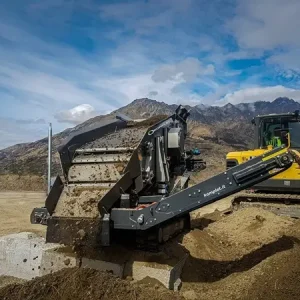
- Screening to spec gradation. State DOT gradation envelopes require the producer to deliver material within tightly defined size envelopes. The Kompatto 5030 — Komplet’s best-selling vibrating screener — pairs naturally with the K-JC 704 PLUS and K-JC 805 to produce three sized products simultaneously, with screen mesh openings adjustable to hit specific state gradation envelopes. The Kompatto 124 handles the highest-throughput operations.
- Stockpile management and source documentation. Once material is produced, separated, and stockpile-approved by the state DOT, delivery to project sites runs on per-load tickets that identify source, stockpile, and contract number. The K-TC 460 tracked mobile conveyor extends stockpile reach and reduces cross-contamination between approved stockpiles in tight yards.
Sizing the Operation to the State
Different state specs implicitly drive different equipment configurations:
- New Jersey, New York, Pennsylvania (Northeast corridor) — High C&D volume, dense urban demolition, blended RCA acceptance. K-JC 604 or K-JC 704 PLUS plus Kompatto 5030 is the most common setup for medium-volume recyclers. Stockpile separation is the operational constraint — the K-TC 460 conveyor pays for itself in tight Northeast yards.
- Florida — High infrastructure activity, hot-weather operations, LBR-driven specs. K-JC 704 PLUS with K-IC 70 secondary or Kompatto 5030 screener for mid-volume production. FDOT documentation discipline is the gating factor — DEP permitting and CTQP-certified personnel are non-negotiable.
- California — Large-volume Class 2 base demand in both NorCal and SoCal markets, high recycled-content acceptance. K-JC 805 plus K-IC 70 plus Kompatto 5030 or Kompatto 124 for high-volume Class 2 base producers. R-value and Sand Equivalent testing are the binding QC constraints.
- Texas — Item 247 Type D acceptance, lower regulatory hurdle than several other states. K-JC 704 PLUS plus Kompatto 5030 covers most regional flexible base producers. Sulfate content testing (Tex-145-E) is the chemistry-side QC constraint specific to Texas.
Frequently Asked Questions
Do all state DOTs accept RCA in base course?
Most state DOTs accept RCA in some form for base course, subbase, and structural fill applications, with specifications and contamination limits that vary by state. The six states profiled in this article (NJ, PA, NY, FL, CA, TX) all accept RCA in base course under defined conditions. For any state not profiled here, consult the current state DOT Standard Specifications for the binding requirements.
Can RCA be used in new structural concrete on state DOT projects?
Generally not. Most state DOTs do not allow RCA in new structural Portland cement concrete on highway and bridge work, or allow it only under tightly controlled mix designs and engineering review. California, Massachusetts, and Oklahoma are noted in FHWA literature as among the small number of states with adopted specifications for RCA in PCC. The reasons for the general restriction are durability-related: RCA carries higher absorption, lower density, and the residual mortar from the original concrete affects long-term concrete performance differently than virgin aggregate does.
What is the maximum top size for RCA in DOT base course applications?
Varies by state and by application. NJDOT historically specifies 1.5-inch top size for RCA in DGA applications. Caltrans Class 2 base is specified at either ¾-inch or 1½-inch maximum. FDOT typically uses 1.5-inch top size. PennDOT 2A has a 2-inch top size. Always confirm the binding spec for the specific application.
Does my RCA producer need a permit to supply state DOT projects?
Generally yes. Most state DOTs require RCA producers to be registered with the state environmental agency for C&D processing, in addition to meeting state DOT-specific stockpile approval and quality control requirements. NYSDOT requires NYSDEC C&D processing facility registration under 6 NYCRR Part 360. FDOT requires DEP permits under FAC 62-701.730 or qualification as a clean debris source. NJDOT requires NJDEP registration. PennDOT requires Bulletin 14 listing or MTD approval. Permits are not optional for commercial RCA supply.
What contamination is universally banned in DOT-spec RCA?
Asbestos is a zero-tolerance contaminant in every state DOT spec we are aware of. Reinforcing steel must be removed (not just specified, but physically separated). Most state specs also impose maximum percentages on wood, plastic, organic matter, glass, brick, and other foreign materials, with state-specific test methods and acceptance thresholds.
Can I use RCA from one state on a project in another state?
Sometimes, with documentation. The producer must meet the receiving state’s source documentation, gradation, contamination, and testing requirements regardless of where the original concrete came from. Cross-border supply is more common between adjacent states with similar specs (e.g., NJ to NY) than across the country. Always confirm with the receiving state DOT and with the relevant project engineer of record.
What’s the cheapest way to start producing on-spec RCA?
For most contractors, a pre-owned compact jaw crusher (typically a K-JC 503 or K-JC 604) plus a vibrating screener (Kompatto 221) is the lowest-capital path into RCA production. Pre-owned Komplet equipment typically saves 40 to 70 percent versus new, with the same factory service network behind every machine. The first six to twelve months of operation are typically focused on building a clean stockpile, getting state DOT stockpile approval, and developing the QC discipline that turns crushed concrete into a sellable product.
How often does the state DOT spec change?
Most state DOTs publish updated Standard Specifications every few years, with technical advisories and special provisions issued more frequently. FDOT issued substantial 2026 revisions emphasizing LBR testing and flat-and-elongated particle restrictions. PennDOT updates Publication 408 periodically. Always check the version-of-record at the state DOT website before bidding.
Final Thoughts
Recycled concrete aggregate has moved from “alternative material” to mainstream component of state DOT base course and structural fill applications across the United States. The economic case is well-documented, the engineering performance has been studied for decades, and the regulatory framework is in place in every state we work in. The producer or contractor who treats RCA as a serious supply-chain commitment — with state DOT registration, stockpile approval, QC-certified personnel, and clean source documentation — is positioned to compete for the steady stream of state, county, and municipal work that calls for on-spec recycled aggregate.
The producer or contractor who treats RCA as an afterthought — running rubble through a crusher and stockpiling the output without traceable sources, gradation testing, or stockpile approval — is competing in the very different market for unpermitted fill, where margins are thin and customer pickiness is high. The equipment is the same. The difference is the discipline.
Komplet America’s compact crusher, screener, and shredder lineup is built for both kinds of operations, from the smallest pre-owned K-JC 503 in a contractor’s yard to a K-JC 805 plus Kompatto 124 plus K-IC 70 plus K-TC 460 production train in a mid-volume recycling facility. The right configuration depends on the volume, the target product mix, and the state spec the operation is supplying. Our specialists work through that match in detail with every customer.
For the full breakdown of crushed stone grades and gradations referenced in state DOT specifications across this article, see Crushed Stone Grades: A Komplet Basic Guide to Aggregate Size and Use Cases. For the contractor-side view of producing crushed stone for paver base, drainage stone, and bedding aggregate on-site, see The Hardscape Contractor’s Guide to On-Site Stone Production.
Ready to Start Producing DOT-Spec RCA?
- Talk to a Komplet specialist about pairing the right crusher and screener to your state’s RCA spec and your target volume. Call 908-369-3340 or visit com/contact-us.
- Browse the full Komplet equipment lineup — crushers, impact crushers, screeners, conveyors, and shredders sized for compact, on-site, and in-yard RCA production.
- Explore equipment financing through Komplet Capital — 24-hour approvals, terms from 36 to 72 months, 100% financing available.
- Consider a pre-owned Komplet machine — typical capital savings of 40 to 70 percent versus new, factory-supported by the same Komplet America service network.
Never enough.
Disclaimer: All state DOT specification summaries in this article are drawn from publicly available state DOT documents and research literature current as of late 2025 and early 2026. Specifications change over time, and the binding spec for any project is the version current on the date of advertisement for bids, as published by the state DOT. Always confirm against the current published Standard Specifications, special provisions, and project-specific requirements before bidding, supplying, or placing material. Komplet America is not a state DOT and does not issue specifications. The information here is intended as orientation, not as a substitute for the binding specification on any specific project. Operating, maintenance, and service guidance is general in nature. Always refer to the official Komplet operator’s manual for the specific machine model and serial number, and follow OEM intervals and procedures. For warranty-protected work, contact Komplet America at 908-369-3340 or your authorized Komplet dealer. Improper service or non-OEM parts may void warranty coverage and create safety hazards.