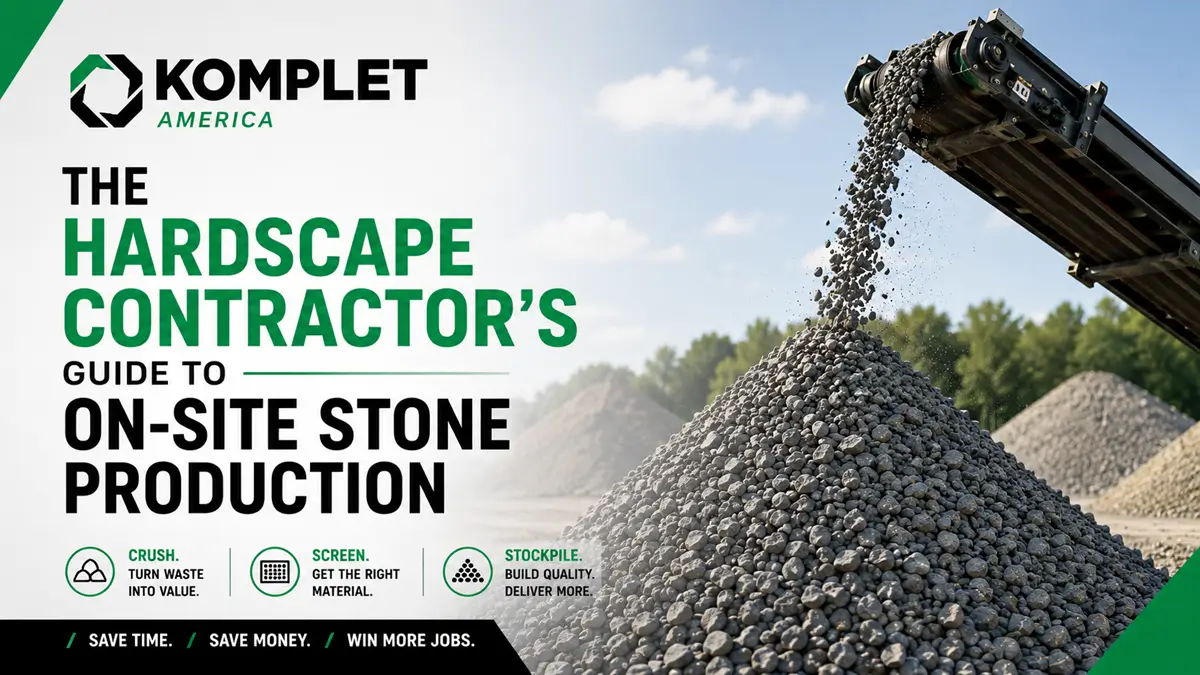

If you run a hardscape, paver, pool, or landscape contracting business, you live downstream of two costs that have been moving against you for the past several years: the price of bulk aggregate delivered to the jobsite, and the tipping fee to dump concrete demolition material at the local landfill or recycling facility. Both are paid in cash. Both come straight off the margin of every project. And both are now large enough that more contractors are doing the math on a different question — what if you produced your own paver base, your own drainage stone, and your own bedding aggregate, on-site, from the demolition rubble you used to pay to throw away?
Komplet America has been the U.S. distributor of Komplet S.p.A. compact crushers, screeners, and shredders since 2018, and the Conti family construction legacy behind Komplet America stretches back to 1906. The contractors who have been moving fastest into on-site stone production over the past few seasons are not the big highway and bridge firms — those operations have run their own crushers for decades. The shift is happening among hardscape contractors, paver installers, pool builders, and landscape contractors doing residential and light commercial work, where the per-project tonnage is small enough that buying-and-dumping looked like the only sensible option until compact tracked equipment changed the economics.
This guide is written for that contractor. It walks through the specific crushed stone products a hardscape contractor uses on every job, the math behind producing them on-site versus buying them in, the demolition-side revenue that doubles the case for owning the equipment, and the Komplet machines sized for the kind of work hardscape and landscape operations actually do. It is a B2B reference, not a homeowner DIY piece. If you are weighing your first compact crusher, this is the article we wish more of our customers had read before they spent their first dollar on a quarry delivery.
Why the Math Works for Hardscape Contractors Right Now
The case for on-site stone production is built on two cost lines. Both are real, both are well-documented, and both have moved sharply in the same direction over the past five years.
Cost Line One: Aggregate Prices
The U.S. Geological Survey tracks construction aggregate prices and reports steady year-over-year increases in the average value per ton of crushed stone. The increases compound. In most metro markets, a hardscape contractor today is paying meaningfully more per ton for paver base, #57 stone, and bedding aggregate than the same contractor paid five years ago, before adjusting for delivery surcharges, fuel charges, or the loss of productive crew time spent waiting on aggregate trucks. Quarry permits are harder to get, existing reserves are depleting in many metros, and trucking economics have not gotten easier. None of these trends is going to reverse in the next five years.
On a typical residential paver patio project, the aggregate cost — base, bedding, joint material — is one of the largest single line items on the bid sheet, often second only to the pavers themselves. On a commercial paver job or a large pool surround, the aggregate cost can rival the equipment-and-labor line. Anything that takes a meaningful percentage off that line item flows directly to gross margin.
Cost Line Two: Concrete Demolition Tipping Fees
If your work involves any tear-out — and most hardscape work does, whether it is an old concrete patio, a cracked sidewalk, a buried slab, a pool deck removal, or a driveway replacement — you have a second cost line that quietly eats margin. Tipping fees for clean concrete and C&D rubble vary widely by region, but in most U.S. metros they run from roughly thirty dollars per ton on the low end to well over a hundred dollars per ton in the highest-cost coastal markets, plus the trucking time and fuel to haul the material there.
On a 600 to 1,200 square foot residential patio replacement, the demolition rubble alone can run from 10 to 25 tons depending on slab thickness. At regional dump fees, that is a meaningful three- or four-figure cost line on a single job — paid out, gone, no return. On a commercial pool deck removal or a parking-lot resurfacing tear-out, the rubble tonnage scales accordingly, and so does the dump fee.
The Combined Math
On-site stone production hits both cost lines simultaneously. The concrete you would have paid to dump becomes the feedstock for the aggregate you would have paid to bring in. The same machine that eliminates one cost produces the input that eliminates the other. The contractor who installs the crushed product they just produced from the rubble they just generated is, in effect, getting paid twice for the same load of concrete: once because they did not dump it, once because they did not buy aggregate.
Add the third lever — selling excess aggregate production to other contractors in your market — and you have a small material-supply business that runs alongside your installation business and uses the same equipment, the same yard, and the same crew.
The Crushed Stone Products a Hardscape Contractor Actually Uses
Almost every hardscape job uses some combination of the same five aggregate products. Understanding which one goes in which layer — and why — is the foundation for sizing the right equipment to produce them. For the full breakdown of crushed stone grades, gradations, and how they are defined under AASHTO and ASTM standards, see our companion piece, Crushed Stone Grades: A Komplet Basic Guide to Aggregate Size and Use Cases. The summary below covers the products most hardscape operations actually order or produce.
Crusher Run (Dense-Grade Aggregate Base)
Crusher run is the workhorse base material under non-permeable paver patios, walkways, driveways, and small parking pads. Top size of three-quarters of an inch to one and a quarter inches, graded continuously down through stone dust. The fines lock up under compaction, the coarse stone provides structural support, and the surface compacts to a tight, smooth bed that pavers can sit on. Regional names include DGA, ABC, GAB, item 4, 411, 21AA, and 21A — same family of products.
On a typical paver installation, crusher run goes down four to six inches deep over compacted subgrade, compacted in lifts. For a 600 square foot residential patio, that is roughly 12 to 18 cubic yards of base material — somewhere in the range of 18 to 27 tons depending on the density of the source rock. Producing that on-site from concrete demolition rubble eliminates the delivery, eliminates the wait, and gives the contractor full control over the gradation and the moisture content at placement.
#57 Stone (Open-Graded Drainage Aggregate)
Nominal one-inch top size graded down to about three-eighths of an inch with no fines. Open enough to drain aggressively, large enough to bridge soft spots, small enough to walk on without rolling stones underfoot. The default product for French drains around pool surrounds and patios, hydrostatic relief behind segmental retaining walls, drainage layers under permeable hardscape, and as a backfill stone behind any vertical hardscape element where water management is part of the design.
Pool builders and patio contractors use #57 in volumes that surprise people who have not added it up. A single residential pool with a patio surround and proper perimeter drainage routinely takes five to fifteen tons of #57. A commercial pool deck or a multi-zone backyard hardscape can take two to three times that. Producing #57 in-house, sized to spec off a Kompatto vibrating screener, turns one of the most expensive line items on a pool job into a stockpile in the contractor’s yard.
#8 Stone (Permeable Paver Bedding)
Roughly three-eighths of an inch top size, no fines, washed clean. The bedding stone for permeable paver installations and the joint fill for permeable pavers in service. Demand for permeable hardscape has grown steadily as municipal stormwater requirements have tightened, and on commercial projects with stormwater compliance obligations, the permeable paver section is increasingly the only path to approval. The full open-graded section — #2 or #3 in the storage layer, #57 in the choker, #8 in the bedding and joints — drains aggressively and stores stormwater volume by design.
A 1,000 square foot commercial permeable paver installation can use 4 to 8 tons of #8 bedding alone, plus several times that in storage and choker layers. The contractor producing those products on-site from concrete demolition or virgin rock has a meaningful cost advantage on every permeable project.
#9 Stone and Stone Dust (#10) — Non-Permeable Paver Bedding and Joint Fill
The bedding stone and joint sweep for traditional, non-permeable paver installations. #9 (between #8 and stone dust) sets up tight under a vibratory plate and resists migration. Stone dust (#10) handles the joint sweep, locking pavers in place and resisting wash-out under wash-down maintenance. For natural stone flagging — bluestone, fieldstone, irregular flag — stone dust is also the standard setting bed.
Most hardscape contractors order #9 and stone dust together for the same job. Producing both off a single screened crusher output is straightforward — the fines stream off a Kompatto screener captures the stone dust, the next deck up captures #9 or #8, and the contractor stockpiles each cleanly for use across multiple jobs.
Larger Drainage Stone (#3, #5, #2)
Coarser products that show up less often on residential work but routinely on commercial pool surrounds, larger retaining walls, permeable pavement subgrade, and stormwater management features. #2 stone in the storage layer of a permeable pavement section, #3 or #5 as a transitional drainage layer over a soft subgrade, #2 or larger as a riprap-style erosion control on cut slopes adjacent to hardscape. A contractor producing crusher run and #57 on-site can also produce these larger fractions by adjusting the screen deck openings.
The Demolition Side: Turning Concrete Tear-Out Into Revenue
Almost every hardscape job worth bidding involves demolition — the existing patio, walkway, driveway, pool deck, or footer that has to come out before the new work goes in. Most contractors think of that demolition as a cost line: jackhammer or saw-cut the slab, load it into a dump truck, pay the dump fee, move on. With a compact mobile crusher on the jobsite, the same demolition becomes the input to the project’s own aggregate base.
Typical Hardscape Demolition Sources
- Residential concrete patio removal — typically 4 to 6 inches thick, often with light wire mesh or rebar reinforcement, slab edges and joints intact.
- Concrete walkway and sidewalk removal — generally 4 inches thick, sometimes with embedded utilities or expansion joints to manage.
- Pool deck demolition — varies from a thin overlay to a full structural deck, often integrated with surrounding patio work.
- Driveway tear-out (residential and small commercial) — 4 to 6 inches of concrete or asphalt, sometimes with a curb or apron section.
- Foundation, footer, and retaining wall demolition — heavier reinforcement, larger sections, but the rubble crushes the same way once broken to feed size.
- Old segmental retaining walls and stacked stone walls — the salvage candidates for #57 backfill or larger drainage stone after primary crushing.
The Revenue Stack on a Single Job
A residential 1,000 square foot patio replacement project with full demolition typically generates 15 to 25 tons of clean concrete rubble. At regional dump fees, that is a real cost line that appears on the bid as a pass-through expense to the homeowner or commercial client. With on-site crushing, that cost line goes to zero, and the same tonnage becomes 15 to 25 tons of crusher run, #57, or screened stone — enough to base a comparable patio or supply most of the hardscape needs of an adjacent project.
The contractor’s improvement on the bid is not just the dump fee saved, and not just the aggregate cost avoided. It is also the time saved waiting on aggregate deliveries, the truck-and-driver hours redeployed from hauling rubble away from the site, and the optionality of producing material for the next job at the same time as completing this one. None of these line items show up on a quarry invoice, but every one of them shows up on the season-end profit statement.
Reinforced Concrete and Rebar
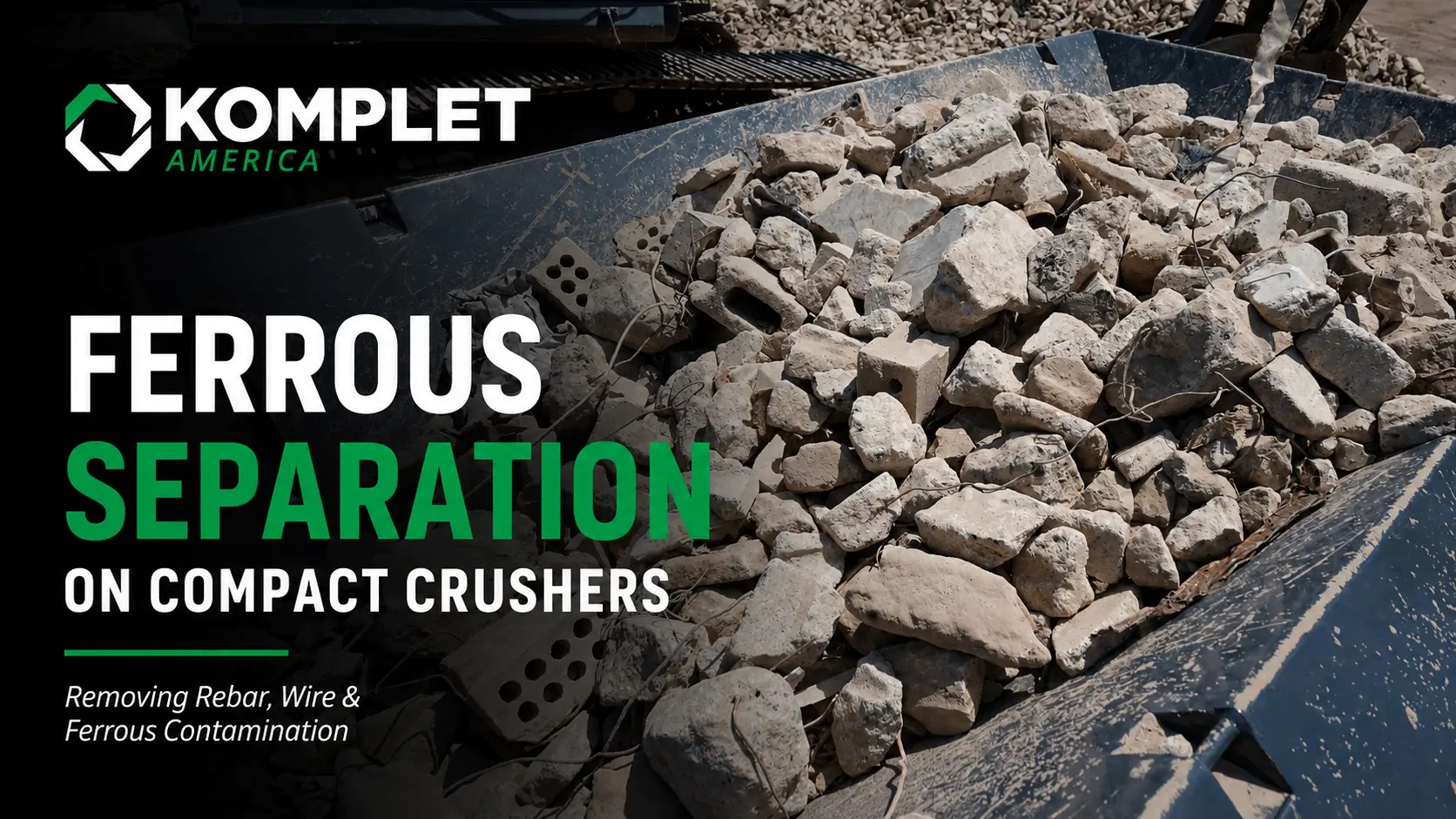
Modern Komplet jaw crushers handle reinforced concrete with embedded rebar as a routine part of the operating spec. The K-JC 604, K-JC 704 PLUS, and K-JC 805 include integrated hydraulic magnetic belts that lift rebar off the discharge conveyor into a separate clean pile during crushing, eliminating the manual rebar removal that used to make concrete demolition recycling so labor-intensive. A reverse jaw function clears any uncrushable material that enters the chamber. The combination handles patio, walkway, driveway, and pool deck rebar without slowing throughput. The recovered rebar is sellable scrap on most days, adding a small additional revenue line to the demolition side.
Equipment Sized for a Hardscape Operation
Komplet’s compact crusher and screener lineup was built for exactly this kind of work — small enough to fit on a residential lot, mobile enough to reposition on a tight commercial site, and productive enough to crush a meaningful patio’s worth of rubble in an afternoon. The right machine for a hardscape contractor depends on annual project volume, the largest-feed-size you need to handle, and whether the operation is producing for in-house use only or also supplying other contractors. The four units below cover most hardscape and landscape operations from the smallest to the largest.
K-JC 503 Mini Mobile Jaw Crusher — The Hardscape Starter
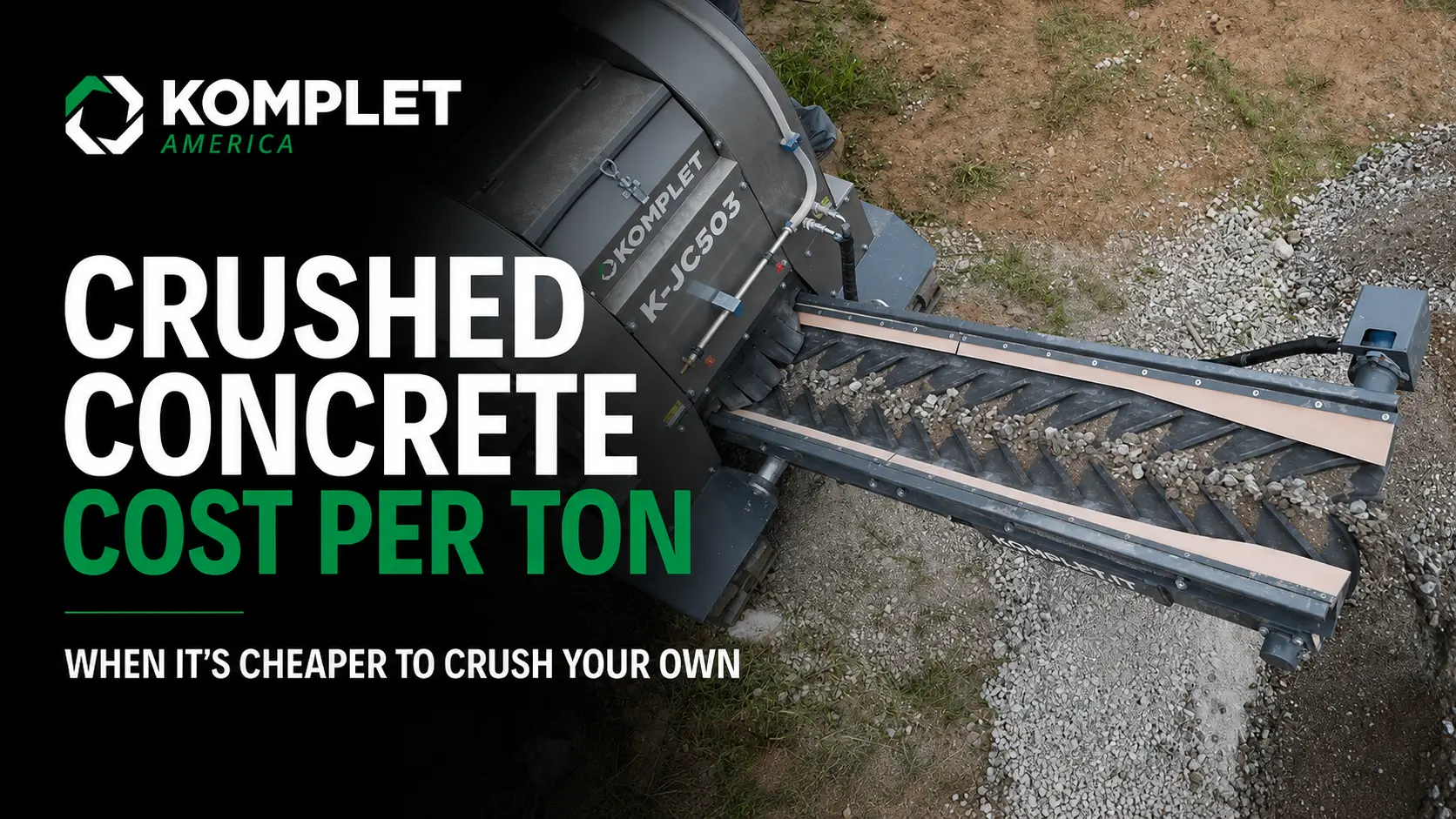
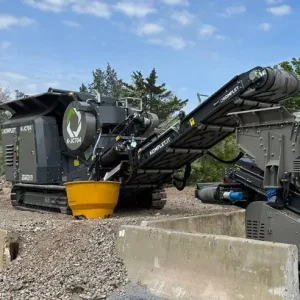
The K-JC 503 is Komplet America’s most compact tracked jaw crusher and the natural starting point for a hardscape, paver, or pool contractor adding on-site crushing for the first time. A 19-inch by 12-inch jaw, output adjustable from three-quarters of an inch to three and a quarter inches, production up to 34 US tons per hour, and a curb weight under 7,500 pounds — towable behind a standard truck. Wireless remote control for operation. Rubber tracks for moving on finished hardscape and lawn without damage.
Where it fits:
- Residential and light commercial paver, patio, walkway, and pool surround projects.
- Small in-yard recycling — handling demolition rubble brought back from job sites.
- Tight-access urban work where larger equipment cannot get to the demolition material.
- First-machine purchase for a contractor producing aggregate for in-house use, with optional sales to a small number of nearby contractors.
For a hardscape operation doing roughly 25 to 75 residential paver and pool projects per year, the K-JC 503 typically pays for itself in dump fees avoided and aggregate costs eliminated within the first 18 to 36 months of operation, depending on regional aggregate and tipping prices and on the contractor’s project mix. The exact payback math will vary — talk to a Komplet specialist for an operation-specific calculation.
K-JC 604 Mobile Jaw Crusher — The Next Step Up
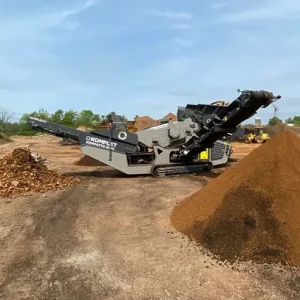
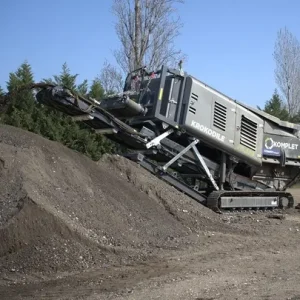
The K-JC 604 steps up to a 23-inch by 16-inch jaw, hydraulically adjustable closed-side setting, integrated vibrating feeder, integrated hydraulic magnetic belt for rebar separation, and production up to roughly 55 US tons per hour. The right machine for hardscape contractors doing higher-volume residential work, larger commercial paver and pool projects, or running an in-yard recycling operation alongside the installation business.
Where it fits:
- Higher-volume hardscape operations — 75 to 200 residential projects per year or a mix of residential and small commercial work.
- Operations that include some demolition contracting — patios, driveways, pool decks, small commercial tear-outs.
- In-yard aggregate production for sale to other hardscape and landscape contractors.
- Reinforced concrete demolition where the larger feed opening and the magnetic belt for rebar separation matter.
Kompatto 221 Vibrating Screener — The Sizing Step
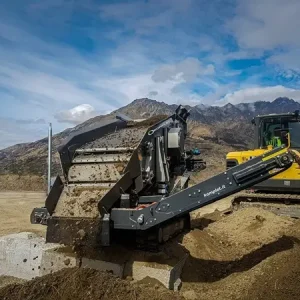
A jaw crusher alone produces an undifferentiated minus output — a single pile of mixed-size crushed material. To sell crusher run, #57, #8, and stone dust as separate products, the operation needs a screening step. The Kompatto 221 is Komplet’s most compact tracked vibrating screener — a 7-foot by 3.5-foot two-deck screen that pairs naturally with the K-JC 503 or K-JC 604 to produce three sized products simultaneously: oversize back to the crusher, mid-size product (typically #57 or #67), and fines (stone dust).
On a hardscape operation that is producing primarily for in-house use, screening matters less — crusher run from a jaw crusher’s direct output goes straight under pavers without further sizing. The screener becomes the productivity multiplier when the operation starts selling sized aggregate, supplying to other contractors, or producing on-spec product for state DOT or municipal jobs. For most hardscape contractors, the screener is a phase-two purchase, added 12 to 24 months after the primary crusher once the operation is running steadily.
K-TC 460 Tracked Mobile Conveyor — Stockpile Management
Once the operation is producing two or more separated products, stockpile management becomes the next bottleneck. Cross-contaminated piles — #57 mixed with stone dust, crusher run mixed with #8 — defeat the purpose of having sized products in the first place. The K-TC 460 is a self-propelled, tracked mobile conveyor that pairs with any Komplet crusher or screener to extend stockpile reach, separate finished products in a tight yard, and reduce loader dependency on the jobsite. At about 7,000 pounds it is towable, and once on site it moves under its own power on rubber tracks. For hardscape operations supplying multiple sized products to other contractors, the K-TC 460 is one of the cheapest yard upgrades available.
Producing On-Spec Paver Base — The Workflow
The day-to-day workflow of producing crushed stone for a hardscape operation is simpler than most first-time buyers expect. Once the crusher is set up and the operator is comfortable with the controls, a typical residential demolition-and-crushing pass takes a half-day to a full day depending on volume, with crushing happening alongside the rest of the project rather than blocking it.
The Sequence
- Pre-break the demolition rubble. For most hardscape demolition — 4- to 6-inch concrete patios, walkways, and decks — an excavator-mounted hydraulic breaker is the standard tool. For very small jobs, a handheld breaker is acceptable but slow. The goal is to get all rubble down to a feed size that fits the jaw opening: roughly 80 percent of the jaw gape is the rule of thumb. For a K-JC 503 with a 19-inch by 12-inch jaw, that means rubble pieces no larger than about 9-1/2 inches in their longest dimension. For a K-JC 604 and K-JC 704 PLUS, about 12-3/4 inches.
- Position the crusher. With rubber tracks on the K-JC 503 and K-JC 604, the machine drives itself onto position from the trailer. For most residential work, the crusher sets up at the edge of the demolition area with the discharge conveyor pointing at the stockpile location. Wireless remote control lets the operator position the machine without leaving the breaker or the loader.
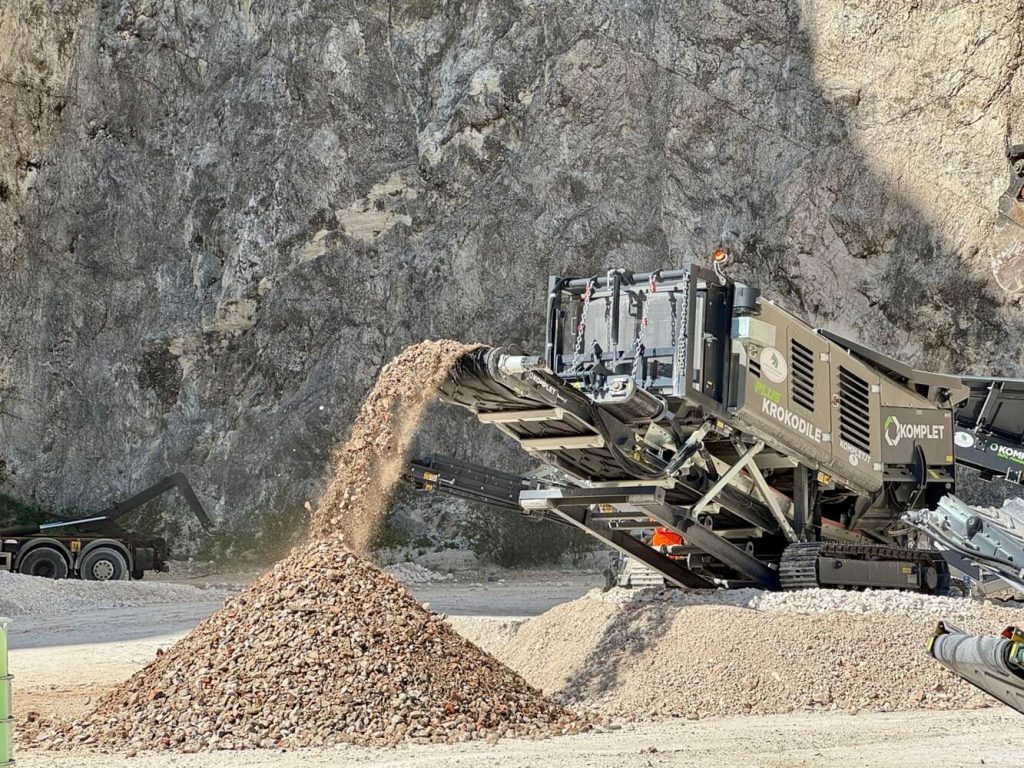
- Run the crusher. Feed the broken rubble into the hopper with an excavator or skid steer. The integrated vibrating feeder controls flow into the jaw. The closed-side setting (CSS) — adjustable hydraulically by remote on the K-JC 503 and K-JC 604 — controls the output size: a tighter CSS produces a finer crusher run, a wider CSS produces a coarser output for downstream screening. For paver base production, a CSS in the three-quarter to one-and-a-quarter inch range produces a serviceable crusher run directly off the jaw.
- Manage the rebar (on the K-JC 604, K-JC 704 PLUS, K-JC 805). The integrated hydraulic magnetic belt lifts ferrous metal off the discharge conveyor into a separate pile during crushing. No manual rebar removal is needed before feeding. The recovered rebar accumulates as a sellable scrap pile alongside the aggregate stockpile.
- Stockpile the output. The discharge conveyor builds the stockpile as the crusher runs. For an operation producing only crusher run, the work is finished here — the pile is ready for use as paver base on the next job. For an operation producing sized products, the crusher output feeds a screener (Kompatto 221 or 5030) for separation into #57, #8, stone dust, and oversize streams.
- Reposition the crusher. Once the rubble pile is processed, the crusher tracks itself out of the way for the rest of the project. For an operation moving between residential job sites, the crusher loads back onto the trailer and travels to the next site.
Throughput Expectations
Real-world throughput on hardscape demolition is generally lower than the rated maximums on the spec sheet, and Komplet rates production conservatively as it is. The published “up to” tons-per-hour figure assumes ideal feed material, optimal closed-side setting, and continuous loading — conditions that hold steady in a high-volume yard but rarely on a residential job site, where the operator is also breaking rubble, moving the loader, and handling other tasks. A K-JC 503 rated up to 34 US tph will typically run at 15 to 25 tph on residential demolition work, depending on operator pace and feed consistency. A K-JC 604 rated up to 55 US tph will typically run in the 25 to 45 tph range on similar work.
The practical implication: a 600 to 1,000 square foot patio demolition (15 to 25 tons of rubble) typically takes a half to a full hour of pure crushing time, plus setup and breakdown. That fits comfortably inside a normal demolition day without slowing the rest of the project.
Becoming a Local Aggregate Supplier — The Cross-Selling Angle
Once the equipment is paid for and the operation is producing reliably, many hardscape contractors discover a second business inside the first one: supplying aggregate to other contractors in the local market. The math here works because the contractor is producing aggregate as a byproduct of work they were already going to do — every ton of aggregate sold to another contractor is incremental revenue against a fixed cost base.
Who Buys
- Other hardscape contractors who do not own crushing equipment.
- Pool builders sourcing #57 for surround drainage and base.
- Mason and stone contractors needing crusher run and bedding stone for retaining wall and patio bases.
- Landscape contractors building dry creek beds, French drains, decorative gravel paths, and erosion control.
- Site contractors working on adjacent residential and small commercial projects.
- Homeowners doing DIY landscape and drainage work — typically through pickup-truck-load sales rather than full deliveries.
How to Price It
Local quarry pricing sets the ceiling. A contractor selling on-site-produced aggregate generally prices a discount below the local quarry’s delivered price for the same product — enough discount to motivate the buyer to come pick it up rather than ordering from the quarry, but not so much that the seller is leaving margin on the table. The economics work because the seller has effectively zero variable cost on the aggregate itself: the production was paid for by the demolition-side savings on the original project.
Most hardscape-contractor-turned-aggregate-supplier operations start with informal sales to known contractors in the network and grow from there. Customer-supply discipline matters: separated piles, consistent gradation, accurate weight, prompt loading. A reputation for sized, clean, on-spec product builds a customer base faster than any marketing effort.
What to Watch
- Most states require some form of recycling facility, solid waste handling, or air-quality permit for commercial concrete recycling operations that accept outside material and sell to third parties. Requirements vary by state and by whether the operation is processing only its own demolition material or accepting outside concrete. Consult the state DEP/DEQ or a local environmental attorney before launching a commercial recycling operation.
- OSHA respirable crystalline silica. Crushing concrete generates respirable silica, which OSHA regulates with a permissible exposure limit of 50 µg/m³ averaged over 8 hours. Komplet jaw crushers include dust suppression as standard equipment to support compliance, and operators should follow the standard hierarchy of controls: engineering (water suppression), administrative (work practices), and PPE (respirators where required).
- Adding aggregate sales to a hardscape operation typically requires updating commercial general liability coverage to include the new line of business. A short conversation with the agent at policy renewal usually handles this.
- Quality control. Customers will return product or refuse to pay for off-spec material. A simple gradation check periodically against AASHTO or ASTM gradation envelopes is the difference between a reliable supplier reputation and a string of disappointed buyers.
Real-World Project Walkthroughs
Two illustrative projects, scaled to common hardscape work. The numbers below are representative ranges drawn from typical project specifications and regional pricing patterns; actual numbers in any specific market and on any specific project will vary based on regional aggregate pricing, dump fees, slab thickness, soil conditions, paver type, and the contractor’s specific project mix.
Project A: 1,000 Square Foot Residential Paver Patio Replacement
Scope: tear out an existing 1,000 sq ft, 4-inch concrete slab patio. Install a new paver patio with proper base and drainage.
Demolition output:
- Concrete rubble: roughly 12 to 16 tons, depending on slab density and any embedded steel.
- Conventional approach: pay regional dump fee on full tonnage, plus trucking time and fuel.
- On-site crushing approach: feed the rubble into a K-JC 503 or K-JC 604 set to a paver-base CSS. Output: roughly 10 to 14 tons of finished crusher run after subtracting the small percentage lost as fines and oversize.
New patio aggregate requirements:
- Crusher run base: 4 to 6 inches deep over compacted subgrade. For 1,000 sq ft, that is roughly 12 to 18 cubic yards, or 18 to 27 tons.
- Bedding layer: 1 inch of #9 stone or coarse bedding sand. For 1,000 sq ft, that is roughly 3 to 4 cubic yards, or 4 to 6 tons.
- Joint sweep: stone dust or polymeric sand, typically less than 1 ton total.
Net result: the demolition rubble produces most of the crusher run base needed for the new patio. The contractor typically supplements with a small additional purchase of crusher run if the existing slab does not produce enough volume, plus the bedding and joint material. Compared to the conventional buy-and-dump approach, the contractor has eliminated the dump fee, eliminated the bulk of the aggregate purchase, and eliminated the wait time on aggregate delivery — three real cost lines on a single residential project.
Project B: 5,000 Square Foot Commercial Permeable Paver Installation
Scope: install a new 5,000 sq ft permeable paver section as a stormwater management feature on a commercial property. No demolition on this project — the section is new construction over prepared subgrade.
Permeable paver section aggregate (engineered for stormwater storage):
- Storage layer: #2 stone, 12 inches deep. For 5,000 sq ft, that is roughly 185 cubic yards, or close to 280 tons.
- Choker layer: #57 stone, 4 inches deep. For 5,000 sq ft, that is roughly 62 cubic yards, or 90 tons.
- Bedding layer: #8 stone, 2 inches deep. For 5,000 sq ft, that is roughly 31 cubic yards, or 45 tons.
- Joint fill: #8 stone in the open joints, typically 5 to 10 percent of the bedding tonnage.
Total aggregate: roughly 415 to 425 tons across three sized products.
This is a large enough job that even with on-site crushing, most contractors will source some product from a quarry or recycler if they don’t have a deep enough in-yard stockpile already built. The project does demonstrate the second use case for the equipment: a contractor running a K-JC 604 and a Kompatto 5030 in the yard for several months before the project starts can build a 400-plus ton stockpile of sized product from in-yard concrete demolition pickups, and supply most or all of the project from in-house production. The aggregate cost on a project of this size is large enough that even partial in-house supply moves the gross margin meaningfully.
On the larger end of the hardscape operation — high volume residential and steady commercial work — this is where the K-JC 604 plus Kompatto 5030 plus K-TC 460 lineup turns the contractor into a small aggregate producer in addition to an installer.
Choosing Your First Komplet Machine
The right first machine for a hardscape contractor depends on three numbers: annual demolition rubble tonnage, annual aggregate tonnage placed, and the largest single piece of feed material the operation routinely encounters. The decision framework below is the same one our specialists walk customers through on a discovery call.
Start with the K-JC 503 If…
- Annual residential project count is in the range of 25 to 75 paver, patio, walkway, or pool projects.
- Demolition rubble feed size is generally 9-1/2 inches and smaller — typical 4- to 6-inch slabs broken to manageable pieces.
- Most projects are in tight residential or limited-access urban settings.
- Initial use case is in-house aggregate production with optional informal sales to nearby contractors.
- Towability behind a standard truck matters for jobsite-to-jobsite transport.
Step Up to the K-JC 604 If…
- Annual residential project count is above 75, or there is a meaningful mix of small commercial work.
- Demolition feed routinely includes pieces in the 10- to 12-3/4-inch range — heavier slabs, structural concrete, or footer demolition.
- Reinforced concrete is a regular part of the feed, and the integrated hydraulic magnetic belt for rebar separation matters.
- The operation includes in-yard recycling — accepting concrete demolition material brought back from job sites for processing.
- Aggregate sales to other local contractors are part of the business plan, and the higher production rate justifies the larger capital outlay.
Add a Screener (Kompatto 221) When…
- The operation needs to produce two or more sized products from a single crusher feed — typically crusher run plus #57, or #57 plus stone dust.
- Aggregate sales to other contractors are happening regularly, and customers are asking for sized product.
- Permeable paver work is a growing line of business, and on-site production of #8 bedding stone is part of the bid strategy.
Add a Conveyor (K-TC 460) When…
- Two or more separated stockpiles are being produced and yard space is starting to constrain operations.
- Loader hours and operator wages are becoming a meaningful operating expense.
- The operation is moving stockpiles into trucks for off-site delivery and a longer reach reduces handling.
Pre-Owned Options
Komplet America maintains a fleet of pre-owned compact crushers and screeners for contractors who want to enter on-site production at a lower capital outlay. Typical capital savings on a pre-owned Komplet machine versus new are 40 to 70 percent, depending on the unit’s age, hours, and condition. All pre-owned units sold through Komplet America are factory-supported by the same Komplet America service network. For first-time buyers running the initial economics, a pre-owned K-JC 503 or K-JC 604 is often the best way to test the operation at lower risk before stepping up to a new machine on the next purchase.
Frequently Asked Questions
Do I need a permit to crush concrete on my own jobsite?
Permit requirements vary by state and by whether the operation is processing only its own project demolition material in place or accepting outside concrete for processing. In most states, processing your own demolition material on your own active jobsite as part of completing the project does not require a separate facility permit. Operating a fixed in-yard recycling facility, or accepting outside concrete from other contractors, generally does require a permit. Consult the state DEP/DEQ or a local environmental attorney before launching a commercial recycling operation.
Will a Komplet jaw crusher handle the rebar in my patio demolition?
Yes. The K-JC 604, K-JC 704 PLUS, and K-JC 805 all include integrated hydraulic magnetic belts that lift rebar off the discharge conveyor into a separate clean pile during crushing. No manual rebar removal is needed before feeding. The reverse jaw function clears any uncrushable material that enters the chamber. The combination handles typical residential and small commercial reinforced concrete as a routine part of the operating spec. The smaller K-JC 503 does not include the magnetic belt — for an operation handling significant rebar volume, the K-JC 604 is the better starting point.
How much does it cost to operate a compact crusher per hour?
Operating cost per hour varies with fuel prices, wear part replacement intervals, and operator wages, but most Komplet customers report all-in operating costs in a meaningfully lower range than the cost of buying aggregate and paying dump fees on the same tonnage. The exact comparison depends on regional aggregate pricing and tipping fees in your market. A Komplet specialist can run an operation-specific calculation using your actual project volumes.
Can I run a Komplet crusher on a residential lot without bothering the neighbors?
Compact Komplet crushers are designed for jobsite use, including in residential settings. The K-JC 503 and K-JC 604 include noise reduction features and standard dust suppression, and the rubber tracks let the machine reposition without damaging finished surfaces. That said, crushing concrete is not silent work, and most contractors limit operating hours to standard daytime construction hours and notify neighboring properties before extended operations. Local noise ordinances may apply.
What’s the difference between crusher run and #57 stone for a paver job?
Crusher run is a dense-graded mix that includes coarse stone and fines — it locks up tight under compaction and is the standard base material under non-permeable paver installations. #57 stone is open-graded with no fines — it drains aggressively but does not compact as tight, and it is the standard product for French drains, pool surround drainage, and the choker layer in permeable paver installations. Most hardscape jobs use both, in different layers, for different functions. For the full crushed stone grades reference, see our companion article.
Can the K-JC 503 handle asphalt as well as concrete?
Yes. The K-JC 503 and the rest of the Komplet jaw crusher lineup handle asphalt, brick, block, and natural stone in addition to concrete. Asphalt crushes more easily than concrete, so production rates on asphalt feed are typically higher than the published concrete-feed rates. For pure asphalt recycling where cubical aggregate shape matters (RAP for new asphalt mix production), the K-IC 70 compact impact crusher is the right machine — it produces a more cubical product than a jaw alone. For most hardscape demolition mixed-feed work, the jaw crusher is the right primary.
How quickly can I get the equipment after I order?
Komplet America forecasts equipment and parts a year in advance to maintain in-stock inventory. Many units ship within days of receiving payment. For specific configurations or attachments, lead times vary based on production and shipping schedules. A Komplet specialist will provide accurate delivery estimates before you commit to a purchase.
Does Komplet offer financing?
Yes. Komplet Capital, Komplet America’s in-house finance team, offers terms from 36 to 72 months with 100% financing available, 24-hour approvals, and the option to work with the customer’s own bank if preferred. Financing structure can also incorporate trade-in value on existing equipment for contractors upgrading from an older machine.
Final Thoughts
Hardscape, paver, pool, and landscape contractors are not the audience the compact-crushing market was originally built for. The first wave of mobile crushers in North America went to demolition firms, road contractors, and aggregate producers — operations large enough that their crushing equipment justified itself in pure tonnage. What changed over the past few years is the math at the smaller end. As aggregate prices and dump fees both moved up, the project tonnage required to make a compact crusher pay for itself moved down — to the point that a hardscape contractor doing 25 to 75 residential projects a year now has a credible business case for owning the equipment.
The contractors moving fastest into on-site production are the ones who run the math honestly: how many tons of demolition rubble do we generate per year, what are we paying to dump it, how many tons of aggregate do we install per year, what are we paying to bring it in. When both numbers are real and both costs are real, the case for a compact crusher writes itself. The K-JC 503 and K-JC 604 were built specifically for this class of operation, and the contractors running them well are the ones who treated the equipment as a profit center rather than a cost line.
If you are weighing your first compact crusher for a hardscape, paver, pool, or landscape operation, the K-JC 503 and K-JC 604 are the two machines built for the volume and access constraints of this kind of work. The Kompatto 221 vibrating screener pairs naturally for sized-product operations, and the K-TC 460 tracked mobile conveyor handles stockpile management as the operation grows. For the full breakdown of crushed stone grades and gradations referenced throughout this article, see Crushed Stone Grades: A Komplet Basic Guide to Aggregate Size and Use Cases. Pre-owned options and equipment financing through Komplet Capital are available — typical capital savings on pre-owned units run 40 to 70 percent versus new, with the same factory service network behind every machine.
Ready to Run the Numbers on Your Operation?
- Talk to a Komplet specialist about pairing the right crusher and screener to your project mix. Call 908-369-3340 or visit com/contact-us.
- Browse the full Komplet equipment lineup — crushers, screeners, conveyors, and shredders sized for compact contractor operations.
- Explore equipment financing through Komplet Capital — 24-hour approvals, terms from 36 to 72 months, 100% financing available.
- Consider a pre-owned Komplet machine — typical capital savings of 40 to 70 percent versus new, factory-supported by the same Komplet America service network.
- Find your local Komplet dealer for rental availability — visit com/find-your-komplet-equipment-dealer.
Never enough.
Disclaimer: All cost, ROI, payback, dump fee, aggregate pricing, project tonnage, and revenue figures in this article are illustrative ranges based on typical regional pricing and project specifications. Actual results vary significantly by region, market, project specifications, equipment utilization, operator skill, financing terms, regulatory environment, and many other factors. Operating, maintenance, and service guidance is general in nature. Always refer to the official Komplet operator’s manual for the specific machine model and serial number, and follow OEM intervals and procedures. For warranty-protected work, contact Komplet America at 908-369-3340 or your authorized Komplet dealer. Improper service or non-OEM parts may void warranty coverage and create safety hazards.