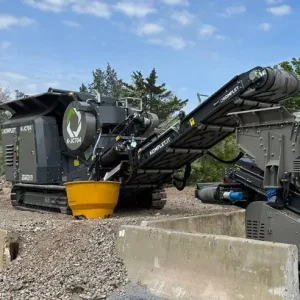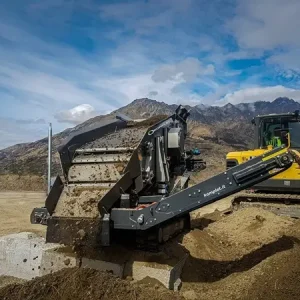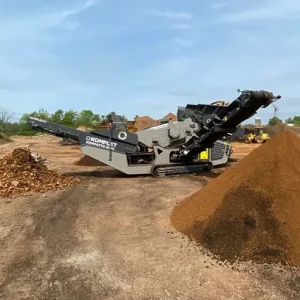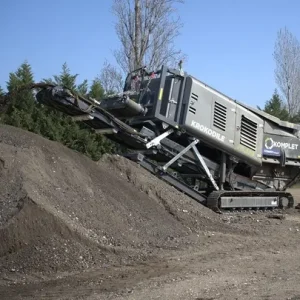

Komplet America has been the official U.S. distributor of Komplet S.p.A. compact crushers, screeners, shredders, and conveyors since 2018, and the Conti family construction legacy behind Komplet America stretches back to 1906. Between the two, we have watched contractors win and lose money on the same kind of project for one repeated reason: the wrong stone in the wrong layer. A driveway that ruts after one winter, a slab that rocks under a forklift, a French drain that clogs in eighteen months — almost always, the stone grade was off.
In the United States, crushed stone is one of the largest construction commodities by volume, with the bulk of it going into roads, ready-mix concrete, asphalt mixes, railroad ballast, drainage systems, and residential driveways. Whether you are buying it from a quarry, hauling it in from a recycler, or producing it yourself on a jobsite with a compact crusher and screener, choosing the right grade for the right layer is one of the cheapest, fastest ways to extend the life of the work and protect your margin.
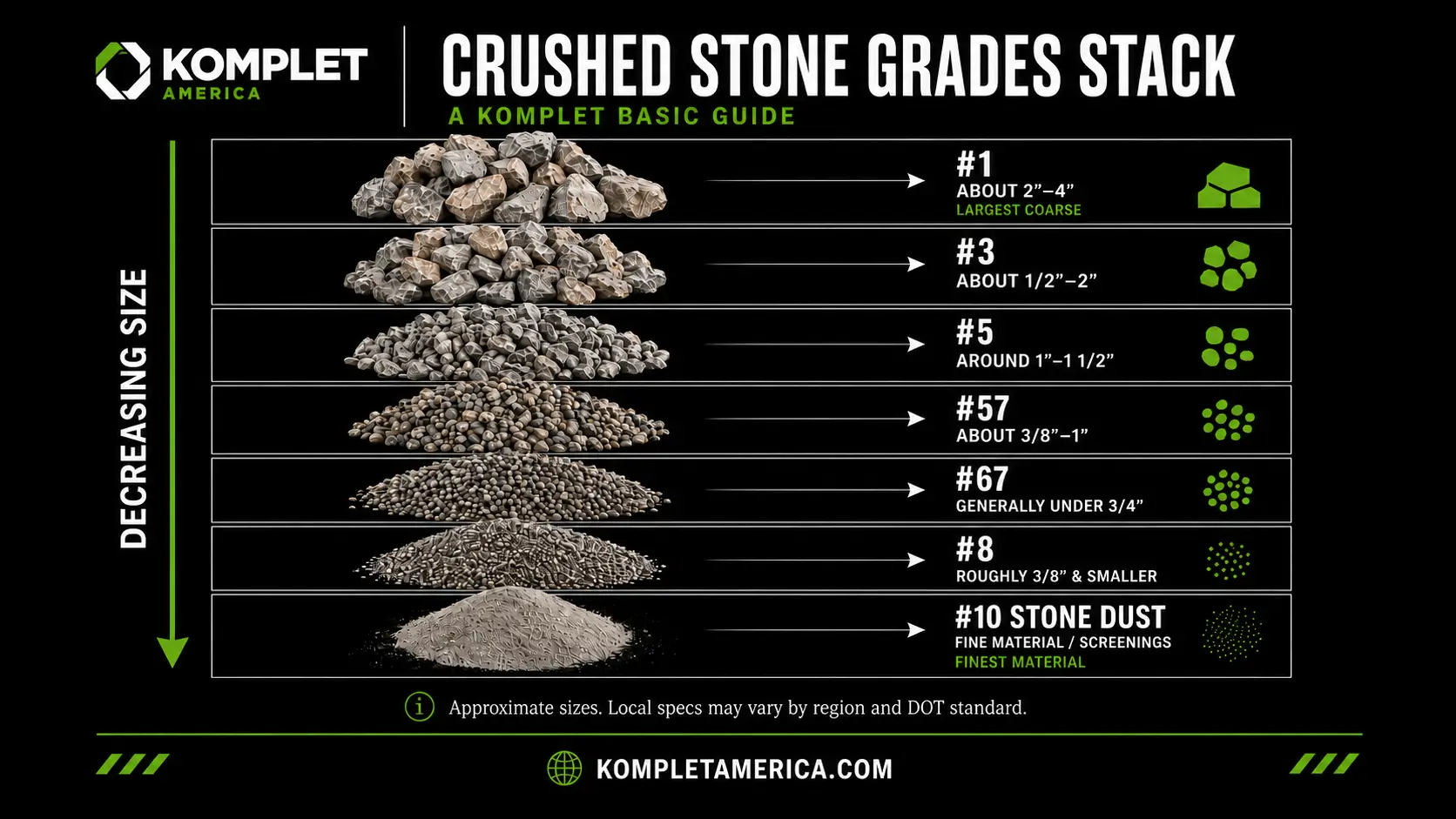
This guide walks through the crushed stone grades a North American contractor sees most often — #1, #3, #5, #57, #67, #8, and #10 stone dust — along with crusher run, dense-grade mixes, and the decorative gravels that appear on most landscape and hardscape jobs. We explain how the grades are defined, what each one is best at, the head-to-head comparisons customers ask about (8 vs. 57, 57 vs. 67), and how to produce on-spec aggregate yourself using a compact Komplet jaw crusher, impact crusher, or vibrating screener. This is a B2B reference written for site contractors, demolition specialists, recyclers, municipalities, and aggregate yards — not a homeowner DIY piece.
What Is Crushed Stone (and How It Differs from Natural Gravel)?
Crushed stone is a manufactured aggregate. Natural rock — limestone, granite, basalt or trap rock, dolomite, sandstone — is blasted or excavated, fed into a primary crusher, then reduced and screened into controlled size fractions. Recycled concrete and recycled asphalt are processed the same way and behave very similarly to virgin crushed stone in most base, drainage, and backfill applications, which is one of the reasons recycled concrete aggregate (RCA) has become a mainstream product on highway and site jobs.
Natural gravel is different. River gravel, bank-run gravel, and glacial gravel form over geologic time as water and ice round the edges off natural rock. The pieces are smoother, often more spherical, and tend to be visually appealing — but those rounded faces are also why natural gravel does not lock up under load the way crushed stone does.
The practical contrast a contractor cares about:
- Crushed stone: Angular faces and sharp edges. Particles interlock under compaction, distribute load efficiently, and resist shifting under traffic. Stronger structural performance under driveways, slabs, parking pads, and roadways. Produced by crushers and screeners, including compact units like the Komplet K-JC 503, K-JC 604, K-JC 704 PLUS, K-JC 805, and K-IC 70.
- Natural gravel: Rounded particles. Smooth, comfortable underfoot, often more pleasing in landscape settings. Wants to roll or migrate under load unless tightly contained by edging, geotextile, or surrounding structure. Better for decorative paths, garden beds, drainage swales, and water features than for primary structural base.
- Crushed gravel: Sometimes a hybrid term. Refers to natural gravel that has been run through a crusher to add fractured faces. It splits the difference — some angularity, some natural rounding — and shows up frequently in regional road specs.
On any given site you may also encounter terms like washed gravel, manufactured aggregate, dense-grade aggregate, open-graded aggregate, and recycled aggregate. They are all variations on the same theme: a known size range with a known amount of fines. The two big questions any contractor should ask are simply, what passes which screen, and how much of it is dust. The answers determine whether the layer drains, compacts, locks up, or migrates.
How Crushed Stone Grades Are Defined
The numbered grade system most U.S. contractors use is rooted in AASHTO M 43 (the standard size of stone for highway construction) and ASTM C33 / D448 (aggregate gradations for concrete and base course). State DOTs publish their own gradation tables that closely mirror these standards, with regional variations on tolerances and naming. The number does not refer to inches or to a screen size directly — it refers to a size class with a defined gradation envelope.
A size class is defined by:
- Top size: the largest screen the bulk of the material passes through.
- Bottom size: the smallest screen the material is retained on.
- Gradation curve: the percentage of the load that passes each intermediate screen.
- Fines content: the percentage of fine material — typically the portion passing the No. 200 sieve — allowed in the mix.
Two grades that look similar at a glance can behave very differently. #57 stone and #67 stone, for example, share a roughly three-quarter-inch top size, but #67 has a tighter spread and compacts denser. That is one of the most common decision points for slab base on a jobsite, and it is also the reason a printed gradation chart is worth more than the eyeball test.
Open-graded versus dense-graded is the other distinction worth memorizing:
- Open-graded aggregate has minimal fines. Voids stay open after placement, so water flows through. Examples: clean #57, clean #67, #3 and #5 base stone with washed fines. Use where drainage is the priority.
- Dense-graded aggregate (also called crusher run, dense-grade base, DGA, ABC, or graded aggregate base) is engineered with a continuous gradation that includes coarse stone, intermediate sizes, and stone dust. Voids close up under compaction, the surface locks up, and the layer carries load. Use where stability and tight surface are the priority.
Most state DOTs reference these gradations in their specifications for surface course, base course, subbase, and structural fill. If the project has an engineer of record or a DOT spec sheet, that document — not a generic chart — is the binding reference. Komplet equipment is sized and screened to produce material that fits these gradations when paired with the correct screen decks, output settings, and (where required) a wash step performed downstream of our equipment.
Coarse Stone Grades: #1, #3, and #5
The coarse end of the size chart is where heavy structural and drainage work lives. These grades carry load on poor subgrade, hold up under water flow, and resist washout on slopes and embankments. They do not produce a finished surface, and that is intentional.
#1 Stone
- Typical size: roughly 2 to 4 inches in diameter.
- Best uses:
- Filling deep voids, soft spots, and oversized excavations during site preparation.
- Sub-base for heavy-duty roads, rail siding work, and other applications carrying repeated heavy loads.
- Erosion control along embankments, ditches, swales, and shoreline restoration where larger stones resist washout.
- Heavy backfill behind retaining walls and large bridge abutments combined with the appropriate geotextile.
Because the particle size is so large, #1 stone does not compact into a smooth surface and is rarely the layer a finished material rides on. It is a foundation grade — bulk support and drainage.
#3 Stone
- Typical size: roughly half an inch to two inches.
- Best uses:
- Railroad ballast and transit applications where angular stone distributes loads and provides excellent drainage between ties.
- Deep road and slab base layers placed over poor or wet subgrade.
- Base material under parking pads, equipment laydown yards, and other heavy-construction surfaces that need to drain.
- Crane mat and timber mat support on soft sites.
#3 stone holds enough void space to move water but is small enough to start building structural lift under traffic. On wet sites, a deep #3 layer on top of a properly placed geotextile is often the difference between a base that holds and one that pumps.
#5 Stone
- Typical size: roughly 1 to 1½ inches.
- Best uses:
- Road and paver base where the project needs balanced compaction and drainage.
- Driveway base on commercial and light industrial sites with truck traffic.
- Transitional layer between very coarse #3 and mid-range #57 in deeper structural sections.
- Stable working platform under formwork and pour edges on concrete sites.
#5 stone is the practical bridge between true subbase coarse and the mid-range workhorses. When a slab needs to drain but also needs to feel solid under the screed, this is often the layer just above the geotextile and just below the #57.
The Mid-Range Workhorses: #57 Stone, #67 Stone, and Crusher Run
If a North American contractor only had to memorize three crushed stone products, it would be these. #57, #67, and crusher run cover the vast majority of residential driveways, paver bases, slab bases, French drains, and small commercial pad jobs. The differences between them are subtle on paper and large in performance.
#57 Stone
- Typical size: nominal one inch top size, generally graded down to about three-eighths of an inch with a clean wash.
- Spec example: AASHTO #57 / ASTM #57 — defined by the percentage retained on each screen size in the standard.
- Best uses:
- Residential and light commercial driveways that need to drain without rutting.
- Concrete and asphalt aggregate when the mix design specifies a #57 stone column.
- French drains and perimeter drainage systems — clean #57 resists clogging and moves water aggressively.
- Backfill behind retaining walls and basement waterproofing membranes for hydrostatic relief.
- Slab base under residential and light commercial pours where drainage is more important than maximum compaction.
#57 is the most-asked-for stone product in North America. The reason is simple: it is open enough to drain, large enough to bridge soft spots, and small enough to walk on without rolling an ankle. For a recycler or a contractor producing material on site, #57 is also the easiest grade to move — there is steady demand from masons, pool installers, landscape contractors, and general site contractors.
#67 Stone
- Typical size: nominal three-quarter-inch top size, generally graded down to a No. 4 sieve (about a quarter inch).
- Best uses:
- Slab base under thin concrete sections — sidewalks, slab-on-grade pads, and smaller equipment pads where a tighter, denser layer matters.
- Road shoulder material and thin pavement section base course.
- Concrete mix designs that call out a smaller coarse aggregate for workability.
- Asphalt base lifts and binder courses on the lighter-duty end of pavement design.
Compared with #57, the tighter spread of #67 closes voids more aggressively under compaction. That makes #67 a smart pick when the slab is thin, the section is shallow, or the surface needs to feel firmer under a vibratory plate.
Crusher Run and Dense-Grade Aggregate Mixes
Crusher run is the umbrella name for any dense-graded mix produced by running material straight through a crusher with no clean screening step — every fraction from the largest particle in the spec down to fines is in the load. Regional names vary: dense-grade aggregate (DGA), graded aggregate base (GAB), aggregate base course (ABC), 411, 21AA, 21A, item 4, and others all describe the same family of products.
- Typical size: top sizes of three-quarters of an inch up to about an inch and a half, depending on regional spec, blended with intermediate sizes and stone dust through #200 fines.
- Best uses:
- Paver base under patios, walkways, light driveways, and small parking areas where the surface must lock up.
- Driveway top course and resurfacing where a tight, smooth-rolling finish matters.
- Equipment laydown areas, gravel parking lots, and farm or estate roads.
- Compacted base under flatwork on dry sites where drainage is not the priority.
Crusher run does not drain through the layer the way clean #57 does — that is the trade-off. The fines that lock up the surface also close most of the voids. On wetter sites or where hydrostatic pressure is a concern, a layered approach (clean stone for drainage, crusher run for surface) is usually the right answer. With a Komplet jaw crusher producing a 0–¾-inch or 0–1¼-inch all-in product, contractors can generate site-mixed crusher run from existing concrete rubble or aggregate stockpiles in a single pass.
Finer Aggregates: #8, #9, and #10 Stone Dust
Below the mid-range workhorses lives a set of finer products that handle bedding, finishing, joint filling, and decorative work. These materials show up under pavers, in concrete and asphalt mixes, and on top of coarser layers when the project calls for a smoother walking or driving surface.
#8 Stone
- Typical size: roughly three-eighths of an inch top size down to a No. 8 sieve.
- Best uses:
- Concrete mix designs and thin asphalt lifts where a small, controlled coarse aggregate is specified.
- Top dressing over a coarser driveway base to soften the ride and smooth the surface.
- Decorative landscape rock around walkways, garden beds, dry creek features, and seating areas.
- Top-up product on existing residential gravel driveways for an even, finished appearance.
Because the particle size is small enough to be comfortable under foot, #8 is a favorite of landscape contractors and pool builders running tight pedestrian work.
#89 Stone
Less commonly called out by name on a typical site contractor’s job, #89 stone is a designed blend of #8 and #9 — roughly a three-eighths-inch top size graded continuously down to a No. 16 sieve. It is primarily an asphalt-plant aggregate, showing up in surface course mixes, micro-surfacing, chip seal applications, and exposed-aggregate concrete designs where a uniform, fine-textured finish is the goal. Some state DOTs also accept #89 in pipe bedding and as a permeable bedding stone under permeable pavers. Producers running a Komplet jaw or impact crusher into a Kompatto vibrating screener can hit a #89 gradation by adjusting deck openings and capturing the right blend of fines; for most on-site recycling and yard operations, the practical workflow is to produce #8 and #10 stone dust separately and let the asphalt plant or specifier blend them as needed.
#9 Stone
- Typical size: between #8 and stone dust — generally a quarter inch and smaller.
- Best uses:
- Setting bed under interlocking pavers and natural-stone flagging where tight tolerances and uniform support matter.
- Chip seal surface treatments on rural roads.
- Joint filling between pavers in permeable hardscape installations.
#9 is the hardscape contractor’s go-to bedding stone because it is small, angular, and self-locking. It does not migrate the way coarse sand can, which is why it has displaced bedding sand on a growing share of paver jobs across North America.
#10 Stone Dust and Screenings
- Typical size: fine material passing roughly a quarter-inch screen, including stone dust through fines.
- Best uses:
- Bedding for pavers, slate, and bluestone slabs to create a tight, stable foundation.
- Joint sweep between pavers and stone in traditional (non-permeable) installations.
- Component of crusher run blends to fill voids and lock up the surface.
- Walkway and pathway surface in rustic and historic park applications.
Stone dust is the binder that makes a dense-graded base behave the way it should. Without it, a #57 layer rolls under a wheel; with the right percentage of stone dust mixed in, the same coarse aggregate becomes a dense, locked surface. For recyclers and aggregate producers, screenings are a high-value byproduct of any crushing operation, and the right screen attachment or downstream vibrating screener lets you separate that fines stream cleanly instead of leaving value on the ground.
Decorative Gravels and Specialty Aggregates
A site contractor or landscape contractor will routinely be asked for products that fall outside the standard graded crushed stone family. These are decorative aggregates — chosen as much for color, shape, and feel as for performance. They have a place in drainage and erosion control, but they are rarely the right answer for a primary structural base under traffic.
Pea Gravel
Small, naturally rounded river stones, generally three-eighths of an inch or smaller. Comfortable underfoot, easy to walk on, and visually warm because of the natural mineral mix. Excellent for garden beds, walking paths, dog runs, kid play areas, and around pool decks when contained by edging. Pea gravel is poor structural base — the rounded shape lets it roll under load — so it should not be used under driveways, slabs, or anywhere a wheel will sit on it for any length of time.
River Rock
Larger natural stones, typically one to three inches, with the same smooth profile as pea gravel. Used in decorative landscaping, dry creek beds, water feature edging, drainage swales, and front-yard groundcover where the look matters. Useful in mid-slope erosion control combined with geotextile, but again, not a structural base material.
Marble Chips
Bright white or off-white angular crushed marble, typically half an inch and smaller. High-end decorative product around shrubs, tree wells, monument sites, and entrance plantings. Drains well in small applications. Avoid in heavy-traffic walkways — the soft particles abrade and discolor faster than crushed limestone or granite.
Lava Rock
Lightweight, porous, and dramatic in color — typically deep red or charcoal black. Common in dry climates as a mulch substitute around xeriscape plantings and as a decorative border around fire features. Lava rock holds its color longer than dyed wood mulch and does not need replacement every season, but it is brittle and breaks down under foot traffic and snow plowing.
Recycled Concrete Aggregate (RCA)
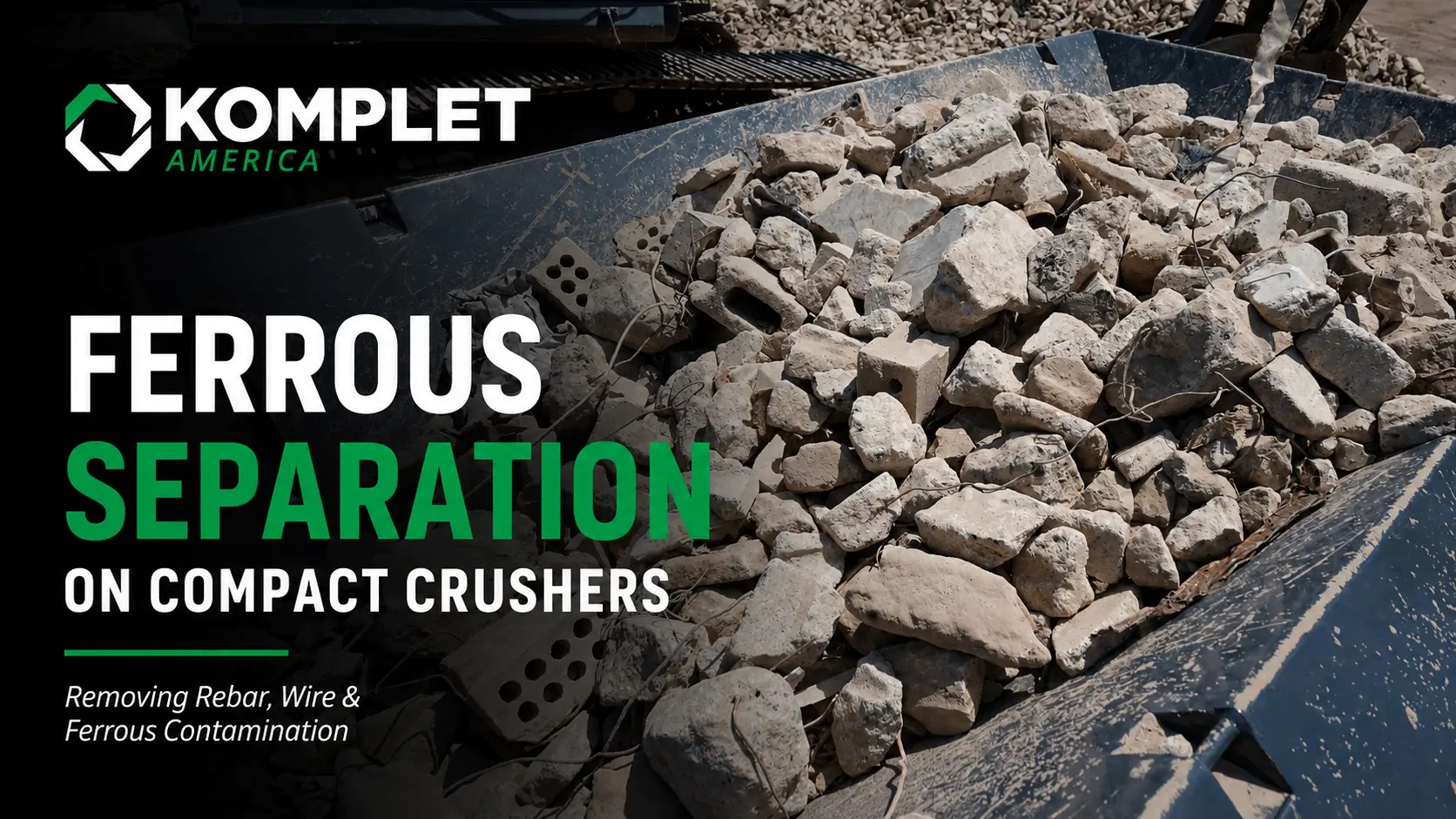
Worth calling out because it is now mainstream on site and DOT work. Crushed concrete from demolition processed through a primary jaw or impact crusher and screened to standard size fractions performs comparably to virgin crushed stone in most base, fill, and drainage applications, often at a meaningful cost advantage. State DOTs increasingly accept RCA in subbase and base course specifications, and the EPA and many state environmental agencies treat it as preferred over landfilling. Komplet’s compact lineup is built specifically for this kind of small- and mid-volume on-site or in-yard recycling — the K-JC 503, K-JC 604, K-JC 704 PLUS, K-JC 805, and the K-IC 70 impact crusher all process concrete into clean, on-spec sized product. The K-IC 70 in particular produces a cubical aggregate suited for DOT-spec material and ready-mix applications.
How to Read a Gravel Size Chart and Choose the Right Grade
A gravel size chart lines up each grade — #1, #3, #5, #57, #67, #8, #9, #10, crusher run — against the percentage of material that passes each standard screen, expressed by sieve size. The chart matters because it lets you predict how a layer will behave before you spread it. Used properly, it answers two questions at once: how big are the largest particles, and how much fine material is in the load?
Working through a typical specification, a contractor should:
- Clarify the application. Driveway, slab base, drainage system, and decorative groundcover are different problems. Match the function before you match the grade.
- Decide the priority — drainage or compaction. Open-graded products like #57 and #67 are written for drainage. Dense-graded products like crusher run and #411 are written for compaction. Trying to get both from one product almost always fails on one axis or the other; the right answer is usually a layered section.
- Check the spec against the chart. If the engineer of record or the state DOT has called out a specific gradation, confirm that the producer is hitting it. If the project does not have a binding spec, AASHTO and ASTM gradations are the safest defaults.
- Confirm the source and the wash. A clean #57 is not the same product as #57 crusher run. Ask the producer or the recycler whether the load has been washed, whether fines have been screened out, and what the gradation report looks like.
- Calculate quantity. Once the grade and the layer thickness are known, tonnage is a function of area, depth, and unit weight (typically about 1.4 to 1.5 tons per cubic yard for most crushed stone, depending on the source rock). Order with a buffer for placement loss and compaction.
This is also the workflow for sizing a producing operation. If the demand is for #57, #8, and stone dust off a single feed, the question becomes whether the screening deck has the right openings, whether throughput is matched to the crusher, and whether stockpile management can keep the three products clean. A Komplet K-TC 460 tracked mobile conveyor extends stockpile reach off any of our crushers and screeners, which is one of the cheapest ways to keep finished grades from contaminating each other in tight yards.
Matching Crushed Stone Grades to Real-World Jobs
This is the part contractors care about most — what to actually spec for the job in front of them. The applications below cover the bulk of work a Komplet customer is asked to bid.
Residential and Light Commercial Driveways
A new driveway over native soil typically wants a layered structural section:
- Geotextile fabric over the prepared subgrade on any soil with significant fines or moisture.
- 4 to 6 inches of #3 or #5 stone as the structural lift, compacted in lifts.
- 3 to 4 inches of #57 or #67 stone as the intermediate layer.
- 1 to 2 inches of #8 stone or crusher run as the surface, depending on whether the customer wants a tight, locked finish or a softer, more decorative look.
On an existing residential driveway that has rutted or thinned, a top-dress with one to two inches of #57 or crusher run is usually the right repair. Do not skip the regrading step — placing fresh stone on top of a sunken crown does not solve the drainage problem that caused the rutting.
Slab Base, Concrete Mixes, and Asphalt Base
- Slab base under residential and light commercial concrete: 4 to 6 inches of #57 or #67 stone over compacted subgrade is the standard recipe. Where vapor and capillary rise are concerns, add a vapor barrier above the stone.
- Heavier slabs and equipment pads: deeper sections of #3 or #5 underneath, transitioning to #57 or #67 as the bedding layer just under the slab.
- Concrete mix designs: the coarse aggregate column is typically #57, #67, or #8, depending on slump, finish, and structural requirements. This is set by the mix designer, not the field.
- Asphalt base: dense-graded aggregate base course (the regional name varies — DGA, ABC, GAB) under the binder lift. Surface and binder mixes use smaller aggregates — typically #8, #89, and finer — drawn directly from the screened products of a producing operation.
French Drains and Drainage Systems
- Perimeter foundation drains and trench drains: clean #57 stone is the default. Wrap the trench in non-woven geotextile, install perforated pipe, and fill with washed #57 to within 6 inches of the surface.
- Curtain drains and yard drains: #57 or #67 over a properly bedded perforated pipe.
- Stormwater infiltration trenches and dry wells: #57 in the open void volume, with the calculation handled by the storm engineer.
- Permeable pavement systems: a stacked open-graded section — typically #2 or #3 in the deep storage layer, #57 in the choker, and #8 in the bedding — engineered to a specified storage volume.
Retaining Walls, Bridge Abutments, and Erosion Control
- Backfill behind segmental retaining walls and gabion baskets: 12 inches of #57 immediately behind the wall, transitioning to native fill compacted in lifts.
- Bridge abutments and structural walls: governed by the project spec — typically a graded backfill specification calling out a specific gradation envelope and compaction requirement.
- Stream bank stabilization, ditch lining, and outfall protection: #1 stone, larger riprap, and engineered rock stacked on a geotextile over the prepared slope.
- Slope erosion control on cut and fill banks: #57 or #67 with vegetation and matting, engineered to the side-slope ratio.
Paver Base and Hardscape Bedding
- Standard non-permeable paver installation: 4 to 6 inches of compacted crusher run as the structural base, 1 inch of #9 stone or coarse bedding sand as the setting bed, and polymeric joint sand sweep on the finished pavers.
- Permeable paver installation: 6 inches or more of #2 stone in the storage layer, 4 inches of #57 in the choker, 2 inches of #8 stone as the bedding layer, and #8 stone in the open joints. The full open-graded section drains aggressively.
- Natural stone flagging and bluestone walkways: 4 inches of crusher run base, 1 inch of #9 stone or stone dust as the setting bed.
Aggregate Yards, Compost Operations, and Recycling Facilities
- Sized salable products: the menu of finished products in most yards leads with #57, #67, #8, stone dust, and crusher run. A compact crushing and screening operation can produce all five from a single feed of clean concrete or virgin rock.
- Compost overs and topsoil screening: covered by the trommel screener line, including the K-TS 30 and K-TS 40, which handle wet, cohesive, organic feed where a vibrating screen would blind.
- Construction-and-demolition feed: the Krokodile PLUS slow-speed shredder reduces large concrete chunks, asphalt slabs, brick, and rubble for a downstream crushing pass when the feed is larger than about 80% of the jaw gape.
Quick Comparisons: 8 vs. 57, 57 vs. 67, and Crusher Run vs. Open-Graded Stone
The questions that come up over and over on the phone and in the yard.
#8 Stone vs. #57 Stone
- #8 stone is small — about three-eighths of an inch top size — and behaves as a finishing or decorative aggregate. Concrete mixes, top dressing, paver bedding (in permeable installations), decorative landscape.
- #57 stone is coarser — about one-inch top size — and behaves as a structural and drainage aggregate. Driveways, French drains, slab base, retaining wall backfill.
- Choosing one over the other is almost never a close call. #8 is a finish; #57 is a base. They show up together on the same job, in different layers.
#57 Stone vs. #67 Stone
- Top size is similar — both nominal three-quarters of an inch to one inch.
- #57 has a wider gradation spread and grades down to roughly three-eighths of an inch. More void space, better drainage, slightly less compactable.
- #67 has a tighter spread and grades down to about a quarter inch. Less void space, better compaction into a denser layer, slightly worse drainage.
- Use #57 when drainage is the priority. Use #67 when a thin, dense base layer is the priority — typically under a thin slab or a road shoulder.
- On a DOT spec sheet, the choice is made for you. On a private job without a binding spec, default to #57 unless the slab section is unusually thin or the surface needs to feel especially firm under compaction.
Crusher Run vs. Clean Open-Graded Stone
- Crusher run includes fines. Locks up under compaction. Resists rutting under traffic. Drains poorly through the layer. Best for driveway top course, paver base, gravel parking lots, and dry-site work.
- Clean open-graded stone (#57, #67, #8 washed) excludes fines. Voids stay open. Drains aggressively. Compacts less and holds shape under load through interlock rather than density. Best for French drains, retaining wall backfill, slab base where drainage matters, and the deeper layers of a section with a layered drainage strategy.
- Many real jobs want both — a coarse open-graded layer for drainage, a crusher run cap for surface lock-up. Layered sections are normal and usually the right call.
Recycled Concrete Aggregate vs. Virgin Crushed Stone
- RCA produced through a properly sized primary crusher and screen behaves comparably to virgin crushed stone in most base, fill, and drainage applications.
- Cost advantage on RCA depends heavily on local hauling and tipping. Where landfill tipping is high and concrete demolition volume is steady, RCA is often 30 to 60 percent cheaper than virgin material delivered.
- RCA carries cementitious fines that can leach lime, raising pH in adjacent soil and water. On most highway and site applications this is not an issue; on sensitive landscape and water feature applications, source virgin or washed material.
- Most state DOTs accept RCA in subbase and base course at varying percentages. Read the spec.
Producing On-Spec Crushed Stone with Komplet Equipment
Komplet America does not sell aggregate. We sell the equipment that lets a contractor, recycler, or municipality produce on-spec aggregate from concrete demolition rubble, virgin rock, or recycled asphalt. Done correctly, on-site or in-yard production replaces the dump-truck round trip to the quarry with a stockpile of usable product, and the savings on hauling and tipping fees alone often pay for the equipment over a few hundred operating hours.
The lineup, mapped to crushed stone production, looks like this:
Compact Jaw Crushers — Primary Reduction
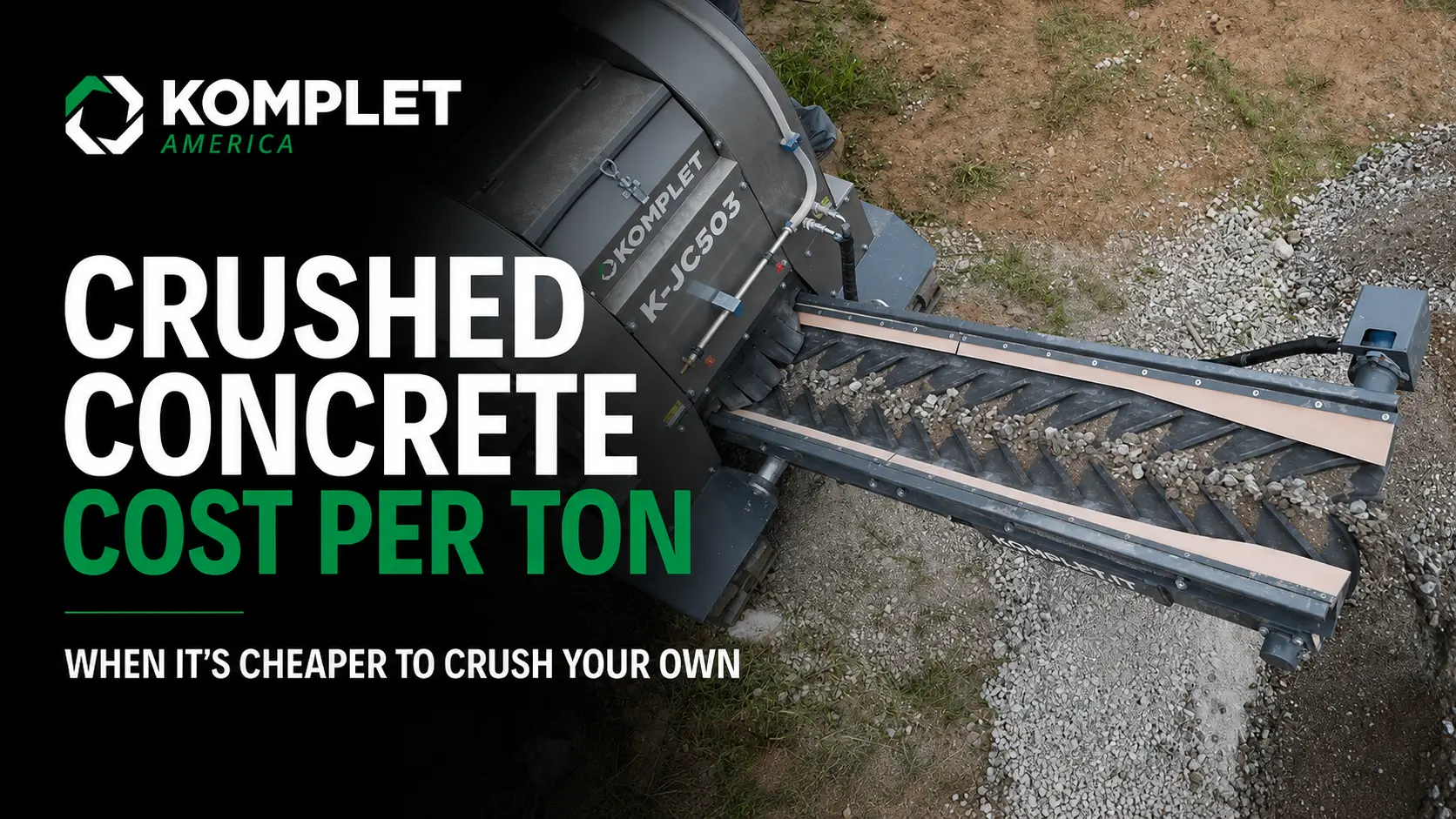
- K-JC 503 mini jaw crusher (19-inch by 12-inch jaw, up to 34 US tph) — designed for the smallest yard footprints and tight urban access. Towable behind a pickup. Best for landscape, hardscape, masonry, basement waterproofing, and pool contractors producing #57 / #67 / stone dust from concrete demolition.
- K-JC 604 mobile jaw crusher (23-inch by 16-inch jaw, up to 55 US tph) — the next step up in throughput and material acceptance, with the same compact tracked footprint. Ideal for driveway and paving contractors and small municipal yards.
- K-JC 704 PLUS portable jaw crusher (27-inch by 16-inch jaw, up to 90 US tph) — Komplet America’s best-selling jaw crusher and the workhorse of the line. Civil, road, bridge, and recycling work.
- K-JC 805 mobile jaw crusher (31-inch by 21-inch jaw, up to 160 US tph) — the largest jaw in our lineup, semi-pro classification. Sized for rock quarries, larger recycling yards, and municipal aggregate production.
K-IC 70 Compact Impact Crusher — Cubical Aggregate and DOT-Spec Material
The K-IC 70 (25-inch by 20-inch inlet, up to 90 US tph) is the right machine when the finished product specification calls for cubical aggregate — concrete mix coarse aggregate, ready-mix supply, recycled asphalt pavement (RAP) reduction for new asphalt production, and DOT-spec base material. An impact crusher uses spinning blow bars to fracture material along internal planes, producing more cubical particles and more controlled fines than a jaw alone. For producers who need to hit a tight gradation envelope with a high percentage of fractured faces, the K-IC 70 is typically the right primary.
Vibrating and Trommel Screeners — Sizing and Fines Separation
- Kompatto 221 (7-foot by 3.5-foot, up to 90 US tph) — the smallest self-propelled scalping screen in the line. Pairs with a K-JC 503 or K-JC 704 PLUS for an integrated crush-and-screen workflow on small yards.
- Kompatto 5030 (8-foot by 3-foot 2-inch + 7-foot by 3-foot 2-inch decks, up to 280 US tph) — Komplet’s best-selling screener. Pairs with the K-JC 704 PLUS, K-JC 805, or Krokodile PLUS for production-scale sizing.
- Kompatto 124 (11.8-foot by 3.7-foot + 10.8-foot by 3.7-foot decks, up to 350 tph) — the largest scalper in the line. Recycling facilities, rock quarries, and large municipal yards.
- K-TS 30 and K-TS 40 trommel screeners — electric-drive trommel screening for compost overs, topsoil, green waste, and wet or cohesive material that would blind a vibrating deck.
Krokodile PLUS Slow-Speed Shredder — Pre-Reduction
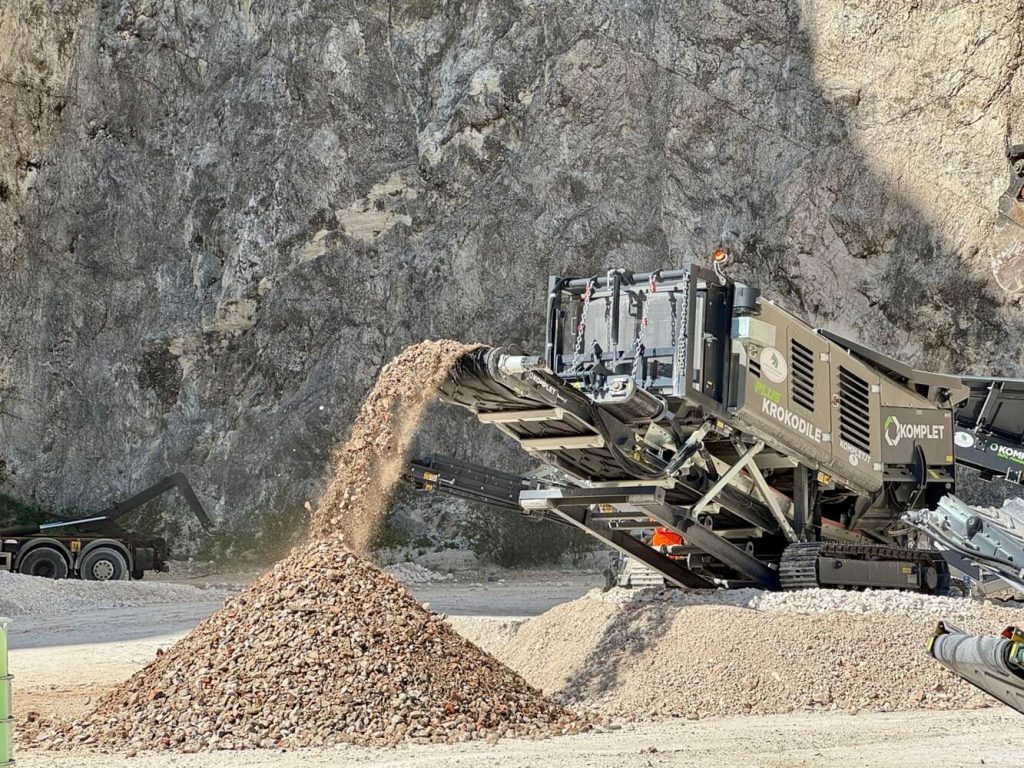
When the feed is larger than about 80% of the primary jaw’s gape — slabs of concrete, oversized rubble, large asphalt pieces, mixed C&D — the Krokodile PLUS dual-shaft shredder pre-reduces the material so it feeds cleanly into a downstream crusher. With the C&D / asphalt teeth and shaft configuration, the Krokodile PLUS handles concrete, asphalt, brick, block, and rubble; with the wood / lightweight waste shaft, it handles wood, drywall, plastics, mixed garbage, and green compost feed. The shafts are interchangeable through the quick-change shaft system.
K-TC 460 Tracked Mobile Conveyor — Stockpile Management
The K-TC 460 is a self-propelled, tracked mobile conveyor that travels on rubber tracks like Komplet’s crushers and screeners. It pairs with any Komplet crusher, screener, or the Krokodile PLUS shredder to extend stockpile reach, separate finished products, and reduce loader dependency on the jobsite. On a producing operation running #57, #67, and stone dust off a single feed, the K-TC 460 is one of the cheapest ways to keep grades from cross-contaminating in a tight yard. At about 7,000 pounds, it is towable behind a standard truck for jobsite-to-jobsite repositioning, and once on site it moves under its own power.
Putting It Together — A Typical On-Site Recycling Train
A representative on-site concrete recycling configuration for a contractor producing #57, #67, and stone dust from demolition rubble:
- Krokodile PLUS or excavator-mounted breaker pre-reduces oversized rubble.
- K-JC 704 PLUS jaw crusher takes the feed down to a 0–1¼-inch product.
- Kompatto 5030 vibrating screener separates the crusher output into #57, #67, and minus-quarter-inch stone dust.
- K-TC 460 tracked mobile conveyor stockpiles the finished products clean of one another.
For a producer focused on cubical aggregate and DOT-spec material, swap the K-JC 704 PLUS for the K-IC 70 impact crusher. For a higher-throughput rock quarry application, step up to the K-JC 805 jaw and the Kompatto 124 scalper.
Frequently Asked Questions
What is the most common crushed stone grade?
#57 stone is the most-asked-for crushed stone product in North America. The combination of one-inch top size, open gradation, and clean drainage makes it the default answer for residential driveways, French drains, retaining wall backfill, and slab base on a wide range of jobs. Because demand is so consistent, #57 is also the easiest grade for a recycler or aggregate producer to move.
Is #57 stone or crusher run better for a residential driveway?
Both have a place. #57 stone produces a free-draining surface that resists puddling and freeze-heave but stays loose underfoot and can roll under tires. Crusher run includes fines that lock up under compaction, producing a tight, smooth-rolling surface that resists rutting but drains poorly through the layer. The strongest residential driveway sections use a layered approach — coarser stone for drainage in the lower section, crusher run as the surface course.
What is the difference between #57 stone and #67 stone?
Top size is similar (about three-quarters of an inch to one inch). The difference is in the spread of sizes below the top. #57 grades down to about three-eighths of an inch and stays open enough to drain aggressively. #67 grades down to about a quarter inch and compacts denser into a tighter, smoother layer. Pick #57 when drainage matters most and #67 when a thin, firm base layer matters most.
Can recycled concrete aggregate replace virgin crushed stone?
In most base course, subbase, and structural fill applications, properly produced recycled concrete aggregate (RCA) performs comparably to virgin crushed stone, often at meaningful cost savings on hauling and tipping. Most state DOTs accept RCA in subbase and base course at varying percentages — read the binding spec for the project. RCA is less suitable in sensitive landscape applications where the cementitious fines can raise soil pH.
What size aggregate goes under pavers?
Standard non-permeable paver installations use a base of compacted crusher run (typically 4 to 6 inches) topped with 1 inch of #9 stone or coarse bedding sand as the setting bed. Permeable paver installations use a stacked open-graded section — #2 stone in the storage layer, #57 in the choker, and #8 in the bedding and joints — engineered for stormwater retention.
How do I produce on-spec #57 stone from a concrete demolition pile?
Pre-reduce oversized rubble (Krokodile PLUS slow-speed shredder or excavator-mounted breaker), feed the rubble through a primary jaw crusher set to a 0–1¼-inch closed-side setting, and screen the crusher output through a vibrating screener with the deck openings set to capture #57. With the right Komplet crusher and screener pairing, this entire workflow runs on a single jobsite without trucking material to a quarry.
What is stone dust used for?
Stone dust (#10) bedding for pavers and bluestone, joint sweep in non-permeable paver installations, and component of crusher run mixes that lock up under compaction. It is also a high-value byproduct of any crushing operation — separated cleanly off a screener, stone dust is a sellable product on its own.
Does Komplet equipment work for both virgin rock and recycled concrete?
Yes. The Komplet jaw crusher line (K-JC 503, K-JC 604, K-JC 704 PLUS, K-JC 805) and the K-IC 70 impact crusher are designed for both virgin rock and recycled concrete, asphalt, brick, block, and rubble. Most Komplet customers run a mix — virgin rock from quarry contracts and concrete from local demolition jobs — through the same machine and screen the output to standard crushed stone grades.
Final Thoughts
Crushed stone grades look like a memorization problem at first — a list of numbers, a chart of sieve openings, a stack of regional DOT codes that all mean roughly the same thing. They are really an engineering problem expressed as a product menu. Once a contractor understands that #57, #67, crusher run, and stone dust are answers to specific questions about drainage, compaction, top size, and fines content, the menu organizes itself around the work in front of them.
The two reliable failure modes — using a draining stone where compaction was needed, and using a compacting stone where drainage was needed — are also the two cheapest mistakes to avoid. A few minutes with the gradation chart and the project spec is the difference between a section that holds for a decade and a callback in eighteen months. For producers, mastering the same fluency turns a pile of concrete demolition into five sellable products instead of one indistinguishable stockpile.
If your operation is producing crushed stone — or wants to start — Komplet America’s compact lineup is built specifically for the size of work most U.S. contractors and yards do. The K-JC 503, K-JC 604, K-JC 704 PLUS, and K-JC 805 cover primary jaw crushing from yard scale up to small-quarry scale. The K-IC 70 compact impact crusher produces cubical aggregate for concrete and DOT-spec applications. The Kompatto 221, Kompatto 5030, and Kompatto 124 handle vibrating screening, the K-TS 30 and K-TS 40 handle trommel screening, the Krokodile PLUS slow-speed shredder pre-reduces oversized C&D and waste, and the K-TC 460 tracked mobile conveyor extends stockpile reach across the full lineup. Pre-owned options and equipment financing are available through Komplet Capital, our in-house finance team.
Ready to Produce On-Spec Crushed Stone Grades?
- Browse the full Komplet equipment lineup — crushers, screeners, shredders, and conveyors built for compact, on-site, and in-yard production.
- Talk to a Komplet specialist about pairing the right crusher and screener for your target product mix. Call 908-369-3340 or visit com/contact-us.
- Explore equipment financing through Komplet Capital — 24-hour approvals, terms from 36 to 72 months, 100% financing available.
- Consider a pre-owned Komplet machine — typical capital savings of 40 to 70 percent versus new, factory-supported by the same Komplet America service network.
- Find your local Komplet dealer for rental availability — visit com/find-your-komplet-equipment-dealer.
Never enough.
Disclaimer: All operating, maintenance, and service guidance in this article is general in nature. Always refer to the official Komplet operator’s manual for the specific machine model and serial number, and follow OEM intervals and procedures. For warranty-protected work, contact Komplet America at 908-369-3340 or your authorized Komplet dealer. Improper service or non-OEM parts may void warranty coverage and create safety hazards.