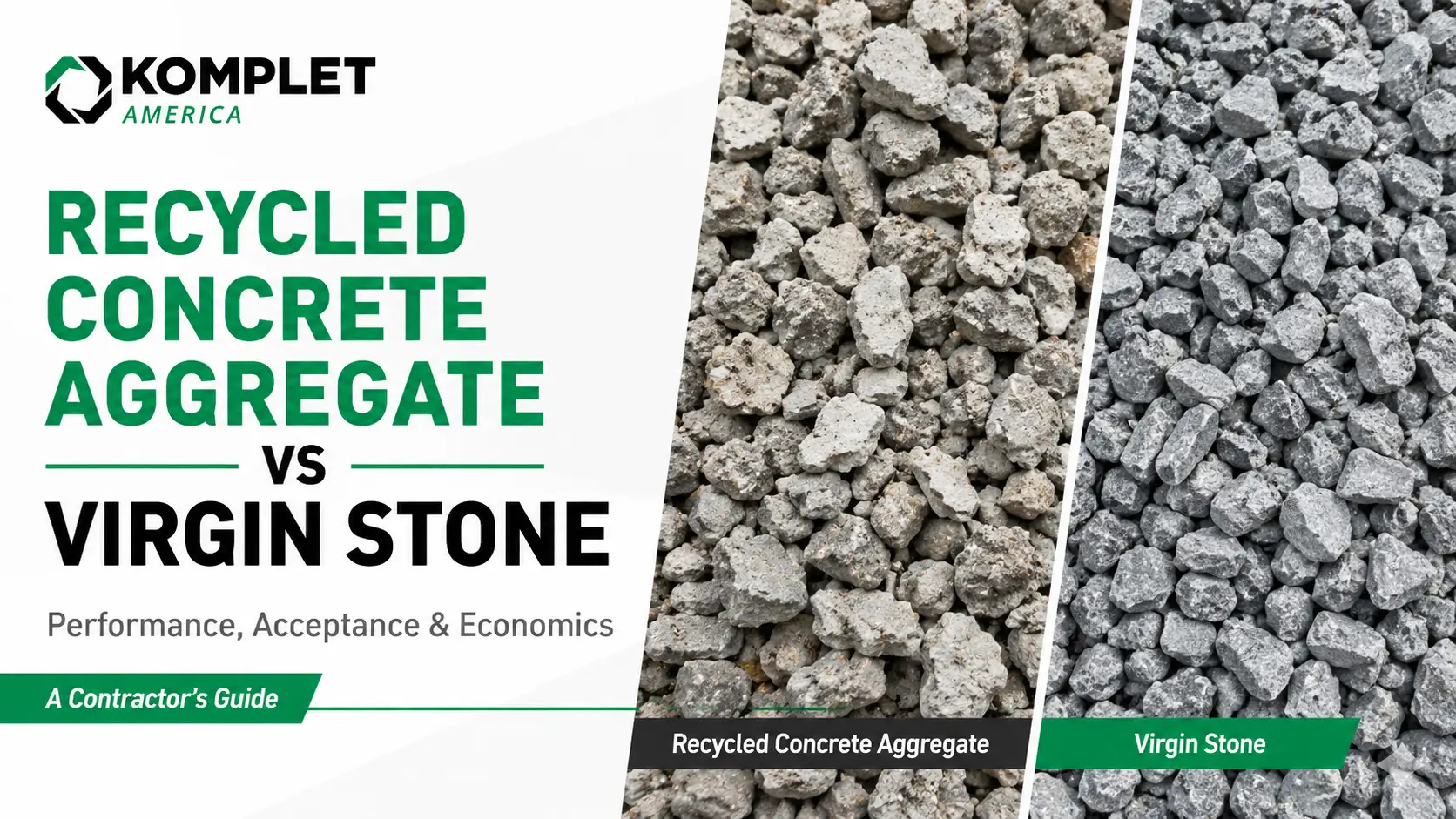

The conversation about recycled concrete aggregate has changed in the past decade. Ten years ago, RCA was treated as a discount alternative to virgin crushed stone — acceptable on private work where the spec was loose, suspect on state DOT and engineered projects, and largely a story about disposal cost avoidance rather than aggregate quality. Today, RCA is a mainstream component of state DOT base course and structural fill specifications across the United States, the subject of decades of FHWA and university research demonstrating performance comparable to virgin aggregate in most non-structural applications, and the foundation of an entire segment of the U.S. construction recycling industry. The contractor who treats RCA the way they treated it ten years ago is operating on outdated information and missing real economic and project opportunities.
The contractor who treats RCA as identical to virgin crushed stone is also missing the picture, in the other direction. RCA differs from virgin aggregate in measurable physical properties — higher absorption, slightly lower density, modestly higher abrasion loss, and the residual cement paste that gives RCA its characteristic appearance and behavior. These differences don’t disqualify RCA from most applications, but they do affect mix design, placement, and acceptance in specific contexts. Knowing where RCA equals or exceeds virgin performance, where it falls measurably short, and where it is the right choice anyway is the contractor’s edge.
This guide is the contractor’s reference for the RCA-versus-virgin decision. It covers the physical property comparison with specific numerical ranges from FHWA and AASHTO research, the U.S. state DOT acceptance framework, the environmental and LEED-credit context that increasingly drives specification decisions on commercial work, the life-cycle economic math that determines when on-site RCA production beats buying virgin aggregate, the quality control documentation that turns a stockpile into a saleable product, and the application matrix that maps RCA to specific use cases. The audience is the contractor making real material specification decisions, the recycler producing aggregate for resale, the engineer evaluating substitution requests, and the project owner weighing the cost-and-sustainability case for RCA on a specific project.
Komplet America has been the U.S. distributor of Komplet S.p.A. compact crushers, screeners, and shredders since 2018, and the Conti family construction legacy behind Komplet America stretches back to 1906. RCA production is the central economic case for compact crushing equipment in the contractor and recycler markets, and the conversations behind this article are the conversations our specialists have with customers evaluating whether on-site RCA production fits their operation. The detail below is the broader context for those conversations.
The Quick Answer
For contractors and engineers who don’t need the full reference:
- RCA performs comparably to virgin crushed stone in most base course, subbase, structural fill, and drainage applications. The performance equivalence is well-documented in FHWA, AASHTO, and university research dating back decades.
- RCA differs from virgin aggregate in measurable physical properties: higher absorption (3–8 percent vs 0.5–2.5 percent for virgin), slightly lower bulk density (typically 5–10 percent lower), modestly higher LA Abrasion loss (25–40 percent vs 15–35 percent for hard virgin rock), and the residual cement paste that produces RCA’s higher absorption and lower density.
- Most U.S. state DOTs accept RCA in base course, subbase, and structural fill applications under defined conditions. State-specific specifications vary in gradation, contamination, source documentation, and application limits.
- RCA is generally not allowed in new structural Portland cement concrete on highway projects. Limited exceptions exist; California, Massachusetts, and Oklahoma are noted in FHWA literature as among the small number of states with adopted specifications for RCA in PCC.
- The economic case for RCA is strongest in regions with high tipping fees and high virgin aggregate prices. Northeast and Pacific region operations face the most favorable RCA economics; South Central operations face less favorable but still positive economics.
- On-site or in-yard production with compact crushing and screening equipment is the dominant production path for contractor-scale and small-recycler operations. State DOT supply requires source documentation, stockpile approval, and gradation reporting per state-specific requirements.
What RCA Actually Is, in Specification Terms
Recycled concrete aggregate (also called RCA, RPCC for recycled Portland cement concrete, or RPCCA for recycled Portland cement concrete aggregate, depending on regional terminology) is aggregate produced by crushing concrete demolition material. The source material is concrete from highway demolition, building demolition, slab and foundation tear-outs, sidewalk and curb work, and other concrete-only or concrete-dominant waste streams. The crushed output is screened into size envelopes that match conventional aggregate specifications — typically AASHTO #57, #67, #8, and dense-graded base.
Important distinction: RCA is not the same as mixed C&D recycled aggregate. Mixed C&D processing accepts a broader feed stream including brick, block, asphalt, drywall, wood, and other materials in addition to concrete. The output of a mixed C&D processing facility may contain meaningful percentages of non-concrete material. RCA produced from clean concrete-only feed has the cleanest performance profile and the broadest acceptance under state DOT and engineered specifications.
RCA Source Categories
- Highway and roadway concrete demolition: typically the highest-quality RCA source. Concrete pavement is structural concrete designed and produced to state DOT mix specifications. Demolition produces a relatively clean, consistent feedstock.
- Building structural concrete demolition: foundations, slabs-on-grade, walls, columns. Quality varies by source — older structural concrete may have meaningful non-concrete contamination from interior renovations.
- Sidewalk, curb, and flatwork demolition: smaller-section concrete, often with minimal reinforcement. Common feedstock for hardscape contractor on-site recycling.
- Mixed concrete demolition: residential and small commercial demolition mixing concrete with brick, block, and other materials. Can produce RCA but requires more aggressive sorting and post-crushing screening.
Physical Property Comparison: How RCA Differs from Virgin Aggregate
The physical property differences between RCA and virgin crushed stone are measurable, well-documented in FHWA and AASHTO research, and consistent enough across sources that they form the basis for state DOT acceptance decisions. Understanding the differences is the foundation of the application matrix that determines where RCA equals or exceeds virgin performance and where it falls measurably short.
Absorption
Absorption — the percentage of water by weight that the aggregate can absorb when soaked — is the single most consistent difference between RCA and virgin crushed stone. The residual cement paste attached to RCA particles is porous; virgin crushed stone is generally dense rock with low porosity.
- Virgin crushed limestone, granite, trap rock: typical absorption 0.5–2.5 percent (per ASTM C127 / AASHTO T 85).
- RCA produced from typical demolition concrete: typical absorption 3–8 percent. Older concrete with more weathered cement paste can exceed 8 percent.
Practical implications: RCA stockpiles need more time to dry after rain. Concrete mix designs incorporating RCA need adjustment for the higher absorption (more water in the mix). Compaction moisture content for RCA in dense-graded base applications is slightly higher than for virgin aggregate of the same gradation. None of these are disqualifying — they are operational adjustments.
Bulk Density
Bulk density — the weight per unit volume of placed aggregate — affects both transportation economics (how many tons per truck) and structural mix design (load distribution per unit volume).
- Virgin crushed limestone: bulk density typically 100–110 lb/ft³ (approximately 1.6–1.75 tons/yd³ compacted).
- Virgin crushed granite: bulk density typically 95–105 lb/ft³.
- RCA: bulk density typically 90–100 lb/ft³ (approximately 1.4–1.5 tons/yd³ compacted) — typically 5–10 percent lower than equivalent virgin aggregate.
Practical implications: a delivered ton of RCA covers slightly more square footage than a delivered ton of virgin aggregate at the same depth. The lower density is a modest advantage in transportation economics (more cubic yards per truck weight limit) but requires adjustment in mix design where weight-based proportioning is specified.
LA Abrasion Resistance
LA Abrasion (per AASHTO T 96 / ASTM C131) measures aggregate resistance to wear and breakage in a standardized rotating drum test. Result is reported as percent loss; lower is better.
- Hard virgin rock (granite, trap rock, hard limestone): typical LA Abrasion loss 15–35 percent.
- Softer virgin rock: typical LA Abrasion loss 30–45 percent.
- RCA from typical demolition concrete: typical LA Abrasion loss 25–40 percent. RCA tends to fall in the middle of the virgin aggregate range.
Practical implications: RCA’s LA Abrasion typically meets the requirements for base course, subbase, and structural fill applications without difficulty. Some state DOT and engineering specifications for high-performance applications (heavy-traffic roadways, certain concrete mix designs) impose LA Abrasion limits that may exclude some RCA sources.
Soundness
Soundness testing (typically sulfate soundness per AASHTO T 104 / ASTM C88) measures aggregate resistance to weathering and freeze-thaw deterioration. PennDOT and several other state DOTs explicitly waive soundness testing for acceptable RCA, on the recognition that the cementitious material in RCA cannot be meaningfully evaluated by the standard sulfate soundness test.
Most state DOT specifications either waive soundness for RCA or apply alternative testing methods specific to RCA. The waiver is based on technical evaluation, not exception — the standard sulfate soundness test produces results for RCA that don’t predict actual field performance.
Particle Shape
RCA produced through compression crushing (jaw crusher) tends to have angular fracture surfaces similar to virgin crushed stone. RCA produced through impact crushing (impact crusher, often the K-IC 70 in compact operations) tends to have more cubical particle shape than jaw-crushed RCA. For applications where particle shape is a binding requirement (state DOT base course with flat-and-elongated particle restrictions, ASTM C33 concrete mix designs), the choice between jaw and impact crushing affects RCA acceptability.
Side-by-Side Comparison Summary
- Absorption: RCA 3–8% vs virgin 0.5–2.5%. RCA absorbs more water.
- Bulk density: RCA 90–100 lb/ft³ vs virgin 95–110 lb/ft³. RCA is slightly lighter.
- LA Abrasion: RCA 25–40% vs virgin 15–45% (range covers soft to hard rock). RCA is comparable to mid-range virgin.
- Soundness: RCA typically waived in state DOT specifications. Virgin tested per AASHTO T 104.
- Particle shape: depends on crushing method. Jaw-crushed RCA is angular; impact-crushed RCA is more cubical.
- Compaction characteristics: comparable in dense-graded applications. RCA’s slightly higher fines content from cement paste fragments produces similar compacted density to virgin DGA.
- Strength under load: comparable for base course, subbase, and structural fill. Modulus of resilience values for RCA are typically 80–95 percent of equivalent virgin aggregate in the same application.
FHWA, AASHTO, and the Federal Framework
The Federal Highway Administration’s research and policy on recycled materials in highway construction provides the technical foundation that most state DOT acceptance decisions are built on. Three FHWA references are particularly relevant for the RCA-versus-virgin discussion:
- FHWA’s Recycled Materials Resource Center publications, including the Recycled Concrete Material User Guideline. The User Guideline summarizes RCA performance characteristics, application categories, and state-by-state acceptance patterns. The document is the authoritative federal-level summary of RCA in highway applications.
- AASHTO standards covering RCA testing and specification: AASHTO M43 (size designation, applies equally to RCA and virgin), AASHTO T 96 (LA Abrasion), AASHTO T 85 (absorption), AASHTO T 27 (sieve analysis), and others. Most state DOT testing protocols for RCA reference these AASHTO standards directly.
- State DOT-specific specifications. Each state DOT publishes its own framework for RCA acceptance — gradation envelopes, contamination limits, testing requirements, and application categories. We cover the state-by-state framework in detail in our companion piece, State DOT Specs for Recycled Concrete Aggregate: A Contractor’s Reference.
Where RCA Is Generally Accepted
- Base course and subbase under flexible (asphalt) and rigid (concrete) pavement, almost universally across U.S. state DOTs, with state-specific gradation, contamination, and source documentation requirements.
- Structural fill, embankment, and backfill behind retaining walls, almost universally.
- Pipe bedding and drainage layers, with state-specific gradation and washing requirements.
- Shoulder and shoulder backing, generally allowed.
- Riprap-class erosion control, where source rock and gradation requirements are met.
Where RCA Is Generally Restricted
- New structural Portland cement concrete on highway and bridge work — most state DOTs do not allow RCA in new structural concrete, or allow it only under tightly controlled mix designs and engineering review. The reasons are durability-related: RCA’s higher absorption, lower density, and residual mortar affect long-term concrete performance differently than virgin aggregate.
- Asphalt mix design — RCA in hot mix asphalt is generally limited or not allowed, with reclaimed asphalt pavement (RAP) the preferred recycled component for new asphalt.
- Pipe bedding for sensitive utility runs (telecommunications, fiber, water main in some jurisdictions) where source-control documentation requirements for RCA make it harder to qualify than virgin aggregate.
- Permeable pavement subbase storage layers in some states, where the cementitious fines in RCA can leach lime over time and affect surrounding soil chemistry.
Application Matrix: Where Each Material Is the Right Choice
Where RCA Is Strongly Indicated
- Driveway base and subbase in residential and light commercial work. Performance is comparable to virgin aggregate; cost is meaningfully lower. State DOTs broadly accept RCA in this application. See Best Gravel for Driveways: A Contractor’s Layer-by-Layer Guide.
- Parking lot base course, including state DOT and municipal projects where state specifications accept RCA.
- Structural fill for general site work — building pads, embankment fill, retaining wall backfill (where soil chemistry is not a concern).
- Utility trench backfill and pipe zone backfill in most non-sensitive applications.
- Construction site stabilization: temporary access roads, equipment laydown areas, construction entrances. RCA’s angular fracture provides good interlock for these short-duration high-stress applications.
- Drainage layer aggregate for non-sensitive applications. See Best Stone for a French Drain for the drainage stone discussion.
- Slab base for residential and light commercial work where moisture-sensitive flooring is not planned. See What Gravel Goes Under a Concrete Slab?.
- Paver base for residential and light commercial paver work. See Paver Base Material Guide.
Where Virgin Aggregate Is Generally the Right Choice
- New structural Portland cement concrete on state DOT and engineered projects (most states do not accept RCA in new PCC).
- ASTM C33 fine aggregate applications (concrete sand, mortar sand). RCA is not typically processed to ASTM C33 fine aggregate gradations.
- Architectural concrete and decorative concrete where appearance and color consistency are project requirements.
- Asphalt mix design (most applications use reclaimed asphalt pavement, RAP, rather than RCA for the recycled component).
- Sensitive landscape and water-feature applications where RCA’s potential for cement leaching could affect soil pH or water chemistry — fish ponds, native plant restoration sites, sensitive wetland-adjacent work, organic agricultural applications.
- Pipe bedding for sensitive utility runs where source documentation requirements favor virgin aggregate.
- Specialty applications where source consistency is required: spec’d concrete pavement on heavy-traffic interstate work, bridge deck concrete, certain heavy industrial slab applications.
LEED, Sustainability, and Environmental Considerations
Sustainability has moved from optional to specified on a meaningful share of commercial construction work. RCA contributes to LEED credits, fits municipal and state sustainability mandates, and increasingly figures into project owner specifications independent of pure cost considerations.
LEED v4 Credits
- Materials and Resources (MR) Credit: Building Product Disclosure and Optimization — Sourcing of Raw Materials. RCA can contribute to credit thresholds for recycled content in building materials, particularly when documented through environmental product declarations (EPDs) or third-party verification.
- Materials and Resources (MR) Credit: Construction and Demolition Waste Management. On-site or near-site RCA production directly diverts demolition concrete from landfill, contributing to credit thresholds for waste diversion (typically 50–75 percent of construction waste diverted, depending on credit option).
- Sustainable Sites credits in some applications, particularly when RCA is used in stormwater management features or permeable pavement systems.
Other Sustainability Frameworks
- Envision (Institute for Sustainable Infrastructure): rates infrastructure projects on sustainability criteria including materials and resources. RCA contributes to multiple Envision credit categories.
- State and municipal green building requirements: California’s CALGreen building code, New York City’s local laws, and similar frameworks in other jurisdictions increasingly include construction waste diversion mandates that RCA helps meet.
- Federal Buy Clean policies: federal infrastructure projects increasingly include embodied-carbon and recycled-content requirements that favor recycled materials including RCA where performance is equivalent.
Environmental Considerations and Limitations
- pH and cement leaching: RCA stockpiles and placed material can release alkaline runoff for the first weeks to months after placement. Most state DOT projects don’t consider this material; sensitive applications (water bodies, native plant restoration, organic agriculture) may.
- Heavy metal content: RCA from older concrete (pre-1985) may contain trace heavy metals from earlier admixture practices. Environmental-screening for sensitive applications can identify these sources.
- Asbestos and contamination: zero tolerance in state DOT specifications. Source documentation that the original concrete is asbestos-free is part of the qualification process for state-spec’d RCA.
- Carbon footprint: RCA’s primary carbon advantage is avoided extraction (quarry blasting, hauling) and avoided landfill (associated transportation and methane). Production of RCA itself uses energy (crushing, screening) but at lower total than virgin extraction in most regional comparisons.
The Economic Case: Life-Cycle Math
The economic case for RCA varies dramatically by region, by operation, and by project specifics. The framework below covers the cost lines that determine whether RCA is meaningfully cheaper than virgin, equally priced, or in some specific cases more expensive once full life-cycle costs are accounted for.
The Two Avoided Cost Lines
On-site or in-yard RCA production affects two cost lines simultaneously:
- Avoided dump fees on demolition rubble. Per the EREF 2024 Analysis of MSW Landfill Tipping Fees, U.S. landfill fees averaged $62.28 per ton for MSW and $65.84 per ton for C&D-accepting landfills in 2024 — a 10 percent increase over 2023 and 30 percent in inflation-adjusted terms since 2016. Northeast averages exceed $80 per ton; Pacific region averages $72.88 per ton. See Construction & Demolition Tipping Fees by Region for the regional breakdown.
- Avoided virgin aggregate purchase. Virgin aggregate prices have continued to rise in lockstep with energy, labor, and permitting costs at virgin quarries. The economics depend on regional virgin pricing and hauling distance.
Production Cost Lines
- Equipment cost (capital amortized over operating life): for compact crushing operations, 5–10 year amortization is typical, with pre-owned equipment offering 40–70 percent capital savings versus new.
- Wear parts: jaw plates, blow bars, and screen mesh are the dominant variable cost lines after fuel and operator wages. See Wear Parts Economics: Jaw Plates, Blow Bars, and Screen Mesh for the detailed wear parts discussion.
- Fuel and operator wages: largest variable cost lines on most compact crusher operations.
- Permitting and ongoing compliance: state-by-state, varies dramatically. We cover this in our companion piece, Permit Guide: Starting a Small-Scale Concrete Recycling Operation.
- OSHA silica compliance: written exposure control plans, dust suppression equipment, training, medical surveillance for covered employees. See OSHA Silica Compliance for Crushing Operations.
Regional Economic Patterns
- High-favorability regions (Northeast, Pacific): high tipping fees plus high virgin aggregate prices produce meaningfully favorable RCA economics. Compact crusher payback in 18–36 months is common for moderate-volume operations. RCA pricing typically 30–50 percent below virgin equivalent.
- Medium-favorability regions (Mid-Atlantic, Midwest, Florida): moderate tipping fees plus moderate virgin pricing produce solid RCA economics for moderate-to-high-volume operations. Compact crusher payback in 24–48 months is typical. RCA pricing typically 20–40 percent below virgin equivalent.
- Lower-favorability regions (South Central, parts of Mountain/Plains): lower tipping fees and lower virgin pricing produce a tighter economic case. Compact crusher payback in 36–60 months is more common. RCA pricing typically 15–25 percent below virgin equivalent.
- These ranges are illustrative and based on industry patterns; specific operation economics vary substantially based on annual tonnage, project mix, equipment scale, and operating discipline.
Quality Control and Documentation
RCA used on state DOT, county, municipal, or engineered projects requires quality control documentation that distinguishes contractor-grade producers from quarry-grade competitors. The producer who treats QC documentation as paperwork to be done at the back end is at a structural disadvantage compared to the producer who treats it as part of the production discipline.
Source Documentation
- Identification of the source concrete: highway demolition, building demolition, slab and foundation work. Source affects acceptable applications.
- Asbestos clearance: documentation that the source concrete is asbestos-free, particularly for older building demolition feedstock.
- Contamination control: documentation of feedstock cleanliness — concrete-only versus mixed C&D feed.
- State DOT contract or PIN identification where the source concrete came from a state DOT project (some states use this as positive identification of acceptable source material).
Production Documentation
- Gradation reports from accredited laboratories meeting AASHTO T 27 / ASTM C136 sieve analysis requirements.
- LA Abrasion testing per AASHTO T 96 / ASTM C131 (where required by the project specification).
- Absorption testing per AASHTO T 85 / ASTM C127 (where required).
- Deleterious material content testing per state-specific methods (Tex-413-A in Texas, similar methods elsewhere).
- Sulfate content testing where the application is sulfate-sensitive (Tex-145-E in Texas, AASHTO T 290 elsewhere).
Ongoing Quality Discipline
- Stockpile management: dedicated stockpile zones for each product, segregation between RCA grades, control of cross-contamination from loader traffic and windborne fines.
- Production sampling: per-stockpile or per-tonnage sampling at frequencies matched to state DOT or engineering requirements.
- Source intake records: incoming concrete demolition tracked by source, date, quantity, and any contamination notes.
- Outbound delivery tickets: per-load tickets identifying source, stockpile, and contract number for state DOT projects.
On-Site Production: The Practical Workflow
For contractors and recyclers producing RCA from concrete demolition rubble, the production workflow is the operational discipline that turns the theoretical economic case into actual realized savings. Compact mobile crushing and screening equipment, sized for typical contractor operations, handles this work without quarry-scale capital investment.
Equipment Configuration by Operation Scale
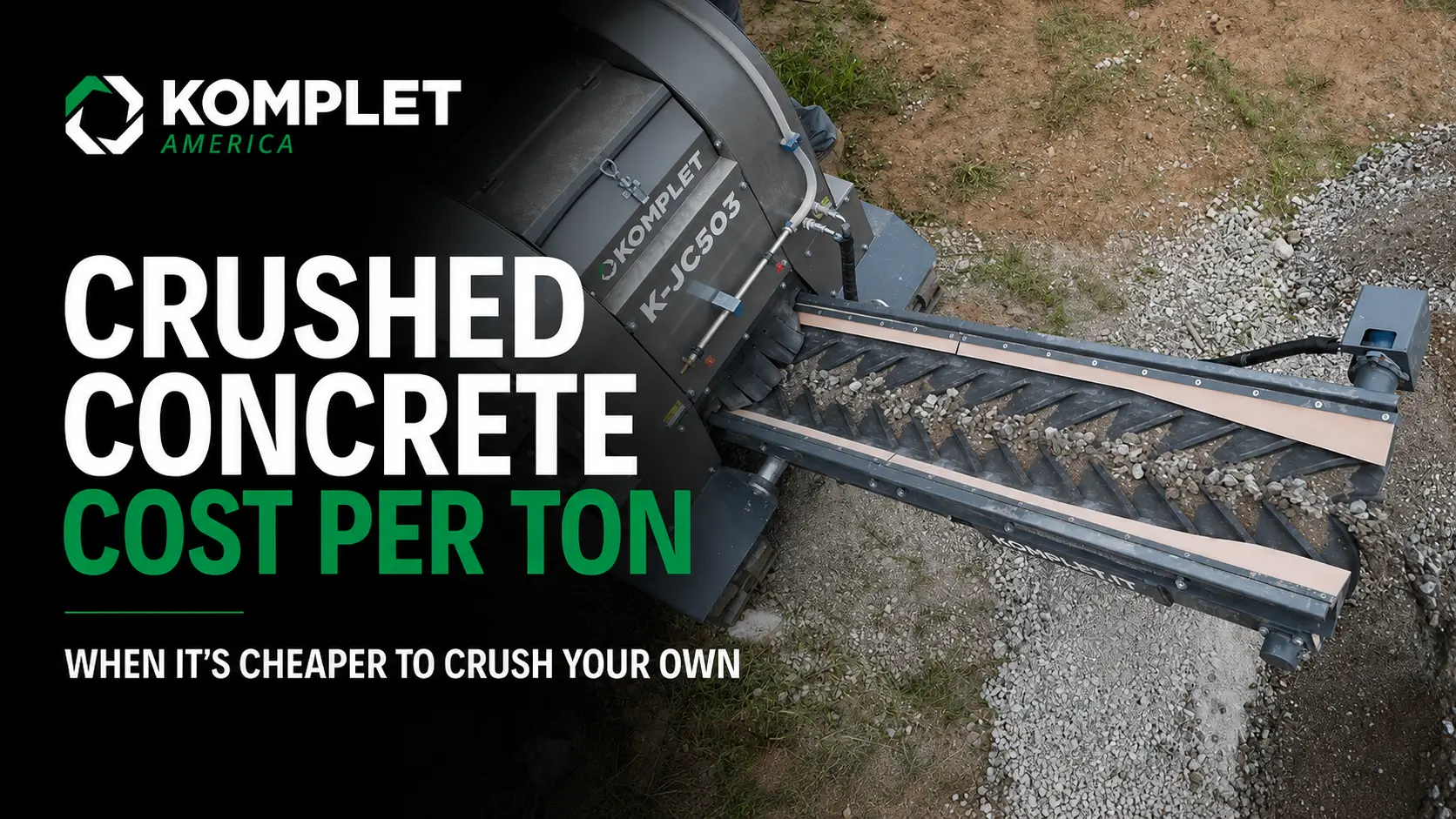
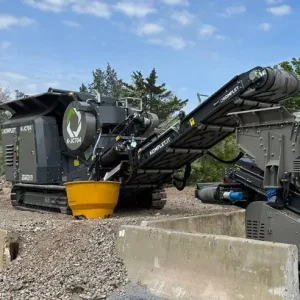
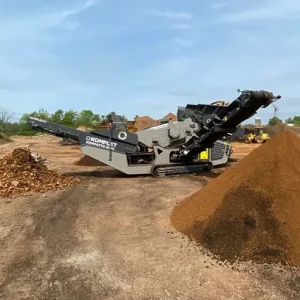
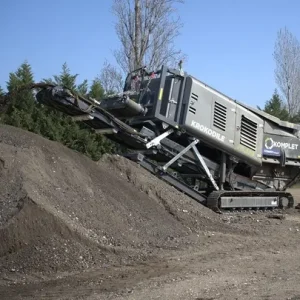
- Small operations (under ~5,000 tons/year — typical hardscape and demolition contractor): the K-JC 503 mini mobile jaw crusher pairs with the Kompatto 221 vibrating screener for compact yard production.
- Medium operations (5,000–25,000 tons/year): the K-JC 604 or K-JC 704 PLUS with the Kompatto 5030 heavy-duty vibrating screener handles higher-volume operations producing both for own use and for resale to other contractors.
- Larger operations (25,000+ tons/year): the K-JC 704 PLUS or K-JC 805 with Kompatto 124 handles in-yard recycling at small-quarry scale.
- Cubical aggregate production (state DOT spec applications, ASTM C33 concrete coarse aggregate): the K-IC 70 compact impact crusher produces cubical aggregate suited to applications where particle shape is a binding requirement.
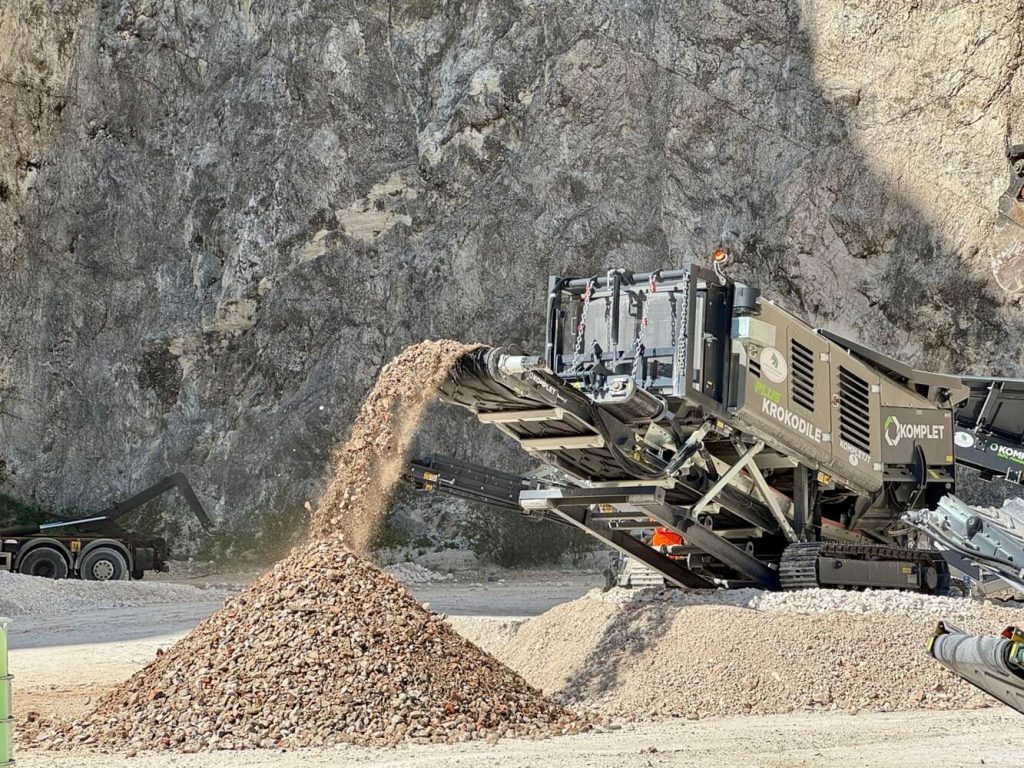
- Pre-reduction of oversized rubble: the Krokodile PLUS slow-speed shredder handles slabs and oversized rubble larger than the jaw crusher’s recommended max feed size, pre-reducing material to a feed size compatible with the primary crusher.
Production Workflow
- Source control: concrete demolition rubble is collected and stockpiled. Mixed-source feed is segregated where possible from cleaner concrete-only feed. Asbestos clearance documentation is collected at intake.
- Pre-reduction (where needed): oversized rubble is broken down with an excavator-mounted hydraulic breaker or with the Krokodile PLUS shredder before primary crushing.
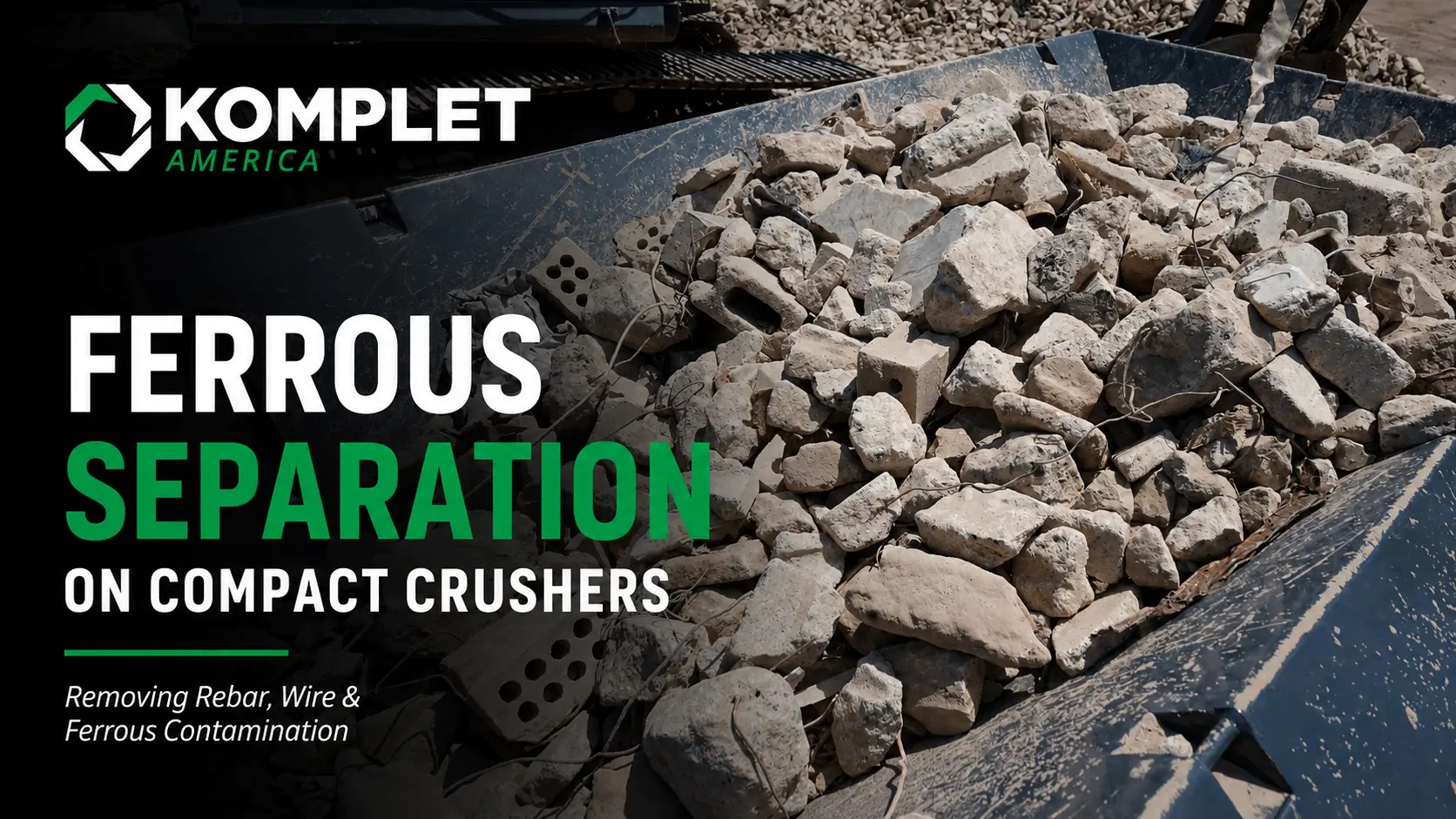
- Primary crushing: concrete is fed through the jaw crusher with closed-side setting (CSS) configured to produce the target top size. Integrated hydraulic magnetic belts (standard on K-JC 604, 704 PLUS, and 805) lift rebar and other ferrous metal off the discharge conveyor during crushing.
- Optional secondary crushing: where particle shape is required (state DOT applications, concrete mix coarse aggregate), the K-IC 70 produces cubical secondary aggregate.
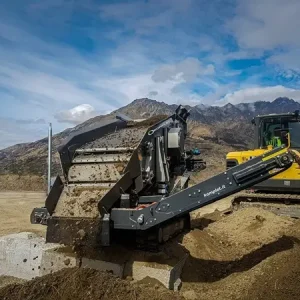
- Screening: the crushed output is fed across a vibrating screener with deck openings sized to capture target gradation envelopes (typically AASHTO #57, #67, #8, and dense-graded base).
- Stockpile management: sized products are stockpiled separately. The K-TC 460 portable mobile conveyor extends stockpile reach and reduces cross-contamination.
- Quality control sampling: per state DOT or engineering specification requirements.
- Outbound delivery: per-load tickets, source documentation, gradation reports as required by the receiving project.
Common Mistakes Contractors Make
Treating RCA as Disposal Rather Than Production
The contractor who treats demolition concrete as something to be ‘gotten rid of’ through crushing — without quality control discipline, without proper stockpile management, without gradation documentation — produces a stockpile that’s worth less than virgin aggregate of the same gradation. The contractor who treats it as production for resale or for own-use to specification produces a stockpile that’s worth virgin equivalent or close to it. Same equipment, same labor, very different economic outcome.
Mixing Source Streams Without Tracking
Concrete from highway demolition, building structural concrete, and mixed C&D demolition can produce meaningfully different RCA quality. Mixing the streams without tracking means the producer can’t claim the stockpile as any specific class of material. State DOT projects requiring source documentation can’t accept the unsourced product. The disciplined producer keeps source streams segregated until the production economics warrant blending.
Skipping Gradation Documentation
RCA without a current gradation report can be sold for non-spec’d uses but cannot be sold to state DOT, municipal, or engineered projects requiring documented gradation. The cost of accredited-lab gradation testing is small compared to the price premium for spec-compliant RCA. Producers who skip the documentation are choosing the lower-margin commodity market over the higher-margin spec’d market.
Overestimating RCA Performance in Restricted Applications
RCA is not a substitute for virgin aggregate in every application. New structural concrete on highway projects, ASTM C33 fine aggregate, certain asphalt mix designs, and sensitive landscape applications all have legitimate technical reasons for restricting or excluding RCA. The producer who pushes RCA into these applications without engineering review risks rejected loads, project delays, and reputational damage. The producer who understands the application matrix focuses sales on applications where RCA is the right answer.
Underestimating Permitting and Compliance Cost
Permits in hand is not the end of the compliance work — it’s the beginning. Annual reports, monitoring, recordkeeping, training, renewals, and modifications are ongoing operational obligations that typically require some combination of internal staff time and ongoing professional support. New entrants who budget for the initial permitting cost without budgeting for the ongoing compliance overhead routinely underestimate the true cost of operation.
Frequently Asked Questions
Is recycled concrete aggregate as good as virgin stone?
For most base course, subbase, structural fill, and drainage applications, properly produced RCA performs comparably to virgin crushed stone. The performance equivalence is well-documented in FHWA, AASHTO, and university research. RCA differs from virgin in measurable physical properties (higher absorption, slightly lower density, modestly higher LA Abrasion loss), but these differences don’t affect performance in non-structural applications and are routinely accommodated in state DOT specifications. For structural concrete mix designs, certain asphalt applications, and sensitive landscape uses, virgin aggregate remains the preferred choice.
Where can RCA not be used?
Most U.S. state DOTs do not allow RCA in new structural Portland cement concrete on highway and bridge projects. RCA is generally not used in ASTM C33 fine aggregate applications, in most asphalt mix designs (RAP is preferred for the recycled component), in architectural and decorative concrete where appearance matters, in pipe bedding for sensitive utility runs, and in landscape and water-feature applications where cement leaching could affect soil pH or water chemistry. State-specific specifications govern acceptance in any specific application.
Is RCA cheaper than virgin stone?
In most U.S. markets, yes. RCA pricing is typically 15–50 percent below virgin equivalent, with the largest savings in regions where virgin aggregate is expensive (Northeast, Pacific) and the smallest savings in regions where virgin is cheap (parts of South Central). For contractors producing their own RCA from on-site or in-yard demolition rubble, the savings include both the avoided dump fee on the rubble being eliminated and the avoided virgin aggregate purchase — a double benefit that makes the on-site production case particularly favorable.
What state DOTs accept RCA?
Most U.S. state DOTs accept RCA in some form for base course, subbase, and structural fill applications. State-specific frameworks include New Jersey’s DGABC blend allowance under N.J.A.C., New York’s Section 733-07 framework, Pennsylvania’s Publication 408 RPCC provisions, Florida’s Section 911-2.7, Caltrans Section 26 Class 2/3 base, Texas’s Item 247 Type D classification, and similar frameworks in other states. We cover the state-by-state framework in detail in our companion piece, State DOT Specs for Recycled Concrete Aggregate: A Contractor’s Reference.
What’s the difference in absorption between RCA and virgin?
RCA absorption is typically 3–8 percent (per AASHTO T 85 / ASTM C127), versus 0.5–2.5 percent for typical hard virgin crushed stone (limestone, granite, trap rock). The higher RCA absorption is a function of the residual cement paste attached to RCA particles. Practical implications: RCA stockpiles dry more slowly after rain, RCA-incorporating concrete mix designs require water adjustment, and RCA compaction moisture content is slightly higher than virgin equivalent. None of these are disqualifying for non-structural applications.
Does RCA contribute to LEED credits?
Yes. RCA can contribute to LEED v4 Materials and Resources credits for both recycled content (Building Product Disclosure and Optimization) and construction waste diversion (Construction and Demolition Waste Management). On-site or near-site RCA production is particularly favorable for the waste diversion credits because the material doesn’t enter the landfill stream. Other sustainability frameworks (Envision, federal Buy Clean, state and municipal green building requirements) increasingly include similar provisions.
Can I use RCA in concrete?
For new structural concrete on state DOT highway projects, generally no — most state DOTs do not allow RCA in PCC, with limited exceptions in California, Massachusetts, and Oklahoma per FHWA literature. For non-structural concrete, controlled low-strength material (CLSM, flowable fill), architectural concrete (with engineering review), and specific structural applications under engineering review, RCA can be incorporated. The mix design adjustments for RCA’s higher absorption and slightly different density are well-established in the technical literature but require qualified concrete mix design support.
Is RCA environmentally better than virgin stone?
In most regional comparisons, yes — RCA’s primary environmental advantages are avoided extraction (quarry blasting, hauling) and avoided landfill (associated transportation and methane). RCA production itself uses energy (crushing, screening) but typically at lower total than virgin extraction in most regional comparisons. The carbon-and-resources case for RCA is the underlying driver of the increasing share of LEED, Envision, and federal Buy Clean specifications that favor recycled materials. For sensitive applications where cement leaching could affect surrounding soil or water chemistry, virgin aggregate may have a smaller environmental footprint specifically in those local impact categories.
What’s the lifespan of RCA-based base course compared to virgin?
Comparable in most applications. State DOT and FHWA performance data over decades of RCA use in base course and subbase show comparable structural performance and comparable service life to virgin aggregate of the same gradation. Failures attributable to RCA-versus-virgin material choice (rather than to poor construction discipline, unsuitable subgrade, or other factors) are not commonly reported in the technical literature. The dominant variable in base course service life is construction discipline (subgrade preparation, geotextile use, compaction, drainage), not RCA-versus-virgin material choice.
Final Thoughts
The RCA-versus-virgin discussion has shifted from a question of whether RCA is acceptable to a question of where RCA is the right choice. In most base course, subbase, structural fill, and drainage applications, the answer is now yes. In structural concrete and certain other restricted applications, the answer remains no. The contractor or engineer who knows the difference operates with a meaningful information advantage in a market where RCA’s share continues to grow.
For the contractor or recycler considering on-site or in-yard RCA production, the case has gotten meaningfully stronger over the past several years. Tipping fees have risen approximately 30 percent in inflation-adjusted terms since 2016 and 10 percent in 2024 alone. Virgin aggregate prices have followed similar trajectories. Permit frameworks have stabilized. State DOT acceptance has broadened. The compact crushing and screening equipment has matured into proven technology with established service networks. The case that was experimental a decade ago is mainstream now.
Komplet’s compact crusher and screener lineup is sized for the contractor and recycler markets where this case applies most directly. Our specialists are happy to talk through the equipment configuration that fits a specific operation’s project mix, target product output, and regional economic environment. The mathematics work most favorably in the markets where dump fees and virgin aggregate prices are highest — and those are exactly the markets where the case for owning the production capability is most compelling.
For broader context across the cluster, see our companion articles: Crushed Stone Grades: A Komplet Basic Guide to Aggregate Size and Use Cases, The Hardscape Contractor’s Guide to On-Site Stone Production, State DOT Specs for Recycled Concrete Aggregate, Construction & Demolition Tipping Fees by Region, Wear Parts Economics: Jaw Plates, Blow Bars, and Screen Mesh, OSHA Silica Compliance for Crushing Operations, Permit Guide: Starting a Small-Scale Concrete Recycling Operation, Crusher Run vs #57 Stone for Driveways, and #57 Stone vs #67 Stone.
Ready to Start Producing RCA from Your Demolition Rubble?
- Talk to a Komplet specialist about pairing the right crusher and screener to your annual rubble tonnage, regional economic environment, and target product mix. Call 908-369-3340 or visit com/contact-us.
- Browse the full Komplet equipment lineup — crushers, impact crushers, screeners, conveyors, and shredders sized for compact contractor and recycling operations.
- Explore equipment financing through Komplet Capital — 24-hour approvals, terms from 36 to 72 months, 100% financing available.
- Consider a pre-owned Komplet machine — typical capital savings of 40 to 70 percent versus new, factory-supported by the same Komplet America service network.
Never enough.
Disclaimer: All physical property ranges, FHWA references, AASHTO standards, state DOT acceptance frameworks, LEED credit information, and economic comparisons in this article are drawn from publicly available sources current as of late 2025 and early 2026. Standards change over time, and the binding spec for any project is the version current at the regulatory agency, engineer of record, or project owner. Specific compliance, performance, and acceptance questions should be reviewed with qualified engineering counsel and with the relevant state and project authorities. Cost ranges, payback timelines, and economic comparisons are illustrative and based on industry patterns; actual results vary significantly by region, market, project specifications, equipment utilization, operator skill, financing terms, and many other factors. Operating, maintenance, and service guidance is general in nature. Always refer to the official Komplet operator’s manual for the specific machine model and serial number, and follow OEM intervals and procedures. For warranty-protected work, contact Komplet America at 908-369-3340 or your authorized Komplet dealer. Improper service or non-OEM parts may void warranty coverage and create safety hazards.