
Pavers are deceptively simple. They look like a tile job done outside — individual concrete or stone units laid in a pattern, with sand swept into the joints. The visible work is the easy part. The work below the visible surface determines whether the patio, walkway, driveway, or commercial plaza performs for thirty years or starts heaving and rocking after the second winter. And that work below the surface is almost entirely about aggregate: which products go in which layer, at what depth, in what condition, with what compaction discipline. Get the aggregate decisions right and the system performs. Get them wrong and no amount of careful paver placement on top of the system can save it.
The reason paver work is more aggregate-sensitive than most other hardscape applications is that pavers carry their loads through the joint pattern between units rather than through a single rigid surface like a slab or pavement. The structural action depends on the bedding layer locking the pavers in plane, the base layer providing uniform support, the edge restraint keeping the perimeter pavers in their pattern, and — for permeable systems — the entire section providing stormwater storage and infiltration without any layer trapping water against the underside of the pavers. Every layer has a job. Every layer has wrong choices that look right at installation and reveal themselves as failures later.
This guide is the contractor’s reference for paver base material selection across standard interlocking concrete pavers, permeable interlocking concrete pavement, natural stone hardscape, and vehicular paver applications. It covers the Interlocking Concrete Pavement Institute (ICPI) framework that most North American paver work follows, the ASTM standards behind specific aggregate products used in paver systems, the layer logic that distinguishes a working paver section from a failure-prone one, the edge restraint and joint stabilization decisions that complete the system, the freeze-thaw considerations that affect aggregate selection in cold climates, and — for the contractor producing aggregate from concrete demolition rubble or natural rock — the production discipline that delivers paver-grade clean aggregate consistently. The audience is the hardscape contractor, the paver installation specialist, the commercial walkway and plaza contractor, the recycler producing aggregate for the hardscape market, and any general contractor handling paver work directly.
Komplet America has been the U.S. distributor of Komplet S.p.A. compact crushers, screeners, and shredders since 2018, and the Conti family construction legacy behind Komplet America stretches back to 1906. Hardscape contractors are one of the strongest segments of our compact crusher customer base, and on-site production of crusher run and sized stone is one of the highest-leverage operational moves a hardscape contractor can make as material costs and dump fees continue to climb. The aggregate logic in this article comes directly from the conversations our specialists have with hardscape contractors sizing equipment for typical paver project mixes.
The Quick Answer
For contractors who don’t need the full reference, the standard sections look like this:
- Standard interlocking concrete paver patio or walkway over typical subgrade: prepared subgrade, geotextile (where soils are wet/silty), 4–6 inches of compacted crusher run base, 1 inch of ASTM No. 8 stone or coarse bedding sand as the setting bed, pavers, polymeric joint sand or No. 8/9 stone joint fill, edge restraint at all perimeters.
- Vehicular paver driveway: same components, deeper section. 8–12 inches of compacted crusher run base over geotextile, with structural lift (#3 or #5 stone) over weak subgrade, 1 inch of ASTM No. 8 stone setting bed, pavers rated for vehicular use, robust edge restraint.
- Permeable interlocking concrete pavement: entirely open-graded section. ASTM No. 2 or No. 3 stone as storage layer (depth varies — typically 8–24 inches based on stormwater design), ASTM No. 57 stone as choker course (typically 4 inches), ASTM No. 8 stone as bedding course (typically 2 inches), pavers with permeable joint pattern, ASTM No. 8 or No. 9 stone as joint fill, edge restraint at all perimeters.
- Natural stone walkway (flagstone, bluestone, fieldstone): 4–6 inches of compacted crusher run base, 1 inch of stone dust or coarse sand setting bed depending on regional practice and stone selection, joints filled with sand, polymeric sand, or stone dust depending on aesthetic and drainage requirements.
- The single most consequential decision: whether the system is permeable or non-permeable. Mixing dense-graded aggregate into a permeable section defeats the drainage function entirely. Mixing open-graded aggregate into a non-permeable section starves the base of structural compaction.
The ICPI Framework: How North American Paver Work Is Specified
The Interlocking Concrete Pavement Institute publishes the technical specifications and best practice guidance that govern most North American paver installation. Two of their Tech Spec documents are particularly relevant for paver base aggregate selection:
- ICPI Tech Spec 2: Construction of Interlocking Concrete Pavements — covers standard non-permeable interlocking concrete paver work, including base preparation, bedding course, paver placement, and joint sand. The reference document for typical residential and commercial paver work.
- ICPI Tech Spec 18: Construction of Permeable Interlocking Concrete Pavement — covers permeable paver systems with their entirely-open-graded section. The reference document for stormwater management paver applications, LEED-credit-pursuing projects, and any paver work designed to infiltrate stormwater on site.
Other ICPI Tech Specs cover specific applications: Tech Spec 4 (Structural Design of Interlocking Concrete Pavements for Roads and Parking Lots), Tech Spec 8 (Concrete Grid Pavements), Tech Spec 14 (Concrete Paver Restraints), and others. The ICPI documents are not building codes themselves, but they are widely referenced by manufacturer warranties, engineering specifications, and project documents — and they are the practical standard most paver installers, suppliers, and inspectors work from.
Why ICPI Matters for Aggregate Selection
The aggregates specified in ICPI documents reference ASTM standards (ASTM C33 for concrete aggregate, ASTM D448 / AASHTO M43 for size designations) rather than colloquial product names. “ASTM No. 8 stone” and “AASHTO No. 8 stone” are the same product — small open-graded clean aggregate with 3/8-inch top size. When a project specification calls for “ASTM No. 8 setting bed,” it’s referencing a binding gradation that the contractor needs to deliver. The contractor’s local aggregate yard may carry the same product under a different name (“#8 stone,” “chip stone,” “clean 3/8,” etc.) — confirm the gradation matches the spec rather than relying on the local name.
Layer Logic: Each Layer Has a Job
A working paver section separates four distinct functions across four (or more) physical layers. Confusing the functions — using a setting bed material for a base, using a base material for joints, using non-permeable aggregate in a permeable system — is the most common cause of paver failure. The framework below applies across both standard and permeable paver systems, with different aggregate choices for each function depending on the system type.
Function 1: Base Layer (Structural Support)
The base layer carries the structural load of the paver system. It distributes vehicle and pedestrian loads to the underlying subgrade, resists differential settlement, and provides a stable, uniform platform for the bedding course above. In standard non-permeable paver systems, the base is dense-graded crusher run (or regional equivalent — DGABC, 2A modified, 21A, etc.) compacted in lifts. In permeable systems, the base is open-graded ASTM No. 2 or No. 3 stone, sized and depth-engineered to provide both structural support and stormwater storage.
The base is also where total section depth is determined. Pedestrian-only patios use 4 inches of compacted base in most regions. Vehicular driveways and parking areas use 8–12 inches or more. Commercial plazas with truck access use engineered sections that can reach 18+ inches. Section depth is determined by traffic loading, subgrade conditions, freeze depth in cold regions, and stormwater requirements (for permeable systems).
Function 2: Setting Bed (Paver Bedding Course)
The setting bed is the thin layer immediately under the pavers. It serves three purposes: it provides the final fine-tuning of paver elevation, it allows individual pavers to consolidate slightly under load without stressing adjacent units, and it protects the paver underside from direct contact with the more aggressive base material. The setting bed is intentionally thin — typically 1 inch — and must remain consistent in thickness across the installation. It is not a leveling layer; the base must already be at design elevation before the setting bed goes down.
ICPI Tech Spec 2 specifies ASTM No. 8 stone or, alternatively, coarse bedding sand meeting ASTM C33 fine aggregate for concrete. In practice, ASTM No. 8 stone (sometimes called “clean No. 8 chips,” “3/8-inch chips,” or “setting bed stone”) is the dominant material in most regions, particularly for vehicular and commercial work. Coarse bedding sand is more common in residential pedestrian patio work, particularly in regions where No. 8 stone is harder to source clean. ICPI Tech Spec 18 specifies ASTM No. 8 stone for permeable paver setting beds — sand is not appropriate in permeable systems because it would clog the open-graded structure.
Function 3: Joint Stabilization
The material between pavers in the joints stabilizes the pattern, prevents paver migration under load, and (in some systems) prevents weed growth and ant activity. Standard non-permeable paver systems most commonly use polymeric joint sand — fine sand mixed with a polymer binder that activates with water and hardens in place. Polymeric sand provides excellent joint stabilization and weed/ant resistance. Traditional sand (silica sand, mason’s sand) is still used in some installations, particularly natural stone work where the polymer aesthetic is undesired.
Permeable paver systems use ASTM No. 8 or No. 9 stone in the joints — open-graded clean aggregate that lets water flow through the joint pattern into the storage layer below. Sand cannot be used in permeable joint patterns because it would clog the joints and defeat the drainage function.
Function 4: Edge Restraint
Edge restraint is not technically an aggregate layer, but it is a structural element of every paver system that fails predictably when omitted. The restraint at the perimeter of the paver field prevents lateral movement of the pavers under load. Without restraint, the pavers walk outward at the perimeter under repeated tire passes or foot traffic, the joints open, the pattern destabilizes, and the system fails progressively from the edges inward. Edge restraint options include manufactured plastic or metal restraint products designed for paver work, concrete curbs cast around the perimeter, embedded steel or stone edging, and structural soldier courses set in concrete. The restraint must be installed before the bedding course is placed (or in coordination with the base, depending on the restraint type) and must extend to the design depth of the system.
Standard Non-Permeable Paver Section: Layer by Layer
The section below covers a typical residential or light commercial non-permeable paver installation following ICPI Tech Spec 2 recommendations. Specific dimensions and materials should be verified against project specifications, manufacturer recommendations, and engineer of record requirements.
Subgrade Preparation
Strip topsoil and organic material to undisturbed mineral soil. Identify and address soft pockets — excavate, replace with structural fill, and proof-roll. Compact uniformly with appropriate equipment for the soil type. Establish design cross-slope for surface drainage. The subgrade preparation principles are the same as for slab base — see What Gravel Goes Under a Concrete Slab? for the broader subgrade discussion.
Geotextile (Where Needed)
On wet, silty, or fines-rich subgrade, non-woven needle-punched geotextile (AASHTO M288 Class 2, AOS appropriate to the surrounding soil) prevents subgrade fines from migrating up into the base aggregate over time. Without geotextile in these conditions, the dense-graded base loses its structural integrity over 5–10 years and the paver system fails progressively. The fabric is essential on wet sites and optional on firm, dry, granular subgrade.
Optional Structural Lift
For paver work over weak or wet subgrade, or for vehicular paver applications with heavier loading, a structural lift of ASTM No. 3 or No. 5 stone (4–8 inches depending on conditions) below the dense-graded base provides additional load distribution and drainage capacity. The structural lift is optional on dry, firm subgrade carrying typical residential pedestrian loads. It becomes important on wet sites, heavy-duty driveways, and commercial vehicular work.
Compacted Dense-Graded Base
4–6 inches compacted depth for residential pedestrian work; 6–8 inches for residential driveway pavers; 8–12 inches for commercial vehicular and heavier residential applications. Crusher run, dense-graded aggregate (DGA), DGABC, 2A modified, 21A, Item 4 Type 2, or whatever the regional equivalent is called — the gradation logic is consistent across regional names. For the regional name guide and detailed material discussion, see Crusher Run vs #57 Stone for Driveways.
Place in lifts not exceeding 4–6 inches uncompacted, compact each lift before placing the next. Optimum moisture content is in the 5–8 percent range; the field test is feel — material clumps when squeezed but doesn’t bleed water. Compact with appropriate equipment: vibratory plate compactor (500–1,000 lb class) for residential work, ride-on tandem vibratory roller for larger commercial sections.
Edge Restraint Installation
Install edge restraints at the perimeter before placing the setting bed. Restraint type and depth depend on the system: spike-anchored plastic restraint for residential pedestrian patios, concrete curbs for commercial work, mortared stone or steel for premium installations. The restraint must be at design depth — typically extending below the base of the setting bed — and the spike or anchor system must reach into the dense-graded base layer.
Setting Bed (Bedding Course)
1 inch of ASTM No. 8 stone or coarse bedding sand, screeded to a consistent thickness. This layer is the contractor’s quality moment — sloppy screeding produces uneven paver elevations that show in the finished surface and lead to differential settlement under load. Use screed rails or PVC pipe to maintain consistent thickness; never use the bedding material to fill low spots in the base.
Paver Placement
Place pavers per the design pattern, working from a starting line. Standard paver placement allows for joint width as designed (typically 1/16 to 1/8 inch for standard interlocking pavers, wider for certain natural stone applications). Cut perimeter pavers to fit the field area, avoiding small pieces (less than 1/4 paver) that destabilize under load.
Joint Sand and Compaction
Sweep polymeric joint sand into the joints, removing excess from the paver surface. Compact the entire field with a plate compactor fitted with a paver pad (rubber or plastic protective pad to prevent paver damage) — this seats the pavers into the bedding course and consolidates the joint sand into the joints. Activate polymeric sand per manufacturer instructions (typically a light water mist that initiates polymer binding).
Permeable Interlocking Concrete Pavement: An Entirely Different System
Permeable interlocking concrete pavement (PICP) is structurally and hydrologically distinct from standard pavers. Every layer is open-graded clean aggregate; nothing in the section is dense-graded. The system functions as a stormwater management facility — a permeable surface that lets rainfall and runoff infiltrate through the joints into a storage reservoir below, where the water either infiltrates into the underlying soil or discharges to a designed outlet. ICPI Tech Spec 18 is the binding reference for design and construction.
The PICP Section
- Subgrade: prepared per design. Some PICP designs (“full infiltration”) rely on the underlying soil to absorb the stored stormwater; subgrade infiltration testing is required. Other designs (“partial infiltration” or “no infiltration”) use an underdrain system to discharge stored water; subgrade infiltration is less critical.
- Geotextile: non-woven needle-punched fabric at the subgrade interface in most PICP designs. The fabric prevents subgrade fines from migrating up into the storage layer and clogging the void space.
- Storage Layer (subbase reservoir): ASTM No. 2 stone (2½-inch top size) or ASTM No. 3 stone (2-inch top size). Depth varies by stormwater design — typically 8–24 inches for residential applications, deeper for commercial work with significant stormwater storage requirements.
- Choker Course: ASTM No. 57 stone (1-inch top size). Typically 3–4 inches. Bridges the larger storage layer stones and provides a stable platform for the bedding course above.
- Bedding Course: ASTM No. 8 stone (3/8-inch top size). Typically 2 inches. The setting bed for the pavers, with the same general function as in standard paver systems but using open-graded clean stone instead of bedding sand.
- Pavers: permeable interlocking concrete pavers with manufacturer-specified joint pattern allowing infiltration. Joint width is typically larger than standard pavers (often 5/16 to 5/8 inch) to provide the open void space the system needs.
- Joint and Opening Fill: ASTM No. 8 or No. 9 stone. Open-graded clean aggregate filling the joints — sand is not appropriate in PICP joints.
Why PICP Sections Differ
The PICP section provides three functions simultaneously: structural support, stormwater storage, and stormwater infiltration. Each layer contributes:
- Storage layer: the largest void space and the largest contribution to stormwater storage volume. Open-graded No. 2 or No. 3 stone has a void ratio of 38–45 percent, meaning roughly 4 of every 10 cubic feet of placed material is available for water storage.
- Choker course: prevents the storage layer stones from migrating upward into the bedding course while still maintaining open-graded drainage.
- Bedding course: provides the paver setting platform while letting infiltrating water pass through.
- Joint fill: lets surface water enter the section through the joints. The single most important function in a PICP system; if joints clog, the entire infiltration function fails.
PICP design is typically performed by a stormwater engineer or landscape architect with PICP design experience. The contractor’s role is faithful execution of the binding design — including the gradation specifications for each layer, which are not interchangeable in a PICP system the way they sometimes are in non-permeable systems.
Material-by-Material Reference
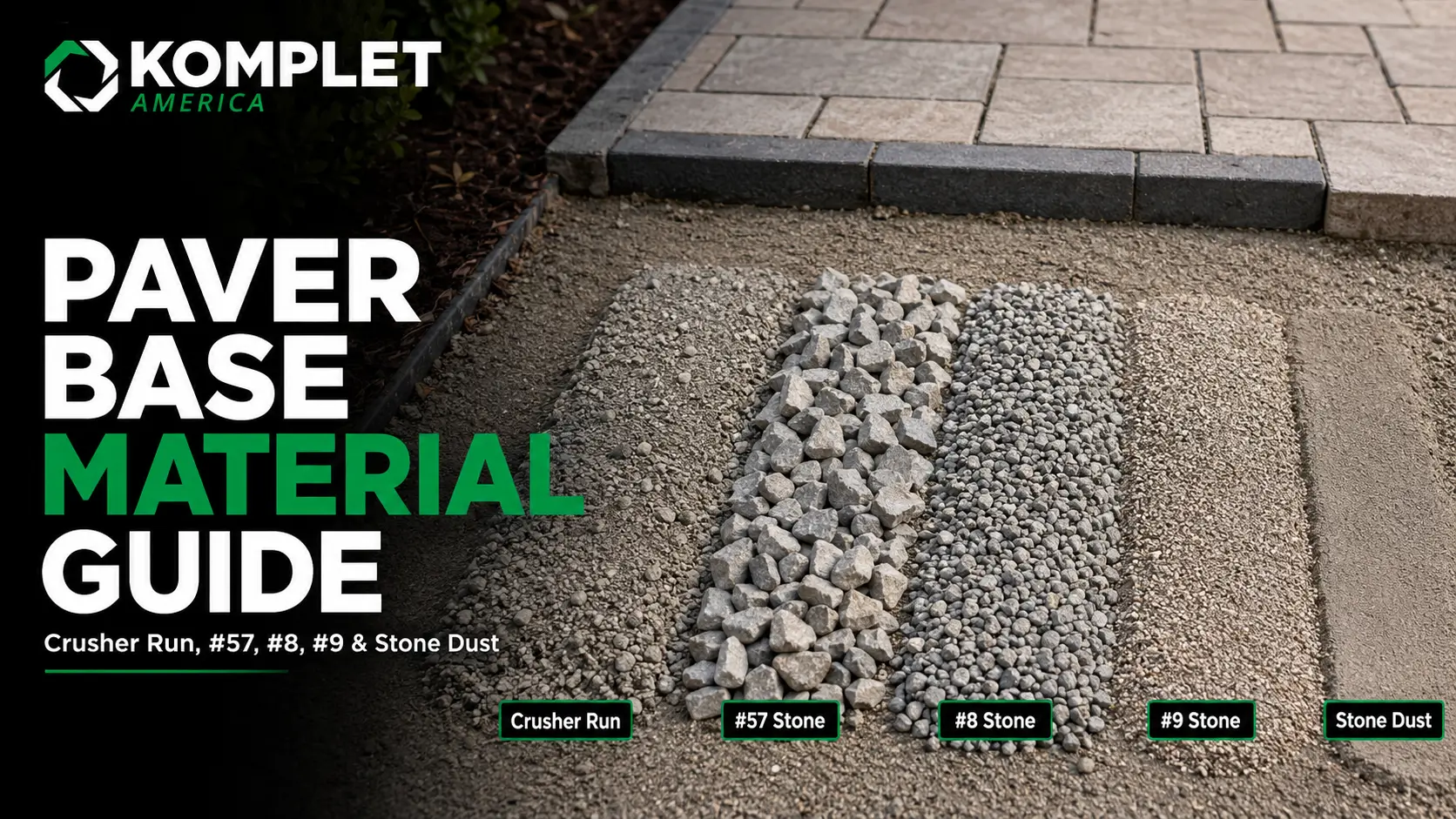
Crusher Run (Dense-Graded Aggregate)
Standard non-permeable paver base. Compacts to a tight, locked surface with high CBR. Top size 1–1½ inches; gradation includes coarse stone, intermediate particles, and 5–12 percent fines passing the #200 sieve. Regional names include DGA, DGABC, 2A modified, 21A, Item 4 Type 2, CR-6, and others. Not appropriate in any layer of a permeable paver system. For detailed crusher run discussion, see Crusher Run vs #57 Stone for Driveways and Best Gravel for Driveways: A Contractor’s Layer-by-Layer Guide.
ASTM No. 57 Stone
1-inch top size open-graded clean stone. Used as choker course in PICP systems. Used as drainage layer in some over-built non-permeable paver designs (typically over weak subgrade with structural-lift design). Not used as a setting bed for pavers — the 1-inch top size is too large to provide consistent paver elevation. Detailed material discussion at #57 Stone vs #67 Stone.
ASTM No. 8 Stone
3/8-inch top size open-graded clean stone. The dominant setting bed material for both standard and permeable paver systems per ICPI specifications. Also used as bedding course and joint fill in PICP. Sometimes called “clean No. 8 chips,” “3/8-inch chips,” “setting bed stone,” or “chip stone” depending on regional terminology. Confirm gradation matches ASTM/AASHTO No. 8 envelope: 100 percent passing ½-inch sieve, 85–100 percent passing 3/8-inch sieve, 10–30 percent passing #4 sieve, 0–10 percent passing #8 sieve.
ASTM No. 9 Stone
¼-inch top size open-graded clean stone — smaller than No. 8. Used as joint fill in PICP systems where finer joint material is appropriate. Also used as paver bedding sand alternative in some regions, though No. 8 is more widely specified. Some regions don’t carry No. 9 stone; No. 89 stone (a slightly different gradation in the same size class) is the common alternative.
Stone Dust / Screenings / No. 10
Fines produced during crushing and screening — material passing the #4 sieve and finer. Used as paver bedding in some traditional natural stone installations (flagstone, bluestone, fieldstone walkways) and as joint fill in some natural stone hardscape work. Not used in standard interlocking concrete paver systems (No. 8 stone or coarse sand are preferred) or in any permeable paver system (would clog the open-graded structure). The aesthetic of stone dust under natural stone is part of the appeal — the fines fill irregular spaces under uneven flagstone in a way that more uniform aggregate does not.
Coarse Bedding Sand
Manufactured concrete sand or natural concrete sand meeting ASTM C33 gradation for fine aggregate. Used as alternative setting bed in standard paver systems, particularly in regions where ASTM No. 8 stone is harder to source clean. ICPI Tech Spec 2 allows either No. 8 stone or coarse bedding sand for setting bed. Sand setting beds typically perform identically to No. 8 stone setting beds in residential pedestrian applications; many installers prefer No. 8 stone for vehicular work because of its slightly better load distribution characteristics.
Polymeric Joint Sand
Specialized joint material — fine sand mixed with a water-activated polymer binder that hardens after installation. Provides excellent joint stabilization, weed resistance, and ant resistance. The dominant joint material for residential and most commercial standard paver work in North America. Activated by light water mist after sweeping into joints. Multiple manufacturers offer products with different polymer chemistries; performance varies modestly across products, with all of them outperforming traditional sand for joint longevity.
Traditional Joint Sand
Silica sand or mason’s sand (washed, finely graded sand without polymer binder). Used in some traditional installations, particularly natural stone hardscape where the polymer aesthetic is undesired or where the joint design is wider than typical interlocking paver work. Performs adequately when properly maintained but allows weed growth and ant activity to develop in the joints over time.
Application Variants: Different Paver Work, Different Sections
Pedestrian Patio
4 inches of compacted crusher run base over compacted subgrade (with geotextile if soils are wet). 1 inch of ASTM No. 8 stone or coarse bedding sand setting bed. Pavers. Polymeric joint sand. Edge restraint at perimeters. The standard residential paver patio section. Performs reliably in most subgrade conditions when properly installed.
Residential Paver Driveway
8 inches of compacted crusher run base (12 inches over weak subgrade). Geotextile is essentially mandatory at this loading level. Optional 4–6 inches of #3 or #5 stone structural lift below the dense-graded base on wet sites. ASTM No. 8 stone setting bed. Vehicular-rated pavers (typically 80mm thickness or thicker — manufacturer specifications determine acceptable applications). Robust edge restraint — concrete curbs are common on driveway perimeters because of the loading. Polymeric joint sand.
Commercial Walkway / Plaza
ICPI Tech Spec 4 governs structural design for commercial paver work. Typical sections include 6–8 inches of compacted crusher run base, 1 inch of ASTM No. 8 setting bed, vehicular-rated pavers if any vehicle access is anticipated, robust edge restraint (often concrete curbs), and polymeric joint sand. Larger plazas may include additional structural design elements: thicker base sections, engineered subgrade preparation, and integrated stormwater management.
Permeable Paver Application
Per ICPI Tech Spec 18, with subgrade preparation, geotextile, ASTM No. 2 or No. 3 storage layer (depth determined by stormwater design), No. 57 choker course, No. 8 bedding course, permeable pavers, No. 8 or No. 9 joint fill, edge restraint. PICP design typically involves a stormwater engineer; the contractor’s role is faithful execution.
Natural Stone Walkway
4–6 inches of compacted crusher run base over compacted subgrade. 1–2 inches of stone dust or coarse sand setting bed depending on stone selection and regional practice. Natural stone units placed on the bedding. Joints filled with stone dust, sand, or polymeric sand depending on aesthetic and drainage requirements. Edge restraint or natural transitions to surrounding landscape. The natural stone aesthetic is generally less compatible with manufactured edge restraint products; concrete curbs, fieldstone borders, or planted edges are more common.
Pool Deck Pavers
Standard residential paver patio section, with additional considerations: drainage away from the pool to prevent pool-water staining of pavers, expansion accommodation between paver field and pool coping, and (in cold climates) attention to freeze-thaw cycles that can lift pavers near the pool edge where moisture concentrates. Some regions specify slip-resistant paver textures for pool deck applications.
Cold Climate and Freeze-Thaw Considerations
Paver systems in regions with winter freeze cycles face unique challenges that affect both base aggregate selection and section depth. Frost-susceptible silty subgrade can heave several inches during freeze events, lifting the entire paver section. Water trapped in any layer of the section freezes and expands, displacing pavers above. Repeated freeze-thaw cycles work the section over time, gradually destabilizing what was a solid installation.
Cold-Climate Adjustments
- Increase base depth. The 4-inch base that works in mild climates may need to be 6–8 inches in regions with significant frost depth. Depth helps both with bearing capacity reductions during thaw and with frost-resistant section behavior.
- Use geotextile aggressively. Subgrade fines migration accelerates during freeze-thaw cycles; the cost of fabric is small compared to the cost of a paver section that fails to fines pumping.
- Address drainage emphatically. Water trapped in the section is the biggest freeze-thaw amplifier. Surface drainage out of the paver field, perimeter drainage at the section edges, and (where relevant) underdrain systems all reduce the freeze-thaw stress on the system.
- Consider permeable systems in marginal applications. PICP systems perform well in cold climates because water doesn’t accumulate in the structure — it infiltrates through the open-graded section to the underlying soil or to a designed outlet. The freeze-thaw amplification of trapped water doesn’t apply.
- Use polymeric joint sand. Traditional sand joints are more vulnerable to freeze-thaw displacement than polymeric sand. The polymer binding holds the joint material in place through cycles that would unbind ordinary sand.
Producing Paver Aggregate On-Site
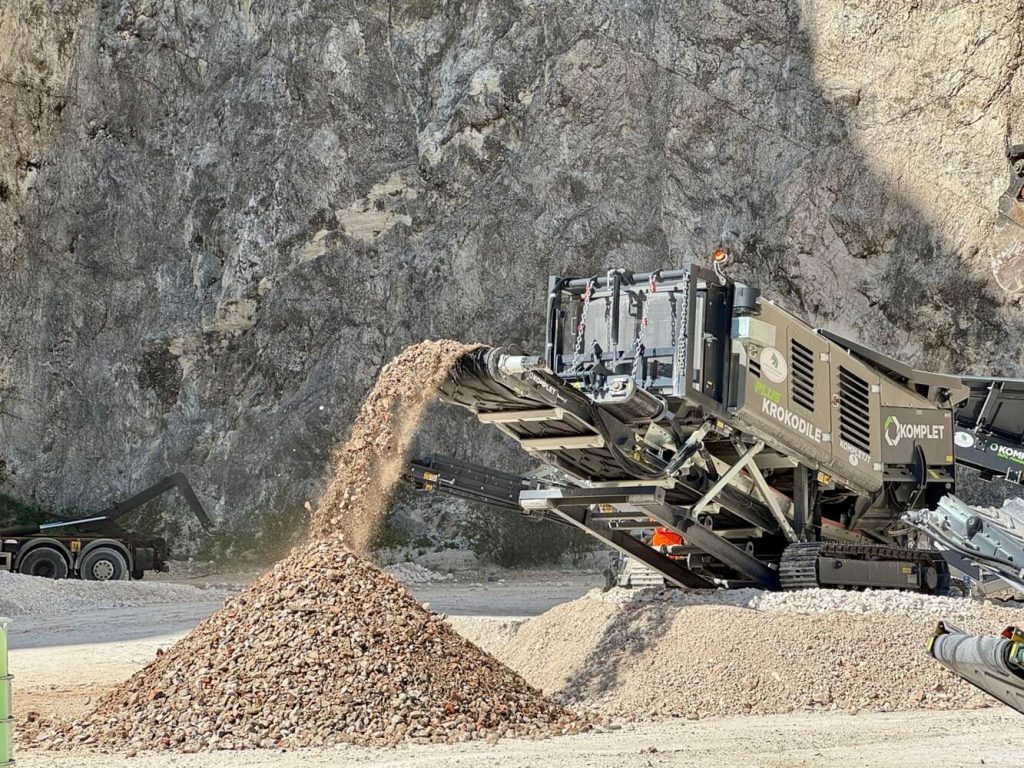
For hardscape contractors and recyclers producing aggregate from concrete demolition rubble, paver materials are one of the standard product mixes the same equipment can deliver. Hardscape work routinely generates concrete demolition feedstock — old patios, driveway aprons, walks, and slabs that come out as part of a renovation or new installation are exactly the source material a compact crusher needs. The economics of on-site recycling are particularly favorable for hardscape contractors because the rubble being eliminated and the aggregate being produced are both contractor-grade products on the same project.
Production Workflow for Paver Materials
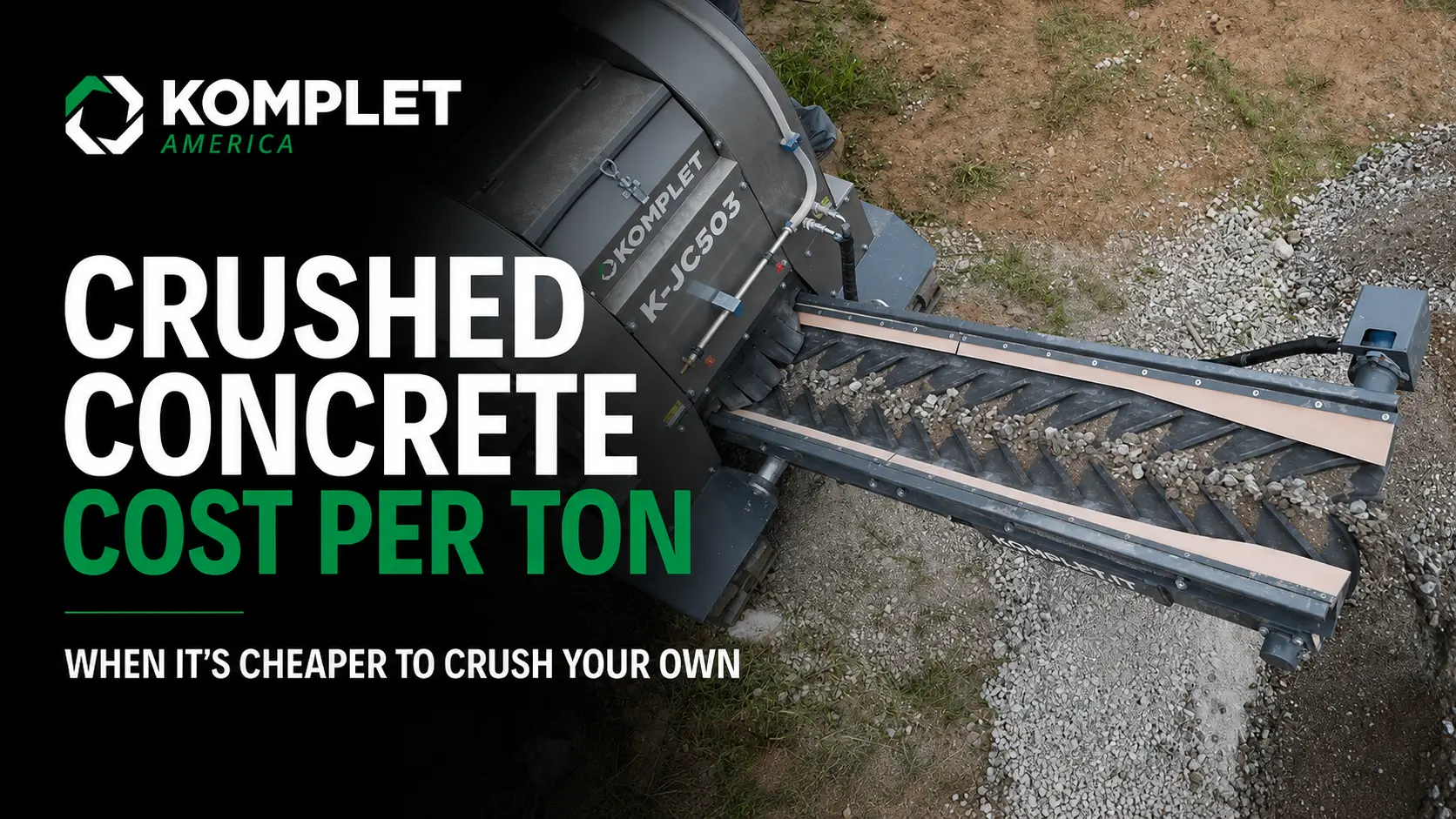
- Crush concrete demolition rubble through a primary jaw crusher — K-JC 503 for compact hardscape operations, K-JC 604 or K-JC 704 PLUS for higher-volume recyclers.
- Magnetic separation removes ferrous metal from the discharge during crushing.
- Screen the crushed output through a vibrating screener — typically the Kompatto 5030 or Kompatto 221 for compact operations. For paver work specifically, multiple screening passes may be needed to separate the crusher run base material, the No. 8 setting bed material, and the stone dust joint material into distinct stockpiles.
- Stockpile each product separately. Cross-contamination is particularly damaging for paver setting bed material — even small amounts of crusher run fines in the No. 8 stockpile compromise the setting bed performance.
Producing Cubical Aggregate
Some applications — particularly setting bed and joint fill applications in commercial paver work — benefit from more cubical aggregate than jaw crushing alone produces. The K-IC 70 compact impact crusher produces cubical aggregate suited to applications where particle shape is a binding requirement. For state DOT acceptance of recycled coarse aggregate in commercial paver and pavement applications, see State DOT Specs for Recycled Concrete Aggregate.
Hardscape-Specific Production Considerations
- Equipment scale matters for hardscape contractors. The K-JC 503 (19″ × 12″ jaw, up to 34 US tph) is the entry-level production machine for hardscape operations producing primarily for own use. The Kompatto 221 paired with the K-JC 503 produces sized products from the same primary feed. For the contractor producing both base aggregate and paver setting bed material from the same job, this configuration handles a typical hardscape contractor’s annual demolition volume.
- Yard discipline matters. Hardscape contractors typically operate from smaller yards than dedicated recyclers. The K-TC 460 portable mobile conveyor extends stockpile reach and reduces the cross-contamination that small yards often produce.
- Cleanliness standards differ by paver application. For residential standard paver work, screened-only recycled aggregate is generally sufficient. For commercial paver work specified to ICPI Tech Spec 4 or to engineer-of-record requirements, washed aggregate may be required. Many hardscape contractors carry both grades of stockpile based on customer mix.
Common Mistakes Paver Installers Make
Using Crusher Run as a Setting Bed
The fines that make crusher run compact also make it the wrong material for a setting bed. Pavers placed on crusher run setting bed sit on a layer that’s already at its compacted state — the layer can’t consolidate further to accommodate paver settlement, and any high spots in the base telegraph through the layer to produce uneven paver elevations. The setting bed needs to be a clean material that allows fine elevation adjustment and consolidates slightly under load. ASTM No. 8 stone or coarse bedding sand are the proven choices.
Using No. 8 Stone or Sand to Level the Base
The setting bed is not a leveling layer. Using No. 8 stone or sand to fill low spots in an out-of-grade crusher run base produces a setting bed of variable thickness — typically 1 inch where the base is at design elevation and 2–3 inches where the base is low. The thicker setting bed areas consolidate more under load, dropping the pavers in those areas and producing differential settlement that shows up as low spots in the paver field within months of installation. The base must be at design elevation before the setting bed is placed.
Skipping Edge Restraint
The single most preventable failure in residential paver work. Edge restraint adds modest cost and modest installation time; omitting it commits the paver field to lateral migration at the perimeter under any sustained load. The pattern fails progressively from the edges inward, and remediation requires lifting the perimeter pavers and installing the restraint that should have been there from the start. The cost differential between original installation with restraint and post-failure remediation is many multiples of the original restraint cost.
Using Dense-Graded Aggregate in a Permeable Section
Permeable paver systems function as stormwater management. Any layer of dense-graded aggregate in the section traps water against the underside of the layer above, defeating the infiltration design. Crusher run between the storage layer and the bedding course, or under the joints, or anywhere in the PICP section, voids the permeable function. The system is structurally a paver system but hydrologically a non-permeable one — and the project that was designed for stormwater credit no longer qualifies. PICP requires entirely open-graded sections.
Skipping Joint Sand Compaction
Polymeric joint sand requires both sweep-in and compaction with a plate compactor (with paver pad) before activation. Skipping the compaction step leaves loose joint material that doesn’t fully bind under polymer activation. The joints fail progressively as traffic loads work the unbound polymeric sand out of the joints, and weeds and ants establish in the gaps within the first season.
Frequently Asked Questions
What gravel goes under pavers?
Standard non-permeable interlocking concrete pavers (ICPI Tech Spec 2): 4–6 inches of compacted crusher run / dense-graded aggregate base over prepared subgrade, with 1 inch of ASTM No. 8 stone or coarse bedding sand as the setting bed directly under the pavers. Permeable interlocking concrete pavement (ICPI Tech Spec 18): an entirely open-graded section — ASTM No. 2 or No. 3 stone storage layer, ASTM No. 57 choker course, ASTM No. 8 bedding course, with ASTM No. 8 or No. 9 stone joint fill. The two systems are not interchangeable; mixing dense-graded and open-graded layers defeats the function of either.
Is crusher run good for paver base?
Yes, for standard non-permeable paver systems. Crusher run compacts to a tight, locked structural base that distributes paver loads to the underlying subgrade and resists differential settlement. ICPI Tech Spec 2 specifies dense-graded aggregate base for typical paver work. Crusher run is not appropriate in any layer of a permeable paver system because the dense-graded structure traps water and defeats the infiltration design.
Can I use #57 stone as paver base?
#57 stone is the choker course in permeable paver systems but is not used as the primary base in standard non-permeable paver work. The 1-inch top size open-graded clean stone doesn’t compact to the tight, locked structure that paver bases require — there are no fines to fill the voids and bind the matrix. For non-permeable paver systems, dense-graded crusher run is the right base material; for permeable systems, #57 fits between the larger storage stone and the smaller bedding course.
What’s the right setting bed material for pavers?
ICPI Tech Spec 2 specifies ASTM No. 8 stone or coarse bedding sand meeting ASTM C33 fine aggregate. ASTM No. 8 stone (3/8-inch top size open-graded clean) is the dominant choice in most regions, particularly for vehicular and commercial work. Coarse bedding sand is more common in residential pedestrian patio work in some regions. For permeable paver systems, ICPI Tech Spec 18 specifies ASTM No. 8 stone — sand is not appropriate in permeable joints. Setting bed thickness should be 1 inch consistent — not used to level out an out-of-grade base.
Should I use polymeric sand or regular sand in paver joints?
For most standard interlocking concrete paver work in North America, polymeric joint sand is the better choice — it provides better joint stabilization, weed resistance, and ant resistance than traditional sand, with longer joint life. Traditional sand is still appropriate in some natural stone hardscape applications where the polymer aesthetic is undesired or where the joint design is wider than typical paver work. For permeable paver systems, joint material is ASTM No. 8 or No. 9 stone — neither polymeric nor traditional sand is appropriate, because either would clog the open-graded structure.
How deep should paver base be?
Pedestrian patios: 4–6 inches of compacted crusher run base over compacted subgrade. Residential paver driveways: 8–12 inches over geotextile, with optional structural lift on weak subgrade. Commercial vehicular paver areas: 8–18+ inches per ICPI Tech Spec 4 design. Permeable paver systems: variable — storage layer depth (8–24+ inches) is determined by stormwater design rather than by structural loading alone. Specific depths should be verified against project specifications, paver manufacturer recommendations, and engineer of record requirements.
Do I need geotextile fabric under paver base?
On wet, silty, or fines-rich subgrade, yes — non-woven needle-punched geotextile (AASHTO M288 Class 2, AOS appropriate to the surrounding soil) prevents subgrade fines from migrating up into the base aggregate over time. Without geotextile in these conditions, the dense-graded base loses its structural integrity over 5–10 years and the paver system fails progressively. On dry, firm, granular subgrade, geotextile is optional. For permeable paver systems, geotextile at the subgrade interface is essentially mandatory regardless of soil conditions because the open-graded storage layer is highly susceptible to subgrade fines clogging.
Can I use recycled concrete aggregate (RCA) for paver base?
Yes, in most U.S. residential and light commercial paver applications. RCA performs comparably to virgin aggregate in paver base work and is often preferable on cost. For ICPI-spec’d commercial paver work, confirm the binding specification — some ICPI documents specifically allow RCA, others reference ASTM C33 or other specifications that may have RCA acceptance limits. For private residential paver work without binding specs, RCA is broadly acceptable. The angular fracture surfaces of recycled concrete actually provide good interlock, similar to virgin crushed stone. Setting bed and joint material RCA must be properly screened (and ideally washed) to remove fines.
Do permeable pavers really work?
Properly designed and properly installed PICP systems perform reliably as stormwater management facilities. The key factors are correct design (typically by a stormwater engineer or landscape architect with PICP experience), correct construction (entirely open-graded section per ICPI Tech Spec 18, no dense-graded aggregate anywhere), and ongoing maintenance (periodic vacuum-sweeping of the joint pattern to prevent clogging from windborne sediment and organic debris). PICP systems that fail typically fail because of installation shortcuts (dense-graded aggregate substituted for open-graded in some layer), design errors (insufficient storage depth for the design rainfall), or inadequate maintenance (clogged joints from years of unaddressed sediment buildup).
Final Thoughts
Paver work succeeds or fails on the basis of layer logic. Each layer has a job; each aggregate is selected for the job its layer needs to perform. The contractor who treats paver installation as a tile job done outside builds patios that fail at the second winter. The contractor who treats it as a layered structural and (for permeable systems) hydrological design builds patios that perform for thirty years.
The ICPI framework is the practical reference for this work in North America, and the technical specifications behind ICPI Tech Spec 2 (standard) and Tech Spec 18 (permeable) are the documents most worth knowing in detail. Within those frameworks, the aggregate decisions are clear: dense-graded crusher run for non-permeable bases, open-graded ASTM No. 2 or No. 3 for permeable storage, ASTM No. 8 for setting beds across both systems, joint material matched to the system type, and edge restraint at all perimeters.
For hardscape contractors, the case for owning compact crushing and screening capability has gotten meaningfully stronger as material costs and dump fees have continued to climb. Hardscape work generates the demolition feedstock that becomes the next paver base. The compact equipment that produces driveway aggregate produces paver setting bed material from the same primary feed. The same yard discipline that produces clean French drain stone produces clean paver base. Komplet’s compact crusher and screener lineup is sized for hardscape contractor operations, and our specialists are happy to talk through the equipment configuration that fits a typical hardscape product mix.
For broader context across the cluster, see our companion articles: Crushed Stone Grades: A Komplet Basic Guide to Aggregate Size and Use Cases, The Hardscape Contractor’s Guide to On-Site Stone Production, Crusher Run vs #57 Stone for Driveways, #57 Stone vs #67 Stone, Best Gravel for Driveways: A Contractor’s Layer-by-Layer Guide, Best Stone for a French Drain, What Gravel Goes Under a Concrete Slab?, and State DOT Specs for Recycled Concrete Aggregate.
Ready to Produce Paver-Grade Aggregate for Your Hardscape Operation?
- Talk to a Komplet specialist about pairing the right crusher and screener for paver base, setting bed, and joint material production. Call 908-369-3340 or visit com/contact-us.
- Browse the full Komplet equipment lineup — crushers, impact crushers, screeners, conveyors, and shredders sized for compact hardscape and recycling operations.
- Explore equipment financing through Komplet Capital — 24-hour approvals, terms from 36 to 72 months, 100% financing available.
- Consider a pre-owned Komplet machine — typical capital savings of 40 to 70 percent versus new, factory-supported by the same Komplet America service network.
Never enough.
Disclaimer: ICPI Tech Spec recommendations, ASTM size designations, paver manufacturer specifications, and engineer of record requirements vary by project, region, and application. Confirm gradation reports, project specs, paver manufacturer specifications, and engineer requirements before designing, ordering, selling, producing, or placing material. Permeable paver design typically requires stormwater engineering by a qualified professional. ICPI Tech Spec 2 and Tech Spec 18 references are current as of late 2025 and early 2026; always confirm against current published versions. Operating, maintenance, and service guidance is general in nature. Always refer to the official Komplet operator’s manual for the specific machine model and serial number, and follow OEM intervals and procedures. For warranty-protected work, contact Komplet America at 908-369-3340 or your authorized Komplet dealer. Improper service or non-OEM parts may void warranty coverage and create safety hazards.