
If you are pricing crushed concrete for a base layer, a driveway, or a fill job, the number you are chasing is dollars per ton delivered to your site. That number moves around a lot — by region, by grade, by how far the material has to travel, and by how much of it you are buying. This guide gives you the current ranges a commercial buyer should expect, breaks down what actually drives the price up or down, and then answers a question most aggregate-pricing pages never touch: at what point does it stop making sense to buy crushed concrete at all, and start making sense to produce it yourself from the material already sitting on your jobsite.
The short version: crushed concrete is one of the cheapest construction aggregates you can buy, and for small one-off jobs, buying it delivered is almost always the right call. But if you are a contractor who generates concrete rubble on a recurring basis — demolition, site work, concrete removal, utility trenching — the economics flip. Every ton of rubble you haul off and then re-buy as finished aggregate is money leaving twice. Understanding both sides of that equation is what this article is about.
This is a contractor-facing guide. If you are a homeowner sourcing a few tons for a patio, the buy-it-delivered numbers below still apply to you, but the on-site production analysis is written for businesses that move enough material to justify equipment. For the equipment side, Komplet America distributes the compact crushers and screeners that make on-site production practical on jobsites where a full-size crushing plant would never fit.
What Crushed Concrete Costs Per Ton
Crushed concrete — often sold under the label recycled concrete aggregate, or RCA — comes from demolished slabs, sidewalks, foundations, and roadways that have been crushed, screened, and cleaned of rebar and contaminants. Because the raw material is a waste stream rather than a quarried virgin product, it lands at the bottom of the aggregate price ladder.
As a working range for commercial buyers, plan on the following. These are material-only figures at the yard or plant, before delivery:
|
Grade / Type |
Typical Price Range (per ton) |
Notes |
|
Basic crushed concrete (unscreened / mixed) |
$10 – $25 |
Some debris, wider size spread; fine for fill and rough base |
|
Screened / graded RCA (clean, rebar-free) |
$20 – $50 |
Sized to spec; commands a premium for structural base |
|
Crushed concrete fines / dust |
$10 – $20 |
Byproduct sizing; used for compaction and bedding |
For comparison, virgin crushed stone and gravel typically run meaningfully higher — commonly in the $30 to $75 per ton range depending on stone type and region. That spread is the entire reason crushed concrete exists as a market: it delivers comparable compaction and load-bearing performance for most non-structural and many structural base applications at a fraction of the cost.
If you want the deeper comparison on where recycled material holds up against virgin stone and where it does not, we cover that in detail in Recycled Concrete Aggregate vs Virgin Stone. The performance answer is nuanced, but the cost answer is not: recycled almost always wins on price.
Crushed Concrete Cost by Region
Aggregate is a low-value, high-weight product, which means transportation dominates its economics and regional supply swings the price hard. The pattern is consistent across the country: areas with heavy demolition and construction activity generate abundant recycled supply and see softer prices, while areas with little demolition run thin on supply and firmer on price. A few generalizations that hold up:
- High-activity metros (Texas, Florida, and other high-growth construction markets). Abundant recycled supply from constant demolition and redevelopment keeps prices toward the low end of the range. Buyers in these markets often see the best per-ton numbers.
- Dense Northeast and coastal corridors. Strong demand and higher operating costs can push prices up, but heavy demolition volume keeps recycled material available. Tipping fees in these regions also tend to run high, which — as you’ll see later — strengthens the case for on-site production.
- Rural and low-population areas. Thin demolition activity means less recycled supply, so prices firm up and hauling distances lengthen. In these markets, the delivered price can climb quickly because the nearest recycler may be far away.
The practical takeaway is that you cannot price crushed concrete off a national average and trust it. Get a current quote from suppliers within a tight radius of your site, and weight proximity heavily — a slightly higher material price from a closer yard often beats a lower price from a distant one once delivery is added.
Crushed Concrete Cost by Application
What you pay also depends on what the material is for, because different applications demand different grades — and grade drives price. Matching the grade to the job keeps you from overpaying for a spec you don’t need or underspecifying and failing an inspection:
- General fill and grading. The cheapest use. Unscreened or coarsely crushed material is perfectly adequate, so this is where basic $10 to $25 per ton material shines. There is rarely a reason to buy graded material for bulk fill.
- Road and driveway base. Usually calls for a graded product — commonly a 3/4-inch-minus recycled base — that compacts to a firm, load-bearing layer. Expect to pay in the screened-RCA range for material that will actually pass a compaction test.
- Drainage and bedding. May need a larger, cleaner fraction with the fines screened out so water moves freely. Cleaner, sized material costs more, but the volume on a drainage job is often small.
- Structural base under slabs or pavement. The most demanding use, and the one where spec compliance matters most. Clean, rebar-free, tightly graded RCA at the top of the price range is appropriate here — and this is exactly the grade on-site production can hit if you pair a crusher with a screener.
Why the Range Is So Wide
A $10 ton and a $50 ton are both “crushed concrete,” and the gap between them comes down to a handful of factors:
- Processing level. Unscreened material straight off a crusher is cheap. Material that has been screened to a tight size, run past a magnet for rebar removal, and graded to a DOT or project spec costs more because more work went into it.
- Clean, rebar-free concrete from a controlled demolition commands a premium. Material with dirt, wood, or asphalt mixed in sells cheaper because the buyer inherits the contamination.
- Regional supply. In metros with heavy demolition and construction activity, recycled supply is abundant and prices soften. In areas with little demolition, supply is thin and prices firm up.
- Order size. Bulk orders — typically anything over roughly 10 tons — usually earn a few dollars per ton off the small-order price. Minimum load and small-order fees can add $25 to $100 on tiny purchases.
- Spring and summer construction demand pushes prices up. Late fall through winter, when demand cools, is usually the cheapest window to buy.
The Cost That Doubles Your Bill: Delivery and Hauling
Here is where a lot of contractors get surprised. The per-ton material price is only half the story. The other half — and on many jobs the larger half — is moving the material. This cuts in two directions, and both matter for the decision that comes later in this article.
Buying: What Delivery Adds
When you buy crushed concrete and have it delivered, expect delivery to add roughly $2 to $20 per ton depending on distance from the supplier. On a short haul from a nearby yard, that is a modest add. On a long haul, or on a small order where a truck’s fixed cost is spread across only a few tons, delivery can rival or exceed the material cost itself. This is why the single biggest lever on your delivered price is sourcing from the closest qualified supplier — proximity beats almost every other discount.
Hauling Off: What You Pay to Get Rid of Rubble
Now flip the truck around. If you are generating concrete rubble on a demolition or site job, you are paying to haul that material away — and then, on many projects, paying again to bring finished aggregate back. Trucking is not cheap. Current market rates for tri-axle dump trucks — which carry roughly 16 to 20 tons per load — commonly run in the range of $85 to $150 per hour, with a multi-hour minimum typical on most jobs. On top of the truck time, you often pay a tipping fee to dispose of the material at the other end.
Tipping fees for construction and demolition material vary enormously by region — we break those down by area in Construction & Demolition Tipping Fees by Region — but the point for this discussion is simple. Every load of rubble leaving your site carries three costs stacked together: the truck, the driver’s time, and the disposal fee. Multiply that across a demolition job and the haul-off line item gets large fast.
Crushed Concrete vs Virgin Stone: The Total Cost Picture
Before getting to the produce-or-buy question, it is worth settling the recycled-versus-virgin cost comparison, because it is often the first decision a buyer faces. On raw material price, recycled concrete wins decisively — but the total cost picture has a few wrinkles worth understanding.
|
Cost Factor |
Recycled Concrete (RCA) |
Virgin Crushed Stone |
|
Material price per ton |
$10 – $50 |
$30 – $75 |
|
Typical savings vs virgin |
20 – 50% lower |
Baseline |
|
Compaction performance |
Excellent (angular, compacts well) |
Excellent |
|
Drainage |
Good |
Good to excellent (spec dependent) |
|
Availability |
Regional (demolition-dependent) |
Broad (quarry-dependent) |
For the large majority of base, fill, and non-structural work, recycled concrete delivers the performance the job needs at 20 to 50 percent below virgin stone. The cases where virgin still makes sense are narrower: applications with a strict specification that recycled cannot meet, projects where a particular stone type is required, or regions where recycled supply is genuinely scarce and the hauling premium erases the material savings.
The performance comparison deserves more nuance than a price table can give it — recycled material behaves differently under certain conditions, and there are applications where the spec genuinely calls for virgin. We work through those distinctions in Recycled Concrete Aggregate vs Virgin Stone. But as a cost statement, the headline is durable: recycled is the value choice, and for most jobs the performance gap does not justify the price gap.
The Real Question: Buy It, or Crush Your Own?
Most crushed-concrete pricing guides stop at “here’s what it costs to buy.” For a contractor who generates rubble, that is the wrong place to stop. The more useful question is whether you should be buying crushed concrete at all — or whether the material you are currently paying to haul away is the same material you are paying to buy back.
Think about a typical concrete removal or demolition job. You break out an old slab, foundation, or roadway. Right now, on most jobs, that rubble follows this path:
- Load the rubble into trucks (loader time, labor).
- Haul it to a transfer station, recycler, or landfill (truck time, fuel, driver).
- Pay a tipping or disposal fee to drop it (per-ton disposal cost).
- Later, buy crushed concrete or virgin base for the new work (material cost).
- Pay to have that finished aggregate delivered to the site (delivery cost).
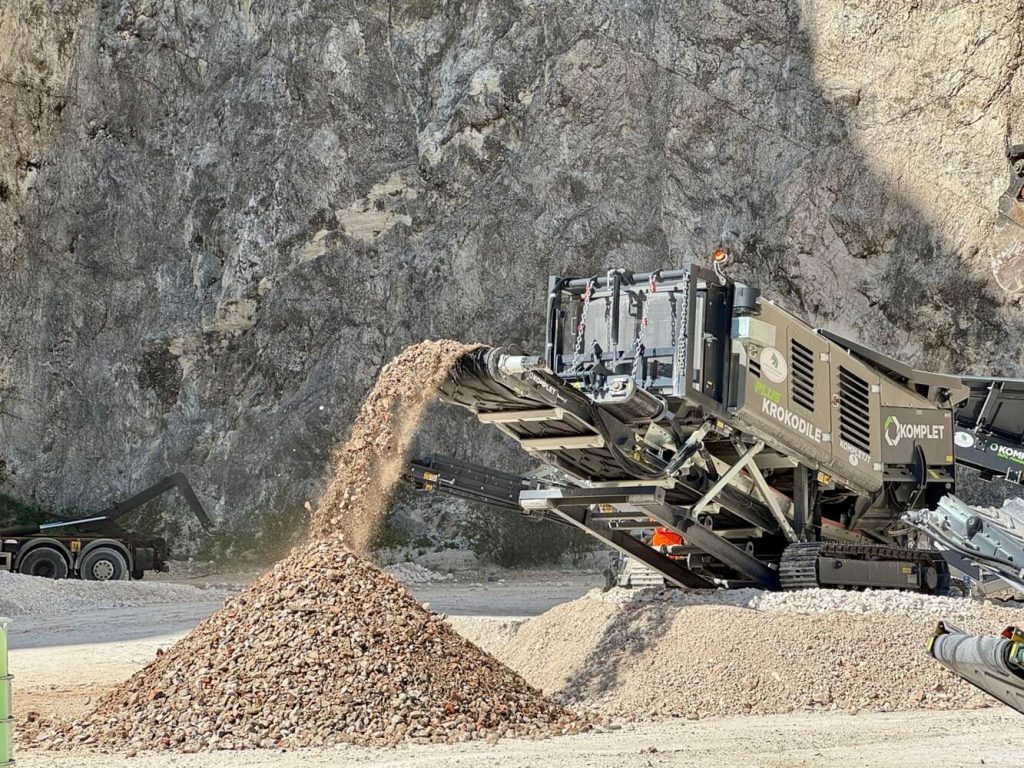
That is five separate cost events, and on a job where the rubble you removed could have become the base you needed, at least four of them are avoidable. On-site crushing collapses the whole sequence: you crush the rubble where it sits, screen it to the size you need, and stockpile finished aggregate a few feet from where it will be placed. The rubble never gets on a truck, never pays a tipping fee, and never has to be re-bought.
The Break-Even Logic
On-site crushing is not free — no equipment is. When you produce your own aggregate, you carry real operating costs: diesel fuel, DEF and diesel particulate filter maintenance, wear parts (jaw plates on a jaw crusher, blow bars on an impact crusher), routine maintenance, and operator labor. As a realistic planning figure, on-site production commonly runs somewhere in the range of $5 to $15 or more per ton in operating cost, depending on material, machine, and utilization. That is a genuine number and any honest analysis has to include it.
But now stack that against what you avoid. When you crush on-site, every ton of rubble you process eliminates:
- The hauling cost to remove that ton (truck + driver + fuel).
- The tipping or disposal fee on that ton.
- The purchase price of the equivalent ton of bought aggregate.
- The delivery cost to bring that bought aggregate to site.
Add those four avoided costs together and, on most demolition and site-work jobs, the total dwarfs the $5 to $15 per ton it costs to run the crusher. That gap is your margin. The more rubble you generate and the more base material you need, the faster on-site production pays for itself.
A Worked Example of the Math
Numbers make this concrete. Consider a demolition contractor tearing out an old commercial slab and foundation, generating a meaningful volume of concrete rubble, who also needs recycled base for the replacement work. Walk the two paths side by side.
Path A — haul off and buy back. The rubble gets loaded and trucked to a recycler or landfill. The contractor pays for truck time (at tri-axle rates commonly in the $85 to $150 per hour range, hauling roughly 16 to 20 tons per load, with multi-hour minimums) plus a tipping fee per ton to dispose of it. Then, for the new base, the contractor buys screened RCA in the $20 to $50 per ton range and pays delivery on top ($2 to $20 per ton). Every ton in this path is touched by hauling twice and paid for as disposal on one end and purchase on the other.
Path B — crush on-site. The rubble is fed into a compact crusher where it sits, screened to the base spec, and stockpiled next to the new work. The contractor’s cost is the operating expense of running the machine — realistically $5 to $15 or more per ton for fuel, DEF and filter maintenance, wear parts, routine service, and operator labor. No haul-off. No tipping fee. No purchase. No delivery.
The difference between those two paths, per ton, is the sum of the hauling, tipping, purchase, and delivery costs in Path A minus the single operating cost in Path B. On a job with real rubble volume, that per-ton difference is substantial, and it repeats on every ton. That is the number that funds the equipment — and once the equipment is paid for, the savings keep accruing on every future job that generates rubble.
The Utilization Factor
The single biggest variable in whether on-site production pays is utilization — how much material the machine processes over its life. Equipment has fixed costs (the purchase or financing payment) that get spread across every ton produced. Run a crusher on one small job and those fixed costs land heavily on a few tons. Run it across a steady stream of demolition and site work and the fixed cost per ton drops toward the marginal operating cost. This is why the buy-versus-produce decision hinges on recurrence: the contractor with regular rubble volume amortizes the machine across thousands of tons, while the occasional user cannot. Before committing to equipment, the honest question to ask is: how many tons will this realistically process per year, and for how many years?
When Buying Still Wins
On-site crushing is not the answer to every job, and it is worth being honest about that. Buying delivered material is usually the better call when:
- The job is a one-off and you generate little or no rubble of your own — you have nothing to feed a crusher.
- The volume is small enough that mobilizing equipment costs more than the material you would save.
- You need a specialty spec or virgin material that recycled concrete cannot meet for that application.
- You do not have recurring work — equipment economics depend on utilization across many jobs, not one.
The dividing line is recurrence and rubble. If you buy crushed concrete a few times a year and rarely generate your own, keep buying. If you are generating rubble and buying base material on a regular basis, you are almost certainly leaving money on the table by not producing on-site.
What On-Site Production Actually Costs to Set Up
The barrier that used to keep on-site crushing out of reach for most contractors was equipment scale. Traditional crushing plants are enormous, expensive, and impractical on a tight urban lot or a residential site. That is the specific gap compact equipment fills. A compact jaw crusher can be moved between jobsites, set up by a single operator, and run in spaces where a full-size plant would never fit.
Komplet’s compact crusher lineup spans a range of production capacities and price points, so the right machine depends on how much material you move:
|
Model |
Production |
Best Fit |
|
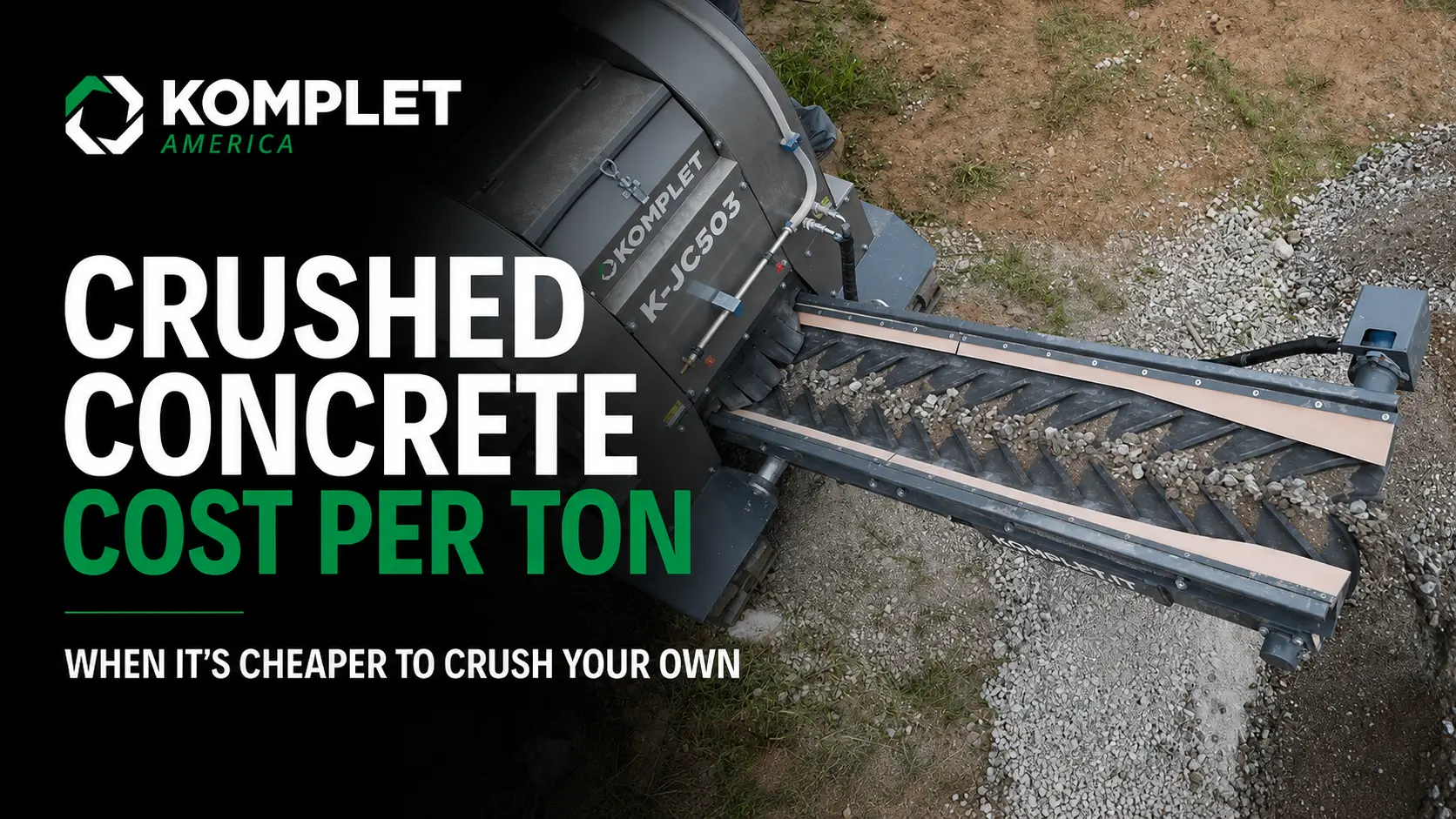
K-JC 503 Mini Jaw |
up to 34 US tph |
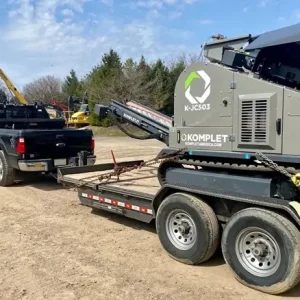
Smallest footprint; pulls behind a pickup; pool, mason, landscape, driveway work |
|
K-JC 604 Mobile Jaw |
up to 55 US tph |
Step up in output; price-sensitive buyers wanting a larger jaw and low operating cost |
|
K-JC 704 PLUS Portable Jaw |
up to 90 US tph |
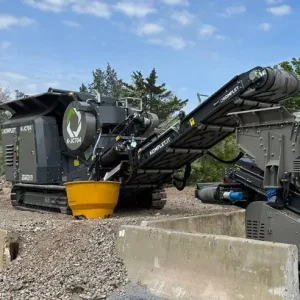
Best-selling crusher; yard-based and recycling operations; higher production |
Magnetic separation for rebar removal is standard across the crusher line — though the extraction hardware differs by model, from a magnetic roller on the K-JC 503 to hydraulically adjustable crossband magnetic belts on the larger machines — and dust suppression is standard on the K-JC 503 and the K-IC 70 impact crusher. All three jaw models run on rubber tracks with full wireless remote control, which is what makes single-operator setup on a jobsite realistic. For the full production step-up, the K-JC 604 and K-JC 704 PLUS carry progressively larger jaws and higher throughput.
Crushing Is Only Half — Screening Finishes the Product
A crusher reduces size; a screener sorts the crushed output into clean, sellable or usable size fractions. If your finished product needs to hit a specific grade — a #57 base, a paver-base fraction, or a clean fill — pairing a crusher with a screener turns your rubble into spec material rather than a single mixed pile. The Kompatto 221 is built to pair with the K-JC 503 or K-JC 704 for exactly this integrated crush-and-screen workflow.
Financing the Equipment
Because the equipment is what unlocks the savings, the way most contractors bridge the gap is financing. Komplet Capital, the in-house finance team, offers term options from 36 to 72 months, with 100% financing available and typically fast approval. The math that matters is whether the monthly payment is less than the monthly savings the machine generates in avoided hauling, tipping, and material purchases — for a contractor with steady rubble volume, it frequently is. See the equipment financing page for structure options, and note that qualified equipment purchases may also be eligible for Section 179 tax treatment.
A pre-owned machine is another route to a lower entry point — Komplet’s pre-owned program typically delivers meaningful capital savings versus new, which can shorten the payback further for the right buyer.
What Goes Into the Per-Ton Operating Cost
Because the whole break-even argument rests on the operating cost of running your own equipment, it is worth being precise about what that $5 to $15 or more per ton actually covers. No responsible analysis should ever claim on-site crushing is “free” or has “no operating cost.” Every machine that runs consumes real inputs. Here is where the money goes:
- Diesel fuel. Compact crushers run Tier 4 Final diesel engines. Fuel is usually the largest single line in the operating cost, and it scales with how hard the machine works and how many hours it runs.
- DEF and emissions-system upkeep. Tier 4 Final engines use diesel exhaust fluid (DEF) and a diesel particulate filter (DPF). Both are ongoing consumables and maintenance items, not one-time costs.
- Wear parts. On a jaw crusher, jaw plates are the primary wear item and get replaced on a cycle driven by material abrasiveness and tonnage. On an impact crusher, the equivalent wear parts are blow bars. Screens, belts, and other high-wear components add to this.
- Routine maintenance. Filters, fluids, greasing, and scheduled service per the OEM interval. Skipping this does not save money — it shortens machine life and risks warranty coverage.
- Operator labor. A trained operator runs the machine. Compact Komplet crushers are designed for single-operator use with wireless remote control, which keeps this cost down relative to equipment that needs a larger crew, but it is not zero.
The reason to itemize this is not to discourage on-site production — it is to make the comparison honest. When you weigh the real, fully-loaded operating cost against the real, fully-loaded cost of hauling and buying, on-site production still wins for the recurring-volume contractor. But you should go in with eyes open about what the machine costs to feed. For a full line-by-line breakdown of the production cost model — fixed versus operating cost, how the number shifts by material, and how to build an estimate for your own operation — see our companion guide on what it costs to produce your own aggregate. Understanding wear-part economics in particular helps you budget accurately; Komplet stocks critical wear parts including jaw plates, blow bars, belts, and screens for all current models through parts and support.
How to Buy Crushed Concrete Without Overpaying
If buying delivered material is the right call for your job, a few tactics keep the delivered price as low as possible. These are the levers that actually move the number:
- Source from the closest qualified supplier. Proximity is the single biggest lever on delivered price. A closer yard almost always beats a cheaper distant one once trucking is added. Weight distance heavily in your sourcing.
- Buy in bulk. Orders over roughly 10 tons typically earn a few dollars per ton off the small-order price and spread the truck’s fixed delivery cost across more material. Consolidate orders where you can.
- Buy in the off-season. Late fall through winter, when construction demand cools, is usually the cheapest window. If your schedule allows stockpiling ahead of a spring job, off-season buying can save 10 to 15 percent.
- Match grade to the job. Do not buy screened, spec-graded material for bulk fill that would be fine with unscreened product. Overspecifying wastes money on processing you do not need.
- Get multiple quotes. Prices vary supplier to supplier even within a region. A few phone calls routinely surface a better number, especially on larger orders where suppliers compete harder.
None of these tactics change the fundamental ceiling, though. Even a perfectly-optimized delivered purchase still carries the material price plus delivery — and for the recurring-volume contractor, that ceiling is exactly what on-site production undercuts.
Frequently Asked Questions
How much does crushed concrete cost per ton?
Crushed concrete generally runs $10 to $50 per ton before delivery. Basic unscreened material sits at the low end ($10 to $25), while clean, screened, rebar-free recycled concrete aggregate graded to spec runs higher ($20 to $50). Delivery typically adds another $2 to $20 per ton depending on distance.
Is crushed concrete cheaper than gravel or crushed stone?
Yes. Virgin crushed stone and gravel commonly run $30 to $75 per ton, while crushed concrete ranges from about $10 to $50 per ton. For most base, fill, and non-structural applications, recycled concrete delivers comparable compaction and load-bearing performance at a fraction of the cost.
What is the difference between crushed concrete and RCA?
They are the same material. RCA stands for recycled concrete aggregate — the industry term for crushed concrete produced from demolished slabs, foundations, sidewalks, and roadways after rebar and contaminants are removed. “Crushed concrete” is the everyday name; “RCA” is the spec-sheet name.
When is it cheaper to crush concrete on-site than to buy it?
On-site crushing usually wins when you generate concrete rubble on a recurring basis and also need base material. Producing your own eliminates the cost of hauling rubble off, the tipping fee to dispose of it, the purchase price of bought aggregate, and the delivery cost to bring that aggregate back. Those combined savings typically far exceed the $5 to $15 or more per ton it costs to operate a crusher.
How much does it cost to run a crusher per ton?
As a realistic planning figure, on-site crushing commonly costs $5 to $15 or more per ton in operating expense. That includes diesel fuel, DEF and filter maintenance, wear parts such as jaw plates or blow bars, routine maintenance, and operator labor. Actual cost depends on the machine, the material, and how heavily the equipment is used.
Can I crush concrete with rebar in it?
Yes. Komplet compact crushers include magnetic separation as standard equipment, which pulls rebar and other ferrous metal out of the crushed stream so you can feed demolition rubble directly without hand-picking every piece of steel first. The exact extraction setup varies by model — the K-JC 503 uses a magnetic roller, while the larger jaw models and the K-IC 70 use a crossband magnetic belt — so it’s worth reviewing the individual product pages to see how each machine handles metal removal.
Do I need a screener as well as a crusher?
Only if your finished product needs to hit a specific size grade. A crusher alone produces a mixed-size output. Adding a screener sorts that output into clean size fractions — a #57 base, a paver-base fraction, fines — so you produce spec material instead of a single blended pile. Many contractors pair a compact crusher with a compact vibrating screener for this reason.
Is on-site crushing worth it for a small contractor?
It depends on volume and recurrence, not company size. A small contractor who generates rubble and buys base material on a regular basis can absolutely justify compact equipment, especially financed against the savings it generates. A contractor who rarely generates rubble or works one-off jobs is usually better off buying delivered material. The dividing line is how often you move material, not how big you are.
Final Thoughts
Crushed concrete is cheap to buy — that part is not in dispute. At $10 to $50 per ton before delivery, it is one of the best values in construction aggregate, and for small or one-off jobs, buying it delivered from the nearest supplier is the right move. But the delivered price is a ceiling, not a floor. For contractors who generate concrete rubble and buy base material on a recurring basis, the lowest-cost ton of aggregate is the one you produce from material already on your site — because it never gets hauled off, never pays a tipping fee, and never has to be re-purchased. The equipment cost is real, but so is the four-way savings it unlocks, and for the right operation the payback math is compelling.
Komplet America distributes the compact crushers and screeners that make on-site aggregate production practical on jobsites where a full-size plant would never fit — from the pickup-towable K-JC 503 to the best-selling K-JC 704 PLUS. If you are generating rubble and buying it back, it is worth running your own numbers. Talk through your material volume and jobsite mix with the team at 908-369-3340, or contact Komplet America to get started.
Ready to Stop Paying for the Same Ton Twice?
- Explore the compact crusher lineup to match production capacity to your material volume.
- Review equipment financing options and see whether the monthly payment beats your monthly haul-and-buy costs.
- Consider a pre-owned machine for a lower entry point with meaningful capital savings.
- Check parts and support so you understand wear-part and service costs before you buy.
- Find your local Komplet dealer for demo scheduling and rental availability.
Never enough.
Disclaimer: Any ROI figures, payback timelines, or dollar-amount savings shown above are illustrative examples only. Actual results depend on jobsite material composition, local hauling and tipping rates, fuel and labor costs, equipment utilization, financing terms, regional regulatory requirements, and operator efficiency. Komplet America makes no guarantee of specific financial returns. Customers should perform their own analysis based on local market conditions before making purchase decisions.
Disclaimer: All operating, maintenance, and service guidance in this article is general in nature. Always refer to the official Komplet operator’s manual for the specific machine model and serial number, and follow OEM intervals and procedures. For warranty-protected work, contact Komplet America at 908-369-3340 or your authorized Komplet dealer. Improper service or non-OEM parts may void warranty coverage and create safety hazards.
Pricing note: Crushed concrete and aggregate prices cited are general market ranges that vary by region, grade, supplier, and season, and are provided for planning context only. Equipment prices, where referenced, are subject to change based on dealer location, availability, and any additional features or customizations, and do not include taxes, shipping, or installation fees. Contact Komplet America at 908-369-3340 or visit our equipment page for current pricing.