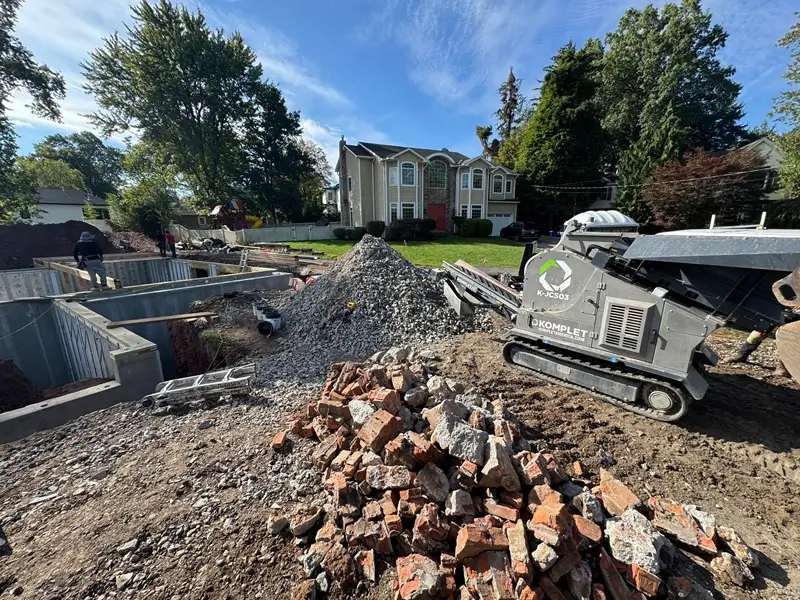

Construction and demolition (C&D) operations generate substantial material that has historically gone to landfill — concrete, asphalt, brick, masonry, wood, drywall, plastics, mixed C&D debris, excavated soil. Operations that recycle this material instead capture multi-category advantages that disposal-only pathways can’t match: economic gains through avoided cost and recovered revenue, environmental benefits through landfill diversion and material displacement, operational improvements through schedule compression and site flow, regulatory positioning through LEED and Buy Clean compliance, and strategic differentiation in increasingly sustainability-focused project markets.
This basic guide walks through the comprehensive business case for construction recycling — five advantage categories with specific mechanisms, applicable material types, and how operations capture each advantage. The goal: provide operations evaluating C&D recycling with the substantive business case rather than vague generalities about “sustainability.” Where compact mobile equipment supports the recycling operation, Komplet America’s lineup supports operations across N&C America.
Category 1: Economic Advantages
The strongest case for construction recycling for many operations is economic — recycling delivers measurable cost reduction and revenue generation that disposal-only pathways can’t match.
Avoided Disposal Costs
Each ton of material recycled avoids tipping fees that would otherwise be paid at landfills or transfer stations. Regional tipping fees vary substantially:
- Major US Northeast metros: $80-$200+/ton typical for C&D
- Major US West Coast metros: $60-$150+/ton typical for C&D
- Midwest/Mountain regions: $30-$80+/ton typical for C&D
- Hauling costs: $5-$30+/ton typical depending on distance
For projects with substantial material volume in high-tipping-fee markets, avoided disposal costs alone often justify recycling equipment investment.
Avoided Aggregate Purchase
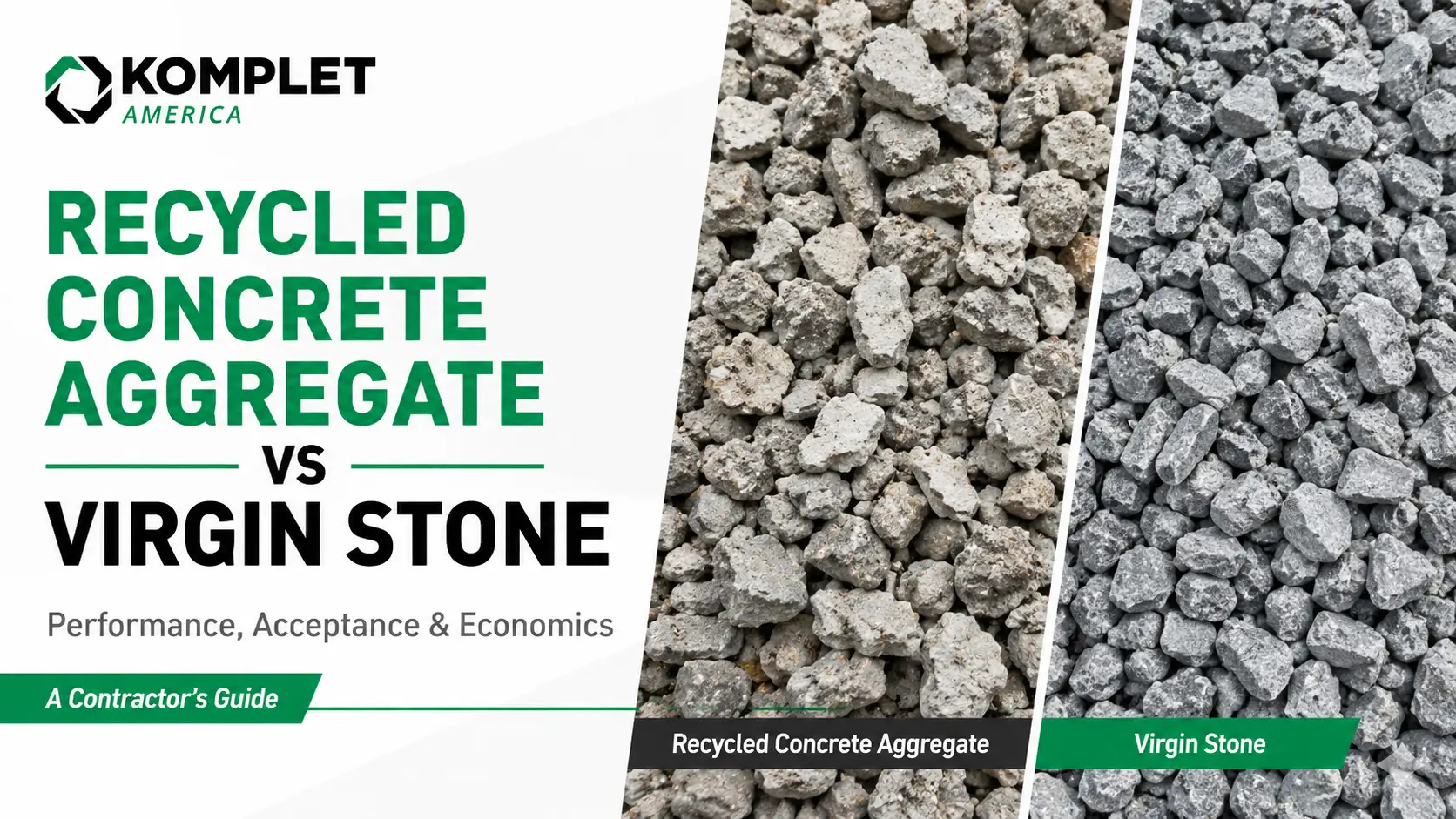
RCA (recycled concrete aggregate) produced from on-site crushing can substitute for purchased virgin aggregate in many project applications:
- Virgin aggregate market pricing: $15-$40+/ton typical for crushed stone, gravel, sand depending on grade and region
- RCA produced from project’s own demolition material eliminates this purchase cost for project base material applications
- Particularly valuable for projects with reconstruction phases — same project demolishes existing concrete, crushes it on-site, and reuses RCA as base material for new construction
Recovered Material Revenue
Beyond cost avoidance, recycling operations generate revenue from recovered material:
- RCA market sales: $10-$25+/ton typical for sale to road base, drainage, structural fill markets
- Recovered scrap rebar from reinforced concrete: $100-$300+/ton typical depending on market and grade
- Recovered ferrous metals from mixed C&D: via Krokodile PLUS shredder + downstream magnetic separation
- RAP (recycled asphalt pavement) market sales: varies by regional asphalt market demand
- Wood biomass and recovered wood: varies by regional biomass and wood product markets
Total Economic Swing per Ton
For the same ton of demolished concrete: disposal pathway costs $50-$200+/ton (tipping fee + hauling) plus typically requires $15-$40+/ton aggregate purchase for project reconstruction — total cost $65-$240+/ton. On-site recycling avoids both, plus generates $10-$25+/ton if RCA sells, plus generates scrap rebar revenue. Total economic swing: $75-$265+/ton in favor of recycling for projects matching the operational profile. Specific economics vary by region and project — run numbers for your specific operation.
Category 2: Environmental Advantages
Landfill Diversion
Each ton recycled is one ton diverted from landfill capacity. Operations achieve diversion rates of 80-95%+ for clean concrete demolition operations on projects matched to the operational profile. Diversion rates support sustainability reporting requirements, regulatory mandate compliance, and project owner sustainability requirements.
Transportation Emissions Reduction
Disposal hauling generates substantial diesel emissions — truck cycles between project site and landfill. On-site processing eliminates these cycles for material reused on-site. Even material that ships off-site for sale typically has shorter transportation distance than disposal-pathway hauling cycles.
Virgin Material Displacement
RCA used as project base material displaces virgin aggregate that would otherwise require quarry extraction, processing, and transportation. Virgin aggregate has substantial embodied carbon profile; RCA has lower embodied carbon due to avoided extraction impacts. The displacement benefit applies to all RCA produced regardless of whether it’s used on-project or sold to off-project markets.
Recovered Ferrous Metals
Reinforced concrete contains rebar that gets recovered through standard magnetic separation during crushing. Recovered ferrous metals enter scrap recycling pathways, displacing virgin steel production demand. Komplet jaw crushers include magnetic separation as standard equipment on K-JC 604+ (optional on K-JC 503 included in base price).
Mixed C&D Recovery
Beyond hard mineral material, mixed C&D includes wood, drywall, plastics, and ferrous metals that can be recovered through slow-speed shredding (Krokodile PLUS). Shredded mixed C&D supports downstream sorting and recovery of multiple material streams — wood for biomass markets, ferrous metals for scrap markets, plastics for recycling markets, with residual material going to disposal at much smaller volume than unsorted disposal-only pathways.
Category 3: Operational Advantages
Schedule Compression
Eliminating disposal hauling cycles compresses project schedules. For projects with material volume that would otherwise require dozens of disposal truck cycles, on-site processing typically saves days to weeks of project schedule duration. Schedule compression has direct economic value beyond material handling — reduced equipment idle time, reduced labor costs, faster project completion enabling earlier project handoff or revenue generation.
Reduced Site Footprint Requirements
Operations that crush on-site reduce the staging area required for stockpiled disposal-bound material. Stockpiles waiting for disposal hauling consume project site footprint that could otherwise support productive operations. Compact mobile crushing equipment processes material in real-time, eliminating the staged stockpile pattern that disposal-only pathways require.
Simplified Material Logistics
Disposal pathways require coordinated logistics: trucks scheduled for disposal hauling, disposal facility hours, weight tickets, transfer documentation. On-site crushing simplifies the logistics chain — material flows from demolition through crushing to project reuse without external coordination. Some logistics still required for material that ships off-site for sale, but the basic operational flow is simplified.
Equipment Utilization
Operations with continuous project pipeline benefit from equipment utilization across multiple projects. Compact mobile crushing equipment moves between project sites supporting recurring deployment — different from fixed plant infrastructure that requires sustained single-location utilization to justify capital. The compact mobile model fits distributed project economics.
Multi-Material Capability
Komplet’s full equipment lineup supports multiple material types from a single operation:
- Hard mineral material (concrete, asphalt, brick, masonry, natural rock): compact mobile jaw crushers and impact crushers
- Mixed C&D (wood, drywall, plastics): Krokodile PLUS slow-speed shredder
- Spec-sized aggregate output: Kompatto vibrating scalping screeners
- Compost, topsoil, mulch (wet/sticky materials): K-TS trommel screeners
- Material handling between equipment: K-TC 460 portable mobile conveyor
Category 4: Regulatory and Compliance Advantages
LEED Certification Support
LEED-certified projects include Construction and Demolition Waste Management requirements with diversion percentage targets. On-site processing supports LEED documentation through measurable material flow records (weight tickets, transfer documentation, processing records). Specific LEED credit requirements vary by version and project type — verify current requirements with applicable sustainability professionals.
Federal Buy Clean Compliance
Federal Buy Clean policies require lower-carbon material sourcing on federal construction projects. RCA produced through on-site crushing typically has lower embodied carbon than virgin aggregate, supporting Buy Clean compliance for projects with material sourcing requirements. Specific Buy Clean requirements continue evolving; verify with project documentation.
State Diversion Mandate Compliance
Multiple US states have C&D diversion mandates requiring percentage-based diversion from landfill. California, Massachusetts, Washington, and other states have mandates with varying specifics. Operations working in these jurisdictions need diversion strategies — including on-site recycling — to maintain compliance.
Tier 4 Final Emissions Compliance
All current Komplet jaw crushers ship with Tier 4 Final emissions-compliant diesel engines, supporting CARB compliance, federal contract eligibility, and most LEED-certified project equipment requirements. Project owners increasingly specify Tier 4 Final equipment for site operations — equipment investment in current Komplet lineup matches these specifications.
Project Owner Sustainability Documentation
Major project owners (institutional, corporate, governmental) increasingly require sustainability documentation from contractors. On-site recycling generates documented material flow records that support sustainability reporting requirements — diversion percentages, recovery rates, equipment compliance documentation.
Category 5: Strategic and Competitive Advantages
Service Differentiation
Operations offering on-site recycling capability differentiate from disposal-only competitors in project bidding. Service differentiation supports premium pricing on sustainability-focused projects, access to projects requiring documented diversion, and competitive advantage in increasingly sustainability-focused contract environments.
Bidding Access to Sustainability-Focused Projects
LEED-certified projects, Buy Clean projects, and sustainability-mandated projects all require contractors with recycling capability or coordinated recycling partners. Operations with their own equipment have bidding access to these projects without requiring third-party recycling coordination.
Customer Relationships in Recycling Markets
Operations producing RCA, RAP, and recovered material develop customer relationships with end-market buyers (road base markets, drainage stone markets, asphalt plants, scrap metal recyclers). These relationships generate recurring revenue and operational continuity beyond single-project work.
Brand Positioning
Sustainability-positioned brand reputation supports broader market positioning across customer segments. Public-facing sustainability messaging (website, marketing collateral, project case studies) reflects operational reality when supported by actual recycling capability.
Resilience to Regulatory Tightening
Regulatory environment around C&D recycling is tightening — more states adopting diversion mandates, Buy Clean policies expanding to additional federal categories, LEED requirements increasing rigor. Operations with established recycling capability are positioned for tightening regulatory requirements rather than scrambling to add capability when mandates apply.
What Construction Recycling Covers (And What It Doesn’t)
What Komplet Equipment Recycles
- Concrete (structural concrete, slabs, foundations, pavement) — jaw crushers
- Asphalt pavement — jaw crushers, producing RAP
- Brick and masonry — jaw crushers
- Natural rock (excavation rock, quarry rock) — jaw crushers
- Wood (framing, lumber, branches, biomass) — Krokodile PLUS slow-speed shredder
- Drywall — Krokodile PLUS slow-speed shredder
- Plastics — Krokodile PLUS slow-speed shredder
- Mixed C&D — Krokodile PLUS slow-speed shredder for volume reduction and downstream sorting
- Compost, topsoil, mulch — K-TS trommel screeners
What Komplet Equipment Does NOT Recycle
- Steel structural members — large structural steel requires specialty steel processing equipment Komplet doesn’t make. Komplet equipment recovers SCRAP REBAR from reinforced concrete via magnetic separation, but doesn’t process structural steel members.
- Hazardous materials (asbestos-containing material, lead-based paint contaminated material, RCRA hazardous waste) — requires specialty hazardous material handling under regulatory frameworks
- Glass and ceramic specialty — specialty processing from manufacturers focused on glass/ceramic recycling segments
- Electronics/e-waste — specialty processing from manufacturers focused on electronics recycling
- Cement plant raw materials (cement manufacturing — limestone, clay, shale, gypsum) — fixed plant equipment from manufacturers focused on cement plant operations
Concrete vs. Cement Terminology Note
“Concrete” and “cement” are not the same. Cement is a powder binder (manufactured at cement plants from raw materials). Concrete is the actual building material (cement + water + aggregate + admixtures). Crushers process concrete (the demolished building material) — not cement (the powder). For more on this terminology distinction, see our Cement Crusher vs. Concrete Crusher guide.
Komplet America’s Compact Mobile Recycling Equipment
For Hard Mineral Material (Concrete, Asphalt, Brick, Masonry)
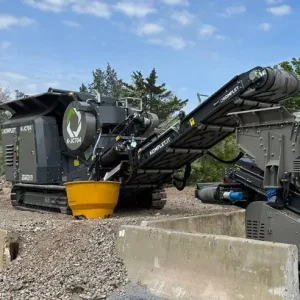
- K-JC 503 — up to 34 US tph, ~7,496 lb. Tight-access urban work. Approximately $108,695.
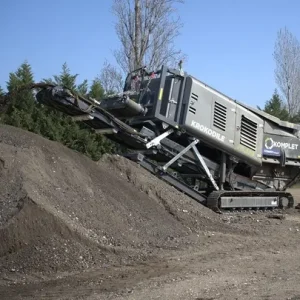
- K-JC 604 — up to 55 US tph, ~19,400 lb. Mid-range demolition. Approximately $205,030.
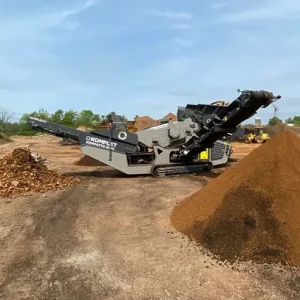
- K-JC 704 PLUS — up to 90 US tph, ~26,455 lb. Komplet’s best-selling crusher. Approximately $241,255.
- K-JC 805 — up to 160 US tph. Largest jaw crusher in the lineup.
- K-IC 70 — up to 90 US tph compact impact crusher for premium cubical aggregate production
For Soft and Mixed C&D (Wood, Drywall, Plastics, Mixed)
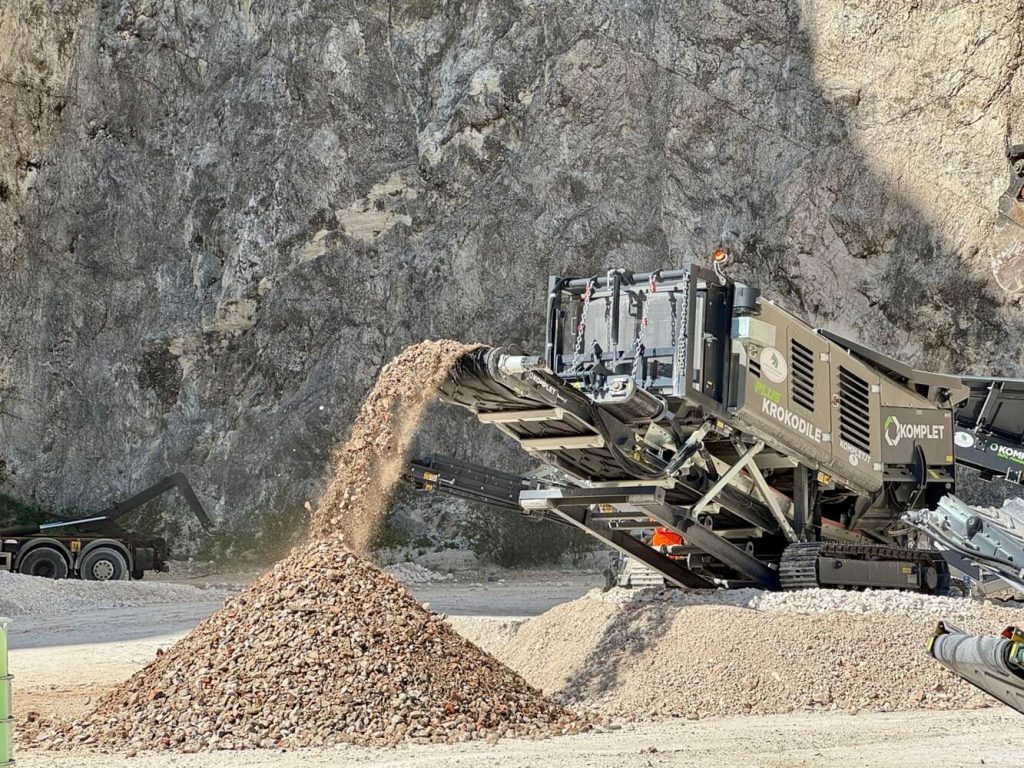
- Krokodile PLUS — single 60″ shaft slow-speed shredder, up to 175 US tph C&D capacity, 220 HP Volvo Penta. Uses teeth (not blades). DOES NOT shred concrete — use jaw crushers for concrete.
For Spec-Sized Aggregate Output
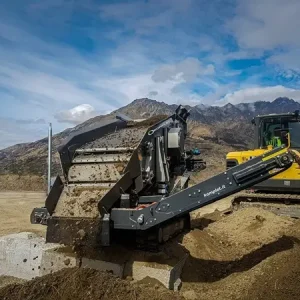
- Kompatto 5030 — up to 280 US tph. Komplet’s best-selling screener. Hydraulic 2-way / 3-way conversion supporting 2 or 3 finished product sizes simultaneously.
- Kompatto 221 — up to 90 US tph. Smallest self-propelled scalper.
- Kompatto 124 — up to 350 tph. Largest scalping screen in the lineup.
For Compost, Topsoil, Mulch (Wet/Sticky Materials)
For Material Handling Between Equipment
- K-TC 460 — up to 132 US tph portable mobile conveyor for workflow integration
Frequently Asked Questions
What’s the single biggest advantage of construction recycling?
Depends on operational profile. For operations in high-tipping-fee markets (major US Northeast and West Coast metros), economic advantage typically dominates — avoided disposal costs alone often justify equipment investment. For operations bidding LEED-certified or Buy Clean projects, regulatory advantage may dominate — bidding access requires recycling capability. For operations with continuous project pipeline, operational advantages may dominate — schedule compression and equipment utilization across projects. The five categories work together; specific operations weight them differently.
How much can construction recycling save my operation?
Highly variable. For projects with substantial material volume in major Northeast metros where tipping fees run $80-$200+/ton, on-site recycling often saves $50-$200+/ton net economic swing per ton processed (avoided disposal + avoided aggregate purchase + recovered material revenue). For projects in lower-tipping-fee markets or with smaller volumes, savings are more modest. Run specific economics for your operation rather than relying on generic claims.
Does construction recycling work for small operations?
Depends on volumes and operational profile. Operations with under 500 tons of crushable material per project typically benefit more from third-party recycling facilities or rental equipment for project-based deployment than ownership economics. The K-JC 503 (smallest jaw crusher in Komplet lineup, $108,695) supports smaller operations or as project-based rental equipment. For operations evaluating ownership versus rental versus third-party recycling, see our Rent vs. Buy guide for full framework.
Can on-site recycling handle hazardous materials?
No — on-site mechanical processing equipment doesn’t address hazardous contamination. Hazardous materials (asbestos-containing material, lead-based paint contamination, RCRA hazardous waste) require specialty hazardous material handling under regulatory frameworks. Komplet equipment processes clean (non-hazardous) C&D material — concrete, asphalt, brick, masonry, wood, drywall, plastics. Verify material classification with applicable regulatory authorities and qualified environmental consultants before processing.
What’s the LEED diversion percentage I should target?
Specific LEED credit requirements vary by version and project type. Operations matching the on-site recycling profile typically achieve 80-95%+ diversion rates for clean concrete demolition operations. Verify current LEED requirements with applicable sustainability professionals for specific projects. Diversion percentage tracking requires documented material flow records.
How does Komplet equipment support steel and rebar recovery?
Komplet jaw crushers include standard hydraulic magnetic belt for ferrous metal recovery — standard on K-JC 604+, optional on K-JC 503 (included in base price). Magnetic separation removes rebar and other ferrous metals from crushed concrete output during operation, supporting clean RCA production AND recovered scrap metal revenue. For STRUCTURAL STEEL members (large beams, columns, structural elements), specialty steel processing equipment is required — this is outside Komplet’s equipment lineup.
What about cement plant recycling?
Cement plant operations (raw material crushing for cement manufacturing) require fixed plant equipment from manufacturers focused on cement plant operations. This is NOT Komplet’s market. Komplet serves the concrete recycling market — operations crushing demolished concrete (the building material) into RCA. “Cement crusher” is a common terminology misnomer; most operations searching for cement crushers actually need concrete crushers.
Where can I see Komplet recycling equipment in operation?
Komplet America offers equipment demos at the Komplet America yard in Hillsborough, NJ (749 Clawson Ave.) or through authorized Komplet dealers across N&C America. Komplet America does not transport equipment to prospect sites for demos. Call 908-369-3340 to schedule a yard visit, or contact your local authorized dealer for regional demo availability.
Final Thoughts
Construction recycling delivers advantages across five categories — economic (avoided disposal costs, avoided aggregate purchase, recovered material revenue), environmental (landfill diversion, transportation emissions reduction, virgin material displacement, ferrous metals recovery), operational (schedule compression, reduced site footprint, simplified logistics, equipment utilization, multi-material capability), regulatory (LEED, Buy Clean, state diversion mandates, Tier 4 Final emissions, sustainability documentation), and strategic (service differentiation, bidding access, customer relationships, brand positioning, regulatory resilience). Operations matching the on-site recycling profile capture multi-category advantages that disposal-only pathways can’t match. Komplet America’s compact mobile equipment lineup supports operations across all current material types — hard mineral material via jaw crushers and impact crusher, mixed C&D via Krokodile PLUS slow-speed shredder, spec-sized aggregate via Kompatto vibrating scalping screeners, compost/topsoil/mulch via K-TS trommel screeners, material handling via K-TC 460 conveyor — backed by authorized dealer network providing local sales, service, training, and rental support.
Browse Komplet America’s compact mobile equipment lineup or call us to discuss equipment selection for your specific construction recycling operation.
Ready to Talk Construction Recycling Equipment?
- Call 908-369-3340
- Email [email protected]
- Schedule a demo at the Komplet America yard or through your local authorized dealer
- Find your local Komplet dealer for rental availability
- Ask about our 1-year / 1,000-hour warranty and equipment financing options
Never enough — that’s how we approach service, support, and helping operations capture the comprehensive advantages of construction recycling.
Disclaimer: All cost, ROI, payback, pricing, tipping fee, embodied carbon, diversion percentage, and revenue figures in this article are illustrative examples based on sample assumptions about volume, regional pricing, material specifications, and market conditions. Actual results vary significantly by region, market, material type, equipment utilization, operator skill, financing terms, regulatory environment, and many other factors. Equipment pricing, tipping fees, RCA pricing, scrap metal pricing, virgin aggregate pricing, fuel costs, and labor rates all change over time and by location. LEED credit requirements, Buy Clean policy requirements, and state diversion mandates are subject to update; consult applicable sustainability professionals for current guidance specific to your projects. Hazardous material handling has specific regulatory requirements; consult applicable regulatory authorities and qualified environmental consultants for guidance specific to your operations. Komplet America makes no guarantee, warranty, or representation of specific financial performance, payback timelines, sustainability outcomes, or business outcomes for any particular operation. For current pricing and a payback estimate based on your specific volume, material, and local market, contact us at 908-369-3340 to speak with our team.