
This guide is written for commercial concrete removal projects — demolition contractors bidding tear-out work, general contractors estimating renovation budgets, parking lot rebuilders calculating teardown costs, and excavation companies planning concrete-bearing site preparation. The cost of removing concrete at commercial scale is fundamentally different from the small residential slab removals that dominate consumer cost-estimating sites; commercial work involves different equipment, different labor structures, different disposal pathways, and — increasingly — different recovery economics through on-site crushing.
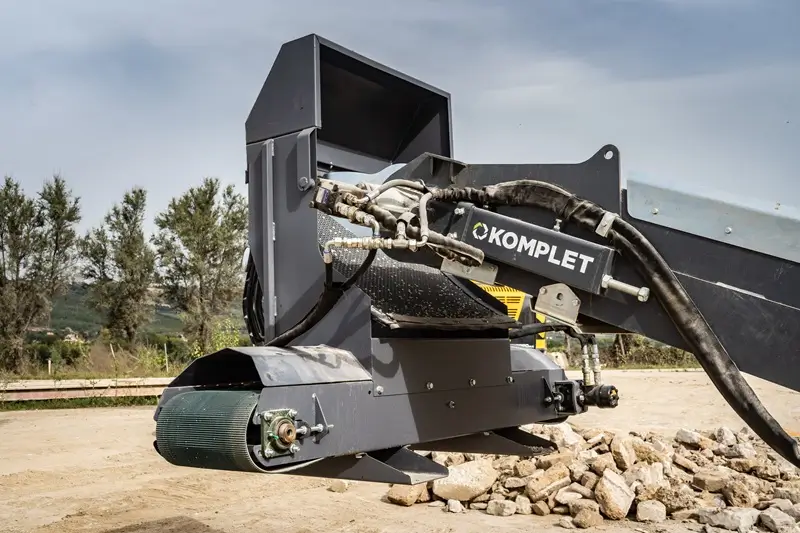
Below: typical commercial concrete removal cost ranges, the cost categories that make up the total, the factors that drive cost variation across projects, and how on-site crushing with compact mobile equipment can dramatically reduce concrete removal cost by avoiding tipping fees, generating recovered material revenue, and compressing project schedules. Includes Komplet America’s compact mobile crusher and screener lineup positioned for commercial concrete removal cost reduction.
Typical Commercial Concrete Removal Cost Ranges
Commercial concrete removal cost varies dramatically based on project specifics, regional market conditions, and disposal logistics. The numbers below are illustrative ranges for commercial projects (NOT residential single-slab removal); actual costs in your specific market may differ significantly.
Per-Square-Foot Pricing
- Light commercial concrete (4-6″ thick, no rebar): $2-$5/sq ft removal-only
- Standard commercial concrete (6-8″ thick, light rebar): $4-$8/sq ft removal-only
- Heavy commercial concrete (8-12″ thick, heavy rebar): $6-$12/sq ft removal-only
- Bridge decks and structural slabs: $10-$20+/sq ft removal-only
- Add for replacement: $5-$15+/sq ft for new concrete pour, depending on spec
Per-Ton Pricing
For larger projects where contractors track tonnage rather than area:
- Demolition labor and equipment: $15-$40/ton
- Hauling to recycler or landfill: $10-$30/ton (depending on distance)
- Tipping fees / disposal: $50-$100+/ton in major US metros (significantly less in rural markets)
- Total disposal-pathway cost: $75-$170+/ton typical for commercial disposal
Project-Total Reference Points
Useful for early bid estimating:
- 5,000 sq ft commercial parking lot (6″ concrete, ~250 tons): $15,000-$50,000 removal cost depending on access, rebar density, and disposal market
- 10,000 sq ft commercial slab (8″ concrete, ~600 tons): $50,000-$120,000 removal cost
- Major commercial demolition (1,000+ tons concrete): $100,000-$300,000+ removal cost
What Makes Up Concrete Removal Cost
Understanding the cost categories helps contractors estimate accurately, compare bids intelligently, and identify which costs are addressable through alternative approaches.
Demolition Labor
Skilled operator labor for excavator and breaker work, ground crew for material handling and site cleanup, supervisor labor for project coordination. Typically 20-30% of total removal cost. Rates vary by region: $50-$100+/hour fully-loaded for skilled operators in major US metros.
Equipment
Excavator(s) with hydraulic breaker attachment for primary concrete demolition, loaders for material handling, dump trucks for haul-out, plus support equipment (compressors, water trucks for dust control). Typically 15-25% of total removal cost. Rented equipment costs significantly more per day than owned equipment but eliminates capital commitment.
Hauling
Truck and driver time, fuel, hours, and disposal site logistics. Typically 15-25% of total removal cost depending on disposal site distance. Long hauls (50+ miles to a recycler or landfill) significantly increase this category. The dominant economic argument for on-site crushing is that hauling cost gets eliminated entirely.
Tipping Fees / Disposal
Concrete tipping fees at landfills or commercial recyclers. The largest variable component of removal cost — ranges from $50/ton+ in major US metros (NYC, Boston, San Francisco, Los Angeles) down to $20-$40/ton in rural markets. For large-volume projects, tipping fees can exceed all other cost categories combined.
Permits and Regulatory Compliance
Demolition permits required by local building authorities, OSHA safety compliance documentation, environmental compliance for asbestos/lead paint pre-1980 buildings, dust control permits in some jurisdictions, traffic control permits for work adjacent to public roads. Typically 2-5% of total removal cost.
Site Restoration
Post-demolition cleanup, base preparation if replacement concrete will pour, grading and compaction, soil amendment if needed. Typically 5-10% of total removal cost for projects ending in restored earth grade.
Factors That Drive Cost Variation
Concrete Type and Reinforcement
Plain unreinforced concrete is fastest and cheapest to remove. Light rebar adds modest cost from slower demolition. Heavy rebar (structural elements, bridge decks, mass concrete with rebar mats) significantly increases cost — both demolition time and post-demolition material handling are slower. Post-tensioned concrete requires specialized procedures and can multiply cost.
Concrete Thickness
Thicker concrete takes longer to break up. 4″ residential slab removal differs significantly in time and equipment requirements from 12″ structural slab removal. Hydraulic breaker class scales with thickness — light-duty breakers handle 6″ or less; heavy-duty breakers needed for 12″+ structural concrete.
Site Access
Tight-access urban sites, indoor work, basement demolition, and second-floor structural concrete all increase cost compared to open-site work. Restricted access requires specialized equipment, more labor for material handling, longer demolition timelines, and potentially specialized rigging.
Regional Tipping Fees
This is the single largest cost driver across regions. Concrete tipping in major US metros runs $50-$100+/ton; rural markets run $20-$40/ton. The same project can cost $50,000-$100,000 more in disposal-pathway terms in expensive metros vs. cheap rural markets.
Hauling Distance
Concrete is heavy and bulky. Round-trip haul time and truck capacity limit how many loads each truck completes per day. Sites 50+ miles from disposal can require 3-5 trucks running constantly to keep up with demolition; close-in sites may need 1-2 trucks. Truck count scales with distance, multiplying transportation cost.
Hazardous Material Considerations
Pre-1980 buildings may contain asbestos in concrete formulations, lead paint on adjacent surfaces, or other regulated materials. Specialized abatement requirements increase cost significantly and may require sequenced demolition with abatement contractors completing work before concrete removal begins.
Project Schedule Pressure
Schedule pressure (overnight work, weekend operations, accelerated completion) increases labor cost through overtime premiums. Rush projects can cost 25-50% more than standard-pace work for the same physical scope.
Concrete Demolition Methods (Commercial Scale)
Commercial concrete demolition uses different methods than residential DIY work. The methods below are the typical commercial-scale approaches.
Excavator-Mounted Hydraulic Breaker (Standard Method)
The dominant commercial concrete demolition tool. Excavator carrier with hydraulic breaker attachment delivers high-impact percussion through a steel chisel point. Roughly 50-200x more impact energy per blow than handheld jackhammers; reach extends 30+ feet from operator position; operator stays in cab away from dust and debris. Hydraulic breakers come in light-duty (200-1,000 ft-lb), mid-duty (1,000-3,000 ft-lb), and heavy-duty (3,000+ ft-lb) classes for different concrete thicknesses.
Saw Cutting
Diamond-blade wet or dry saws score concrete along controlled break lines before hydraulic breaker work. Used when precise edges are required to preserve adjacent structures, when partial removal is specified, or when access constraints prevent typical breaker work. Costs more per square foot than direct breaker demolition; necessary for specific situations.
Hydraulic Splitters and Wedge Systems
For applications where vibration or noise must be minimized (work adjacent to occupied buildings, sensitive equipment, or vibration-sensitive operations), hydraulic splitters expand wedges in pre-drilled holes to fracture concrete with minimal noise and vibration. Higher cost per ton than breaker work; specialized application.
Controlled Explosive Demolition
Bridge piers, large industrial structures, and high-rise demolition sometimes use controlled explosive demolition. Requires licensed blasting contractors, regulatory permits, neighborhood notification, and post-blast structural cleanup. Highly specialized — not a standard commercial concrete demolition method.
The On-Site Crushing Alternative: How It Reduces Cost
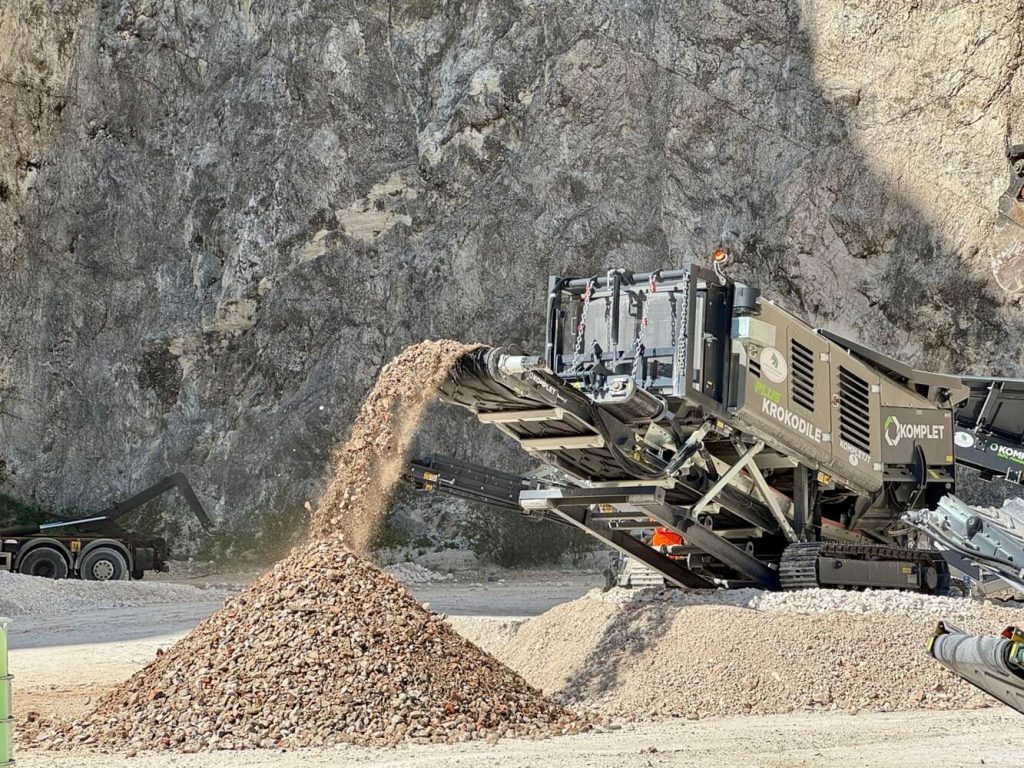
On-site crushing converts the disposal-pathway cost stream (tipping fees, hauling, dump waiting) into a recovery-pathway cost stream (equipment operation, recovered material revenue). For most commercial concrete removal projects above 200-500 tons, on-site crushing reduces total removal cost significantly while producing recoverable revenue.
Avoided Tipping Fees
On-site crushing eliminates most tipping fees by converting demolition concrete into recycled aggregate (RCA) on-site rather than hauling to a recycler or landfill. For a 500-ton commercial project in a $75/ton tipping market, that’s $37,500 in avoided fees alone.
Avoided Hauling Cost
Reduced haul-out volume (typically 75-95% reduction since most material stays on-site or relocates as finished RCA) eliminates most truck rotations. For projects with significant haul distance, this saves $5,000-$30,000+ per project.
Recovered Material Revenue
RCA sales typically generate $15-$30/ton; recovered ferrous metal (rebar) sells at $100-$300+/ton scrap. For a 500-ton project with 5% rebar content (25 tons), recovered material revenue typically runs $7,500-$22,500+.
Project Schedule Compression
Eliminating haul-out trips and dump waiting time typically compresses demolition schedule by 10-30%. Faster project completion means lower overhead absorption per project, faster crew rotation to the next contract, and potentially earlier billing milestones.
Net Cost Reduction Example
For a typical 500-ton commercial concrete demolition project in a major US metro:
- Conventional disposal cost: $75,000-$170,000+ (demolition + hauling + tipping fees)
- On-site crushing equipment cost: $15,000-$30,000 (operation + crew + minor wear parts)
- Recovered material revenue: $7,500-$30,000+ (RCA sales + scrap metal)
- Net project savings: $60,000-$170,000+ vs. conventional disposal
Numbers vary substantially by region, project specifics, and market conditions. The range shown is illustrative; actual project economics require specific market analysis.
Komplet America’s Concrete Removal Cost-Reduction Lineup
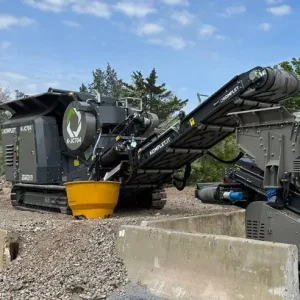
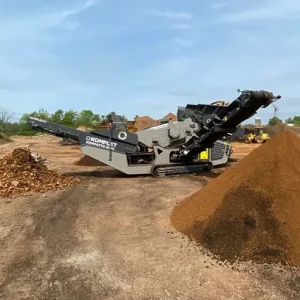
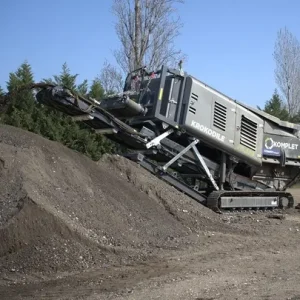
Compact Mobile Jaw Crushers
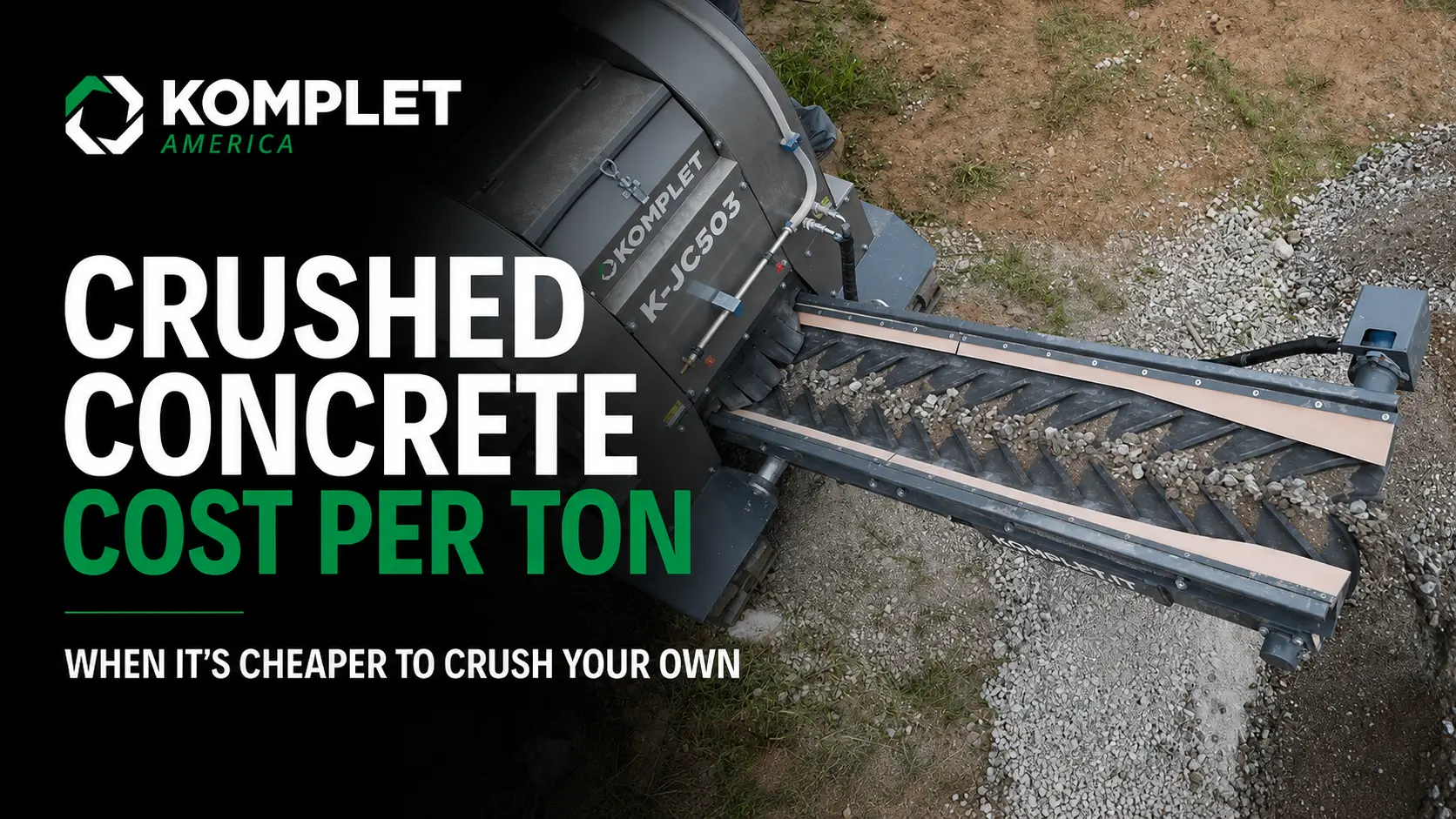
- K-JC 503 — up to 34 US tph, 19″ x 12″ jaw, 25 HP Tier 4 Final, ~7,496 lb.
- K-JC 604 — up to 55 US tph, 23″ x 16″ jaw, ~19,400 lb.
- K-JC 704 PLUS — up to 90 US tph, 27″ x 16″ jaw, ~26,455 lb. Komplet’s best-selling crusher.
- K-JC 805 — up to 160 US tph, 31″ x 21″ jaw, ~49,600 lb. Largest jaw crusher.
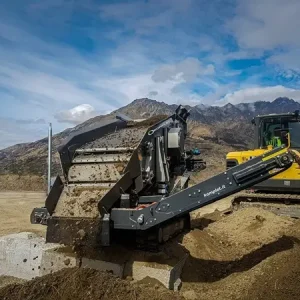
Vibrating Scalping Screeners (For RCA Spec Production)
- Kompatto 5030 — up to 280 US tph, hydraulic 2-way / 3-way conversion. Komplet’s best-selling screener. Pairs naturally with the K-JC 704 PLUS for typical contractor concrete recycling operations.
Equipment Financing
Komplet Capital offers 24-hour approval, 100% financing, 3-6 year terms. Many demolition contractors structure equipment financing so monthly payments are fully covered by avoided dump fees alone — meaning the equipment has $0 net operating cost while producing additional revenue from RCA and scrap metal sales. Section 179 tax deduction up to $1.22M (2024 limit) on new equipment.
Frequently Asked Questions
How much does commercial concrete removal cost per ton?
Conventional disposal pathway typically runs $75-$170+/ton total (demolition + hauling + tipping fees) in major US metros. Rural markets typically $50-$100/ton. On-site crushing pathway typically reduces total cost to $15-$30/ton operating cost, often partially or fully offset by recovered material revenue ($15-$30/ton RCA sales + $100-$300+/ton scrap metal). Actual costs vary significantly by region, project specifics, and market conditions.
How much does commercial concrete removal cost per square foot?
Commercial removal-only pricing typically runs $2-$5/sq ft for light commercial (4-6″ no rebar), $4-$8/sq ft for standard commercial (6-8″ light rebar), $6-$12/sq ft for heavy commercial (8-12″ heavy rebar), and $10-$20+/sq ft for bridge decks and structural slabs. Add $5-$15+/sq ft for replacement concrete. Pricing varies significantly by region, access, and rebar density.
What’s the cheapest way to remove commercial concrete?
For most commercial projects above 200-500 tons, on-site crushing significantly reduces total cost compared to conventional disposal. The crushing alternative converts disposal cost (tipping fees + hauling) into recovery cost (equipment operation + recovered revenue). For very small projects (under 100-200 tons total) or projects with no on-site crushing infrastructure available, conventional disposal may still be cheaper after accounting for equipment mobilization.
Should I rent or buy crushing equipment for a single demolition project?
Renting is typically the right starting point for first-time crushing operations. Komplet’s authorized dealer network includes rental partners offering rent-to-own arrangements where rental payments credit toward eventual purchase. Find your local Komplet dealer or call (908) 369-3340 to discuss rental options. For contractors with recurring demolition pipeline, ownership economics typically justify purchase after 3-5 projects worth of rental experience.
How long does commercial concrete demolition take?
Highly variable based on project size, concrete thickness, and equipment. Reference points: a 5,000 sq ft commercial parking lot (250 tons) with on-site crushing typically completes demolition + crushing in 2-4 working days. A 10,000 sq ft slab (600 tons) typically takes 4-7 days. Larger projects scale proportionally. Without on-site crushing, projects typically take 10-30% longer due to haul-out logistics.
Do I need permits for commercial concrete removal?
Demolition permits are typically required by local building authorities for commercial concrete demolition. Crushing demolition concrete for use on the same project is generally permitted under standard construction activities. Operating as a commercial recycler accepting outside material requires state-level permits in most jurisdictions. Consult local building authorities and a local environmental attorney for specific requirements in your jurisdiction.
What happens to the concrete after it’s removed?
Conventional pathway: hauled to a commercial recycler (who crushes it into RCA they sell) or to a landfill (where it occupies airspace at $50-$100+/ton tipping fees). On-site crushing pathway: crushed and screened into spec-sized RCA on-site for resale, on-site reuse as base material, or use on subsequent project work. The on-site pathway captures the value that conventional disposal pathway surrenders to recyclers downstream.
Can I crush concrete with rebar in it?
Yes. Komplet jaw crushers (K-JC 604, K-JC 704 PLUS, K-JC 805) include integrated hydraulic magnetic belts that lift ferrous metal off the discharge conveyor automatically during crushing. The reverse jaw function clears any uncrushable material that enters the chamber. Together these features handle reinforced concrete without manual rebar removal — and the recovered rebar typically sells as scrap metal at $100-$300+/ton, adding revenue.
Final Thoughts
Concrete removal cost varies dramatically based on project specifics, regional market conditions, and the disposal pathway chosen. The conventional disposal pathway — demolition + hauling + tipping fees — has been the default for decades and remains the cheapest option for very small projects. For commercial-scale work, the on-site crushing alternative typically delivers significantly lower total cost while producing recoverable material revenue. The contractors making real money on concrete removal are increasingly the ones owning the workflow end-to-end — capturing avoided dump fees, recovered material revenue, and project schedule compression that the haul-out alternative surrenders.
Komplet America’s compact mobile crushing and screening lineup — jaw crushers from K-JC 503 through K-JC 805, the K-IC 70 impact crusher, and the Kompatto 221, 5030, and 124 vibrating scalping screens — covers commercial concrete removal cost reduction from tight-access urban work through high-volume aggregate-producer scale. Browse the complete equipment lineup or call us to discuss whether on-site crushing fits your concrete removal economics.
Ready to Talk Concrete Removal Cost Reduction?
- Call (908) 369-3340
- Email [email protected]
- Schedule a demo or request a quote
- Find your local Komplet dealer for rental availability
- Ask about our 1-year / 1,000-hour warranty and equipment financing options
Never enough — that’s how we approach service, support, and helping commercial demolition contractors turn concrete removal cost into recovered revenue.
Disclaimer: All cost, ROI, payback, pricing, dump fee, hauling, and revenue figures in this article are illustrative examples based on sample assumptions about volume, regional pricing, material specifications, and market conditions. Actual results vary significantly by region, market, material type, equipment utilization, operator skill, financing terms, regulatory environment, and many other factors. Concrete removal pricing, tipping fees, RCA pricing, scrap metal pricing, fuel costs, and labor rates all change over time and by location. Komplet America makes no guarantee, warranty, or representation of specific financial performance, payback timelines, or business outcomes for any particular operation. For current pricing and a payback estimate based on your specific volume, material, and local market, contact us at (908) 369-3340 to speak with our team.