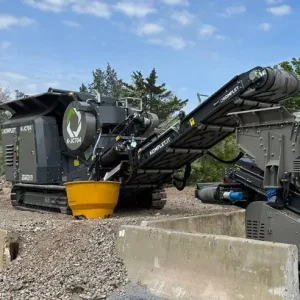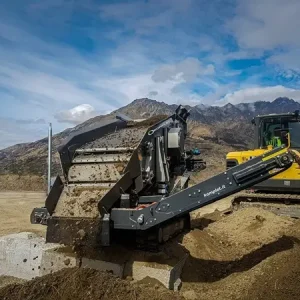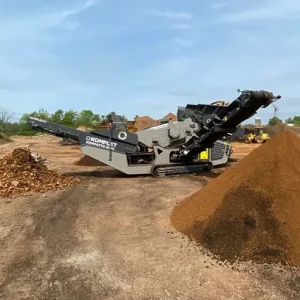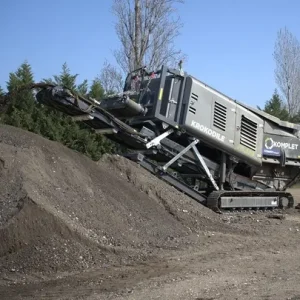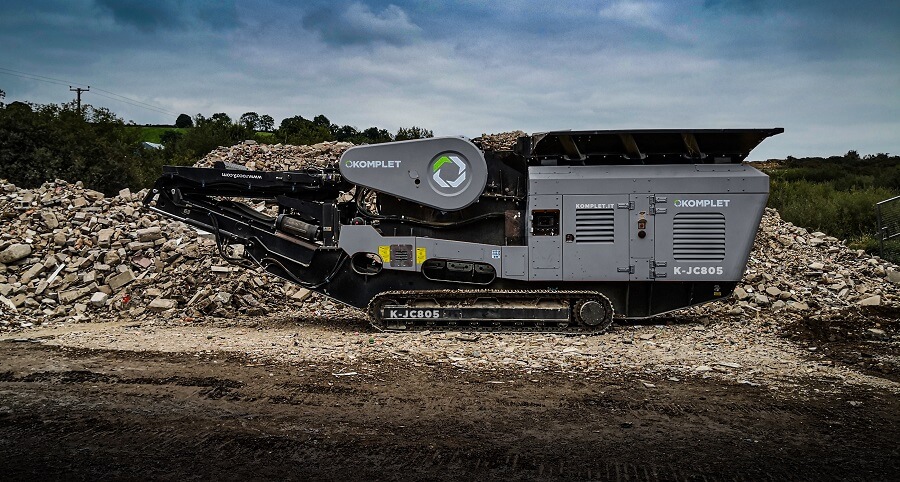

On-site rock crushers lower material and hauling costs through five mechanisms: eliminating tipping fees on demolition concrete, removing the round-trip hauling miles to a transfer station, avoiding the cost of importing virgin aggregate, freeing loader hours from cycle work, and creating a saleable product (recycled concrete aggregate) from material that otherwise leaves the site as waste. For a contractor processing meaningful demolition volume, the financed monthly payment on a Komplet jaw crusher is often fully covered by tipping fees and import-aggregate costs avoided in the first quarter of operation.
This guide explains how the cost math actually works on a real jobsite — what’s driving the savings, where the savings come from in dollar terms, which Komplet machine fits which operation, and how to validate the case before committing capital. The mechanisms are durable across regions and project types; the specific dollar figures depend on local tipping rates, local aggregate prices, and project mix.
The Cost Problem: Why Hauling Concrete Costs More Than Most Contractors Realize
On a typical demolition or renovation project, concrete is the largest waste stream by weight. Without on-site processing, the workflow is the same one most contractors have used for decades:
- Demolish the concrete (slabs, footings, sidewalks, foundations, masonry).
- Load broken concrete into trucks at the project site.
- Haul the trucks to a transfer station, recycling facility, or landfill.
- Pay tipping fees per ton on the inbound material.
- Order virgin aggregate (crushed stone) for backfill, base course, drainage, or fill on the same project.
- Pay for the virgin aggregate plus delivery from the quarry to the project site.
- Receive and place the imported aggregate.
Every step is a cost line. Step 2 burns diesel and operator hours on truck loading. Step 3 burns diesel and driver hours on hauling. Step 4 is a tipping fee that varies regionally but is almost always meaningful. Step 5 burns capital on a material that’s chemically and structurally similar to the demolition concrete leaving the site. Step 6 burns more diesel and driver hours on inbound delivery. The same material gets handled, transported, paid for, and re-handled multiple times — and the contractor pays for every cycle.
On-site crushing collapses that workflow. The demolition concrete becomes aggregate without leaving the project. The hauling miles disappear, the tipping fees disappear, and the imported aggregate that would otherwise replace what was hauled away mostly doesn’t need to be imported.
Five Mechanisms by Which Rock Crushers Lower Costs
1. Tipping Fees Avoided
Tipping fees on demolition concrete vary dramatically by region. Urban markets and coastal jurisdictions with limited landfill capacity tend to be highest. Rural and inland markets tend to be lowest. Whatever the local rate, every ton of concrete the contractor processes on-site is a ton not paid for at a transfer station gate. Across a meaningful project — measured in hundreds or thousands of tons — that line item alone often justifies the equipment investment.
2. Hauling Miles Eliminated
Round-trip hauling has two costs: the truck (diesel, tires, maintenance, depreciation) and the driver (wages, benefits, schedule risk). On urban projects, hauling miles are particularly expensive because traffic congestion makes each round trip take longer than the route distance suggests. On rural projects, hauling miles add up because nearest transfer stations may be substantial distances away. Either way, on-site processing eliminates the round trip entirely.
3. Import-Aggregate Purchases Avoided
This is the lever most contractors underestimate. The alternative to using recycled aggregate from on-site processing isn’t “no aggregate” — it’s importing virgin crushed stone from a quarry to backfill the same project. Recycled concrete aggregate substitutes directly for virgin aggregate in road base, drainage, fill, and non-structural concrete applications, typically at 30 to 50 percent lower cost per ton than virgin material. The contractor avoids both the price differential and the inbound delivery cost.
4. Loader Hours Freed for Higher-Value Work
On a project without on-site processing, the loader spends meaningful hours moving concrete to and from haul trucks. With on-site crushing — especially when paired with a K-TC 460 tracked mobile conveyor clearing crusher discharge to a stockpile — the loader is freed for hopper feeding, truck loading on outbound finished product, or other revenue-generating work. Loader hours have a real cost, and reallocating them is a real saving.
5. Recycled Concrete Aggregate Becomes a Saleable Product
Beyond cost avoidance, on-site crushing creates a product. Recycled concrete aggregate (RCA) — commonly sold as 2-inch minus, 3/4-inch minus, or #57 crushed concrete — competes directly with virgin crushed stone on most base and fill applications. Yard-based contractors and recyclers sell RCA to other contractors at a meaningful margin. For project-based contractors, RCA produced beyond on-project needs becomes inventory for future projects or saleable material to nearby buyers.
How the Math Actually Works: A Cost-Mechanics Walkthrough
This is illustrative — actual results depend on specific local costs, project conditions, and equipment utilization. Use this as a structural template, not a quote:
- Estimate annual demolition concrete tonnage. Be conservative. A small-to-mid contractor might process a few thousand tons per year; a steady demolition contractor might process tens of thousands.
- Estimate local tipping fee per ton. Call two or three local transfer stations or recycling facilities for current rates.
- Estimate hauling cost per ton. Include diesel, driver wages, truck depreciation, and route time. Most contractors who haven’t measured this directly underestimate it.
- Estimate virgin-aggregate replacement cost per ton. Local quarry pricing plus delivery from quarry to project.
- Multiply tons × (tipping fee + hauling + virgin aggregate avoided) = annual gross savings.
- Subtract on-site processing operating costs: fuel for the crusher, wear parts (jaw plates, screens, belts), operator labor, and any maintenance overhead.
- Compare net annual savings against the financed monthly payment on the equipment. Komplet Capital terms are 100 percent financing, 24-hour approvals, and 36/48/60/72-month options.
For most contractors with steady demolition or recycling volume, this math produces a net positive within the first year — often within the first quarter. The decisive line item is usually the combination of tipping fees and virgin-aggregate avoidance, which compounds with every project.
The math is also conservative on revenue: it counts only avoided costs, not RCA sales revenue. For yard-based contractors and recyclers selling RCA to other operators, that adds another revenue line on top of the cost avoidance.
Which Komplet Crusher Fits Which Operation
The right machine for any specific contractor depends on annual processing volume, feed material size, and project mix. Rough sizing guide for jaw crushers:
Under 5,000 Tons Annually
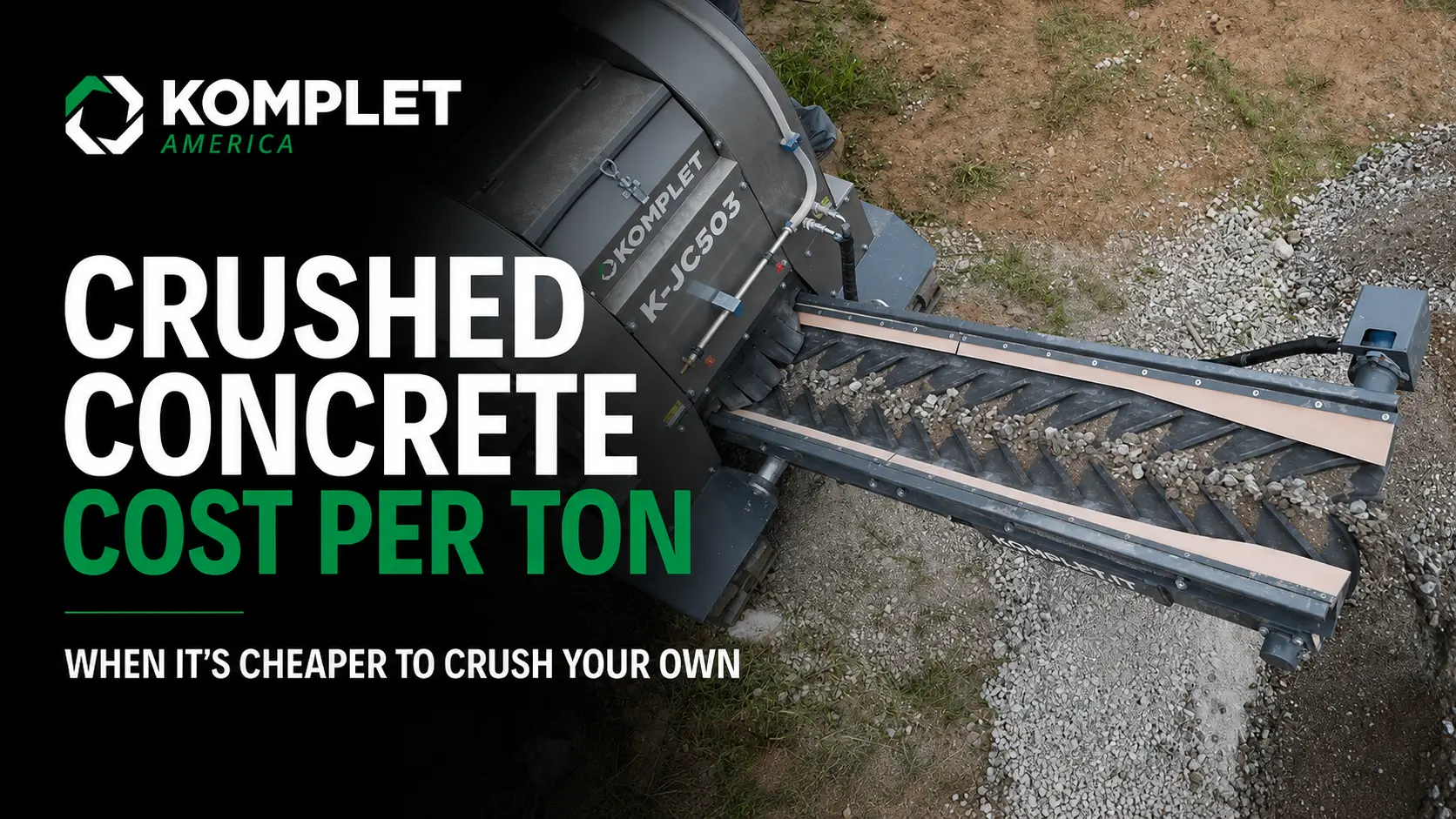
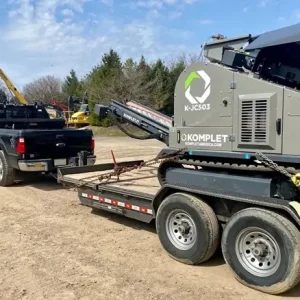
The K-JC 503 mini jaw crusher is the right answer for pool, mason, basement waterproofing, landscaping, and hardscaping contractors. Up to 34 US tph, 19″ × 12″ jaw, 25 hp Tier 4 Final, 7,496 lb transport weight (towable behind a standard pickup). The K-JC 503 is the lowest-capital entry point into on-site processing for specialty contractors.
5,000 to 30,000 Tons Annually
The K-JC 604 mobile jaw crusher handles mid-size site contractor and municipal yard volume. Up to 55 US tph, 23″ × 16″ jaw.
30,000 to 100,000 Tons Annually
The K-JC 704 PLUS portable jaw crusher — Komplet’s best-selling crusher — covers the contractor- and recycler-scale volume range. Up to 90 US tph, 27″ × 16″ jaw, 74 hp. This is the standard pairing for civil, road and bridge, demolition, and recycling spreads.
100,000 to 300,000 Tons Annually
The K-JC 805 mobile jaw crusher is the largest jaw in the lineup. Up to 160 US tph, 31″ × 21″ jaw, 130 hp. Quarry, large-recycling, and high-volume civil applications.
Cubical Aggregate, RAP, and DOT-Spec Output
For operations producing premium cubical aggregate, recovered asphalt pavement reduction, or DOT-spec material, the K-IC 70 compact impact crusher is engineered specifically for that workflow. Up to 90 US tph. The K-IC 70 is often paired with a jaw crusher upstream for primary reduction and the K-IC 70 for finishing.
Mixed C&D Streams
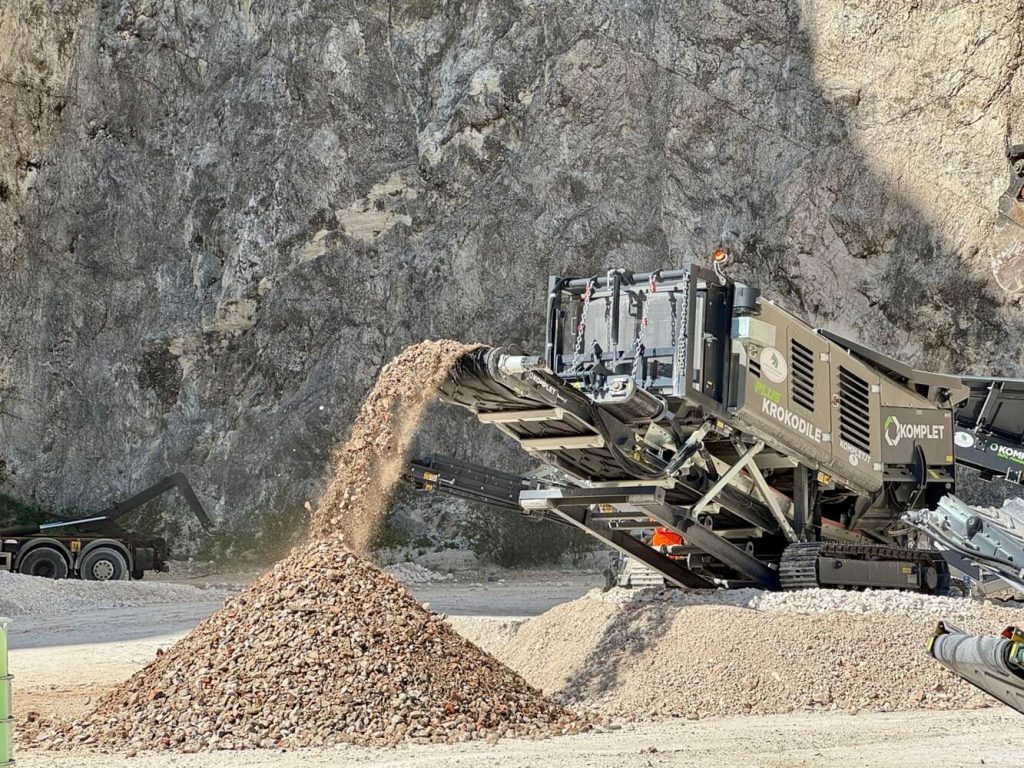
For projects where the waste stream includes wood, drywall, plastics, and other soft mixed C&D alongside concrete, the Krokodile PLUS slow-speed shredder handles both fractions with quick-change shafts: the C&D/asphalt shaft processes concrete and asphalt at up to 175 US tph; the wood/lightweight waste shaft processes wood, drywall, plastics, garbage, mixed waste, and green compost. Many demolition contractors run a Krokodile PLUS alongside a Komplet jaw crusher to capture the entire waste stream as recycled product.
Pairing the Crusher with Screening and Conveying for Full ROI
A crusher alone produces unsorted output. A complete on-site processing spread that maximizes the cost-savings case usually includes:
Screener for Product Cuts
A Kompatto 5030 vibrating screener (Komplet’s best-selling screener, up to 280 US tph) or Kompatto 124 vibrating screener (up to 350 tph) separates crusher output into product cuts — typically 2-inch minus, 3/4-inch minus, and oversize for return to the crusher. Spec-graded RCA commands higher per-ton pricing on resale than unscreened crusher output.
Tracked Conveyor for Stockpiling
The K-TC 460 tracked mobile conveyor — up to 132 US tph, 15-foot pile height, self-propelled on rubber tracks — clears crusher discharge continuously to a stockpile. That eliminates the loader cycles that would otherwise be required to move discharge, which is the loader-hour-avoidance lever from earlier. The K-TC 460 weighs 7,000 lb in transport and is towable behind a standard work truck.
Trommel Screener for Soil and Compost Operations
For yard-based contractors who also process soil, compost, or green material alongside concrete recycling, the K-TS 30 or K-TS 40 trommel screener adds a second product line and a second revenue stream from the same yard footprint.
Financing the Equipment So Avoided Costs Cover the Payment
The capital structure that turns the cost-savings case into actual fleet decisions is Komplet Capital — Komplet America’s in-house financing team. Standard terms:
- 100 percent financing — no down payment required for qualified borrowers.
- 24-hour approvals on most applications.
- 36, 48, 60, and 72-month term options.
- Section 179 tax deduction eligibility on qualifying purchases — up to $1.22M (2024 limit) for many small and mid-sized contractors.
- Illustrative APR ranges: approximately 7.50% (excellent credit) to 18% (higher-risk credit). Final rate depends on credit profile and time in business.
- Financing structures applicable to both new and pre-owned purchases.
Many contractors structure the financed monthly payment to be fully covered by tipping fees and import-aggregate costs avoided during the same month. When the math works, the equipment is paid for by the costs it eliminates — and any RCA sales revenue, loader-hour reallocation, or longer-term margin improvement is incremental upside on top of cost coverage.
For contractors weighing the capital outlay, the Komplet pre-owned equipment program is also worth considering. Pre-owned units typically deliver 40 to 70 percent capital savings versus new, with the same OEM parts and service network supporting them. A pre-owned K-JC 704 PLUS with documented history can deliver the same cost-savings mechanics as new equipment at a substantially lower monthly payment.
Frequently Asked Questions
How do rock crushers lower hauling costs?
On-site crushers eliminate the round-trip hauling cycle that would otherwise carry demolition concrete from the project to a transfer station and bring imported virgin aggregate back. Each round trip is diesel, driver hours, truck wear, and tipping fees — all avoided when the concrete is processed on-site into recycled aggregate that stays on the project.
Can a crusher really pay for itself in tipping fees alone?
For contractors with steady demolition or recycling volume, yes — often within the first year of operation. The math depends on local tipping rates, hauling costs, and annual tonnage processed. Tipping fees vary by region but are almost always meaningful enough that several thousand tons of avoided fees can cover a financed monthly payment on a Komplet jaw crusher. Add the avoided cost of importing virgin aggregate to replace the hauled-away material, and the case strengthens further. Run the numbers with your specific local costs before committing capital.
What is recycled concrete aggregate (RCA)?
Recycled concrete aggregate is the product of crushing demolition concrete to aggregate sizes. RCA substitutes for virgin crushed stone in road base, drainage, fill, and non-structural concrete applications, typically at 30 to 50 percent lower cost per ton than virgin material. Common product cuts include 2-inch minus, 3/4-inch minus, and #57 crushed concrete. Komplet jaw crushers and the K-IC 70 impact crusher produce spec-compliant RCA on-site.
Which Komplet crusher is right for a small contractor?
For pool, mason, basement waterproofing, landscaping, and hardscaping contractors processing under 5,000 tons annually, the K-JC 503 mini jaw crusher is the standard answer. It transports at 7,496 lb behind a standard pickup, processes up to 34 US tph, and is the lowest-capital entry point into on-site crushing; certified pre-owned units are typically 40 to 70 percent below new pricing.
What’s the best-selling Komplet jaw crusher?
The K-JC 704 PLUS portable jaw crusher is Komplet’s best-selling crusher. It processes up to 90 US tph through a 27″ × 16″ jaw, runs a 74 hp Tier 4 Final engine, and covers the 30,000-to-100,000-tons-annually volume band — the contractor- and recycler-scale range that matches the largest customer segment.
Can I use recycled concrete aggregate for structural concrete?
Generally no, not for structural concrete production. RCA performs well in non-structural applications: road base, drainage, fill, residential sub-bases, commercial base, and general backfill. For structural concrete production and high-traffic industrial applications, engineers typically specify virgin aggregate. The cost-savings case for on-site crushing is built on the non-structural applications, which represent the majority of aggregate use on most jobsites.
How long does setup take on a Komplet crusher?
Komplet jaw crushers are tracked, self-propelled, and engineered for fast setup. Most units are ready to run within hours of arriving at a new jobsite — not the days or weeks required for permanent plant installations. The K-JC 503 and K-JC 604 are towable behind standard work trucks; the K-JC 704 PLUS and K-JC 805 transport on heavy-haul trailers but still walk into position on rubber tracks once on site.
Does Komplet equipment work for asphalt recycling too?
Yes. Komplet jaw crushers handle asphalt alongside concrete. The K-IC 70 compact impact crusher is engineered specifically for reclaimed asphalt pavement (RAP) reduction to spec-compliant aggregate suitable for new asphalt mixes. The Krokodile PLUS slow-speed shredder also handles asphalt at up to 175 US tph with the C&D/asphalt shaft. The same cost-savings mechanisms — tipping fees avoided, virgin material avoided, hauling miles eliminated — apply to asphalt recycling as to concrete recycling.
Can I finance a Komplet rock crusher?
Yes. Komplet Capital offers 100 percent financing, 24-hour approvals, and 36/48/60/72-month term options on both new and pre-owned equipment. Section 179 tax deduction may apply for qualifying purchases. Many contractors structure the financed monthly payment to be fully covered by avoided tipping fees and virgin-aggregate costs from the same month.
Final Thoughts
On-site rock crushers don’t reduce material and hauling costs through some special productivity trick. They reduce them by collapsing a multi-step workflow — haul out, tip, buy back, haul in — into a single on-site processing step. The savings come from eliminating cost lines that the traditional workflow takes for granted: tipping fees, round-trip hauling, virgin-aggregate purchases, loader cycle time. Each one is measurable. Together, they often add up to enough to cover the financed payment on the equipment within the first year of operation.
The right Komplet machine for any specific contractor depends on annual volume and material mix — the K-JC 503 for specialty contractors, the K-JC 704 PLUS for the contractor- and recycler-scale middle, the K-JC 805 for high-volume work, the K-IC 70 for cubical aggregate and RAP, and the Krokodile PLUS for mixed C&D streams. Pair the crusher with a Kompatto screener and a K-TC 460 tracked conveyor to maximize the productivity case, and structure the financing through Komplet Capital so the unit is producing revenue inside the first budget cycle.
Komplet America builds compact crushers, screeners, the Krokodile PLUS slow-speed shredder, and the K-TC 460 tracked mobile conveyor for contractors who need real production in tight footprints. To see the full lineup, explore the crusher, screener, shredder, and conveyor categories. To talk financing or pricing, contact Komplet Capital, visit the contact page, or call 908-369-3340.
Ready to lower your material and hauling costs?
- Browse the full Komplet equipment lineup — crushers, screeners, the Krokodile PLUS shredder, and the K-TC 460 conveyor.
- Talk to Komplet Capital about 100 percent financing, 24-hour approvals, and Section 179 tax deduction eligibility.
- Save 40–70 percent with certified pre-owned Komplet equipment — the same cost-savings mechanics at a lower monthly payment.
- Review Komplet parts and support coverage to model ongoing operating costs into your math.
- Find your local Komplet dealer for rental availability before you buy.
Never enough.
Disclaimer: All operating, maintenance, and service guidance in this article is general in nature. Always refer to the official Komplet operator’s manual for the specific machine model and serial number, and follow OEM intervals and procedures. For warranty-protected work, contact Komplet America at 908-369-3340 or your authorized Komplet dealer. Improper service or non-OEM parts may void warranty coverage and create safety hazards.
Disclaimer: Cost savings figures, payback timelines, tipping fee references, virgin-aggregate price differentials, RCA sales pricing, financing rates, and ROI examples shown above are illustrative examples only. Actual results depend on jobsite material composition, local hauling and tipping rates, fuel and labor costs, equipment utilization, financing terms, regional regulatory requirements, and operator efficiency. Komplet America makes no guarantee of specific financial returns. The Komplet Capital financing calculator is for illustration purposes only and is not an approval or an offer to finance. Customers should perform their own analysis based on local market conditions and consult their tax advisor on Section 179 eligibility before making purchase decisions.
Equipment prices are subject to change based on dealer location, availability, and any additional features or customizations. Prices do not include taxes, shipping, or installation fees, which may apply depending on your region. Contact Komplet America at 908-369-3340 or visit kompletamerica.com for current pricing.