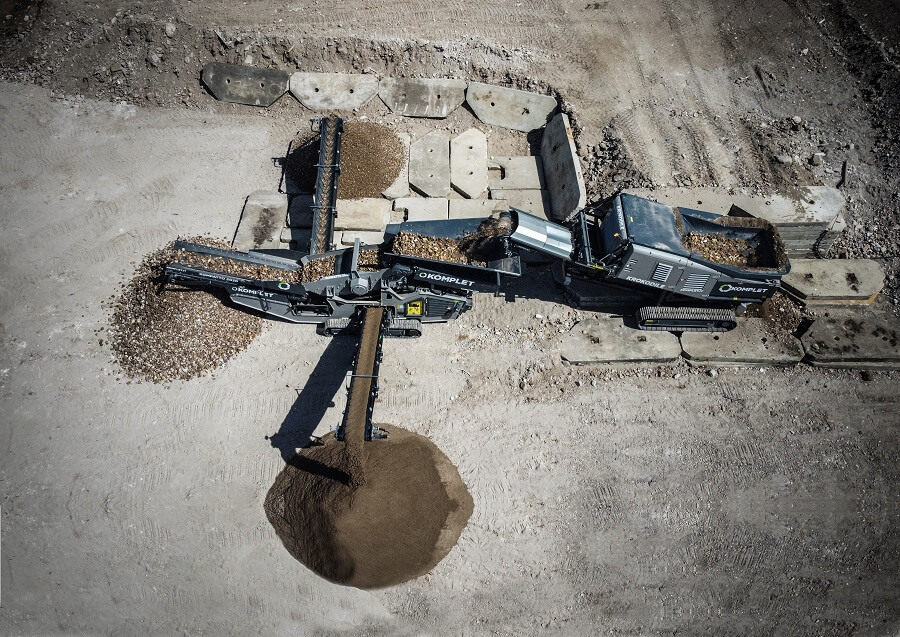

A mobile screener is one of the most underappreciated pieces of equipment in compact mobile material processing. Where crushers reduce material size, screeners separate material into spec-graded products — and the difference between a screened operation and an unscreened one is the difference between selling base course at premium prices and selling unsorted aggregate at commodity discount. Selecting the right mobile screener determines not just operational efficiency but the actual revenue per ton the operation captures from its processed material.
This guide walks through the two main mobile screener categories (vibrating and trommel), the key selection variables (throughput, deck configuration, screen media options, mobility), the on-site benefits that justify mobile over stationary screening, the pairing logic for screener-with-crusher operations, and where Komplet America’s Kompatto and K-TS lineups fit across operational profiles. The framing throughout is practical and focused on what produces the right screener choice for specific operations rather than generic recommendations.
What Is a Mobile Screener?
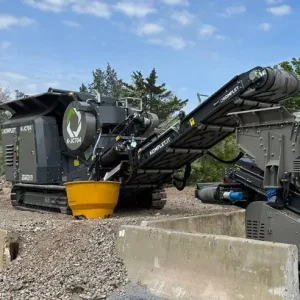
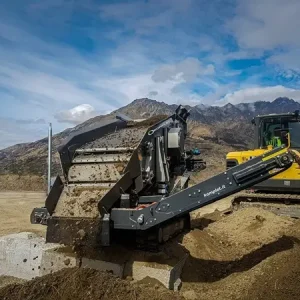
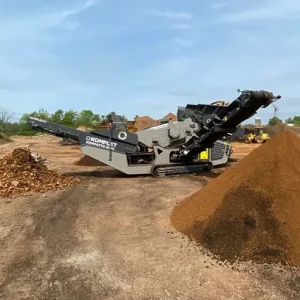
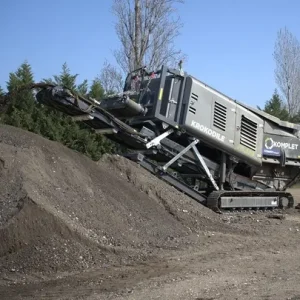
A mobile screener is a self-propelled or transportable screening plant that separates material into multiple size fractions through one or more vibrating or rotating screen decks. Material enters the screener via hopper or feed conveyor, passes over the screen deck(s), and discharges through multiple output conveyors — one per size fraction. The result: a single feed pile of mixed-size material becomes multiple stockpiles of spec-sized material, each ready for sale or use without further processing.
Mobile screeners differ from stationary screeners in three operationally important ways: they are tracked or wheeled for site-to-site mobility, they are powered by integrated diesel engines for off-grid operation, and they are typically operated by a single trained operator with remote-control capability for tracked movement and basic operational functions. The mobile category serves contractor-scale operations, recycling yards, mid-size aggregate suppliers, and any operation that needs screening capability without committing to fixed-plant infrastructure.
The Two Main Categories: Vibrating Screeners vs Trommel Screeners
Mobile screeners come in two fundamental categories that handle different material types and produce different output characteristics. Choosing between them is the first selection decision; getting it wrong means the equipment can’t produce the spec product the operation needs to sell.
Vibrating Screeners
Vibrating screeners use mechanical vibration to move material across one or more inclined or horizontal screen decks. Material smaller than the screen aperture falls through; material larger than the aperture continues across the deck and discharges off the end. Multiple decks (double-deck or triple-deck configurations) produce multiple size fractions in a single pass.
Best for: hard, dry, granular material — concrete, asphalt, aggregates, processed C&D material, demolition debris, sand and gravel, and quarry products. Output produces clean spec-graded material at high throughput rates. Limitations: less effective with wet, sticky, or cohesive material that binds to the screens or doesn’t size cleanly through vibration alone.
Komplet’s vibrating screener lineup (Kompatto series):
- Kompatto 221 — up to 90 US tph; 25 hp diesel; two 7′ × 3.5′ double-deck screens; 3-product output. The smallest self-propelled mobile screening plant in the Komplet lineup, designed for limited-access job sites. Can be fed directly by an excavator, backhoe, processed material pile, or the discharge belt of a Komplet crusher.
- Kompatto 5030 — up to 280 US tph; double-deck screen box (8′ × 3′2″ upper, 7′ × 3′2″ lower); 3-product or 2-product split configuration; supports steel mesh, punch plates, and reinforced bars; processes sand, gravel, aggregates, C&D material, landfill waste, and topsoil. Komplet’s best-selling screener.
- Kompatto 124 — up to 350 US tph; the largest scalping screen in the lineup; 75 hp; high-throughput configuration for quarry, recycling yard, and large-scale aggregate operations.
Trommel Screeners
Trommel screeners use a rotating cylindrical drum with screen apertures along the drum surface. Material entering the drum tumbles as the drum rotates; smaller material falls through the apertures while larger material continues to the discharge end. The tumbling action handles cohesive and damp material that doesn’t size cleanly on vibrating screens.
Best for: cohesive, damp, or organic material — compost, mulch, topsoil, screen-out from landfill operations, biomass, and similar materials. The tumbling action separates fines from oversize even when the material is too sticky to vibrate cleanly. Limitations: lower throughput per dollar than vibrating screens for hard granular material; not the best choice when feed is dry concrete or aggregate.
Komplet’s trommel screener lineup (K-TS series):
- K-TS 30 — compact trommel screener for compost, topsoil, green/cohesive material, and similar applications. 23 kW genset configuration.
- K-TS 40 — up to 120 US tph; 40 kW genset; varied compost, topsoil, and waste-stream applications.
Key Selection Variables
- Throughput Capacity Required
How many tons per hour does the operation need to process? Match throughput to actual operational demand, not aspirational maximum demand:
- Up to 90 tph: Kompatto 221 (vibrating) or K-TS 30 (trommel, depending on material).
- 90-280 tph: Kompatto 5030 (vibrating, dominant choice) or K-TS 40 (trommel for cohesive material).
- 280-350+ tph: Kompatto 124 (vibrating, large-scale operations).
Note on “up to” production ratings: the rated tph reflects maximum potential output under ideal conditions — consistent feed material (size, hardness, moisture), skilled operator use, proper setup, and minimal downtime. Clean concrete with no rebar, fed at a steady rate in optimal weather, will produce higher output than mixed, wet, or irregular materials. Operations should plan for typical output, not maximum output.
- Number of Output Products Required
How many distinct spec products does the operation need to produce per processing run? More output products typically means more deck levels and more discharge conveyors:
- 2-product split: oversize and undersize from a single deck. Adequate for some operations but limits salability of intermediate sizes.
- 3-product split: typical configuration — fines, mid-size, and oversize. Most Komplet vibrating screeners offer 3-product split as standard or convertible configuration.
- 4+ product split: typically requires multiple-pass processing or larger stationary plant configurations.
Operations selling into multiple market segments (landscape stone, base course, riprap, fines) typically need 3-product or 4-product capability to capture market value. Operations producing for a single market (base course only) can sometimes work with 2-product configurations.
- Material Type and Condition
Match the screener type to the dominant material the operation processes:
- Hard, dry, granular material (concrete, asphalt, sand, gravel, processed aggregate): vibrating screener (Kompatto series). Higher throughput, cleaner separation.
- Cohesive, damp, organic material (compost, mulch, topsoil, biomass): trommel screener (K-TS series). Tumbling action handles material that vibrating screens can’t process cleanly.
- Mixed material profile: Operations handling both hard and cohesive material may need both screener types or a vibrating screener with specialized screen media (anti-clogging mesh, heated decks, or similar adaptations).
- Mobility Requirements
Will the screener move between sites, or operate in one location for extended periods?
- Multi-site mobile operations: All Komplet screeners are tracked and self-propelled, designed for site-to-site movement on standard trailers behind standard trucks.
- Single-yard operation: Mobile screeners work fine in fixed-yard operation. The mobility is unused but doesn’t penalize the operation.
- Tight-access sites: Smaller screeners (Kompatto 221) fit confined spaces that larger screeners can’t physically access.
- Standalone vs Crusher-Paired Operation
Will the screener operate independently, or be paired with a crusher in a processing line?
- Standalone screening: Feed material delivered by excavator, loader, or other handling. Kompatto 221, 5030, and 124 all handle standalone operation cleanly.
- Pre-screening before crushing: The screener processes feed material to remove fines (already-sized material that doesn’t need crushing), feeding only oversized material to the crusher. Improves crusher throughput and reduces unnecessary wear.
- Post-crushing screening: The screener processes crusher output to produce multiple spec-graded products. Most operations producing aggregate for sale use this configuration.
- Pre and post combined: Some operations run two screeners — one before, one after the crusher. Maximizes throughput and product control. Typical at recycling yards and aggregate operations.
Three Ways a Mobile Screener Simplifies Work at Your Job Site
Mobile screeners are versatile, high-performance, compact pieces of equipment that get the job done efficiently, safely, and cost-effectively. The on-site benefits cluster around three primary advantages:
- Site-to-Site Mobility and Fast Deployment
A mobile screener offers portability — easy to relocate and set up. Compact dimensions and relatively low transport weight make it convenient to transport to and from job sites at the beginning and completion of projects. While static screeners operate from a fixed location for the project’s duration, a track-mounted mobile screener can rapidly move between two job sites or along the quarry face to limit interruption to production time. For pavers, masons, landscapers, and on-site construction recyclers operating multiple project sites, mobility is structural — it determines whether the equipment can be where it’s needed when it’s needed.
- Direct On-Site Material Processing
Because mobile screeners are compact and self-driven, they can operate right next to demolition sites or other areas with waste, organics, and recyclables. Material doesn’t need to be hauled to a separate processing facility — the screener comes to the material rather than the material going to the screener. For road building operations, landscaping contractors, waste management operations, and demolition businesses, this eliminates the round-trip hauling that off-site processing requires.
- Reduced Manual Labor and Higher Productivity
Mobile screeners limit the need for non-powered material handling equipment such as wheelbarrows, sorting belts, or manual sorting. Workers can focus on tasks that require more skill — operating crushers, managing stockpiles, coordinating loads, working with customers — rather than repetitive manual labor. The labor productivity improvement compounds across project life: a screener-equipped operation typically produces 2-5x more output per labor hour than an operation relying on manual sorting or off-site processing.
Screen Media: The Variable That Determines Output Quality
Beyond the screener itself, the choice of screen media (the material the screen deck is made from) determines what output spec the screener can produce. Different media types serve different applications:
- Steel mesh: Standard for most aggregate and C&D applications. Durable, reliable, well-suited to standard gradations.
- Punch plates: Heavier-duty than mesh. Used for harsh applications with abrasive material or where mesh would clog.
- Reinforced bars: For very heavy material and rough scalping applications. Coarse separation with high throughput.
- Polyurethane: Anti-clogging properties for sticky or cohesive material. Used where steel media would bind.
- Specialty configurations: Some applications use specialty screen configurations — heated decks for frozen material, sloped decks for sticky material, multi-angle decks for difficult sizing.
The Kompatto 5030 supports steel mesh, punch plates, and reinforced bars in its standard configuration, making it the most flexible screener in the Komplet lineup for varied material applications.
Application-Specific Considerations
C&D Recycling Operations
Typically pair a vibrating screener (Kompatto 5030) with a jaw crusher (K-JC 704 PLUS or K-JC 805) in a complete processing line. The screener pre-screens incoming demolition material to remove fines and contamination before crushing, then post-screens crusher output into spec-graded RCA products.
Topsoil and Compost Operations
Trommel screeners (K-TS 30, K-TS 40) are dominant. The tumbling action handles the cohesive nature of topsoil and compost cleanly; vibrating screens struggle with these materials.
Aggregate Yards and Sand & Gravel Operations
Vibrating screeners (Kompatto 5030, Kompatto 124) handle the throughput and dry granular material typical of aggregate operations. The 3-product split produces typical aggregate gradations directly.
Construction Site Use
Smaller screeners (Kompatto 221) fit limited-access construction sites where larger equipment can’t operate. Useful for single-project operations, residential demolition, and tight urban work.
Demolition Contractors
Often pair Kompatto 5030 with K-JC 704 PLUS for the typical demolition material flow. The screener separates concrete, masonry, and aggregate fractions while the crusher reduces oversized material to spec.
Disaster Recovery Operations
Trommel screeners (K-TS 40) excel in disaster recovery — storm debris, flood material, and mixed waste streams that include both organic and inorganic content. The tumbling action handles the variable material conditions that disaster recovery typically presents.
Frequently Asked Questions
What’s the difference between a vibrating screener and a trommel?
Vibrating screeners use mechanical vibration on inclined or horizontal screen decks; trommel screeners use a rotating cylindrical drum with screen apertures. Vibrating screeners excel with hard, dry, granular material at high throughput. Trommel screeners excel with cohesive, damp, organic material that doesn’t size cleanly through vibration alone. The right choice depends entirely on the dominant material the operation processes.
How many output products can a Kompatto 5030 produce?
The Kompatto 5030 produces three end-product material sizes from its double-deck screen via three extraction belts. The configuration can also be set up as a 2-way split for two end-products if the operation needs simpler output. The 3-way split is the more common configuration.
What size feed material can a Kompatto 5030 handle?
Komplet recommends keeping maximum feed material below 15″ in any dimension. The double-deck screen can be set up to output material sizes from fine topsoil at 1/4″ to 5″ oversize, depending on screen media selected.
Does a Komplet screener pair with a Komplet crusher?
Yes — that’s a standard configuration. The Kompatto 221 can be fed directly by the discharge belt of a Komplet crusher. Larger screeners (5030, 124) commonly pair with K-JC 704 PLUS or K-JC 805 jaw crushers in full processing lines. Pairing produces both pre-screening (before crushing) and post-screening (after crushing) capability.
Can a screener handle wet or damp material?
Depends on screener type and material. Vibrating screeners (Kompatto series) operate best with dry materials but can handle some moisture. The Kompatto 5030 specifically can process damp or sticky materials such as compost, though it operates best with dry materials. Trommel screeners (K-TS series) handle wet and cohesive material more cleanly than vibrating screeners — that’s their primary advantage for compost and topsoil applications.
Does Section 179 apply to mobile screeners?
Yes. Section 179 of the Internal Revenue Code allows businesses to deduct the full purchase price of qualifying equipment in the year placed in service. For tax year 2026, the maximum deduction is $2,560,000. Compact mobile screeners qualify. Confirm specific eligibility with your tax advisor.
Should I rent or buy a mobile screener?
Depends on usage. Operations with 30+ operating days per year typically come out ahead with ownership; operations with intermittent use may benefit from renting through Komplet authorized rental houses. The rent vs. buy framework applies to screeners the same way it applies to crushers — match procurement strategy to actual utilization profile.
Final Thoughts
The right mobile screener choice is fundamentally about matching equipment to material and matching equipment to operational profile. Hard, dry, granular material flows naturally to vibrating screeners (Kompatto series); cohesive, damp, organic material flows naturally to trommel screeners (K-TS series). Operations producing high tonnage with multi-product output get capability that smaller screeners can’t deliver; operations working tight sites with modest throughput get mobility that larger screeners can’t fit. The mismatch between equipment and operation is what produces frustrated equipment owners; the match produces operations that capture the full value of their processed material across years of reliable service.
The Conti family construction legacy that informs Komplet America’s approach to equipment dates to 1906, and the screener selection lesson from that lineage is straightforward: don’t buy bigger than the operation needs (capital tied up in unused capacity), don’t buy smaller than the operation needs (production bottleneck and frustrated operators), and don’t buy the wrong screener type for the dominant material (the equipment will fail to produce spec product regardless of operator skill). Done well, the screener selection is informed by actual material, actual throughput, actual project profile, and actual budget. Done poorly, it’s informed by spec sheet superficial features and aspirational use cases that the operation never actually realizes.
To explore Komplet’s mobile screeners, the full lineup is at Komplet screener lineup. Pre-owned equipment is at Komplet’s pre-owned inventory. Equipment financing through Komplet Capital is at Komplet Capital financing. Or call Komplet America directly at (908) 369-3340.
Ready to Select the Right Mobile Screener?
- Define your screening requirements — material type, throughput target, output product count, mobility needs, and crusher pairing.
- Call Komplet America at (908) 369-3340 to discuss your specific application. Komplet’s team can match equipment to your operational profile.
- Discuss financing through Komplet Capital at Komplet Capital financing — 100% financing, 24-hour approvals.
- Talk to your CPA about Section 179 — for tax year 2026, the maximum deduction is $2,560,000.
- Find your local Komplet dealer at Find Your Komplet Dealer for in-person equipment evaluation.
Never enough.
Disclaimer: Throughput figures (“up to” tons per hour) are illustrative best-case scenarios based on ideal conditions — consistent feed material, skilled operator, proper setup, and minimal downtime. Actual output varies by material, operator, and operating environment. Komplet America makes no guarantee of specific throughput rates.
Disclaimer: Pricing references are 2026 figures and subject to change based on configuration, dealer location, and additional features. Prices do not include taxes, shipping, or installation. Contact Komplet America at (908) 369-3340 for current pricing.
Disclaimer: Section 179 limits are 2026 figures based on the One Big Beautiful Bill Act of 2025. Komplet America is an equipment distributor, not a tax advisor. Consult a qualified CPA before making decisions based on tax treatment.
All operating, maintenance, and service guidance is general in nature. Always refer to the official Komplet operator’s manual for the specific machine model and serial number, and follow OEM intervals and procedures.