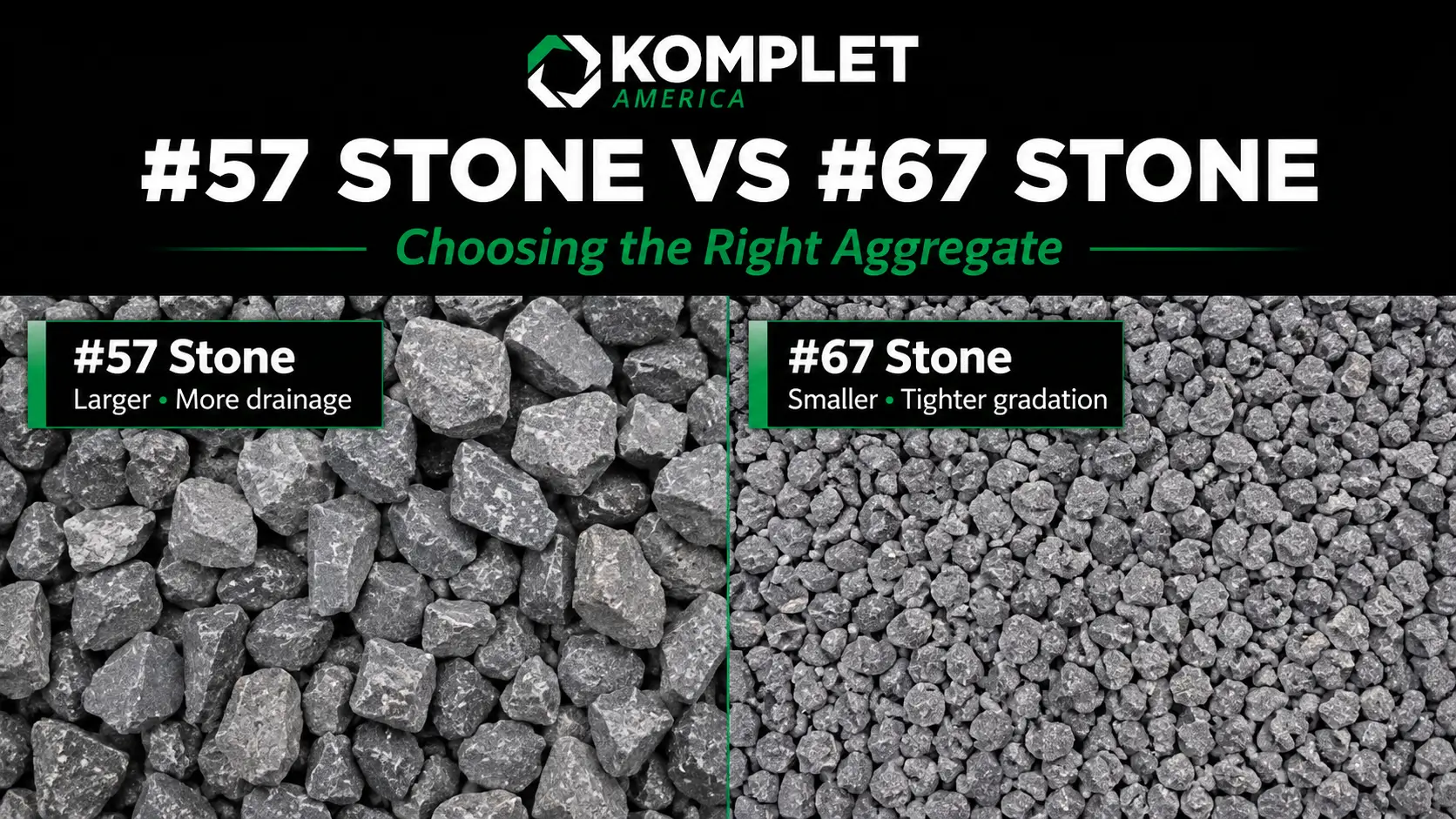

#57 stone and #67 stone are two of the most commonly produced and most commonly confused crushed aggregate products in the United States. They look almost identical in a stockpile. Both are open-graded, both are clean of fines, both have angular fracture surfaces, both are produced from the same parent rocks (limestone, granite, trap rock, gravel, slag, or recycled concrete). Drop a handful of each into a contractor’s hand and most experienced operators couldn’t tell them apart by sight alone. The difference shows up under the sieve analysis, in the drainage rate after placement, in the compactability under a plate compactor, and in which ASTM and AASHTO specifications they’re approved for. Choosing the wrong one for the application doesn’t show up immediately — it shows up six months later, when the slab pad has settled or the drainage layer has clogged or the concrete mix has come back from the lab with a marginal gradation report.
This guide is the contractor’s reference for #57 versus #67 stone. It covers the AASHTO M43 size designations and ASTM C33 concrete aggregate specifications behind each product, the practical differences in how each grade performs after placement, the applications where each is the right choice, the regional availability patterns that affect what the local aggregate yard actually carries, and — for the contractor producing aggregate on-site or in-yard from concrete demolition rubble — the screener mesh configuration math that determines whether a single screening pass can produce both products from the same feed.
The audience is the contractor, recycler, or aggregate producer making real decisions about specification, supply, and production. Both #57 and #67 are workhorse products. Neither is universally better. The right choice depends on what the layer needs to do, what the binding specification (if any) requires, what the local market carries, and — for the producer — what the screener can practically separate from the feed in a single pass.
Komplet America has been the U.S. distributor of Komplet S.p.A. compact crushers, screeners, and shredders since 2018, and the Conti family construction legacy behind Komplet America stretches back to 1906. Most of the contractors and recyclers running our equipment produce some combination of #57, #67, #8, and crusher run-equivalent products from the same primary feed material. The configuration discussion below comes directly from the conversations our specialists have when sizing screeners and screen meshes for customers’ specific product mixes.
The Quick Answer
For contractors who don’t need the full reference:
- Both #57 and #67 are AASHTO M43 size designations for clean, open-graded coarse aggregate. Both are widely used as drainage stone, base course, retaining wall backfill, and ASTM C33 coarse aggregate for concrete mixes.
- #57 is the larger of the two: 1-inch top size, gradation extending down to the #4 sieve.
- #67 is the smaller and tighter: ¾-inch top size, gradation extending down to the #8 sieve.
- Use #57 where drainage controls the layer or where a coarser aggregate works structurally — lower base layers, French drains, retaining wall backfill, slab base over wet subgrade.
- Use #67 where the section is thinner, where a smoother finish under compaction matters, or where the project specification calls for #67 specifically — sidewalk and small slab pads, road shoulders, and concrete mix designs that specify #67 coarse aggregate.
- In most U.S. markets, the local aggregate yard carries one or the other, not always both. Regional usage patterns drive which is locally available.
Where #57 and #67 Come From: The AASHTO M43 Framework
Both #57 and #67 are size designations under AASHTO M43, the AASHTO standard size designation for stone, gravel, and slag (also published as ASTM D448, the equivalent ASTM standard). M43 establishes 17 standard size numbers ranging from #1 (largest, 4-inch top size) through #10 (smallest, screened through a #4 sieve as fines), each defined by a percent-passing envelope across a series of named sieves. The size numbers are universal: a #57 stone produced in California has the same target gradation envelope as a #57 stone produced in Pennsylvania, regardless of source rock or producer.
ASTM C33 is the related specification — the standard specification for concrete aggregates — which references the M43 size numbers when defining acceptable gradations for coarse aggregate in structural concrete. C33 specifies allowable size designations (including #57 and #67 among others), particle shape requirements, deleterious material limits, soundness, abrasion, and other properties. When a structural engineer specifies “#57 coarse aggregate” for a concrete mix design, they’re referencing AASHTO M43 size #57 with the additional requirements of ASTM C33.
The AASHTO #57 Gradation Envelope
- Top size: 1 inch (25 mm).
- 100 percent passing 1½-inch sieve.
- 95–100 percent passing 1-inch sieve.
- 25–60 percent passing ½-inch sieve.
- 0–10 percent passing #4 sieve (4.75 mm).
- 0–5 percent passing #8 sieve (2.36 mm).
The defining features: 1-inch top size, and the gradation envelope ends at the #4 sieve with very low fines content. The envelope is intentionally wide between the 1-inch and ½-inch sieves — anywhere from 40 to 75 percent of the material can fall in that range. That width is why #57 stone from different producers can look noticeably different in a stockpile while still meeting the same AASHTO specification.
The AASHTO #67 Gradation Envelope
- Top size: ¾ inch (19 mm).
- 100 percent passing 1-inch sieve.
- 90–100 percent passing ¾-inch sieve.
- 20–55 percent passing 3/8-inch sieve.
- 0–10 percent passing #4 sieve.
- 0–5 percent passing #8 sieve.
The defining features: ¾-inch top size (one size smaller than #57), and the gradation envelope is otherwise similar in shape — open-graded, minimal fines, similar percent-passing values at the bottom of the envelope. The smaller top size and the slightly tighter middle of the envelope produces a denser packing structure when the material is placed and compacted.
The Other Open-Graded Sizes Worth Knowing
AASHTO M43 includes several other size designations a contractor encounters routinely:
- #3 stone — 2-inch top size, structural lift over very weak subgrade, primary drainage in deep applications.
- #5 stone — 1½-inch top size, structural lift, large drainage applications, riprap-class erosion control in lighter duty.
- #7 stone — ½-inch top size, intermediate between #67 and #8 in some regional usage; less common as a standalone product.
- #8 stone — 3/8-inch top size, decorative finish layer, paver bedding, chip seal aggregate, small concrete mix coarse aggregate.
- #89 stone — 3/8-inch top size, broader gradation than #8, common in some regional pavement applications.
- #9 stone — ¼-inch top size, paver joint sand alternative, fine aggregate for thin concrete sections.
For the full breakdown of crushed stone size designations, applications, and gradation envelopes, see our pillar piece, Crushed Stone Grades: A Komplet Basic Guide to Aggregate Size and Use Cases.
How #57 and #67 Differ in Practice
The gradation envelopes above are the spec; what matters on the jobsite is how each product behaves after placement. The differences are real but often subtle.
Drainage Rate
#57 drains faster than #67. Both are open-graded with minimal fines, but the larger top size and wider gradation envelope of #57 produces a higher void ratio when placed and compacted — typically 38–45 percent of bulk volume is air space, versus roughly 33–40 percent for #67. The practical consequence: water moves through #57 at a noticeably higher rate, especially under sustained flow. For French drains, perimeter drains around foundations, and other applications where drainage is the controlling function, #57 is the typical specification.
Both materials meet the open-graded clean stone definition for drainage purposes. The choice between them in drainage applications is usually about whether the drain pipe and the surrounding aggregate envelope have enough room for #57’s larger particle size, or whether the geometry of the drain trench works better with the smaller #67 particles.
Compaction and Surface Finish
#67 compacts to a smoother, denser finish than #57 in the same lift thickness. The smaller top size means individual stones interlock more tightly when worked under a plate compactor or vibratory roller. The result is a flatter finished surface that’s better suited to receiving a thin concrete cap, an asphalt overlay, or a paver layer above. #57 in the same application can leave a slightly rougher finish where the larger stones telegraph through any thin layer placed above.
Neither material compacts to anywhere near the density or smoothness of dense-graded aggregate (crusher run, DGA, DGABC). Open-graded stones don’t lock up the way dense-graded aggregates do — there are no fines to fill the voids and bind the matrix. Both #57 and #67 are still open-graded; the difference between them is one of degree.
Bridging Capacity
#57 bridges weak or wet subgrade more effectively than #67. The larger top size distributes vehicle and structural loads to the underlying soil over a wider footprint, reducing the stress concentration that causes weak soils to fail in punching shear. Used as the lower drainage layer of a driveway over wet subgrade, #57 typically outperforms #67. On firm, dry subgrade, the bridging difference is less important and #67 can serve the same structural role.
ASTM C33 Concrete Aggregate
Both #57 and #67 are listed as acceptable size designations in ASTM C33 for coarse aggregate in concrete mix designs, but they’re not interchangeable in mix design. The concrete mix designer specifies a particular size designation based on:
- Wall thickness and rebar spacing — the maximum aggregate size cannot exceed three-quarters of the minimum clear spacing between bars, one-fifth of the narrowest dimension between forms, or one-third of the slab thickness in unreinforced sections (per ACI 318).
- Pumpability — smaller top sizes pump more reliably through smaller-diameter lines, particularly in high-rise placement.
- Workability and finishability — smaller top sizes produce a slightly more workable mix that’s easier to consolidate around dense rebar.
In practical terms, residential and light-commercial concrete mix designs commonly call for #57 (when sections are thick enough to accommodate 1-inch top size) or #67 (in thinner sections or where pumpability matters). The mix designer’s specification is binding — substituting one for the other on a structural concrete pour without engineer approval is a documentation problem at best and a structural problem at worst.
Side-by-Side Summary
- Top size: #57 is 1 inch. #67 is ¾ inch.
- Drainage rate: #57 drains faster (higher void ratio).
- Compaction smoothness: #67 finishes smoother under compaction.
- Bridging weak subgrade: #57 bridges better.
- Concrete mix coarse aggregate: both acceptable under ASTM C33, but not interchangeable in a specific mix design.
- Common driveway use: #57 in lower base/drainage; #67 in thinner sections.
- Best for French drains: typically #57 (depending on pipe size).
- Best for sidewalk slab base: typically #67.
- Common mistake with #57: using it where surface smoothness controls.
- Common mistake with #67: using it where #57’s drainage capacity is required.
When #57 Is the Right Choice
Drainage-Critical Applications
- French drains — both straight-line French drains and curtain drain configurations. The 1-inch top size accommodates 4-inch perforated drain pipe and provides high through-flow capacity around the pipe.
- Perimeter drainage around foundations and basement walls. The larger top size and higher void ratio resist clogging from soil migration over time.
- Dry wells, infiltration trenches, and stormwater retention systems where water needs to reach the surrounding soil through the aggregate layer.
- Drainage stone behind retaining walls — both modular block walls and cast-in-place concrete walls. #57 reduces hydrostatic pressure against the wall while providing structural backfill.
- Construction entrances and tracking pads at the entry of building sites. State DOT erosion-and-sediment control specs commonly specify #57 or coarser stone for this application.
Structural and Base Applications
- Lower base of driveways and parking areas, particularly over wet, silty, or weak subgrade where #57’s bridging capacity matters.
- Slab base under residential and light-commercial slabs-on-grade, where vapor retarders and capillary breaks under the slab benefit from #57’s high void ratio.
- Base course for permeable paver systems — the design intent of permeable hardscape is open-graded aggregate that lets stormwater pass through the surface and into the subgrade.
- Pipe bedding for water main, sewer, and stormwater pipes (where the project specification allows #57; some pipe-bedding specs require finer or specifically-graded products).
Concrete Mix Coarse Aggregate
- Residential foundations, basement walls, and slabs-on-grade where wall thickness and rebar spacing accommodate 1-inch top size.
- Most ready-mix concrete plant production in regions where #57 is the standard coarse aggregate size — many concrete plants stock only one coarse aggregate size, and in much of the country that size is #57.
- Lean concrete base under structural concrete pavement.
When #67 Is the Right Choice
Smaller-Section and Tighter-Tolerance Applications
- Sidewalk slab base, where the typical 4-inch slab is too thin to accommodate #57’s 1-inch top size without potential telegraphing of larger stones through the concrete surface.
- Small slab pads — equipment pads, mechanical pads, AC condenser pads, decorative concrete pads — where finished surface smoothness matters more than maximum drainage.
- Road shoulder aggregate where the shoulder section is shallow and the smaller particle size produces a tighter-locked finish.
- Trench backfill in narrower trenches where the larger #57 particles would create awkward placement or compaction challenges.
Concrete Mix Designs Specifying #67
- Reinforced concrete sections with closely-spaced rebar where the maximum aggregate size requirement (per ACI 318) excludes #57.
- Pumped concrete applications — particularly high-rise placement — where the smaller top size pumps more reliably through smaller-diameter lines.
- Architectural concrete and decorative concrete mixes where finer aggregate produces a smoother finish or specific aesthetic effect.
- Some state DOT bridge deck and structural concrete specifications that name #67 as the required coarse aggregate size.
Decorative and Hardscape Applications
- Decorative landscape stone — many homeowner-facing applications prefer #67’s slightly smaller and more uniform appearance over #57’s wider size range.
- Pathway and walking-surface aggregate where the smaller particles create a more comfortable walking surface.
- Backfill around decorative landscape features where the smaller particle size produces a cleaner finished appearance.
Regional Availability: What Your Local Aggregate Yard Actually Carries
State DOT specifications drive regional aggregate production. In states where the DOT specifies #57 for most base course and structural fill applications, local quarries optimize their crushing and screening operations to produce #57 in volume. In states where the DOT specifies #67 instead, the regional supply tilts the other way. The contractor planning a project should know what the local market actually carries before specifying:
- Northeast (NY, NJ, PA, CT, MA): both #57 and #67 are widely available. #57 dominates for state DOT base course; #67 is common for concrete mix designs.
- Mid-Atlantic (MD, DE, VA, WV): #57 dominates. #67 is available but less commonly stocked.
- Southeast (NC, SC, GA, FL): mixed. Florida specs frequently call for #57; the Carolinas and Georgia lean toward #57 for road work and #67 for concrete mixes.
- Midwest (OH, IN, IL, MI, WI): both are widely available. State DOT specifications drive regional preferences within the broader region.
- Mountain/Plains (CO, MN, IA, MO): regional variation is high. Western Plains markets sometimes carry only one of the two; Front Range Colorado markets typically carry both.
- Pacific (CA, OR, WA): California aggregate markets use Caltrans Class 2 base specifications more than AASHTO size numbers. The equivalent products to #57 and #67 are available but often called by Caltrans naming conventions. The Pacific Northwest uses both AASHTO size numbers and regional naming.
- South Central (TX, OK, AR, LA): TxDOT’s flexible base classification system uses different naming than AASHTO. #57 and #67 are available but often called by TxDOT or local-yard names.
For the producer-side context on how state DOT specifications drive aggregate supply, see State DOT Specs for Recycled Concrete Aggregate: A Contractor’s Reference.
Producing #57 and #67 On-Site from Concrete Demolition Rubble
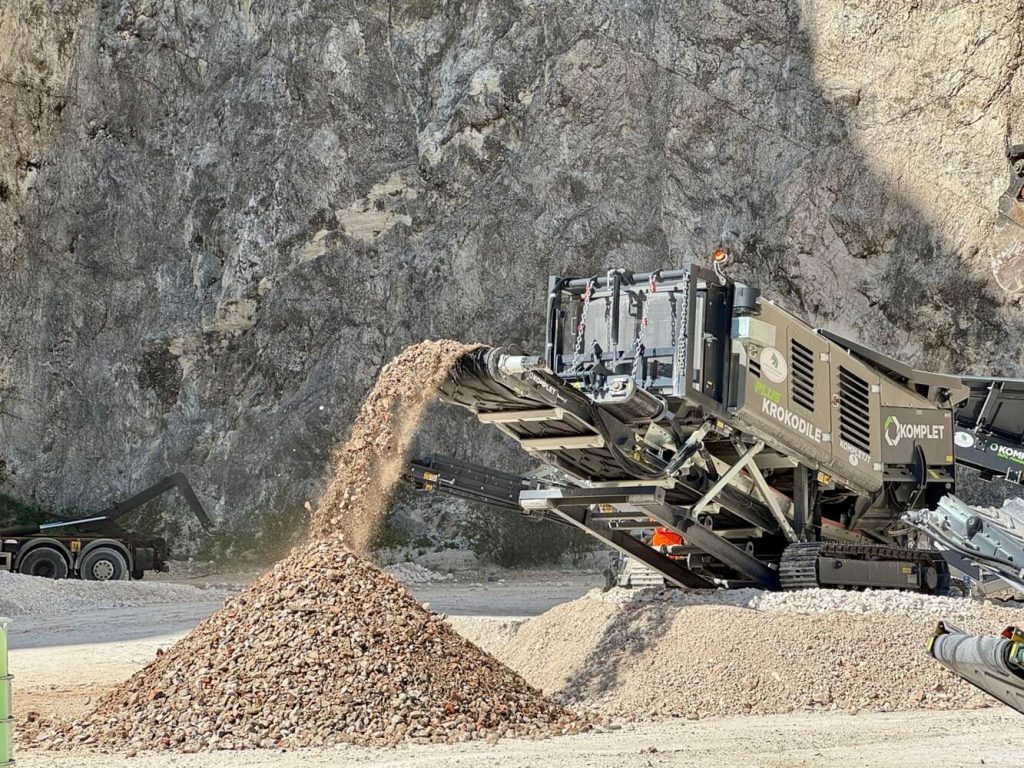
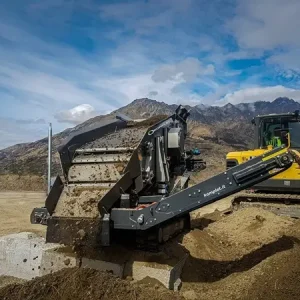
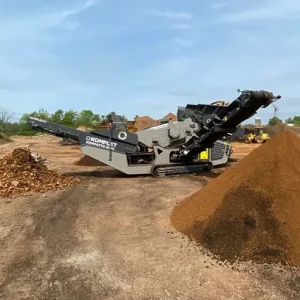
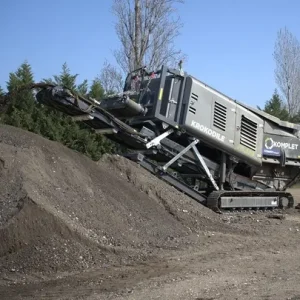
For contractors and recyclers producing aggregate from concrete demolition rubble, both #57 and #67 are routinely producible from the same primary feed material using a compact jaw crusher and a vibrating screener with appropriately-configured mesh openings. The economics of on-site production have shifted meaningfully in favor of recycled concrete aggregate over the past several years as virgin aggregate prices and dump fees have both moved up substantially. We cover the regional cost picture in our companion piece, Construction & Demolition Tipping Fees by Region: A Contractor’s 2026 Reference.
Workflow Overview
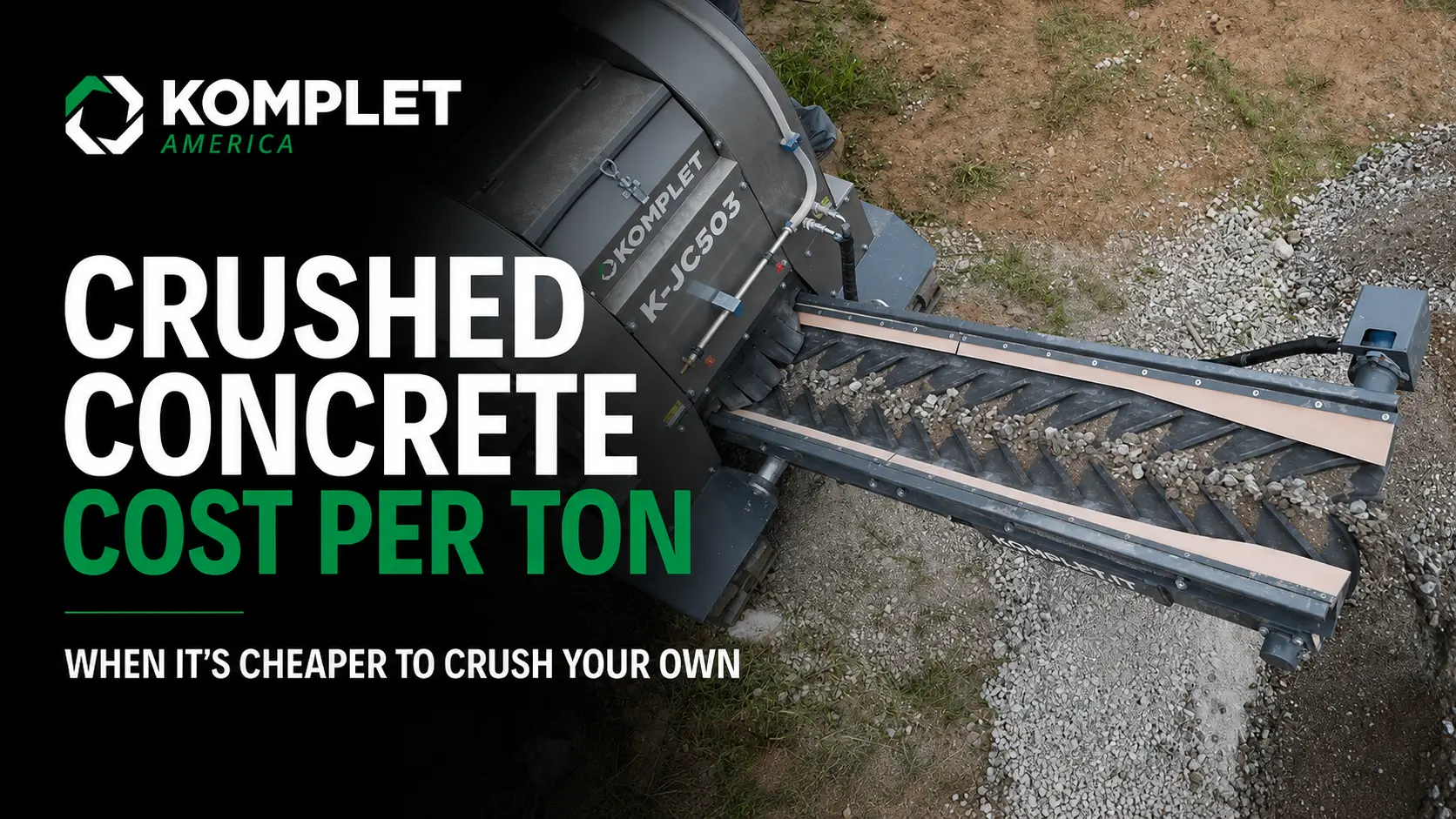
- Concrete demolition rubble is fed into a primary jaw crusher — typically the K-JC 503, K-JC 604, K-JC 704 PLUS, or K-JC 805 depending on operation scale — and reduced to a primary crushed output with a top size set by the closed-side setting (CSS) of the crusher.
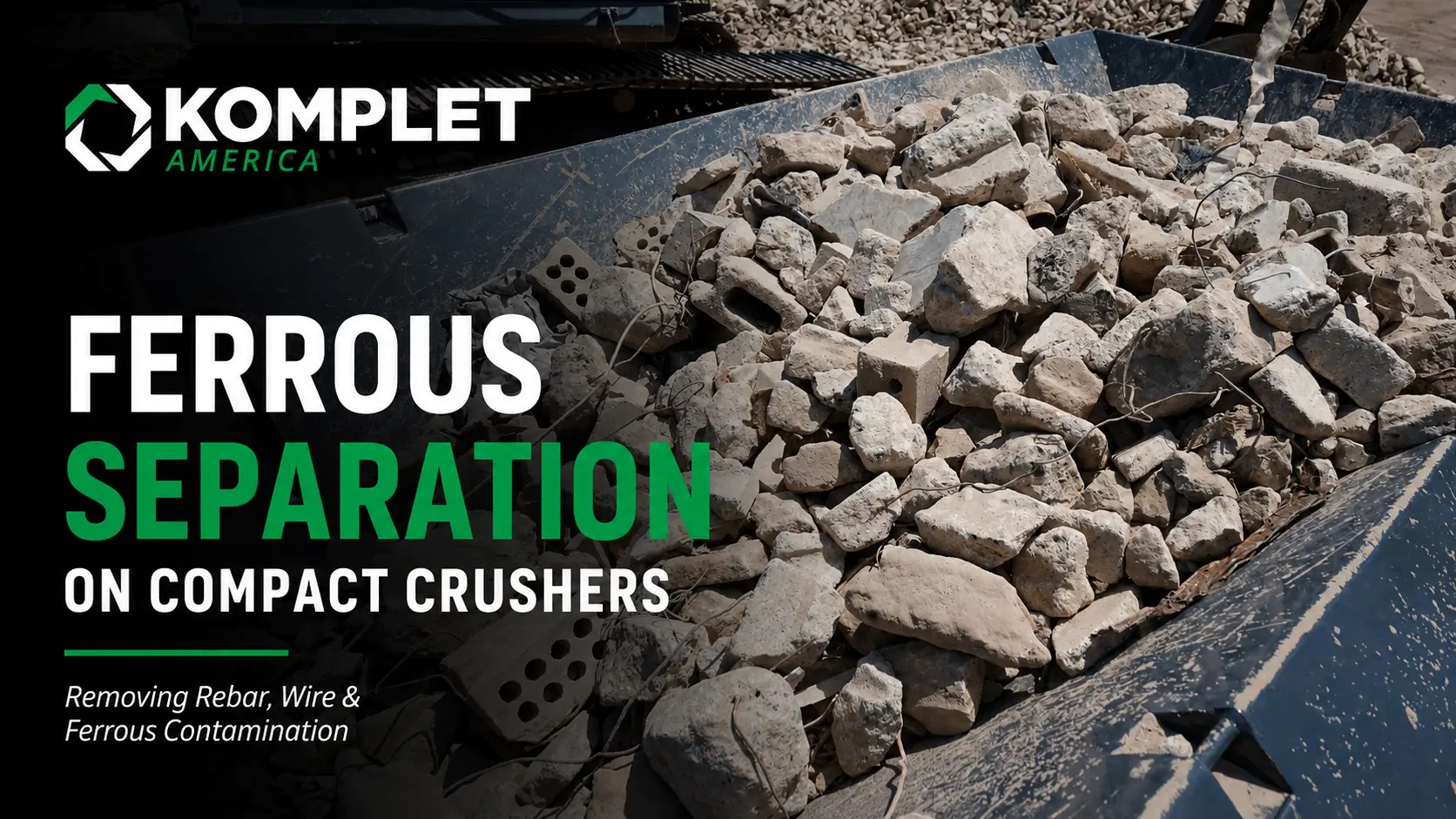
- Rebar and other ferrous metal is removed by integrated hydraulic magnetic belt (standard on the K-JC 604, 704 PLUS, and 805) during crushing.
- The crushed output is fed across a vibrating screener — typically the Kompatto 5030 heavy-duty vibrating screener or Kompatto 124 — with screen mesh openings sized to separate the output into target gradation envelopes.
- Sized products are separately stockpiled. Cross-contamination between stockpiles must be managed through clean loader practices, dedicated stockpile zones, and conveyor placement.
Screen Mesh Configuration: #57 vs #67
Producing #57 versus #67 from the same crushed feed comes down to the screen mesh openings selected for the working deck of the screener. The screener separates material above and below each chosen mesh opening; configuring two or three decks with different opening sizes produces multiple sized products simultaneously.
To produce #57 (top size 1 inch, bottom of envelope at #4 sieve):
- Top deck: 1-inch openings (oversize bypass — material above 1 inch returns to the crusher or goes to a separate oversize stockpile).
- Bottom deck: #4 sieve equivalent (typically a 4-mesh or ¼-inch opening — material below this opening is the fines stream).
- Middle deck stream: #57 envelope material falls between the top and bottom deck openings.
To produce #67 (top size ¾ inch, bottom of envelope at #8 sieve):
- Top deck: ¾-inch openings (oversize bypass).
- Bottom deck: #8 sieve equivalent (typically an 8-mesh opening — finer than the #4 used for #57 separation).
- Middle deck stream: #67 envelope material falls between.
Producing both products from the same operation generally requires either two screening passes with different mesh configurations, or a four-deck screener configured with all four required openings (1-inch, ¾-inch, #4, #8). The Kompatto 5030 configured with three decks can produce three sized products simultaneously, which is the most common configuration in our customer base. For operations producing both #57 and #67, the typical practice is to standardize on one product as the primary output and produce the other in dedicated screening passes when demand calls for it.
Quality Considerations for Recycled #57 and #67
Recycled concrete aggregate (RCA) produced as #57 or #67 carries a few characteristics that differ from virgin aggregate of the same size designation:
- Higher absorption: residual mortar in RCA absorbs more water than virgin aggregate. For drainage and base course applications, this is generally not problematic. For ASTM C33 concrete mix designs, RCA is restricted in many state DOT specifications and is generally not allowed in new structural concrete on highway projects.
- Slightly lower density: bulk density typically 5–10 percent lower than virgin equivalent. The same volume covers more square footage at slightly lower weight per cubic yard.
- More angular fracture: RCA fracture surfaces are highly angular, which actually improves interlock and packing density compared to naturally rounded gravel. For drainage applications, this is neutral or positive.
- Tramp metal residual: occasional small wire and rebar fragments may remain after magnetic separation. Producers selling on-spec RCA need clean stockpile management and quality control discipline to maintain product integrity.
State DOT acceptance of RCA in #57 and #67 sizes varies. Most state DOTs accept RCA as a substitute for virgin coarse aggregate in subbase, base course, and structural fill applications; fewer accept it in concrete mix coarse aggregate. The producer selling RCA into state-spec’d projects needs to know exactly what their state DOT allows and what documentation the state requires. See our companion piece, State DOT Specs for Recycled Concrete Aggregate: A Contractor’s Reference, for the full producer-side reference.
Common Mistakes Contractors Make
Specifying One When the Project Requires the Other
State DOT and engineer-specified projects often name a specific size designation by AASHTO or ASTM number. The most common mistake is the contractor or supplier substituting #57 for #67 (or vice versa) because the local yard happens to carry the other one. The substitution may seem reasonable on a casual reading — both are open-graded clean stone, both meet the general drainage and base course descriptions — but the spec is binding. A load of #57 delivered to a project specifying #67 is a rejected load. Confirm the binding specification before delivery.
Mixing #57 and #67 in a Stockpile
Once #57 and #67 are mixed in a stockpile, the result is neither product. The combined gradation falls outside both M43 envelopes — the bottom end is too fine for #57, the top end is too coarse for #67. The blended material may serve perfectly well in non-spec applications (general drainage, residential construction without binding specs), but it cannot be sold or specified as either #57 or #67 to a project requiring the binding specification.
Using #57 or #67 as a Driving Surface
Both #57 and #67 are open-graded clean stones with minimal fines. Neither compacts to a tight, locked driving surface the way crusher run does. Used as the surface course of a gravel driveway or parking area, either material will roll under turning tires, migrate to the edges, leave bare patches in the middle, and require regular top-up. The void space that drains water also prevents the material from locking up. For driving surfaces, dense-graded aggregate (crusher run, DGA, or regional equivalent) is the right material. We cover the layer logic in detail in Crusher Run vs #57 Stone for Driveways: A Contractor’s Guide to Picking the Right Aggregate.
Skipping Geotextile Below the Drainage Layer
On wet, silty, or fines-rich subgrade, both #57 and #67 will eventually fail by the same mechanism: subgrade fines pumping up into the aggregate layer over time, clogging the void space, and converting the designed-drainage layer into a saturated, weak layer. Non-woven geotextile placed over prepared subgrade prevents the migration. The cost is small compared to rebuilding the layer five years later. Skipping geotextile is the most common preventable cause of long-term drainage layer failure.
Buying by Yard Name Instead of by Specification
Local aggregate yards use their own product names that don’t always map cleanly to AASHTO size numbers. “3/4 stone,” “clean #1,” “limestone screenings,” and similar local names mean different things at different yards. For project work specified by AASHTO or ASTM number, confirm the yard’s product matches the binding spec before ordering. A gradation report from the yard is the cleanest documentation; for projects without binding specs, a sample inspection at the yard is usually sufficient.
Frequently Asked Questions
Is #57 or #67 stone better for drainage?
#57 stone drains faster than #67 stone. The 1-inch top size and slightly wider gradation envelope produce a higher void ratio when placed and compacted. For French drains, perimeter drainage, and other applications where drainage rate is the controlling function, #57 is the typical specification. #67 still drains substantially better than dense-graded aggregate (crusher run) because both #57 and #67 have minimal fines, but the through-flow rate of #57 is higher.
Is #57 or #67 stone better under a concrete slab?
Depends on the slab thickness and rebar configuration. For typical residential slabs (4–6 inches thick) and most slab pads, #57 is acceptable when the maximum aggregate size requirement allows 1-inch top size. For thinner slabs (4-inch sidewalks, decorative concrete) or sections with closely-spaced rebar, #67 is often the better choice because the smaller top size meets ACI 318 maximum aggregate size requirements and produces a smoother finished surface. The structural engineer’s mix design specification is the binding answer.
Are #57 and #67 the same size?
No. #57 has a 1-inch top size with the bottom of its gradation envelope ending at the #4 sieve. #67 has a ¾-inch top size with the bottom of its envelope at the #8 sieve. The size designations are governed by AASHTO M43 (and the equivalent ASTM D448), with specific percent-passing values defining each envelope. Visually they can look similar in a stockpile, but the sieve analysis distinguishes them clearly.
Can I substitute #57 for #67, or vice versa?
On non-spec’d private work without binding gradation requirements, the two products often perform similarly enough that substitution is acceptable. On state DOT, county, municipal, or engineer-specified projects, substitution requires written approval from the engineer of record or DOT representative. The specifications are binding documents. The best practice is to deliver exactly what the spec calls for; substitution requests should be handled before the delivery, not after.
Why do some regions carry only #57 and others only #67?
State DOT specifications drive regional aggregate production. In states where the DOT base course and structural fill specs name #57, regional quarries optimize their crushing and screening to produce #57 in volume; #67 is available but less commonly stocked. In states with #67-dominant DOT specs, the supply tilts the other way. Operations near interstate boundaries or large urban markets often carry both. Confirm what your local market actually carries before specifying for a project.
Can I use recycled concrete aggregate (RCA) as #57 or #67 stone?
RCA can be produced to either AASHTO size envelope through proper crushing and screening. State DOT acceptance of RCA in these sizes varies — most state DOTs accept RCA as a substitute for virgin coarse aggregate in subbase, base course, and structural fill applications, with state-specific gradation, contamination, and source documentation requirements. For ASTM C33 concrete mix coarse aggregate, RCA is restricted in many state DOT specs and generally not allowed in new structural concrete on highway projects. Confirm with the binding specification for any specific project.
Can I produce both #57 and #67 from the same concrete demolition pile?
Yes, with appropriate equipment and operational discipline. The same primary jaw crusher output can be screened to either gradation envelope, depending on screen mesh configuration. Producing both products simultaneously typically requires either two screening passes with different mesh configurations, or a multi-deck screener configured with all four required openings (1-inch, ¾-inch, #4 sieve, #8 sieve). Many operations standardize on one product as the primary output and produce the other in dedicated screening campaigns when demand calls for it. The Komplet Kompatto 5030 with three decks is a common configuration for this workflow.
Which is more expensive, #57 or #67?
Pricing depends on the local market and the relative production economics of each size. In regions where one product dominates supply, that product is usually the cheaper of the two because the local quarries produce it in volume. In regions where supply is balanced, prices are typically similar. Recycled concrete aggregate (RCA) of either size is generally meaningfully cheaper than virgin equivalent — the cost advantage of RCA is one of the primary economic drivers behind on-site and in-yard concrete recycling.
What about #5, #6, #8, and other M43 size numbers — when do those come up?
The full AASHTO M43 size designation system runs from #1 (largest, 4-inch top size) through #10 (smallest, fines passing the #4 sieve). Different sizes serve different applications: #3 and #5 for structural lift over weak subgrade and large-volume drainage; #7 and #8 for thinner sections and smaller paver bedding; #9 for paver joint sand alternatives. The full breakdown is covered in our pillar piece, Crushed Stone Grades: A Komplet Basic Guide to Aggregate Size and Use Cases.
Final Thoughts
#57 stone and #67 stone occupy adjacent positions in the AASHTO M43 size designation system, and for many practical applications they perform similarly enough that the choice between them comes down to what’s locally available and what the binding specification (if any) requires. The differences that matter — drainage rate, compaction smoothness, bridging capacity, concrete mix design fit — are real and meaningful in specific applications, but they’re matters of degree rather than of fundamental difference.
For the contractor, the practical guidance is: know the binding specification (if any), know what your local market carries, and know which product fits the function the layer needs to serve. For the producer running a compact crushing and screening operation, the practical guidance is: configure the screener to hit the gradation envelopes your local market wants, manage stockpiles cleanly, and document the gradation of finished product so the material can be sold to spec’d projects with confidence.
The same compact equipment that produces crusher run-equivalent from concrete demolition rubble produces #57 and #67 sized stone from the same feed. The investment in a primary jaw crusher and a vibrating screener is the investment that turns demolition rubble from a paid-out cost line into multiple saleable product streams. Komplet’s compact crusher and screener lineup is sized for this work, and our specialists are happy to talk through the equipment configuration that fits a specific operation’s product mix and target market.
For broader context across the cluster, see our companion articles: Crushed Stone Grades: A Komplet Basic Guide to Aggregate Size and Use Cases, Crusher Run vs #57 Stone for Driveways, The Hardscape Contractor’s Guide to On-Site Stone Production, State DOT Specs for Recycled Concrete Aggregate: A Contractor’s Reference, and Construction & Demolition Tipping Fees by Region: A Contractor’s 2026 Reference.
Ready to Produce the Right Aggregate Size for Your Market?
- Talk to a Komplet specialist about pairing the right crusher and screener configuration to your target product mix. Call 908-369-3340 or visit com/contact-us.
- Browse the full Komplet equipment lineup — crushers, impact crushers, screeners, conveyors, and shredders sized for compact contractor and recycling operations.
- Explore equipment financing through Komplet Capital — 24-hour approvals, terms from 36 to 72 months, 100% financing available.
- Consider a pre-owned Komplet machine — typical capital savings of 40 to 70 percent versus new, factory-supported by the same Komplet America service network.
Never enough.
Disclaimer: AASHTO M43 and ASTM D448 size designations, ASTM C33 concrete aggregate specifications, and state DOT acceptance of recycled concrete aggregate vary by source, region, and project specification. Confirm the gradation report, project spec, and engineer of record requirements before ordering, selling, producing, or placing material. Cost ranges and economic comparisons are illustrative and based on industry patterns; actual results vary significantly by region, market, project specifications, equipment utilization, operator skill, financing terms, and many other factors. Operating, maintenance, and service guidance is general in nature. Always refer to the official Komplet operator’s manual for the specific machine model and serial number, and follow OEM intervals and procedures. For warranty-protected work, contact Komplet America at 908-369-3340 or your authorized Komplet dealer. Improper service or non-OEM parts may void warranty coverage and create safety hazards.