
Reclaimed asphalt pavement is accepted in some form by every U.S. state DOT for hot mix asphalt production. The 2024 NAPA industry survey documented 101.4 million tons of RAP recycled — most of it incorporated back into new HMA mixtures through state-spec-driven processes. The federal-level framework (FHWA’s Long-Term Pavement Performance program, AASHTO M 323 binder selection, the AASHTO suite of testing standards) provides the technical foundation. But the binding spec for any specific project is the state DOT’s published requirements — and those vary substantially across the United States, in both the maximum RAP percentage allowed and the procedural framework that governs RAP qualification, stockpile management, and mix design.
For contractors, recyclers, and producers supplying state DOT projects, knowing the specific state framework matters operationally — what percentage of RAP can go into the surface course versus the binder course, what binder grade adjustment applies above which threshold, what processing and gradation requirements govern the stockpile, what documentation supports state DOT acceptance, what high-RAP options exist for qualified producers, and how state DOT-approved RAP differs from general construction-grade RAP. The differences are not trivial. Florida averages 34 percent RAP content in its HMA mixes per FDOT-sponsored research — substantially above the national average of approximately 22 percent. New Jersey allows 15 percent RAP in surface course and 20 percent in base courses standard, with NJAPA producer members capable of producing high-RAP mixes exceeding 30 percent. California raised the standard from 15 percent in 2009 to 25 percent in 2013 to nonstandard specifications allowing up to 40 percent today.
This guide is the contractor’s reference for state-by-state RAP specifications across six anchor states — New Jersey, California, Florida, Pennsylvania, Texas, and New York — chosen for their combination of regional importance, RAP utilization scale, and policy leadership. The framework presented for each state covers the maximum RAP percentages by application, the binder grade adjustment rules, the processing and stockpile requirements, the QC documentation standards, and the high-RAP and pilot specifications where they exist. For the operational reference behind the production discipline that delivers state-spec-compliant RAP — feed quality, crushing, screening, and source documentation — see our companion piece, What Is RAP? A Contractor’s Guide to Reclaimed Asphalt Pavement. For the parallel state-by-state framework for recycled concrete aggregate, see State DOT Specs for Recycled Concrete Aggregate.
Komplet America has been the U.S. distributor of Komplet S.p.A. compact crushers, screeners, and shredders since 2018, and the Conti family construction legacy behind Komplet America stretches back to 1906. State DOT supply is where the production discipline pays back most directly — producers who can document compliance with state DOT processing, gradation, and stockpile requirements access spec-driven markets at premium pricing. The detail below is the framework that supports those conversations.
The Quick Answer
For contractors who don’t need the full reference:
- Every U.S. state DOT accepts RAP in some form for HMA production under defined conditions. AASHTO M 323 provides the federal-level binder selection framework that most state DOTs reference.
- Maximum RAP percentages vary substantially by state and by mix type. Surface course mixes typically have lower RAP limits than base or binder course mixes; high-traffic mixes typically have lower RAP limits than lower-traffic mixes; mixes using polymer-modified binders typically have lower RAP limits than mixes using conventional binders.
- Florida and California lead the U.S. in high-percentage RAP utilization at the state DOT level. Florida averages 34 percent RAP content in HMA mixes statewide; California has implemented nonstandard specifications allowing up to 40 percent RAP in pilot projects.
- State DOT acceptance typically requires source documentation, stockpile approval, gradation testing, and binder content characterization. Producers supplying state DOT projects need quality control documentation that distinguishes state-spec-compliant RAP from general construction-grade RAP.
- Binder grade adjustment per AASHTO M 323 generally applies when RAP content exceeds 15–25 percent depending on the state. Higher RAP percentages require softer virgin binder grades to compensate for the aged RAP binder.
- High-RAP and pilot specifications exist in most major paving states for qualified producers with established RAP processing and QC programs. The trend is consistently upward — states are loosening RAP limits as performance data accumulates and as binder economics drive demand.
The Federal Framework: FHWA and AASHTO Baseline
Before the state-specific framework, the federal-level baseline that most state DOT specifications reference:
FHWA Publications
- FHWA-RD-97-148, “User Guidelines for Waste and Byproduct Materials in Pavement Construction” — the foundational federal reference. Provides definitions, properties, and applications for RAP across the spectrum of pavement uses.
- FHWA-HRT-11-021, “Reclaimed Asphalt Pavement in Asphalt Mixtures: State of the Practice” (April 2011) — the comprehensive synthesis of state DOT RAP practices, binder selection (referencing AASHTO M 323), Long-Term Pavement Performance findings, and best practices for high-RAP mixtures.
- FHWA-HIF-22-003, “Resource Responsible Use of Reclaimed Asphalt Pavement” — recent FHWA reference covering RAP processing, QC, and stockpile requirements across state DOT practices.
- FHWA’s Long-Term Pavement Performance (LTPP) program findings: pavements containing up to 30 percent RAP perform comparably to pavements built from virgin materials.
AASHTO Standards
- AASHTO M 323: “Superpave Volumetric Mix Design” — the binder grade selection standard for HMA containing RAP. The standard provides binder grade adjustment guidelines based on RAP percentage, with most state DOTs adopting M 323 references in their specifications.
- AASHTO T 308: Asphalt binder content by ignition method. Standard test for characterizing RAP binder content.
- AASHTO T 27: Sieve analysis. Standard test for RAP gradation after binder extraction.
- AASHTO R 35: Superpave volumetric mix design practice. Referenced by most state DOT Superpave specifications.
Binder Grade Adjustment Logic (AASHTO M 323)
AASHTO M 323 provides the framework most state DOTs reference for binder grade selection in HMA with RAP:
- RAP content under 15 percent: typically no binder grade adjustment required. The virgin binder is the same grade as a no-RAP mix.
- RAP content 15–25 percent: typically one-grade-softer virgin binder required (e.g., PG 64-22 substituted for PG 70-22). The softer virgin binder compensates for the aged RAP binder when the two blend in the mix.
- RAP content above 25 percent: typically requires binder grade adjustment based on the recovered binder grade of the specific RAP source, with qualification testing required to validate the blended binder properties.
- State DOTs adopt the M 323 framework with state-specific refinements. The percentages above are general defaults; state-specific thresholds may differ.
New Jersey Department of Transportation (NJDOT)
NJDOT operates one of the more sophisticated state DOT RAP frameworks in the United States, with significant industry collaboration through the New Jersey Asphalt Pavement Association (NJAPA) and ongoing research partnerships with Rutgers University.
NJDOT RAP Percentages by Course
- Surface course (wearing course): up to 15 percent RAP in NJDOT-approved HMA mixes per NJAPA producer documentation.
- Intermediate and base course mixes: up to 20 percent RAP in NJDOT-approved HMA mixes.
- High RAP mixes (HRAP): NJAPA producer members can produce NJDOT-approved quality RAP mixes with recycled content exceeding 30 percent. The HRAP framework allows producers with qualified processing and QC programs to push RAP percentages substantially higher than the standard limits.
NJDOT Specification Framework
- Standard HMA specifications: Section 401 of NJDOT Standard Specifications covers HMA courses; Section 902.11 covers Hot Mix Asphalt RAP requirements.
- High Recycled Asphalt Pavement Mix (HRAP): defined specification framework for high-RAP mixtures, with performance testing requirements that include APA rutting and modified TxOL tests for mixture qualification.
- Mill and overlay context: most NJDOT rehabilitation projects are mill-and-overlay with 2-inch overlay, with up to 15 percent RAP being allowed in the surface course as the standard.
- Research base: NJDOT has been building a performance database of high-RAP mixes since 2008, with continuous spec refinement based on field performance data.
NJDOT Performance Testing for RAP Mixes
- APA (Asphalt Pavement Analyzer) rutting test: required for high-RAP mix qualification.
- Modified TxOL test (Texas Overlay Tester): required for high-RAP mix qualification, evaluates resistance to reflection cracking.
- These performance tests distinguish NJDOT’s HRAP framework from straight volumetric mix design — qualification requires demonstrating both volumetric compliance and adequate cracking/rutting resistance.
California Department of Transportation (Caltrans)
Caltrans has executed one of the most aggressive RAP utilization timelines among major state DOTs, with successive expansion of RAP limits since 2009 and active development of high-percentage RAP specifications through industry pilot projects.
The Caltrans RAP Timeline
- 2009: Caltrans Section 39 first allowed 15 percent RAP in conventional asphalt mixes.
- 2013: Limit raised to 25 percent RAP in conventional asphalt mixes.
- 2021: Caltrans, working with industry partners, developed nonstandard specification procedures to allow up to 40 percent RAP in conventional asphalt mixes. The nonstandard specifications are being evaluated through pilot projects in multiple Caltrans districts.
- Pilot project framework: six pilot projects statewide are evaluating performance of asphalt pavement containing up to 40 percent RAP, in partnership with the University of California Pavement Research Center (UCPRC).
California AB 2953 (Effective January 1, 2024)
Assembly Bill 2953, effective January 1, 2024, requires local agencies in California with jurisdiction over streets and highways and that exceed population thresholds (100,000 per county or 25,000 per city) to allow the percent of reclaimed asphalt pavement used in roadway construction to be consistent with the current Caltrans Standard Specifications Section 39-2.02B. The effect is that the Caltrans RAP framework — currently 25 percent standard with up to 40 percent in pilot projects — becomes the de facto floor for local agency specifications in larger California jurisdictions.
Practical implications for contractors:
- Local agency projects that previously limited RAP to 15 percent are now required to allow at least 25 percent per Caltrans Section 39-2.02B.
- The AB 2953 mandate is creating substantial new demand for RAP-capable asphalt mix designs in California municipal markets, beyond the Caltrans-direct supply chain.
- Contractors operating in California local agency markets need to know both the Caltrans framework and the local interpretation of AB 2953 compliance.
Caltrans Section 39 Specific Requirements
- RAP exceeding 15 percent: virgin binder grade must be the specified grade with the upper and lower temperature classification reduced by 6 degrees Celsius. This is California’s specific implementation of the AASHTO M 323 binder grade adjustment rule.
- RAP sampling: per California Test 125, with sampling from the recycled asphalt pavement system during HMA production.
- Mix design verification: contractor job mix formula proposal (Form DOT CEM-3511) documents RAP percentage and characteristics; Caltrans verification on Form DOT CEM-3513.
- Quality control: standard QC requirements include RAP gradation, asphalt content, and verification testing during production.
Caltrans RHMA-G (Rubberized HMA) and RAP
Caltrans Standard Specifications historically did not allow RAP in rubberized hot mix asphalt — gap-graded (RHMA-G) mixes. UCPRC studied the use of up to 10 percent RAP (by aggregate replacement) in RHMA-G through five pilot projects (in Sonoma, Ventura, Imperial, and other counties), with results indicating minor effects on mechanical properties. This is an evolving area with continued research and potential future spec changes.
Florida Department of Transportation (FDOT)
FDOT operates one of the highest-utilization RAP frameworks in the United States, with average RAP content in Florida HMA mixes reaching 34 percent in 2022 per FDOT-sponsored NCAT research — substantially above the national average of approximately 22 percent.
FDOT Section 334 RAP Limits
- Traffic Levels A, B, and C mixtures: maximum 50 percent RAP by weight of total aggregate.
- Traffic Levels D and E mixtures: maximum 30 percent RAP by weight of total aggregate.
- Mixtures using PG 76-22 (PMA), PG 76-22 (ARB), or PG 82-22 (PMA) asphalt binders: maximum 20 percent RAP by weight of total aggregate. Exception: amounts greater than 20 percent RAP can be used if no more than 20 percent by weight of the total asphalt binder comes from the RAP material.
- High Polymer asphalt binder mixtures: RAP is not allowed.
FDOT RAP Stockpile and Source Requirements
- Statewide RAP stockpile database: FDOT maintains an approved-stockpile registry that producers reference for project supply.
- Source documentation: RAP must come from an FDOT-approved stockpile or from millings from a Department project. Millings from an FDOT project can be used directly without separate stockpile approval.
- Minimum RAP binder content: 4.0 percent by weight of RAP. Exception for fractionated RAP: minimum 2.5 percent binder content for the coarse fraction (material retained on the No. 4 sieve).
- Stockpile consistency: stockpiled RAP must be reasonably consistent in characteristics and contain no aggregate particles which are soft or conglomerates of fines.
- Pavement coring reports: when the contract includes milling of existing asphalt pavement, the Pavement Coring Report may be available on FDOT’s website to support RAP source characterization.
FDOT High-Performance RAP Framework
- Statewide average RAP content of 34 percent reflects mature RAP utilization across FDOT projects.
- Softer asphalt binder for high-RAP mixes: FDOT requires softer asphalt binder for mixtures containing over 15 percent RAP. This is FDOT’s implementation of the AASHTO M 323 binder grade adjustment principle.
- COAC (Corrected Optimum Asphalt Content) approach: FDOT has been evaluating the COAC approach through sponsored research at NCAT, with potential future implementation to further improve cracking performance of high-RAP mixes.
- Quality control during production: FDOT requires QC sampling and testing per Section 334 with binder content (Pb), gradation (P-8 and P-200), and roadway density measurements.
Pennsylvania Department of Transportation (PennDOT)
PennDOT Publication 408 (the Pennsylvania Department of Transportation Standard Specifications) provides the framework for RAP utilization across HMA, base, intermediate, and surface courses. Pub 408 is updated through periodic Change Packets; current version is Publication 408/2020 with Change 5 effective October 7, 2022.
PennDOT RAP Percentages by Application
- Superpave HMA surface course (wearing course): up to 15 percent RAP per Publication 408 standard specifications. The lower limit on the surface course reflects the higher quality requirements for surface aggregates (wear/abrasion resistance, friction characteristics).
- Superpave HMA base or intermediate course: up to 25 percent RAP per Publication 408 standard specifications.
- Shoulder wearing courses: up to 20 percent RAP allowed in shoulder applications.
- Binder grade adjustment: per PennDOT Pub 27 (Bulletin 27), Chapter 2A, if 16 percent or more RAP is included in the mixture, or if 5 percent or more RAP and 5 percent RAS is included in the mixture, the PG-Binder grade must be adjusted in accordance with Appendix H requirements.
PennDOT High-RAP Specifications
- PennDOT and industry have collaboratively developed high-RAP mixes for specific applications, with up to 50 percent RAP content allowed in 19-mm binder course material for low-volume roads (with approved job mix formula).
- Expansion in progress: high-RAP mix specifications are being extended to 25-mm base course and 9.5-mm wearing course applications, based on demonstrated performance of the 19-mm binder course program.
- Full Depth Reclamation: covered by Pub 408 Section 344, governing pavement rehabilitation using FDR techniques.
PennDOT Specification Sections
- Section 409 — Superpave Mixture Design, Standard and RPS Construction of Plant-Mixed HMA Courses: the primary HMA specification.
- Section 410 — Superpave Mixture Design, Standard and RPS Construction of Plant-Mixed HMA Fine-Graded Courses.
- Section 411 — Superpave Mixture Design, Standard and RPS Construction of Plant-Mixed WMA Courses (warm mix asphalt).
- Section 344 — Full Depth Reclamation: covers FDR techniques for pavement reconstruction.
- Section 491 — Milling of Asphalt Paving Surface: covers the milling production methodology that generates millings-grade RAP.
Texas Department of Transportation (TxDOT)
TxDOT operates a binder-replacement-based RAP framework that differs structurally from the aggregate-replacement-based frameworks used by most other state DOTs. The TxDOT approach focuses on the total recycled binder content (combined from RAP and RAS) rather than on the RAP percentage by aggregate weight.
TxDOT Item 341 — Dense-Graded Hot-Mix Asphalt
- RAP and RAS recycled materials are permitted in dense-graded HMA unless otherwise shown on the plans.
- Maximum allowable percentages are specified in Item 341 Table 4, with the framework structured around recycled binder content rather than RAP-only percentages.
- Combined recycled binder limit: typically 20 percent maximum when the originally specified PG binder is used. RAP and RAS in combination contribute to the recycled binder calculation.
- Substitute PG binders: allowed only at the discretion of the Engineer if Hamburg Wheel test results meet performance criteria.
- Warm Mix Asphalt: when used with WMA, the originally specified PG binder is allowed at the maximum recycled binder content; the WMA framework provides additional flexibility for RAP utilization.
Related TxDOT Items
- Item 340 — Dense-Graded Hot-Mix Asphalt (Small Quantity): the small-quantity equivalent of Item 341 with similar RAP/RAS framework.
- Item 344 — Superpave Mixtures: covers Superpave-method HMA for higher-volume applications.
- Item 341M — Municipal Dense-Graded Hot-Mix Asphalt: the municipal-application equivalent specification for off-system roads.
- Item 347 — Thin Overlay Mixture (TOM): pavement preservation applications.
TxDOT Performance Testing and QC
- Hamburg Wheel test (Tex-242-F): primary rutting performance test, used to evaluate RAP-containing mixtures and substitute binders.
- Tex-236-F: standard test method for binder content and gradation of RAP and RAS stockpiles for mix design purposes.
- Texas Gyratory Compactor (TGC): used for dense-graded HMA per Tex-206-F.
- RAS as a separate material class: any stockpile containing RAS is considered a RAS stockpile and limited to no more than 3.0 percent of the HMA mixture per Table 4.
New York State Department of Transportation (NYSDOT)
NYSDOT operates a mix-design-driven RAP framework. Rather than specifying maximum RAP percentages by mix type or traffic level, NYSDOT permits RAP in any asphalt mixture provided the mix design meets the volumetric and performance requirements outlined in NYSDOT Materials Method 5.16 (Superpave Hot Mix Asphalt Mixture Design and Mixture Verification Procedures).
NYSDOT RAP Framework
- Materials Method 5.16: governs Superpave HMA mix design including RAP-containing mixtures. RAP may be used in the design and production of any asphalt mixture, subject to mix design qualification.
- Producer responsibility: the asphalt producer is responsible for preparing the mix design; NYSDOT (through the Regional Materials Engineer) is responsible for checking the submitted design for completeness and accuracy.
- Mix design specificity: a complete asphalt mixture design is required for each aggregate source combination, differing aggregate gradations, differing RAP percentages, and a separate job mix formula (JMF) for each plant using the same aggregate at a site having multiple plants.
- RAP sample preparation: RAP samples must be processed to remove all material larger than the scalping screen which will be used during production, and dried to a constant weight before use in mix design.
NYSDOT Specification Sections
- Section 400 — Hot Mix Asphalt: covers HMA materials, plant production, and pavement construction.
- Section 401 — Plant Production: governs HMA plant operations, including RAP incorporation procedures.
- Section 402 — Hot Mix Asphalt (HMA) Pavements: covers placement, compaction, and acceptance.
- Reclaimed Asphalt Pavement for Earthwork and Subbase: separate specification framework covering non-HMA uses of RAP.
NYC DOT Municipal Practice
New York City Department of Transportation operates two in-house asphalt plants producing approximately 75 percent of the asphalt used in City operations, with an average RAP content of 40 percent across the two plants. NYC DOT’s municipal RAP utilization represents a high-percentage benchmark for urban municipal asphalt production in the United States — though NYC DOT operates under municipal specifications rather than NYSDOT specifications, the operational framework informs broader urban paving practice.
Cross-State Comparison: At a Glance
The six anchor states above cover most of the RAP-utilization patterns observed across U.S. state DOT practice. A simplified comparison:
- Surface course RAP limits: NJDOT 15% / Caltrans 25% standard (40% pilot) / FDOT up to 50% based on traffic level / PennDOT 15% / TxDOT binder-content framework / NYSDOT mix-design-driven.
- Base/intermediate course RAP limits: NJDOT 20% / Caltrans same framework as surface / FDOT same as surface / PennDOT 25% / TxDOT same framework / NYSDOT same framework.
- Binder grade adjustment threshold: NJDOT and PennDOT 15-16% / Caltrans 15% (6°C reduction) / FDOT 15% (softer binder) / TxDOT performance-based / NYSDOT mix-design-based.
- Statewide average RAP content (2021-2022 NAPA data): Florida 34% (highest among major states) / national average ~22%.
- High-RAP framework: NJDOT HRAP (>30%) / Caltrans pilot 40% / FDOT 50% for low-traffic / PennDOT 50% pilot for 19mm binder / TxDOT performance-driven / NYSDOT mix-design-driven.
- Local-agency consistency mandate: California AB 2953 (effective January 1, 2024) — unique among major states in requiring local agencies to adopt state DOT RAP framework. Other states generally allow local agency flexibility.
State DOT Acceptance: What Producers Need to Document
Across all six anchor states (and most other U.S. state DOTs), supplying state DOT projects with RAP requires documentation that distinguishes state-spec-compliant material from general construction-grade RAP.
Source Documentation
- Identification of the source project, agency, and contract.
- Asbestos clearance documentation, particularly for older pavement demolition feedstock.
- Confirmation that the source pavement is asphalt-only (not mixed with concrete, brick, or other materials).
- Mill or removal date and project identification for stockpile-aging tracking.
Production Documentation
- Binder content per state-specific test method (AASHTO T 308 / ASTM D6307 / Tex-236-F or equivalent).
- Gradation per state-specific method.
- Stockpile approval where required (FDOT statewide stockpile database is the most formalized example).
- Performance testing where required (APA, TxOL, Hamburg Wheel, etc., per state DOT spec).
Mix Design Documentation
- Job mix formula (JMF) showing virgin and RAP component proportions.
- Binder grade documentation, including any state-required adjustment for RAP content thresholds.
- Aggregate gradation documentation for combined virgin + RAP aggregate structure.
- Volumetric properties at design air voids per AASHTO R 35 or state equivalent.
Production Discipline for State DOT Supply
Producing RAP that consistently meets state DOT specifications requires production discipline that distinguishes state-spec-driven operations from general construction supply. The operational fundamentals:
Source Segregation
State DOT specifications generally require that RAP from a particular project not be blended or commingled with RAP from other projects, because binder properties and aggregate sources vary by source. Dedicated stockpiles by source project are standard practice in state-spec-driven RAP production. Producers operating mixed-source stockpiles can supply general construction markets but lose the higher-value state DOT spec market.
Stockpile Management
Asphalt Institute recommendation: maximum stockpile height of 3 meters (10 feet) to prevent agglomeration. State DOT specifications (FDOT in particular) require stockpiles to be “reasonably consistent in characteristics” — a requirement that’s difficult to meet with poorly managed stockpiles. Operational fundamentals:
- Stockpile height limit per Asphalt Institute guidance.
- Sloped surface for moisture drainage.
- Cover or shelter in regions with high precipitation and humidity.
- Stockpile age tracking with periodic re-processing or removal of overage material.
- Dedicated zones for source-segregated stockpiles to prevent cross-contamination.
Processing Equipment Configuration
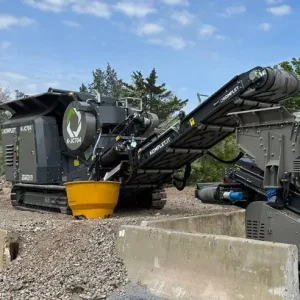
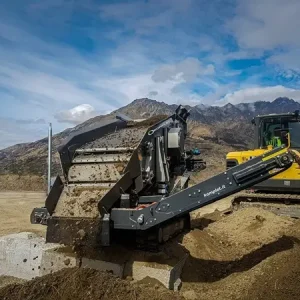
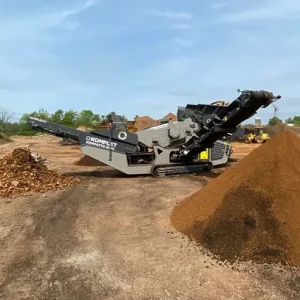
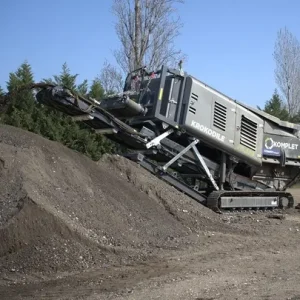
Compact crushing and screening equipment handles RAP production for state DOT supply when configured correctly. The same Komplet equipment platform used for concrete recycling produces state-spec-compliant RAP with operational adjustments specific to the asphalt binder content:
- Primary jaw crusher: K-JC 503, K-JC 604, K-JC 704 PLUS, or K-JC 805 depending on operation scale. CSS typically set at ¾-inch for state DOT spec RAP production.
- Vibrating screener: Kompatto 5030 or Kompatto 221 for source-segregated stockpile production with fractionation capability.
- Magnetic separation: standard on K-JC 604, K-JC 704 PLUS, and K-JC 805. Removes embedded ferrous metal during crushing.
- Conveyor: K-TC 460 for source-segregated stockpile management.
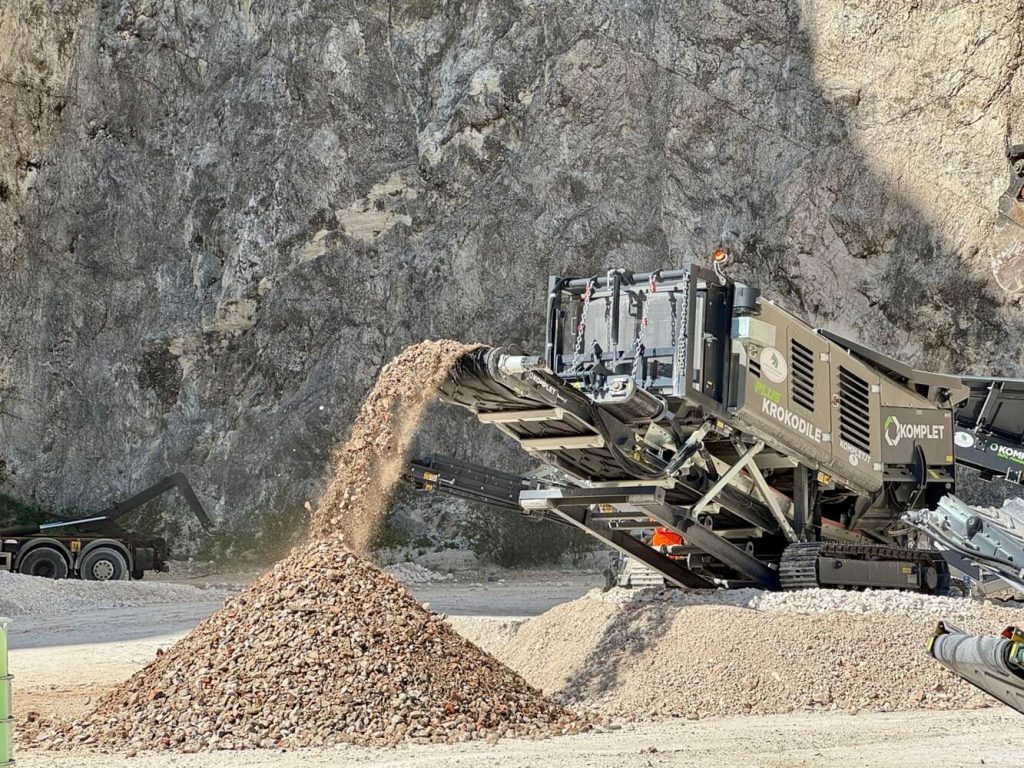
- Pre-reduction: Krokodile PLUS slow-speed shredder for full-depth removal feed or mixed C&D streams.
Common Mistakes Producers Make
Treating State DOT Spec as the Same as General Construction
State DOT specifications differ from general construction RAP supply in source documentation, stockpile management, gradation testing, binder content characterization, and mix design qualification. Producers who treat the two as interchangeable supply lose the state DOT market or operate non-compliantly. The discipline difference is real and the price premium is real.
Commingling Source Streams
State DOT specifications generally require source-segregated stockpiles for the reasons covered in the pillar piece. Producers who maintain mixed-source stockpiles cannot supply state DOT spec-driven projects. Source segregation is the most common compliance gap for producers transitioning from general construction supply to state DOT supply.
Ignoring Stockpile Height Limits
The Asphalt Institute 3-meter (10-foot) stockpile height limit is operational guidance grounded in agglomeration risk. State DOTs (FDOT in particular) translate this into stockpile consistency requirements that effectively enforce the height limit. Producers operating taller stockpiles risk rejected loads when the binder agglomeration shows up in production sampling.
Skipping Binder Grade Adjustment
AASHTO M 323 binder grade adjustment isn’t optional when RAP content exceeds the state DOT threshold (typically 15–16 percent in NJ, PA, FL, CA, with state-specific variations). Producers using the original virgin binder grade at RAP percentages above the threshold are out of compliance with state DOT specifications. The binder adjustment isn’t a paperwork exercise — the blended binder properties are measurably different from the no-RAP mix, and downstream pavement performance depends on the adjustment being made.
Underestimating High-RAP Qualification
High-RAP mix specifications (NJDOT HRAP, Caltrans 40% pilot, PennDOT 50% pilot, FDOT 50%) carry performance testing requirements that go beyond standard volumetric mix design. APA rutting test, TxOL cracking test, Hamburg Wheel test — these are project-by-project qualification requirements that take time and money to navigate. Producers attracted to the higher RAP percentages without the qualification capability find themselves outside their economic envelope quickly.
Frequently Asked Questions
What’s the maximum RAP percentage allowed by state DOTs?
Varies substantially by state and by mix type. Florida (FDOT Section 334) is highest at 50% RAP for Traffic Levels A/B/C; California has nonstandard pilot specifications allowing up to 40% RAP; New Jersey HRAP framework allows over 30% with qualified producers; Pennsylvania pilot programs allow up to 50% for specific 19-mm binder course applications. Standard limits across most major states for surface course are 15-25% RAP. Higher RAP percentages typically require binder grade adjustment and qualification testing.
Does AASHTO M 323 require binder grade adjustment for RAP?
Yes, when RAP content exceeds threshold percentages. AASHTO M 323 provides the federal-level framework that most state DOTs reference: RAP content under 15% typically requires no binder grade adjustment; 15-25% RAP typically requires one-grade-softer virgin binder; above 25% RAP typically requires adjustment based on recovered RAP binder grade with qualification testing. State-specific implementations vary in the exact thresholds and adjustment magnitudes.
Does NJDOT accept high-RAP mixes?
Yes, through the New Jersey Asphalt Pavement Association (NJAPA) producer member framework. NJAPA producer members can produce NJDOT-approved quality RAP mixes with recycled content exceeding 30%. The High Recycled Asphalt Pavement Mix (HRAP) specification requires performance testing including APA rutting test and modified TxOL test for mixture qualification. Standard NJDOT mixes allow up to 15% RAP in surface course and 20% in intermediate/base course.
What’s California AB 2953 and how does it affect RAP?
California Assembly Bill 2953, effective January 1, 2024, requires local agencies with jurisdiction over streets and highways and that exceed population thresholds (100,000 per county or 25,000 per city) to allow the percent of RAP used in roadway construction to be consistent with Caltrans Standard Specifications Section 39-2.02B. The practical effect is that local agency projects in larger California jurisdictions are required to allow at least the Caltrans-standard 25% RAP. This is creating substantial new demand for RAP-capable asphalt mix designs in California municipal markets.
What RAP percentage does FDOT allow?
Per FDOT Section 334: up to 50% RAP for Traffic Levels A, B, and C; up to 30% RAP for Traffic Levels D and E; up to 20% RAP when using PG 76-22 (PMA), PG 76-22 (ARB), or PG 82-22 (PMA) asphalt binders (exception: amounts greater than 20% RAP can be used if no more than 20% by weight of the total asphalt binder comes from the RAP material). RAP is not allowed in mixtures containing High Polymer asphalt binder. Statewide average RAP content in Florida HMA mixes was 34% per 2022 NAPA data — highest among major paving states.
What documentation do state DOTs require for RAP?
Typically includes source identification (project, agency, contract), asbestos clearance documentation, binder content characterization (AASHTO T 308 or state equivalent), gradation testing (AASHTO T 27 or state equivalent), stockpile approval (where required — FDOT operates a statewide stockpile database), and mix design documentation including job mix formula, binder grade, and volumetric properties. Performance testing (APA, TxOL, Hamburg Wheel, etc.) is required for high-RAP qualification in most major state DOT frameworks.
Can I use the same RAP for multiple state DOT projects?
Generally no, in spec-driven supply. State DOT specifications typically require that RAP from a particular project not be blended or commingled with RAP from other projects, because binder properties and aggregate sources vary by source. Source-segregated stockpiles by project are standard practice. Producers supplying multiple state DOT projects typically maintain multiple dedicated stockpiles rather than a single mixed-source stockpile.
What’s the difference between asphalt millings and processed RAP?
Asphalt millings are RAP at the milling stage — material removed by a milling machine and ready for use or further processing. Processed RAP is millings that have been crushed and screened to specification, or material from full-depth removal that has been processed to specification. Many state DOTs recognize the two as distinct material classes, with millings often allowed for direct use without further processing (subject to source documentation) while processed RAP requires standard production discipline. FDOT specifically allows millings from an FDOT project to be used directly. We cover the broader RAP definitions and production framework in our pillar piece, What Is RAP? A Contractor’s Guide to Reclaimed Asphalt Pavement.
Is RAP allowed in concrete pavement?
Different framework. State DOT specifications for RAP cover asphalt mixtures (HMA, WMA, cold mix, base course/subbase applications). For new structural Portland cement concrete (PCC) on highway projects, recycled concrete aggregate (RCA) is the relevant recycled material, with state-specific specifications that are typically more restrictive than for RAP in HMA. For the state-by-state framework on RCA, see State DOT Specs for Recycled Concrete Aggregate.
Final Thoughts
State DOT RAP specifications are a moving target. Florida averaged 34 percent statewide in 2022 with the framework continuing to evolve. California moved from 15 percent in 2009 to 25 percent in 2013 to 40 percent pilot specifications in 2021, with AB 2953 extending the framework to local agencies in 2024. NJDOT, PennDOT, and TxDOT all maintain active high-RAP research and pilot programs. The trajectory is consistent across all major paving states: higher RAP percentages, broader acceptance, better performance documentation.
For producers and contractors operating in or expanding into state DOT supply, the framework is mature enough to support real business decisions, and the price premium for state-spec-compliant RAP makes the production discipline worth maintaining. The investment in source-segregated stockpile management, gradation testing, binder content characterization, and mix design qualification is real — and the return is access to a market that grows every year as state DOTs continue to expand RAP utilization in response to economic pressure, sustainability mandates, and accumulated performance evidence.
Komplet America’s compact crusher and screener lineup is sized for the production scales where state DOT RAP supply makes economic sense for contractors and recyclers. Our specialists work with customers across all six anchor states (and beyond) on equipment configuration that matches state-specific spec requirements, stockpile management practices, and target production volumes. The framework above is the broader context for those conversations.
For broader context across our cluster, see our companion articles: What Is RAP? A Contractor’s Guide to Reclaimed Asphalt Pavement, Crushed Stone Grades: A Komplet Basic Guide to Aggregate Size and Use Cases, State DOT Specs for Recycled Concrete Aggregate, Recycled Concrete Aggregate vs Virgin Stone, Construction & Demolition Tipping Fees by Region, and Concrete Disposal Costs: Haul Away or Crush On Site?.
Ready to Supply State DOT RAP Projects?
- Talk to a Komplet specialist about pairing the right crusher and screener configuration for state DOT spec-driven RAP production. Call 908-369-3340 or visit com/contact-us.
- Browse the full Komplet equipment lineup — crushers, impact crushers, screeners, conveyors, and shredders sized for compact contractor and recycling operations.
- Explore equipment financing through Komplet Capital — 24-hour approvals, terms from 36 to 72 months, 100% financing available.
- Consider a pre-owned Komplet machine — typical capital savings of 40 to 70 percent versus new, factory-supported by the same Komplet America service network.
Never enough.
Disclaimer: State DOT specifications, AASHTO standards, and FHWA references are current as of late 2025 and early 2026. Standards change frequently through state DOT spec book updates, change packets, and special provisions; the binding spec for any specific project is the version current at the regulatory agency and engineer of record. State DOT specification citations in this article are drawn from publicly available NJDOT Standard Specifications and NJAPA materials, Caltrans Section 39 Standard Specifications and related construction manual references, FDOT Section 334 (Superpave Asphalt Concrete) and related FDOT publications, PennDOT Publication 408 and Publication 27 (Bulletin 27 Chapter 2A), TxDOT Item 341 (Dense-Graded Hot-Mix Asphalt), and NYSDOT Materials Method 5.16 and related Section 400 references. RAP percentages, binder grade adjustment thresholds, processing requirements, and stockpile management requirements vary by state, by project, and by mix type. Specific compliance questions for any project should be reviewed with qualified engineering counsel and with the relevant state DOT, local agency, and project authority. Operating, maintenance, and service guidance is general in nature. Always refer to the official Komplet operator’s manual for the specific machine model and serial number, and follow OEM intervals and procedures. For warranty-protected work, contact Komplet America at 908-369-3340 or your authorized Komplet dealer. Improper service or non-OEM parts may void warranty coverage and create safety hazards.