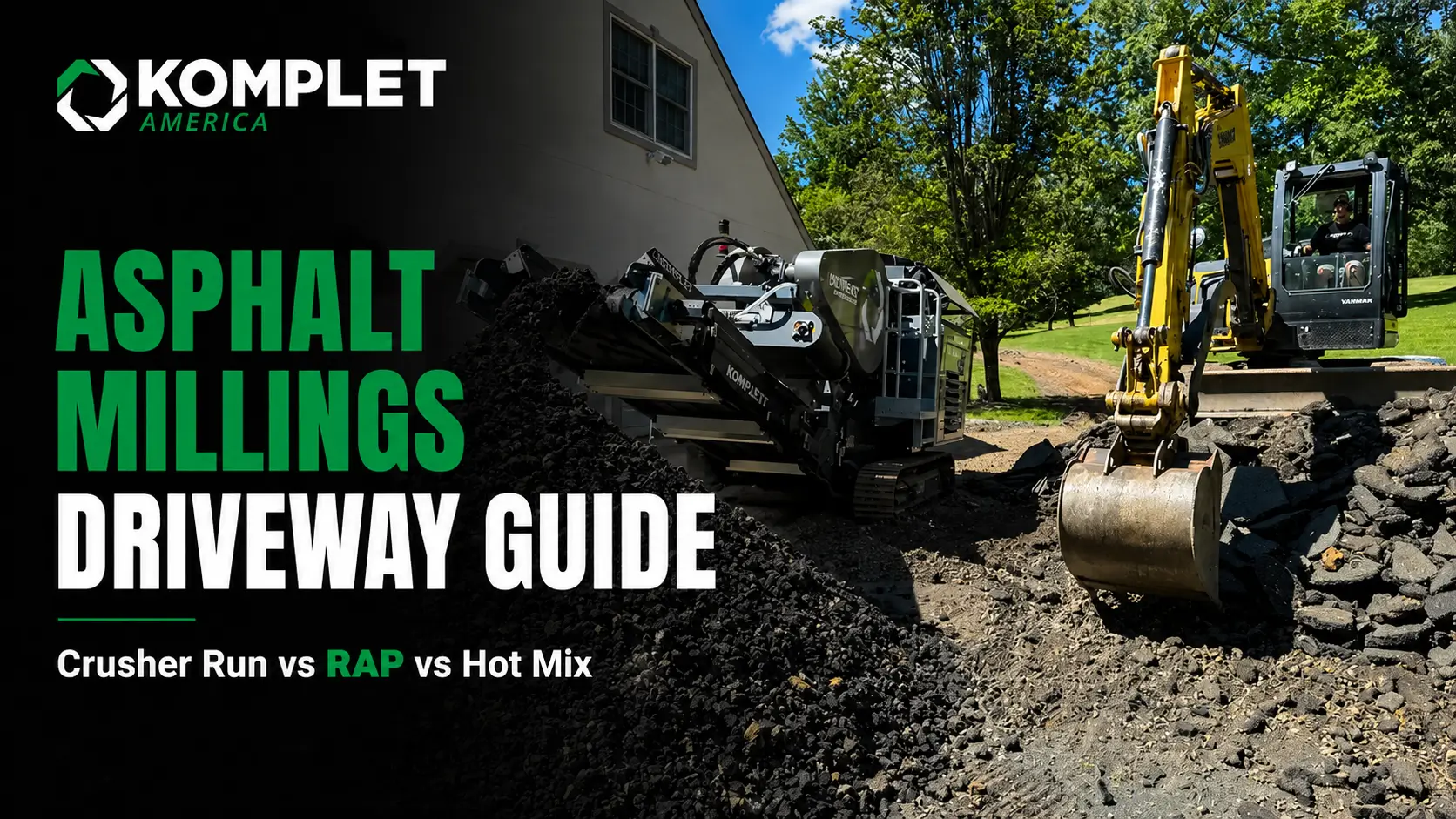

The asphalt millings driveway market has changed substantially over the past decade. What started as a budget improvisation — homeowners getting truckloads of millings free or cheap from local paving contractors and spreading them on a rural driveway — has matured into a recognized residential paving category with established cost structures, performance expectations, and installation discipline. Asphalt millings driveways now appear in suburban contexts where homeowners actively choose them over new asphalt or gravel. Paving contractors offer them as a deliberate service line rather than an afterthought. Material pricing has stabilized in the $10-40 per ton range in 2026 across most U.S. markets. The economics deliver a serviceable driveway surface at 60-80 percent less than new asphalt installation, with a useful life that justifies the savings for the right applications.
The threshold question for homeowners and contractors evaluating an asphalt millings driveway isn’t whether the material works — it does, when properly installed. The threshold questions are: how do millings compare to the realistic alternatives (crusher run, new asphalt, recycled concrete aggregate), what installation discipline does a millings driveway require, what depth and compaction are appropriate for the loading, what site preparation is required underneath, what’s the realistic useful life and maintenance pattern, and — for contractors and recyclers producing the material — what production discipline delivers driveway-grade millings consistently.
This guide is the contractor’s reference for the millings-driveway decision. It covers the head-to-head comparison against crusher run and new hot mix asphalt, the residential installation workflow with specific depth and compaction guidance, the cost structure across material and installation, the long-term performance and maintenance pattern, the production workflow for contractors and recyclers who produce millings from their own demolition feedstock, and the equipment configuration that handles both residential-scale millings production and the related concrete aggregate work that hardscape and driveway contractors typically need. The audience is the residential paving contractor, the hardscape contractor adding asphalt millings to the service menu, the rural site contractor, the demolition contractor with regular access to millings feedstock, and any general contractor handling driveway work directly.
Komplet America has been the U.S. distributor of Komplet S.p.A. compact crushers, screeners, and shredders since 2018, and the Conti family construction legacy behind Komplet America stretches back to 1906. The same compact equipment platform that handles concrete recycling for hardscape contractors handles asphalt millings production for paving contractors, with operational adjustments specific to the asphalt binder content. The detail below is the practical framework for the residential and light commercial market where this case applies most directly. For the technical foundation on what RAP is and how it’s produced, see our pillar piece, What Is RAP? A Contractor’s Guide to Reclaimed Asphalt Pavement.
The Quick Answer
For contractors and homeowners who don’t need the full reference:
- Asphalt millings (RAP) make an excellent low-cost driveway surface, typically 50–75 percent less expensive installed than new hot mix asphalt, with useful life of 7–15 years versus 15–20 for new asphalt.
- Standard residential installation: 3–4 inches of compacted millings (4 inches for heavier vehicle use) over 4–6 inches of compacted crusher run base over prepared subgrade. Compaction with a vibratory roller is non-negotiable.
- Crusher run is cheaper per ton ($15–$30 per ton in 2026) and serves as the structural base, but it stays loose and doesn’t bind together the way millings do. Use crusher run for the base layer, not the surface.
- Asphalt millings cost $10–$40 per ton material in 2026, $25–$55 per ton delivered, or $3–$6 per square foot installed by a paving contractor. Free millings are sometimes available from paving contractors and county road departments — bring your own truck and accept variable quality.
- New hot mix asphalt costs $4–$7 per square foot installed in 2026 and lasts 15–20 years with a uniform smooth surface. Use new asphalt where appearance and longevity justify the premium; use millings where the budget and use case favor savings over premium finish.
- Recycled concrete aggregate (RCA) is another driveway option. RCA is generally cheaper than virgin crushed stone but doesn’t bind together like millings — it performs more like crusher run. Best used as base material rather than surface.
The Three-Way Comparison: Millings, Crusher Run, and Hot Mix
For homeowners and contractors evaluating a residential driveway, the three realistic options are asphalt millings (RAP), crusher run (dense-graded aggregate base), and new hot mix asphalt (HMA). Each has a distinct profile across cost, appearance, performance, and maintenance. The right choice depends on the specific project’s priorities.
Asphalt Millings (RAP)
- Material cost (2026): $10–$40 per ton, with free or near-free availability from some paving contractors and county road departments. Delivered cost typically $25–$55 per ton including trucking.
- Installed cost: $3–$6 per square foot for professional installation including base preparation, millings delivery, placement, and compaction.
- Appearance: dark gray to black surface, coarser texture than new asphalt, gradually tightens and smooths over the first year as binder activates and traffic compacts the surface.
- Performance: re-binds in warm weather as the residual asphalt binder softens and reactivates, creating a semi-solid surface that handles vehicle traffic. Cold-weather installation produces a slower bind; warm-weather installation produces faster setting and tighter final surface.
- Useful life: 7–15 years with proper installation. Top end of the range with quality material, proper base, and good compaction; bottom end with poorer material or installation shortcuts.
- Maintenance: minimal — periodic regrading of high-traffic areas, occasional addition of fresh millings every 5–10 years to refresh the surface.
- Trade-offs: residual binder may track onto vehicles and walkways during hot weather (first few seasons); coarser appearance than new asphalt; bind quality varies with weather and material source.
Crusher Run (Dense-Graded Aggregate)
- Material cost (2026): $15–$30 per ton, broadly available from aggregate yards and direct from recyclers. The lowest-cost driveway material per ton in most U.S. markets.
- Installed cost: $1.50–$3.50 per square foot for professional installation including base preparation, material delivery, placement, and compaction.
- Appearance: gray to tan depending on rock source, granular crushed-stone texture, no binder. Doesn’t change appearance materially over time aside from settling and the eventual need for regrading.
- Performance: compacts to a tight locked structural surface with high California Bearing Ratio. Doesn’t bind together the way millings do — stays as a granular aggregate surface. Functions excellently as a structural base but doesn’t seal against water infiltration.
- Useful life: indefinite for the base layer, with periodic regrading and refresh of the surface aggregate. As a driveway surface, useful life depends on rate of erosion and migration — typically 3–7 years before substantial regrading is needed.
- Maintenance: regrading every 2–5 years, refresh of surface aggregate every 5–10 years, attention to drainage to prevent erosion and washout.
- Trade-offs: surface stays loose, tracks onto vehicles and walkways more than a bound surface, doesn’t shed water as completely as a paved surface, more vulnerable to erosion on sloped driveways.
- For the detailed crusher run discussion, see Crusher Run vs #57 Stone for Driveways and Best Gravel for Driveways: A Contractor’s Layer-by-Layer Guide.
New Hot Mix Asphalt (HMA)
- Material cost (2026): $80–$130 per ton delivered for residential-quantity hot mix, depending on region and mix specification.
- Installed cost: $4–$7 per square foot for professional installation including base preparation, asphalt delivery, paving, and compaction. The premium pricing reflects the specialized equipment (paver, vibratory roller, asphalt distributor for tack coat) and the limited working time of hot mix.
- Appearance: uniform black surface, smooth texture, professional paved appearance. Continues to look new for 3–5 years before weathering and aging produce visible texture changes.
- Performance: rigid bound surface that sheds water, resists erosion, supports vehicle and equipment loads efficiently, and provides smooth ride quality. The standard for residential and light commercial paving.
- Useful life: 15–20 years with proper installation, base preparation, and routine maintenance (sealing every 3–5 years).
- Maintenance: periodic crack sealing (annual to biennial), surface sealing every 3–5 years, full resurfacing at 15–20 year intervals.
- Trade-offs: highest installed cost, requires specialized paving equipment that homeowners can’t DIY, weather-sensitive installation (cold weather paving produces poorer compaction and shorter pavement life).
Side-by-Side Cost Summary
For a typical 600 square foot residential driveway (a single-car driveway, roughly 12 ft × 50 ft):
- Asphalt millings installed: roughly $1,800–$3,600 (at $3–$6/sq ft).
- Crusher run installed: roughly $900–$2,100 (at $1.50–$3.50/sq ft).
- Hot mix asphalt installed: roughly $2,400–$4,200 (at $4–$7/sq ft).
- DIY installation reduces all three by 30–60 percent on labor, with material costs and equipment rental still required.
Installation Workflow: How a Millings Driveway Is Built
A properly installed asphalt millings driveway is a layered system, just like any other paved driveway. The visible millings surface is one layer of a multi-layer section that determines whether the driveway performs for ten-plus years or fails progressively within the first two seasons. The installation workflow:
Step 1: Site Preparation and Subgrade
- Strip topsoil and organic material. Vegetation, root mat, and dark organic soil all need to come off — millings placed over topsoil fail because the organic layer compresses and decomposes under load, producing settlement and rutting.
- Identify and address soft spots in the subgrade. Wet, silty, or clay subgrade may need excavation and replacement with structural fill, or geotextile fabric between subgrade and base course.
- Grade for drainage. A driveway needs cross-slope (typically 2–3 percent crown or single-direction slope) to shed water off the surface, and surface drainage at the perimeter to prevent water from undermining the section. Drainage discipline matters more for millings driveways than for new asphalt because the millings surface is more permeable.
- Compact the subgrade uniformly with a plate compactor for residential work, or a small vibratory roller for larger driveways.
Step 2: Geotextile (Where Appropriate)
On wet, silty, or fines-rich subgrade, non-woven needle-punched geotextile (AASHTO M288 Class 2) between subgrade and base course prevents subgrade fines from migrating up into the base aggregate over the life of the driveway. Without geotextile in wet conditions, the base layer loses structural integrity over 5–10 years and the entire section fails progressively. The fabric is essential on wet sites and optional on firm, dry, granular subgrade.
Step 3: Compacted Crusher Run Base
4–6 inches of compacted crusher run (dense-graded aggregate) is the structural base for the millings surface. Place in lifts not exceeding 4 inches uncompacted, compact each lift to design density before placing the next. Optimum moisture content is in the 5–8 percent range for compaction efficiency.
- Why crusher run for the base: dense-graded aggregate compacts to a tight locked structure with high bearing capacity. The structural base distributes vehicle loads to the underlying subgrade and resists differential settlement.
- Compaction equipment: vibratory plate compactor (500–1,000 lb class) for residential work; ride-on tandem vibratory roller for larger driveways or commercial work.
- Compacted depth check: probe the base with a steel rod after compaction; a properly compacted base resists penetration substantially more than uncompacted material.
- Final grade: confirm cross-slope and longitudinal grade before placing millings. The millings surface follows the base; correcting grade with the millings layer doesn’t work because the surface thickness is intentionally consistent.
Step 4: Millings Placement
Place 3–4 inches of asphalt millings over the compacted base, distributed evenly across the driveway. The placement step itself is straightforward — dump from the truck, spread with a box scraper or grader attachment, level by eye and rake. The technical work is in the underlying base preparation and the subsequent compaction.
- Depth standard: 3 inches compacted for light residential use (passenger vehicles, occasional pickup truck); 4 inches compacted for heavier residential use (frequent pickup trucks, RVs, delivery vehicles); 4–6 inches compacted for commercial light vehicular use.
- Loose to compacted conversion: millings compact approximately 10–15 percent under proper rolling. Place 3.5 inches loose to achieve roughly 3 inches compacted; 4.5–5 inches loose for 4 inches compacted.
- Density: asphalt millings are approximately 110 lb/ft³ (1.5 tons/yd³) at typical placed density. For a 600 sq ft driveway at 4 inches compacted depth, expect approximately 10–12 tons of millings.
- Material temperature: millings can be placed cold (ambient temperature) — this is standard practice. The binder activation comes from sun-warming after placement, not from heated installation. Warm-weather installation (summer months) produces faster setting and tighter final surface than cold-weather installation.
Step 5: Compaction
This is the step that distinguishes a successful millings driveway from a failed one. Loose millings are loose gravel; compacted millings re-bind into a semi-solid surface. Skipping the compaction step or under-compacting produces a driveway that ruts, shifts, and erodes within the first season.
- Equipment: vibratory plate compactor (1,000+ lb class) is the minimum for residential work; ride-on tandem vibratory roller (1–3 ton class) is preferred for any driveway over 500 sq ft.
- Process: 4–6 passes per area with the roller, with overlap between passes. The final passes should produce a tight, locked surface with minimal visible voids.
- Temperature considerations: warm-weather compaction (60°F+ ambient) produces better binder activation and tighter final surface. Cold-weather compaction works but produces a slower-binding driveway that may require additional time and traffic to fully consolidate.
- Surface finish: a properly compacted millings driveway is firm enough to walk on without sinking and supports vehicle traffic immediately. The binder continues to consolidate over the first 30–90 days of service.
Step 6: Curing and First-Season Care
The compacted millings continue to bind over the first 30–90 days after installation. During this period:
- Allow vehicle traffic immediately — vehicle traffic actually helps the compaction and binding process.
- Avoid sharp turning, hard braking, and concentrated point loads in the first two weeks. The surface is still consolidating and is more vulnerable to displacement during this period.
- Expect some residual binder to track onto vehicles and walkways in hot weather during the first few seasons. This diminishes as the surface ages and the binder fully consolidates.
- Spot-fill any low areas with additional millings after the first month of use. Add a thin layer (½–1 inch) of millings to low spots and compact in place.
Application Variants: When Each Material Wins
When Asphalt Millings Is the Right Choice
- Rural and semi-rural driveways where appearance is secondary to function and budget.
- Long driveways where the cost differential between millings and new asphalt is substantial (a 200-foot residential driveway at 12 feet wide is 2,400 sq ft; the cost differential between millings at $4/sq ft and new asphalt at $5.50/sq ft is roughly $3,600).
- Farm and agricultural driveways where heavy equipment traffic would damage new asphalt sooner than millings.
- Driveways with sustained vehicle traffic where dust suppression from a bound surface is desirable but new asphalt is not justified by appearance requirements.
- Construction site entrances and laydown areas where temporary-but-durable surface is needed.
- Parking pads for RVs, boats, equipment, and other heavy items where a sealed surface isn’t required but a stable surface is.
- Driveway extensions or expansion of existing gravel driveways to add a more durable surface.
When Crusher Run Is the Right Choice
- Lowest-budget driveway projects where any bound surface (millings or asphalt) is beyond the budget.
- Temporary driveways for construction site access where the surface will be replaced before final occupancy.
- Rural driveways with infrequent use where the cost savings justify the looser surface and more frequent regrading.
- Base layer under any of the bound surfaces (millings, hot mix, paver work) — crusher run is the standard structural base regardless of what surface goes on top.
When New Hot Mix Asphalt Is the Right Choice
- Suburban and urban driveways where appearance matters and budget supports the premium.
- Driveways subject to neighborhood association or municipal aesthetic standards that don’t accept millings.
- High-traffic commercial driveways and parking lots where the longer useful life and better load-bearing characteristics justify the premium.
- Properties where resale value benefits from a finished paved appearance.
- Driveways with significant slope where the rigidity and erosion resistance of bound asphalt outperforms the more flexible millings surface.
Production: How Driveway-Grade Millings Are Made
For contractors and recyclers producing asphalt millings for the residential driveway market, production discipline determines whether the output is sellable at premium driveway-grade pricing or relegated to the general-construction commodity market. The production workflow:
Source: Where Millings Come From
- Direct from milling operations: paving contractors performing mill-and-overlay work on roads and parking lots generate millings as the primary output. Highest-quality source — material is consistent within the project, fresh, and produced at ¾-inch top size by the milling head.
- Stockpiled millings from previous projects: paving contractors and recyclers often stockpile millings between projects for resale. Quality varies with stockpile age — millings stored under 6 months are typically excellent, 6-12 months are good with potential modest agglomeration, over 12 months may require re-crushing.
- Crushed RAP from full-depth removal: pavement reconstruction projects produce RAP in oversize chunks that need crushing and screening to produce driveway-grade material. The downstream processing matters here — properly processed full-depth RAP is comparable to direct millings; poorly processed material is more variable.
- Mixed sources: producers blending millings from multiple sources for resale need to maintain reasonable consistency in particle size and binder content. Driveway market doesn’t require state-DOT-spec source segregation, but excessive variability shows up in installation quality.
Production Workflow for Driveway-Grade Millings
- Feed acceptance: inspect incoming material for cleanliness, particle size, and source quality. Reject loads with excessive contamination (soil, vegetation, large oversize, mixed C&D).
- Pre-reduction (if needed): full-depth removal feed and oversize stockpile material may require pre-breaking with an excavator-mounted hydraulic breaker before crushing.
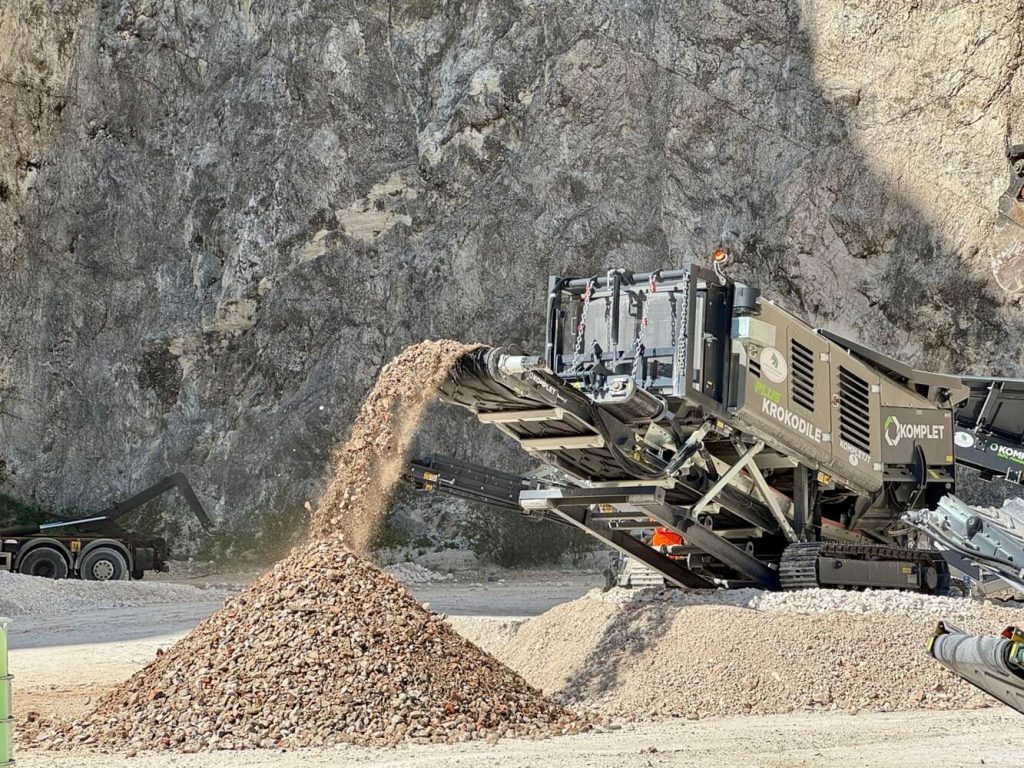
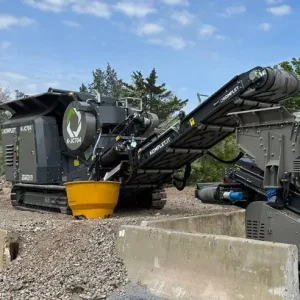
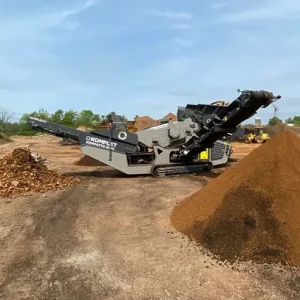
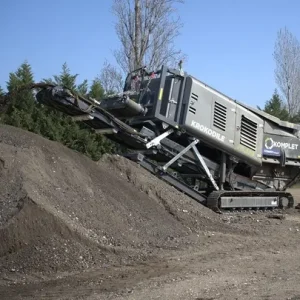
- Primary crushing: K-JC 503, K-JC 604, or K-JC 704 PLUS jaw crushers reduce oversize RAP to driveway-grade top size. CSS typically set at ¾-inch to produce material in the 0–¾-inch range appropriate for driveway application.
- Magnetic separation: standard on K-JC 604 and K-JC 704 PLUS, removes embedded ferrous metal during crushing.
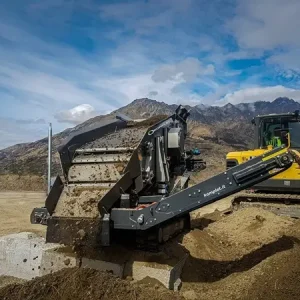
- Screening: Kompatto 221 or Kompatto 5030 separates the crushed output into target gradation. For driveway-grade millings, top deck typically ¾-inch or 1-inch openings with oversize bypass; bottom deck typically #4 sieve or #8 sieve to remove excess fines.
- Stockpile management: separate driveway-grade millings from other RAP products. Maintain stockpile height under 3 meters (10 feet) per Asphalt Institute recommendation to prevent agglomeration. Slope stockpile surfaces for drainage.
- Quality documentation: gradation reports for higher-value supply; binder content characterization where customers request it; visual inspection records for stockpile consistency.
Equipment Configuration for Driveway-Market Production
For contractors producing millings primarily for residential driveway supply, equipment configuration matches operation scale:
- Small operations (under ~3,000 tons/year): K-JC 503 + Kompatto 221. Adequate for paving contractors producing millings as a byproduct of their own milling work and as a service line for residential customers.
- Medium operations (3,000–15,000 tons/year): K-JC 604 or K-JC 704 PLUS + Kompatto 5030. Production-grade equipment for contractors and recyclers supplying multiple residential customers and small commercial paving operations.
- Larger operations (15,000+ tons/year): K-JC 704 PLUS or K-JC 805 + Kompatto 124. Dedicated recycler scale serving multiple paving contractors and commercial customers.
- Conveyor support: K-TC 460 portable mobile conveyor extends stockpile reach and supports cleaner segregation between driveway-grade and state-DOT-spec material.
Economic Case: Why Contractors Add Millings to the Service Menu
For paving contractors, hardscape contractors, and site contractors evaluating whether to add asphalt millings as a service line, the economic case has several dimensions:
Margin Structure
- Material cost: $10–$40 per ton; sometimes free from own milling operations.
- Sell price (installed): $3–$6 per square foot, which at 110 lb/ft³ density and 4-inch compacted depth converts to approximately $20–$40 per ton material-equivalent revenue plus installation labor.
- Gross margin: typically 40–60 percent on installed work, varying with material cost, equipment efficiency, and labor productivity.
- Cycle time: a 600 sq ft millings driveway typically takes 4–8 labor-hours total (subgrade prep, base placement, base compaction, millings placement, millings compaction) for a 2–3 person crew with appropriate equipment.
Equipment Leverage
- Contractors who already own loaders, excavators, and small rollers for other paving or hardscape work can add millings installation with minimal incremental equipment investment.
- The vibratory roller used for millings compaction is the same equipment used for crusher run base compaction on any driveway project.
- Plate compactors used for residential paver work also handle millings driveway compaction for smaller driveways.
- For contractors producing their own millings: compact crushing and screening equipment serves the millings supply and any concrete recycling or other aggregate production work the contractor does. See Hardscape Contractor’s Guide to On-Site Stone Production for the broader on-site aggregate production framework.
Market Positioning
- Millings driveways fit a specific customer segment — homeowners and property owners prioritizing cost savings over premium appearance. This segment is substantial in rural and semi-rural markets and growing in suburban markets as homeowners become more aware of millings as a credible alternative.
- Adding millings to a paving contractor’s service menu expands the addressable market without competing with the contractor’s higher-margin new asphalt work — customers choosing millings would not have purchased new asphalt in most cases.
- Cross-selling: customers starting with a millings driveway often return for additional millings work as their property expands (parking pads, equipment laydown areas, additional driveway segments) and may eventually upgrade to new asphalt for primary surfaces.
Adjacency to Concrete Recycling
For contractors already producing recycled concrete aggregate through compact crushing equipment, adding asphalt millings production is operationally straightforward — same equipment platform, different feed material, different screen mesh configurations. The two markets (concrete RCA for hardscape and base; asphalt millings for driveway surfaces) target different customer segments but share the same equipment investment. The economic case for owning compact crushing capability strengthens with each additional product stream the equipment can serve. See Recycled Concrete Aggregate vs Virgin Stone and Concrete Disposal Costs: Haul Away or Crush On Site? for the broader recycling economics framework.
Common Mistakes Contractors and Homeowners Make
Skipping the Base Layer
The single most common installation failure. A 4-inch millings layer placed directly on topsoil or unprepared subgrade looks fine for the first month and fails progressively from there — settlement under load, rutting in vehicle tracks, water infiltration undermining the surface. Millings are the visible surface of a layered system, not a one-layer paving solution. The crusher run base layer underneath is structural and not optional for any driveway expected to perform.
Under-Compacting the Millings
Loose millings are loose gravel. The transformation into a semi-solid bound surface comes from compaction during installation. Under-compaction (insufficient passes with the roller, undersized equipment, skipped compaction step entirely) produces a driveway that ruts and shifts in the first month. The cost of proper compaction equipment is small compared to the cost of remediating an under-compacted driveway.
Cold-Weather Installation Without Adjustment
Asphalt millings re-bind through warming of the residual binder. Cold-weather installation (below 40°F ambient) produces slower bind, looser final surface, and risk of permanent under-consolidation if the surface doesn’t see warm-weather traffic. Late-fall and winter installation requires either compensation through additional compaction effort or acceptance of a longer consolidation period. The optimal installation window is May through September in most U.S. climates.
Using Loose RAP Without Crushing or Screening
Free RAP from a paving contractor’s stockpile is great economics but variable quality. Stockpiled material that has agglomerated, includes oversize chunks, or has excessive fines may need crushing or screening before driveway use. Some contractors install loose RAP without processing and accept the variable surface; others process the material first to deliver a more consistent driveway. The customer expectations should match the material grade actually being installed.
Ignoring Drainage
Millings driveways are more permeable than new asphalt — water penetrates the surface to some degree and can undermine the section if drainage is inadequate. Cross-slope (2–3 percent crown or single-direction slope), perimeter drainage to prevent water collecting at the edges, and attention to upstream runoff entering the driveway area all matter more for millings than for sealed asphalt. Drainage discipline is base preparation discipline.
Mismatched Customer Expectations
For paving contractors offering millings as a service line, mismatched expectations cause most customer dissatisfaction. Millings are not new asphalt — appearance is coarser, surface is less uniform, residual binder may track for the first few seasons, useful life is shorter, and final consolidation takes time. Customers who expect a new-asphalt appearance from millings pricing are predictably dissatisfied. Clear up-front communication on appearance, performance, and timeline prevents most post-installation friction.
Frequently Asked Questions
How much does an asphalt millings driveway cost?
In 2026, asphalt millings cost $10–$40 per ton material, $25–$55 per ton delivered, or $3–$6 per square foot installed by a professional contractor. For a typical 600 sq ft single-car residential driveway at 4 inches compacted depth, total installed cost runs approximately $1,800–$3,600. This compares to $2,400–$4,200 for new hot mix asphalt and $900–$2,100 for crusher run. DIY installation reduces costs by 30–60 percent on labor. Free millings are sometimes available from paving contractors and county road departments — bring your own truck and accept variable quality.
How thick should asphalt millings be for a driveway?
Standard residential installation: 3–4 inches of compacted millings (4 inches for heavier vehicle use including pickup trucks, RVs, or frequent delivery vehicles), placed over 4–6 inches of compacted crusher run base over prepared subgrade. Loose-to-compacted conversion is approximately 10–15 percent, so place 3.5–4.5 inches loose to achieve 3–4 inches compacted. For commercial light vehicular use, 4–6 inches compacted. Compaction with a vibratory roller is non-negotiable regardless of depth.
Do asphalt millings harden?
Yes. The residual asphalt binder coating each particle softens in warm weather (typically 70°F+ ambient) and re-bonds the particles together. Combined with mechanical compaction during installation, this produces a semi-solid surface that handles vehicle traffic. The initial compaction during installation produces immediate consolidation; the binder activation through warm-weather curing produces additional hardening over the first 30–90 days of service. Cold-weather installation produces a slower bind; warm-weather installation (May through September in most U.S. climates) produces faster setting and tighter final surface.
How long does an asphalt millings driveway last?
7–15 years with proper installation, with the top of the range reflecting quality material, proper base preparation, good compaction, and adequate drainage. Compare to 15–20 years for new hot mix asphalt and 3–7 years before substantial regrading for crusher run surface. Useful life is shortened by inadequate base preparation, under-compaction, poor drainage, freeze-thaw cycles in cold climates, and heavy point loads (frequent commercial vehicle traffic, RV parking on a section designed for passenger vehicles).
Is crusher run better than asphalt millings for a driveway?
Different materials for different roles. Crusher run is cheaper per ton and serves excellently as the structural base layer under any driveway surface. Asphalt millings serve excellently as the surface layer above the crusher run base. The two are complementary rather than alternatives. A driveway built with crusher run alone (no millings surface) is functional but stays loose, requires more frequent regrading, and tracks aggregate onto vehicles and walkways more than a bound millings surface. A driveway built with millings alone (no crusher run base) fails progressively because the millings layer lacks structural support.
Can asphalt millings be installed DIY?
Yes, with appropriate equipment and base preparation. The straightforward DIY workflow: prepare subgrade, install and compact 4–6 inches of crusher run base, place and grade 3–4 inches of millings, compact with rented vibratory roller (1–3 ton class). Equipment rental for the compactor and a small loader or skid steer for material handling is typically $300–$800 for a weekend project, depending on region. The technical work is in the base preparation and compaction — placing the millings is straightforward; compacting them properly is what determines success. DIY installation reduces total cost by 30–60 percent versus professional installation.
Where do asphalt millings come from?
Asphalt millings are produced primarily by milling machines during road and parking lot resurfacing operations. The milling machine grinds away the top 1–6 inches of existing asphalt pavement and pickup-loads the ground material directly into haul trucks. Material is generated continuously during state DOT, municipal, and private commercial milling operations. Paving contractors, recyclers, and aggregate suppliers stockpile millings between projects. For the broader RAP production framework, see our pillar piece, What Is RAP? A Contractor’s Guide to Reclaimed Asphalt Pavement.
Do asphalt millings track onto vehicles?
Some, particularly in the first 1–2 seasons after installation and during hot weather when the residual binder is softest. Tracking diminishes as the surface ages and the binder fully consolidates. To minimize tracking: install during warm weather for faster initial bind; ensure thorough compaction during installation; avoid driving on the driveway during the first 24 hours after installation if possible; provide a transition area (concrete apron or compacted crusher run) between the millings driveway and any walkways or garage floors where tracking is undesired. Some homeowners apply a thin sand or stone dust topping to the first few feet at transitions to reduce tracking.
Are asphalt millings environmentally friendly?
Yes, on multiple dimensions. Asphalt millings are the most-recycled material in the United States by tonnage — NAPA documented 101.4 million tons of RAP recycled in 2024. Using millings for a driveway avoids the energy and emissions of producing new asphalt (the binder production specifically is energy-intensive), avoids the landfill disposal of milled material, and uses material that’s already produced as a byproduct of routine pavement maintenance. The carbon footprint of a millings driveway is substantially lower than new hot mix asphalt across the full life cycle. For contractors producing millings from their own demolition feedstock, the environmental case extends to avoided dump fees and trucking emissions as well.
Final Thoughts
Asphalt millings driveways occupy a specific economic and performance niche in the residential paving market — meaningfully cheaper than new asphalt, meaningfully better-performing than gravel or crusher run alone, with useful life and appearance that fit a substantial customer segment. The market has matured over the past decade from improvised solution to recognized residential paving category. Cost structures have stabilized. Installation discipline has been documented. Performance expectations are realistic.
For paving contractors, hardscape contractors, and site contractors evaluating whether to add millings to the service menu, the economic case combines real margin on the installation work with leverage on equipment that’s already part of the operation. For homeowners evaluating millings versus new asphalt or crusher run, the choice comes down to budget, appearance priorities, and useful-life expectations — clear criteria that produce clear decisions. For contractors and recyclers producing millings as a product line, the production discipline is straightforward when the same compact crushing and screening equipment used for concrete recycling is configured for asphalt millings.
Komplet America’s compact crusher and screener lineup is sized for the contractor and recycler operations where millings production fits alongside other recycling work. Our specialists work with paving contractors, hardscape contractors, and dedicated recyclers on equipment configurations that handle the full product mix — concrete RCA, asphalt millings, processed RAP, and the related aggregate products that serve residential and light commercial markets. The framework above is the broader context for those conversations.
For broader context across our cluster, see our companion articles: What Is RAP? A Contractor’s Guide to Reclaimed Asphalt Pavement, State DOT Specs for RAP: A Contractor’s Reference, Crusher Run vs #57 Stone for Driveways, Best Gravel for Driveways: A Contractor’s Layer-by-Layer Guide, Crushed Stone Grades: A Komplet Basic Guide to Aggregate Size and Use Cases, The Hardscape Contractor’s Guide to On-Site Stone Production, Recycled Concrete Aggregate vs Virgin Stone, and Concrete Disposal Costs: Haul Away or Crush On Site?.
Ready to Add Asphalt Millings to Your Service Menu?
- Talk to a Komplet specialist about pairing the right crusher and screener configuration for millings production at your operation scale. Call 908-369-3340 or visit com/contact-us.
- Browse the full Komplet equipment lineup — crushers, impact crushers, screeners, conveyors, and shredders sized for compact contractor and recycling operations.
- Explore equipment financing through Komplet Capital — 24-hour approvals, terms from 36 to 72 months, 100% financing available.
- Consider a pre-owned Komplet machine — typical capital savings of 40 to 70 percent versus new, factory-supported by the same Komplet America service network.
Never enough.
Disclaimer: Cost ranges, installation specifications, equipment recommendations, and performance expectations in this article are illustrative and based on industry patterns; actual results vary significantly by region, market, project specifications, equipment utilization, operator skill, weather conditions, and many other factors. Material costs reflect 2026 U.S. residential and light commercial market conditions current as of late 2025 and early 2026; prices vary substantially by region and over time. Installation depths, compaction requirements, and base preparation recommendations should be verified against local soil conditions, traffic loading, climate, and any applicable local codes or homeowner association requirements. For commercial or state-DOT-spec’d work, refer to applicable specifications and engineering requirements. Operating, maintenance, and service guidance for Komplet equipment is general in nature. Always refer to the official Komplet operator’s manual for the specific machine model and serial number, and follow OEM intervals and procedures. For warranty-protected work, contact Komplet America at 908-369-3340 or your authorized Komplet dealer. Improper service or non-OEM parts may void warranty coverage and create safety hazards.