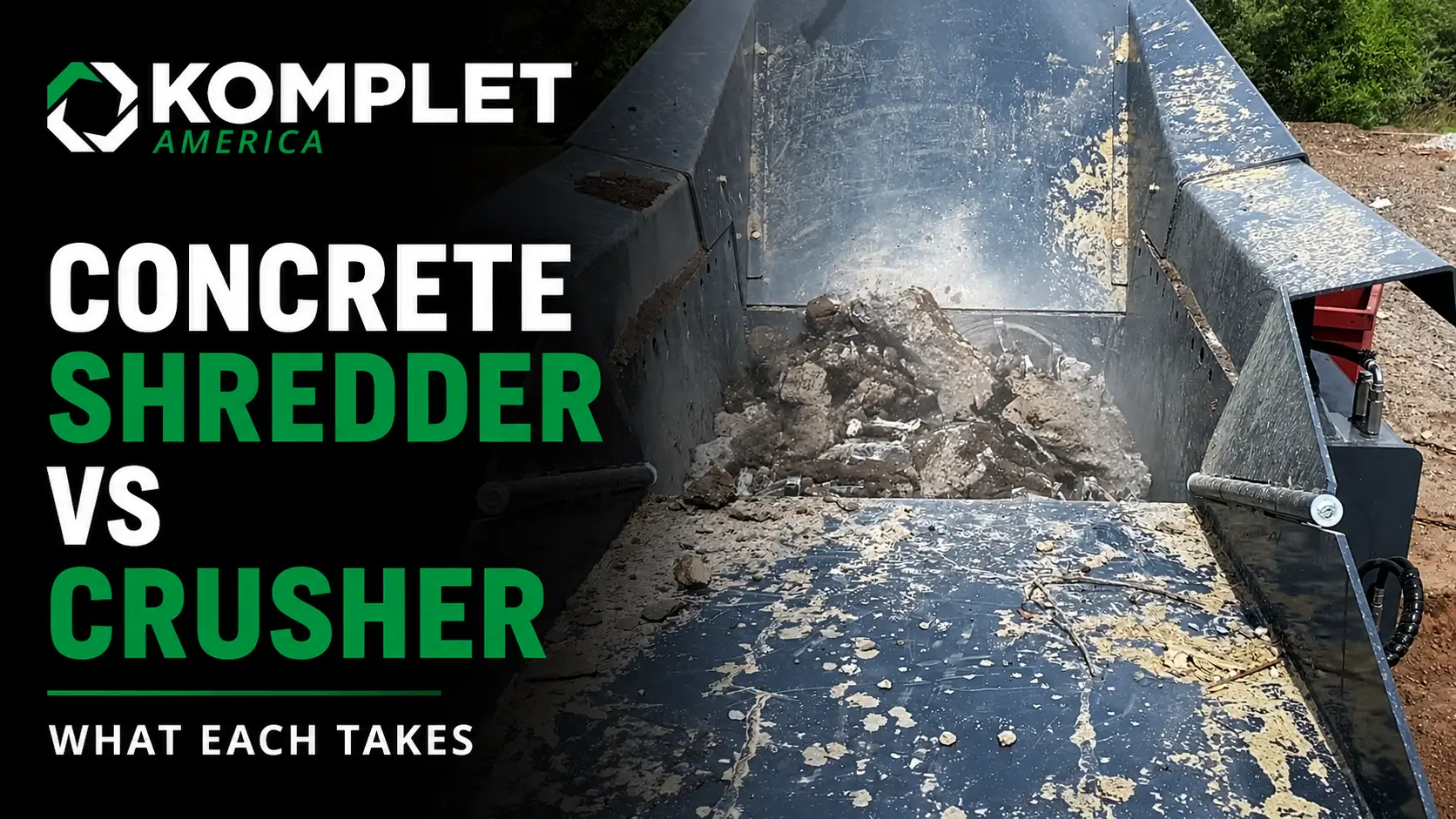

Search for a concrete shredder and you find crushers. Search for a C&D shredder and you find both, described in language that makes them sound interchangeable. They are not, and the difference is not a matter of degree. These machines reduce material by different physical means, they accept completely different feed, and choosing the wrong one produces either a machine that stalls on half your pile or a machine you did not need to buy.
The distinction that matters is simple to state. A crusher reduces material that fits in its chamber. A shredder takes material a crusher cannot accept at all. Everything else follows from that.
This article covers what each machine does mechanically, what each will and will not take, where the reduction ceiling sits on a single machine, and how operators running both put them in sequence. Refer to the operator’s manual prior to operating any Komplet machinery.
The Question Behind the Search
People searching for a concrete shredder are usually asking one of two different questions without realizing they are different.
The first is about size reduction of concrete itself: taking broken slab, footings and rubble down to something placeable or saleable. That is crusher work. Concrete is a compressive material and compression crushing is the efficient way to break it.
The second is about clearing a mixed pile. Demolition debris that arrives as concrete plus wood plus rebar plus plastic plus whatever the building had in it. Land clearing that produces root balls and stumps alongside dirt and rock. Storm cleanup where nothing arrives sorted. That is shredder work, and no crusher setting solves it, because the problem is not that the material is too big. The problem is that the material is not all the same thing.
Knowing which question you are asking answers most of the equipment decision on its own.
How Each Machine Reduces Material
Crushers apply force
A jaw crusher squeezes material between a fixed and a moving jaw plate until it fractures. An impact crusher throws material against blow bars and breakers at speed and fractures it on impact. Both depend on the material being brittle enough to break under load. Concrete, rock, brick, block and asphalt all qualify. The full lineup is on the crushers page.
Both also depend on the material entering a confined chamber and passing through a controlled gap. That constraint is the whole reason crushers are particular about feed.
Slow-speed shredders apply torque
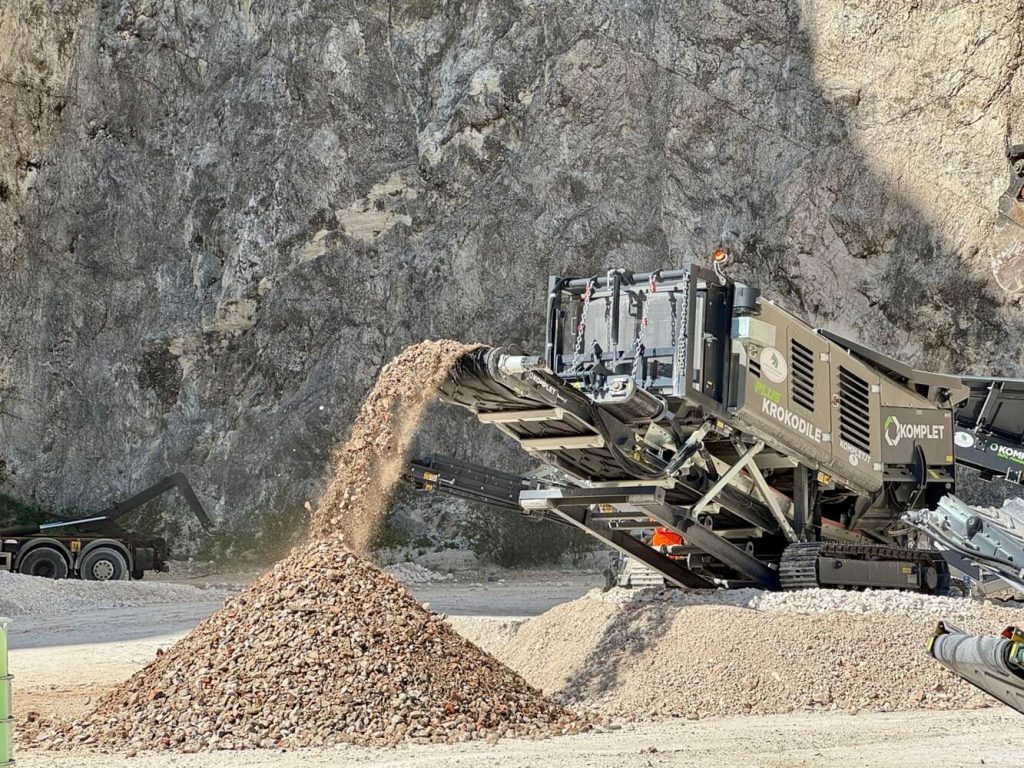
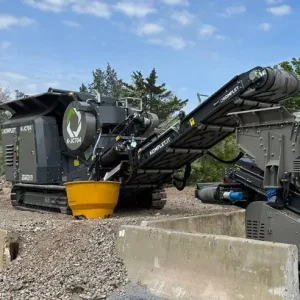
The Krokodile PLUS works differently. It uses dual-shaft slow-speed shredding, with two counter-rotating shafts turning at zero to 35 rpm and developing very high torque. Material is gripped between the shafts and torn, sheared and pulled apart rather than squeezed or struck. The shafts carry Hardox wear components and are driven by a 220 horsepower Volvo Penta engine.
Torque at low speed is what lets a shredder take material that would stop a crusher. A tree root does not fracture under compression, it deforms. A refrigerator does not shatter, it folds. A mattress does not break at all. Slow-speed shearing handles all three, because it does not require the material to be brittle.
Reduction Ratio and the Ceiling on One Machine
Reduction ratio is feed size divided by product size, and it puts a hard ceiling on what any single machine does in one pass.
Jaw crushers are generally worked to about six to one, meaning a six inch piece reduced to roughly one inch. Impact crushers reach considerably higher, with figures commonly cited between eight and twelve to one. Those are the ranges the machines are designed around, and no setting adjustment moves a machine outside its own range. A jaw can be pushed past six to one, but efficiency falls off rather than the product getting finer, which is why a second stage usually beats forcing the first one.
The practical consequence for anyone sizing equipment is that the arithmetic between your feed and your target product tells you how many machines you need. Sixteen inch feed to a three-quarter inch product is a reduction of over twenty to one. That is not a one-machine job at any setting on any compact crusher.
Where the shredder changes the math
A shredder in front of the crusher does not improve the crusher’s ratio. What it does is change the feed the crusher starts from, which changes the reduction the crusher has to deliver. Oversized, awkward material becomes material that enters the chamber cleanly and consistently.
This is also the practical answer to bridging, which is one of the most common causes of lost hours on a compact crusher. A bridge is usually a feed problem rather than a setting problem, and material prepared to a consistent size ahead of the crusher bridges far less. The setting side of that is covered in our post on closed side setting and jaw crusher output.
What a Crusher Will Not Accept
Every crusher has a list, and it is worth being blunt about it rather than discovering it on a job.
- Wood, brush, limbs and green waste. Not brittle, will not fracture, packs and wraps
- Tree roots and stumps. Same problem, with dirt and rock embedded in them
- White goods and appliances. Sheet metal folds rather than breaking
- Plastics, film, insulation and soft materials. Blind the chamber rather than passing through
- Mixed loads generally, where the crushable and non-crushable arrive together
- Anything larger than about 80% of the feed opening (jaw gape), regardless of what it is made of
Steel is its own category. A jaw crusher tolerates encapsulated rebar reasonably well because compression squeezes rather than strikes, though long loose pieces still cause trouble. An impact crusher is far less forgiving, particularly when running chrome blow bars, which offer much better wear resistance in abrasive material but are brittle and will not tolerate steel in the feed.
What the Krokodile PLUS Takes
The shredder’s list is close to the inverse. Published capacities are up to 175 US tph on construction and demolition material and up to 18 US tph on waste, with the difference between those two numbers reflecting how much harder mixed waste is to process than rubble.
Materials
Concrete, asphalt, brick, block and rubble on the construction side. Wood, green waste, tree roots and brush on the organic side. Bulky material including white goods. Mixed demolition debris that has not been sorted, which is the case the machine exists for.
Quick-change shafts
Shaft configuration is what adapts the machine to the material, and the quick-change shaft system means one chassis covers more than one application. A yard running C&D during the week and storm debris after a weather event is not buying two machines. The control system also offers different shredding modes for different materials, and a reverse dual-shaft function for sticky material and clearing blockages.
The rest of the configuration
- Sixty inch shaft length, zero to 35 rpm, high torque drive
- 220 horsepower Volvo Penta engine
- Hardox wear components on the shredding shafts
- Hydraulically adjustable side walls and a tilting rear hopper for feeding oblong material
- Magnetic separation as part of the standard configuration
- Tracked chassis, wireless remote control, roughly 34,000 pounds
- Working footprint about 28 feet long, folding to about 23 feet for transport
Slow Speed Versus High Speed
Not all shredders work the same way, and the distinction between slow-speed shredding and high-speed grinding is the one buyers most often miss.
High-speed machines reduce material with velocity, using rotors turning fast enough to break material through repeated strikes. They produce a finer product and higher throughput on clean, consistent organic feed. What they do poorly is tolerate contamination. Tramp metal entering a high-speed rotor is a serious event, and the wear part consumption on abrasive or dirty material is significant.
Slow-speed shredding trades throughput for tolerance. Running at low rpm with high torque means contamination passes through rather than causing damage, dust generation is lower, noise is lower, and the fire risk associated with high-speed processing of dry organic material is reduced. For C&D and mixed demolition material, where contamination is guaranteed rather than possible, that tradeoff generally favors slow speed.
Running Both: Shredding Ahead of Crushing
Operators running both machines are not duplicating capability. They are splitting a job that one machine cannot do.
What the sequence accomplishes
- Oversized and mixed material is reduced to something the crusher chamber accepts consistently
- Non-crushable material is separated out before it reaches the crusher rather than jamming it
- Reinforcement buried inside intact concrete sections is liberated, so the crusher’s magnet can actually reach it
- Feed arrives at a consistent size, which reduces bridging and stabilizes production
- Wear on the crusher drops, because the crusher is no longer being asked to handle material it was not built for
Where the magnet fits
Magnetic separation is standard on every Komplet crusher and part of the standard Krokodile PLUS configuration. Steel liberated by the shredder is caught downstream rather than passing into the product. How each machine handles the metal it recovers, and which side it discharges on, is covered in our post on ferrous separation on compact crushers.
Which Machine Your Operation Needs
The decision comes down to what shows up on your pile, not to which machine is more capable.
A crusher is the answer when
- Your material is predominantly concrete, rock, brick, block or asphalt
- It arrives reasonably sorted, or you can sort it economically
- You need a sized, saleable or placeable product with a specification behind it
- Your reduction requirement fits within one or two passes
A shredder is the answer when
- Your material arrives mixed and sorting it by hand is the bottleneck
- Wood, roots, green waste or bulky items make up a real share of the pile
- Volume reduction for disposal or transport is the goal rather than a sized product
- Feed size is the thing stopping you rather than product size
Both, when
Your operation takes material in from outside sources and cannot control what arrives, or you are producing a saleable aggregate from feed that starts mixed. Transfer stations, C&D recyclers and municipal yards land here most often. The shredder makes the material processable and the crusher makes it saleable.
Site and Transport Realities
A machine that cannot get to the work is not a solution. The Krokodile PLUS is built on a tracked chassis with a working length of roughly 28 feet, folding to about 23 feet for transport at roughly 34,000 pounds.
That matters for the same reason the compact crushers matter. Equipment that moves between sites on standard transport, sets up in a short window and works in confined space fits the way most contractors actually operate, which is several jobs rather than one fixed installation. Setup on Komplet machines is typically inside fifteen minutes.
Frequently Asked Questions
Can you shred concrete?
Yes. A slow-speed shredder processes concrete, asphalt, brick, block and rubble with the appropriate shaft configuration. Whether you should depends on the goal. If you need a sized, saleable aggregate, a crusher does that better. If the concrete arrives mixed with wood, steel and debris, the shredder handles the mixed load a crusher cannot accept.
What is the difference between a shredder and a crusher?
A crusher reduces material by force, either squeezing it between jaw plates or striking it with blow bars, and it requires material brittle enough to fracture and small enough to enter the chamber. A shredder reduces material with high torque at low speed, tearing and shearing it apart, which lets it take wood, roots, appliances and mixed debris that a crusher cannot process.
Do I need a shredder or a crusher?
Look at your pile. Predominantly concrete, rock or asphalt arriving reasonably sorted, and you need a crusher. Mixed material with wood, roots or bulky items where sorting is the bottleneck, and you need a shredder. Material coming in from outside sources that you cannot control usually calls for both.
What can a C&D shredder process?
Concrete, asphalt, brick, block and rubble on the construction side, plus wood, green waste, tree roots and bulky material including white goods. Published capacity on the Krokodile PLUS is up to 175 US tph on C&D material and up to 18 US tph on waste.
What is a slow speed shredder?
A shredder that reduces material using high torque at low rotational speed, typically with dual counter-rotating shafts, rather than using velocity. The Krokodile PLUS runs its shafts at zero to 35 rpm. Slow speed operation tolerates contamination such as tramp metal far better than high-speed grinding, and generates less dust and noise.
Can a shredder replace a crusher?
Not for producing sized aggregate. A shredder reduces and liberates material but does not produce the controlled gradation a crusher does. Operations needing a saleable or specified product use the shredder to prepare material and the crusher to size it.
Does shredding first help the crusher?
Yes, in several ways. Feed arrives at a consistent size, which reduces bridging and stabilizes production. Non-crushable material is separated before it reaches the chamber. Reinforcement buried in intact sections is liberated so the crusher’s magnet can reach it. Crusher wear drops because it is no longer processing material it was not built for.
Is a mobile shredder practical for a contractor rather than a fixed facility?
Yes. The Krokodile PLUS is tracked, remote controlled, transports at roughly 34,000 pounds and folds to about 23 feet. It is built for operators who move between jobs rather than running a single fixed installation, which is the same reasoning behind the compact crusher line.
Final Thoughts
The reason shredder and crusher content reads as interchangeable is that both machines make big material smaller. That framing hides the only distinction that matters on a jobsite, which is what each one will accept in the first place.
A crusher is a sizing machine. It takes material it can break and turns it into a product with a gradation. A shredder is a processing machine. It takes material that cannot be sorted or handled and turns it into something workable. Operators who buy the wrong one usually did so because they were thinking about output size when the real constraint was on the input side.
Komplet America is the official North and Central American distributor of Komplet compact crushing, screening, shredding and conveying equipment. The Krokodile PLUS slow-speed shredder covers mixed and oversized material, while the jaw crusher line runs from the K-JC 503 through the K-JC 604, K-JC 704 PLUS and K-JC 805, with the K-IC 70 compact impact crusher for higher reduction and better particle shape. See the full range on the shredders page and the crushers page, with equipment financing through Komplet Capital.
Ready to Match the Machine to Your Pile?
- Call Komplet America at 908-369-3340 and describe what actually arrives on your site
- Compare the Krokodile PLUS against the crusher line on the shredders page
- Keep wear parts on hand through parts and support
- Explore terms through Komplet Capital on the equipment financing page
- Find your local dealer for a demo at find a dealer
Never enough.
Disclaimer: All operating, maintenance, and service guidance in this article is general in nature. Always refer to the official Komplet operator’s manual for the specific machine model and serial number, and follow OEM intervals and procedures. For warranty-protected work, contact Komplet America at 908-369-3340 or your authorized Komplet dealer. Improper service or non-OEM parts may void warranty coverage and create safety hazards.