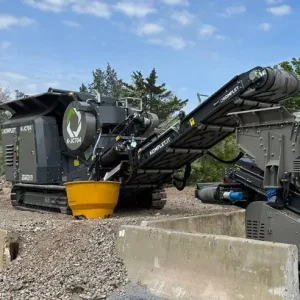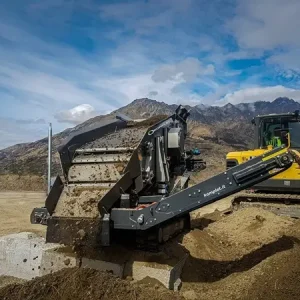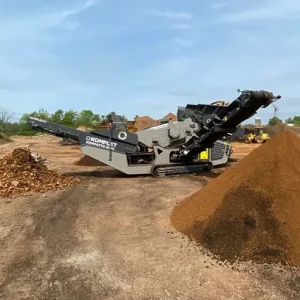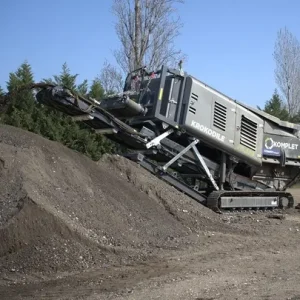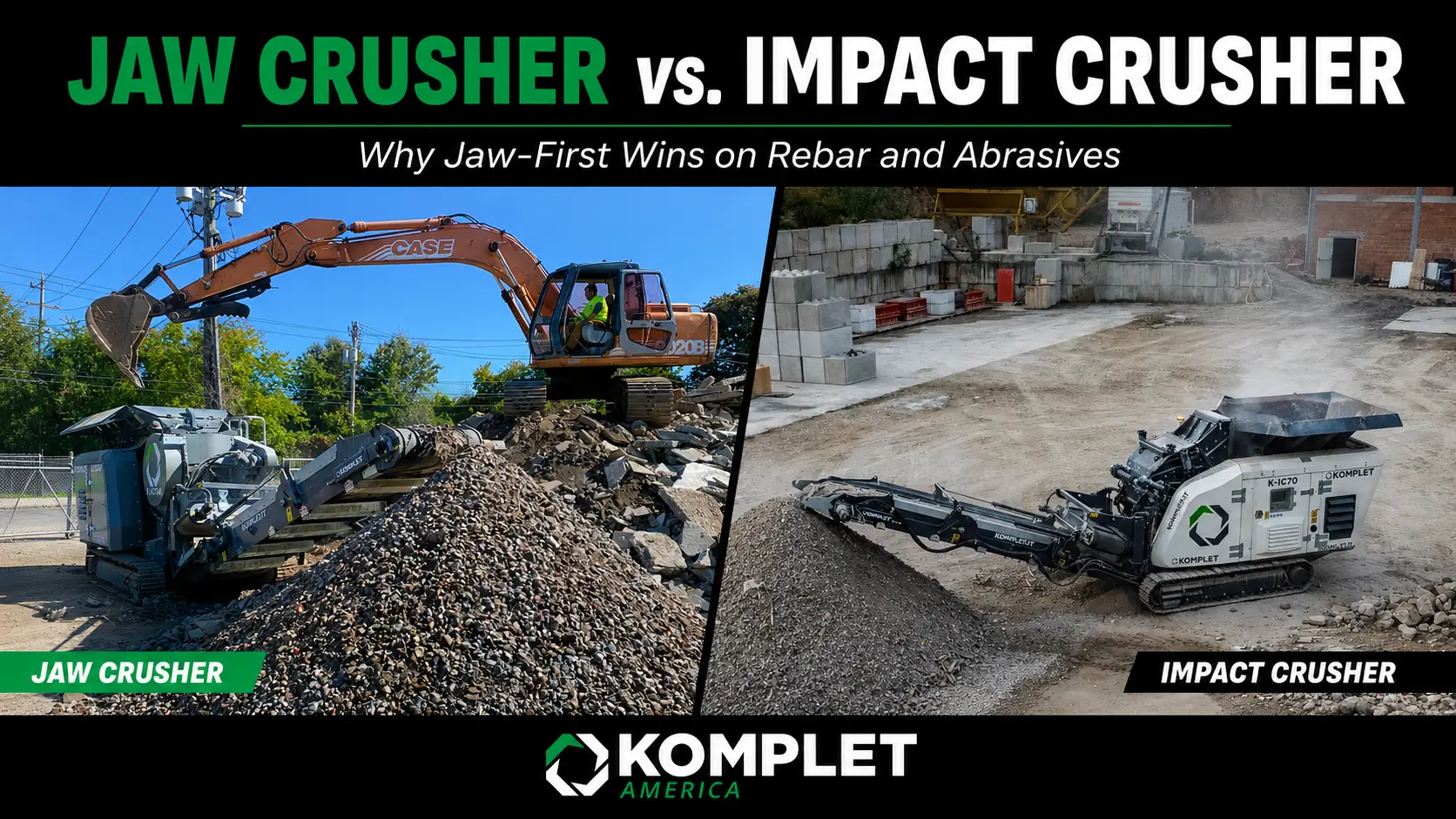

Walk any concrete recycling or demolition trade show floor and you will hear the same pitch: bring an all-in-one impact crusher to the jobsite, feed it your rubble, and walk away with finished spec product in a single pass. It is a clean story. For some material, on some sites, it is even the right call. But the impact-first narrative quietly assumes a world that most demolition and recycling contractors do not actually work in — a world without rebar surprises, without abrasive grit, and without the constant need to move between sites with different material every week.
This guide takes the other side of that argument. For reinforced concrete, abrasive feed material, and contractors who run multiple jobs with unpredictable inputs, a compression-based jaw crusher paired with a separate, modular screener is frequently the more durable, more flexible, and more cost-controlled choice than a single all-in-one impactor. Below we break down exactly why — by crushing mechanism, by material, by wear economics, and by workflow — and where an impact crusher genuinely earns its place as a finishing stage rather than the front line.
Komplet America builds both. We distribute a full lineup of compact jaw crushers and the K-IC 70 compact impact crusher, plus a complete screener range. That means we have no incentive to oversell one mechanism — only to put the right one at the front of your workflow. Refer to the user manual prior to operating any Komplet machinery.
Two Different Machines Doing Two Different Jobs
Before comparing them on concrete, it helps to be precise about how each crusher actually breaks rock, because the mechanism is the source of every downstream difference in wear, contamination tolerance, and output shape.
How a Jaw Crusher Works
A jaw crusher reduces material by compression. A fixed jaw plate and a moving jaw plate form a V-shaped chamber; the moving jaw squeezes feed material against the fixed jaw until it fractures, and gravity pulls the broken pieces down and out through an adjustable discharge gap. The mechanical principle has been refined since Eli Whitney Blake patented the first mechanical jaw crusher in 1858, and it remains the dominant method of primary crushing for hard, dense, contaminated material for a simple reason: squeezing rock is forgiving in ways that hitting it is not.
Jaw crushers use jaw plates as their primary wear part. The discharge gap (closed-side setting) is adjustable, so a single machine can be dialed for coarser or finer output depending on the job. On Komplet jaw crushers, all functions are run by wireless remote control, and magnetic separation is standard across the crusher line to pull liberated rebar and tramp steel off the discharge belt.
How an Impact Crusher Works
An impact crusher reduces material by high-speed impact rather than compression. A spinning rotor fitted with blow bars (not “hammers” and not “liners”) strikes the feed and hurls it against fixed impact aprons inside the chamber; the repeated impacts shatter the material along its natural fracture lines. That impact action is what produces the highly cubical, well-graded particle shape impact crushers are prized for — the kind of shape that meets DOT specifications for new asphalt and high-grade aggregate.
The Komplet K-IC 70 is a premium cubical-aggregate machine. It is genuinely excellent at what it is designed for: reducing Recovered Asphalt Pavement (RAP) to fine material for new asphalt production, turning clean broken concrete into spec aggregate, and producing DOT-spec material. The question is not whether impact crushing works. It is whether impact crushing belongs at the front of a workflow that starts with raw, reinforced, abrasive demolition debris.
Reinforced Concrete: Where Jaw-First Earns Its Keep
Demolition concrete is rarely clean. Slabs, footings, columns, and structural elements come laced with rebar, wire mesh, and embedded steel. How a crusher reacts to that steel is the single biggest practical difference between the two mechanisms — and it is the difference the impact-first pitch tends to skate past.
What Rebar Does to a Jaw
In a compression chamber, rebar is an inconvenience the machine is built to tolerate. The jaw squeezes the concrete off the steel; the liberated rebar passes through the discharge gap as elongated pieces and is pulled off the belt by the standard magnetic separator. The steel does not have to be perfectly clean going in. The crusher is not trying to pulverize the steel — only to break the concrete around it. That is why jaw crushers are the default front-line machine across demolition specialists and recycling facilities handling structural debris.
What Rebar Does to an Impactor
In an impact chamber, the same rebar is a problem. Blow bars spinning at high speed are designed to shatter brittle material, not to absorb repeated strikes against tough, ductile steel. Long lengths of rebar can wrap the rotor, lodge in the chamber, and force unplanned downtime to clear a blockage. Even when the machine keeps running, hammering steel accelerates blow-bar wear dramatically and risks damage to the rotor and aprons. This is precisely why impact-crusher operators are warned to pre-process or remove heavy reinforcement before feeding — a step that quietly erases the “one machine, one pass” simplicity the all-in-one pitch promised.
The honest framing: an impact crusher can be fed lightly reinforced material, but every length of rebar you feed it is wear you are paying for and risk you are carrying. A jaw crusher treats that same rebar as routine. For raw reinforced demolition concrete, jaw-first is not a preference — it is the lower-risk, lower-cost path.
Abrasive Material and the Economics of Wear
The second place the impact-first story breaks down is abrasion. Hard, gritty, silica-heavy material — granite, trap rock, river gravel, dirty mixed C&D — wears crushing surfaces fast. The mechanism determines how fast, and how expensively.
Why Impact Crushers Wear Faster on Abrasive Feed
Impact crushing is high-velocity, high-contact-frequency crushing. Every particle is struck repeatedly at speed, which means abrasive material is constantly grinding against the blow bars and aprons. On hard, abrasive feed, blow-bar wear can be steep, and blow bars are a consumable you replace on a schedule that the material dictates, not one you choose. The cubical output is real, but on abrasive rock you are buying that particle shape with accelerated wear-part consumption.
Why Compression Tolerates Abrasion Better
A jaw crusher’s compression action involves far less high-velocity surface contact. Jaw plates wear, of course — they are the primary wear item — but the wear is slower and more predictable on abrasive material than blow-bar wear in an impact chamber doing the same job. For a contractor whose feed is hard and gritty, the jaw’s wear economics are simply easier to live with and easier to budget. Across a year of mixed abrasive jobs, the difference in wear-part spend between a jaw front end and an impact front end can be substantial.
Operating cost is never zero with either machine. Both burn diesel, both need OEM maintenance, both consume wear parts and operator labor, and both have DEF and DPF service requirements — realistic all-in operating cost typically runs in the range of roughly $5 to $15 or more per ton depending on conditions. The point is not that the jaw is free to run. It is that on abrasive, reinforced feed, the jaw’s cost curve is flatter and more controllable than the impactor’s.
Modular Screener vs. All-in-One: The Flexibility Argument
The all-in-one impact crusher folds screening and recirculation into a single chassis. That integration is the headline feature — and it is also the constraint. When crushing and screening live in one machine, you cannot deploy them independently, you cannot easily change your output spec without reconfiguring the whole unit, and when one subsystem needs service, the entire production line stops.
The Jaw-Plus-Screener Workflow
Pairing a jaw crusher with a separate, mobile screener decouples the two functions. The jaw handles primary reduction; a Kompatto vibrating screener sizes the output into finished fractions. Komplet’s Kompatto 5030 — the best-selling screener in the lineup — pairs naturally with the K-JC 704 PLUS or K-JC 805 to build a crush-and-screen line that you control stage by stage.
The practical advantages of keeping the stages separate:
- Independent deployment: run the jaw on one job and the screener on another, or run the jaw alone when you only need a coarse product.
- Spec flexibility: swap screen media to change your finished fractions without touching the crusher’s setup.
- Service resilience: if one machine needs maintenance, the other keeps working instead of idling your whole line.
- Right-sized capital: mobile conveyor only if and when stockpiling demands it.
- Resale and redeployment: separate machines can be reassigned, rented out, or sold independently as your fleet needs change.
Multi-Site Reality
Contractors who move between sites rarely face the same material twice. One week it is clean structural concrete; the next it is mixed C&D with brick, block, and rubble; the week after it is hard abrasive rock. A jaw crusher’s adjustable discharge gap and contamination tolerance make it the adaptable front end for that unpredictability. A separate screener lets you reconfigure the back end per job. An all-in-one impactor, by contrast, is optimized for a narrower material window — and every job outside that window is a job where the integration works against you.
Where the Impact Crusher Genuinely Wins
This is not an argument that impact crushing is obsolete. It is an argument about sequence. The impact crusher is a superb finishing machine — it simply belongs after the dirty work is done, not in front of it.
The K-IC 70 is the right tool when:
- You need a highly cubical, well-graded final product — DOT-spec aggregate or material for new asphalt.
- You are reducing Recovered Asphalt Pavement (RAP) to fine material for asphalt production.
- Your feed is already clean and de-reinforced — for example, concrete that has passed through a jaw first, with rebar removed.
- Particle shape, not contamination tolerance, is the governing requirement of the job.
That last point is the heart of the matter. In many high-spec operations the strongest configuration is jaw first, impact second: the jaw takes the raw, reinforced, abrasive demolition concrete and produces a clean, de-reinforced intermediate product; the impact crusher then refines that clean feed into premium cubical spec material. Used that way, the impactor never has to eat rebar or raw grit, and you get its best output without paying its worst wear bills. The all-in-one pitch collapses these two stages into one machine and one material assumption — which is exactly where it goes wrong on real demolition feed.
A Simple Decision Framework
Strip away the marketing and the choice comes down to a few honest questions about your material and your workflow.
- Is your feed reinforced? If raw demolition concrete with rebar is your everyday input, start with a jaw. Steel is routine for compression and costly for impact.
- Is your feed abrasive? Hard, gritty, silica-heavy rock favors the jaw’s slower, more predictable wear over accelerated blow-bar consumption.
- Do you work multiple sites with changing material? A jaw plus a separate screener gives you independent, reconfigurable stages. An all-in-one locks you into one material window.
- Is cubical particle shape the governing spec? If clean feed and DOT-spec output are the priority, add an impact crusher as a finishing stage — ideally behind a jaw, not instead of one.
- What is your realistic wear budget? Model wear-part spend across a full year of your actual material, not a single clean demo. The jaw front end is usually the flatter, more controllable curve on reinforced abrasive feed.
Komplet America’s Compact Mobile Lineup
Komplet America builds the full toolkit so you can match the machine to the material rather than forcing the material to fit one machine.
- K-JC 503 Mini Jaw Crusher — the most compact jaw, easily towed behind a pickup; up to 34 US tph. For tight-access and lower-volume work.
- K-JC 604 Mobile Jaw Crusher — a step up in production with a larger jaw; up to 55 US tph.
- K-JC 704 PLUS Portable Jaw Crusher — the best-selling crusher in the lineup; up to 90 US tph, with Komplet Connect remote monitoring standard.
- K-JC 805 Mobile Jaw Crusher — the largest jaw, a semi-pro machine and strong pre-processor for screening operations; up to 160 US tph.
- K-IC 70 Compact Impact Crusher — premium cubical aggregate and RAP reduction; up to 90 US tph. Best deployed as a finishing stage on clean, de-reinforced feed.
- Kompatto 5030 Heavy-Duty Vibrating Screener — best-selling screener; pairs with the jaw line to size finished fractions; up to 280 US tph.
- K-TC 460 Tracked Mobile Conveyor — self-propelled on rubber tracks; repositions alongside any crusher or screener to build stockpiles and cut loader dependency.
Magnetic separation is standard across the crusher line, every machine runs by wireless remote control, and the whole lineup is built around the five pillars Komplet equipment is known for: affordable, minimum footprint, easy transport, easy operation, and on-site cost savings from recycling material instead of hauling it. Equipment prices are available on each product page and from Komplet America.
Frequently Asked Questions
Is a jaw crusher or an impact crusher better for concrete recycling?
It depends on the concrete and your workflow. For raw demolition concrete with rebar and for abrasive feed, a jaw crusher is generally the better front-line choice because compression tolerates steel and resists abrasive wear better than high-speed impact. An impact crusher is better as a finishing stage on clean, de-reinforced feed when a highly cubical, DOT-spec product is the goal. Many high-spec operations run jaw first, impact second.
Which crusher is best for demolition concrete with rebar?
A jaw crusher. Its compression action squeezes concrete off the rebar and passes the steel through to a magnetic separator, which is standard on Komplet crushers. Feeding heavy rebar into an impact crusher risks wrapping the rotor, blockages, and accelerated blow-bar wear, which is why reinforcement is typically removed or pre-processed before impact crushing.
Can an impact crusher handle reinforced concrete?
It can handle lightly reinforced material, but every length of rebar accelerates blow-bar wear and raises the risk of rotor blockages and downtime. For routinely reinforced demolition concrete, a jaw crusher is the lower-risk, lower-cost choice. If you need impact-crusher output, run the material through a jaw first to liberate and remove the steel.
Why pair a jaw crusher with a separate screener instead of buying an all-in-one impactor?
Keeping crushing and screening as separate machines lets you deploy them independently, change your output spec by swapping screen media without reconfiguring the crusher, and keep producing if one machine needs service. It also right-sizes your capital and makes each machine easier to redeploy, rent, or resell. An all-in-one impactor folds both functions into one chassis optimized for a narrower material window.
Do impact crushers use hammers?
No. Impact crushers use blow bars mounted on a spinning rotor, not hammers and not liners. Jaw crushers use jaw plates. Getting the terminology right matters when you are sourcing wear parts.
What is the difference between a jaw plate and a blow bar?
A jaw plate is the compression wear surface in a jaw crusher — material is squeezed between a fixed and a moving jaw plate. A blow bar is the impact wear surface bolted to the rotor of an impact crusher — it strikes material at high speed. Both are consumable wear parts, but they wear under very different conditions, which is why material type drives the choice of machine.
Which Komplet crusher should I choose for reinforced, abrasive concrete?
A jaw crusher from the K-JC line, sized to your throughput — the K-JC 704 PLUS is the best-selling model and the K-JC 805 is the largest and a strong pre-processor for screening. Pair it with a Kompatto screener to size your output, and add a K-IC 70 impact crusher only if you need premium cubical spec material as a finishing stage on clean feed.
Does on-site crushing actually save money?
Crushing and reusing material on-site can reduce hauling and tipping fees by keeping material out of the landfill and out of trucks, which is one of the core reasons contractors invest in compact mobile crushers. Actual savings depend on your local hauling and tipping rates, material composition, utilization, and operating costs, so run the numbers against your own market before deciding.
Final Thoughts
The all-in-one impact crusher is a strong machine inside a narrow story — clean feed, cubical output, one pass. The trouble is that most demolition and concrete recycling work lives outside that story, in a world of rebar, grit, and material that changes from site to site. For that world, a jaw crusher paired with a modular screener is the more durable, more flexible, and more cost-controlled front end, with the impact crusher earning its place as a finishing stage on clean, de-reinforced feed. Choose by your material and your workflow, not by the pitch — and when the material is reinforced and abrasive and the jobs keep changing, jaw-first is usually the answer.
Komplet America distributes the full toolkit to build the right line for your material: a complete range of compact jaw crushers, the K-IC 70 impact crusher for finishing-stage cubical output, a heavy-duty screener lineup, and the K-TC 460 tracked mobile conveyor to tie the workflow together. Flexible equipment financing and a pre-owned program make it easier to right-size your investment, and our parts and support team keeps jaw plates, blow bars, and screen media on hand.
Ready to Build a Jaw-First Workflow?
- Talk through your material and site mix with Komplet America at 908-369-3340 to spec the right crusher-and-screener line.
- Explore the full jaw crusher lineup and match a model to your throughput and access constraints.
- Compare screeners to size your finished fractions independently of the crusher.
- Review equipment financing options — 24-hour approval and 100% financing available.
- Find your local Komplet dealer for a demo and rental availability.
Never enough.
Disclaimer: Any ROI figures, payback timelines, or dollar-amount savings referenced above are illustrative examples only. Actual results depend on jobsite material composition, local hauling and tipping rates, fuel and labor costs, equipment utilization, financing terms, regional regulatory requirements, and operator efficiency. Komplet America makes no guarantee of specific financial returns. Customers should perform their own analysis based on local market conditions before making purchase decisions.
Disclaimer: All operating, maintenance, and service guidance in this article is general in nature. Always refer to the official Komplet operator’s manual for the specific machine model and serial number, and follow OEM intervals and procedures. For warranty-protected work, contact Komplet America at 908-369-3340 or your authorized Komplet dealer. Improper service or non-OEM parts may void warranty coverage and create safety hazards.