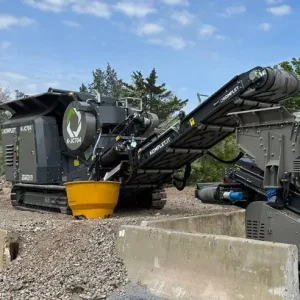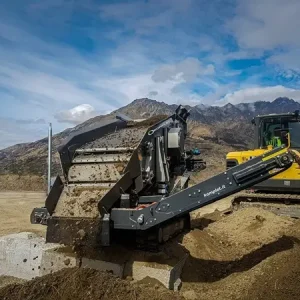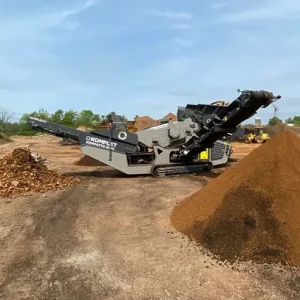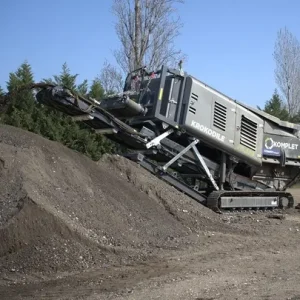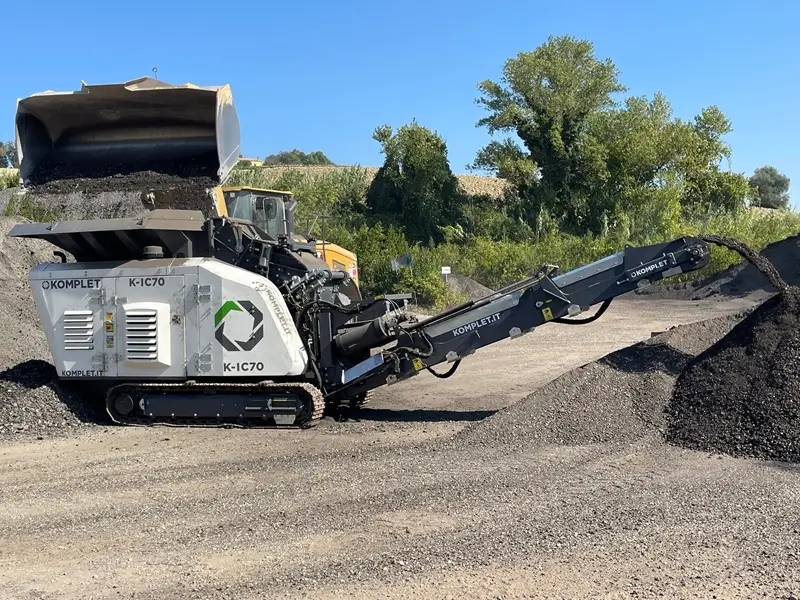

Operations evaluating material processing equipment investment face a foundational choice: compact mobile equipment that deploys to project sites and moves between operational locations, or stationary fixed plant equipment installed at permanent facility locations. The two equipment categories serve different operational profiles, deliver different economic returns, and fit different growth trajectories. For project-based operations across N&C America — demolition contractors, recyclers, excavators, aggregate producers, composters, landscape suppliers, disaster recovery operations, and many others — compact mobile equipment delivers operational and economic advantages that stationary alternatives can’t match. For very high-volume centralized operations, stationary fixed plant economics typically dominate.
This basic guide walks through the strategic value proposition for compact mobile equipment — across all four Komplet equipment categories (crushing, screening, shredding, conveying) — and the operational profiles where compact mobile economics work better than stationary alternatives. Komplet America’s full compact mobile equipment lineup supports operations across the diverse customer base.
Foundational Definition: What ‘Compact Mobile’ Means
Before walking through the value proposition, the foundational definition matters. Compact mobile equipment in this context refers to:
Self-Contained Operation
Equipment includes integrated diesel power (no grid electricity required), self-contained hydraulic systems for operational functions, and integrated control systems. The equipment operates as a complete unit at any project site without requiring external infrastructure connection.
Self-Propelled Tracked Mobility
Equipment moves under its own power on tracked undercarriage — drives onto and off transport trailers, repositions on project sites, and travels short distances at project sites without external transport equipment. Track-mounted design supports operation on rough or unprepared surfaces typical at construction and demolition project sites.
Standard Equipment Trailer Transport
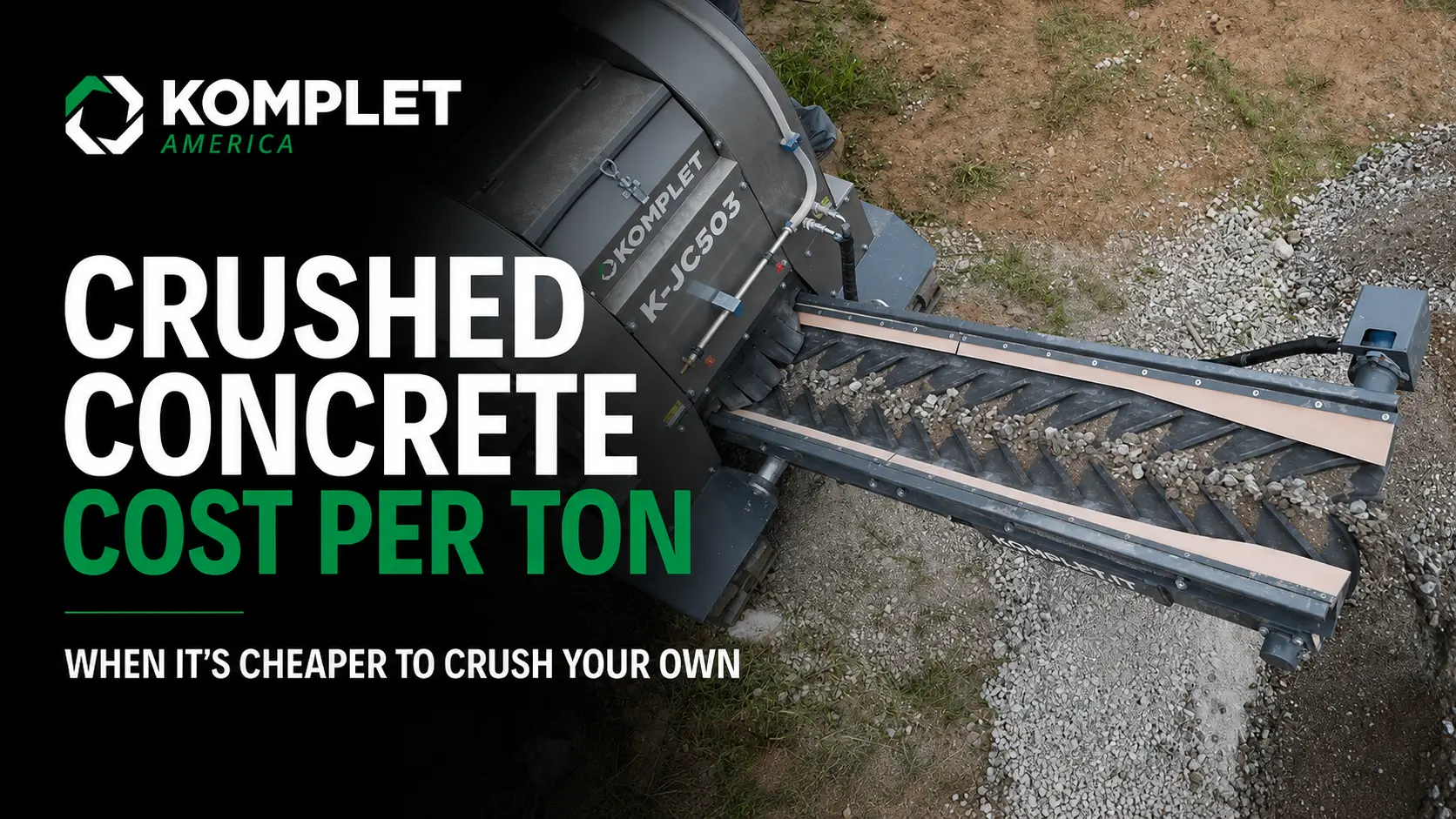
Equipment fits standard equipment trailers for site-to-site transport without requiring specialized hauling permits in most jurisdictions. The smallest Komplet jaw crusher (K-JC 503 at ~7,496 lb) fits compact trailers; the largest (K-JC 805 at ~49,600 lb) requires heavier trailer capacity but still uses standard equipment trailer infrastructure.
Wireless Remote Control
Modern compact mobile equipment includes wireless remote control supporting safe operator distance during operation, single-operator deployment, and flexible operational positioning. Wireless remote operation reduces required operator headcount per equipment and supports faster site setup.
Tier 4 Final Emissions Compliance
All current Komplet jaw crushers and the K-TC 460 conveyor use Tier 4 Final emissions-compliant diesel engines, supporting operation in jurisdictions with current emissions standards including California (CARB), federal contracts requiring Tier 4 Final equipment, and LEED-certified projects with low-emission equipment requirements.
Advantage 1: Rapid Deployment to Project Sites
Same-Day Production
Compact mobile equipment arrives at project sites via standard equipment trailer, drives off the trailer under self-propelled tracked mobility, and begins production after operator pre-shift inspection per OEM operator’s manual. Typical site setup completes in hours, not days. Compare this to stationary equipment installation which involves construction, permitting, infrastructure development, and commissioning over months to years before production begins.
Multi-Site Operations Support
Operations covering multiple project sites simultaneously benefit from equipment that moves between sites efficiently. Capital cost of stationary equipment can’t be justified for distributed project work; equipment that requires multi-day setup at each site doesn’t fit project-based construction economics. Same-day deployment supports project-based business models that require equipment ready when project mobilization begins.
Disaster Recovery and Surge Capacity
Disaster recovery operations following hurricanes, tornadoes, fires, floods, and major weather events generate sudden equipment demand. Compact mobile equipment from inventory can deploy quickly to support disaster response work; stationary equipment manufacturing schedules and installation timelines typically can’t respond to disaster recovery demand windows. Operations that maintain compact mobile equipment fleets can capture disaster recovery work that’s not accessible to stationary operations.
Advantage 2: Operational Flexibility Across Project Types
Variable Site Assignments
Project-based operations face variable site assignments — different project locations, different material types, different operational profiles per project. Compact mobile equipment supports this variability through site-to-site movement and operational flexibility. Stationary equipment serves single-location operations regardless of project pipeline variability.
Tight-Access Urban Work
Urban project sites face access constraints that exclude larger equipment — narrow streets, small lot footprints, indoor demolition spaces, alley access only, downtown overhead constraints. Compact mobile equipment fits tight access:
- K-JC 503: 5′ transport width fits narrow access; ~7,496 lb supports lighter transport infrastructure
- K-JC 604: Mid-size compact mobile capability
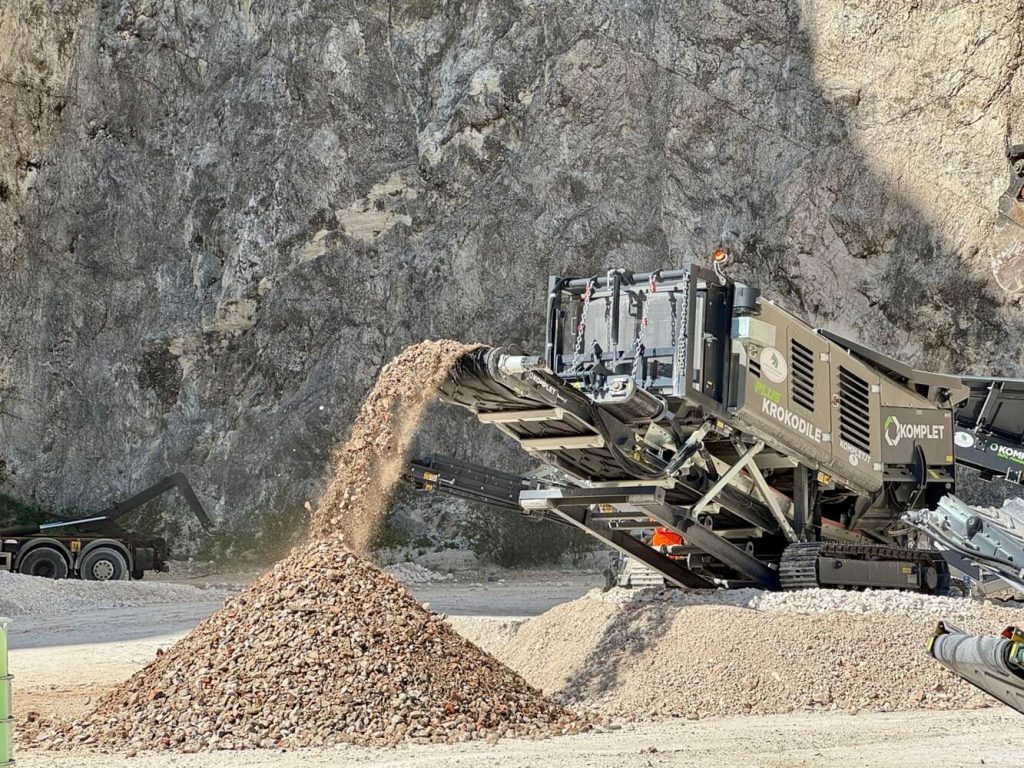
- Krokodile PLUS: Compact mobile shredder operating at urban project sites
Distributed Operations Across Geography
Operations covering geographic areas larger than economically viable single-facility transport range typically need either compact mobile equipment that moves with the work, or multiple stationary plants serving sub-regions. Stationary capital infrastructure for multiple facilities doesn’t scale economically; compact mobile equipment enables distributed operational coverage from single equipment investment.
Material Processing at Generation Point
On-site processing eliminates the disposal hauling cycle for material that gets reused on the project. Each ton of material processed on-site typically saves $5-$30/ton in hauling cost plus $30-$200+/ton in tipping fees (depending on regional market). The transportation reduction supports both project economics and environmental performance simultaneously.
Advantage 3: Lower Capital Profile and Faster Payback
Capital Investment Range
Compact mobile equipment capital ranges in the six figure range with higher pricing for the largest models toward and above seven figures. Stationary equipment capital typically ranges into seven figures and beyond depending on plant scale and complexity, plus permanent infrastructure costs (foundations, electrical, plumbing, dust collection, control systems) and site development. Capital-constrained operations may find compact mobile economics work where stationary capital isn’t accessible.
Faster Payback on Lower Capital
Payback period economics work simply: payback time = initial capital cost / annual operational savings. Lower initial capital cost (compact mobile equipment) drives faster payback at the same operational savings level. For project-based operations achieving similar tipping fee avoidance and recovered material revenue regardless of equipment type, compact mobile equipment delivers materially shorter payback than stationary alternatives — often under 1-2 years for high-utilization operations in high-tipping-fee markets.
Komplet Capital Financing
Komplet Capital offers 24-hour approval, 100% financing, 3-6 year terms on Komplet equipment. New equipment qualifies for Section 179 tax deduction up to $1.22M (2024 limit). The K-JC 503 at approximately $108,695 fits within Section 179 limits with significant headroom for combined equipment purchases. Financing structures matter — talk to the team about options that fit operational economics.
Resale Value and Trade-In
Compact mobile equipment retains residual value for resale or trade-in when operations grow, change focus, or transition equipment fleet. Stationary equipment installations have minimal resale value once installed; the integrated infrastructure investment doesn’t transfer to new operators. Operations following phased equipment strategy benefit from compact mobile equipment’s residual value characteristics.
Advantage 4: Permitting and Regulatory Flexibility
Project-Specific vs. Permanent Permitting
Stationary plant operations require permanent operating permits, environmental permits, zoning compliance, and ongoing regulatory compliance for the specific facility location. Permitting timelines can extend over years; permit modifications during operational life can be complex. Compact mobile equipment typically operates under project-specific permits at each project site (where required) without permanent facility permitting. Specific regulatory requirements vary by jurisdiction.
Lower Site-Specific Regulatory Burden
Compact mobile operations don’t require permanent industrial zoning at the operational site, don’t trigger long-term land use commitments, and generally face lower site-specific regulatory burden than stationary operations. Operations can adjust to changing regulatory environments through changing project assignments rather than facility-level adaptation.
Tier 4 Final Equipment Supports Compliance
Current Komplet jaw crushers ship with Tier 4 Final emissions compliance, supporting operation in restricted emissions markets (California CARB, federal contracts requiring lower-emission equipment, LEED-certified projects with equipment requirements). Equipment with older emissions tiers may face operational restrictions in these markets — current Komplet equipment avoids this challenge.
Advantage 5: Single-Operator Deployment with Wireless Remote
Reduced Operational Headcount
Wireless remote control supports operation by a single operator from outside the immediate work zone — no specialized setup crew required at each new site, no permanent operations staff structure required at fixed locations. The operational headcount difference between compact mobile equipment (typically 1 operator) and stationary plant operations (multi-person operations team) represents substantial labor cost difference over equipment operational life.
Safety Through Operator Distance
Wireless remote operation supports operator positioning outside the immediate work zone, reducing exposure to material handling hazards, dust exposure, and equipment proximity. Combined with standard safety features (emergency stops, integrated dust suppression, reverse jaw function on crushers), compact mobile equipment supports safer operational profiles than less-automated stationary alternatives.
Operator Training and Skill Requirements
Compact mobile equipment with wireless remote operation reduces operator training requirements compared to complex stationary plant operation. Authorized Komplet dealers provide operator training as part of new equipment delivery. The reduced training requirement supports faster operational ramp for new operations and faster operator turnover handling.
Komplet America’s Full Compact Mobile Equipment Lineup
Komplet America’s compact mobile equipment lineup spans all four equipment categories — crushing, screening, shredding, conveying — supporting diverse operational profiles across N&C America.
Compact Mobile Crushers
- K-JC 503 — up to 34 US tph, ~7,496 lb. Tight-access urban work.
- K-JC 604 — up to 55 US tph, ~19,400 lb. Mid-range demolition.
- K-JC 704 PLUS — up to 90 US tph, ~26,455 lb. Komplet’s best-selling crusher.
- K-JC 805 — up to 160 US tph, ~49,600 lb. Largest jaw crusher in the lineup.
- K-IC 70 — up to 90 US tph, 25″ x 20″ feed, 100 HP, ~28,600 lb. Premium cubical aggregate.
Compact Mobile Vibrating Scalping Screeners
- Kompatto 221 — up to 90 US tph.
- Kompatto 5030 — up to 280 US tph, hydraulic 2-way / 3-way conversion. Best-selling screener.
- Kompatto 124 — up to 350 tph. Largest mobile scalping screen.
Compact Mobile Trommel Screeners
- K-TS 30 — up to 80 tph, 23 kW genset. Compost, topsoil, mulch screening.
- K-TS 40 — up to 120 tph, 40 kW genset. Higher-volume trommel screening.
Compact Mobile Slow-Speed Shredder
- Krokodile PLUS — 60″ single-shaft slow-speed shredder, 220 HP Volvo Penta, up to 175 US tph C&D / up to 18 US tph waste, ~34,000 lb. Mixed/soft C&D processing.
Compact Mobile Conveyor
- K-TC 460 — up to 132 US tph, 25″ Chevron 3-ply belt, 25 HP Tier 4 Final, ~7,000 lb. Material handling and workflow integration.
When Stationary Equipment Makes Better Sense
Honest scope: stationary fixed plant equipment makes better economic sense for some operational profiles. Compact mobile equipment isn’t universally superior — it serves specific operational profiles where compact mobile economics work.
Very High Annual Volumes
Operations consistently processing 300,000+ tons annually per primary crusher typically need stationary fixed plant equipment for sustained throughput. Compact mobile equipment at this scale would require running 24/7 with no headroom, accelerating wear and limiting redundancy. Komplet doesn’t serve mining markets which typically operate at this scale.
Long-Term Centralized Operations
Centralized recycling facilities, regional aggregate operations, and similar centralized models with 10-20+ year operational horizons may justify stationary plant capital infrastructure. The fixed-cost amortization period and operational stability support the capital commitment.
Specialized Industrial Applications
Manufactured sand production, fine-grinding industrial applications, glass and ceramic specialty processing, and other specialty industrial applications typically require equipment from manufacturers focused on those specific segments. Komplet doesn’t serve these specialty markets.
Frequently Asked Questions
What’s the difference between mobile and stationary crushing equipment?
Compact mobile equipment is self-contained, self-propelled, tracked equipment that deploys to project sites and moves between operational locations. Stationary fixed plant equipment is permanently installed at facility locations, requires ongoing site infrastructure, and serves centralized material flow operations. Different equipment categories serve different operational profiles.
Can compact mobile equipment handle commercial-volume operations?
Yes — compact mobile equipment serves commercial-scale operations across the full Komplet lineup. The K-JC 805 (up to 160 US tph) and Kompatto 124 (up to 350 tph) handle high-volume operations within the compact mobile category. Operations processing 300,000+ tons annually per crusher typically need stationary fixed plant equipment for sustained throughput.
Does compact mobile equipment require less operator training?
Generally yes — wireless remote control, integrated control systems, and self-contained operation simplify operator training compared to complex stationary plant operation. Authorized Komplet dealers provide operator training as part of new equipment delivery. Specific training requirements depend on equipment model and operational profile.
How long does it take to deploy compact mobile equipment to a new site?
Typically hours, not days. Equipment arrives via standard equipment trailer, drives off the trailer under self-propelled tracked mobility, and begins production after operator pre-shift inspection per OEM operator’s manual. Compare to stationary plant facility setup involving construction, permitting, infrastructure development, and commissioning over months to years.
Can I rent compact mobile equipment for individual projects?
Yes — Komplet America’s authorized dealer network includes rental partners across N&C America. Rental availability varies by region and equipment model. Rental is typically the right starting point for first-time operations and single-project work; ownership economics typically justify purchase for operations with recurring project pipeline. Call (908) 369-3340 to discuss rental availability.
Does compact mobile equipment work outside crushing applications?
Yes — Komplet America’s full compact mobile equipment lineup spans crushing, screening, shredding, and conveying. Operations needing screening (Kompatto vibrating scalping screeners, K-TS trommel screeners), shredding (Krokodile PLUS slow-speed shredder), or conveying (K-TC 460 portable mobile conveyor) all benefit from compact mobile capability across each equipment category.
Should I buy or rent compact mobile equipment?
Renting is typically the right starting point for first-time operations and single-project work. For operations with recurring project pipeline (multiple projects per year with significant material processing volumes), ownership economics typically justify purchase. Komplet Capital financing supports ownership transitions for operations growing from rental to owned equipment.
What’s the warranty on Komplet compact mobile equipment?
All new Komplet equipment ships with 1-year / 1,000-hour warranty (whichever comes first). Komplet America’s parts inventory is forecasted 12 months in advance, supporting fast wear-part availability. Authorized dealers across North and Central America provide local service support — call (908) 369-3340 for parts, service, or technical questions.
Final Thoughts
The mobile vs. stationary equipment decision depends on operational profile, volume, geographic distribution, capital constraints, and growth trajectory. Compact mobile equipment delivers strategic advantages — rapid deployment, operational flexibility, lower capital profile, faster payback, permitting flexibility, single-operator deployment — across project-based operations, distributed operations, and capital-constrained scenarios. Stationary fixed plant equipment delivers strategic advantages for very high-volume centralized operations with long-term operational horizons. Komplet America’s compact mobile equipment lineup spans all four equipment categories (crushing, screening, shredding, conveying) supporting diverse operations across N&C America. Operations matching equipment category to operational profile produce strong economics; operations using the wrong equipment for the wrong profile produce poor economics in either direction.
Browse Komplet America’s full compact mobile equipment lineup or call us to discuss whether compact mobile equipment fits your specific operational profile.
Ready to Talk Compact Mobile Equipment?
- Call (908) 369-3340
- Email [email protected]
- Schedule a demo or request a quote
- Find your local Komplet dealer for rental availability
- Ask about our 1-year / 1,000-hour warranty and equipment financing options
Never enough — that’s how we approach service, support, and helping operations match the right compact mobile equipment to their specific operational requirements.
Disclaimer: All cost, ROI, payback, pricing, tipping fee, and revenue figures in this article are illustrative examples based on sample assumptions about volume, regional pricing, material specifications, and market conditions. Actual results vary significantly by region, market, material type, equipment utilization, operator skill, financing terms, regulatory environment, and many other factors. Equipment pricing, stationary plant capital costs, fuel costs, labor rates, and tipping fees all change over time and by location. Komplet America makes no guarantee, warranty, or representation of specific financial performance, payback timelines, or business outcomes for any particular operation. For current pricing and a payback estimate based on your specific volume, material, and local market, contact us at (908) 369-3340 to speak with our team.