
Crushing concrete, asphalt, brick, and natural rock generates respirable crystalline silica — the airborne particle size that lodges deep in the lungs and causes silicosis, lung cancer, COPD, and reactivation of latent tuberculosis. OSHA has known about silica’s health effects for over a century, and the agency’s modernized standards have been in active enforcement since 2017 (construction) and 2018 (general industry). Every contractor running a compact crusher, every recycler operating an in-yard concrete recycling facility, and every demolition firm processing rubble on a jobsite is operating under one of two binding OSHA standards: 29 CFR 1926.1153 if the work is classified as construction, or 29 CFR 1910.1053 if it is classified as general industry.
Compliance is not optional. The standards apply regardless of company size, regardless of whether the operation has experienced a citation in the past, and regardless of whether anyone in the organization has read the standard before. The cost of non-compliance ranges from OSHA citations and penalties to worker silicosis and the consequences for the affected employees and their families. The cost of compliance is substantially lower — engineering controls, work practice controls, a written exposure control plan, periodic exposure monitoring where required, and respiratory protection where engineering controls cannot reduce exposure below the permissible exposure limit. Most of those compliance steps are achievable through equipment that the well-run crushing operation already uses or should use.
This guide walks through what the OSHA respirable crystalline silica standards require, how the requirements apply specifically to crushing operations, what engineering controls actually look like on a compact crusher, and what a contractor needs to have in place to operate compliantly. It is a B2B regulatory reference written for the operator, owner, or compliance manager of a contractor or recycler running a compact jaw crusher, impact crusher, or vibrating screener. It is not legal advice. Specific compliance questions for any specific operation should be reviewed with qualified counsel and with a certified industrial hygienist who can perform exposure assessments under the standard’s requirements.
Komplet America has been the U.S. distributor of Komplet S.p.A. compact crushers, screeners, and shredders since 2018, and the Conti family construction legacy behind Komplet America stretches back to 1906. Komplet equipment ships with integrated dust suppression as standard equipment on the jaw crusher line and the K-IC 70 impact crusher — engineering controls designed to support OSHA silica compliance for our customers’ operations. The detailed information below is the regulatory backdrop for those design choices.
What Respirable Crystalline Silica Is — and Why It’s a Health Hazard
Crystalline silica is silicon dioxide (SiO₂) in a crystalline form. It exists naturally as quartz, cristobalite, and tridymite — the three forms named in OSHA’s standard. Quartz is by far the most common; it is a major component of sand, granite, sandstone, gravel, mineral ores, brick, mortar, concrete, and most natural and recycled aggregate materials. Anything a contractor crushes, screens, drills, or grinds in the construction or recycling business is likely to contain crystalline silica.
“Respirable” is the specific particle size range that matters for human health. OSHA defines respirable crystalline silica as quartz, cristobalite, or tridymite contained in airborne particles small enough to penetrate deep into the gas-exchange region of the lungs — typically particles under 10 micrometers in diameter, with the heaviest health concern around 4 micrometers. Bulk silica is not the hazard; airborne respirable-size silica particles are the hazard. The line between the two is mechanical — anything that breaks, abrades, or impacts crystalline silica material at sufficient energy generates respirable particles. Crushing, screening, drilling, sawing, grinding, and cleanup activities all qualify.
The Health Effects
OSHA recognizes the following health effects associated with chronic respirable crystalline silica exposure:
- Silicosis — irreversible scarring of the lung tissue from accumulated silica particles. Progressive over years to decades; results in declining lung function and, in advanced cases, premature death. Three classifications: chronic (most common, develops over 10+ years of exposure), accelerated (5-10 years of higher-level exposure), and acute (months to a few years of very high exposure, rare and severe).
- Lung cancer — established carcinogen relationship with crystalline silica exposure. Risk increases with cumulative exposure dose.
- Chronic obstructive pulmonary disease (COPD) — chronic bronchitis and emphysema patterns documented in workers with significant cumulative silica exposure.
- Activation of latent tuberculosis — silica-damaged lung tissue is more susceptible to TB infection and reactivation. The mechanism is well-documented.
- Kidney disease and autoimmune disorders — emerging research suggests connections to silica exposure, though the causal evidence is less established than for the respiratory effects above.
The progression is slow. A worker exposed at levels that exceed the OSHA action level for years may not show symptoms for a decade or more, by which point the lung damage is permanent and the prognosis is shaped by exposure history that cannot be reversed. The compliance discipline of the operating year is what determines the cumulative exposure dose of the worker, and the cumulative dose is what determines the long-term health outcome.
The Two OSHA Standards: Construction (1926.1153) and General Industry (1910.1053)
OSHA’s modernized respirable crystalline silica standards were finalized in March 2016 and have been in active enforcement since 2017 for construction and 2018 for general industry. Two parallel standards apply, with substantially identical core requirements but different compliance pathways:
29 CFR 1926.1153 — Construction
Applies to construction work as defined in 29 CFR 1910.12(b). Most contractor-side crushing operations — concrete demolition recycling at a jobsite, on-site processing during active construction, road and bridge demolition crushing — fall under the construction standard. The construction standard provides two compliance pathways:
- Specified exposure control methods (Table 1): a tabulated list of common construction tasks paired with required engineering controls, work practices, and respiratory protection. If the contractor performs a Table 1 task and fully implements the listed controls, the contractor does not have to perform exposure monitoring or separately demonstrate PEL compliance for that task. The trade-off is rigid implementation requirements.
- Alternative exposure control methods: for tasks not listed on Table 1, or where the employer chooses not to use Table 1 for a listed task, the contractor must measure employee exposures and limit them to the PEL using the hierarchy of controls (engineering, work practice, respiratory protection).
Most crushing tasks at a construction site are not specifically listed on Table 1 — Table 1 is dominated by stationary saws, hand grinders, jackhammers, drills, and similar handheld and stationary tools. Contractors running mobile compact crushers in construction settings generally fall under the alternative exposure control methods pathway, which means exposure assessment is required.
29 CFR 1910.1053 — General Industry and Maritime
Applies to general industry workplaces. A fixed in-yard concrete recycling facility, an aggregate yard producing crushed stone for sale, a stationary crushing operation at a quarry — these typically fall under the general industry standard. The general industry standard does not have a Table 1 simplified compliance pathway; it requires the alternative exposure control methods approach (exposure assessment, hierarchy of controls, PEL compliance) for all covered operations.
The general industry standard contains an exception: an employer may follow the construction standard (1926.1153) for a task in a general industry setting if the task is indistinguishable from a construction task on Table 1 and the task will not be performed regularly in the same environment and conditions. This is a narrow exception intended for occasional maintenance and repair activities, not for routine production crushing.
Determining Which Standard Applies
- Mobile crushing on an active construction or demolition site, processing material as part of completing the project: typically 1926.1153 (construction).
- Mobile crushing on an active site, but the operation accepts outside material from other sources: gray area depending on facts, often classified as general industry by the time outside material is being accepted.
- Fixed in-yard crushing operation at a recycler’s yard, producing material for sale or for state DOT supply: typically 1910.1053 (general industry).
- Stationary crushing at a quarry: typically 1910.1053 (general industry), though MSHA standards may also apply if the quarry is regulated by the Mine Safety and Health Administration rather than OSHA.
Core Numerical Requirements (Both Standards)
- Permissible Exposure Limit (PEL): 50 micrograms of respirable crystalline silica per cubic meter of air (50 µg/m³), measured as an 8-hour time-weighted average (TWA). No employee may be exposed above this level.
- Action Level (AL): 25 µg/m³, measured as an 8-hour TWA. Triggers exposure assessment and (where exposure is at or above the AL) ongoing monitoring obligations. Exposures below the AL relieve the employer of certain ongoing obligations.
- Both numbers are 8-hour TWA — short-duration spikes during a portion of the shift are averaged across the full 8 hours.
How the Standard Applies to a Crushing Operation
A compact crushing operation generates respirable crystalline silica at multiple points in the workflow. Understanding the silica-generating activities helps the operator identify where engineering controls and work practices need to focus.
Silica-Generating Activities at a Crushing Operation
- Crushing chamber — the primary source. Material is fractured, abraded, and reduced under high force, generating respirable particles continuously during operation.
- Discharge conveyor — material falling onto and off of conveyors, particularly at transfer points, generates dust as particles are disturbed by air currents and impact.
- Stockpile build — material falling onto stockpiles from a conveyor at height generates a dust plume on impact.
- Loader operations — feeding the hopper with an excavator or loader disturbs the feed material and stockpile, generating airborne dust.
- Screening — material moving across a vibrating screen deck or through a trommel drum generates dust through agitation, particle separation, and cascade effects.
- Cleanup activities — sweeping, blowing with compressed air, or otherwise disturbing accumulated dust on equipment, ground, and stockpile surfaces. Dry sweeping is specifically restricted by the standards where it could contribute to employee exposure.
- Dry weather conditions — wind, vehicle movement, and ambient air movement disturb settled dust and airborne particles, increasing exposure for workers in the operating area.
Who’s Exposed
- Crusher operator — the primary exposed worker, responsible for operating the machine and most often within the dust generation zone.
- Loader and excavator operators — feed the hopper, move material around the operation. Exposure varies based on cab enclosure quality, HVAC filtration, and proximity to dust generation points.
- Ground personnel — anyone walking the operation: spotters, supervisors, maintenance workers, drivers receiving loads. Often exposed without realizing it because their work is intermittent and they perceive themselves as bystanders.
- Visitors and inspectors — even short-duration exposures count toward cumulative dose, though OSHA’s compliance focus is on regular employee exposures.
The Hierarchy of Controls: How OSHA Expects Compliance to Work
Both OSHA standards apply the standard hierarchy of controls — a sequence of preferred control methods that the employer must work through before resorting to less-preferred controls. The hierarchy is not optional; an employer cannot skip directly to respiratory protection if engineering controls are feasible.
First Priority: Engineering Controls
Engineering controls modify the workplace to reduce or eliminate the exposure at the source. They are the highest-priority control method and the standard’s preferred path. The employer is required to implement feasible engineering controls before relying on work practice controls or respiratory protection. For crushing operations, engineering controls primarily mean dust suppression and dust collection systems integrated with the equipment:
- Water spray dust suppression — water mist applied at dust generation points (crusher discharge, conveyor transfer points, stockpile buildup) to bind dust particles and prevent them from becoming airborne. The most common and most effective engineering control on compact crushing operations.
- Wet crushing — applying water directly into the crushing chamber, suppressing dust at the source. Effective but increases wear on chamber components and can affect product moisture content for downstream applications.
- Dust collection systems — vacuum or filter systems capturing airborne dust at generation points. More common on stationary plants than on mobile compact crushers.
- Enclosed cabs with HEPA-filtered HVAC — for excavator and loader operators feeding the operation. Reduces operator exposure substantially when properly maintained and when cab integrity is preserved.
- Wind screens and physical barriers — partial enclosures around dust generation zones to reduce dispersion.
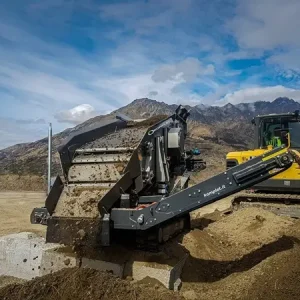
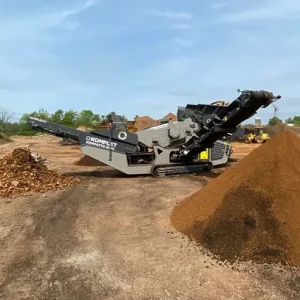
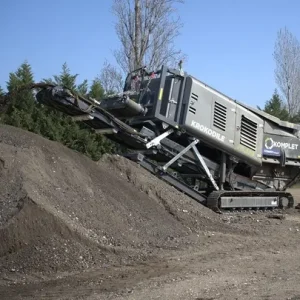
Komplet jaw crushers — the K-JC 503, K-JC 604, K-JC 704 PLUS, and K-JC 805 — and the K-IC 70 compact impact crusher all include integrated dust suppression as standard equipment. The systems use water sprayers positioned at the crusher discharge and (on appropriate models) at conveyor transfer points to suppress dust at the primary generation zones. Operating water flow is adjustable and the system runs from the machine’s onboard water supply or from an external water source. The dust suppression system is one of several engineering features that support OSHA silica compliance for our customers’ operations, alongside enclosed conveyor designs and chamber configurations that minimize dust escape.
Second Priority: Work Practice Controls
Work practice controls modify how the operation is conducted, without modifying the equipment itself. Used to supplement engineering controls or to provide additional exposure reduction where engineering controls alone are insufficient:
- Restricted access zones around the operating crusher, with personnel kept outside the highest-exposure zone except as needed for direct operation.
- Wet methods for cleanup — hosing instead of sweeping, wet wiping instead of dry brushing.
- Restrictions on dry sweeping and compressed-air blowdown of accumulated dust on equipment and surfaces. The standards specifically prohibit dry sweeping or dry brushing where such activity could contribute to employee exposure to respirable crystalline silica, unless wet sweeping, HEPA-filtered vacuuming, or other methods that minimize the likelihood of exposure are not feasible. Compressed air blowdown for cleanup is similarly restricted unless used in conjunction with a ventilation system that effectively captures the dust cloud.
- Scheduled breaks rotating workers out of high-exposure tasks to reduce individual cumulative exposure (note: rotation reduces individual exposure but does not reduce overall workforce exposure, and OSHA does not consider rotation alone to be an acceptable substitute for engineering controls).
- Pre-job exposure briefing for crew, including identification of dust hazards and the controls in place.
- Visual inspection of dust suppression system before each shift, with operating logs documenting that the system was checked and is functioning.
Third Priority: Respiratory Protection (PPE)
Respiratory protection is the lowest-priority control method and is required only where engineering and work practice controls cannot reduce exposure below the PEL. The standard requires:
- During periods necessary to install or implement feasible engineering and work practice controls.
- During tasks (such as certain maintenance and repair tasks) for which engineering and work practice controls are not feasible.
- Where engineering and work practice controls are not sufficient to reduce exposures to or below the PEL.
Where respirators are required, they must comply with 29 CFR 1910.134 (the OSHA general respiratory protection standard), including a written respiratory protection program, medical evaluation of employees required to wear respirators, fit testing, and training. Respirators alone are not compliance — they are the supplement to engineering and work practice controls that must already be in place.
The Compliance Checklist: What an Operator Needs in Place
Following the OSHA standards on a crushing operation produces a defined set of documents, procedures, and ongoing activities. The list below covers the core requirements; the actual compliance depth needed for a specific operation depends on whether the operation is following Table 1 (construction only, and only for listed tasks), the alternative exposure control method, or the general industry standard.
Written Exposure Control Plan
Both the construction and general industry standards require a written exposure control plan for operations subject to the alternative exposure control methods pathway. The plan must contain at minimum:
- A description of tasks in the workplace that involve exposure to respirable crystalline silica.
- A description of the engineering controls, work practices, and respiratory protection used to limit employee exposure for each task.
- A description of housekeeping measures used to limit employee exposure (the construction standard adds explicit requirements around restricted dry sweeping/brushing).
- A designated competent person who is responsible for implementing the plan.
- Procedures used to restrict access to work areas where exposure may exceed the PEL.
The plan must be reviewed and evaluated at least annually and updated when changes to the operation create new or different exposure conditions. The plan must be made available to employees and to OSHA on request.
Exposure Assessment
For operations under the alternative exposure control methods pathway, the employer must assess the 8-hour TWA exposure of each employee who may reasonably be expected to be exposed to silica at or above the action level. Two assessment options:
- Performance option: assessment based on any combination of air monitoring data and objective data sufficient to accurately characterize employee exposures. Provides flexibility but places the burden on the employer to demonstrate the data is sufficient.
- Scheduled monitoring option: initial monitoring through personal breathing zone air samples, followed by a defined monitoring schedule based on results. If initial monitoring shows exposures below the AL, monitoring may be discontinued. If exposures are at or above the AL but at or below the PEL, monitoring is repeated within six months. If exposures are above the PEL, monitoring is repeated within three months until two consecutive measurements taken seven or more days apart are below the AL or PEL respectively.
Air monitoring must be performed by a qualified industrial hygienist or other competent professional, using sampling and analytical methods specified by the standard (typically OSHA ID-142, NIOSH NMAM 7500, NMAM 7602, or NMAM 7603 analytical methods). Laboratories analyzing samples must be accredited to ANS/ISO/IEC Standard 17025 with respect to crystalline silica analyses.
Regulated Areas (General Industry Standard)
The general industry standard requires the employer to establish a regulated area wherever an employee’s exposure to airborne respirable crystalline silica is, or can reasonably be expected to be, in excess of the PEL. The regulated area must be demarcated, access limited to authorized employees, and signage posted at all entrances. The construction standard does not have an identical regulated area requirement but does have access restriction requirements addressed through the written exposure control plan.
Medical Surveillance
Medical surveillance is required for employees who will be occupationally exposed to respirable crystalline silica at or above the action level for 30 or more days per year. Medical surveillance includes:
- Initial medical examination within 30 days of initial assignment to a covered position, including medical and work history, physical examination focused on the respiratory system, chest X-ray, pulmonary function test, TB testing, and any other tests deemed appropriate by the physician or other licensed health care professional (PLHCP).
- Periodic examinations at least every three years thereafter, with the same components.
- PLHCP written medical opinion provided to the employer and a separate detailed medical report provided to the employee. The opinion to the employer is limited and does not include specific medical findings — only any limitations on the employee’s silica exposure and any recommended limitations on respirator use.
- All medical surveillance is provided at no cost to the employee, at a reasonable time and place.
Hazard Communication and Training
Both standards require employers to comply with the OSHA Hazard Communication standard (29 CFR 1910.1200) regarding silica, and require employees to be trained in:
- The health hazards associated with exposure to respirable crystalline silica.
- Specific tasks in the workplace that could result in exposure.
- Specific measures the employer has implemented to protect employees, including engineering controls, work practices, and respirators.
- Contents of the standard.
- Identity of the competent person designated under the written exposure control plan (construction standard).
- The purpose and description of the medical surveillance program.
Recordkeeping
Required records include:
- Air monitoring data: maintained for the duration of employment plus 30 years.
- Objective data: maintained for the duration of reliance on the data.
- Medical surveillance records: maintained for the duration of employment plus 30 years.
- Records must be made available upon request to employees, designated representatives, and OSHA.
Practical Implementation: A Day-One Checklist for a Crushing Operation
For a contractor or recycler launching or formalizing OSHA silica compliance on a crushing operation, the following checklist captures the practical sequence of steps. This is not a substitute for review by qualified counsel and a certified industrial hygienist; it is an orientation for the operator getting started.
Week One
- Confirm which standard applies: construction (1926.1153), general industry (1910.1053), or — for some operations — both at different points in the workflow.
- Identify all crushing-related tasks in the operation that may generate respirable silica. Identify all employees and contractors who perform or work near those tasks.
- Inventory existing engineering controls — especially dust suppression on the crusher and any conveyors. Confirm the system is operating, water flow is adequate, and operators know how to use it.
- Designate a competent person responsible for the silica program. The competent person must have training, knowledge, and authority to implement the written exposure control plan and identify and address conditions that could result in exposures above the PEL.
- Engage an industrial hygienist to perform initial exposure assessment. Personal breathing zone sampling on representative employees during representative crushing tasks, analyzed by an accredited laboratory using one of the standard analytical methods.
Month One
- Draft the written exposure control plan based on initial exposure assessment results. Identify the engineering controls, work practices, and (if needed) respiratory protection in use for each task. Designate the competent person.
- Establish housekeeping procedures restricting dry sweeping and compressed-air cleanup. Substitute wet methods, HEPA-filtered vacuuming, or compressed air with effective dust capture.
- If initial assessment shows any employees exposed at or above the action level for 30 or more days per year, set up the medical surveillance program with a qualified PLHCP. Arrange initial medical examinations within 30 days of those employees’ next assignment to covered work.
- Implement hazard communication training for all employees who may be exposed. Document attendance.
- If respirators are needed for any task, establish a written respiratory protection program under 29 CFR 1910.134, including medical evaluation, fit testing, and training.
Ongoing
- Operate dust suppression equipment every shift. Document operating checks. Report and address any malfunction immediately.
- Conduct repeat air monitoring on the schedule required by exposure assessment results: every six months if at or above AL, every three months if above PEL, and continuing until two consecutive measurements (taken seven or more days apart) demonstrate compliance.
- Conduct annual medical surveillance for covered employees (every three years for the comprehensive examination, with interim screenings as recommended by the PLHCP).
- Review and evaluate the written exposure control plan at least annually. Update when changes to the operation create new or different exposure conditions.
- Maintain all records for the periods required: air monitoring and medical surveillance for duration of employment plus 30 years; objective data for duration of reliance.
Engineering Controls on Komplet Equipment
Komplet’s compact crusher and screener lineup is designed with OSHA silica compliance in mind, with integrated dust suppression as standard equipment on the jaw crushers and the K-IC 70 impact crusher. The specific engineering features below are the primary contributions Komplet equipment makes to a customer’s overall compliance program.
Integrated Water Spray Dust Suppression
Standard on the K-JC 503, K-JC 604, K-JC 704 PLUS, K-JC 805, and K-IC 70. Water sprayers positioned at the crusher discharge bind dust particles to water droplets, dropping them out of the air before they become respirable hazards. Operating water flow is adjustable from the control system; water draws from the machine’s onboard tank or from an external water source. The system is engineered to use as little water as needed to control dust effectively, which keeps wear part wear from accelerating unnecessarily and prevents the finished product from becoming over-saturated for downstream applications.
Conveyor Spray Points
Conveyor transfer points are secondary dust generation zones where material falls from one conveyor onto another or off the discharge conveyor onto a stockpile. Komplet equipment includes spray points at these transfer locations on appropriate models, suppressing dust at the points where it would otherwise become airborne.
Closed-Body Designs
The crusher chamber, hopper, and conveyor body designs on Komplet equipment minimize the open surface area through which dust can escape. Closed conveyor returns, properly sealed chamber covers, and skirting at material transfer points all reduce the dust escape rate compared to open designs.
Operator Position
Wireless remote control is standard on the Komplet jaw crusher line, allowing the operator to position themselves away from the highest-dust-generation zone during normal operation. The operator can manage the crusher from a safe distance while keeping visual oversight of the operation, reducing personal exposure compared to operations where the operator must work directly at the machine.
Pre-Reduction Equipment
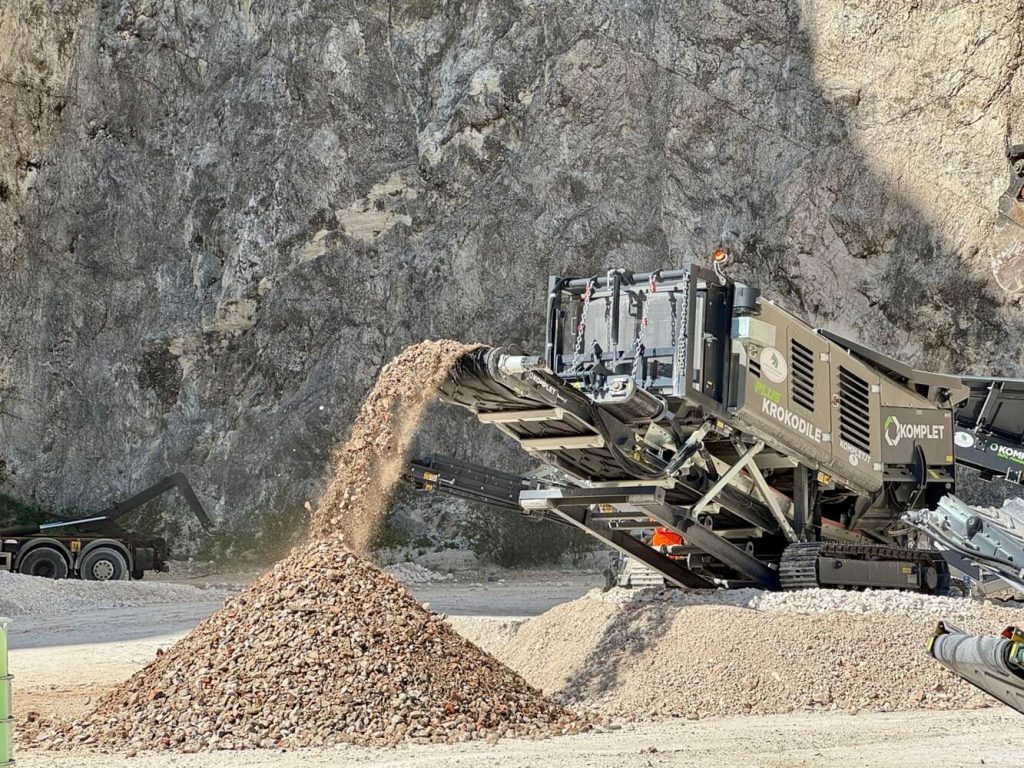
The Krokodile PLUS slow-speed shredder pre-reduces oversized concrete, asphalt, and rubble before the primary crusher. Slow-speed shredding generates substantially less respirable dust than high-speed crushing of the same volume of material — a fundamental difference in physics — and pre-reduction means the primary crusher operates on consistent feed size, which improves crushing efficiency and reduces overall operation time and cumulative dust generation.
Common Compliance Mistakes Operators Make
Treating the PEL as a Goal Rather Than a Ceiling
The PEL is the maximum allowable exposure. The action level (AL) at half the PEL is the threshold at which exposure assessment and ongoing monitoring obligations apply. Operating at or near the PEL is operating at the edge of the standard’s allowance — and exposure measurements have inherent variability. An operation routinely measuring at 45 µg/m³ has effectively no margin for variation in conditions before measurements exceed the PEL on a given day.
Skipping the Written Exposure Control Plan
OSHA inspection priorities frequently include written exposure control plan review. An operation without a written plan is in immediate non-compliance regardless of what its actual engineering controls look like. The plan does not need to be elaborate — it needs to exist, identify tasks and controls, designate a competent person, and be reviewed annually.
Missing the Medical Surveillance Threshold
The 30-day-per-year exposure threshold for medical surveillance is easy to miss. Workers who are exposed at or above the action level for fewer than 30 days per year are not covered, but workers who cross the threshold for any reason — increased crushing volume, change in feed material, change in workforce assignments — must be enrolled in medical surveillance. Tracking which employees cross the threshold is the operator’s responsibility.
Operating Dust Suppression Inconsistently
The dust suppression system on a Komplet (or any) crusher only protects workers when it is running. An operation that runs dust suppression sometimes — when the supervisor is on site, when a contract requires it, when the visible dust is bad — does not get exposure reduction the rest of the time. Per-shift verification that dust suppression is operating is part of the ongoing compliance discipline.
Forgetting Visiting and Receiving Personnel
Drivers receiving loads, contractors and inspectors visiting the operation, and other intermittent personnel are all potentially exposed. Their exposure may not trigger medical surveillance individually because they don’t reach the 30-day threshold, but they must still be addressed through access restriction, hazard communication signage, and the written exposure control plan’s procedures for non-routine visitors.
Confusing OSHA and MSHA Jurisdiction
OSHA covers most construction, general industry, and recycling operations. MSHA (Mine Safety and Health Administration) covers active mines and quarries, with somewhat different but parallel silica regulations. An operation that operates partially under OSHA jurisdiction (e.g., a recycling yard) and partially in a quarry setting may face both regimes at different points in the workflow. Confirm jurisdiction with qualified counsel before assuming which agency’s standards apply.
Frequently Asked Questions
Does the OSHA silica standard apply to my small contracting business?
Yes. The standards apply regardless of company size. There is no small-business exemption. Any employer with employees who may be exposed to respirable crystalline silica at or above the action level (25 µg/m³ as an 8-hour TWA) is subject to the standard’s requirements. The construction standard’s Table 1 simplified compliance pathway is available to construction employers performing listed tasks, but most mobile crushing operations are not specifically listed on Table 1, which means most contractors fall under the alternative exposure control methods pathway requiring exposure assessment.
What’s the PEL again, and what’s the action level?
Permissible Exposure Limit (PEL): 50 micrograms of respirable crystalline silica per cubic meter of air, measured as an 8-hour time-weighted average. Action Level (AL): 25 µg/m³, also measured as an 8-hour TWA. The action level triggers exposure assessment and ongoing monitoring obligations. The PEL is the maximum allowable exposure that no employee may exceed.
Do I need to do air monitoring on my crushing operation?
Most likely yes. Operations under the alternative exposure control methods pathway (which includes most mobile compact crushing operations) must perform exposure assessment to characterize employee exposures relative to the AL and PEL. Two methods are allowed: the performance option (any combination of air monitoring and objective data sufficient to characterize exposures) and the scheduled monitoring option (initial monitoring followed by a defined repeat schedule). Either method requires qualified industrial hygiene services.
Are Komplet crushers OSHA-compliant out of the box?
Komplet jaw crushers and the K-IC 70 impact crusher ship with integrated dust suppression as standard equipment — engineering controls designed to support OSHA silica compliance. The equipment supports compliance, but compliance is a property of the operation, not of the equipment alone. The customer’s written exposure control plan, exposure assessment, work practice controls, training, recordkeeping, and (where applicable) respiratory protection program are all separate compliance requirements that the equipment supports but does not provide.
What happens if I get cited for a silica violation?
OSHA citations include a description of the violation, the standard violated, abatement requirements, and proposed penalty. Penalties range substantially based on whether the violation is classified as serious, willful, or repeat, and on the size of the employer. Beyond the citation itself, OSHA’s Severe Violator Enforcement Program and the agency’s increasing focus on silica-related enforcement create heightened scrutiny for repeat or serious violators. The cost of compliance is essentially always substantially lower than the cost of a serious citation, the legal response, and the operational disruption that follows.
Do I need a written exposure control plan even if my exposures are below the action level?
If you are following the construction standard’s Table 1 pathway for tasks listed on Table 1, the written exposure control plan is required. If you are following the alternative exposure control methods pathway, the written exposure control plan is required regardless of measured exposure levels — the plan documents the engineering controls, work practices, and procedures used to keep exposures below the PEL. The plan is not contingent on having high exposures; it is the operational documentation showing how compliance is achieved.
What about workers wearing N95 masks — does that count as compliance?
An N95 dust mask is not a substitute for engineering controls. The hierarchy of controls requires engineering controls first, work practice controls second, and respiratory protection only where engineering and work practice controls are insufficient. Even when respiratory protection is used, it must comply with 29 CFR 1910.134 (the OSHA respiratory protection standard), which includes a written respiratory protection program, medical evaluation, fit testing, and training. An N95 mask alone, without these supporting program elements, is not compliant respiratory protection under the standard.
What’s the relationship between OSHA silica and the EPA’s air quality regulations?
OSHA silica standards govern worker exposure in the workplace. EPA air quality regulations govern emissions to the outside environment. Both may apply to a crushing operation, but they regulate different things. EPA’s National Emissions Standards for Hazardous Air Pollutants (NESHAP) does not currently include crystalline silica as a listed pollutant, though some state environmental agencies may regulate silica emissions under state-specific rules. OSHA compliance and EPA / state air quality compliance are separate compliance tracks.
Is dust suppression alone sufficient, or do I need a full dust collection system?
Depends on measured exposure levels. Water spray dust suppression is the most common engineering control on compact mobile crushing operations and is typically sufficient — combined with work practice controls — to keep exposures below the PEL in most contractor and recycler applications. Stationary plants and large-volume operations may require additional dust collection (vacuum or filter systems) to achieve compliance. The exposure assessment determines whether engineering controls are sufficient or whether additional measures are needed.
Final Thoughts
OSHA’s respirable crystalline silica standards have been actively enforced for over eight years as of 2026. The compliance landscape is mature, the engineering controls are well-developed, and the cost of non-compliance — both regulatory and human — is well-documented. The contractor or recycler who treats silica compliance as a serious commitment, with a written exposure control plan, properly maintained engineering controls, exposure monitoring where required, and ongoing operator discipline, is operating in alignment with both the standard’s letter and its purpose.
The contractor who treats it as paperwork to be done if and when an inspector arrives is taking on substantial regulatory risk and, more importantly, is putting workers at risk of permanent lung damage that will not show up for a decade after the exposure that caused it. The lag time between exposure and disease is what makes silicosis particularly insidious — the operation that ignores compliance today may not see the consequences until the workers exposed today are no longer working at the operation, and the consequences fall on those workers and their families regardless of what the operation does later.
Komplet America’s design philosophy on dust suppression and supporting engineering controls reflects the recognition that compliance is a partnership between equipment design and operating discipline. The equipment provides the engineering controls; the operator provides the discipline; the written exposure control plan provides the documentation that connects the two. Each is necessary; none is sufficient on its own.
For broader context on compact crusher operations across application areas, technical reference, and the economic environment shaping equipment purchase decisions, see our companion articles: Crushed Stone Grades: A Komplet Basic Guide to Aggregate Size and Use Cases, The Hardscape Contractor’s Guide to On-Site Stone Production, State DOT Specs for Recycled Concrete Aggregate: A Contractor’s Reference, and Construction & Demolition Tipping Fees by Region: A Contractor’s 2026 Reference.
Ready to Bring Engineering Controls Into Your Operation?
- Talk to a Komplet specialist about the dust suppression and supporting engineering features on the right machine for your operation. Call 908-369-3340 or visit com/contact-us.
- Browse the full Komplet equipment lineup — crushers, impact crushers, screeners, conveyors, and shredders with integrated dust suppression.
- Explore equipment financing through Komplet Capital — 24-hour approvals, terms from 36 to 72 months, 100% financing available.
- Consider a pre-owned Komplet machine — typical capital savings of 40 to 70 percent versus new, factory-supported by the same Komplet America service network with the same engineering controls.
Never enough.
Disclaimer: This article is provided for general informational purposes only and is not legal, regulatory, or industrial hygiene advice. OSHA’s respirable crystalline silica standards (29 CFR 1926.1153 for construction and 29 CFR 1910.1053 for general industry and maritime) contain detailed requirements that may apply differently to specific operations. Specific compliance questions should be reviewed with qualified counsel and with a certified industrial hygienist who can perform exposure assessments and develop site-specific compliance programs under the standard’s requirements. Komplet America does not provide legal, regulatory, or industrial hygiene services. The standards may be amended after the publication date of this article; always confirm current requirements directly at osha.gov before relying on summaries. Operating, maintenance, and service guidance is general in nature. Always refer to the official Komplet operator’s manual for the specific machine model and serial number, and follow OEM intervals and procedures. For warranty-protected work, contact Komplet America at 908-369-3340 or your authorized Komplet dealer. Improper service or non-OEM parts may void warranty coverage and create safety hazards.