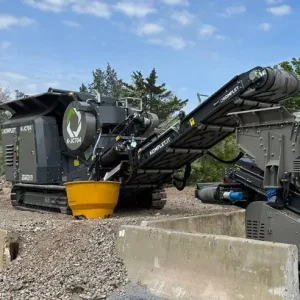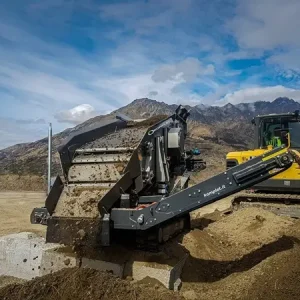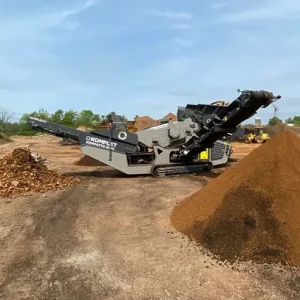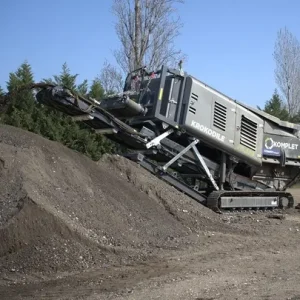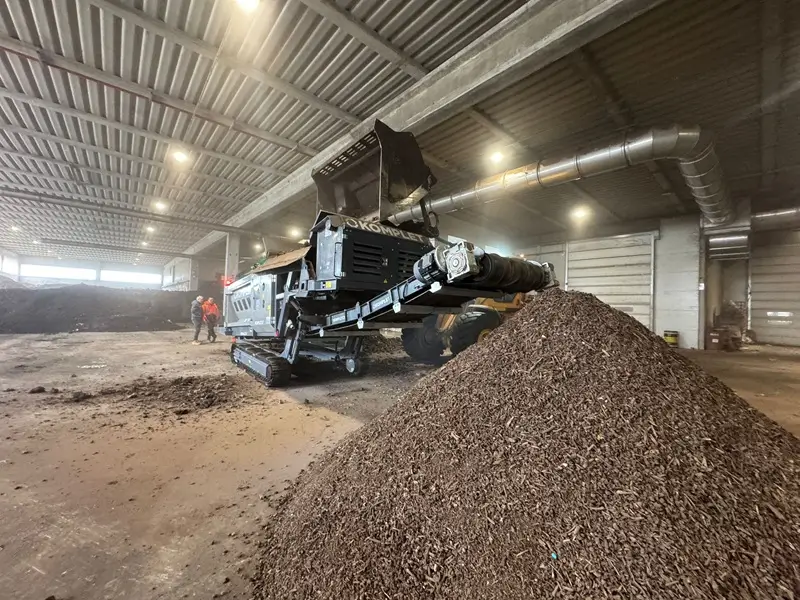

Trommel screeners occupy a specific role in compact mobile material processing — they handle the wet, sticky, organic, and moisture-laden materials that vibrating scalping screens struggle with. For topsoil producers, compost facilities, mulch operations, and C&D recyclers handling fines-heavy mixed material, the trommel is the right tool. For dry crushed aggregate, RCA, and clean stone, vibrating scalping screens deliver higher throughput. Knowing which screener fits which material is one of the foundational equipment decisions in any material processing operation.
This guide walks through the role of trommel screeners in material separation — how they work mechanically, when to choose trommel over vibrating scalping, the specific applications they excel at, and how Komplet America’s K-TS 30 and K-TS 40 trommel screeners deliver industrial-throughput trommel performance in compact mobile packages.
How Trommel Screeners Work
A trommel screener uses a slowly rotating perforated drum mounted at a slight downward incline. Material enters the drum at the higher (feed) end through a feed hopper. As the drum rotates (typically 10-30 RPM), material tumbles through the rotating cylinder. Particles smaller than the drum perforations fall through the holes onto a discharge conveyor below; larger particles continue through the drum and exit at the lower (discharge) end as oversize.
The mechanical principles that distinguish trommels from vibrating scalping screens:
Tumbling Action
Material rotates with the drum, lifting up the side and falling back through the center. This tumbling exposes new surfaces of each particle to the perforations as they cycle through, giving multiple opportunities for under-size material to fall through. The action is gentle — particularly important for materials like compost where structure preservation matters.
Gravity-Based Separation
Unlike vibrating scalping screens (which use aggressive deck vibration to drive material through mesh openings), trommels rely on gravity and tumbling to separate. This works particularly well for sticky, wet, or fibrous material where forced vibration would pack the material against the screen and reduce throughput.
Multiple Drum Zones
Some trommel designs have multiple zones with different perforation sizes — fines fall through the first zone, mid-sizes through the second, and so on. Material flows through the drum and undergoes multiple separations in a single pass. The K-TS 30 and K-TS 40 support different drum configurations matching this multi-zone approach.
Internal Cleaning Brush
An integrated cleaning brush rotates against the drum surface, keeping perforations clear of material that would otherwise pack into them and reduce throughput. This is critical for sticky/wet materials — without active brush cleaning, perforations blind quickly and the trommel loses effective screening area.
Trommel vs. Vibrating Scalping Screen: Which Should You Use?
This is the foundational decision in material screener selection. Both technologies are mature, both work well for their intended materials, and neither is universally better — but each has clear strengths and weaknesses.
Use a Trommel When…
- Material is wet, sticky, or has high moisture content (topsoil, compost, mulch, mixed C&D fines)
- Material contains organic content that aggressive vibration would pulverize (compost, mulch, soil with organic matter)
- Feed material composition is highly variable (mixed soil, mixed C&D fines, recycled mulch)
- Output structure preservation matters (landscape topsoil, finished compost, screened mulch)
- Operating in cold or wet conditions where vibrating screens may have cold-start issues with sticky material
Use a Vibrating Scalping Screen When…
- Material is dry crushed aggregate (crushed stone, RCA, RAP, pit-run gravel)
- Throughput is the priority (vibrating screens deliver more tons per hour per square foot of screening area than trommels for dry material)
- Multiple spec sizes are needed simultaneously (2-deck or 3-way split vibrating screens produce multiple outputs in a single pass; the Kompatto 5030 and 124 specifically support this)
- Operating space is constrained (some Kompatto models are more compact than equivalent-throughput trommels)
Run Both When…
Many operations benefit from running both technologies. Examples: a C&D recycler runs vibrating scalping for crushed concrete and a trommel for the wet/organic mixed C&D fines fraction; a quarry operation runs vibrating scalping for primary aggregate production and a trommel for the topsoil overburden generated during pit development; an excavation contractor runs vibrating scalping for excavated rock and a trommel for soil screening on the same project. Multi-technology operations capture the strengths of each system rather than forcing one technology to handle all material types.
Komplet America’s K-TS Trommel Screener Lineup
K-TS 30 Compact Trommel Screener
The K-TS 30 compact trommel screener — Komplet’s smaller trommel — fits operations with moderate-volume material screening needs in tight-access conditions or smaller facilities.
- Throughput: Up to 80 tph
- Drum configurations: 68″ x 51″ or 103″ x 51″ (longer drum option for more screening area)
- Power: 23 kW genset (self-contained, no external power required)
- Weight: Approximately 8,818 lb
- Mobility: Self-propelled tracked, wireless remote control, hydraulically folding
K-TS 40 Portable Trommel Screener
The K-TS 40 portable trommel screener — Komplet’s larger trommel — handles serious topsoil, compost, mulch, and mixed C&D operations at higher throughput than the K-TS 30.
- Throughput: Up to 120 tph
- Drum configurations: 126″ x 55″ or 171″ x 43″ (configuration options for different applications)
- Power: 40 kW genset
- Weight: Approximately 25,353 lb
- Mobility: Self-propelled tracked, wireless remote control, hydraulically folding conveyors
Real Applications Where Trommels Shine
Topsoil Production
Landscape supply yards and topsoil producers use trommel screeners to remove rocks, roots, organic debris, and oversized material from raw soil. The output is clean spec-sized topsoil suitable for sale to landscape contractors, developers, and homeowners. The K-TS 30 and K-TS 40 handle moisture-laden soil that vibrating scalping screens would struggle with — processing soil at field moisture levels rather than waiting for it to dry.
Compost Production
Compost facilities use trommel screeners to separate finished compost from oversized material that hasn’t fully decomposed (woody debris, large organic chunks). The gentle drum action preserves the granular structure of finished compost — vibrating screens would pulverize the structure that gives finished compost its quality. Output goes to retail bagging, bulk landscape supply, or specialty agricultural markets.
Mulch Production
Mulch producers use trommel screeners to remove oversized material (uncomposted wood chunks, tramp material) from finished mulch. The trommel’s gentle action preserves mulch fiber structure while removing problem oversize. Particularly valuable for natural and dyed mulch products where consistent appearance matters for retail sales.
Mixed C&D Recycling Fines
After primary crushing or shredding, demolition operations often produce a mixed C&D fines stream containing dirt, gypsum, organic material, and other moisture-laden components. Trommel screening separates this into useful fractions — clean fines for fill applications, mid-size base material, and oversize for further processing or disposal. The trommel handles moisture content that vibrating screens can’t manage in this material stream.
Excavation Soil Recovery
Excavation contractors use trommel screeners to convert excavated soil into useful streams — clean fill material, base aggregate, and oversize for separate disposal. On-site soil screening eliminates aggregate purchases for the project’s foundation work while diverting excavated material from landfill disposal. Particularly valuable on sites with rocky or root-laden soil that needs cleaning before reuse.
Recycled Wood and Yard Waste
Operations processing yard waste, brush, or recycled wood often need to separate finished output from oversized material that needs further processing. Trommel screeners handle this material gently, preserving the chip/shred quality that defines saleable end product.
Choosing the Right Trommel for Your Operation
Five factors determine the right trommel:
- Material type and moisture. Topsoil, compost, mulch, mixed C&D fines, organic-rich material: trommel is the right choice. Dry crushed aggregate, clean stone, dry RCA: vibrating scalping screen is typically more efficient.
- Throughput target. Under 80 tph: K-TS 30. 80-120 tph: K-TS 40. Higher than 120 tph: typically requires either a larger trommel beyond Komplet’s compact lineup or paired multiple machines.
- Drum length and configuration. Longer drums provide more screening area for difficult material; shorter drums offer better mobility and reduced footprint. K-TS 30 and K-TS 40 both offer drum configuration options.
- Mobility requirements. Single-site operations: any setup works. Multiple sites: tracked self-propelled with wireless remote and hydraulic folding (Komplet’s standard) is essential.
- Capital and financing. Komplet Capital offers 24-hour approval, 100% financing, and 3-6 year terms. Section 179 tax deduction up to $1.22M (2024 limit) on new equipment purchases.
Trommel Maintenance Considerations
Trommel screeners have specific maintenance considerations distinct from vibrating scalping screens. Always refer to the OEM operator’s manual for your specific machine, but the general categories include:
Drum Bearing Maintenance
The drum is supported by drive bearings that carry the rotational load. Bearing maintenance per OEM specifications — typically lubrication intervals and periodic inspection. Failed drum bearings cause significant downtime; address developing issues before catastrophic failure.
Cleaning Brush Service
The integrated cleaning brush wears as a consumable. Replace per visual wear indicators or per OEM-specified intervals. A worn brush stops cleaning effectively, which causes drum perforations to blind, which reduces throughput. Regular brush replacement is preventive maintenance, not optional.
Drum Inspection
Drum perforations can wear over time, particularly when processing abrasive material. Visual inspection during service identifies developing wear. Drum replacement is a major service event but is rare with proper material matching (using trommels for appropriate material rather than abrasive aggregate).
Conveyor and Discharge Components
The discharge conveyors, idler assemblies, and chute components see wear similar to other compact mobile equipment. Routine inspection during scheduled service.
Engine and Genset Service
The 23 kW (K-TS 30) or 40 kW (K-TS 40) genset requires standard diesel engine maintenance per OEM specifications — air filters, oil and oil filters, fuel filters, coolant, and DEF if applicable.
Frequently Asked Questions
What’s the main advantage of a trommel over a vibrating screen?
Trommels handle wet, sticky, organic, and moisture-laden materials that vibrating scalping screens struggle with. The tumbling action and integrated cleaning brush prevent perforation blinding that would block a vibrating screen’s mesh. Trommels also handle materials gently — preserving the structure of finished compost, mulch, and topsoil that aggressive vibration would pulverize.
Can a trommel screen crushed aggregate?
Technically yes, but typically not the best choice. Vibrating scalping screens deliver higher throughput on dry crushed aggregate per square foot of screening area than trommels. Most aggregate-focused operations use vibrating scalping. Trommels are typically the right tool for moisture-laden or organic-rich material rather than dry stone.
How does the K-TS 30 compare to the K-TS 40?
The K-TS 30 handles up to 80 tph with smaller drum options (68″ x 51″ or 103″ x 51″), 23 kW genset, ~8,818 lb. The K-TS 40 handles up to 120 tph with larger drum options (126″ x 55″ or 171″ x 43″), 40 kW genset, ~25,353 lb. Choose based on throughput target, drum size needed, and capital position. Many operations start with the K-TS 30 and scale up to the K-TS 40 as volume justifies.
Do I need a separate power source for a trommel?
No. Komplet K-TS trommels include onboard genset packages — 23 kW for K-TS 30, 40 kW for K-TS 40 — that provide self-contained power. No external power source, no grid dependency, no generator coordination. The machine arrives ready to run.
How long does setup take on a Komplet trommel?
Under 30 minutes typical, from transport configuration to operating. Both K-TS models are self-propelled tracked with hydraulically folding components and wireless remote control. One operator drives the machine into position, deploys conveyors, runs a brief warm-up, and starts feeding.
What’s the best material to feed a trommel?
Trommels excel with wet, sticky, organic, and moisture-laden materials: topsoil with field moisture, finished compost, mulch, mixed C&D fines, screened soil, and yard waste. They’re not the right tool for dry crushed aggregate (use a vibrating scalping screen instead), hard rock (would damage the drum), or hot/abrasive materials.
Can I rent a Komplet trommel?
Yes — through Komplet’s authorized dealer and rental network. Find your local Komplet dealer or call 908-369-3340. Many rental partners offer rent-to-own arrangements where rental payments credit toward eventual purchase — useful for testing the economics on real projects before committing to ownership.
What’s the warranty on Komplet K-TS trommels?
All new Komplet equipment, including the K-TS 30 and K-TS 40 trommels, comes with a 1-year / 1,000-hour warranty (whichever is earlier). Komplet America’s parts inventory is forecasted 12 months in advance, supporting fast wear-part availability when service items are needed. Authorized dealers across North and Central America provide local service support.
Final Thoughts
Trommel screeners are the right tool for specific applications — wet/sticky/organic materials where vibrating scalping screens struggle. The tumbling drum action, integrated cleaning brush, and gentle handling combine to deliver effective separation for topsoil, compost, mulch, mixed C&D fines, and excavated soil that other screening technologies handle poorly. Operations matching the right tool to the right material — vibrating scalping for dry aggregate, trommel for wet/organic material, both for diverse operations — capture the operational efficiency that drives real material processing economics.
Komplet America’s K-TS trommel lineup — the K-TS 30 (up to 80 tph) and K-TS 40 (up to 120 tph) — covers the trommel screening needs of contractor-scale through serious commercial topsoil, compost, mulch, and recycling operations. Browse the complete screener lineup — including both Komplet’s K-TS trommels and Kompatto vibrating scalping screens — to compare specs, or call us and we’ll help you spec the right screening solution for your material and throughput goals.
Ready to Talk Trommel Screening?
- Call 908-369-3340
- Email [email protected]
- Schedule a demo or request a quote
- Find your local Komplet dealer for rental availability
- Ask about our 1-year / 1,000-hour warranty and equipment financing options
Never enough — that’s how we approach service, support, and helping you separate material into the spec sizes your customers actually buy.