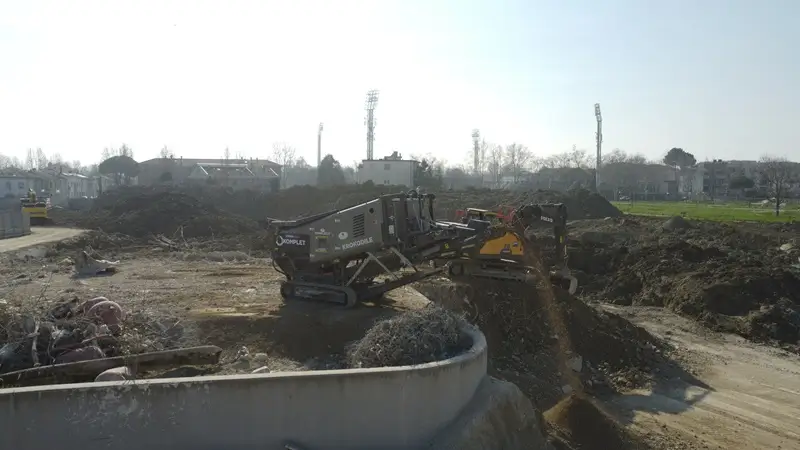

Construction and demolition (C&D) projects generate enormous quantities of mixed waste — concrete, asphalt, wood, drywall, brick, and bulky debris. Hauling that waste off-site is expensive, slow, and creates downstream tipping fees. A slow-speed shredder lets contractors process C&D material directly on the jobsite, turning what would have been disposal cost into reusable aggregate, mulch base, or volume-reduced waste ready for transport.
This guide walks through how slow-speed shredders work, why low-RPM high-torque shredding is the right approach for tough C&D materials, and how the Krokodile PLUS — Komplet America’s slow-speed mobile shredder — adapts to a wide range of construction waste streams through its dual-shaft, quick-change tooth and shaft system.
What Is a Slow-Speed Shredder?
A slow-speed shredder is a heavy-duty material reduction machine that operates at low rotational speed (typically 0–35 rpm) but with extremely high torque. Instead of using high-velocity blades or hammers to fracture material through impact, slow-speed shredders use shafts equipped with hardened teeth that grip, tear, and shear material as the shafts rotate. This controlled, high-torque action is what allows them to process the toughest construction waste — including reinforced concrete and asphalt — without overheating, throwing dust clouds, or destroying the cutting components.
Slow-Speed vs. High-Speed Shredders
Slow-speed shredders are designed for tough, dense, and contaminated material. Their high torque pulls material through the shafts even when rebar, wire, or oversized pieces are present. Output sizing is controlled by the tooth/shaft configuration and the spacing between the shafts, not by a screen at the bottom of the chamber.
High-speed shredders (sometimes called fast shredders or grinders) operate at high RPM and use hammers or knives to fracture material through impact. They are typically suited to lighter, more uniform feed — wood waste, plastics, and pre-sorted single-stream material. They are more sensitive to contaminants, generate substantially more dust and noise, and consume more fuel per ton when run on heavy materials.
For mixed C&D waste — where the feed could include concrete chunks with rebar, asphalt slabs, wood with embedded nails, drywall, and bulky debris all in the same load — slow-speed is the right category.
How the Krokodile PLUS Handles Construction and Demolition Waste
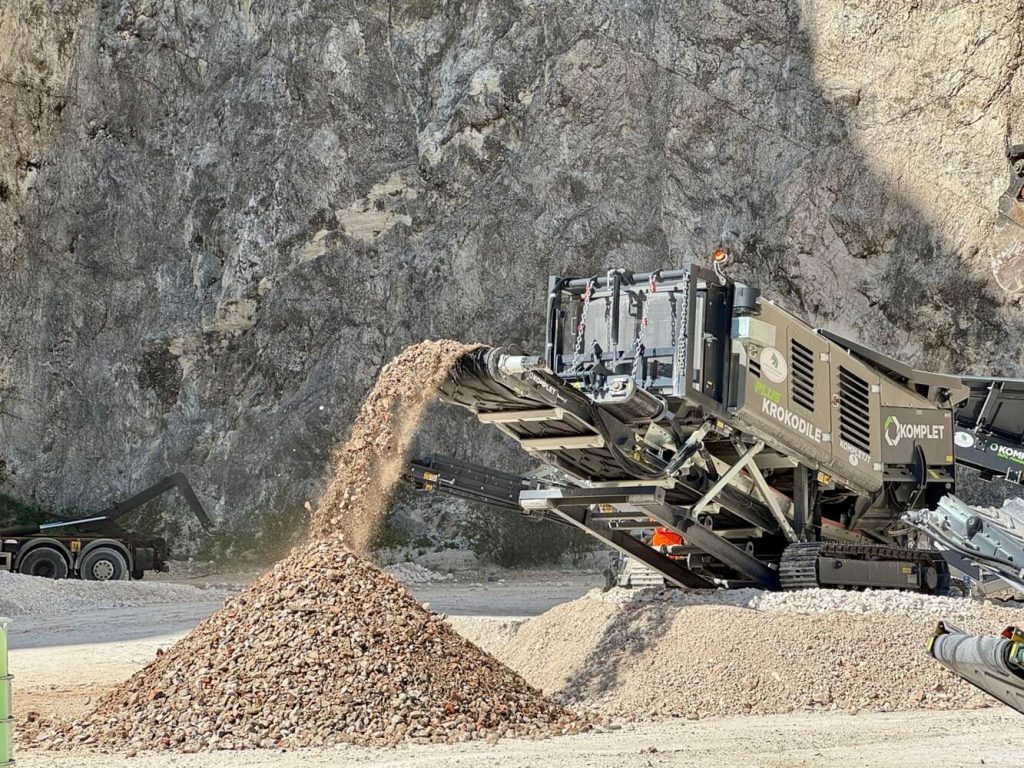
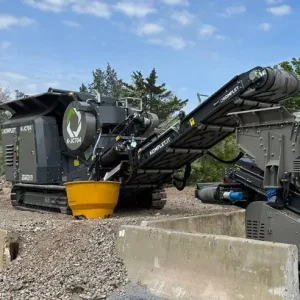
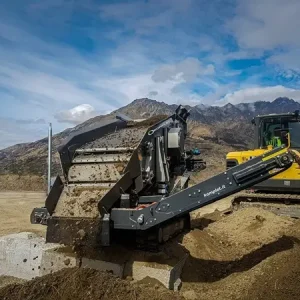
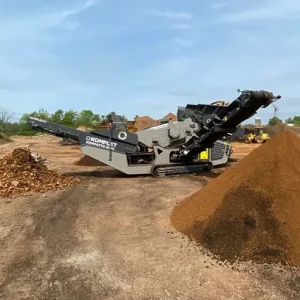
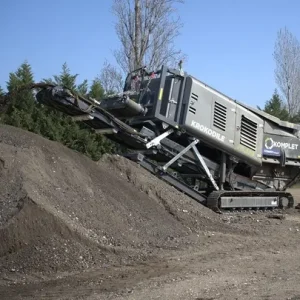
The Krokodile PLUS is a 220-horsepower Volvo Penta Tier 4 Final diesel-powered slow-speed mobile shredder built for tough material processing applications. Its 60-inch dual-shaft system delivers high torque at low shaft speed. The machine is mounted on a tracked chassis for jobsite mobility and operated by wireless remote — operators do not stand on or near the machine during shredding.
The Quick-Change Shaft System
One of the Krokodile PLUS’s most practical features is its quick-change shaft system. Two distinct shaft and tooth configurations are available, and they can be swapped to match the job:
- C&D / Asphalt teeth and shafts — engineered for concrete, asphalt, brick, block, rubble, and other heavy aggregate-based debris.
- Wood / Lightweight Waste teeth and shafts — engineered for wood, drywall, plastics, mixed garbage, green compost material, and other lighter C&D debris.
This means a single Krokodile PLUS can serve a contractor whose work flips between concrete-heavy demolition projects and wood-heavy land clearing or municipal waste reduction. Instead of buying two specialized machines, the operator changes the shafts to match the day’s feed.
Shredding Modes
The Krokodile PLUS offers multiple shredding modes selectable from the wireless remote: C&D, Wood, Waste, Customized, and Synchronized/Asynchronized shaft rotation. The Customized and Synchronized/Asynchronized modes are particularly valuable when a load contains a mix of materials that respond differently to standard shaft programming — operators can fine-tune shaft speed, direction, and torque profile to match the specific material being processed.
Output Capacities and Material Sizes
Output volumes vary significantly based on material density, contamination, feed consistency, and operator skill. The figures below are the website-published “up to” figures under ideal conditions — actual production on any specific job will depend on the variables present that day.
- Concrete and asphalt (C&D shaft): up to 175 US tons per hour
- Mixed waste (waste shaft configuration): up to 19 US tons per hour
- Plastics (waste shaft configuration): up to 18 US tons per hour
Wood and lighter materials produce lower tons-per-hour figures because the same volume of material weighs substantially less than concrete or asphalt — the machine is moving similar volume through the shafts, just at lower mass.
What the Krokodile PLUS Does and Does Not Process
The Krokodile PLUS is versatile, but it is not unlimited. Understanding what it handles well — and what it does not — keeps operators safe and protects the warranty.
Materials It Processes Well
- Concrete (slabs, blocks, demolition rubble) — with or without light rebar contamination, using the C&D shaft
- Asphalt (chunks, slabs, demolition pavement) — using the C&D shaft
- Brick, block, masonry, and stone rubble — using the C&D shaft
- Wood (beams, pallets, planks, branches, brush) — using the wood/waste shaft
- Drywall, plastics, and mixed lightweight waste — using the wood/waste shaft
- Green compost feedstock and bulky organic material — using the wood/waste shaft
- Mixed C&D streams with multiple material types in one load
Materials It Does Not Process
The Krokodile PLUS is not a metal shredder. While it tolerates light steel contamination — short rebar, nails embedded in wood, occasional banding — it is not designed to shred clean steel scrap, pipe, structural rebar bundles, or vehicle bodies. Heavy ferrous contamination should be removed before feeding. The integrated magnetic separator (included on Krokodile PLUS as configured) extracts ferrous metal from the discharge stream — that is its purpose. The shafts are not the right tool for shredding metal as the primary material.
It is also not a fine-grinder. If a project needs a sub-inch product or a tightly-controlled aggregate gradation, the Krokodile PLUS output should feed downstream into a jaw crusher (the K-JC 704 PLUS or K-IC 70 impact crusher) and then a screener (the Kompatto 5030 or Kompatto 124) to produce spec-size aggregate. The Krokodile PLUS is the volume-reduction and pre-processing step in that workflow, not the finishing step.
Why On-Site C&D Shredding Makes Economic Sense
Hauling untreated C&D waste off-site has three cost components that compound: trucking, tipping, and time. Slow-speed shredding on-site reduces all three.
Trucking Cost Reduction
Shredded material is denser and more uniform than mixed demolition rubble. A truck loaded with shredded C&D output carries more usable tonnage per haul than the same truck loaded with bulky, irregular debris. Fewer trips, lower fuel cost, and lower per-load labor cost.
Tipping Fee Reduction
Many landfills and transfer stations charge by volume rather than weight, or charge premium rates for bulky and unsorted material. Shredded C&D output is volume-reduced and easier to sort downstream, reducing the per-ton disposal fee in many markets. In some regions, shredded clean C&D output qualifies as a recyclable feedstock that is accepted at lower cost — or at no cost — by aggregate recyclers.
Project Timeline Acceleration
On-site processing decouples the demolition crew from the hauling schedule. The crew does not have to wait for trucks to return from the dump, does not have to coordinate with off-site processors, and does not lose hours per day on truck logistics. The Krokodile PLUS can be moved between active demolition zones throughout the day to keep the workflow moving.
Operator Safety on a Slow-Speed Mobile Shredder
The Krokodile PLUS is operated by wireless remote control. Operators do not stand on or near the machine during shredding — they direct feed, monitor output, and control the machine from a safe distance. This is a fundamental safety advantage of the slow-speed mobile shredder category.
Standard safe-operation practices for any C&D shredding operation include:
- Personal protective equipment — hard hat, safety glasses, hearing protection, steel-toe boots, and high-visibility vest
- Pre-shift inspection — walk the machine, check teeth and shaft condition, verify hydraulic and fluid levels, confirm magnet and discharge belts are clear
- Defined exclusion zone around the machine during operation — no foot traffic in feed or discharge area
- Clear communication between feed-loader operator and the shredder operator — agree on hand signals or radio channel before starting
- Stop the machine before clearing any blockage — never reach toward the shafts while they are turning, even at low speed
- Use the dual-shaft reverse function (built into the Krokodile PLUS) to clear sticky or bound-up material rather than manual intervention
Is a Slow-Speed Shredder Right for Your Operation?
Slow-speed shredding pays back fastest when these conditions are present in the operation:
- Recurring C&D volume — demolition contractors, civil and excavation crews, and recycling facilities that process material weekly or daily
- Mixed material streams — operations whose feed shifts between concrete-heavy and wood-heavy throughout the year benefit most from the quick-change shaft system
- Tight project sites or urban work — compact mobile shredding eliminates the staging space needed for stockpiles awaiting hauling
- Disposal cost pressure — operations in markets with rising tipping fees, long hauls to landfill, or limited acceptance of bulky C&D debris
- Material recovery opportunity — operations that can sell the shredded output as recycled aggregate, mulch, or biomass feedstock
If the operation is single-material at very low volumes (occasional pallet shredding, light yard waste only), a smaller stationary shredder or contracted hauling may make more sense. If the operation needs sub-inch crushed concrete output for spec aggregate, a compact jaw crusher alone may be more appropriate than a shredder. The Krokodile PLUS is sized for serious C&D throughput across multiple material types.
Frequently Asked Questions
Can a slow-speed shredder process concrete with rebar?
Yes. The Krokodile PLUS handles concrete with light rebar contamination using its C&D shaft configuration. The high-torque slow-speed shafts will tear through and discharge rebar fragments along with the concrete. The integrated magnetic separator extracts the ferrous fragments from the discharge stream. Heavy structural rebar bundles or large steel members should still be removed before feeding.
How much does the Krokodile PLUS process per hour?
On the C&D shaft, the published output is up to 175 US tons per hour for concrete and asphalt under ideal conditions. Mixed waste runs at up to 19 US tph, and plastics at up to 18 US tph. “Up to” reflects ideal feed consistency, skilled operator, dry material, and minimal contamination — actual jobsite output will vary.
How long does it take to swap shafts on the Krokodile PLUS?
Komplet’s quick-change shaft system is designed to be performed by trained Komplet-certified service technicians or by trained operators using the Komplet operator’s manual procedure. Refer to the operator’s manual for the exact procedure and torque specifications, and contact Komplet America at 908-369-3340 if your operation needs guidance on the swap process for your specific machine.
Is the Krokodile PLUS operated manually or by remote?
By wireless remote. All shredding modes, shaft direction, hopper position, and discharge belt operation are controlled wirelessly. Operators stand outside the active zone of the machine.
What is the difference between slow-speed and high-speed shredders?
Slow-speed shredders run at low RPM with very high torque, using teeth on shafts to grip and tear material. They are best for tough, dense, or contaminated feed like C&D debris. High-speed shredders run at high RPM and rely on impact (hammers or knives) for material reduction. They are best for lighter, cleaner, single-stream feed and produce more dust and noise per ton of heavy material processed.
Can the Krokodile PLUS be moved between jobsites easily?
Yes. The machine is built on a tracked chassis with hydraulic mobility on-site, and at 34,171 lb operating weight, it transports on a standard heavy-haul trailer between sites.
Does the Krokodile PLUS need a special foundation?
No. The slow-speed mobile shredder operates on a level, prepared work area on its own tracked chassis. There is no fixed foundation, anchor pad, or stationary infrastructure required.
How does the Krokodile PLUS compare to other shredder categories?
Compared to stationary slow-speed shredders, the Krokodile PLUS offers mobility — it goes to the waste rather than requiring waste be brought to it. Compared to high-speed grinders, the Krokodile PLUS handles tougher and more contaminated feed with less dust and lower fuel-per-ton on heavy material. Compared to jaw or impact crushers, the Krokodile PLUS handles a much wider range of material types — wood, drywall, plastics, mixed waste — that crushers cannot process.
Final Thoughts
Slow-speed shredding is the right approach for contractors and recyclers handling tough, mixed, and contaminated C&D waste streams. The combination of low RPM, high torque, dual-shaft architecture, and a quick-change shaft system is what makes a slow-speed mobile shredder versatile across concrete-heavy, wood-heavy, and mixed material days. Add wireless remote operation, a tracked chassis, and integrated magnetic separation, and the Krokodile PLUS becomes a single-investment solution for a recurring multi-material waste challenge that would otherwise require multiple specialized machines or sustained reliance on hauling and tipping fees.
Komplet America stocks the Krokodile PLUS in the Hillsborough, NJ yard and supports it through a Komplet-certified service network across North and Central America. For specific application questions — material types, expected throughput on your jobsite material, financing through Komplet Capital, or pre-owned availability — contact Komplet America directly or work with your local Komplet dealer.
Learn more about the Krokodile PLUS slow-speed mobile shredder, explore Komplet’s complete equipment lineup, or review equipment financing options through Komplet Capital.
Ready to Add a Slow-Speed Shredder to Your Operation?
- Call Komplet America at 908-369-3340 to discuss your specific C&D material and expected volume
- Request a yard demonstration in Hillsborough, NJ — bring sample material and see the Krokodile PLUS process it before you buy
- Review Krokodile PLUS specifications and pricing — base unit, magnetic separator, and hydraulic hopper configurations
- Explore equipment financing with Komplet Capital — terms from 36 to 72 months, 100% financing available
- Find your local Komplet dealer for rental availability and regional support
Never enough.
Disclaimer: All operating, maintenance, and service guidance in this article is general in nature. Always refer to the official Komplet operator’s manual for the specific machine model and serial number, and follow OEM intervals and procedures. For warranty-protected work, contact Komplet America at 908-369-3340 or your authorized Komplet dealer. Improper service or non-OEM parts may void warranty coverage and create safety hazards.
Disclaimer: Production rates and throughput figures shown above (“up to” tons per hour) reflect maximum potential output under ideal conditions — consistent feed material, dry conditions, skilled operator, proper setup, and minimal downtime. Actual results on any specific jobsite will vary based on material composition, moisture content, contamination level, operator experience, and other site conditions. Komplet America makes no guarantee of specific throughput or financial returns. Customers should perform their own analysis based on their material and local market conditions before making purchase decisions.