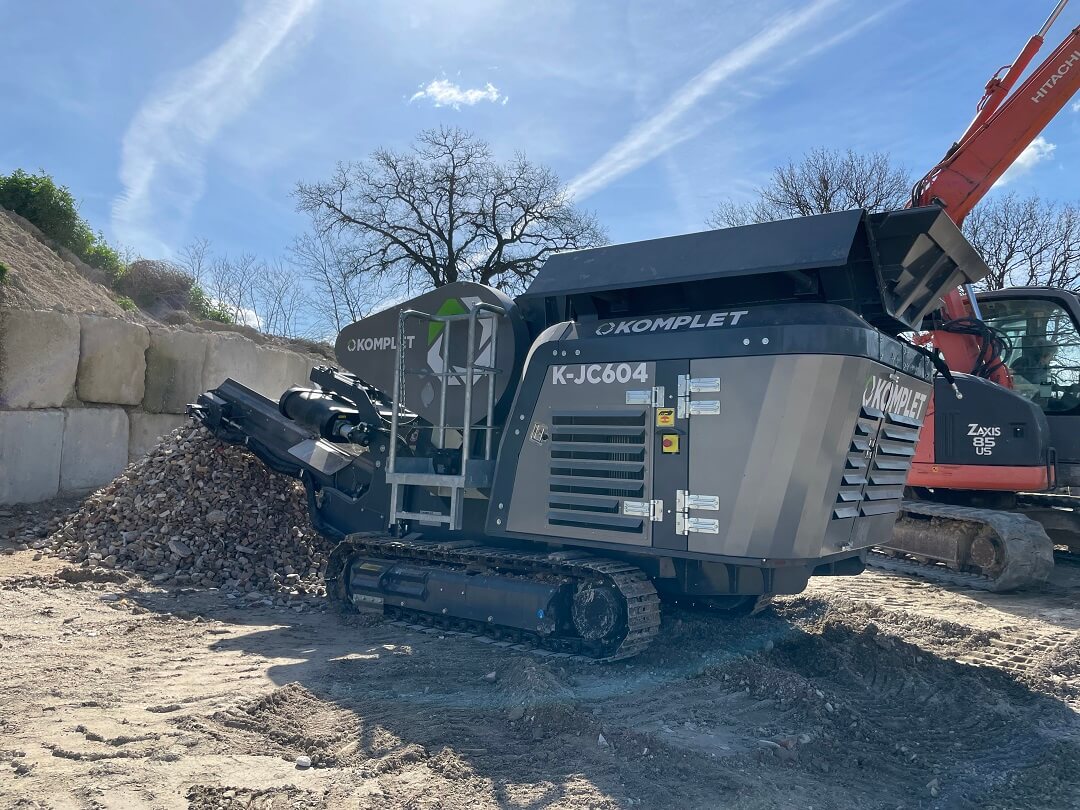

Concrete and asphalt are the two most-recycled materials by volume in North American construction. Demolished concrete becomes recycled concrete aggregate (RCA) for road base, drainage stone, and engineered fill. Reclaimed asphalt pavement (RAP) feeds new hot-mix asphalt designs at blending rates up to 30%. The equipment that turns demolished hardscape into saleable spec aggregate is the jaw crusher — and for compact mobile contractor and aggregate-producer scale work, jaw crushers are the workhorse of the recycling industry.
This guide walks through how jaw crushers recycle concrete and asphalt, the specific features that matter for contaminated demolition feed (rebar, dirt, foreign objects), the typical workflow on a real demolition site, and how Komplet America’s compact mobile jaw crusher lineup handles the realities of contractor-scale concrete and asphalt recycling.
How Jaw Crushers Recycle Concrete and Asphalt
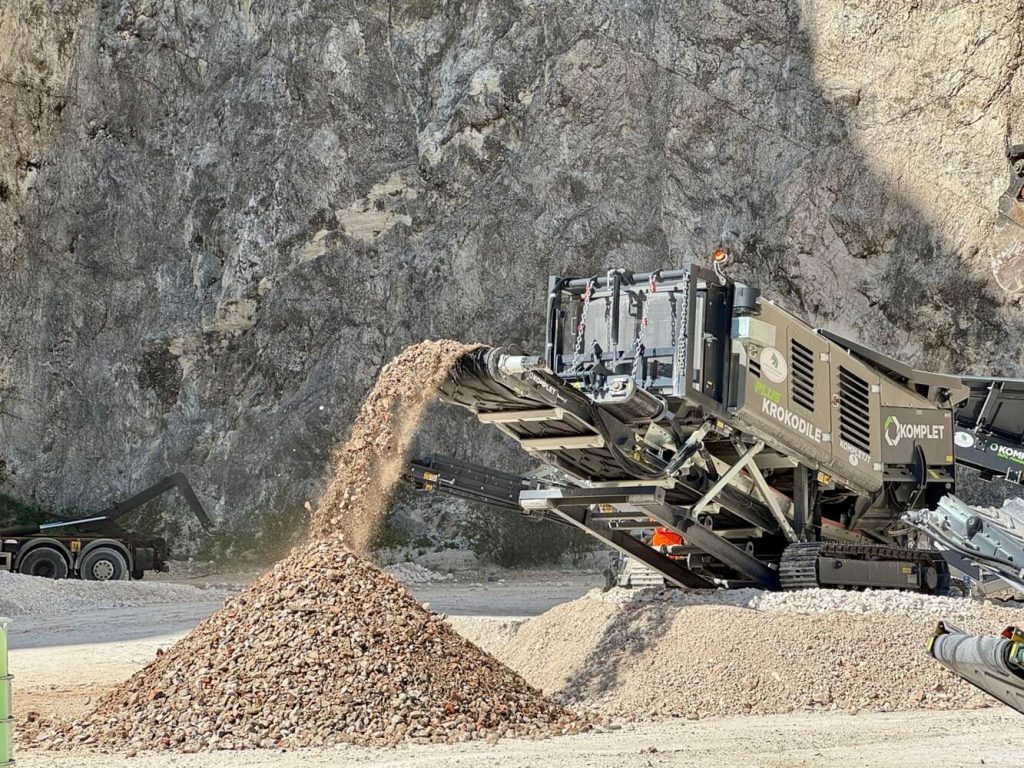
A jaw crusher uses a moving jaw plate that swings against a fixed jaw plate, applying compressive force to fracture material between them. Concrete and asphalt are both brittle materials that fracture cleanly under compression, making them well-suited to jaw crushing. The fractured material falls through the bottom of the chamber and exits onto a discharge conveyor.
Why Compression Works for Concrete
Concrete is fundamentally a brittle composite — cement matrix binding aggregate stones together. Compressive force fractures the matrix and breaks the cement bonds, releasing the aggregate stones and producing a new mix of recycled aggregate. The harder the concrete (cured, mature, high-strength mix designs), the more energy it takes to crush, but the cleaner the resulting RCA. Modern Komplet jaw crushers handle concrete strengths up to and beyond standard structural ratings.
Why Compression Works for Asphalt
Asphalt is a more complex feed than concrete. Bitumen-bound aggregate behaves elastically when warm and brittle when cold — meaning asphalt crushes more cleanly in cooler conditions and tends to gum up jaw plates in hot weather. Modern compact mobile jaw crushers handle asphalt across temperature ranges with adjustable jaw settings and (when needed) brief cooling periods between crushing sessions.
Real Components of a Mobile Jaw Crusher
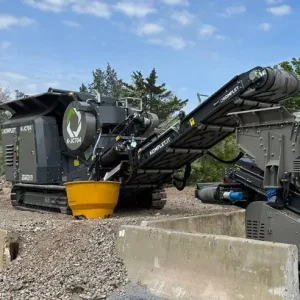
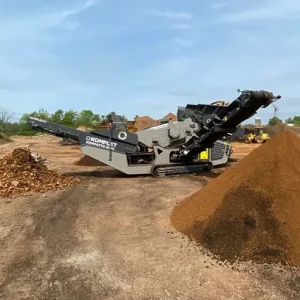
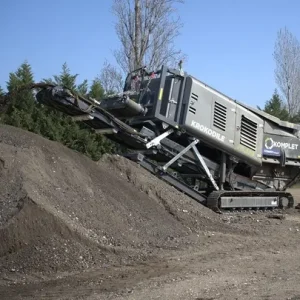
On compact mobile jaw crushers like the Komplet lineup, the major mechanical components are:
- Diesel engine (25-130 HP depending on model — Komplet uses Tier 4 Final diesel for current emissions compliance, NOT electric motors as on stationary plants)
- Hydraulic system powering jaw movement, conveyor folding, track propulsion, and feeder operation
- Fixed and moving jaw plates (replaceable wear parts) creating the crushing chamber
- Vibrating feeder delivering material at controlled rate from the loading hopper into the jaw
- Discharge conveyor carrying crushed material out from below the jaw chamber
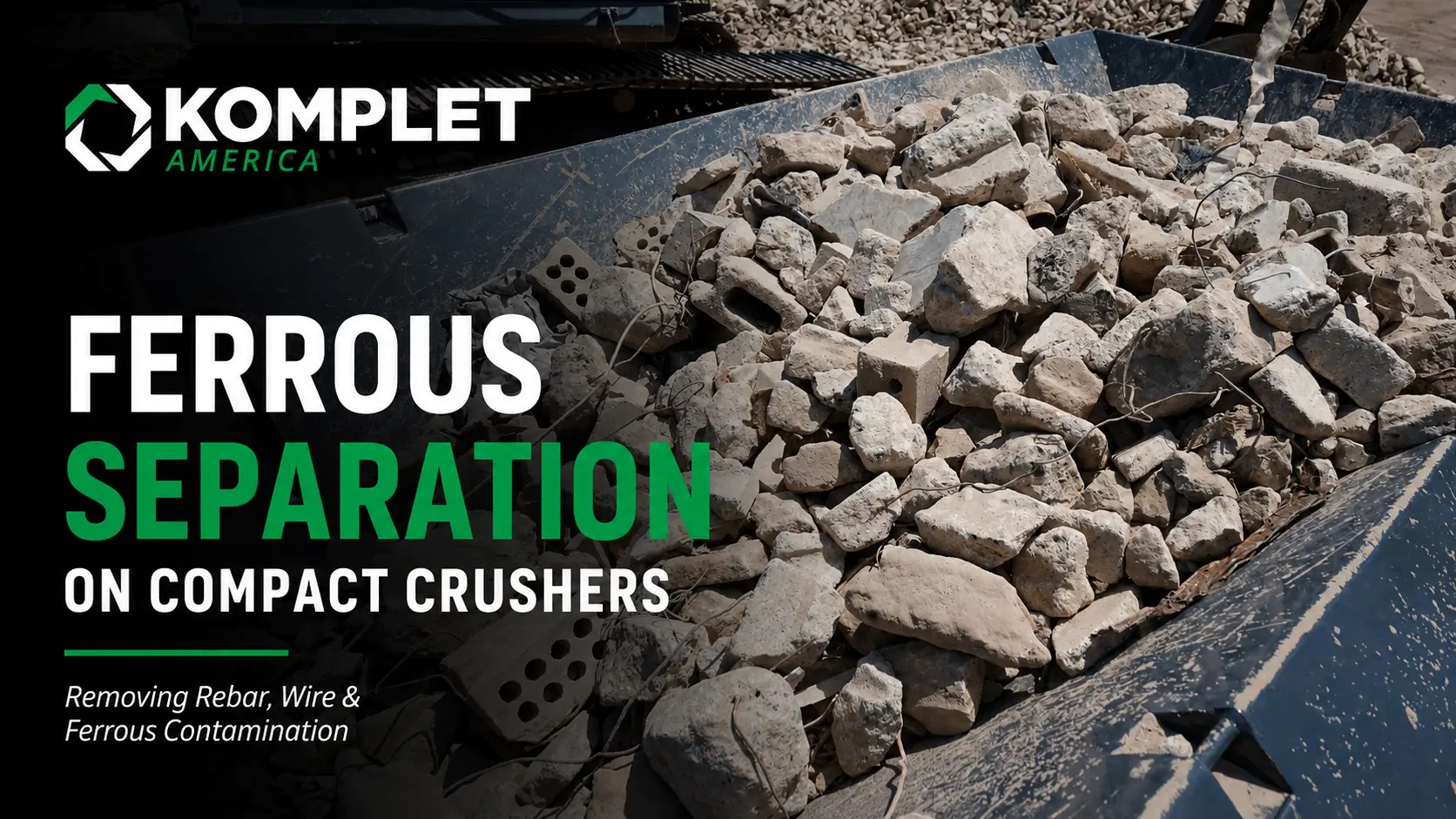
- Hydraulic magnetic belt (over the discharge conveyor) lifting ferrous metal — mostly rebar — into a separate clean pile
- Rubber tracks for self-propelled mobility
- Wireless remote control for operator-friendly single-person operation
Key Jaw Crusher Features for Concrete and Asphalt Recycling
Concrete and asphalt feed are not clean, dry, predictable material. Real demolition concrete contains rebar, embedded copper conduit, brick mortar, dirt, soil, occasional unbroken stones, and sometimes contractor-leftover steel (rerod cutoffs, drilled fasteners). Real asphalt millings contain fines, dirt, and sometimes unexpected metal fragments. The features below separate jaw crushers that handle real-world recycling feed from machines that only handle clean material.
1. Hydraulic Magnetic Belt for Rebar Recovery
This is the most critical feature for concrete recycling. The integrated magnetic belt sits over the discharge conveyor and lifts ferrous metal — almost always rebar in demolition concrete — into a separate clean pile during crushing. Recovered metal sells to scrap recyclers ($100-$300+/ton in 2026 markets), and the cleaner RCA output commands premium spec-aggregate pricing. Standard equipment on the K-JC 604, K-JC 704 PLUS, and K-JC 805.
2. Reverse Jaw Function
If uncrushable material enters the chamber — an unbroken section of rebar, a steel beam fragment, a foreign object — the operator reverses the jaw via wireless remote and clears the obstruction in seconds. Without this feature, an uncrushable jam means hours of manual cleanout. Standard on all Komplet jaw crushers.
3. Standard Dust Suppression for OSHA Silica Compliance
OSHA’s respirable crystalline silica rule applies to crushing operations. Komplet jaw crushers ship with water-spray dust suppression as standard equipment. Connect a garden-hose water line, the system runs automatically, and the machine operates within OSHA PEL of 50 ug/m3 averaged over 8 hours. Dust suppression isn’t an add-on — it’s how the machines come from the factory.
4. Adjustable Closed-Side Setting (CSS)
The CSS is the gap between the jaw plates at the closed position — it determines output size. Hydraulic CSS adjustment lets operators shift between coarse output (3-6″ oversize for riprap) and fine output (1.5″ minus for spec aggregate base) without manual tooling. Adjust during operation as material composition changes or as customer demand shifts between spec sizes.
5. Wireless Remote Control
Every primary function — drive, feeder rate, jaw direction, conveyor folding, emergency stop — controlled remotely. One operator handles the full machine from a position with optimal visibility. No second operator needed; reduces labor cost and lets the operator monitor feed quality from the loader cab.
6. Self-Propelled Tracked Mobility
Drive the machine into position via wireless remote. No specialized rigging, no crane work, no dedicated setup crew. Tracks deliver better stability than wheels on uneven demolition sites. Setup time under 30 minutes from transport configuration to operating.
Komplet America’s Jaw Crusher Lineup for Concrete and Asphalt
Each crusher in the lineup serves a distinct operation size:
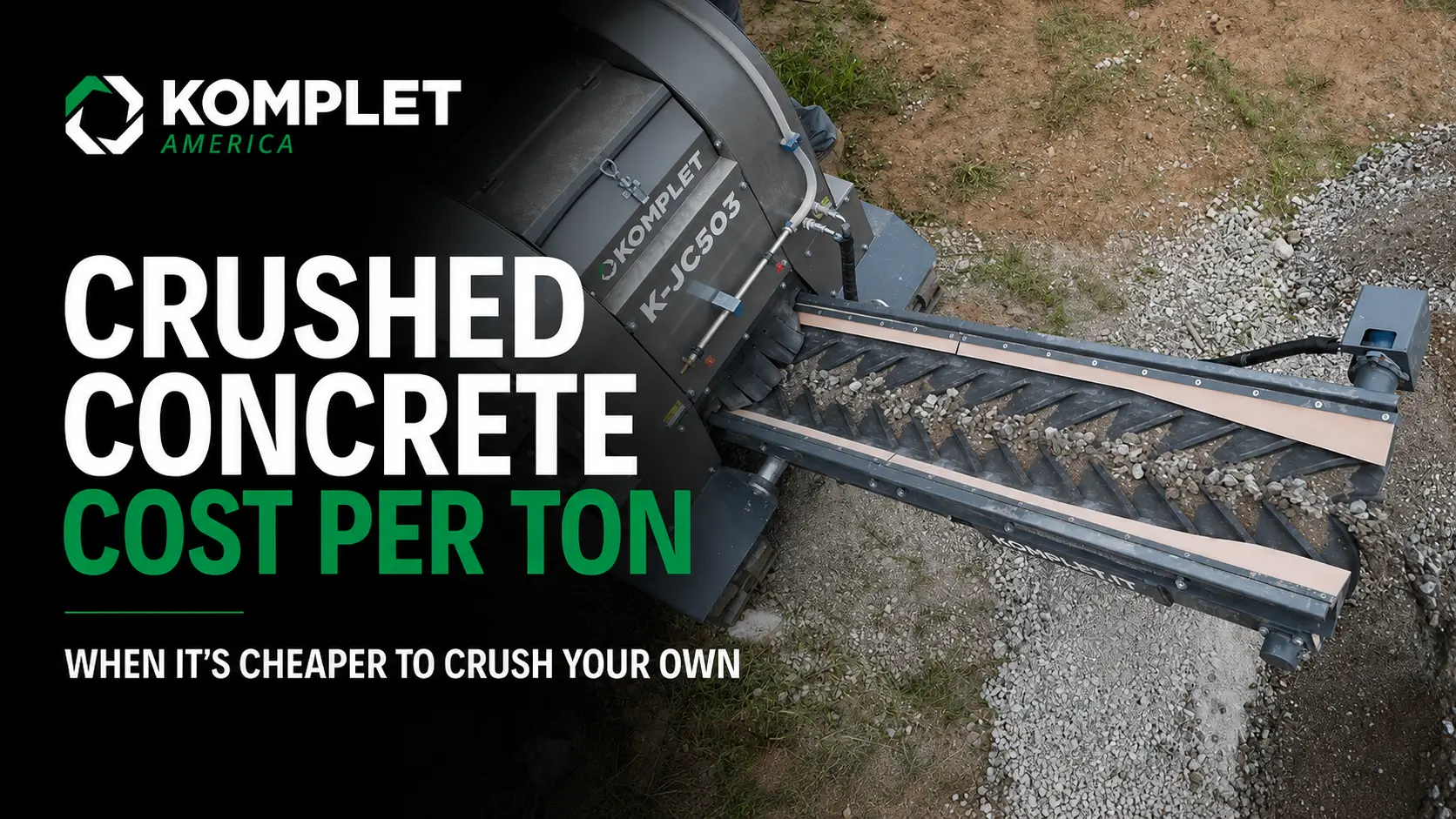
- K-JC 503 — up to 34 US tph, 19″ x 12″ jaw, 25 HP Tier 4 Final diesel, ~7,496 lb. Smallest crusher; built for tight-access urban demolition.
- K-JC 604 — up to 55 US tph, 23″ x 16″ jaw, 55 HP, ~19,400 lb. Mid-range mobile crusher with integrated magnetic separation.
- K-JC 704 PLUS — up to 90 US tph, 27″ x 16″ jaw, 74 HP, ~26,455 lb. Komplet’s best-selling crusher and the workhorse for typical contractor-scale concrete and asphalt recycling.
- K-JC 805 — up to 160 US tph, 31″ x 21″ jaw, 130 HP, ~49,600 lb. Largest jaw crusher in Komplet America’s lineup, for high-volume demolition recycling and aggregate production.
The Cubical Aggregate Option: K-IC 70 Impact Crusher
For operations producing premium cubical aggregate (concrete batch plants, hot-mix asphalt plants), the K-IC 70 compact impact crusher — up to 90 US tph, 100 HP, launched at WOC 2024 — adds a secondary cubical-shaping stage. The K-IC 70 also serves as a primary crusher for clean, rebar-free feed where cubical particle shape is the priority. Many operations run K-JC 704 PLUS (primary jaw) feeding K-IC 70 (cubical secondary) for premium aggregate output.
Typical On-Site Concrete and Asphalt Recycling Workflow
Step 1: Demolition and Material Sorting
Demolition crew separates concrete from soft waste (wood, drywall, plastics, fabric). The concrete fraction goes into a stockpile or staging area near the crusher. Soft waste goes separately to either landfill, a slow-speed shredder for volume reduction, or recyclers. Some pre-sorting (removing copper plumbing, salvageable metal, foreign objects) happens at this stage to maximize recovery and minimize crusher contamination.
Step 2: Pre-Breaking (When Needed)
Pieces larger than about 80% of the crusher’s jaw gape get pre-broken with an excavator-mounted hydraulic breaker. For Komplet’s lineup, anything larger than ~12-3/4″ needs pre-breaking for the K-JC 704 PLUS, ~16-3/4″ for the K-JC 805. Most demolition concrete (slabs, footings, walls) is already in the right range or breaks down with minimal pre-work.
Step 3: Loading and Crushing
Loader feeds the jaw crusher’s hopper. The vibrating feeder delivers material at controlled rate into the jaw chamber. Compression fractures the material; output falls onto the discharge conveyor. Magnetic belt lifts rebar into a separate clean pile. Crushed concrete exits as 3-6″ pieces (typical jaw crusher output).
Step 4: Screening
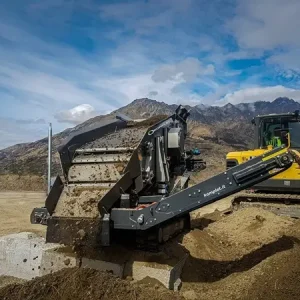
Crushed material feeds a Kompatto vibrating scalping screen for separation into spec sizes. The Kompatto 5030 — Komplet’s best-selling screener — converts hydraulically between 2-way and 3-way split, producing 3 saleable spec sizes (e.g., 3/4″ base + 1-1/2″ drainage + oversize) from a single pass.
Step 5: Stockpiling and Disposition
Each spec size goes to its own stockpile, ready for sale to contractors, road builders, drainage installers, or use directly on the same project. Recovered rebar goes to a scrap recycler. Fines (under 1/4″) serve as low-cost fill or compacted base material.
Same Workflow Handles Asphalt
The same K-JC 704 PLUS + Kompatto 5030 combination that crushes and screens concrete also handles asphalt. Typical asphalt feed: full-depth pavement removal (slabs of cured asphalt), milling material from cold planing, or chunked asphalt from parking lot resurfacing. Output: spec-sized RAP for sale to hot-mix plants, cold-patch material, base aggregate, or drainage applications. Multi-material flexibility from a single equipment setup.
The Business Case for On-Site Concrete and Asphalt Recycling
Avoided Tipping Fees
Concrete and asphalt to landfill or C&D recycler: typically $50-$100+/ton tipping fees in major metros. A demolition project producing 500 tons of concrete and asphalt: $25,000-$50,000+ in dump-fee avoidance from on-site processing. This is usually the largest single economic driver.
Recovered Material Revenue
RCA sales: typically $15-$30/ton depending on spec size and region. RAP sales: typically $5-$20/ton. Recovered ferrous metal: $100-$300+/ton. For a 500-ton concrete and asphalt project, recovered material revenue typically runs $5,000-$15,000+ on top of dump-fee avoidance.
Project Schedule Compression
On-site crushing eliminates haul-out trips, dump-waiting time, and aggregate-purchase delivery scheduling. Demolition projects with on-site recycling typically complete 10-30% faster than haul-out alternatives. Faster projects mean lower overhead absorption and faster crew rotation to the next contract.
Equipment Financing Math
Komplet Capital offers 24-hour approval, 100% financing, and 3-6 year terms. Many contractors structure the financing so monthly payments are fully covered by avoided dump fees alone — meaning the equipment has $0 net operating cost while producing additional revenue from RCA and RAP sales. Section 179 tax deduction up to $1.22M (2024 limit) applies to new equipment purchases.
Ownership vs. Rental: When Does Each Make Sense?
Rental: Project-Based Operations
Contractors with intermittent demolition projects, seasonal work, or testing the on-site recycling business case typically start with rental. Daily, weekly, or monthly rental rates avoid capital commitment while letting you experience the operational reality. Many rental programs include rent-to-own conversions where rental payments credit toward eventual purchase.
Ownership: Sustained Recycling Operations
Operations producing 500+ tons/month of concrete and asphalt typically reach the cost-effectiveness threshold for ownership. At that volume, rental rates compound to exceed ownership cost within 12-24 months. Owned equipment is also available 24/7 without scheduling constraints, supporting time-sensitive demolition project timelines.
Hybrid: Owned Crusher + Rental Screener (or Vice Versa)
Some operations buy the higher-utilization machine and rent the supplementary one. A demolition contractor crushing every project might own the K-JC 704 PLUS but rent the Kompatto 5030 only for projects requiring screening. Capital-efficient if utilization patterns differ between machines.
Frequently Asked Questions
Can a jaw crusher handle reinforced concrete with rebar?
Yes. The K-JC 604, K-JC 704 PLUS, and K-JC 805 all include the hydraulic magnetic belt as standard equipment. The belt lifts rebar off the discharge conveyor into a separate clean pile during crushing. The reverse jaw function clears any uncrushable material that enters the chamber. These features make Komplet jaws specifically suited to demolition concrete with embedded reinforcement. Recovered rebar typically sells for $100-$300+/ton as scrap.
How does a mobile jaw crusher handle asphalt in hot weather?
Hot asphalt tends to gum up jaw plates. Best practices: crush in the cooler part of the day when possible, reduce feed rate slightly during peak heat, run brief cooling periods between sessions if buildup occurs, and clean jaw faces during scheduled service. Komplet jaw crushers handle asphalt across normal temperature ranges with adjustable settings; extreme heat conditions may require operational adjustments.
What size aggregate can a jaw crusher produce?
Output is set by the closed-side setting (CSS) and the screen mesh installed on the downstream screener. Typical jaw crusher output is 3-6″ pieces. Pairing with a Kompatto vibrating scalping screen produces multiple spec sizes simultaneously: 3/4″ minus base, 1-1/2″ drainage, #57 stone, fines, and oversize. For sub-1″ cubical aggregate (concrete or asphalt mix designs), add a K-IC 70 impact crusher between the jaw and the screener.
What’s the difference between a mobile and stationary jaw crusher?
Mobile jaw crushers (Komplet’s lineup) are self-propelled tracked machines with onboard diesel engines. They drive between job sites and process material on the spot. Stationary jaw crushers are fixed industrial installations with electric motors that require external power and dedicated infrastructure. For contractor-scale demolition recycling, mobile is the right answer — material comes to the demolition site, not the other way around.
Can the same jaw crusher handle both concrete AND asphalt?
Yes. Komplet jaw crushers are designed for multi-material flexibility. The same K-JC 704 PLUS that crushes demolition concrete also crushes full-depth asphalt pavement, asphalt millings, natural rock, brick, and masonry. Switching between materials may require minor CSS adjustments and brief cleaning between sessions, but the same equipment serves both materials.
How much can I save by recycling concrete and asphalt on-site?
Typical savings: $50-$100/ton in avoided tipping fees, plus $5-$30/ton in recovered material revenue, plus 10-30% project schedule compression. For a 500-ton project, total economic benefit typically runs $30,000-$65,000+ vs. haul-out disposal. Multiplied across an active demolition contractor’s annual project pipeline, the dollars become substantial — frequently sufficient to fully cover equipment financing payments.
How long does it take to set up a jaw crusher on a job site?
Under 30 minutes for a typical Komplet jaw crusher. The machine is self-propelled tracked with hydraulically folding conveyors and wireless remote control. One operator drives the machine into position, deploys conveyors, runs a brief warm-up, and starts feeding. The compact mobile design specifically supports moving between demolition sites with minimal setup time on each new project.
What’s the warranty on Komplet jaw crushers?
All new Komplet equipment comes with a 1-year / 1,000-hour warranty. Komplet America’s parts inventory is forecasted 12 months in advance, supporting fast wear-part availability when service items are needed. Authorized dealers across North and Central America provide local service support.
Final Thoughts
Concrete and asphalt are the two highest-volume recyclable materials in the construction industry — and jaw crushers are the equipment that turns demolition output into recycled aggregate revenue. The right jaw crusher handles real-world contaminated demolition feed (rebar, dirt, embedded metal), produces consistent spec output, complies with OSHA silica regulations out of the box, and integrates with downstream screening for multiple saleable spec sizes. The economics — avoided tipping fees, recovered material revenue, project schedule compression, and Section 179 tax treatment — favor on-site processing across a wide range of operation sizes.
Komplet America’s jaw crusher lineup — from the K-JC 503 for tight-access urban demolition through the K-JC 805 for high-volume aggregate work, plus the K-IC 70 impact crusher for premium cubical output — covers the full spectrum of contractor and aggregate-producer concrete and asphalt recycling operations. Browse the full crusher lineup and screener lineup or call us and we’ll help you spec the right combination for your operation.
Ready to Talk Concrete and Asphalt Recycling?
- Call (908) 369-3340
- Email [email protected]
- Schedule a demo or request a quote
- Find your local Komplet dealer for rental availability
- Ask about our 1-year / 1,000-hour warranty and equipment financing options
Never enough — that’s how we approach service, support, and helping you turn demolition concrete and asphalt into spec aggregate revenue.
Disclaimer: All cost, ROI, payback, dump fee, scrap pricing, and revenue figures in this article are illustrative examples based on sample assumptions about volume, regional pricing, material specifications, and market conditions. Actual results vary significantly by region, market, material type, equipment utilization, operator skill, financing terms, regulatory environment, and many other factors. Equipment pricing, tipping fees, RCA pricing, RAP pricing, scrap metal pricing, fuel costs, and interest rates all change over time and by location. Komplet America makes no guarantee, warranty, or representation of specific financial performance, payback timelines, or business outcomes for any particular operation. For current pricing and a payback estimate based on your specific volume, material, and local market, contact us at (908) 369-3340 to speak with our team.