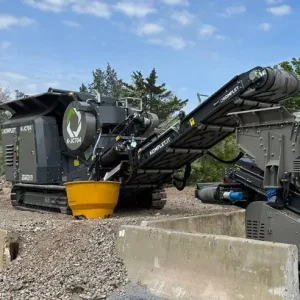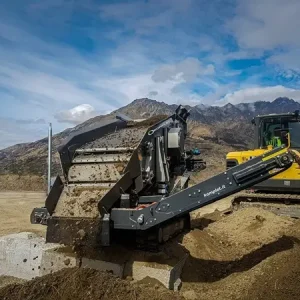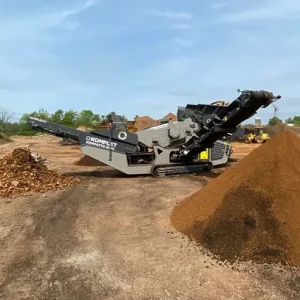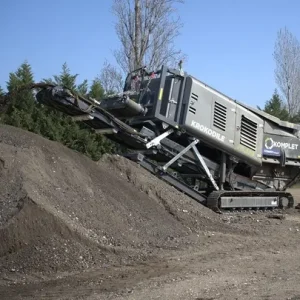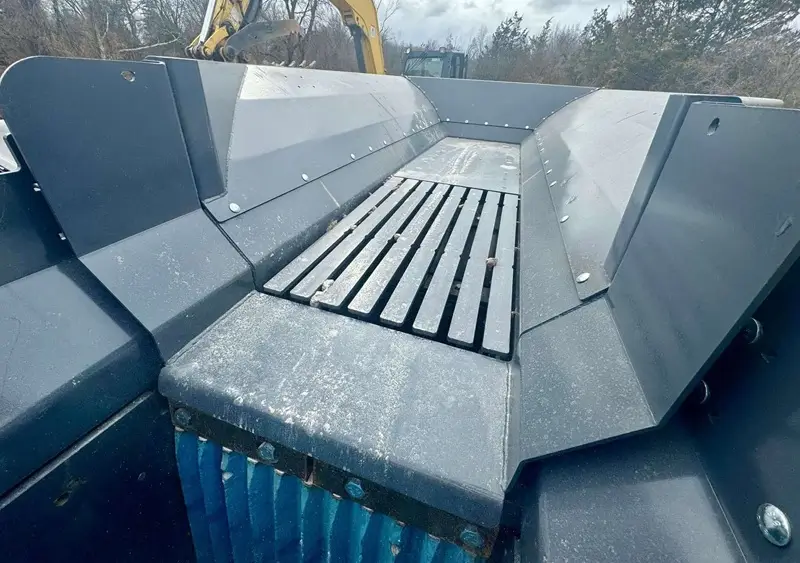

Feed size limits are a function of jaw inlet dimensions. Material that exceeds the recommended max feed size either won’t enter the chamber, or will enter but hang at the top causing bridging that slows production and accelerates wear at the inlet edges. The recommended max feed sizes below are the practical limits for steady production — push past them and throughput drops while wear accelerates.
K-JC 503 Mini Jaw Crusher
- Jaw opening: 19″ × 12″
- Recommended max feed size: approximately 10″ minus
- Production capacity: up to 34 US tph
- Output range: 3/4″ to 3-1/4″ (hydraulically adjustable)
- Engine: 25 hp Tier 4 Final diesel
- Transport weight: 7,496 lb (towable behind a standard pickup)
- Best fit: pool, mason, basement waterproofing, landscaping, and hardscaping contractors processing residential and small-site concrete and masonry waste.
K-JC 604 Mobile Jaw Crusher
- Jaw opening: 23″ × 16″
- Recommended max feed size: approximately 14″
- Production capacity: up to 55 US tph
- Engine: 55 hp
- Transport weight: 19,400 lb
- Best fit: mid-size site contractors, paving and driveway contractors, municipal yard work, small-volume civil.
K-JC 704 PLUS Portable Jaw Crusher
- Jaw opening: 27″ × 16″
- Recommended max feed size: approximately 14″
- Production capacity: up to 90 US tph
- Engine: 74 hp Tier 4 Final
- Transport weight: 26,455 lb
- Komplet Connect remote monitoring: Standard
- Best fit: Komplet’s best-selling crusher; civil, road, bridge, demolition, and recycling spreads at contractor- and recycler-scale volume.
K-JC 805 Mobile Jaw Crusher
- Jaw opening: 31″ × 21″
- Recommended max feed size: approximately 18″
- Production capacity: up to 160 US tph
- Engine: 130 hp Tier 4 Final
- Best fit: the largest jaw in the lineup; rock quarry, large-recycling, and high-volume civil applications.
Note: “recommended max feed size” is not the same as “absolute maximum that will enter the jaw.” The recommended max feed size is the largest feed material that will process at steady production rates without causing bridging at the inlet, excessive jaw plate stress, or feed cycle delays. Material at or below the recommended size feeds smoothly. Material between the recommended size and the absolute jaw opening enters but slows production and accelerates wear.
For oversized feed material — large concrete chunks from heavy demolition, broken slab fragments above the recommended size, or masonry wall sections that won’t fit through the jaw — the answer isn’t to force them through a jaw crusher. The answer is upstream reduction with a Krokodile PLUS slow-speed shredder (with the C&D/asphalt shaft) or with a hydraulic breaker before crusher feed.
What Mobile Jaw Crushers Handle Well
Concrete (With or Without Rebar)
Concrete is the standard feed material for mobile jaw crushers — it fractures cleanly under compression, produces predictable output sizes, and is the largest single waste stream on most demolition and renovation projects. Komplet jaw crushers handle concrete with rebar via standard magnetic separation (standard on K-JC 604 and larger; optional on K-JC 503), recovering the ferrous rebar from the discharge stream. Recycled concrete aggregate (RCA) — typically sold as 2-inch minus, 3/4-inch minus, or #57 crushed concrete — is the resulting saleable product.
Asphalt
Asphalt fractures at the binder-aggregate interface under compression. Komplet jaw crushers handle asphalt alongside concrete, though for high-volume reclaimed asphalt pavement (RAP) reduction to spec-compliant aggregate for new asphalt mixes, the K-IC 70 compact impact crusher is engineered specifically for that workflow and produces better cubical output. The Krokodile PLUS with the C&D/asphalt shaft also handles asphalt at up to 175 US tph as a primary or secondary processing option.
Brick and Masonry Block
Brick and concrete masonry block fracture cleanly and process at near-peak production rates with relatively modest jaw plate wear. Brick and block streams are common in demolition and renovation work, often co-mingled with concrete in the same waste pile. Recovered brick has both salvage value (whole bricks for landscape or historic restoration markets) and crushed-aggregate value.
Natural Rock — Within Limits
Compact mobile jaw crushers like the Komplet lineup handle natural rock at small-quarry and rock-yard scales — limestone, sandstone, softer granites, and similar feed material. They are not engineered for industrial mining, large-scale quarry feed, or the hardest abrasive ores. The K-JC 805 is the largest jaw in the Komplet lineup and serves rock quarry applications, but Komplet’s positioning is compact, mobile, contractor- and recycler-scale equipment — not industrial-mining-scale.
Limestone, Sandstone, and Softer Sedimentary Rock
These softer rocks process at near-peak production with relatively low jaw plate wear. They are well within the operational comfort zone of compact mobile jaw crushers. For landscape contractors, hardscape contractors, and small site work involving sedimentary rock reduction, the K-JC 503 or K-JC 604 sized to project volume is typically the right fit.
Hard Rock: What Compact Mobile Jaw Crushers Can and Can’t Do
Hard rock — granite, basalt, quartzite, traprock, hardrock ores — is at the upper end of what compact mobile jaw crushers process. The crushers will reduce these materials, but jaw plate wear accelerates and production rates drop relative to softer feed materials. Three operating realities to understand:
Plate Wear Accelerates
Manganese steel jaw plates are designed to wear in. On softer feed material (concrete, asphalt, brick), a set of jaw plates may deliver thousands of operating hours. On hard granite or basalt, the same plates may deliver substantially fewer hours before requiring rotation or replacement. Operators processing hard rock daily should plan jaw plate inventory accordingly and confirm parts availability through the Komplet America parts and support team.
Production Rate Drops
“Up to 90 US tph” on a K-JC 704 PLUS is a best-case figure on clean concrete with optimal feed conditions. On hard granite at the same machine, real-world production may be meaningfully lower. “Up to” production figures across the Komplet lineup assume optimal feed material; harder rock means lower throughput on the same machine.
Industrial Mining Is Not the Komplet Use Case
Komplet equipment is engineered for compact, mobile, contractor- and recycler-scale work. The lineup serves rock quarry applications at the K-JC 805 size class and below — but it does NOT compete in large-scale industrial mining, ore extraction, or fixed-plant high-throughput operations. Operators with hard rock processing requirements at industrial scale should consult equipment categories outside Komplet’s positioning.
What Mobile Jaw Crushers Can’t Handle
Material outside the jaw crusher’s design envelope causes one of three failure modes: clogging (material doesn’t fracture, just deforms or wedges in the chamber), excessive wear (material that grinds rather than fractures), or actual damage (material that breaks something in the machine). Five categories to send elsewhere:
Wood, Drywall, Plastics, and Soft Mixed C&D Waste
This is the most common operating mistake. Demolition projects produce concrete and brick alongside wood framing, drywall, plastic siding, packaging, and other soft mixed waste — and operators sometimes try to feed all of it into the jaw crusher. Soft material doesn’t fracture under compression; it deforms, wedges in the chamber, and clogs the discharge. The fix is to separate the streams: hard mineral fraction goes to the jaw crusher; soft mixed C&D goes to the Krokodile PLUS slow-speed shredder with the wood/lightweight waste shaft. Many demolition operations run a Komplet jaw crusher and a Krokodile PLUS together to handle the entire waste stream.
Wet Clay, Mud, and Cohesive Soil
Wet cohesive material doesn’t fracture — it sticks. Clay, mud, wet topsoil, and similar cohesive material clog the jaw faces, wedge between the toggle and the swing jaw, and turn what should be a clean-fracture process into a dirty deforming process. For soil and cohesive material screening, a K-TS 30 or K-TS 40 trommel screener is the right tool — engineered to handle damp and cohesive material that would clog a vibrating screener or jaw crusher.
Thick Solid Metal
Magnetic separation handles ferrous rebar in concrete and similar embedded metal. The jaw crusher itself is not engineered to crush solid steel — structural beams, vehicle bodies, large machine components. Thick solid metal entering the jaw chamber will damage jaw plates, toggle, or the swing jaw. The Krokodile PLUS handles embedded metal in C&D streams (rebar, nails, fasteners) but is also not designed for thick solid metal stock.
Glass — In Quantity
Small amounts of glass embedded in C&D waste typically pass through without issue. Quantities of bulk glass (specialty recycling streams, broken architectural glazing in volume) are abrasive and produce uneven loading on the jaw plates. For dedicated glass recycling, specialty equipment outside the Komplet lineup is the right answer. Komplet does NOT compete in glass and ceramic specialty recycling.
Material Larger Than Recommended Max Feed Size
As covered above, feed material that exceeds the recommended max feed size for the specific machine bridges at the inlet, slows production, and accelerates wear at the inlet edges. The fix is upstream reduction — hydraulic breaker on demolition material, primary shredder pass through a Krokodile PLUS for very large concrete chunks, or sizing up to a larger jaw crusher.
Wear Patterns to Watch For by Material Type
Abrasive Material Wear
Sandstone, slag, high-silica feed material, and dirty concrete (concrete with embedded sand or aggregate fines) wear jaw plates through abrasion rather than impact. Visible wear pattern: smooth polishing of the jaw plate teeth, even erosion across the plate face, and loss of bite over time. Mitigation: rotate jaw plates per OEM intervals, inspect for wear during routine maintenance, keep replacement plates in inventory before they’re needed.
Hard Rock Impact Wear
Granite, basalt, and similar hard rock wear plates through impact — the plates take harder hits with each fracture cycle. Visible wear pattern: chipping or spalling at the plate teeth, faster overall plate erosion, and potential cracking on lower-quality replacement plates. Mitigation: use OEM jaw plates rated for the application, keep production rates within sustainable ranges (don’t push the machine past its design feed rate), and inspect after every shift on hard rock work.
Mixed Demolition Material Wear
Mixed demolition concrete (concrete with brick, mortar, embedded fines, and varied aggregate) wears plates at moderate rates with relatively predictable patterns. This is the standard wear profile for most contractors and the basis for typical jaw plate service intervals.
Embedded Metal Wear
Rebar in concrete is handled via magnetic separation and typically doesn’t reach the jaw plates. Larger embedded metal that escapes pre-feed sorting — wire rope, larger fasteners, structural rebar fragments — can localize wear or cause spalling. Mitigation: visual inspection of feed material before loading, magnetic separation properly maintained, and feed sorting on streams known to contain heavy metal content.
Where the Krokodile PLUS Fits in the Material Picture
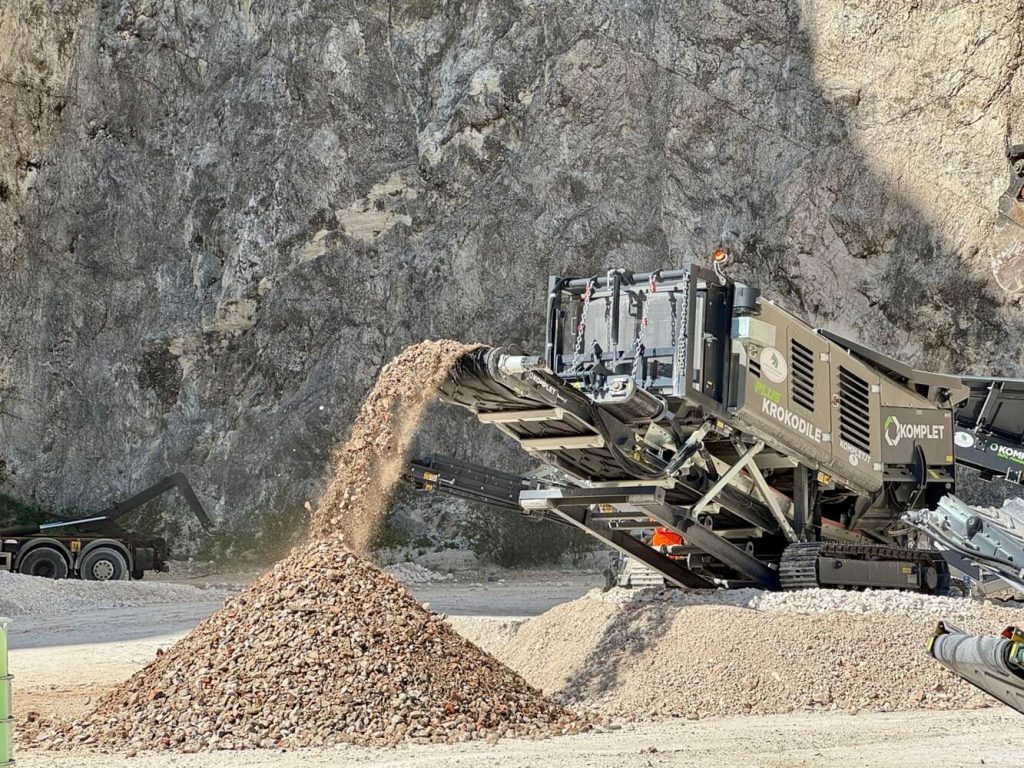
The Krokodile PLUS slow-speed shredder is the answer for material that’s outside the jaw crusher’s design envelope. It uses two parallel shafts at low RPM with high torque, fitted with interchangeable teeth sized for the material stream. Two shaft configurations cover the full range:
- C&D / Asphalt shaft — for concrete (with or without rebar), asphalt, brick, block, and rubble. Up to 175 US tph. Useful for primary reduction of oversized concrete before jaw crusher feed, or as a stand-alone solution for concrete and asphalt processing.
- Wood / Lightweight Waste shaft — for wood (including treated, painted, and metal-embedded), drywall, plastics, garbage, mixed C&D waste, and green compost material. Up to 19 US tph on mixed waste. The right tool for the soft-fraction material that jaw crushers can’t process.
Many demolition operations run a Komplet jaw crusher and a Krokodile PLUS together — the jaw crusher handles the hard mineral fraction (concrete, asphalt, brick) and the Krokodile PLUS handles the soft mixed-waste fraction (wood, drywall, plastics) with shaft changes between project phases as the material stream shifts. The shaft change is engineered as a quick-change operation, not a factory rebuild.
For operators trying to figure out whether a specific material stream belongs in a jaw crusher or a slow-speed shredder, the rule of thumb is: hard, brittle, and fits through the jaw opening = jaw crusher; soft, mixed, fibrous, or oversized = Krokodile PLUS.
Frequently Asked Questions
What’s the maximum feed size for a Komplet jaw crusher?
Recommended max feed sizes for the Komplet jaw crusher lineup: K-JC 503 approximately 10″ minus, K-JC 604 approximately 14″, K-JC 704 PLUS approximately 14″, and K-JC 805 approximately 18″. These are the practical maximums for steady production. Material between the recommended size and the absolute jaw opening will enter the chamber but slow production and accelerate wear; oversized material should be reduced upstream with a hydraulic breaker or a Krokodile PLUS slow-speed shredder.
Can a jaw crusher crush rebar-reinforced concrete?
Yes. Komplet jaw crushers process rebar-reinforced concrete with magnetic separation recovering the ferrous rebar from the discharge stream. Magnetic separation is standard on the K-JC 604 and larger units and optional on the K-JC 503. The fractured concrete becomes recycled concrete aggregate (RCA); the rebar is recovered as ferrous scrap with meaningful per-ton resale value.
Can I crush wood, drywall, or plastics in a jaw crusher?
No. Soft mixed C&D material (wood, drywall, plastics, garbage) doesn’t fracture under compression — it deforms and clogs the chamber. The right tool is the Krokodile PLUS slow-speed shredder with the wood/lightweight waste shaft, which is engineered specifically for this material stream. Many demolition operations run both: a jaw crusher for the hard mineral fraction and a Krokodile PLUS for the soft mixed-waste fraction.
Does Komplet equipment crush hard rock?
Compact Komplet jaw crushers handle hard rock at small-quarry and rock-yard scales — limestone, sandstone, softer granites, basalt at modest volume. The K-JC 805 is the largest jaw in the lineup and serves rock quarry applications. Komplet does NOT compete in industrial mining, large-scale ore extraction, or fixed-plant high-throughput hard-rock operations. For hard rock processing at industrial scale, equipment outside Komplet’s positioning is the right answer.
How fast do jaw plates wear out?
Jaw plate life depends heavily on material — soft concrete and brick may deliver thousands of operating hours per plate set, while hard granite or abrasive sandstone may deliver substantially fewer. OEM jaw plate replacement intervals are guidance based on typical material; operators processing heavier or more abrasive material should inspect more frequently and keep replacement plates in inventory through Komplet America’s parts and support team.
Why shouldn’t I crush wet clay or muddy soil?
Wet cohesive material doesn’t fracture under compression — it sticks to the jaw faces, wedges in the chamber, and clogs the discharge. For soil and cohesive material screening, a trommel screener (K-TS 30 or K-TS 40) is the right tool, engineered to handle damp and cohesive material that would clog a vibrating screener or jaw crusher.
Can a jaw crusher handle asphalt?
Yes. Komplet jaw crushers process asphalt alongside concrete and brick. For dedicated reclaimed asphalt pavement (RAP) reduction to spec-compliant aggregate for new asphalt mixes, the K-IC 70 compact impact crusher is engineered specifically for that workflow and produces better cubical output. The Krokodile PLUS with the C&D/asphalt shaft also handles asphalt at up to 175 US tph.
What’s the best material for a jaw crusher?
Concrete (with or without rebar), asphalt, brick, masonry block, and softer natural rock fall in the operational sweet spot — they fracture cleanly, produce predictable output sizes, and don’t accelerate jaw plate wear excessively. For most contractors, demolition concrete and brick are the highest-volume feed materials and the materials Komplet jaw crushers process most efficiently.
How do I know which Komplet jaw crusher fits my project?
Match the machine to feed size and annual volume. K-JC 503 (10″ max feed, up to 34 tph) for pool, mason, basement waterproofing, and landscaping/hardscaping at under 5,000 tons annually. K-JC 604 (14″ max feed, up to 55 tph) for mid-size site contractors at 5,000–30,000 tons. K-JC 704 PLUS (14″ max feed, up to 90 tph) for civil, road, bridge, and recycling at 30,000–100,000 tons. K-JC 805 (18″ max feed, up to 160 tph) for the highest-volume work at 100,000–300,000 tons. Komplet’s crusher comparison page covers full specs across the lineup.
Final Thoughts
Mobile jaw crushers are precision tools for specific material streams. Concrete, asphalt, brick, masonry block, and natural rock at the right feed sizes are the operational sweet spot — clean fracture, predictable output, manageable jaw plate wear, and saleable recycled material at the discharge. Material outside that envelope — soft mixed C&D, wet cohesive material, thick solid metal, oversized feed — needs different equipment, not harder feeding into the wrong machine.
The right operating posture is to match the material to the machine before the project starts. Hard mineral fraction within recommended feed size limits goes to the jaw crusher. Soft mixed C&D and oversized concrete go to the Krokodile PLUS slow-speed shredder. Wet cohesive soil and compost goes to a trommel screener. RAP that needs cubical output goes to the K-IC 70 impact crusher. When the material is matched to the machine, the equipment delivers near nameplate production, jaw plate wear stays predictable, and the project produces saleable recycled material instead of equipment downtime.
Komplet America builds compact crushers, screeners, the Krokodile PLUS slow-speed shredder, and the K-TC 460 tracked mobile conveyor for contractors who need real production in tight footprints. To see the full lineup, explore the crusher, screener, shredder, and conveyor categories. To talk financing or pricing, contact Komplet Capital, visit the contact page, or call (908) 369-3340.
Ready to match the right machine to your material?
- Browse the full Komplet crusher lineup — K-JC 503, K-JC 604, K-JC 704 PLUS, K-JC 805, and K-IC 70 — with full specs and feed size recommendations on each product page.
- For mixed C&D streams, review the Krokodile PLUS slow-speed shredder — quick-change shafts cover both concrete/asphalt and wood/drywall/plastics/mixed waste.
- For soil, compost, and cohesive material, the K-TS 30 and K-TS 40 trommel screeners handle what jaw crushers can’t.
- Talk to Komplet Capital about 100 percent financing, 24-hour approvals, and Section 179 tax deduction eligibility.
- Find your local Komplet dealer for rental availability and pre-purchase inspection.
Never enough.
Disclaimer: All operating, maintenance, and service guidance in this article is general in nature. Always refer to the official Komplet operator’s manual for the specific machine model and serial number, and follow OEM intervals and procedures. For warranty-protected work, contact Komplet America at (908) 369-3340 or your authorized Komplet dealer. Improper service or non-OEM parts may void warranty coverage and create safety hazards.
Disclaimer: Recommended max feed sizes, production capacities, jaw plate wear life, and material-handling guidance shown above are general guidance based on typical operating conditions. Actual feed limits, production rates, and wear life depend on specific material composition, hardness, moisture content, feed cycle pacing, operator efficiency, and machine condition. “Up to” production figures across the Komplet lineup describe best-case throughput on optimal feed material. Confirm feed size and material compatibility for any specific project with Komplet America at the time of equipment selection.
Disclaimer: Cost savings figures, payback timelines, financing rates, and ROI examples shown above (where applicable) are illustrative examples only. Actual results depend on jobsite material composition, local hauling and tipping rates, fuel and labor costs, equipment utilization, financing terms, regional regulatory requirements, and operator efficiency. Komplet America makes no guarantee of specific financial returns. The Komplet Capital financing calculator is for illustration purposes only and is not an approval or an offer to finance. Customers should perform their own analysis based on local market conditions and consult their tax advisor on Section 179 eligibility before making purchase decisions.
Equipment prices are subject to change based on dealer location, availability, and any additional features or customizations. Prices do not include taxes, shipping, or installation fees, which may apply depending on your region. Contact Komplet America at (908) 369-3340 or visit kompletamerica.com for current pricing.