
Jaw crushers and hammer mills are both used to reduce rock, concrete, and recyclable material — but they’re built for very different jobs. Using the wrong one chews through wear parts, eats horsepower, and leaves you with the wrong product on the stockpile.
This guide breaks down how each machine works, where each one wins, and — because many modern contractors are choosing a third option — how impact crushers fit into the comparison. By the end, you’ll know which crusher belongs on your next job.
What Rock Crushers Actually Do
Across mining, construction, demolition, and recycling, rock crushers serve three core purposes:
- Produce properly sized aggregate, ballast, or feedstock for downstream processing.
- Reduce blasted or demolished material to a size that can be conveyed, hauled, or stockpiled.
- Prepare ore or other material for further size reduction in a secondary or tertiary stage.
The right crusher for your operation depends on what you’re feeding it (hard vs. soft, abrasive vs. brittle, clean vs. contaminated), what output size and shape you need, and how much material you need per hour. Jaw crushers and hammer mills use fundamentally different mechanics to do this job.
Jaw Crushers: How They Work and Where They Win
Jaw crushers use compression. A movable jaw swings toward a fixed jaw, and the material caught between them is squeezed until it fractures. It’s the same principle as crushing a soda can between your palms — steady pressure, forced along the material’s weakest points.
Jaw crushers almost always handle the primary stage — the first reduction of large feedstock. They’re the industry workhorse because they handle the widest range of materials, including hard abrasive ones like:
- Granite and basalt
- Reinforced concrete (including rebar)
- Natural river rock and fieldstone
- Asphalt
- Glass, porcelain, and ceramic
- Iron ore and other mined feedstock
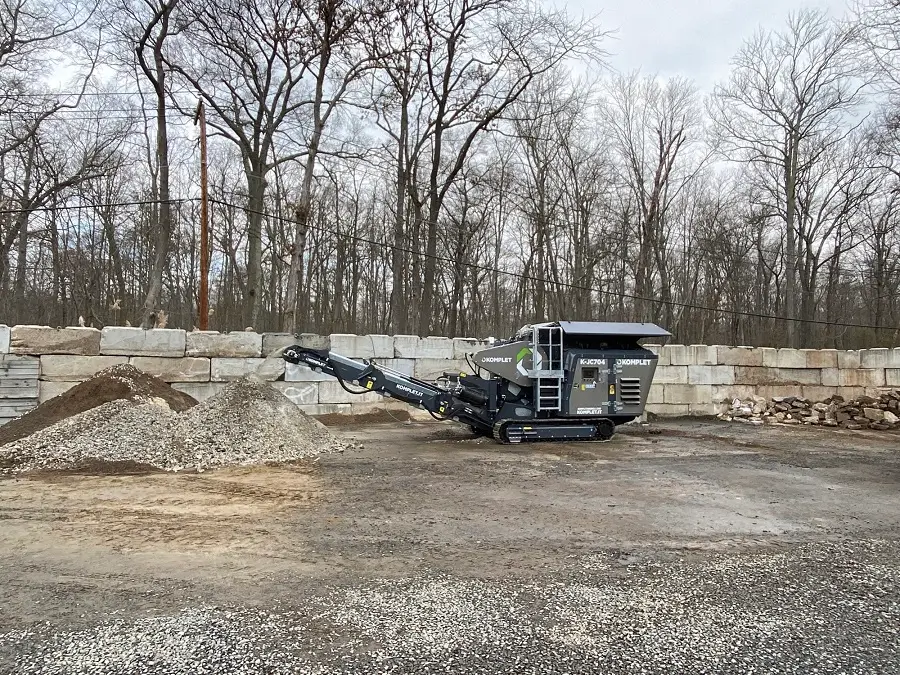
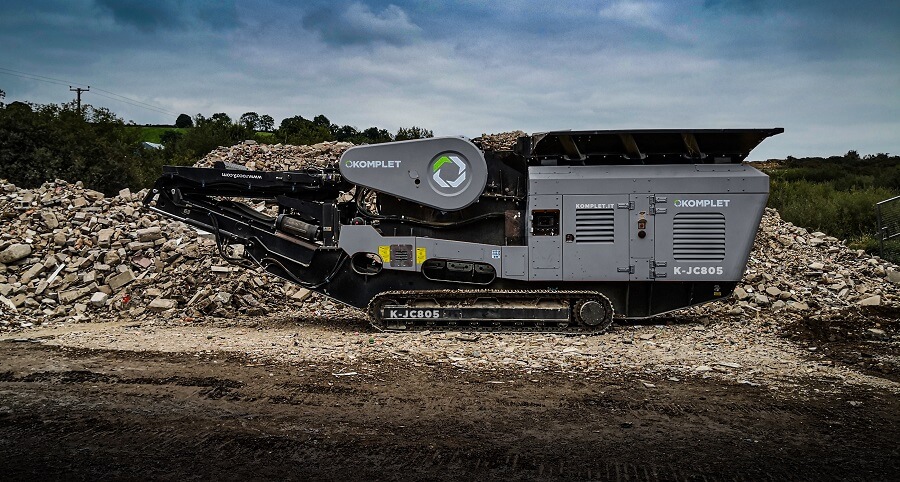
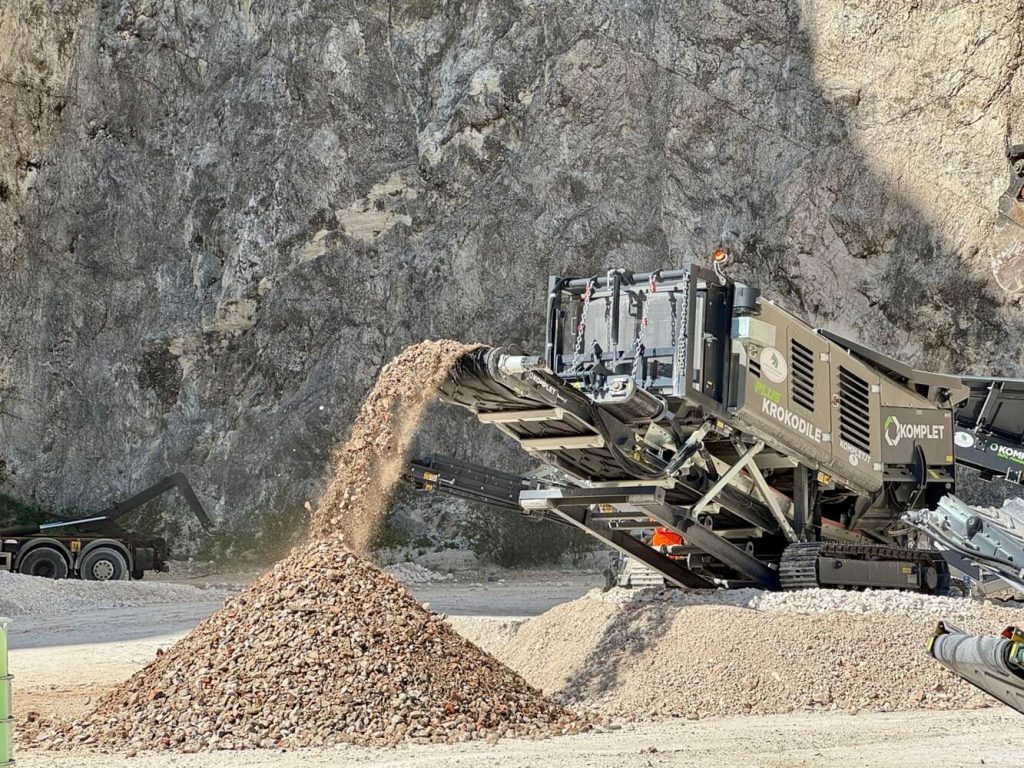
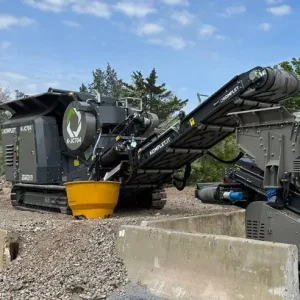
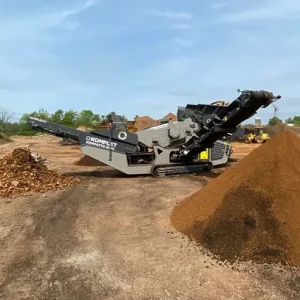
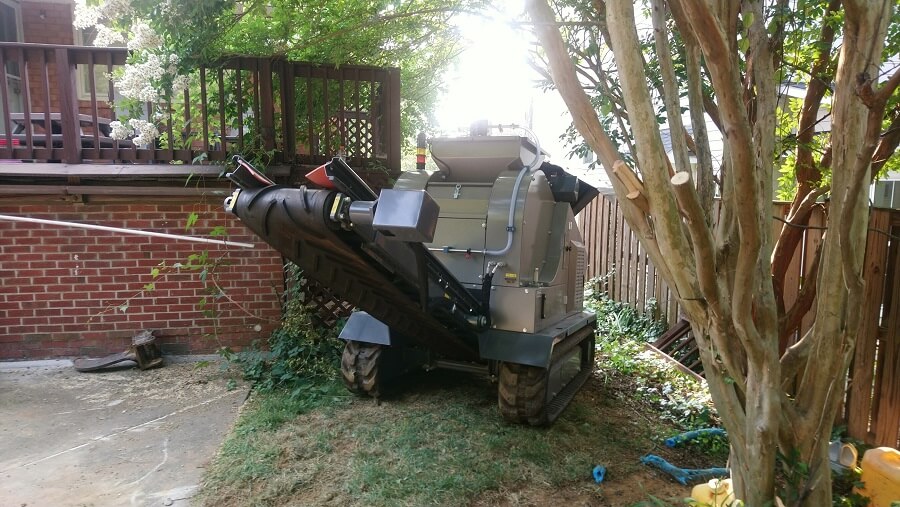
Compact mobile jaw crushers — like Komplet’s K-JC 503, K-JC 604, K-JC 704 Plus, and K-JC 805 — offer mobility on tight demolition sites and in confined quarry spaces. Depending on the model, they accept feed up to 16+ inches across and reduce it to ¾-inch to 3½-inch output in a single pass — the ideal size for downstream screening, further crushing, or direct use as road base or fill.
Jaw Crusher Strengths
- Handles the hardest and most abrasive materials
- High reduction ratio in a single stage
- Simple, rugged design with fewer moving parts
- Lower operating cost per ton on hard rock and concrete
- Mobile models move between sites on a standard trailer
Jaw Crusher Trade-offs
- Output particle shape is less cubical (more elongated pieces)
- Higher vibration than some alternatives
- Not ideal when the goal is fine, spec-shape aggregate
Hammer Mills: How They Work and Where They Win
Hammer mills use impact — not compression. Inside the crushing chamber, a rotor spins at high speed with hammers attached to it. As material enters, the hammers strike it repeatedly, shattering it against fixed breaker plates or a screen grate until the pieces are small enough to pass through.
Hammer mills excel with brittle, low-abrasive materials. The repeated impact tends to break these materials along their natural fault lines, producing more cubical shapes and a higher reduction ratio than compression crushers can achieve on the same feed. Typical hammer mill applications include:
- Limestone, sandstone, and other sedimentary rock
- Glass, tile, and ceramic recycling
- Brittle coal and gypsum
- Light concrete where abrasion is not severe
- Feed preparation for mineral processing
Hammer Mill Strengths
- High reduction ratio on brittle material
- Produces more cubical particle shape
- Simple internal structure
- Good throughput on the right feedstock
Hammer Mill Trade-offs
- Rapid wear on hard or abrasive material (hammers erode fast on granite or reinforced concrete)
- Screens can clog with damp or sticky feed
- Not well suited to feed containing rebar or other hard contaminants
- Hammer and screen replacement is labor-intensive compared to jaw plate service
Note: Komplet America’s current product line focuses on jaw and impact crushers designed for mobile on-site work. If your application genuinely calls for a hammer mill, we’d rather point you to the right machine than sell you the wrong one. But for most contractors who are weighing their options, you’ll find that a jaw crusher or an impact crusher — or the two working together — solves the problem more cost-effectively. More on that in the next section.
The Third Option: Where Impact Crushers Fit
Most contractors weighing “jaw crusher or hammer mill” are actually trying to balance two needs: reducing tough feed material AND producing good product shape. For that specific tradeoff, a modern compact impact crusher often wins over both options.
Impact crushers — specifically horizontal shaft impactors (HSI) — use the same high-speed-rotor concept as hammer mills, but with blow bars instead of hammers, and an adjustable impact-plate (apron) geometry. The result: cubical product shape like a hammer mill, better handling of moderate abrasion, and higher throughput of concrete and asphalt than a hammer mill delivers.
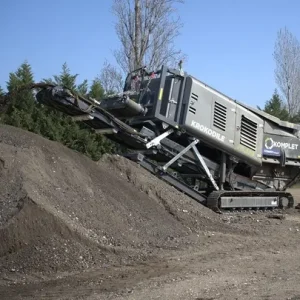
The Komplet K-IC 70 — Komplet’s first compact tracked impact crusher, launched at World of Concrete — is purpose-built for asphalt recycling, concrete recycling, and softer rock on tight job sites. It delivers the cubical shape and high reduction ratio contractors traditionally went to hammer mills for, in a mobile, track-mounted package.
Which Crusher Should You Pick?
Pick a Jaw Crusher If:
- Your feed includes hard, abrasive rock (granite, basalt, fieldstone)
- You’re crushing reinforced concrete with rebar
- You need a primary crusher that handles mixed C&D debris
- You want the lowest operating cost per ton
- Mobility between multiple job sites matters
Pick a Hammer Mill If:
- You’re crushing brittle, low-abrasive feed (limestone, sandstone, glass, ceramic)
- Your feed is clean (no rebar, no steel contamination)
- You need a high reduction ratio in a single stage
- The application is stationary and material is consistent
Pick an Impact Crusher If:
- You’re recycling asphalt or softer concrete
- Cubical product shape matters for your spec
- You want higher reduction ratio than a jaw in a mobile machine
- Your feed is relatively clean (or you pre-screen for metals)
Pick a Combination If:
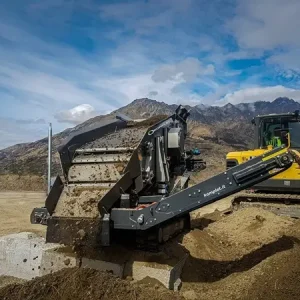
Many operations benefit from a primary jaw + secondary impact setup. The jaw crusher handles the initial reduction of hard or mixed material, then the impact crusher shapes the output into spec aggregate. Pairing a Komplet jaw crusher with the K-IC 70, plus a mobile scalping screener — the Kompatto 5030 for most contractor operations, or the Kompatto 124 for higher-throughput demolition and recycling work — is a proven workflow for producing saleable material.
Frequently Asked Questions
Can a jaw crusher replace a hammer mill?
For hard and abrasive feed — yes, easily. For brittle, low-abrasive material where you need a very high reduction ratio in one stage, a hammer mill still has an edge on specific applications. For most contractor and recycling work, a jaw crusher (or a jaw-plus-impact combination) does the job more reliably and with lower wear costs.
Why can’t a hammer mill handle reinforced concrete?
Rebar, scrap metal, and other hard contaminants destroy hammer mill internals quickly. Hammers, screens, and grates wear out fast or get damaged on impact with steel. Jaw crushers handle rebar-laden concrete routinely — the steel passes through and can be magnetically separated from the output.
What’s the difference between a hammer mill and an impact crusher?
Both use a high-speed rotor and impact force. Hammer mills typically use pivoting hammers and a screen or grate at the bottom to control output size. Impact crushers use fixed blow bars on the rotor with adjustable impact plates (aprons) around it — no bottom screen. Impact crushers generally handle larger feed and more abrasive material than hammer mills, and they’re more common in mobile crushing setups.
Can one crusher handle both concrete and asphalt?
A jaw crusher handles both, though it produces cleaner results on concrete. An impact crusher handles both, with cleaner results on asphalt. If you regularly switch between the two, either machine works — the “better” choice depends on which material you crush more often.
What size feed can a compact jaw crusher accept?
Depends on the model. Komplet’s compact jaw crushers typically accept feed up to 16+ inches across in their larger models — enough for most demolition debris, concrete slabs, and blasted rock on contractor-scale operations.
Final Thoughts
Jaw crushers and hammer mills are both useful — for different jobs. Jaw crushers dominate primary crushing for hard, abrasive, mixed-debris feed. Hammer mills shine on clean, brittle, low-abrasive material where high reduction ratios matter in a single stage. For many modern contractors, a compact impact crusher fills the gap between them — delivering cubical product shape without the wear cost of running a hammer mill on the wrong feed.
Komplet America offers a complete line of compact, mobile crushers, screeners, shredders, and conveyors designed for contractors, demolition crews, and recyclers who need to turn waste streams into revenue streams — right on the job site.
Ready to Find the Right Machine?
- Call 908-369-3340
- Email [email protected]
- Schedule an in-person demo or request a quote
- Ask about our 1-year / 1,000-hour warranty and equipment financing options
Never enough — that’s how we approach service, support, and helping you get the right machine for the job.