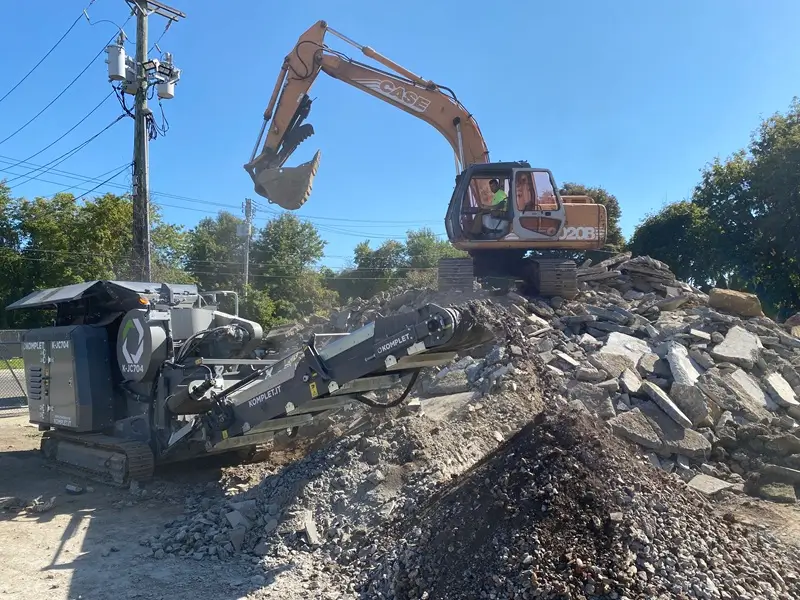

This guide is written for professional concrete demolition operations — demolition contractors, road builders, excavation companies, paving operations, parking lot rebuilders, and concrete recyclers. Breaking up concrete at commercial scale is a different operation than DIY backyard slab removal: it involves hydraulic breakers (not handheld jackhammers), staged workflow (break, separate, crush, screen), regulatory compliance (OSHA silica, waste-diversion mandates), and business economics (avoided dump fees, recovered material revenue) that fundamentally change how the work gets approached.
Below: the actual professional workflow for breaking up concrete and turning it into spec recycled aggregate (RCA), the equipment that handles each stage, and how Komplet America’s compact mobile crusher and screener lineup fits into commercial-scale concrete demolition operations.
Two Different Operations: Breaking and Crushing
Professional concrete demolition is two distinct operations, often handled by different equipment.
Breaking is the structural-demolition step. Existing concrete (slabs, foundations, walls, pavement, structural elements) gets fractured into pieces small enough to handle, transport, and feed into a crusher. The breaking equipment of choice is an excavator-mounted hydraulic breaker — not a handheld jackhammer.
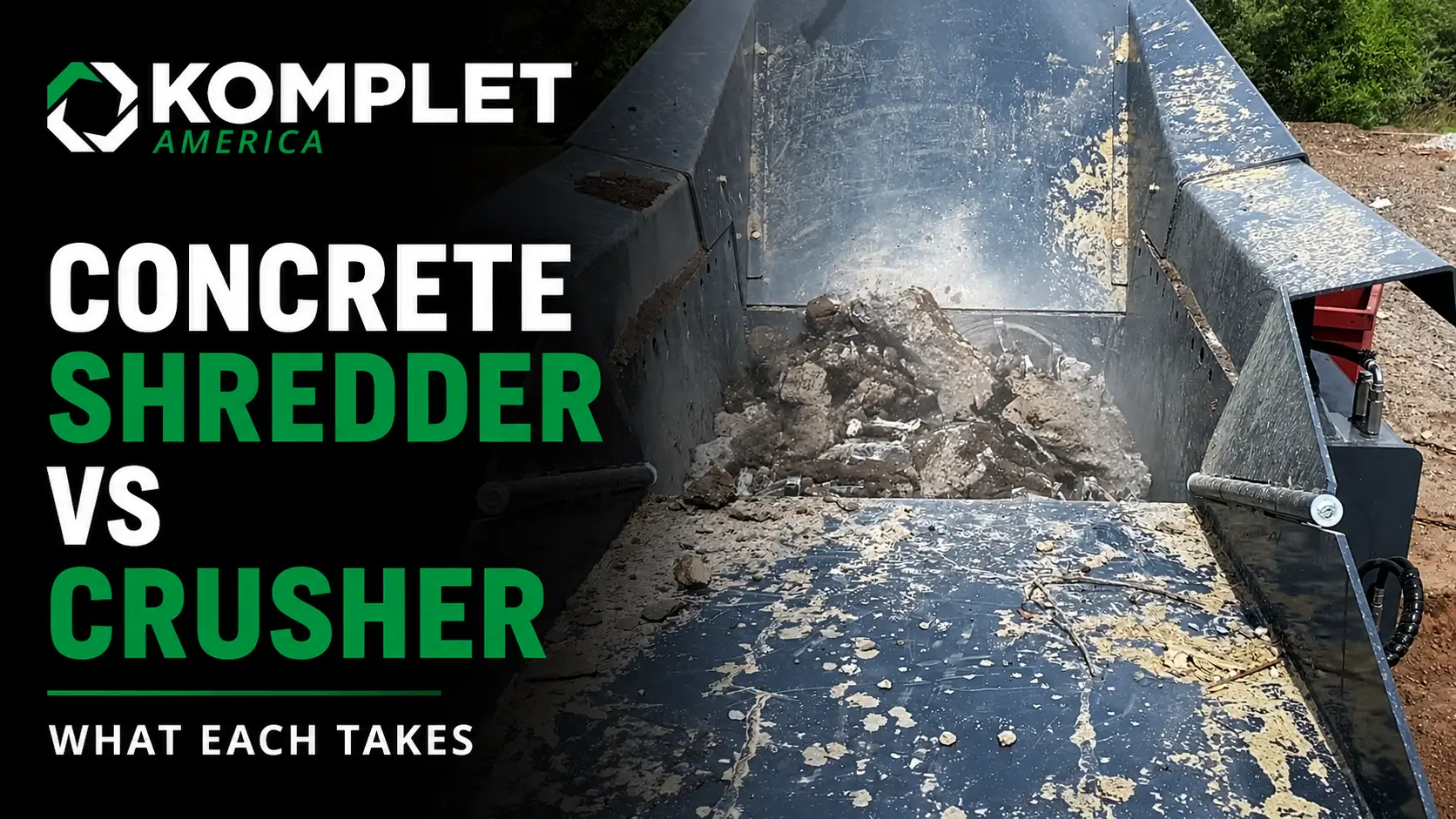
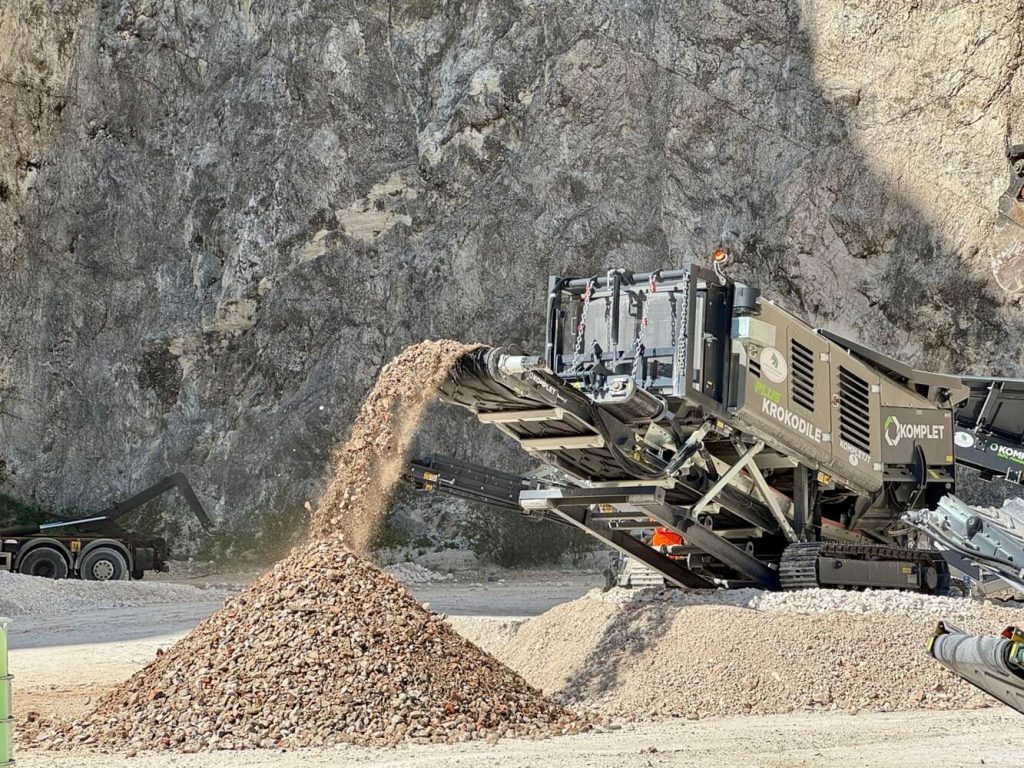
Crushing is the size-reduction step that turns broken concrete into saleable spec aggregate. A compact mobile jaw crusher reduces broken concrete to 3-6″ pieces; downstream screening separates the output into spec sizes (3/4″ base, 1-1/2″ drainage, #57 stone, fines, oversize) ready for resale or on-site reuse.
Some smaller demolition operations rent both stages on-demand. Operations doing concrete demolition regularly typically own at least the crushing equipment (rebuilds capital quickly through avoided dump fees) and may own the breaking equipment as well or contract excavator services with breakers attached.
Stage 1: Breaking Up the Concrete Structure
Hydraulic Breakers (Excavator-Mounted)
The standard professional tool for breaking concrete at scale is a hydraulic breaker (also called a hoe ram, rock hammer, or hydraulic hammer) attached to an excavator’s boom. The excavator positions the breaker; the breaker delivers high-impact percussion through a steel chisel point that fractures concrete on contact.
Advantages over handheld jackhammers: roughly 50-200x more impact energy per blow; reach extends 30+ feet from operator position; operator stays in the cab away from dust, vibration, and falling debris; no operator fatigue limitations on production rate. For commercial concrete demolition, an excavator with a hydraulic breaker is the right starting point.
Sizing the Breaker to the Job
Hydraulic breaker sizing depends on what you’re breaking. Light-duty breakers (200-1,000 ft-lb impact class) handle slab demolition, sidewalks, light foundations, and concrete up to roughly 6″ thick. Mid-duty (1,000-3,000 ft-lb) handles most building foundations, parking lot pavement, and structural elements up to 12″ thick. Heavy-duty (3,000+ ft-lb) handles bridge decks, mass concrete, mass walls, heavily reinforced structural elements, and concrete over 12″ thick. Match the breaker class to the heaviest concrete you’ll encounter on the job.
Pre-Cutting With a Diamond Saw (When Specified)
Some demolition specifications require precise cuts to preserve adjacent structures or limit disturbance areas. Diamond-saw cuts (wet or dry) score the concrete along controlled break lines before hydraulic breaking. The breaker then fractures along the saw cuts predictably, leaving clean edges. Common in renovation work, partial-removal projects, and demolition adjacent to structures that must remain intact.
Wreckling Balls and Cranes (Specialized Use)
Traditional wrecking-ball demolition (cable-suspended steel ball swung against the structure) still has applications for heavy mass-concrete demolition where access supports it. Less common than excavator-mounted breakers in modern North American practice; remains in use for specific industrial demolition scenarios.
Explosive Demolition (Highly Specialized)
Bridge piers, large industrial structures, and high-rise demolition sometimes use controlled explosive demolition. Requires licensed blasting contractors, regulatory permits, neighborhood notification, and post-blast structural cleanup. Not a standard tool for typical commercial concrete demolition; mentioned for completeness.
Stage 2: Pre-Processing Before Crushing
Sizing for the Crusher Feed
Broken concrete pieces need to fit the crusher’s feed opening. For Komplet’s lineup: K-JC 503 = ~10″ max feed; K-JC 604 = ~14″; K-JC 704 PLUS = ~14″; K-JC 805 = ~18″. Pieces larger than these limits need additional breaking with the hydraulic breaker before feeding the crusher.
Removing Easy Contaminants
Some materials should be separated from the concrete BEFORE crushing rather than relying on downstream separation. Salvageable copper plumbing, copper wire, salvageable structural steel, large foreign objects (HVAC ductwork, electrical panels) all get pulled out at the site by demolition crew. The cleaner the feed entering the crusher, the higher the throughput, the longer the wear-part life, and the cleaner the resulting RCA.
Rebar Stays In
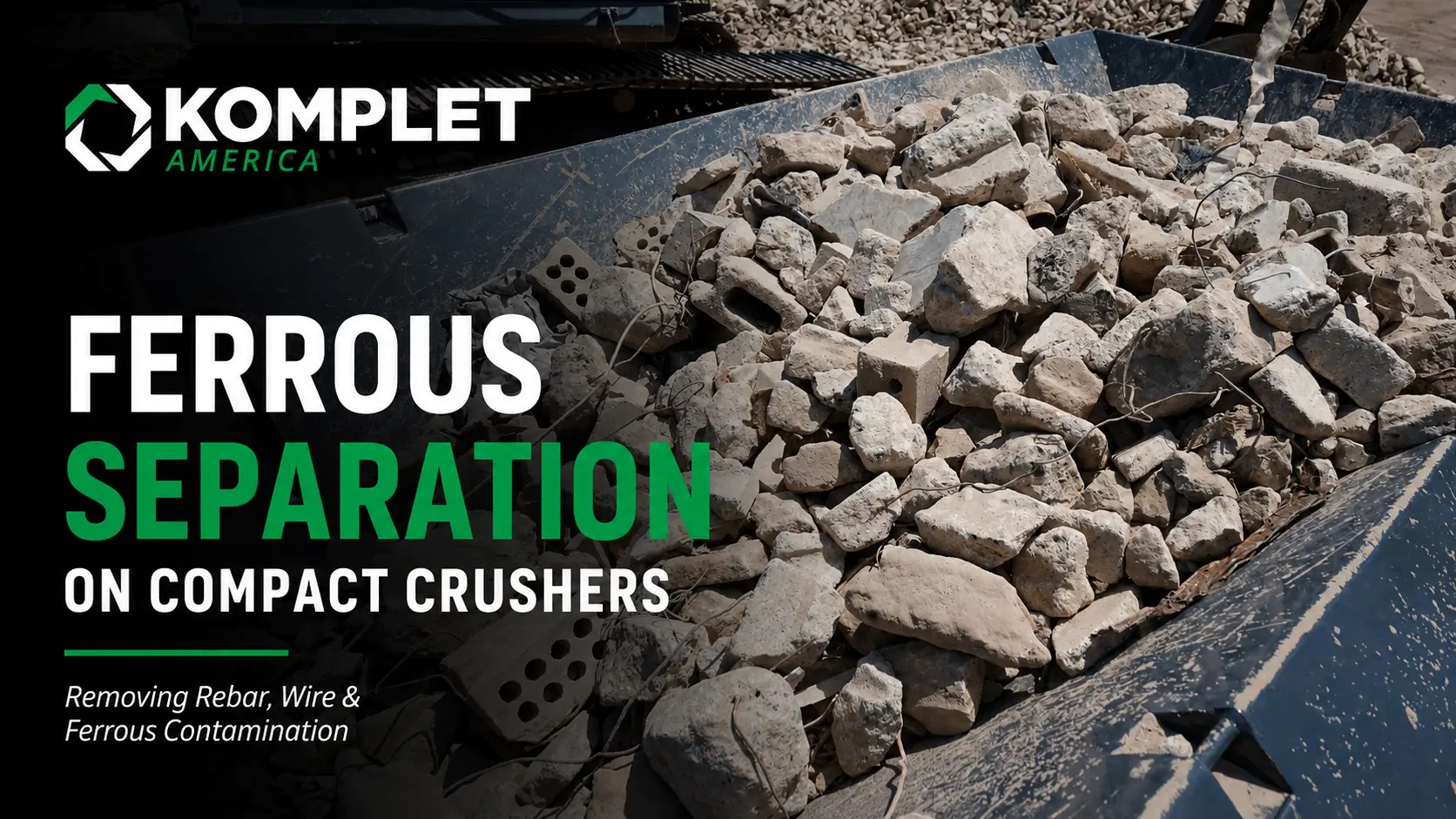
Rebar typically does NOT get removed before crushing. Modern Komplet jaw crushers handle reinforced concrete with embedded rebar — the integrated hydraulic magnetic belt lifts ferrous metal off the discharge conveyor into a separate clean pile during crushing. Manual rebar removal slows demolition and is unnecessary when the crusher has integrated magnetic separation.
Stage 3: Crushing With a Compact Mobile Jaw Crusher
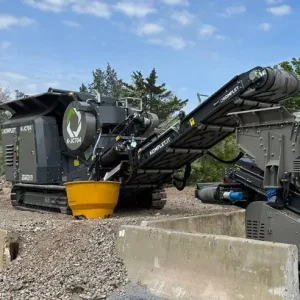
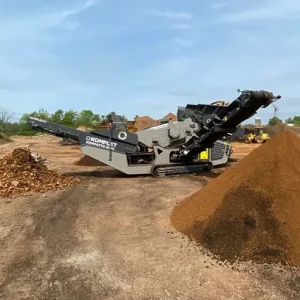
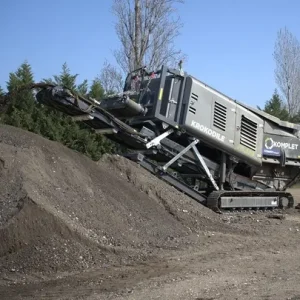
Komplet America’s Jaw Crusher Lineup
- K-JC 503 — up to 34 US tph, 19″ x 12″ jaw, 25 HP, ~7,496 lb. Tightest-access tracked machine; built for urban demolition and small contractor operations.
- K-JC 604 — up to 55 US tph, 23″ x 16″ jaw, 55 HP, ~19,400 lb. Mid-range mobile crusher with magnetic separation.
- K-JC 704 PLUS — up to 90 US tph, 27″ x 16″ jaw, 74 HP, ~26,455 lb. Komplet’s best-selling crusher and the workhorse for typical commercial concrete demolition operations.
- K-JC 805 — up to 160 US tph, 31″ x 21″ jaw, 130 HP, ~49,600 lb. Largest jaw crusher in Komplet America’s lineup, for high-volume demolition operations and aggregate producers.
Critical Crusher Features for Concrete Work
Three features matter most for breaking up concrete at scale:
- Hydraulic magnetic belt (standard on K-JC 604, K-JC 704 PLUS, K-JC 805) — lifts rebar and ferrous metal off the discharge conveyor into a separate clean pile. Without this, you spend time manually removing metal from the output stream.
- Reverse jaw function — if uncrushable material enters the chamber, the operator reverses the jaw via wireless remote and clears the obstruction in seconds. Without this, an uncrushable jam means hours of manual cleanout.
- Standard dust suppression — water-spray system runs automatically from a garden-hose connection. Required for OSHA crystalline silica compliance (PEL of 50 ug/m3 over 8 hours). Connect water, system runs.
Stage 4: Screening Into Spec Sizes
Crushed concrete leaves the jaw crusher as a mix of sizes (typically 3-6″ pieces with fines). To produce saleable RCA, the output goes through a vibrating scalping screen that separates the mix into spec sizes.
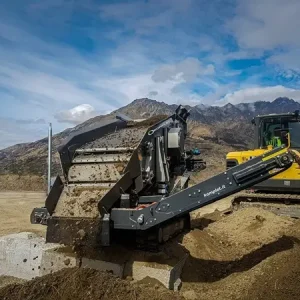
Komplet’s Vibrating Scalping Screen Lineup
- Kompatto 221 — up to 90 US tph, two-deck. Compact tracked screener for smaller operations.
- Kompatto 5030 — up to 280 US tph, heavy-duty double-deck with hydraulic conversion between 2-way and 3-way split. Komplet’s best-selling screener and the natural pair for the K-JC 704 PLUS.
- Kompatto 124 — up to 350 tph. Largest mobile scalping screen in Komplet America’s lineup.
Common RCA Output Specs
Typical commercial RCA spec sizes from a jaw + screener combination:
- Fines (under 1/4″) — low-cost fill, compacted base material
- 3/4″ minus base — road and parking lot base (highest-volume application)
- 1-1/2″ drainage — foundation drainage, French drains, septic field stone
- #57 stone (3/4″ to 1″) — drainage, decorative aggregate
- Oversize (over 2″) — riprap, large drainage stone, or feedback to crusher for further reduction
Safety and Regulatory Compliance
OSHA Crystalline Silica Compliance
OSHA’s respirable crystalline silica rule (PEL of 50 ug/m3 averaged over 8 hours) applies to concrete demolition operations. Concrete contains crystalline silica; breaking and crushing releases respirable particles. Compliance requires documented dust-control practices: water spray during breaking, water-spray dust suppression on the crusher (standard on Komplet jaw crushers), respiratory PPE for workers in proximity to dust generation, and exposure assessment documentation. Active OSHA enforcement carries meaningful penalties.
PPE Requirements
Concrete demolition operations require: hard hats, safety glasses or face shields, hearing protection (hydraulic breakers and crushers exceed 85 dB), high-visibility vests on active job sites, steel-toe boots, gloves, and respiratory protection in dust-exposed areas. Specific requirements scale with project conditions and applicable federal/state OSHA standards.
Site Containment
Active demolition sites need barricades, exclusion zones around breaker reach, traffic control where work happens adjacent to public roads, and dust containment to prevent migration to adjacent properties. Indoor or partially-enclosed concrete demolition adds ventilation requirements and material containment.
Waste-Diversion Mandates
Many state, county, and municipal jurisdictions mandate minimum C&D waste diversion percentages on construction and demolition projects (typically 50-75% diversion). On-site concrete crushing produces measurable, documented diversion that contributes to compliance — recovered RCA, recovered ferrous metal, and volume reduction all count toward diversion targets. LEED v4 also awards Materials and Resources credits for documented C&D waste diversion.
The Economics of On-Site Concrete Crushing
Avoided Tipping Fees
Tipping fees for concrete and C&D waste in major US metros routinely run $50-$100+ per ton. Hauling broken concrete to a recycler 20-50 miles away adds $10-$30/ton in transport. For a typical commercial demolition producing 500-1,000 tons of concrete, total disposal cost can run $30,000-$130,000. On-site crushing eliminates most of that.
Recovered Material Revenue
RCA sales: typically $15-$30/ton depending on spec size and region. Recovered ferrous metal: typically $100-$300+/ton. For a 500-ton demolition project, recovered material revenue typically runs $5,000-$15,000+ on top of dump-fee avoidance.
Project Schedule Compression
On-site crushing eliminates haul-out trips, dump waiting time, and post-demolition site cleanup time. Demolition projects with on-site recycling typically complete 10-30% faster than haul-out alternatives. Faster completion means lower overhead absorption and faster crew rotation to the next contract.
Equipment Financing Math
Komplet Capital offers 24-hour approval, 100% financing, and 3-6 year terms. Many demolition contractors structure equipment financing so monthly payments are fully covered by avoided dump fees alone. New equipment qualifies for Section 179 tax deduction up to $1.22M (2024 limit).
Frequently Asked Questions
Should I use a jackhammer to break up commercial concrete?
No — for commercial-scale work, a handheld jackhammer is the wrong tool. An excavator-mounted hydraulic breaker delivers 50-200x more impact energy per blow, extends reach, and keeps the operator out of the dust and vibration zone. Handheld jackhammers are appropriate only for very small projects (residential slab removal under 100 sq ft) or for trim work in hard-to-reach areas after primary breaking is complete.
Can I break up reinforced concrete with rebar in it?
Yes — and you don’t need to manually remove the rebar before crushing. Komplet jaw crushers (K-JC 604, K-JC 704 PLUS, K-JC 805) include integrated hydraulic magnetic belts that lift rebar off the discharge conveyor into a separate clean pile during crushing. The reverse jaw function clears any uncrushable material that enters the chamber. The combination handles reinforced demolition concrete without manual rebar removal.
How long does it take to break up and crush a typical commercial concrete project?
Highly variable based on project size, concrete thickness, equipment selected, and crew size. Reference points: a typical 5,000 sq ft commercial parking lot (6″ thick concrete) produces approximately 250 tons of demolition material; with an excavator-mounted hydraulic breaker plus a K-JC 704 PLUS jaw crusher and Kompatto 5030 screener, crews typically complete the breaking + crushing in 2-4 working days. Larger projects scale proportionally; smaller projects compress.
Do I need permits to break up concrete on a job site?
Demolition permits are typically required by local building authorities for commercial concrete demolition. Crushing for use on the same project (or a related project) is generally permitted under standard construction activities. Operating as a commercial recycler accepting outside material requires state-level permits in most jurisdictions. Consult your local building department and a local environmental attorney before launching commercial concrete recycling operations.
Can I rent the equipment instead of buying?
Yes. Komplet works through a dealer and rental network across North and Central America. Find your local Komplet dealer or call (908) 369-3340 to connect with a rental partner. Many partners offer rent-to-own arrangements where rental payments credit toward eventual purchase. Rental is typically the right starting point for contractors testing the on-site recycling business case before committing to ownership.
How thick of a concrete slab can a jaw crusher handle?
Concrete thickness matters less than the size of the broken pieces fed into the crusher. Once the hydraulic breaker has fractured the slab into pieces that fit the jaw opening (~14″ for K-JC 704 PLUS, ~18″ for K-JC 805), the crusher handles standard structural concrete thicknesses of 4″, 6″, 8″, 12″ and beyond. The breaking equipment has to handle the thickness; the crusher handles the resulting pieces.
How does on-site crushing handle OSHA silica compliance?
Concrete contains crystalline silica; breaking and crushing release respirable particles regulated by OSHA’s PEL of 50 ug/m3 averaged over 8 hours. Komplet jaw crushers ship with water-spray dust suppression as standard equipment. Connect a garden-hose water line, the system runs automatically, and the machine operates within OSHA limits. Documented dust-control practice is critical for any commercial concrete demolition operation.
Final Thoughts
Breaking up concrete at commercial scale is a four-stage operation: structural demolition with a hydraulic breaker, pre-processing to size and clean the feed, primary crushing with a jaw crusher, and final screening into spec sizes. Each stage has the right equipment, the right techniques, and the right regulatory considerations. The contractors making real money on concrete demolition are the ones who own the workflow end-to-end — capturing avoided dump fees, recovered material revenue, and project schedule compression that haul-out disposal alternatives surrender to recyclers downstream.
Komplet America’s compact mobile equipment lineup — jaw crushers from K-JC 503 through K-JC 805, the K-IC 70 impact crusher, and the Kompatto 221, 5030, and 124 vibrating scalping screens — covers commercial concrete demolition operations from tight-access urban work through high-volume aggregate-producer scale. Browse the complete equipment lineup or call us and we’ll help you spec the right combination for your operation.
Ready to Talk Concrete Demolition?
- Call (908) 369-3340
- Email [email protected]
- Schedule a demo or request a quote
- Find your local Komplet dealer for rental availability
- Ask about our 1-year / 1,000-hour warranty and equipment financing options
Never enough — that’s how we approach service, support, and helping commercial demolition contractors turn concrete demolition into spec aggregate revenue.
Disclaimer: All cost, ROI, payback, dump fee, scrap pricing, and revenue figures in this article are illustrative examples based on sample assumptions about volume, regional pricing, material specifications, and market conditions. Actual results vary significantly by region, market, material type, equipment utilization, operator skill, financing terms, regulatory environment, and many other factors. Equipment pricing, tipping fees, RCA pricing, scrap metal pricing, fuel costs, wear-part costs, and interest rates all change over time and by location. Komplet America makes no guarantee, warranty, or representation of specific financial performance, payback timelines, or business outcomes for any particular operation. For current pricing and a payback estimate based on your specific volume, material, and local market, contact us at (908) 369-3340 to speak with our team.