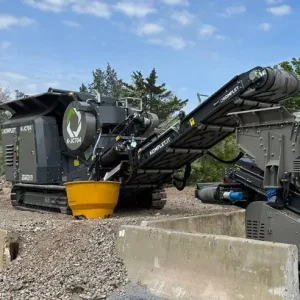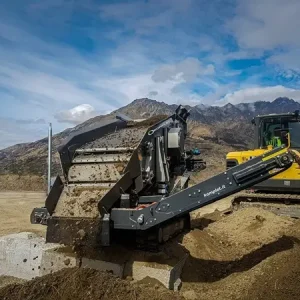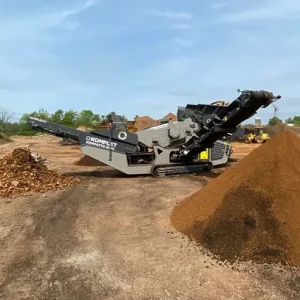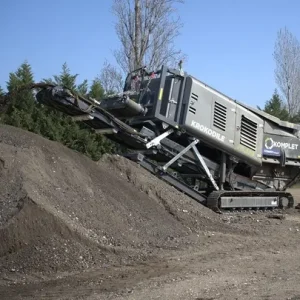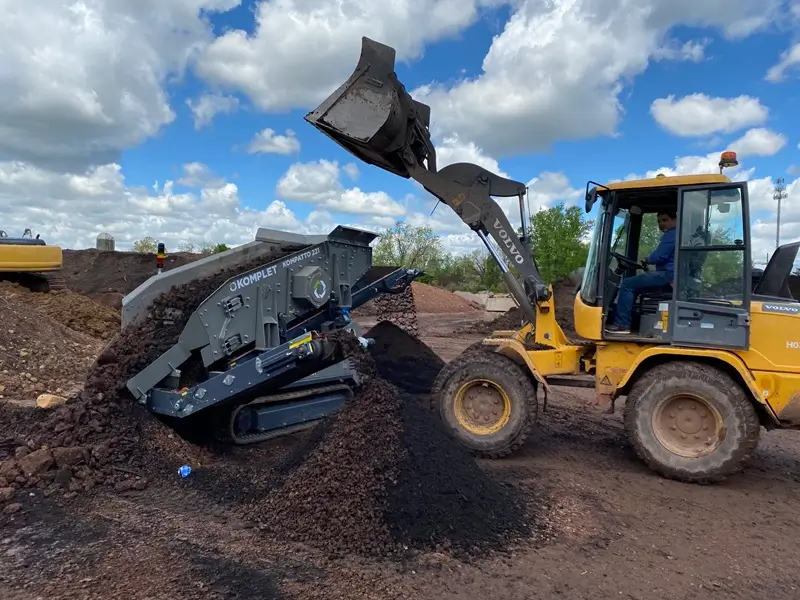

Portable screeners separate processed material into product cuts — typically 2-inch minus, 3/4-inch minus, #57 crushed concrete, and oversize for return to the crusher. Screeners do not crush; they sort what a crusher has already produced, or sort soil and compost into spec-graded product. The Komplet lineup covers both screening categories: Kompatto 221, Kompatto 5030, and Kompatto 124 vibrating scalping screens for crushed C&D material; K-TS 30 and K-TS 40 trommel screeners for soil, compost, and cohesive material that would clog a vibrating screener. The community-park outcome — clean recycled aggregate for park base courses, screened topsoil for planting beds, finished compost for landscape work — depends on selecting the right screener category for the right material stream.
This guide explains what portable screeners actually do, how they fit into the C&D recycling workflow alongside crushers, which Komplet model fits which application, and how the resulting screened products end up in community park construction, landscape work, and infrastructure projects across North and Central America.
What Portable Screeners Actually Do
“Screening” gets used loosely in equipment marketing. The technical reality is specific: a screener separates a feed material into different size fractions by passing it across a perforated screen surface or rotating drum. Material smaller than the openings drops through to a product cut; material larger than the openings passes over to a different cut or back to upstream processing. What a screener does NOT do is reduce material in size — that’s a crusher’s job. The screener sorts what’s already produced.
Two technologies in the Komplet lineup, each engineered for different material types:
Vibrating Scalping Screeners
Vibrating screeners use mechanically vibrated screen decks (one, two, or three deck levels) to separate dry, free-flowing material into product cuts. The vibration keeps material moving across the screen surface and prevents blinding (clogging of the screen openings). Vibrating screeners are the standard tool for separating crushed concrete, asphalt, brick, masonry, and rock into 2-inch minus, 3/4-inch minus, #57 crushed concrete, and other spec-graded aggregate cuts.
Trommel Screeners
Trommel screeners use a rotating drum with perforated walls. Material enters one end of the drum, tumbles as the drum rotates, and falls through the wall openings into product collection. The tumbling action handles damp, cohesive, or sticky material that would clog a vibrating screen — soil, compost, mulch, fines-heavy material, and green waste. Trommels are the right tool for soil and compost work; vibrating screeners are the right tool for crushed mineral material.
Picking the wrong screener type is one of the most common mistakes new operators make. Wet topsoil through a vibrating screener clogs the screen in minutes. Dry crushed concrete through a trommel is inefficient and slow. Match the screener to the material stream.
Where Screeners Fit in the C&D Recycling Workflow
On a complete on-site C&D recycling spread, the screener doesn’t work alone — it’s the second stage in a multi-step processing flow:
Step 1: Material Sorting
Demolition material on the project site is sorted by waste stream — hard mineral fraction (concrete, asphalt, brick, masonry block, rock) goes one way; soft mixed C&D fraction (wood, drywall, plastics, garbage, mixed waste) goes another way; clean fill and excavation soil goes a third way.
Step 2: Primary Reduction
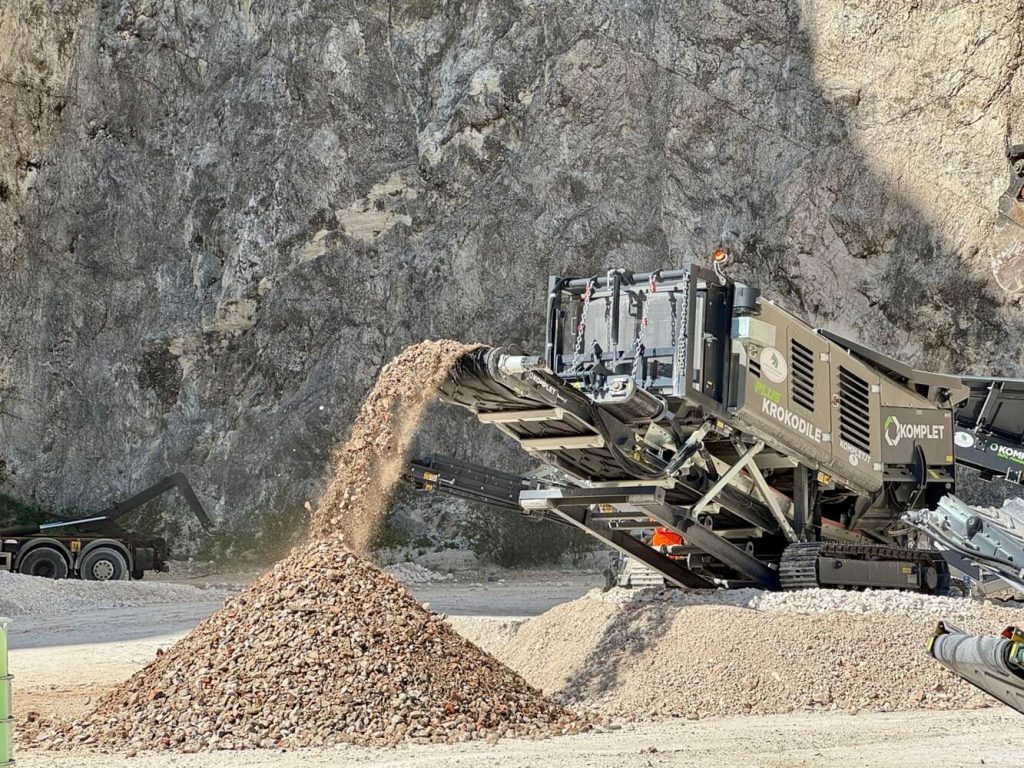
Hard mineral material goes through a Komplet jaw crusher — typically the K-JC 704 PLUS at contractor scale, sized up or down based on annual volume. Soft mixed waste goes through the Krokodile PLUS slow-speed shredder with the wood / lightweight waste shaft (or the C&D / asphalt shaft for oversized concrete pre-reduction). Soil and compost streams typically don’t need primary reduction — they go directly to screening.
Step 3: Screening to Product Cuts
Crusher output goes to a vibrating Kompatto screener, separating into 2-inch minus, 3/4-inch minus, #57 crushed concrete, and oversize for return to the crusher. Soil and compost streams go to a K-TS trommel, separating into clean finished product and oversize for further processing or removal.
Step 4: Stockpile Management
Screened products go to discrete stockpiles via a K-TC 460 tracked mobile conveyor — keeping product cuts separated, building tall (15-foot) stockpiles to maximize yard footprint, and reducing the loader cycles that would otherwise be required to move material around.
Step 5: End-Use Sale or On-Project Reuse
Screened recycled aggregate goes to road base, drainage, fill, non-structural concrete, and similar applications — either on the same project (avoided cost on imported virgin aggregate) or to other contractors as saleable product. Finished compost and screened topsoil go to landscape contractors, plant nurseries, and municipal parks departments. The material that left the demolition site as waste comes back as engineered product.
Komplet Vibrating Screeners: Sizing for Crushed Mineral Material
Kompatto 221
- Production: up to 90 US tph
- The smallest self-propelled scalper in the Komplet lineup
- Best fit: paired with the K-JC 503 mini jaw crusher or K-JC 704 PLUS for small-contractor and mid-size operations
- Track-mounted, wireless remote control
Kompatto 5030
- Production: up to 280 US tph
- Komplet’s best-selling screener
- Best fit: paired with K-JC 704 PLUS, K-JC 805, K-IC 70, or Krokodile PLUS for contractor- and recycler-scale civil, road, bridge, and demolition recycling
- Track-mounted, wireless remote control
Kompatto 124
- Production: up to 350 tph
- The largest scalping screen in the Komplet lineup
- Best fit: high-throughput recycling, civil, and small-quarry spreads at the upper end of the Komplet scale
- Track-mounted, wireless remote control
All three vibrating Kompatto screeners are tracked, self-propelled, and operated by wireless remote — letting a single operator handle the screener alongside the crusher and conveyor. Note that factory-integrated dust suppression is not standard on the Kompatto screeners; site-level dust controls (water trucks, perimeter misting, enclosure of dusty zones) supplement the equipment where local conditions warrant.
Komplet Trommel Screeners: For Soil, Compost, and Cohesive Material
K-TS 30 Compact Trommel Screener
- Production: up to 60 m³/h (cubic meters per hour)
- Compact, electric-friendly operation on damp and cohesive material
- Best fit: composting facilities, plant nurseries, municipal yards, small landscape contractors
K-TS 40 Portable Trommel Screener
- Production: up to 120 tph
- Larger drum and capacity for varied compost, topsoil, and waste streams
- Best fit: mid-size composting operations, landscape supply yards, larger municipal yard work
Trommel screeners are the right tool for soil and compost work specifically because the rotating drum handles material conditions that would clog a vibrating screen. Wet topsoil after rain, partially decomposed compost, mulch with fibrous content, fines-heavy excavation soil — all of these run through a trommel where they would not run through a Kompatto. For yard-based contractors who screen multiple material types, the K-TS plus a Kompatto covers the full range.
Real Applications: Where Screened Products End Up
Recycled Concrete Aggregate (RCA) for Road Base and Fill
The largest single use of screened C&D output is recycled concrete aggregate (RCA) for road base, sub-base, drainage, and fill applications. RCA produced by a Komplet jaw crusher and screened to spec on a Kompatto vibrating screener substitutes directly for virgin crushed stone in non-structural applications, typically at 30 to 50 percent lower cost per ton than virgin material. Civil contractors, municipal public works departments, and aggregate yards all sell or self-consume RCA at meaningful volume.
Screened Topsoil for Landscape and Park Construction
On yard-based operations that handle excavation soil, soil amendments, and landscape topsoil, the K-TS 30 or K-TS 40 trommel produces screened topsoil suitable for community park planting beds, sports field construction, residential landscape installation, and green-infrastructure stormwater management projects. Note that screened topsoil is screened topsoil — properly classified soil that’s been processed to remove rocks, roots, and oversize material. It is not “made from” demolition concrete; concrete and topsoil are different materials with different uses.
Finished Compost for Plant Nurseries and Soil Amendment
Composting facilities run partially decomposed compost through a K-TS 30 or K-TS 40 trommel to produce finished compost — separating fully decomposed product from oversize material for return to the active compost pile. Finished compost serves the same end markets as screened topsoil: landscape contractors, plant nurseries, municipal yards, and direct-to-consumer landscape supply.
Drainage Stone and #57 Aggregate
Larger Kompatto screeners (5030 and 124) can produce #57 crushed concrete and similar drainage-stone product cuts at meaningful volume — used for drainage backfill, French drain construction, residential and commercial drainage applications, and below-grade utility work.
Mulch and Decorative Wood Products
On operations running the Krokodile PLUS slow-speed shredder with the wood / lightweight waste shaft for tree trimmings and yard waste, a K-TS trommel downstream produces sized mulch products for landscape supply markets. Different drum perforations produce different mulch sizes from the same shredded feedstock.
Pipe Bedding and Construction Backfill
Spec-graded RCA and screened-aggregate cuts from Komplet screeners serve pipe bedding, utility construction, and general construction backfill applications that previously consumed virgin crushed stone. Cost savings to the contractor compound across every project, and the recycled product reduces virgin aggregate demand and associated quarrying.
The Community Park Connection: How Recycling Equipment Supports Public Spaces
Community park construction, urban green space development, and municipal landscape work all consume meaningful volumes of recycled aggregate and screened soil products. The connection between portable screening equipment and community spaces is direct, even if it’s not always visible:
Park Base Courses Use RCA
Walking paths, playground base courses, sports field sub-bases, drainage layers under planted areas, and parking-lot construction in public parks all use base aggregate. Recycled concrete aggregate from on-site processing of demolition material — produced by a Komplet jaw crusher and screened to spec on a Kompatto — substitutes directly for virgin material in these applications. The same demolition concrete that left a teardown site as waste comes back as the base layer under a community park.
Park Topsoil Often Comes from Yard-Based Recyclers
Topsoil for park construction comes from landscape supply yards and topsoil operators, many of whom run K-TS trommel screeners to produce spec-graded topsoil from excavation soil, soil amendments, and on-site soil sources. The screening operation removes rocks, roots, and oversize material to produce uniform planting-grade topsoil.
Compost for Park Planting Beds
Public parks and municipal landscape projects use finished compost for planting beds, soil amendment, and tree-pit installation. Composting facilities running K-TS trommels produce the finished compost; the same trommel infrastructure that handles topsoil for one project handles compost for another.
Stormwater and Green Infrastructure
Modern park design integrates green stormwater infrastructure — bioswales, rain gardens, permeable surfaces, and stormwater retention ponds. Aggregate sub-bases under permeable pavers, drainage stone in bioswale construction, and amended soil in rain gardens all consume screened aggregate and screened soil products. Komplet equipment supports these applications across the screening spread.
Honest Framing: What Screeners Don’t Do
It’s worth being clear about what screeners are and aren’t. They are precision tools for material separation, not a complete C&D recycling solution by themselves. Three honest limits:
- Screeners don’t crush. A screener separates material that’s already at near-product size; it doesn’t reduce demolition concrete from broken slabs to aggregate. That’s a crusher’s job. A screener without an upstream crusher on hard mineral material is the wrong tool for the job.
- “Screened topsoil” is topsoil that’s been screened, not topsoil produced from demolition concrete. Crushed concrete is recycled concrete aggregate, not topsoil. The two are different materials with different uses. Operations that produce both run separate workflows: jaw crusher and Kompatto for the concrete fraction; trommel screener for the soil fraction.
- Specialty applications require specialty review. Marine artificial reef construction, beneficial use applications under state environmental permits, and other specialty uses of recycled C&D material require project-specific environmental review, permitting, and material selection criteria. Generic “recycled aggregate goes to artificial reefs” claims oversimplify a regulated process. Consult environmental engineers and state regulators on specialty applications.
Within the standard scope — separating crushed mineral material into spec-graded RCA, separating soil and compost into spec-graded landscape product — Komplet screeners deliver the screening capability the C&D recycling workflow requires. Outside that scope, the right answer is appropriate technical and regulatory review, not stretching the equipment past its design envelope.
Frequently Asked Questions
What is a portable screener and what does it do?
A portable screener separates feed material into different size fractions by passing it across a perforated screen surface or rotating drum. Material smaller than the screen openings drops through to one product cut; material larger passes over to a different cut. Screeners do not crush or reduce material — they sort what an upstream crusher has already produced, or sort soil and compost into spec-graded landscape product. Komplet’s portable screener lineup covers both vibrating scalping screens (Kompatto 221, 5030, 124) and trommel screens (K-TS 30, K-TS 40).
What is the difference between a vibrating screener and a trommel?
Vibrating screeners use mechanically vibrated screen decks to separate dry, free-flowing material — the standard tool for separating crushed concrete, asphalt, brick, masonry, and rock into spec-graded recycled aggregate. Trommel screeners use a rotating perforated drum to separate damp, cohesive, or sticky material — the standard tool for soil, compost, mulch, and green waste. Picking the wrong type is a common mistake: wet topsoil clogs a vibrating screen, and dry crushed concrete is inefficient on a trommel. Match the technology to the material.
Can a screener crush demolition concrete?
No. Screeners separate; they don’t reduce. Crushing demolition concrete to aggregate sizes requires a crusher — a Komplet jaw crusher (K-JC 503, K-JC 604, K-JC 704 PLUS, K-JC 805) or impact crusher (K-IC 70). The crusher produces the size reduction; the screener separates the crusher output into product cuts. A complete on-site C&D recycling spread typically includes both.
What is the best Komplet screener for demolition concrete?
Match the screener to the upstream crusher’s production capacity. The Kompatto 221 (up to 90 US tph) pairs with the K-JC 503 or K-JC 704 PLUS for small-contractor operations. The Kompatto 5030 (up to 280 US tph; Komplet’s best-selling screener) pairs with the K-JC 704 PLUS, K-JC 805, K-IC 70, or Krokodile PLUS for contractor- and recycler-scale work. The Kompatto 124 (up to 350 tph; the largest scalper in the lineup) pairs with the K-JC 805 or large-volume Krokodile PLUS spreads.
What is the best Komplet screener for soil and compost?
Trommel screeners — K-TS 30 (up to 60 m³/h) for compact composting facilities, plant nurseries, and small landscape operations; K-TS 40 (up to 120 tph) for mid-size composting and larger landscape supply yards. Vibrating Kompatto screeners are the wrong tool for soil and compost because damp cohesive material clogs the screen openings.
Can recycled concrete aggregate be used in community park construction?
Yes. Recycled concrete aggregate (RCA) substitutes for virgin crushed stone in road base, drainage, fill, and non-structural concrete applications — including walking path base courses, playground sub-bases, sports field sub-bases, parking lot construction, and drainage stone for bioswales and stormwater infrastructure in community parks. RCA is typically 30 to 50 percent less expensive per ton than virgin crushed stone. Specific application suitability depends on the project specification; engineers should confirm RCA acceptability for any specific use.
Is screened topsoil made from demolition concrete?
No. Screened topsoil is topsoil that’s been processed through a trommel to remove rocks, roots, and oversize material — producing uniform planting-grade soil. The soil itself comes from excavation, soil amendment, or composting operations, not from crushed concrete. Crushed concrete is recycled concrete aggregate (RCA), which is a completely different material used for base courses, fill, and drainage. Operations that produce both run separate workflows.
How fast can a Komplet screener set up on a new jobsite?
Komplet screeners are tracked, self-propelled, and engineered for fast setup. Most units are operational within hours of arriving at the jobsite — not the days or weeks required for permanent plant installations. The Kompatto 221, 5030, and 124 walk off the trailer and into position by wireless remote, without requiring a second machine to position them. The K-TS 30 and K-TS 40 trommels are similarly engineered for mobile, fast-setup deployment.
Do Komplet screeners include dust suppression?
Factory-integrated dust suppression is not standard on Komplet screeners (Kompatto 221, 5030, 124, K-TS 30, K-TS 40) or the K-TC 460 conveyor. Standard dust suppression is included on Komplet crushers (K-JC 503, K-JC 604, K-JC 704 PLUS, K-JC 805, K-IC 70) and the Krokodile PLUS slow-speed shredder — the equipment that generates primary fugitive dust through fracturing or shredding action. On screening operations where local conditions warrant additional dust control, site-level controls (water trucks, perimeter misting, enclosure of dusty zones) supplement the equipment.
Final Thoughts
The path from demolition material to community park construction runs through specific engineered equipment doing specific jobs. A jaw crusher reduces broken concrete to aggregate sizes. A vibrating Kompatto screener separates the aggregate into spec-graded product cuts. A trommel K-TS handles soil and compost streams that would clog a vibrating screen. A K-TC 460 tracked mobile conveyor moves screened products to discrete stockpiles. The community park, the new sidewalk base, the planting bed, the drainage course — all of them depend on the right screener doing the right job in the right place in the workflow.
Komplet’s screening lineup covers both vibrating scalping (for crushed mineral material) and trommel screening (for soil and compost). Selecting the right screener for the right material — and pairing it with the right upstream crusher and downstream conveyor — is what turns a C&D recycling concept into actual saleable product on actual community projects. The math, the technical fit, and the operational scale all matter.
Komplet America builds compact crushers, screeners, the Krokodile PLUS slow-speed shredder, and the K-TC 460 tracked mobile conveyor for contractors who need real production in tight footprints — including the recycling and yard operations that supply community-scale public spaces. To see the full lineup, explore the crusher, screener, shredder, and conveyor categories. To talk financing or pricing, contact Komplet Capital, visit the contact page, or call 908-369-3340.
Ready to put a Komplet screener on your jobsite?
- Browse Komplet vibrating screeners — Kompatto 221, 5030, and 124 for crushed mineral material.
- Review the K-TS 30 and K-TS 40 trommel screeners for soil, compost, and cohesive material.
- Talk to Komplet Capital about 100 percent financing, 24-hour approvals, and Section 179 tax deduction eligibility.
- Save 40–70 percent with certified pre-owned Komplet equipment — verified history, OEM parts support.
- Find your local Komplet dealer for rental availability or pre-purchase inspection.
Never enough.
Disclaimer: All operating, maintenance, and service guidance in this article is general in nature. Always refer to the official Komplet operator’s manual for the specific machine model and serial number, and follow OEM intervals and procedures. For warranty-protected work, contact Komplet America at 908-369-3340 or your authorized Komplet dealer. Improper service or non-OEM parts may void warranty coverage and create safety hazards.
Disclaimer: Production figures (“up to” tph), application suitability for recycled concrete aggregate (RCA), screened topsoil specifications, finished compost classifications, and other end-product references shown above are illustrative examples only. Actual product suitability depends on specific project specifications, regulatory requirements, environmental review, and engineering judgment. Recycled materials in specialty applications (marine reefs, beneficial use, environmental remediation) require project-specific permitting and review by qualified environmental engineers and state regulators. Komplet America does not represent that any specific recycled material will be acceptable for any specific end use; engineers and project owners should verify acceptability before specifying.
Disclaimer: Cost savings figures, payback timelines, financing rates, and ROI examples shown above (where applicable) are illustrative examples only. Actual results depend on jobsite material composition, local hauling and tipping rates, fuel and labor costs, equipment utilization, financing terms, regional regulatory requirements, and operator efficiency. Komplet America makes no guarantee of specific financial returns. The Komplet Capital financing calculator is for illustration purposes only and is not an approval or an offer to finance. Customers should perform their own analysis based on local market conditions and consult their tax advisor on Section 179 eligibility before making purchase decisions.
Equipment prices are subject to change based on dealer location, availability, and any additional features or customizations. Prices do not include taxes, shipping, or installation fees, which may apply depending on your region. Contact Komplet America at 908-369-3340 or visit kompletamerica.com for current pricing.