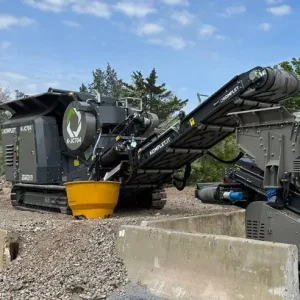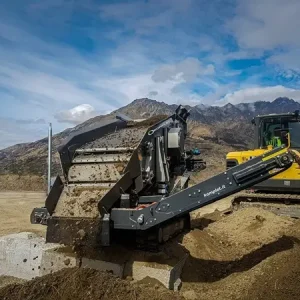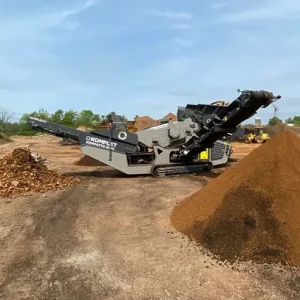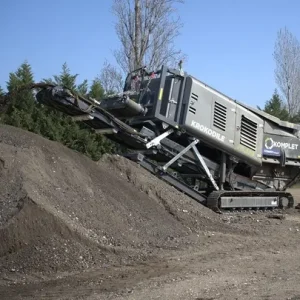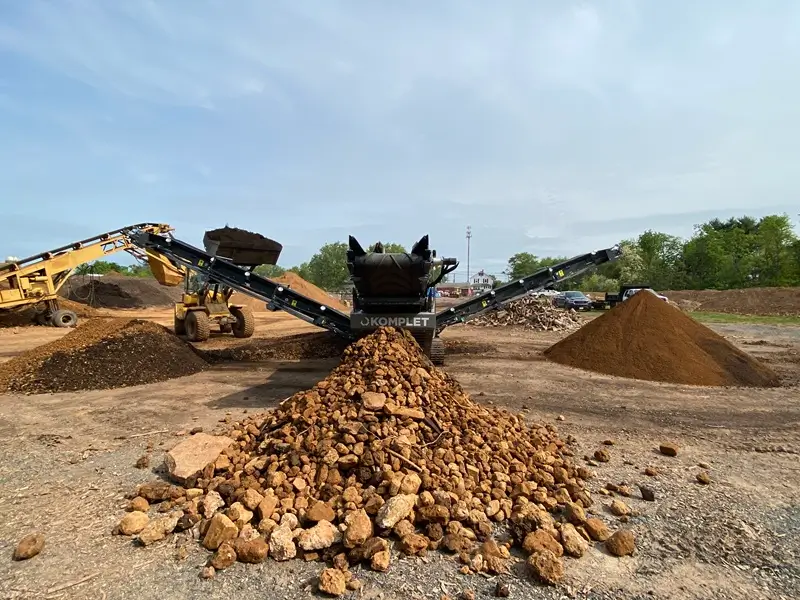

Mobile screener selection comes down to two technology decisions and one sizing decision. First: vibrating scalping screens for dry, free-flowing crushed mineral material (recycled concrete, asphalt, brick, masonry, rock); trommel screens for damp, cohesive material (soil, compost, mulch, fines-heavy waste) that would clog a vibrating screen. Second: within each technology, match production capacity to actual annual volume — too-small equipment runs at the throughput limit and bottlenecks the operation; too-large equipment runs underutilized and wastes capital. Komplet’s lineup covers both technologies across three production sizes each — Kompatto 221 (90 tph), Kompatto 5030 (280 tph, best-seller), and Kompatto 124 (350 tph) vibrating scalping screens; K-TS 30 (60 m³/h) and K-TS 40 (120 tph) trommel screens. The third dimension — pairing the screener with the right upstream crusher and downstream conveyor — is where the operation comes together.
This guide walks through the technology choice, sizing within each technology, the Komplet model-by-model fit, pairing with the broader processing spread, and the financial considerations that affect the actual capital decision. The goal is to give a contractor or yard operator enough information to make the right choice for their actual operation rather than chase generic specs.
Step 1: Vibrating vs. Trommel — Match the Technology to the Material
The first and most important screener-selection decision is the technology category. Picking the wrong type creates problems no amount of operator skill or production tuning can fix.
Vibrating Scalping Screens
Vibrating screens use mechanically vibrated screen decks (typically one, two, or three deck levels) to separate dry, free-flowing material into product cuts. The vibration keeps material moving across the screen surface and prevents blinding (clogging of the screen openings). “Scalping” specifically refers to the heavy-duty first-stage separation — taking oversize material off the top deck for return to the crusher and dropping product-size material to the lower decks for further classification.
Best fit for vibrating scalping screens:
- Crushed concrete and reclaimed concrete aggregate (RCA)
- Crushed asphalt and reclaimed asphalt pavement (RAP)
- Crushed brick, masonry block, and rubble
- Crushed natural rock and quarry-spec aggregate
- Dry sand and gravel
- General mineral aggregate sizing into spec-graded product cuts
Komplet’s Kompatto 221, Kompatto 5030, and Kompatto 124 are all vibrating scalping screens engineered for these applications.
Trommel Screens
Trommel screens use a rotating drum with perforated walls. Material enters one end of the drum, tumbles as the drum rotates, and falls through the wall openings into product collection. The tumbling action handles damp, cohesive, or sticky material that would clog a vibrating screen — the drum’s rotation continuously dislodges material from the screen openings rather than depending on vibration to keep them clear.
Best fit for trommel screens:
- Topsoil and excavation soil (especially when damp or after rain)
- Compost (active and finished)
- Mulch and shredded wood waste
- Mixed C&D waste with fines content
- Sand and gravel from excavation streams
- Beneficial soil amendment streams
Komplet’s K-TS 30 and K-TS 40 are trommel screeners engineered for these applications.
Why Picking Wrong Doesn’t Work
Damp topsoil through a vibrating screen clogs the screen openings within minutes — the material is too cohesive, too fines-heavy, and too sticky for vibration alone to keep moving. Operators try to fix this with bigger openings, more vibration, or working with drier material; none of these solutions work consistently. Eventually the operation either accepts terrible throughput or buys a trommel.
Dry crushed concrete through a trommel works mechanically — the drum rotates, the material falls through — but it’s inefficient. Trommel throughput on dry mineral material is substantially lower than vibrating screen throughput on the same material at the same scale. The capital cost per ton of throughput is much higher. Operations that try to use a trommel as their primary mineral-aggregate screener typically end up adding a vibrating scalper later.
The right answer is matching technology to material. Operations that handle both streams (a yard that processes both demolition concrete and topsoil, for example) typically run both technologies — a Kompatto for the mineral side, a K-TS for the soil side.
Step 2: Size the Screener to Actual Production Volume
Within each technology category, the second decision is production capacity. The Kompatto vibrating screeners span 90 to 350 tph; the K-TS trommels span 60 m³/h to 120 tph. The right size depends on three factors:
Annual Volume Through the Operation
The starting point. An operation that processes 5,000 tons per year of crushed concrete is overserved by a Kompatto 124 (350 tph) — the machine could complete a year’s worth of work in a few weeks of full-time operation, with the rest of the year representing idle financed capital. The same 5,000-ton-per-year operation is appropriately served by a Kompatto 221 (90 tph), which finishes the work in a reasonable utilization window without straining the machine.
Conversely, an operation processing 100,000 tons per year is poorly served by a Kompatto 221 — the machine runs flat-out, never catches up, becomes a permanent bottleneck, and wears out faster than it should. The same volume is appropriately served by a Kompatto 5030 (280 tph) or Kompatto 124 (350 tph) running at reasonable utilization.
Pairing Capacity with the Upstream Crusher
Screener throughput should match or exceed crusher throughput on the upstream side. A K-JC 704 PLUS jaw crusher (90 US tph) feeding into a Kompatto 5030 vibrating screener (280 US tph) gives the operator screening headroom — the screener never bottlenecks the crusher. Going the other way (oversized crusher feeding undersized screener) creates throughput problems and material backups at the screener feed point.
Typical pairings:
- K-JC 503 (34 tph) → Kompatto 221 (90 tph)
- K-JC 604 (55 tph) → Kompatto 221 (90 tph) or Kompatto 5030 (280 tph)
- K-JC 704 PLUS (90 tph) → Kompatto 5030 (280 tph)
- K-JC 805 (160 tph) → Kompatto 5030 (280 tph) or Kompatto 124 (350 tph)
- K-IC 70 impact crusher (90 tph) → Kompatto 5030 (280 tph)
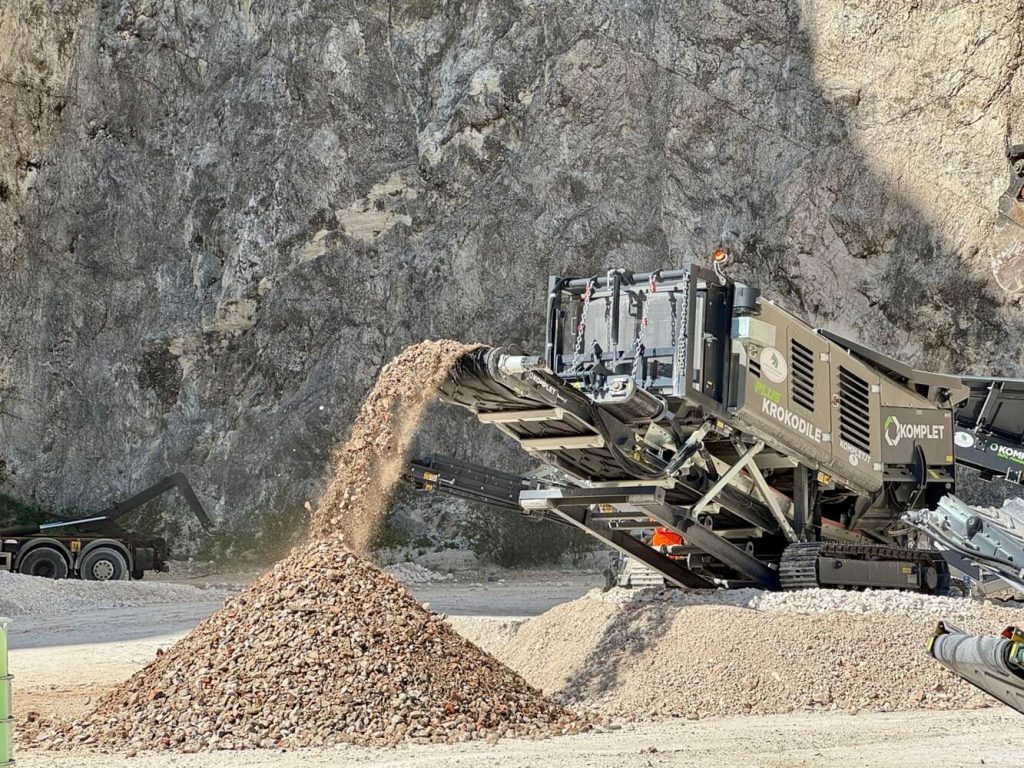
- Krokodile PLUS (175 tph C&D shaft) → Kompatto 5030 (280 tph)
Headroom for Growth
If the operation expects to grow over the next 3 to 5 years, sizing the screener with some headroom protects against early-replacement costs. A Kompatto 5030 sized for current K-JC 704 PLUS production gives the operation room to add a K-JC 805 or Krokodile PLUS later without buying a new screener. The capital efficiency of right-sized growth headroom is substantial.
The Five Komplet Screeners: Detailed Fit Guide
Kompatto 221 Vibrating Scalping Screener
- Production: up to 90 US tph
- Type: vibrating scalping (multi-deck vibrating screen)
- Track-mounted, self-propelled, wireless remote operation
- Best fit: Small-contractor and mid-size operations. Pairs naturally with K-JC 503 or K-JC 704 PLUS for civil, demolition recycling, and small aggregate yard work.
- Note: factory dust suppression is NOT standard on Komplet screeners (only on crushers and the Krokodile PLUS); site-level controls supplement where local conditions warrant.
Kompatto 5030 Heavy-Duty Vibrating Scalping Screener
- Production: up to 280 US tph
- Type: vibrating scalping (heavy-duty, multi-deck)
- Komplet’s best-selling screener
- Track-mounted, self-propelled, wireless remote operation
- Best fit: Contractor- and recycler-scale civil, road, bridge, demolition recycling, and aggregate yard work. Pairs with K-JC 704 PLUS, K-JC 805, K-IC 70, or Krokodile PLUS for almost all standard mineral-aggregate operations.
Kompatto 124 Mobile Vibrating Scalping Screener
- Production: up to 350 tph
- Type: vibrating scalping (largest capacity in the Komplet lineup)
- Track-mounted, self-propelled, wireless remote operation
- Best fit: High-throughput regional operations — large recycling spreads, small-quarry applications, multi-shift aggregate yards. Pairs with K-JC 805 or large-volume Krokodile PLUS configurations.
K-TS 30 Compact Trommel Screener
- Production: up to 60 m³/h (cubic meters per hour)
- Type: rotating-drum trommel
- Best fit: Compact composting facilities, plant nurseries, municipal yards, small landscape contractors. Handles damp topsoil, finished compost, mulch, and mixed cohesive material that would clog a vibrating screen.
K-TS 40 Portable Trommel Screener
- Production: up to 120 tph
- Type: rotating-drum trommel (larger drum, larger capacity)
- Best fit: Mid-size composting operations, larger landscape supply yards, municipal yard work at meaningful scale. Handles same material range as K-TS 30 at higher throughput.
Step 3: Pairing the Screener with the Broader Processing Spread
A screener doesn’t operate alone. It sits between an upstream feed source (typically a crusher, sometimes a loader feeding from a stockpile) and a downstream stockpile (typically built by a tracked mobile conveyor). The complete processing spread determines whether the screener delivers the throughput it’s specified for.
Standard Three-Machine Spread for Mineral Aggregate
The standard configuration for on-site C&D recycling, civil project recycling, and most contractor-scale mineral aggregate work:
- Komplet jaw crusher (size matched to project volume)
- Kompatto vibrating scalping screener (size matched to or exceeding crusher capacity)
- K-TC 460 tracked mobile conveyor (132 US tph, 15-foot pile height, 7,000 lb pickup-towable)
This three-machine spread covers the full workflow: crusher reduces feed material, screener separates into product cuts, conveyor stockpiles the product. Single-operator wireless control across all three machines lets one trained operator coordinate the entire spread from one position.
Demolition Spread with Krokodile PLUS
For demolition contractors with mixed C&D waste streams:
- Komplet jaw crusher (mineral fraction)
- Krokodile PLUS slow-speed shredder with quick-change shafts (mixed waste fraction)
- Kompatto vibrating screener (sizing crushed mineral material)
- K-TC 460 tracked mobile conveyor (stockpiling)
This four-machine spread captures the full demolition stream — hard mineral material to recycled aggregate, soft mixed waste to volume-reduced shred. The Krokodile PLUS quick-change shafts handle both hard and soft waste from one machine.
Composting and Landscape Yard Spread
For composting facilities, landscape supply yards, and municipal yard operations:
- K-TS 30 or K-TS 40 trommel screener (sizing soil and compost)
- K-TC 460 tracked mobile conveyor (stockpiling finished product)
This two-machine spread handles compost, topsoil, mulch, and similar cohesive materials. Operations that also handle some demolition or aggregate work can add a Kompatto and jaw crusher; the K-TC 460 redeploys across both setups.
Features That Should Affect Your Screener Selection
Deck Configuration and Screen Media
On vibrating scalping screeners, the number of decks (one, two, or three) determines how many product cuts the machine produces in a single pass. Most contractor- and recycler-scale operations spec multi-deck configurations: an oversize deck (returns material to the crusher), a primary product deck (typically 2-inch or 3-inch minus), and a secondary product deck (typically 3/4-inch minus or fines). Screen media — wire cloth, polyurethane panels, woven mesh — depends on material abrasiveness and product specification. The authorized Komplet dealer network can spec configuration based on the operation’s typical material and target product mix.
Track-Mounted Self-Propulsion
All current Komplet screeners are tracked and self-propelled — they walk off the trailer and into operating position by wireless remote, without requiring a second machine to position them. This is standard configuration on the Komplet lineup and a meaningful operational advantage compared to wheeled equipment that requires a haul truck for repositioning.
Wireless Remote Operation
Wireless remote control is standard across the Komplet lineup. A single trained operator coordinates the screener alongside the crusher and conveyor from one position, without needing dedicated screener and conveyor operators. For contractor- and recycler-scale operations, this is one of the largest single labor-cost advantages of the equipment.
Tier 4 Final Compliance
All current Komplet screeners meet EPA Tier 4 Final emissions standards for non-road diesel engines. This is required for new-equipment sale in the United States, but it also matters operationally — lower fuel burn at comparable production rates, and acceptance on construction sites with emissions restrictions (some urban jurisdictions, federal projects, state-funded work).
Maintenance Access
Mobile screeners require routine maintenance — engine service, hydraulic system service, screen media replacement, lubrication. Komplet equipment is engineered for accessible maintenance points: ground-level access to engine service points where possible, easy screen-deck access for media replacement, hydraulic system serviceable through standard panels. The crusher and screener maintenance guide covers the full maintenance framework.
Budget and Total Cost of Ownership
Sticker price is the most visible cost component, but it’s typically the smallest portion of the equipment’s total cost over its operating life. Three financial considerations that should affect screener selection:
Total Cost of Ownership
Beyond acquisition cost, screener TCO includes fuel (Tier 4 Final engines deliver lower burn than predecessors), wear parts (screen media is the largest single category, with intervals dependent on material abrasiveness), scheduled maintenance labor, hydraulic fluid and filter service, unplanned downtime cost (the largest hidden cost most operations don’t track), and end-of-life resale value (better on equipment with documented OEM service history). The stone crusher price factors guide covers the full TCO framework — same principles apply to screening equipment.
Financing through Komplet Capital
Komplet Capital offers 100 percent financing on new and certified pre-owned Komplet equipment, with 24-hour approvals and 36/48/60/72-month term options. For tax years beginning in 2026, Section 179 tax deduction allows immediate first-year expensing of up to $2,560,000 in qualifying equipment, with 100 percent bonus depreciation restored for qualified property acquired after January 19, 2025. Most contractor- and recycler-scale Komplet purchases fall well under the cap, allowing immediate first-year expensing. Consult a tax advisor for specific eligibility.
Certified Pre-Owned
Komplet’s certified pre-owned program delivers verified-history equipment with OEM parts support and the same authorized dealer service network, typically at 40 to 70 percent capital savings versus new. Pre-owned screeners can be the right answer for operations sizing into a complete spread (crusher + screener + conveyor) at the budget for a single new machine, or for operations testing a new equipment category before committing to new.
Honest Framing: What Komplet Screeners Don’t Do
“Choose the right screener” works honestly only if it acknowledges what the equipment isn’t engineered for:
- Industrial mining-scale operations. The Kompatto 124 at 350 tph is the largest in the Komplet lineup. Operations processing million-ton-per-year volumes typically run fixed-plant industrial-mining screening equipment outside the compact-mobile category.
- Specialty industrial sieving. Vibrating screens for food, pharmaceutical, or specialty industrial sieving (where hygiene, contamination control, and product purity are paramount) use entirely different equipment categories. Komplet’s screeners are construction-aggregate equipment for crushed mineral and soil/compost streams.
- Highly abrasive specialty rock streams. Komplet equipment handles construction-relevant rock types (limestone, granite, basalt at typical contractor scale). Operations processing extremely abrasive specialty rock at high volumes may require specialty wear-resistant configurations beyond standard screen media.
- Hazardous waste streams. Asbestos, lead-contaminated material, refrigerants, and other specialty hazardous streams require permitted specialty contractors. Komplet equipment handles standard mineral and C&D waste streams, not hazardous waste.
Within Komplet’s actual scope — compact mobile screening for crushed mineral material and soil/compost streams at contractor- and recycler-scale operations — the lineup covers the full range from small contractor work to high-throughput regional yards. Outside that scope, the right answer is appropriate specialty equipment, not stretching the wrong tool past its design envelope.
Frequently Asked Questions
What’s the difference between a vibrating screen and a trommel?
Vibrating screens use mechanically vibrated screen decks to separate dry, free-flowing material — the standard tool for crushed concrete, asphalt, brick, masonry, and rock. Trommel screens use a rotating drum with perforated walls to separate damp, cohesive material — the standard tool for soil, compost, mulch, and fines-heavy waste. Picking the wrong type creates problems no operator skill can fix: damp material clogs vibrating screens; dry mineral material is inefficient on a trommel.
What is a scalping screen?
A scalping screen is a heavy-duty vibrating screener used as the first separation stage on crushed mineral material. The top deck removes oversize material (returned to the crusher), and lower decks classify the rest into product cuts. “Scalping” describes the function (heavy-duty first-stage separation), not a different technology category — Komplet’s Kompatto 221, 5030, and 124 are all vibrating scalping screeners.
Which Komplet screener is best for crushed concrete?
Match production capacity to upstream crusher and annual volume. The Kompatto 221 (90 tph) pairs naturally with the K-JC 503 or K-JC 704 PLUS for small-contractor operations. The Kompatto 5030 (280 tph; Komplet’s best-selling screener) pairs with the K-JC 704 PLUS, K-JC 805, K-IC 70, or Krokodile PLUS for contractor- and recycler-scale work. The Kompatto 124 (350 tph) pairs with the K-JC 805 or large-volume Krokodile PLUS configurations.
Which Komplet screener is best for topsoil and compost?
Trommel screeners — K-TS 30 (60 m³/h) for compact composting facilities, plant nurseries, and small landscape operations; K-TS 40 (120 tph) for mid-size composting and larger landscape supply yards. Vibrating Kompatto screeners are the wrong tool for soil and compost because damp cohesive material clogs the screen openings. Operations that handle both demolition concrete and topsoil typically run both technologies — a Kompatto for the mineral side, a K-TS for the soil side.
Do Komplet screeners include factory dust suppression?
No. Standard factory-integrated water-spray dust suppression is included on every Komplet crusher (K-JC 503, K-JC 604, K-JC 704 PLUS, K-JC 805, K-IC 70) and on the Krokodile PLUS slow-speed shredder — the equipment that generates primary fugitive dust through fracturing or shredding action. It is not standard on Komplet screeners (Kompatto 221, 5030, 124, K-TS 30, K-TS 40) or the K-TC 460 conveyor — these machines move material rather than fracture it. On sites where local conditions warrant additional dust control on the screening operation, site-level controls (water trucks, perimeter misting, enclosure of dusty zones) supplement the equipment.
How fast can a Komplet screener set up on a new jobsite?
Komplet screeners are tracked, self-propelled, and engineered for fast setup — most units are operational within hours of arriving at a new site, walking off the trailer and into position by wireless remote without requiring a second machine to position them. The actual deployment timeline depends on transport distance, infrastructure conditions, and any site-preparation requirements.
Can I run multiple Komplet screeners with one operator?
Yes. Wireless remote operation is standard across the Komplet lineup. A single trained operator coordinates the screener alongside the upstream crusher (or shredder) and downstream conveyor from one position. For complete processing spreads (crusher + screener + conveyor, or crusher + Krokodile PLUS + screener + conveyor), single-operator coordination is one of the largest labor-cost advantages of the Komplet equipment.
How do I size a screener to my operation’s volume?
Three factors: total annual volume (an operation processing 5,000 tons per year is overserved by a 350-tph machine; an operation processing 100,000 tons per year is underserved by a 90-tph machine), pairing with the upstream crusher (screener throughput should match or exceed crusher throughput), and growth headroom over the next 3 to 5 years. The authorized Komplet dealer network provides capacity-sizing consultation as part of pre-purchase work.
Are pre-owned Komplet screeners a good option?
For many operations, yes. Komplet’s certified pre-owned program typically delivers 40 to 70 percent capital savings versus new on the same equipment specs. Pre-owned units include verified history, OEM parts support, and the same authorized dealer service network as new equipment. Particularly useful for operations sizing into a complete spread at the budget for a single new machine, or for operations testing a new equipment category.
Final Thoughts
Mobile screener selection is fundamentally a matching problem — match the technology to the material (vibrating for dry mineral, trommel for damp soil and compost), match the capacity to the operation’s actual annual volume, match the screener to the upstream crusher and downstream conveyor in a complete processing spread, and match the financing structure to the cash flow profile of the work the equipment will do. The Komplet lineup covers all five screening positions across both technologies — Kompatto 221, 5030, and 124 vibrating scalping screens, K-TS 30 and K-TS 40 trommels — engineered for contractor- and recycler-scale work.
The questions to answer before specifying a screener are concrete and operational: what material streams does the operation handle, what’s the realistic annual volume, what does the upstream crushing or feeding look like, what’s the labor profile, and what’s the financing and tax-treatment context. With those answers in hand, the right screener choice becomes obvious — and the wrong choices (mismatching technology to material, oversizing or undersizing capacity, ignoring the broader spread) become avoidable.
Komplet America builds compact crushers, screeners, the Krokodile PLUS slow-speed shredder, and the K-TC 460 tracked mobile conveyor for contractors who need real production in tight footprints. To see the full lineup, explore the crusher, screener, shredder, and conveyor categories. To talk financing, sizing, configuration, or pricing, contact Komplet Capital, visit the contact page, or call 908-369-3340.
Ready to choose your next mobile screener?
- Browse the full Komplet screener lineup — Kompatto 221, 5030, and 124 vibrating scalping screens; K-TS 30 and K-TS 40 trommels.
- Talk to Komplet Capital about 100 percent financing, 24-hour approvals, and Section 179 tax deduction eligibility for 2026.
- Save 40–70 percent with certified pre-owned Komplet equipment — same engineered features at lower capital outlay.
- Find your local Komplet dealer for capacity-sizing consultation, rental availability, and pre-purchase inspection.
- Call 908-369-3340 or contact Komplet America directly for configuration help and pairing guidance.
Never enough.
Disclaimer: All operating, maintenance, and service guidance in this article is general in nature. Always refer to the official Komplet operator’s manual for the specific machine model and serial number, and follow OEM intervals and procedures. For warranty-protected work, contact Komplet America at 908-369-3340 or your authorized Komplet dealer. Improper service or non-OEM parts may void warranty coverage and create safety hazards.
Disclaimer: Production figures (“up to” tph, m³/h), pairing recommendations, sizing guidance, and capacity ranges shown above are illustrative examples only. “Up to” production figures describe best-case throughput on optimal feed material; actual production depends on material composition, moisture content, deck configuration, screen media, operator efficiency, and feed cycle pacing. Actual results depend on jobsite conditions, project specifications, and operator-specific factors. Komplet America makes no guarantee of specific production rates or processing volumes.
Disclaimer: Tax-related figures in this article — including Section 179 deduction limits ($2,560,000 maximum for tax years beginning in 2026 with $4,090,000 phase-out threshold) and 100 percent bonus depreciation for qualified property acquired after January 19, 2025 — are based on current U.S. Internal Revenue Code provisions as of publication. Tax laws change; actual tax treatment depends on the buyer’s entity structure, taxable income, equipment classification, business use percentage, and other factors. Consult a qualified tax advisor or CPA to confirm Section 179 eligibility and applicable deduction amounts for any specific equipment purchase. Komplet America does not provide tax advice.
Equipment prices are subject to change based on dealer location, availability, and any additional features or customizations. Prices do not include taxes, shipping, or installation fees, which may apply depending on your region. Contact Komplet America at 908-369-3340 or visit kompletamerica.com for current pricing.