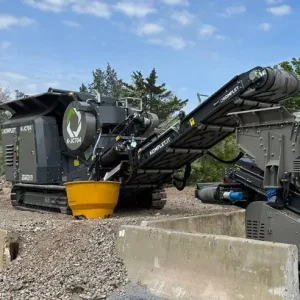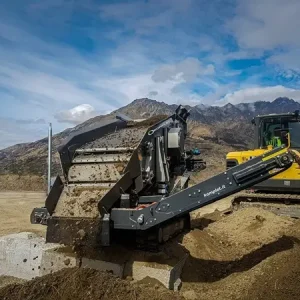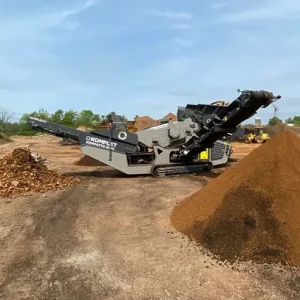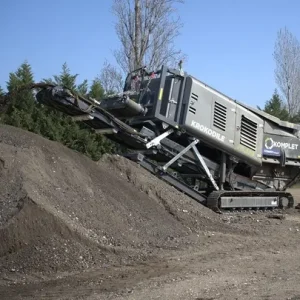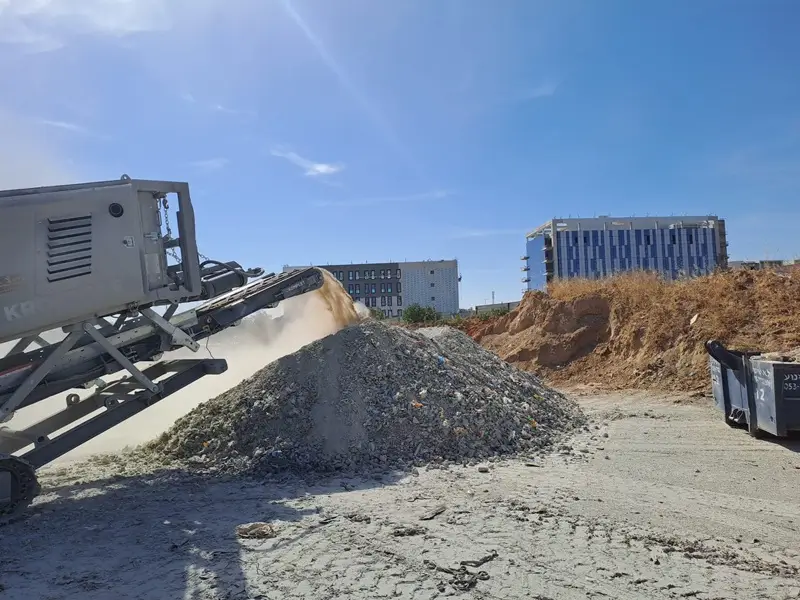

Construction and demolition waste is one of the largest single categories of solid waste generated in North America. Traditional disposal — hauling unprocessed debris to landfill — burns fuel, fills landfills, and forfeits the recyclable value of the material. On-site shredding with a slow-speed mobile shredder turns that disposal stream into a recovery stream.
This article explains the environmental benefits of using the Krokodile PLUS — Komplet America’s slow-speed mobile shredder — for C&D and waste recycling. We will cover landfill diversion, transport emission reduction, energy efficiency relative to high-speed grinders, and how the Krokodile PLUS supports circular construction practices.
What the Krokodile PLUS Is (and What It Is Not)
The Krokodile PLUS is a slow-speed mobile shredder. That category distinction matters for environmental performance. Slow-speed shredders run at low rotational speed (typically 0–35 rpm) with very high torque, using teeth on dual shafts to grip and tear material. They are not high-speed grinders — high-speed machines use hammers or knives at high RPM to fracture material through impact, which generates substantially more dust, noise, and fuel-per-ton on heavy materials.
The slow-speed approach is what makes the Krokodile PLUS a practical fit for environmentally-sensitive projects: less dust, lower noise emissions, lower fuel consumption per ton on heavy C&D feed, and the ability to process tough or contaminated material that high-speed grinders cannot tolerate.
Key Specifications
- 220-horsepower Volvo Penta Tier 4 Final diesel engine — emissions-compliant for North American jobsites
- 60-inch dual-shaft system with quick-change tooth and shaft configurations
- Tracked chassis for on-site mobility — no foundation required
- Wireless remote operation — operators stand outside the active machine zone
- Integrated magnetic separator — extracts ferrous metal from the discharge stream for recycling
- Operating weight: 34,171 lb
Reducing Landfill Waste Through On-Site Shredding
The most direct environmental benefit of slow-speed shredding is landfill diversion. Bulky, unprocessed C&D debris consumes far more landfill volume than the same material shredded and recovered as recycled aggregate, mulch, or biomass feedstock.
Volume Reduction
Mixed C&D debris in its raw form — concrete chunks with rebar, irregular wood, drywall sheets, mixed waste — has substantial void space. Shredded output is denser and more uniform, occupying less volume per ton. For waste streams that must still be disposed (uncontaminated portions), volume reduction means fewer truckloads and lower disposal cost. For recovered streams, the shredded output is in a form that recyclers actually want.
Material Recovery and Reuse
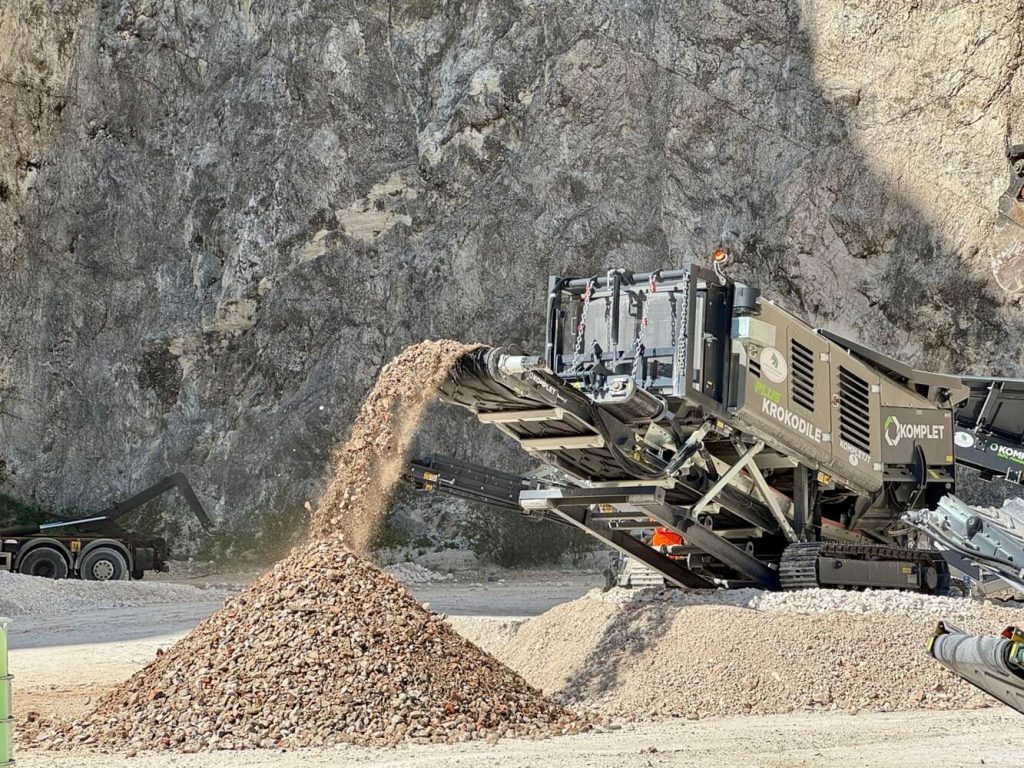
With the C&D shaft installed, the Krokodile PLUS reduces concrete and asphalt rubble to a size that downstream processing — a compact jaw crusher or impact crusher — can finish into spec-grade recycled aggregate. With the wood/lightweight waste shaft installed, output can become mulch, biomass feedstock, or volume-reduced disposal material. The integrated magnetic separator extracts ferrous content (rebar fragments, embedded nails, banding) for scrap metal recycling — recovering value that would otherwise be landfilled.
Lower Transport Emissions Through On-Site Processing
Hauling unprocessed C&D waste consumes diesel fuel and generates emissions on every load. Each round-trip to landfill or transfer station — often 20, 50, or 100 miles each way depending on jobsite location — adds Scope 3 emissions to the project. On-site shredding cuts the number of haul trips required.
Three mechanisms drive the emission reduction:
- Volume reduction — fewer trucks needed to move the same material
- Density improvement — each truck carries more usable tonnage per haul
- Local recovery — material recovered on-site or sold to nearby recyclers eliminates the long haul to landfill entirely
For projects with sustainability goals — LEED, Envision, or contract-required diversion thresholds — these reductions are quantifiable and reportable. The contractor maintains documentation of material diverted from landfill, and the diversion math becomes straightforward when processing happens on-site rather than through external recyclers.
Energy Efficiency: Why Slow-Speed Beats High-Speed on Heavy Material
On heavy C&D material — concrete, asphalt, dense rubble — slow-speed shredders are more fuel-efficient per ton processed than high-speed grinders. This is counterintuitive to operators familiar with smaller hammer-mill or grinder equipment, but it reflects the physics of how each category reduces material.
How Slow-Speed Shredding Saves Fuel on Heavy Feed
High-speed grinders work by repeated impact — hammers strike the material at high velocity, fracturing it through accumulated impact energy. On dense material, much of the input energy becomes heat, dust, and noise rather than productive size reduction. Slow-speed shredders work by gripping and tearing — the high-torque shafts pull material through and reduce it through controlled shear. Less wasted energy per ton processed, less heat dissipated to the environment, less wear on cutting components.
Lower Dust and Noise Emissions
Dust and noise are environmental impacts that affect both jobsite air quality and surrounding communities. Slow-speed shredders generate substantially less of both than high-speed grinders running on the same heavy feed. For urban demolition, projects near residential or sensitive sites, or projects under municipal noise ordinances, the difference can determine whether on-site processing is permitted at all.
Supporting Circular Construction Practices
Circular construction is the principle that materials should stay in productive use as long as possible — reused, repurposed, or recycled rather than landfilled at end of life. Slow-speed shredding is one of the practical bridges between demolition output and circular reuse.
The Krokodile PLUS supports circular construction in three concrete ways:
- Concrete and asphalt rubble become recycled aggregate when fed through a Krokodile PLUS plus downstream crusher and screener — replacing virgin aggregate in road base, fill, and non-structural applications
- Demolition wood becomes mulch, biomass fuel, or composted feedstock — replacing virgin wood chips and reducing landfill methane
- Drywall, plastics, and mixed lightweight waste become volume-reduced or recovered streams — improving the economics of downstream sorting and recovery
None of these recovery paths require new infrastructure. They require shredding the material on-site so it is in a form that downstream recyclers actually want. The Krokodile PLUS is the on-site step that makes the rest of the chain work.
Practical Considerations Before Deploying
On-site slow-speed shredding is not the right answer for every project. The environmental benefit shows up when the operation has recurring volume, mixed material streams, or distance-to-landfill that makes the transport math compelling. For one-off projects with very small volumes, contracted hauling may be more efficient.
When On-Site Shredding Wins on Environmental Math
- Recurring C&D volume — demolition contractors and recyclers processing material weekly or daily
- Long haul to landfill — every additional mile of haul distance increases the emission savings from on-site processing
- Mixed material with recovery potential — feed that includes recoverable concrete, wood, and metal benefits more from on-site separation than feed that is purely disposal-bound
- Project sustainability requirements — LEED, Envision, or contract-required diversion targets
- Tipping fee pressure — markets where landfill cost has risen and recycling outlets are cheaper or revenue-generating
Frequently Asked Questions
Is the Krokodile PLUS a high-speed or slow-speed shredder?
The Krokodile PLUS is a slow-speed shredder. Shaft speed is in the 0–35 rpm range, with very high torque delivered through the dual-shaft system. It is not a high-speed grinder.
How much material can the Krokodile PLUS process per hour?
Up to 175 US tons per hour of concrete and asphalt under ideal conditions on the C&D shaft. Up to 19 US tph on mixed waste and up to 18 US tph on plastics, both with the wood/waste shaft. Actual jobsite output varies with material composition, contamination, and operator skill.
Does the Krokodile PLUS reduce dust and noise compared to high-speed grinders?
Yes, on heavy C&D material, slow-speed shredding generates substantially less dust and noise per ton than high-speed grinding. This matters for jobsites under municipal noise ordinances, near residential areas, or with air quality requirements.
Can on-site shredding contribute to LEED or other sustainability credits?
On-site C&D shredding supports landfill diversion, which is a measurable component of LEED Materials & Resources credits and other green building rating systems. Specific credit eligibility depends on the project’s rating system version and how recovered material is documented and used. Consult the project’s sustainability consultant or LEED-AP for specific credit calculation.
Is the Krokodile PLUS engine emissions-compliant?
Yes. The Krokodile PLUS uses a 220-horsepower Volvo Penta Tier 4 Final diesel engine, meeting current U.S. EPA emissions standards for non-road diesel equipment.
How does the magnetic separator support recycling?
The integrated magnetic separator extracts ferrous metal — rebar fragments, embedded nails, banding — from the shredded discharge stream as the material exits the machine. Captured ferrous material is collected separately and can be sold to scrap metal recyclers, recovering value and avoiding landfilling of recyclable steel.
Does the Krokodile PLUS work on plastics?
Yes, with the wood/lightweight waste shaft installed. Output is up to 18 US tons per hour on plastics under ideal conditions. The slow-speed approach handles mixed plastic waste with less melting, smearing, and shaft binding than high-speed grinders.
Can the Krokodile PLUS be used inside a recycling facility, or only outdoors?
The Krokodile PLUS is a diesel-powered machine designed for outdoor or well-ventilated operation. It is not intended for use inside enclosed indoor spaces without appropriate exhaust extraction. For indoor electric-drive applications, talk to Komplet America about the available equipment lineup.
Final Thoughts
The environmental case for slow-speed mobile shredding is straightforward: process material where it is generated, recover what can be recovered, reduce what must be hauled, and choose a machine category whose physics suit the feed. On heavy C&D waste, that means slow-speed — not high-speed grinding. The Krokodile PLUS combines emissions-compliant Tier 4 Final power, low-noise low-dust slow-speed shredding, and a quick-change shaft system that adapts to mixed material streams.
For contractors and recyclers building toward circular construction practices, the Krokodile PLUS is one piece of a workflow — pair it with a Komplet jaw or impact crusher downstream for recycled aggregate production, or with a Komplet screener for material classification. The full equipment lineup is engineered to work together, and Komplet America’s sales and service teams can help configure the right combination for your operation.
Learn more about the Krokodile PLUS slow-speed mobile shredder, explore Komplet’s complete equipment lineup, or review equipment financing options through Komplet Capital.
Ready to Reduce Your Project’s Environmental Impact?
- Call Komplet America at 908-369-3340 to discuss slow-speed shredding for your specific C&D waste stream
- Request a yard demonstration in Hillsborough, NJ — bring sample material and see slow-speed shredding before you commit
- Review Krokodile PLUS specifications and pricing
- Explore equipment financing through Komplet Capital — terms from 36 to 72 months, 100% financing available
- Find your local Komplet dealer for rental availability and regional support
Never enough.
Disclaimer: All operating, maintenance, and service guidance in this article is general in nature. Always refer to the official Komplet operator’s manual for the specific machine model and serial number, and follow OEM intervals and procedures. For warranty-protected work, contact Komplet America at 908-369-3340 or your authorized Komplet dealer. Improper service or non-OEM parts may void warranty coverage and create safety hazards.
Disclaimer: Production rates and throughput figures shown above (“up to” tons per hour) reflect maximum potential output under ideal conditions. Actual results will vary based on material composition, moisture content, contamination level, operator experience, and other site conditions. Komplet America makes no guarantee of specific throughput or financial returns. Customers should perform their own analysis based on their material and local market conditions before making purchase decisions.