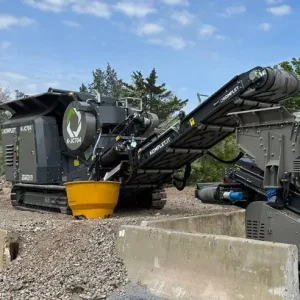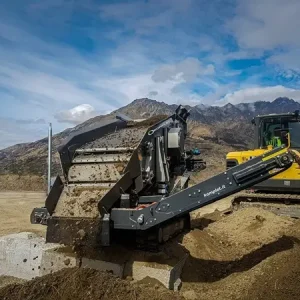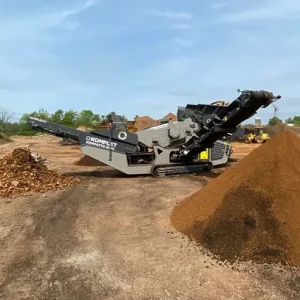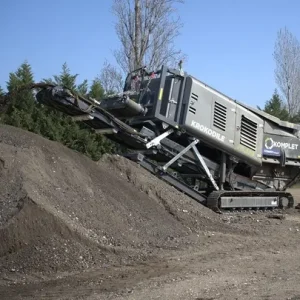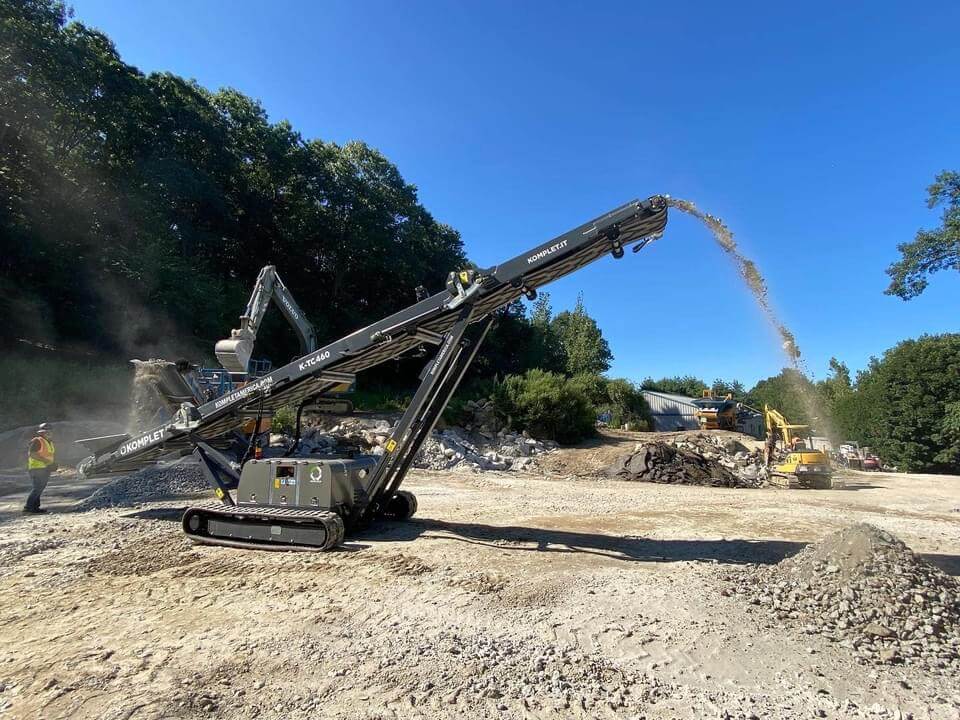

Tracked mobile conveyors improve jobsite efficiency and reduce labor costs through four mechanisms: replacing dedicated loader hours that would otherwise clear crusher or screener discharge, eliminating the second-operator requirement that comes with wheeled or towable stackers, allowing a single wireless-remote operator to coordinate the entire crushing-and-screening spread, and building taller, cleaner stockpiles that reduce rehandling. On a Komplet jobsite, the K-TC 460 tracked mobile conveyor walks itself into position on rubber tracks, runs at up to 132 US tph, builds 15-foot stockpiles, and is operated by the same wireless remote that runs the crusher or screener — turning a job that traditionally required two or three workers into a single-operator workflow.
This guide explains how tracked mobile conveyors actually change the labor math on a jobsite — what’s happening operationally, where the labor savings come from, and how the K-TC 460 fits into a Komplet compact-equipment spread alongside crushers, screeners, and the Krokodile PLUS slow-speed shredder. For the productivity case (continuous discharge, choke-out elimination, throughput gains), see the sister piece: How Tracked Conveyors Boost Crusher and Screener Productivity.
The Labor Cost Problem on Compact Crushing and Screening Sites
On a compact crushing or screening operation, labor is the second-largest variable operating cost behind diesel — and often the most volatile. Operator wages, benefits, training time, scheduling overhead, and the cost of running short-handed when crews call out all add up to a meaningful share of operating budget. Equipment that reduces labor headcount, or lets the same headcount cover more ground, has direct and durable payback.
The traditional spread without tracked-conveyor support typically requires:
- A crusher or screener operator at the machine.
- A loader operator dedicated to clearing discharge from the machine to a stockpile.
- A second loader operator (on busier spreads) loading trucks for outbound product.
- A spotter or ground person on tighter sites where visibility is limited.
Adding a tracked mobile conveyor to that spread typically eliminates one of the loader operator roles entirely (the discharge-clearing loader), and in many cases lets the crusher operator handle the conveyor alongside the crusher with a single wireless remote — collapsing two or three labor positions into one. That’s where the labor savings come from.
Four Mechanisms by Which Tracked Mobile Conveyors Cut Labor Costs
1. Replacing Dedicated Loader Hours
Without a discharge conveyor, the crusher or screener’s output piles directly under the machine. Within minutes, the pile reaches the discharge chute and starts backing up. The fix on a traditional spread is a loader running back and forth between the discharge and a remote stockpile location — typically 6 to 8 hours per shift of dedicated cycle work.
A K-TC 460 carries discharge away at up to 132 US tph and stacks it at a 15-foot pile height. The crusher runs continuously. The dedicated loader cycle disappears. The loader operator is freed for higher-value work — feeding the crusher hopper, loading trucks for outbound product, or doing yard work — or, on smaller spreads, the second loader role is eliminated entirely. Either outcome translates directly into labor cost savings.
2. Eliminating the Second-Operator Requirement
Wheeled or towable stackers reposition with help. Each repositioning means a tow vehicle (a loader, telehandler, or pickup) and a second operator running it. On a yard that repositions the conveyor multiple times per day — typical for spreads handling multiple product cuts or running multiple machines through the day — that’s hours of second-operator time consumed by conveyor moves alone.
The K-TC 460 walks itself on rubber tracks under wireless remote control. No tow vehicle, no loader assist, no second operator. The same crusher or screener operator repositions the conveyor without leaving the operating zone. For yard operations and multi-machine spreads, this is one of the most consistently underestimated labor savings of tracked over wheeled conveyors.
3. Single-Operator Coordination
Compact spreads on tight jobsites — pool, mason, basement waterproofing, urban demolition, small site contractors — often run with one or two operators total. Equipment that requires multiple simultaneous operator roles forces those small crews into headcount additions or scheduling compromises. The K-TC 460’s wireless remote is engineered to be operated by the same person running the crusher or screener — sweep the discharge across an arc, walk the conveyor back as the pile builds, raise or lower the boom, fold and unfold for transport — without leaving the machine controls.
For a small crew, that single-operator capability is the difference between running the spread with two people or three. The labor cost difference compounds across every shift the equipment runs.
4. Reducing Rehandling Through Better Stockpile Geometry
Loader-built stockpiles are shaped by the loader’s reach and bucket — typically 8 to 10 feet high, with a wide base and a lot of yard footprint. A 15-foot pile from a tracked conveyor holds substantially more material in the same ground area, with cleaner separation between products. Better stockpile geometry means less rehandling — fewer loader passes to consolidate piles, less mixed product needing re-screening, and cleaner outbound loading.
Rehandling is invisible labor cost. Every time a loader has to move the same material twice, the operator hour gets counted twice. A tracked conveyor that builds the pile correctly the first time eliminates that hidden line item across the operating budget.
K-TC 460 Tracked Mobile Conveyor: The Specs Behind the Labor Savings
The K-TC 460 is the tracked mobile conveyor in the Komplet lineup. It is engineered to pair with the full range of Komplet crushers, screeners, and the Krokodile PLUS shredder, and to be run by a single operator from a wireless remote.
- Engine: 25 hp Tier 4 Final diesel — right-sized for the conveyor’s actual workload, low fuel burn per ton.
- Drive: Self-propelled on rubber tracks — no tow vehicle, no loader assist, no second operator required to reposition.
- Belt: 25 inches × 393 inches, 3-ply Chevron — handles concrete, asphalt, brick, block, rubble, rock, gravel, sand, dirt, soil, compost, wood chips, and shredded C&D.
- Production: up to 132 US tph — clears compact crusher and screener discharge continuously.
- Pile height: 15 feet — denser stockpiles, less rehandling, higher inventory density per square foot of yard.
- Working dimensions (L × W × H): 32’8″ × 7’5″ × 15′
- Transport dimensions (L × W × H): 16’7″ × 7’5″ × 6’9″
- Weight: 7,000 lb — towable behind standard work trucks, no permitted move, no heavy-haul tractor.
- Control: Wireless remote — single-operator setup, single-operator repositioning, single-operator stockpile management.
Two specs deserve a closer look in the labor-cost context: the wireless-remote control system and the 7,000-pound transport weight.
Why Wireless Remote Drives Labor Savings
The wireless remote is what enables the single-operator workflow. The same operator running the crusher or screener walks the conveyor into position, sweeps the discharge across an arc as the pile builds, walks the conveyor back as the pile reaches its 15-foot height, folds and unfolds the boom, and repositions between stockpiles — without leaving the operating zone, without a second person, and without climbing onto the conveyor itself. On a compact spread where one or two operators run the entire fleet, every “second person required” requirement removed from the workflow translates to direct labor savings.
Why Transport Weight Drives Labor Savings
At 7,000 pounds, the K-TC 460 is towable behind a standard work truck or pickup with the right hitch and trailer rating. It does not require a heavy-haul tractor, a permit move, or a dedicated lowboy. For contractors moving equipment between jobsites, that means no scheduled escort vehicles, no permit applications, no specialty hauler bookings — and no logistics-coordinator labor consumed by the equipment moves themselves. The K-TC 460 follows the work like the rest of the compact Komplet lineup.
Pairing the K-TC 460 with the Rest of the Komplet Lineup
The K-TC 460 is engineered to pair with the full Komplet equipment lineup. Standard pairings, with the labor implications of each:
Compact Crushers + K-TC 460
On smaller spreads with the K-JC 503 mini jaw crusher (up to 34 US tph), K-JC 604 mobile jaw crusher (up to 55 US tph), or K-JC 704 PLUS portable jaw crusher (up to 90 US tph, Komplet’s best-seller), the K-TC 460’s 132-tph capacity comfortably clears discharge with substantial headroom. The K-JC 503 + K-TC 460 combination — both pickup-towable, both wireless-remote-controlled — is the tightest-access single-operator on-site processing spread in the lineup.
Larger Crushers + K-TC 460
On the K-JC 805 mobile jaw crusher (up to 160 US tph), the K-TC 460 still clears discharge with appropriate operator pacing; on the largest spreads, multiple K-TC 460s in parallel handle peak production. The K-IC 70 compact impact crusher (up to 90 US tph) pairs cleanly with a single K-TC 460 for cubical aggregate and RAP production.
Screeners + K-TC 460
Komplet vibrating screeners — Kompatto 221 (up to 90 US tph), Kompatto 5030 (up to 280 US tph; Komplet’s best-selling screener), and Kompatto 124 (up to 350 tph) — pair with the K-TC 460 to clear screener discharge to product-cut stockpiles. On multi-product yards running multiple screen decks, a single conveyor can be repositioned across the day to clear different machines at different times.
Trommel Screeners + K-TC 460
For composting, topsoil, and green-material operations, the K-TS 30 compact trommel or K-TS 40 portable trommel pairs with the K-TC 460 to build clean finished-compost or screened-topsoil stockpiles. The 25-inch Chevron belt handles cohesive and damp material that would clog a vibrating screener but moves smoothly on a conveyor.
Krokodile PLUS Shredder + K-TC 460
On C&D recycling, asphalt processing, and mixed waste streams, the Krokodile PLUS slow-speed shredder (up to 175 US tph on C&D and asphalt with the C&D/asphalt shaft) pairs with a K-TC 460 to clear shredded output. The Krokodile PLUS uses a quick-change shaft system: C&D/asphalt shaft for concrete, asphalt, brick, block, and rubble; wood/lightweight waste shaft for wood, drywall, plastics, garbage, mixed waste, and green compost. The K-TC 460 handles output from either shaft configuration.
The Labor Math: How a Tracked Conveyor Pays for Itself in Operator Hours
The cost-savings case for a tracked mobile conveyor is rarely about the conveyor in isolation — it’s about how the conveyor changes the operator headcount required to run the spread. Three high-leverage labor levers:
Lever 1: Eliminating the Discharge-Clearing Loader Operator
On a traditional spread without a discharge conveyor, a dedicated loader operator runs 6 to 8 hours per shift clearing crusher or screener output. Replacing that role with a tracked conveyor frees those hours for higher-value work — or, on a smaller spread, eliminates the role entirely. Annual labor savings, including wages, benefits, training time, and scheduling overhead, are typically substantial relative to the financed monthly payment on the conveyor itself.
Lever 2: Eliminating the Second Operator on Conveyor Moves
Wheeled or towable stackers require a second operator running a tow vehicle every time the conveyor repositions. On a yard that repositions the conveyor 3 to 6 times per day, that’s hours of second-operator time consumed by conveyor logistics alone. The K-TC 460’s tracked mobility under wireless remote eliminates that second-operator role entirely.
Lever 3: Reducing Rehandling Across the Yard
Loader-built stockpiles often need to be moved a second time during the project — consolidated, re-screened, or repositioned to make truck loadout possible. Each rehandle is operator hours that don’t show up on the bid sheet but do show up in the operating budget. A 15-foot pile from a tracked conveyor placed correctly the first time eliminates most rehandling.
For most contractors making the rent-vs-buy decision on a conveyor, the financed monthly payment from Komplet Capital — 100 percent financing, 24-hour approvals, 36/48/60/72-month terms, Section 179 eligibility — is fully covered by labor cost avoidance alone, before counting the productivity, fuel, and stockpile-density gains. That alignment between financed payment and labor savings is what makes the K-TC 460 a routine fleet addition rather than a discretionary purchase.
Where Tracked Mobile Conveyors Earn Their Keep on Labor Cost
Demolition and C&D Recycling
Demolition contractors and C&D recyclers run high-volume material flows with tight crew scheduling. The K-TC 460 paired with a K-JC 704 PLUS or K-IC 70 collapses a three-operator spread (crusher operator + discharge loader + truck loader) into a two-operator spread (crusher operator running the conveyor by remote + truck loader). Across a busy demolition season, the labor savings are decisive.
Civil, Road, and Bridge Construction
Civil contractors processing on-site rock, concrete, or RAP often run lean crews. Adding a K-TC 460 lets a small civil crew handle on-site processing without adding headcount — keeping the labor budget on the project predictable and the schedule on track.
Aggregate Processing Yards and Small Quarries
Yard-based aggregate operators run multiple machines simultaneously across the day. The K-TC 460’s tracked mobility means a single conveyor can be redeployed across the yard during the day — clearing different machines on different shifts — without consuming a dedicated operator per machine. Yard throughput per labor hour climbs, and the operating margin per ton processed climbs with it.
Composting Facilities and Municipal Yards
Composting facilities, plant nurseries, and municipal public works yards typically run on small headcounts year-round. A K-TC 460 paired with a K-TS 30 or K-TS 40 trommel screener lets one operator handle the entire screening-and-stockpiling workflow. For municipal operations facing tight personnel budgets, that single-operator capability is often the deciding factor in adopting the equipment.
Pool, Mason, Landscape, and Hardscape Contractors
Specialty contractors running compact crushers like the K-JC 503 on residential and small commercial sites often work with two-person crews. The K-TC 460 + K-JC 503 single-operator-by-wireless-remote spread lets one person run the entire on-site crushing operation while the second person handles material feeding, customer interaction, or other site work.
What Tracked Conveyors Don’t Do
Honest framing matters more than overclaim. The K-TC 460 is a powerful piece of equipment for compact crushing, screening, and shredding spreads — but it’s not a universal solution and not the answer for every operation:
- Industrial-scale mining and ore extraction. Komplet’s positioning is compact, mobile, contractor- and recycler-scale equipment — not industrial mining. Operators with industrial-scale processing requirements should look at fixed-plant conveyor solutions outside the Komplet category.
- Permanent fixed-plant installations. The K-TC 460 is built for mobility. For permanent recycling facilities or fixed processing plants where the conveyor never moves, a stationary conveyor solution may be more cost-effective.
- Material outside the conveyor’s capacity envelope. The 132-tph capacity covers compact crushers and screeners; larger machines (Kompatto 5030 at 280 tph, Kompatto 124 at 350 tph, Krokodile PLUS at 175 tph on C&D) may run at peak production above what a single K-TC 460 clears. On those spreads, multiple conveyors in parallel handle peak loads.
- Replacement for skilled operators. The K-TC 460 reduces the number of operators needed, but it doesn’t eliminate the need for trained operators on the equipment that remains. Operator training, especially on wireless-remote operation and stockpile geometry planning, still matters.
Frequently Asked Questions
How does a tracked mobile conveyor reduce labor costs?
Four mechanisms: it eliminates the dedicated loader operator who would otherwise run discharge-clearing cycles for 6 to 8 hours per shift; it eliminates the second-operator-plus-tow-vehicle requirement that wheeled or towable stackers create; it lets a single wireless-remote operator run the conveyor alongside the crusher or screener; and it builds taller, denser stockpiles that reduce rehandling. The combined effect typically collapses a two-or-three-operator spread into one or two operators.
What is the K-TC 460?
The K-TC 460 is Komplet America’s tracked mobile conveyor. It runs a 25 hp Tier 4 Final diesel engine, processes up to 132 US tph, builds 15-foot stockpiles, weighs 7,000 lb in transport (towable behind a standard work truck), and is operated by wireless remote. It pairs with the full Komplet crusher, screener, and Krokodile PLUS shredder lineup.
Can one operator run a Komplet crusher and the K-TC 460 at the same time?
Yes. Both the crusher and the K-TC 460 are operated by wireless remote, designed to be run by a single operator from a single position. The same person who runs the crusher can sweep the conveyor across an arc as the pile builds, walk the conveyor back as the pile reaches its 15-foot height, fold and unfold the boom, and reposition between stockpiles — all without leaving the operating zone. This single-operator coordination is one of the largest labor-cost advantages of the K-TC 460.
How is a tracked conveyor different from a wheeled stacker?
A tracked conveyor walks itself on rubber tracks under wireless remote control. A wheeled or towable stacker requires a tow vehicle (a loader, telehandler, or pickup) and a second operator to move it. Tracked conveyors reposition during production without help; wheeled stackers function essentially as stationary equipment once placed. For yards that reposition the conveyor multiple times per day, the labor cost difference is substantial.
How heavy is the K-TC 460?
The K-TC 460 weighs 7,000 lb in transport configuration (16’7″ × 7’5″ × 6’9″). It is towable behind a standard work truck or pickup with the right hitch and trailer rating, with no permit move, no lowboy, no heavy-haul tractor required. It travels under standard trailer rules in most U.S. jurisdictions.
What can the K-TC 460 belt handle?
The 25-inch, 3-ply Chevron belt handles the typical Komplet material range: concrete, asphalt, brick, block, rubble, rock, gravel, sand, dirt, soil, compost, wood chips, and shredded C&D. The Chevron pattern is what allows the steep belt angle that produces the 15-foot pile height.
Can the K-TC 460 work with composting and trommel screening?
Yes. The K-TC 460 pairs with the K-TS 30 compact trommel screener and K-TS 40 portable trommel screener for composting, topsoil, and green-material applications. Composting facilities, plant nurseries, and municipal public works yards typically run a trommel screener feeding a K-TC 460 to build clean finished-compost or screened-topsoil stockpiles with single-operator workflow.
Is the K-TC 460 Tier 4 Final compliant?
Yes. The K-TC 460 runs a 25 hp Tier 4 Final diesel engine, meeting current EPA emissions standards for non-road diesel engines. All current Komplet equipment sold in the United States meets Tier 4 Final, including all crushers, screeners, the Krokodile PLUS slow-speed shredder, and the K-TC 460 conveyor.
Can I finance a K-TC 460?
Yes. Komplet Capital offers 100 percent financing, 24-hour approvals, and 36/48/60/72-month term options on the K-TC 460 and the rest of the Komplet lineup. Section 179 tax deduction may apply for qualifying purchases. For most contractors, the financed monthly payment is fully covered by labor cost avoidance alone.
Final Thoughts
Tracked mobile conveyors reduce labor costs through specific operating mechanics, not through marketing claims. Continuous belt movement replaces dedicated loader cycles. Self-propelled tracks under wireless remote eliminate the second-operator requirement that wheeled stackers create. Single-operator coordination collapses a multi-operator spread into one. Tall, dense stockpiles reduce rehandling that consumes invisible operator hours. Each mechanism is measurable, and each one delivers a real reduction in operator headcount or operator hours per ton processed.
On a compact Komplet spread, the K-TC 460 is the equipment that turns the lineup into a single-operator production system. Combined with Komplet Capital’s 100 percent financing, 24-hour approvals, and 36/48/60/72-month terms, the labor cost savings typically cover the financed monthly payment alone — before counting the productivity, fuel, and stockpile-density gains covered in the sister piece on tracked conveyor productivity.
Komplet America builds compact crushers, screeners, the Krokodile PLUS slow-speed shredder, and the K-TC 460 tracked mobile conveyor for contractors who need real production in tight footprints — and tight crews. To see the full lineup, explore the crusher, screener, shredder, and conveyor categories. To talk financing or pricing, contact Komplet Capital, visit the contact page, or call (908) 369-3340.
Ready to cut labor costs on your spread?
- Review the K-TC 460 tracked mobile conveyor — specs, pricing, and pairing guide.
- Read the sister piece on How Tracked Conveyors Boost Crusher and Screener Productivity for the throughput case.
- Talk to Komplet Capital about 100 percent financing, 24-hour approvals, and Section 179 tax deduction eligibility.
- Save 40–70 percent with a pre-owned K-TC 460 or paired Komplet machine.
- Find your local Komplet dealer for rental availability before you buy.
Never enough.
Disclaimer: All operating, maintenance, and service guidance in this article is general in nature. Always refer to the official Komplet operator’s manual for the specific machine model and serial number, and follow OEM intervals and procedures. For warranty-protected work, contact Komplet America at (908) 369-3340 or your authorized Komplet dealer. Improper service or non-OEM parts may void warranty coverage and create safety hazards.
Disclaimer: Labor cost savings figures, operator-hour reductions, headcount reductions, payback timelines, financing rates, and ROI examples shown above are illustrative examples only. Actual results depend on jobsite material composition, local wage rates, fuel and maintenance costs, equipment utilization, financing terms, regional regulatory requirements, and operator efficiency. Komplet America makes no guarantee of specific financial returns or labor cost reductions. The Komplet Capital financing calculator is for illustration purposes only and is not an approval or an offer to finance. Customers should perform their own analysis based on local market conditions and consult their tax advisor on Section 179 eligibility before making purchase decisions.
Equipment prices are subject to change based on dealer location, availability, and any additional features or customizations. Prices do not include taxes, shipping, or installation fees, which may apply depending on your region. Contact Komplet America at (908) 369-3340 or visit kompletamerica.com for current pricing.