
French drains fail for one reason more often than any other: the void space that lets the drain move water gets clogged, and the buried trench stops being a drainage system and becomes a long, narrow zone of saturated stone. Once the void space is gone, no amount of perforated pipe or careful slope can recover the function. The drain that should have lasted thirty years is replaced or excavated for repair after seven.
The single most preventable cause of premature French drain failure is the wrong aggregate. Stone that’s too fine clogs from the inside as fines settle out of the water that’s supposed to be moving through. Stone that’s contaminated with dust or crusher fines clogs from day one — the drain never works at design capacity because the voids were never open. Stone selected for its appearance or its delivered cost rather than its drainage characteristics produces drains that look fine on the day of installation and fail invisibly two years later, somewhere underground where no one can see what went wrong.
This guide is the contractor’s reference for selecting, specifying, and sourcing French drain aggregate. It covers the hydrology of why void space matters, the AASHTO M43 size designations and ASTM specifications behind clean drainage stone, the geotextile selection criteria that protect the aggregate from soil migration over time (with the apparent opening size and permittivity values that distinguish a working fabric from a marginal one), the perforated pipe selection logic, the slope and sizing math that determines drain capacity, the failure mode forensics that explain how French drains die, and — for the contractor producing aggregate on-site or in-yard — the production discipline required to deliver clean drainage stone rather than contaminated near-clean stone. It is written for the foundation contractor, basement waterproofing contractor, drainage contractor, hardscape contractor, and recycler producing aggregate for resale into drainage applications.
Komplet America has been the U.S. distributor of Komplet S.p.A. compact crushers, screeners, and shredders since 2018, and the Conti family construction legacy behind Komplet America stretches back to 1906. Drainage stone production is one of the natural product mixes for compact crushing and screening operations — the same equipment that produces driveway aggregate produces drainage aggregate, with screening discipline being the variable that determines whether the output is contractor-grade clean stone or marginal contaminated stone. The conversations behind this article are the conversations our specialists have with customers configuring screeners for clean drainage product.
The Quick Answer
For contractors and operators who don’t need the full reference:
- Clean, washed #57 stone is the standard aggregate for most French drain applications. 1-inch top size, open-graded, minimal fines.
- Clean #67 stone is acceptable for smaller-section drains where the larger #57 stone is awkward to place around 4-inch perforated pipe.
- “Clean” matters as much as the size designation. Washed stone is preferred over screened-only stone because washing actively removes the residual dust that screening alone may leave behind.
- Wrap the aggregate in non-woven geotextile fabric meeting AASHTO M288 Class 2 (residential) or Class 3 (lighter duty) specifications, with apparent opening size (AOS) and permittivity matched to the surrounding soil.
- Use 4-inch (residential) or larger (commercial) corrugated or rigid perforated PVC pipe with perforations facing down, sloped at minimum ⅛ inch per foot (1 percent grade).
- Do not use crusher run, dense-graded aggregate, or stone dust — the fines that make these materials compact also clog the void space the drain needs to function.
- Pea gravel can work in landscape drainage applications but is generally not the right choice for structural French drains because the rounded shape lacks the angular interlock that holds clean crushed stone in position.
How a French Drain Actually Works: The Hydrology of Void Space
A French drain is a passive subsurface drainage system. Water in the surrounding soil enters the drain trench, moves through the open void space between aggregate particles to the perforated pipe, enters the pipe through perforations, and flows by gravity to a discharge point — typically a daylight outlet, dry well, sump pump basin, or storm sewer connection. There are no moving parts, no power, no mechanical components. The system works because of three properties of the materials chosen: the hydraulic conductivity (permeability) of the soil being drained, the permeability of the aggregate, and the carrying capacity of the perforated pipe.
Why Void Ratio Determines Performance
The void ratio of a clean open-graded aggregate is the volume of air space between particles, expressed as a percentage of the total bulk volume. Clean #57 stone typically has a void ratio of 38–45 percent — meaning roughly 4 out of every 10 cubic feet of placed material is open space available to carry water. That open space is the drain’s hydraulic capacity.
By contrast, dense-graded aggregate (crusher run) has a void ratio of less than 10 percent after compaction. The fines that make crusher run lock up and resist rutting also fill the voids that water would otherwise move through. A French drain trench filled with crusher run has roughly one-tenth the hydraulic capacity of the same trench filled with clean #57. The drain still passes some water, but at a small fraction of design capacity, and the residual fines migrate over time to fill the remaining voids until the drain stops functioning entirely.
The Permeability Comparison
- Clean #57 stone: permeability typically in the range of tens of feet per minute. Water moves through the aggregate at rates that are essentially unlimited compared to typical soil and pipe flow rates.
- Clean #67 stone: similar permeability, slightly lower than #57 due to smaller top size and tighter packing.
- Pea gravel (rounded): permeability lower than equivalent crushed stone because the rounded shape produces more uniform packing with smaller voids.
- Crusher run / dense-graded aggregate: permeability typically measured in inches per day or slower. Effectively impermeable for drainage purposes.
- Native soil (clay): permeability typically in the inches-per-day range or slower. The soil itself is the drainage limit on most residential applications, not the aggregate or pipe.
The practical implication: in most residential applications, the soil’s ability to release water to the drain is the rate-limiting step, not the aggregate’s ability to move water once it enters the trench. But when the aggregate’s permeability drops to soil-level numbers — which happens immediately if dense-graded aggregate is used, and progressively if dirty open-graded aggregate is used — the entire drainage system fails because the soil has no faster path to the pipe than it has through itself.
Why Clean Washed #57 Stone Is the Default
AASHTO #57 stone has become the default French drain aggregate across most U.S. markets for a combination of technical and practical reasons. The technical case is solid; the practical reasons explain why #57 became the default rather than #67, #5, or another similar open-graded product.
Technical Properties
- Top size: 1 inch. Large enough to provide high void ratio but small enough to place around 4-inch perforated pipe without bridging or large gaps.
- Bottom of envelope: under AASHTO M43, #57 stone is required to have 0–10 percent passing the #4 sieve and 0–5 percent passing the #8 sieve. Properly produced #57 has minimal fines content.
- Void ratio after placement: typically 38–45 percent.
- Angular fracture surfaces (when produced from crushed limestone, granite, trap rock, or recycled concrete) provide interlock that keeps the aggregate stable in the trench under loads from the surrounding soil and any backfill above.
- Compatible with standard 4-inch perforated drain pipe both in dimension (the stone surrounds the pipe without gaps) and in pipe-protection terms (the angular stone doesn’t compromise pipe integrity).
Practical Reasons #57 Won the Market
- Production economics: #57 is one of the most commonly produced AASHTO sizes nationally because it serves multiple applications (drainage, base course, concrete coarse aggregate). High production volume means consistent supply and competitive pricing.
- Local availability: virtually every U.S. aggregate yard carries #57 in some form. The contractor specifying #57 is rarely faced with sourcing problems.
- Familiarity: state DOTs, building inspectors, engineering firms, and contractors all know what #57 is. Substituting another size triggers questions; specifying #57 is the path of least documentation.
- Washing economics: clean #57 (washed) is widely available because the same product is used in concrete mixes that require ASTM C33 cleanliness. The washing infrastructure exists in every market that produces concrete coarse aggregate.
Washed vs. Screened — A Critical Distinction
Aggregate suppliers offer two grades of cleanliness on what is otherwise the same product:
- Screened #57 stone has been mechanically separated by size through a vibrating screener or trommel. The stone meets the gradation envelope but may carry residual dust on the surface of individual particles — particularly when the source rock is dusty or the production process generates significant fines that don’t fully separate during screening.
- Washed #57 stone has been sprayed or rinsed with water during or after screening to actively remove dust from the particle surfaces. The result is visibly cleaner stone with substantially lower residual fines content.
For French drain and other drainage applications where any residual dust will eventually settle out and contribute to long-term clogging, washed stone is preferred over screened-only. The price difference is typically modest. Specifying “washed #57” rather than just “#57” on a drainage application is one of the few decisions that delivers proportional long-term benefit at low incremental cost.
Geotextile Selection for French Drains: Different Criteria Than Driveways
Geotextile fabric in French drain construction serves a different primary function than geotextile in driveway construction. In driveway construction, the fabric provides separation and load distribution. In French drain construction, the fabric provides filtration — letting water pass through to the aggregate while preventing surrounding soil fines from migrating into the drainage stone over time. The selection criteria are different, and the specifications most commonly used are different.
The Two Critical Geotextile Properties for Drainage Applications
- Apparent Opening Size (AOS), also called O95 — the size of the largest opening in the fabric, measured in millimeters or as the equivalent U.S. sieve size. The AOS must be small enough to retain the surrounding soil’s fines but large enough to let water pass without resistance.
- Permittivity — the rate at which water can pass through the fabric per unit hydraulic head, measured in seconds⁻¹ (sec⁻¹). The permittivity must be high enough that the fabric doesn’t become the bottleneck in the drainage flow path.
Soil-Specific AOS Selection
AOS is selected based on the gradation of the surrounding soil:
- Clay soils (high fines content): smaller AOS, typically AOS 0.21 mm (#70 sieve) or finer. Some specifications go to AOS 0.15 mm or smaller for very fine clay soils.
- Silty soils: AOS 0.21–0.42 mm range (#40–#70 sieve equivalent).
- Sandy soils: AOS 0.42–0.60 mm range (#30–#40 sieve equivalent).
- Mixed or unknown soils: AOS 0.21 mm (#70 sieve) is a common conservative default that works across most soil types.
Permittivity Requirements
AASHTO M288 specifies minimum permittivity values for different geotextile classes:
- Class 1 (heavy-duty): minimum permittivity typically 0.5 sec⁻¹ for survivability under aggressive installation.
- Class 2 (standard): minimum permittivity typically 0.2 sec⁻¹ — adequate for most residential and light commercial drainage.
- Class 3 (lighter duty): minimum permittivity 0.1 sec⁻¹ — acceptable for passive drainage with low installation stress.
For most residential French drain applications, a non-woven needle-punched geotextile rated at AASHTO M288 Class 2 with AOS 0.21 mm and permittivity ≥ 0.2 sec⁻¹ provides reliable filtration without flow restriction. This is the default specification for foundation drains, perimeter drains, and yard French drains in most residential settings.
Wrapped vs. Sock-Wrapped Pipe Configurations
Two installation patterns dominate residential French drain work:
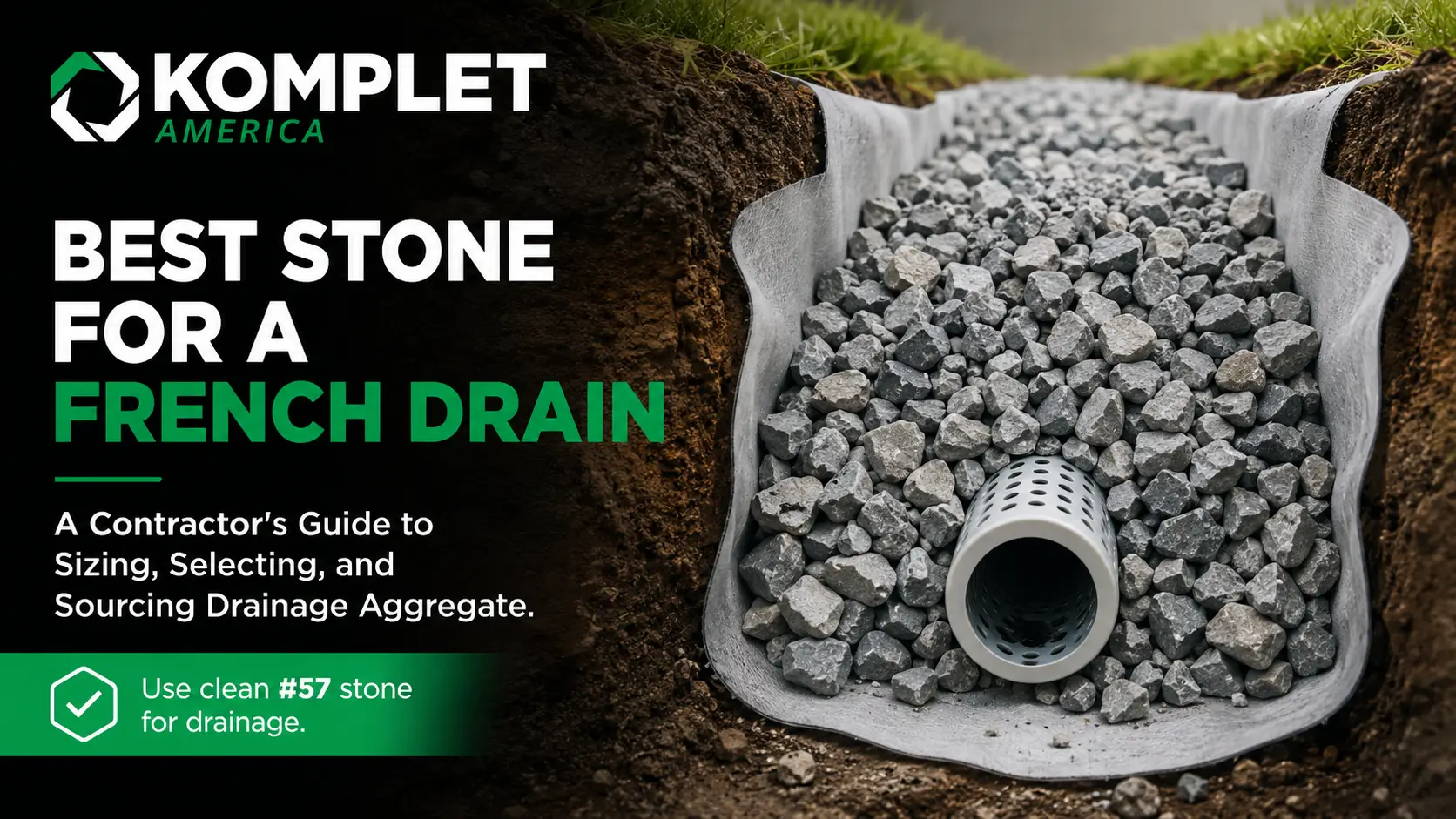
- Trench-wrapped configuration: geotextile lines the trench (sides and bottom), aggregate is placed inside, and the fabric is folded over the top before backfill. This is the standard residential approach and provides full filtration around the entire aggregate envelope.
- Sock-wrapped pipe: a fabric sleeve is pre-installed on the perforated pipe before placement. Aggregate is placed around the pipe directly without trench-wide geotextile. Used in some commercial and larger-section drains where trench-wide fabric is impractical.
The trench-wrapped approach provides better long-term filtration and is the standard recommendation for residential foundation, perimeter, and yard French drains. Sock-wrapped pipe alone is not generally adequate for foundation drainage in fine-soil conditions because the pipe sleeve can fail at seams or develop localized clogging that compromises the entire system.
Perforated Pipe Selection
The perforated drain pipe is the path that carries collected water from the trench to the discharge point. Pipe selection affects both the immediate carrying capacity of the system and the long-term reliability.
Pipe Material Options
- Corrugated polyethylene (HDPE) pipe — the most common residential drain pipe. Lightweight, flexible, available in solid wall and perforated configurations. Standard sizes are 3-inch, 4-inch, and 6-inch interior diameter for residential work; up to 24-inch and larger for commercial and stormwater applications.
- Rigid PVC schedule 40 or schedule 35 pipe with field-drilled or factory-perforated holes. Better long-term structural integrity than corrugated; stiffer to install in trenches with bends and grade changes.
- Smooth-wall HDPE (SDR 35 or similar) — middle ground between corrugated and rigid PVC. Good balance of rigidity, flow characteristics, and installation flexibility.
Pipe Sizing
Pipe diameter is sized based on the volume of water the drain needs to carry. Residential foundation and perimeter drains typically use 4-inch pipe — adequate for most residential applications and standardized across the industry. Commercial drains, large-acreage agricultural drainage, and high-flow stormwater applications size up to 6-inch, 8-inch, 12-inch, or larger pipe based on engineering calculations of expected flow.
As a rough guide for residential work:
- 3-inch pipe: small-section landscape drains, light yard drainage.
- 4-inch pipe: foundation perimeter drains, basement waterproofing, yard French drains, and curtain drains in residential settings.
- 6-inch pipe: residential drains where flow volumes are higher (large impervious area collecting to a single drain, longer drain runs, multiple drain inlets combining into a main).
- 8-inch and larger: commercial and engineered applications.
Perforation Orientation
Perforated pipe can be installed with perforations facing up, down, or to the sides. The accepted standard for French drains is perforations facing down, for two reasons: water enters the pipe from the bottom of the trench (after passing through the aggregate above), and downward-facing perforations allow water to enter the pipe even when the pipe is not full — the design condition for most residential drains. Perforations facing up are generally inappropriate; the pipe doesn’t fill with water until the trench is fully saturated, which defeats the design intent.
Slope and Sizing: The Math
Minimum Slope
French drain pipe must be sloped to discharge water by gravity. The minimum acceptable slope for residential drain pipe is typically:
- ⅛ inch per foot (approximately 1 percent grade). This is the bare minimum for most residential perimeter drains, foundation drains, and yard French drains.
- ¼ inch per foot (approximately 2 percent grade) is preferred where site conditions allow — provides better self-cleansing flow velocity and tolerance for installation grade variations.
Below 1 percent grade, water flow becomes too slow to carry settled fines and debris through the pipe; the system gradually accumulates sediment and reduces capacity over time. Above 5 percent grade, the flow velocity becomes high enough that the pipe interior may erode and joints may experience water-hammer stress; at very steep grades, rigid PVC is preferred over corrugated HDPE.
Trench Width and Depth
Standard residential French drain trench dimensions:
- Width: 8–12 inches for 4-inch pipe; 18–24 inches for 6-inch pipe; engineered for larger pipe sizes. Width must accommodate the pipe, the geotextile wrap, and clean stone clearance around the pipe.
- Depth: minimum 12 inches below the lowest point being drained for foundation drains, with frost line clearance in cold climates; 24–36 inches for typical perimeter drains; deeper for foundation drains in basement applications. Depth must accommodate the discharge point’s gravity slope from the trench upstream — water must always flow downhill in the system.
- Aggregate envelope: at least 4–6 inches of clean stone above and around the pipe. The full trench is typically backfilled with clean stone wrapped in geotextile.
Estimating Aggregate Quantity
Worked example: 50-foot perimeter drain, 12-inch wide trench, 24-inch deep, 4-inch perforated pipe.
- Trench volume: 50 ft × 1 ft × 2 ft = 100 cu ft = 3.7 cu yd.
- Subtract pipe volume: ~½ cu ft (negligible at this scale).
- Aggregate needed: ~3.7 cu yd × 1.35 tons/yd³ = ~5 tons clean #57 stone.
- Plus 10% waste/placement loss: ~5.5 tons.
- Geotextile: trench surface area × 1.5 (for wrap and overlap) ≈ 50 sq ft × 5 ft envelope perimeter × 1.5 ≈ 375 sq ft.
These calculations should be confirmed against project-specific dimensions and supplier-provided density values. Local scale tickets from prior similar jobs are the best reference for fine-tuning the math. For broader estimating context across residential drainage and driveway work, see Best Gravel for Driveways: A Contractor’s Layer-by-Layer Guide.
Construction Sequence: Building a French Drain Right
- Identify the discharge point and confirm gravity flow path. The drain must discharge to daylight, a dry well, a sump pump basin, or a storm sewer connection — every other component depends on knowing where the water goes.
- Mark the drain alignment and trench width. Allow for excavation tolerance and pipe path. Avoid utility conflicts; call 811 before excavation.
- Excavate to design depth at design slope. Maintain consistent grade — variations in trench bottom create pockets that hold water and accumulate debris.
- Verify the trench bottom slope with a transit, laser level, or string line. Field-correct any reverse grade or flat spots. The slope is the most consequential physical detail of the entire installation.
- Place geotextile fabric in the trench. Sides and bottom should be covered, with enough overhang to fold the fabric over the top of the aggregate after placement. Overlap adjacent rolls by 12–18 inches.
- Place a 2-inch bedding layer of clean #57 stone in the bottom of the trench.
- Lay perforated pipe on the bedding layer with perforations facing down. Verify slope of the pipe with a level. Connect pipe sections per manufacturer’s specifications — slip joints, snap couplings, or compression fittings depending on pipe type.
- Place clean #57 stone around and over the pipe. Maintain 4–6 inches of stone above the pipe and on each side; full trench width is filled with stone for traditional French drains.
- Fold the geotextile fabric over the top of the aggregate, with overlap of 6–12 inches.
- Backfill above the geotextile with topsoil, sod, gravel, mulch, or whatever finished surface treatment the site requires. The fabric over the top prevents fines from migrating down into the aggregate from the surface.
- Verify the discharge point is functioning. Water poured into the upstream end of the drain should reach the discharge in a few minutes for a residential-scale drain.
Why French Drains Fail: The Five Most Common Forensic Findings
When a French drain fails and is excavated for repair or replacement, the cause is almost always one of five issues — ranked roughly by frequency:
1. Wrong Aggregate (Crusher Run, Stone Dust, or Dirty Stone)
By far the most common failure cause. The drain was built with crusher run instead of clean stone, with un-washed screened stone instead of washed stone, or with a contaminated load that included fines. The void space was either compromised at installation or filled in within months by migration of the included fines. The fix is always excavation and rebuild with proper clean aggregate.
2. Missing or Improper Geotextile
The drain was built without geotextile, or with a lightweight landscape fabric that doesn’t meet drainage geotextile specifications, or with the fabric placed only partially around the aggregate envelope. Surrounding soil fines migrate into the aggregate over 3–7 years, clogging the void space progressively. Often shows up first as reduced flow capacity, then as complete drain failure.
3. Inadequate or Reversed Slope
The trench was excavated without consistent grade, leaving low spots that accumulate water and debris. In severe cases, the pipe slopes uphill at portions of its length, creating water traps that never drain and accumulate sediment. The downstream end may still discharge, but the system upstream of the reverse grade fails progressively as sediment fills the low spots.
4. Discharge Point Failure
The drain itself functions, but the discharge point is blocked, buried, frozen (in cold climates), submerged (in flood-prone areas), or otherwise non-functional. Water backs up into the drain, the system saturates, and the upstream sections lose their drainage function. Common problem on drains that discharge to daylight outlets — vegetation, sediment, or vandalism block the outlet over time without the homeowner noticing.
5. Pipe Damage
The pipe was damaged during installation (heavy equipment crushing, improper handling) or during subsequent landscape work (rototilling, deep planting, fence post installation). Crushed or punctured pipe reduces or eliminates flow at the damage point. Often discoverable only by excavation; the symptom is local drainage failure with the rest of the system functioning normally.
Producing Clean Drainage Stone On-Site
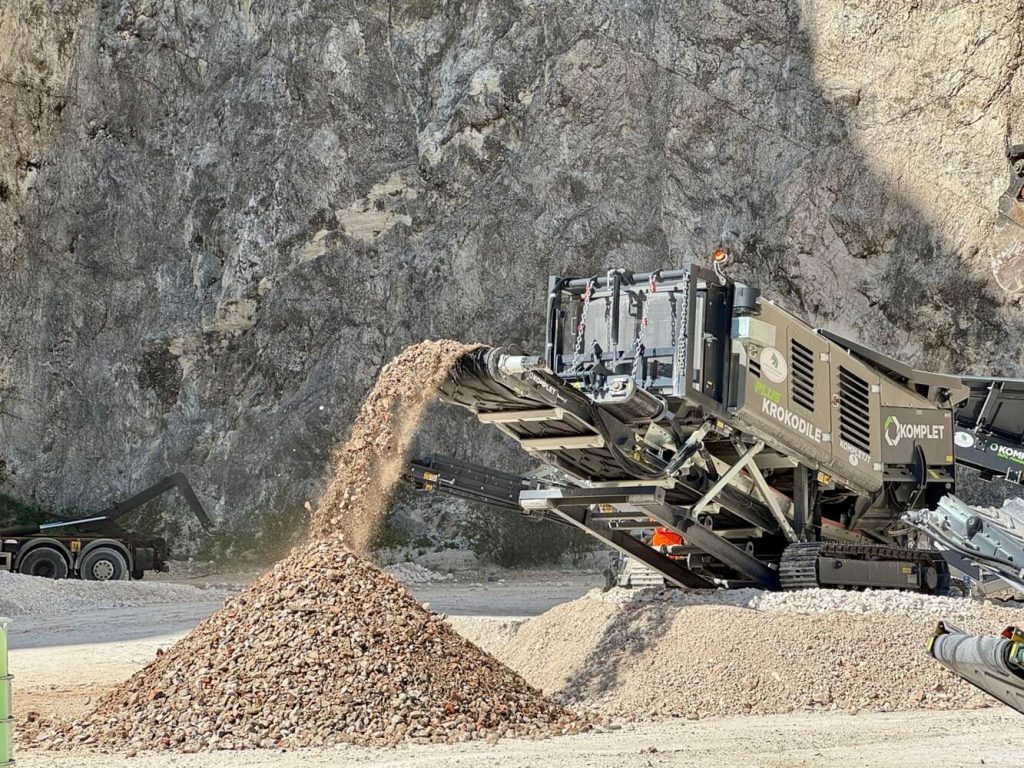
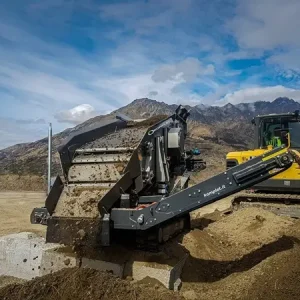
For contractors and recyclers producing aggregate from concrete demolition rubble, drainage stone is one of the natural product streams the same equipment can deliver. The key operational discipline that distinguishes producing French-drain-grade clean stone from producing marginal contaminated stone is fines management — at the screener, in the stockpile, and during loading.
The Production Workflow
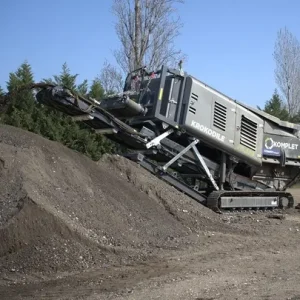
- Crush concrete demolition rubble through a primary jaw crusher — typically the K-JC 503, K-JC 604, K-JC 704 PLUS, or K-JC 805 depending on operation scale.
- Magnetic separation (integrated hydraulic magnetic belts on K-JC 604, 704 PLUS, and 805) removes ferrous metal from the discharge during crushing.
- Screen the crushed output through a vibrating screener — the Kompatto 5030 is the workhorse for compact operations producing sized products. Configure the screener with deck openings sized to capture the AASHTO #57 envelope (1-inch top deck, #4 sieve bottom deck) or the #67 envelope (¾-inch top, #8 bottom). For drainage stone specifically, the bottom deck must be configured tightly — fines that escape the bottom deck are the drainage failures of next year.
- Stockpile the sized product separately from fines, oversize, and other product streams. Cross-contamination between piles converts saleable drainage stone into reject material.
Washing — The Premium Production Step
Producing washed drainage stone — meeting the cleanliness standard that French drain applications really call for — requires water spray during or after screening. A water sprayer positioned over the screening deck (operated from the screener’s onboard dust suppression system, supplied from an external water tank, or fed from a site water source) sprays the material as it crosses the deck, washing residual dust off the particle surfaces. The wash water and dust drop through the bottom deck as fines; the cleaned stone discharges as a saleable washed product.
Operations producing washed stone for French drain or concrete coarse aggregate sale typically build dedicated wash stations rather than relying on the screener’s dust suppression alone. The capital investment is modest compared to the price premium for washed stone in most markets. For operations selling to general construction without spec-driven cleanliness requirements, screened-only stone is often acceptable — but for French drain applications specifically, the recommendation is washed.
Stockpile Management
- Dedicated stockpile zone for clean drainage stone, separated from crusher run / dense-graded aggregate stockpiles by enough distance that windblown fines don’t reach the clean stone.
- Loader discipline — clean buckets between products, no cross-loading of crusher run and clean stone with the same equipment, segregated paths between the loader and each stockpile.
- Conveyor placement — the K-TC 460 portable mobile conveyor extends stockpile reach and allows operators to build clean piles further from the screener and loader traffic that would otherwise contaminate the product.
- Cover (where weather allows) — covered stockpile or an enclosed yard reduces wind-driven contamination from neighboring piles or operations.
Quality Documentation for Drainage Stone Sales
For producers selling clean drainage stone into spec’d projects (state DOT drainage applications, municipal stormwater work, engineered drainage installations), gradation documentation is the credentialing step that separates contractor-grade producers from quarry-grade competitors. A current gradation report from an accredited lab — covering percent passing each named sieve, deleterious material content, and source documentation — is the documentation that turns a stockpile into a saleable product. For state DOT applications specifically, see State DOT Specs for Recycled Concrete Aggregate: A Contractor’s Reference.
Common Mistakes Contractors Make
Using Whatever Stone Is Cheapest
On a residential French drain that costs a few thousand dollars to install, the difference between cheap dirty stone and washed clean stone is sometimes a few hundred dollars on the materials line. The contractor saving a few hundred dollars at installation is committing the homeowner to a few thousand dollars of remediation work in 5–10 years when the drain fails. The math doesn’t favor the cheap stone in any defensible scenario.
Skipping Geotextile to Save Time
Geotextile placement adds 30–60 minutes to a typical residential French drain installation. Skipping this step is the single most expensive shortcut in residential drainage work. The drain that’s installed without geotextile fails reliably within a decade. The drain that’s installed with proper geotextile lasts 25+ years.
Specifying Slope Without Verifying It
“At least ⅛ inch per foot” written on a plan and “at least ⅛ inch per foot” achieved in the field are different things. Field verification — with a transit, laser level, string line, or even a spirit level on a board — is the only check that catches the reverse grade or flat spot that turns into a failure point. The verification adds little time; the failure costs much.
Discharging to a Bad Outlet
A daylight outlet that discharges into a swale that itself drains poorly, a sump basin that doesn’t have a working sump pump, a connection to a storm sewer that’s already at capacity — none of these are functioning discharge points. The drain works upstream; the water has nowhere to go downstream; the system fails as a whole. The discharge point assessment is part of the drain design, not an afterthought.
Trenching Through Tree Roots Without a Plan
Tree roots and French drain pipe interact poorly. Roots seek water; perforated pipe is the wettest thing in the soil. Drains routed through the root zones of mature trees develop root infiltration that progressively clogs the pipe interior. Where trees can’t be avoided, root barriers or solid (non-perforated) pipe through the root zone, transitioning back to perforated pipe past the tree, can prevent the problem.
Frequently Asked Questions
What is the best gravel for a French drain?
Clean, washed AASHTO #57 stone is the standard default for most French drain applications — 1-inch top size, open-graded with minimal fines, high void ratio for water flow, widely available across the U.S. AASHTO #67 stone (¾-inch top size) is acceptable in smaller-section drains. The aggregate must be clean (preferably washed) — residual dust and fines clog the void space and shorten the drain’s service life.
Should French drain stone be washed or screened?
Washed is preferred for drainage applications. Screened-only stone meets the gradation envelope but may carry residual dust on particle surfaces; washing actively removes the dust during or after screening. The price difference is typically modest, and the long-term performance difference is significant. For French drain applications specifically, specifying “washed #57” rather than just “#57” is one of the few decisions that delivers proportional long-term benefit at low incremental cost.
Can I use crusher run in a French drain?
No. Crusher run is dense-graded aggregate engineered for compaction and surface stability; it contains 5–12 percent fines (passing #200 sieve) that fill the void space the drain needs to function. Compacted crusher run has roughly one-tenth the hydraulic capacity of clean #57 stone in the same trench. A French drain built with crusher run is essentially non-functional from day one and gets worse over time as the residual fines migrate.
Can I use pea gravel for a French drain?
Pea gravel is sometimes used in landscape and decorative drainage applications, but it’s generally not the right choice for structural French drains. The rounded shape produces tighter packing with smaller voids than equivalent crushed stone, and the lack of angular interlock means the aggregate can shift and migrate over time. Pea gravel French drains can work in low-flow landscape applications but are not recommended for foundation perimeter drains or other applications where reliable long-term performance matters.
What’s the right slope for a French drain pipe?
Minimum ⅛ inch per foot (approximately 1 percent grade) for most residential applications. ¼ inch per foot (2 percent) is preferred where site conditions allow because it provides better self-cleansing flow velocity and tolerance for installation grade variations. Below 1 percent grade, the flow velocity becomes too slow to carry settled fines through the pipe and the system gradually accumulates sediment. Above 5 percent grade, rigid PVC is preferred over corrugated HDPE to handle higher-velocity flow.
How deep should a French drain be?
Depends on the drain’s purpose. Foundation perimeter drains are typically installed at footing depth to capture water before it reaches the basement wall. Yard French drains are typically 18–24 inches deep, capturing water from the seasonal high water table. Curtain drains intercepting hillside groundwater can be 36 inches or deeper. Cold-climate drains must be deep enough to remain functional during freeze events — at least 6–12 inches below the local frost line for any portion that needs to function in winter.
Do I really need geotextile fabric in a French drain?
Yes, in essentially all soil conditions. Without geotextile, surrounding soil fines migrate into the aggregate over 3–7 years and clog the void space the drain needs to function. The fabric is the single most effective long-term protection of the drain’s drainage capacity. Skipping geotextile to save 30–60 minutes of installation time commits the drain to failure within a decade. Use AASHTO M288 Class 2 non-woven needle-punched fabric with AOS 0.21 mm (or finer for clay soils) and permittivity ≥ 0.2 sec⁻¹ as the residential standard.
Can I use recycled concrete aggregate (RCA) in a French drain?
Yes, when properly produced and screened to the AASHTO #57 or #67 envelope. RCA’s angular fracture surfaces actually interlock better than naturally rounded gravel, providing stable aggregate placement around the drain pipe. The cleanliness standard for RCA in drainage applications is the same as for virgin aggregate — washed or properly screened to remove residual fines. Producers selling RCA into drainage applications need clean stockpile management and quality control discipline to maintain product integrity. State DOT acceptance of RCA in drainage applications varies; for private residential drainage work, RCA is broadly acceptable and often preferable on cost.
How long should a properly built French drain last?
A properly built French drain — clean washed open-graded aggregate, AASHTO M288 Class 2 geotextile, properly sloped pipe, functional discharge point — typically performs reliably for 25+ years with no maintenance. Drains that fail in 5–10 years almost always trace back to one of five issues: wrong aggregate, missing or inadequate geotextile, reversed or inadequate slope, blocked discharge point, or damaged pipe. None of the failure modes are unavoidable; all of them can be prevented by proper construction discipline.
Final Thoughts
French drains are simple in concept and unforgiving in execution. The aggregate either has the void space to move water or it doesn’t. The geotextile either filters soil fines or it doesn’t. The pipe either slopes downhill consistently or it doesn’t. The discharge point either receives water or it doesn’t. There are no marginal performances; there are working drains and non-working drains, and the difference is determined by a small number of decisions made at construction.
Of those decisions, aggregate choice is the most consequential and the most reversible at the specification stage. Specifying clean washed #57 stone rather than crusher run, screened-only stone, or whatever the supplier delivers when the order says “gravel” is a decision the contractor makes once and locks in the drainage performance for decades. The cost increment is small. The performance increment is the difference between a drain that works and a drain that doesn’t.
For contractors who do drainage work routinely — foundation contractors, basement waterproofing specialists, hardscape contractors, drainage specialists, recyclers producing aggregate for resale — the case for owning the production capability for clean drainage stone has gotten meaningfully stronger over the past several years as virgin aggregate prices have climbed and dump fees on demolition rubble have climbed alongside them. The same compact equipment that produces driveway aggregate produces French drain aggregate, with screening discipline being the variable that determines product class. Komplet’s compact crusher and screener lineup is sized for this kind of contractor work, and our specialists are happy to talk through the equipment configuration and screening setup that produces drainage-grade clean stone consistently.
For broader context across the cluster, see our companion articles: Crushed Stone Grades: A Komplet Basic Guide to Aggregate Size and Use Cases, Crusher Run vs #57 Stone for Driveways, #57 Stone vs #67 Stone, Best Gravel for Driveways: A Contractor’s Layer-by-Layer Guide, State DOT Specs for Recycled Concrete Aggregate, and Construction & Demolition Tipping Fees by Region.
Ready to Produce Clean Drainage Stone for Your Operation?
- Talk to a Komplet specialist about pairing the right crusher and screener configuration for clean drainage stone production. Call 908-369-3340 or visit com/contact-us.
- Browse the full Komplet equipment lineup — crushers, impact crushers, screeners, conveyors, and shredders sized for compact contractor and recycling operations.
- Explore equipment financing through Komplet Capital — 24-hour approvals, terms from 36 to 72 months, 100% financing available.
- Consider a pre-owned Komplet machine — typical capital savings of 40 to 70 percent versus new, factory-supported by the same Komplet America service network.
Never enough.
Disclaimer: Aggregate gradations, geotextile specifications (AOS, permittivity, AASHTO M288 classes), pipe sizing, and slope requirements vary by application, project specification, and regional standards. Confirm engineer of record requirements, project specifications, and applicable building codes before designing, installing, or specifying drainage systems. Worked examples and estimating math are illustrative; project-specific calculations should be verified against actual conditions, supplier scale tickets, and binding specifications. Operating, maintenance, and service guidance is general in nature. Always refer to the official Komplet operator’s manual for the specific machine model and serial number, and follow OEM intervals and procedures. For warranty-protected work, contact Komplet America at 908-369-3340 or your authorized Komplet dealer. Improper service or non-OEM parts may void warranty coverage and create safety hazards.