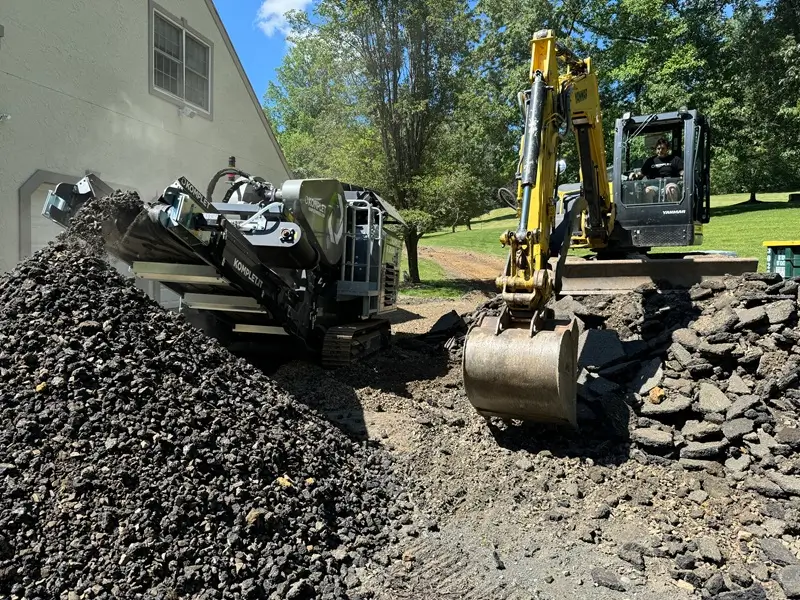

Twenty years ago, crushing stone meant trucking material to a fixed crushing plant somewhere off-site, paying tipping fees and haul costs both directions, and hoping the spec aggregate that came back was what you needed. Today, a mobile crusher does the work on your job site — no hauling, no dump fees, no waiting on someone else’s schedule. The economics have completely changed.
This guide walks through the real advantages of mobile crushers for contractors, demolition crews, recyclers, and quarry operators. We cover the operational benefits, the financial case (with worked numbers), how mobile compares to stationary crushing in practice, and how Komplet America’s compact mobile lineup fits the work most contractor-scale operations actually do.
What Is a Mobile Crusher?
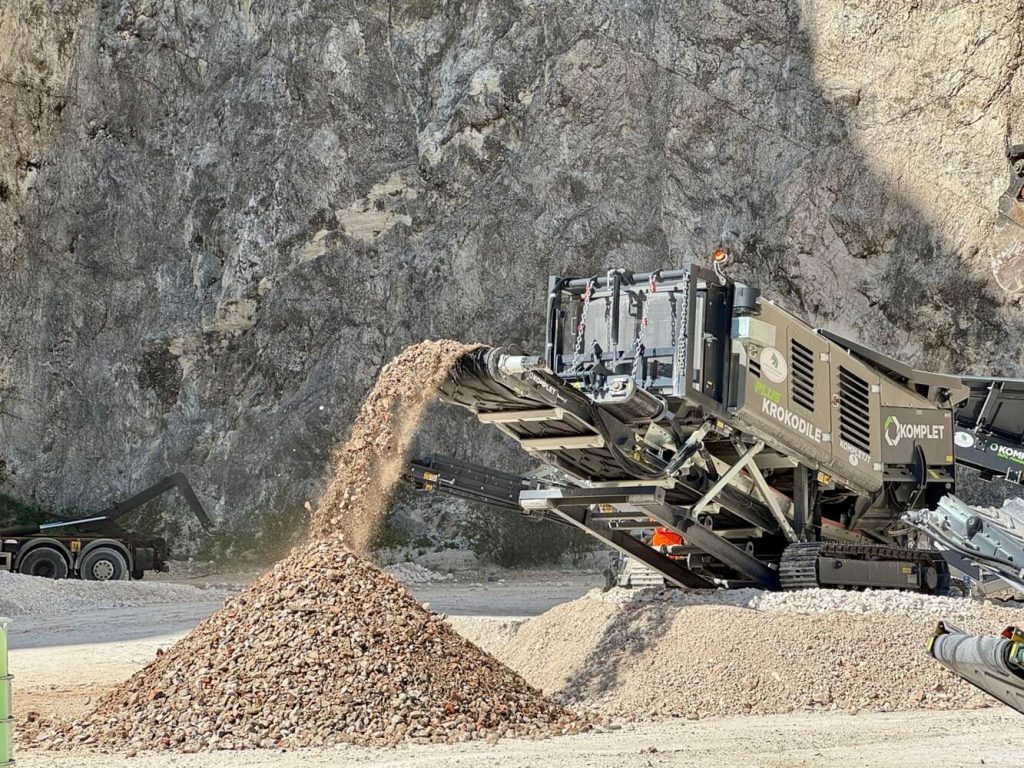
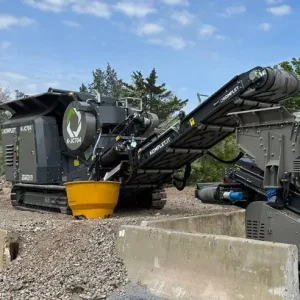
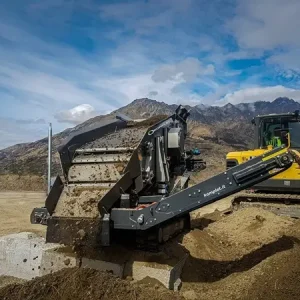
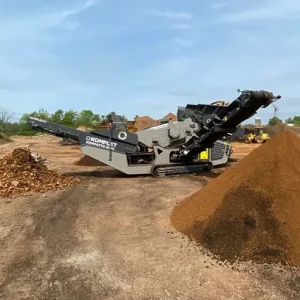
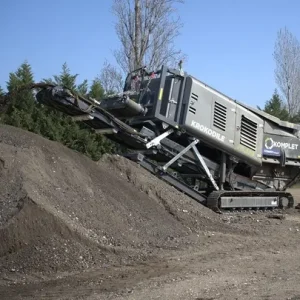
A mobile crusher is a self-contained crushing plant mounted on rubber tracks (or wheels) that can be moved between job sites under its own power. It includes everything needed to crush stone, concrete, asphalt, or demolition debris on location: the crushing chamber, feed hopper, output conveyor, dust suppression, controls, and onboard diesel power. Setup typically takes 15 minutes or less from arrival to first material crushed.
In contrast, a stationary (fixed) crushing plant is bolted to a foundation at a permanent site. Material has to be hauled in, crushed, and hauled back out — adding hauling cost, time, and logistical complexity to every load. For most contractor and mid-size recycler operations, mobile is the dominant choice.
The Seven Real Advantages of Mobile Crushers
1. Eliminating Hauling Costs
A 25-ton dump truck running concrete debris to a recycling center 30 minutes away costs $250-$400 per round trip in many markets — counting the truck rental, fuel, and driver time. Multiply that across hundreds of loads in a year and the haul bill becomes one of the biggest line items in the operation.
A mobile crusher works on the job site. The material doesn’t move. Instead of paying to truck debris off and aggregate back, you crush in place and use the output where it sits. Even on operations where finished product still needs delivery to customers, the haul leg is shortened dramatically and never round-trip.
2. Eliminating Dump and Tipping Fees
Construction and demolition (C&D) tipping fees in major US markets range from $40 per ton in lower-cost regions to $100+ per ton in dense urban markets. A mid-size demolition contractor producing 2,000 tons of debris per month at $75/ton is paying $150,000/month just to make problems disappear.
With a mobile crusher on site, that debris becomes a product instead of a problem. The dump fees disappear. Better yet, your competitors who don’t crush on-site become potential customers — they bring you their concrete debris, paying you a tip fee, which becomes a second revenue stream on top of finished aggregate sales.
3. Producing On-Site Aggregate
Virgin aggregate prices have steadily climbed since 2020 and continue rising. A typical contractor or excavator buying base material, drainage stone, or backfill aggregate at $20-$35 per ton gets to skip that entire cost line when an on-site mobile crusher produces spec-equivalent recycled aggregate from demolition material.
For larger operations, the math gets even better — finished product can be sold to other contractors, builders, or municipalities at $15-$30 per ton (typical RCA pricing), creating a margin business on top of the hauling and dump-fee savings. The K-JC 704 PLUS, at up to 90 US tph, can produce 500+ tons per shift — enough to supply most contractor projects with finished aggregate from their own debris.
4. Tracked Mobility Between Sites
Modern compact mobile crushers are self-propelled on rubber tracks with wireless remote control. The operator drives the machine off the trailer, positions it on the site, and starts crushing — all without specialized equipment or extra labor. When the job ends, the same operator drives it back onto the trailer for transport to the next site.
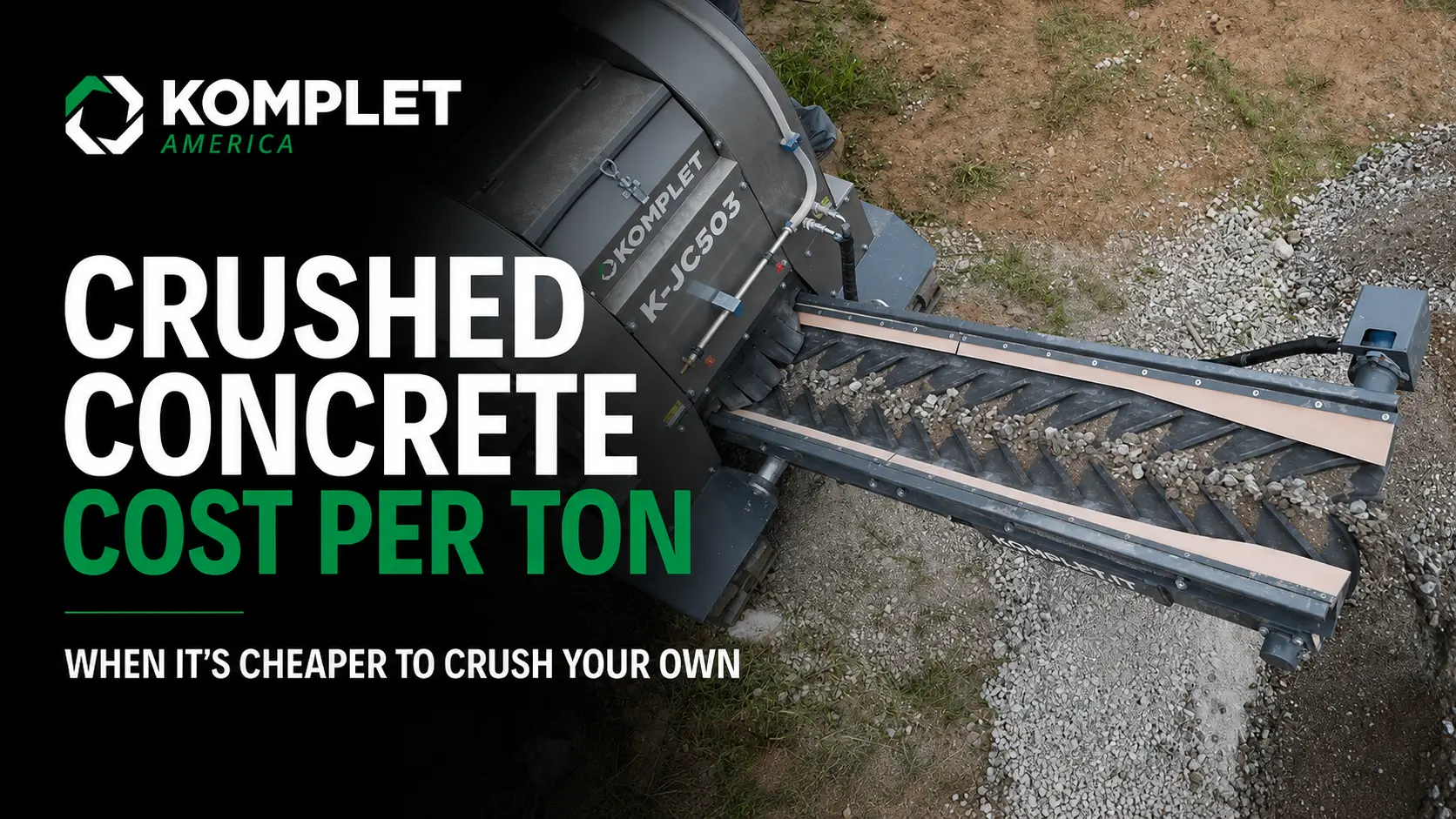
Komplet’s compact tracked design also fits sites that larger machines can’t access. The K-JC 503 at 7,496 lb is the most compact tracked jaw crusher on the market — built for urban demo, basement-level concrete recycling, and tight-access sites where a 60,000+ lb machine simply can’t reach.
5. Quick Setup and Tear-Down
Mobile crushers are designed to be productive within 15 minutes of arriving on site. Drive the machine into position, deploy the hydraulically folding conveyors, connect the dust-suppression water line, run a short warm-up, and begin feeding. At the end of the job, the same process runs in reverse — conveyors fold up, machine drives onto the trailer, and you’re moving to the next site.
This is a major productivity advantage compared to stationary plants, where commissioning a new site takes days or weeks of foundation work, electrical hookups, and equipment installation. For contractors and rental operators handling multiple jobs per month, the time saved on setup compounds into significantly more productive work hours per year.
6. Lower Total Cost of Ownership
Compact mobile crushers are dramatically less expensive to buy than stationary plants — often by an order of magnitude. They also avoid the site-prep costs (foundations, permits, electrical infrastructure) that come with stationary installations.
Equally important: mobile crushers can be financed, depreciated, and even resold like other heavy equipment. Komplet Capital — Komplet America’s in-house financing arm — offers 24-hour credit approval, 100% financing, and 3-6 year terms. Combined with Section 179 tax deduction (up to $1.22M of equipment fully deductible in the year of purchase, 2024 limit), the upfront cost is structured to align with the cash flows the machine generates from day one.
7. Direct OSHA Silica Compliance
OSHA’s permissible exposure limit (PEL) for respirable crystalline silica is 50 ug/m3 — the regulation applies to any operation that crushes stone, concrete, or aggregate. Stationary crushing plants and mobile crushers both have to manage silica dust, but mobile crushers built with dust suppression as standard equipment are OSHA-ready out of the box.
Every Komplet mobile crusher ships with water-spray dust suppression nozzles at the feed hopper and discharge conveyor. The operator connects a standard garden-hose water line and the system runs automatically. No retrofit, no add-on cost — Komplet machines are OSHA-compliant the day they arrive on site.
Mobile vs. Stationary Crusher: Practical Comparison
The decision between mobile and stationary crushing isn’t always clear-cut. Each has roles where it makes sense.
When Mobile Wins
- Demolition contractors working multiple sites per year — eliminating hauling round-trips and dump fees more than pays for the machine.
- C&D recyclers with fluctuating volumes — mobile equipment scales up or down based on actual feed material.
- Excavation contractors producing on-site aggregate or fill — mobile crushing turns excavated rock into base material at the source.
- Rental fleets — equipment can move between customers and projects rather than being locked to a single site.
- Site developers and infrastructure projects — large-scale on-site processing for subdivisions, solar farms, commercial development, road construction.
- Anyone in regions with high tipping fees — Northeast, Mid-Atlantic, West Coast metros, and major urban centers, where the dump-fee savings alone justify the equipment.
When Stationary Still Wins
- Single-site high-volume quarries producing 500+ tph year-round at a permanent location — fixed plants can be sized larger and run continuously.
- Aggregate producers with dedicated long-term reserves — capital can be amortized over decades.
- Cement and mineral processing — specialized industrial applications where material sources don’t move.
For the majority of contractor, demolition, and mid-size recycler operations in North America, mobile crushing is the dominant choice — and the gap has widened every year as mobile equipment has become more capable and tipping fees have continued to climb.
The Mobile Crusher ROI in Real Numbers
Here’s how the math works for a typical mid-size demolition contractor.
Operation Profile
- Monthly debris volume: 2,000 tons of mixed concrete, rebar, and brick
- Local C&D dump fee: $75/ton
- Virgin aggregate purchase price: $20/ton (1,000 tons/month bought as backfill and base)
- Truck hauling: $300 per 25-ton load (80 round trips per month)
Old Workflow (Without On-Site Crushing)
- Dump fees: 2,000 tons x $75 = $150,000/month
- Truck haul costs: 80 trips x $300 = $24,000/month
- Aggregate purchases: 1,000 tons x $20 = $20,000/month
- Total monthly outflow: approximately $194,000
New Workflow With a K-JC 704 PLUS Mobile Crusher
- Gross monthly benefit: approximately $194,000 (eliminating all of the above)
- Finance payment via Komplet Capital (5-year term): approximately $5,100/month
- Operating costs (fuel, operator, wear parts): approximately $4,000/month
- Net monthly benefit: approximately $185,000
- Payback: First month of operation. The crusher pays for itself before the second payment.
In high-tipping-fee markets (above $50/ton), a K-JC 704 PLUS typically pays back in 3 to 8 months of full-use operation. After that, the savings continue for the working life of the machine. For a payback estimate based on your specific volume and local market, call 908-369-3340 and we’ll run the numbers with you.
Komplet America’s Mobile Crusher Lineup
Komplet America offers four jaw crushers and one impact crusher — all tracked, self-propelled, mobile, and built for the contractor-scale operator.
K-JC 503 — The Most Compact Tracked Jaw Crusher Available
K-JC 503 — up to 34 US tph, 19″ x 12″ jaw, 25 HP, 7,496 lb. Best for urban demolition, basement-level concrete recycling, landscape contractors, and tight-access sites where larger machines won’t fit.
K-JC 604 — Mid-Range Versatility
K-JC 604 — up to 55 US tph, 23″ x 16″ jaw, 55 HP, 19,400 lb. Variable-speed grizzly feeder, hydraulic CSS adjustment, reverse jaw function, magnetic belt, dust suppression standard. The step-up for contractors outgrowing a K-JC 503 or moving from hired crushing services to in-house.
K-JC 704 PLUS — Komplet’s Best-Selling Crusher
K-JC 704 PLUS — up to 90 US tph, 27″ x 16″ jaw, 74 HP, 26,455 lb. The universal workhorse for C&D recycling, demolition, and aggregate production. Fits a standard flatbed trailer for transport. Handles 80%+ of contractor-scale crushing scenarios.
K-JC 805 — Quarry-Scale Mobile Crushing
K-JC 805 — up to 160 US tph, 31″ x 21″ jaw, 130 HP, 49,600 lb. Komplet America’s largest mobile jaw crusher. For demolition contractors running multiple crews, urban redevelopment with sustained high volume, and small C&D recycling yards needing serious daily output.
K-IC 70 — Compact Impact Crusher
K-IC 70 — up to 90 US tph, 25″ x 20″ inlet, 100 HP, 28,600 lb. Launched at WOC 2024. The cubical-output complement to a primary jaw — critical for asphalt recycling and applications requiring spec-shaped aggregate. Many serious operations run a K-JC 704 PLUS for primary plus a K-IC 70 for secondary cubical shaping.
Browse the full crusher lineup for complete specs, or pair any crusher with a Kompatto vibrating scalping screen to produce multiple spec sizes from a single workflow.
Frequently Asked Questions
What’s the main advantage of a mobile crusher over a stationary plant?
The single biggest advantage is eliminating material hauling. With a stationary plant, you pay to truck debris in and aggregate out — a round-trip cost on every load. A mobile crusher works at the source. No hauling, no dump fees, no waiting on someone else’s schedule. For most contractor and mid-size recycler operations, this alone justifies the equipment.
How long does it take to set up a mobile crusher on a new site?
Under 15 minutes from arrival to first material crushed on most Komplet machines. Tracked self-propelled mobility, hydraulically folding conveyors, and wireless remote control make setup a one-operator task. Drive the crusher off the trailer, position it, deploy the conveyors, connect water for dust suppression, and start feeding.
What can a mobile crusher actually crush?
Most concrete, brick, asphalt, demolition debris, and natural rock — granite, basalt, limestone, sandstone, bluestone, quartzite. Komplet jaw crushers handle reinforced concrete with rebar (the magnetic belt separates the rebar). Avoid feeding wet clay, large quantities of wood, plastics, or large metal objects. For details on material compatibility, see our material compatibility guide.
How much does a mobile crusher cost?
Komplet’s compact lineup ranges from approximately $108K for the K-JC 503 to approximately $241K for the K-JC 704 PLUS, with the K-JC 805 at the top of the lineup. All Komplet equipment qualifies for Komplet Capital financing — 24-hour credit approval, 100% financing, and 3-6 year terms. New equipment also qualifies for Section 179 tax deduction (up to $1.22M deductible in the year of purchase, 2024 limit).
Can mobile crushers handle reinforced concrete with rebar?
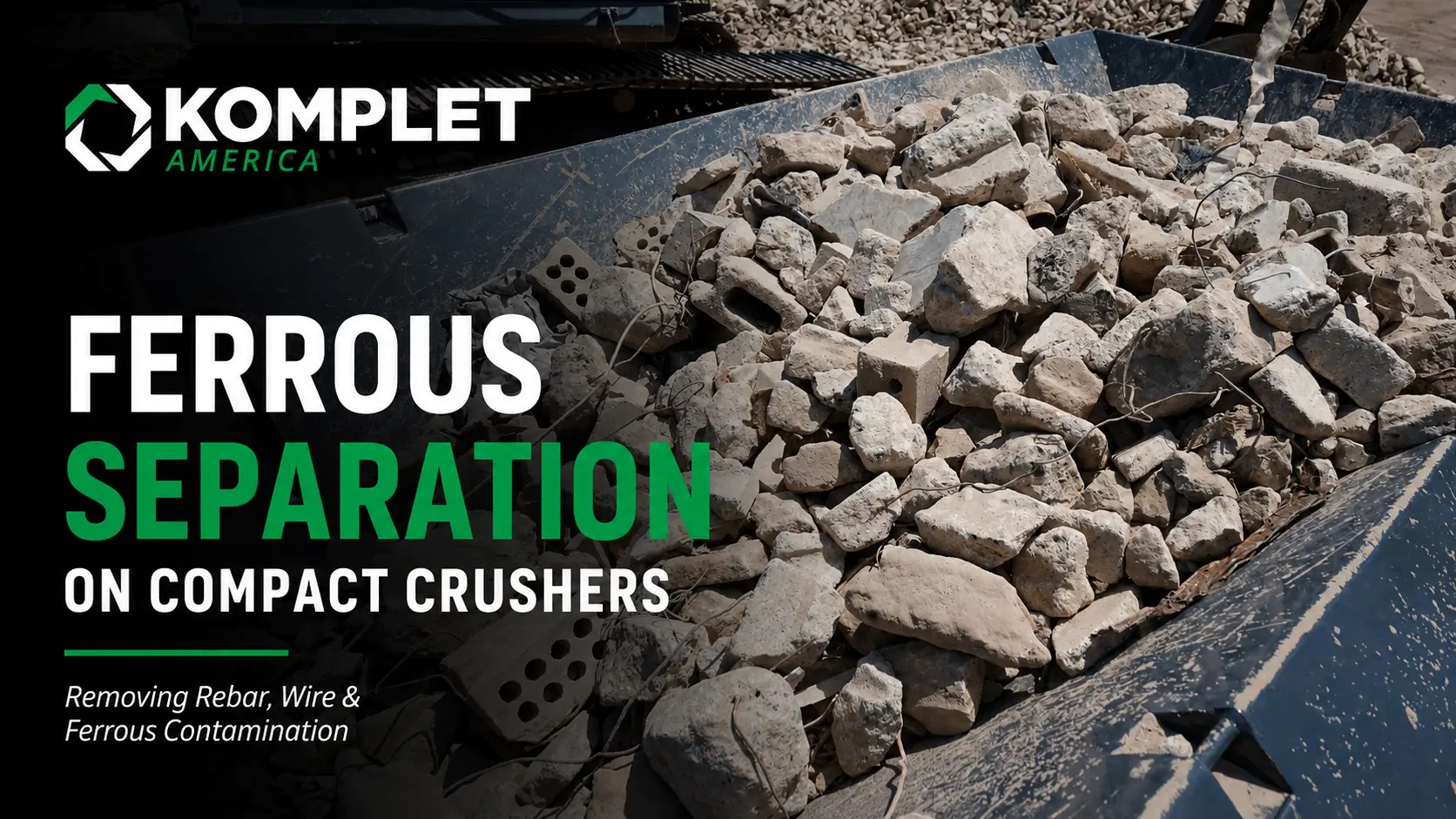
Yes. Komplet jaw crushers fracture concrete around rebar through compressive force. The hydraulic magnetic belt above the discharge conveyor lifts the rebar off the output stream into a separate pile. The K-JC 604, K-JC 704 PLUS, and K-JC 805 all include the magnetic belt, reverse jaw function, and reversible jaw plates as standard equipment.
Do I need a separate operator for the mobile crusher?
Mobile crushers are operated remotely via wireless remote — typically by the same loader operator feeding material into the hopper. One person can run both the crusher and the feeding equipment. Larger operations sometimes assign a dedicated crusher operator at higher throughput rates, but the equipment itself doesn’t require a separate person.
How do mobile crushers handle dust on site?
Every Komplet mobile crusher ships with dust suppression water-spray nozzles as standard equipment, positioned at the feed hopper and discharge conveyor. The operator connects a standard garden-hose water line and the system operates automatically. This is critical for OSHA silica compliance (PEL of 50 ug/m3) on virgin stone and concrete crushing operations.
Are mobile crushers good for small contractors or just big operations?
Mobile crushers scale across the full contractor range. The K-JC 503 at up to 34 US tph fits small landscape, paving, and excavation contractors. The K-JC 704 PLUS at up to 90 US tph covers most mid-size demolition and C&D recycling operations. The K-JC 805 at up to 160 US tph handles quarry-scale work. With Komplet Capital financing structuring monthly payments to align with savings, mobile crushing is accessible to operations as small as a single-truck demolition contractor.
Final Thoughts
The case for mobile crushers comes down to a simple operational truth: material is heavy, hauling is expensive, and dump fees keep climbing. A mobile crusher works where the material is, eliminates the hauling round-trip, turns dump fees into savings, and creates on-site spec aggregate that either replaces purchased material or becomes a revenue stream. For most contractor-scale operations, the math works out to first-month or first-quarter payback in moderate-to-high tipping fee markets.
Komplet America’s compact mobile lineup — from the K-JC 503 for urban demo up to the K-JC 805 for quarry-scale production, plus the K-IC 70 impact crusher for cubical output — covers the full range of contractor-scale crushing applications. Browse the full crusher lineup and screeners to see the combinations that fit your material and throughput, or call us and we’ll help you spec the right machine.
Ready to Talk Mobile Crushing?
- Call 908-369-3340
- Email [email protected]
- Schedule a demo or request a quote
- Ask about our 1-year / 1,000-hour warranty and equipment financing options
Never enough — that’s how we approach service, support, and helping you turn material into margin on every job site.
Disclaimer: All ROI, payback, and revenue figures in this article are illustrative examples based on sample assumptions about volume, local pricing, material mix, and operating conditions. Actual results vary significantly by region, market, material type, equipment utilization, operator skill, financing terms, and many other factors. Dump fees, aggregate pricing, fuel costs, hauling rates, and interest rates all change over time and by location. Komplet America makes no guarantee, warranty, or representation of specific financial performance or payback timelines for any particular operation. For a payback estimate based on your specific volume, material, and local market, contact us at 908-369-3340 to speak with our tea