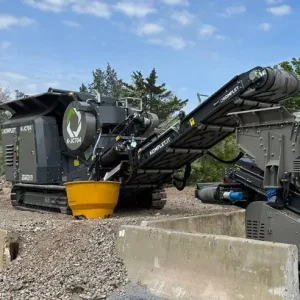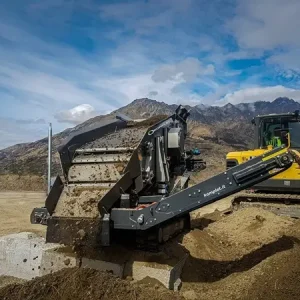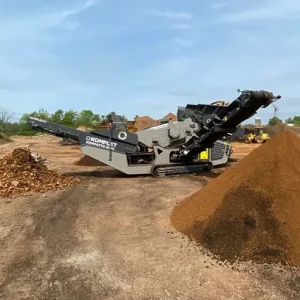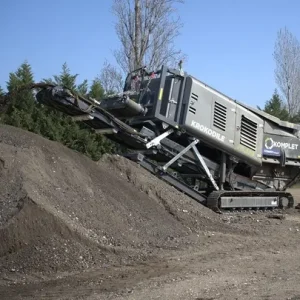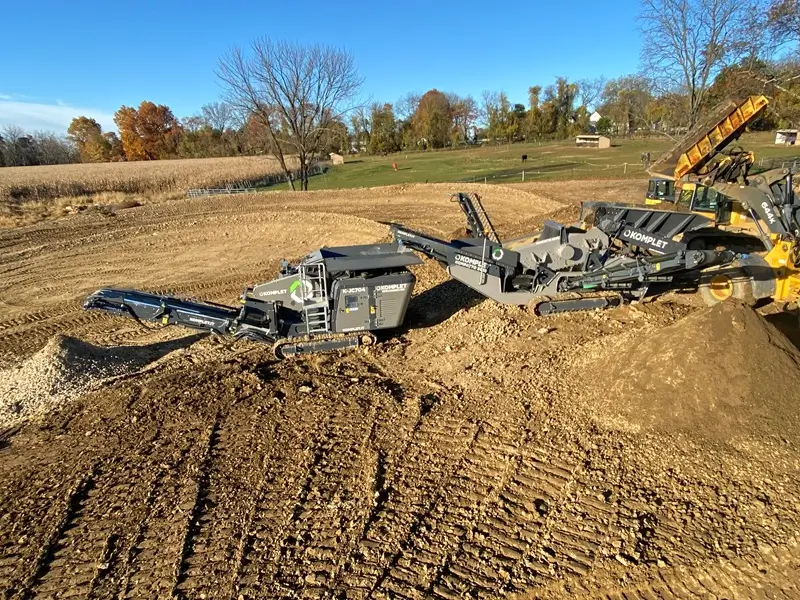

A crusher takes raw demolition debris and reduces it. A screener takes that crushed output and sorts it into sized products. Used together — sized to match each other’s production rates — the two machines turn a pile of mixed concrete, asphalt, and rubble into clean, gradable, sellable aggregate. Used in mismatched pairings, one bottlenecks the other and production stalls.
This guide walks through the practical crusher-and-screener combinations Komplet America customers actually use, why each pairing makes sense, and how to size a portable crushing-and-screening system to the work in front of you.
Why Combine Crushing and Screening?
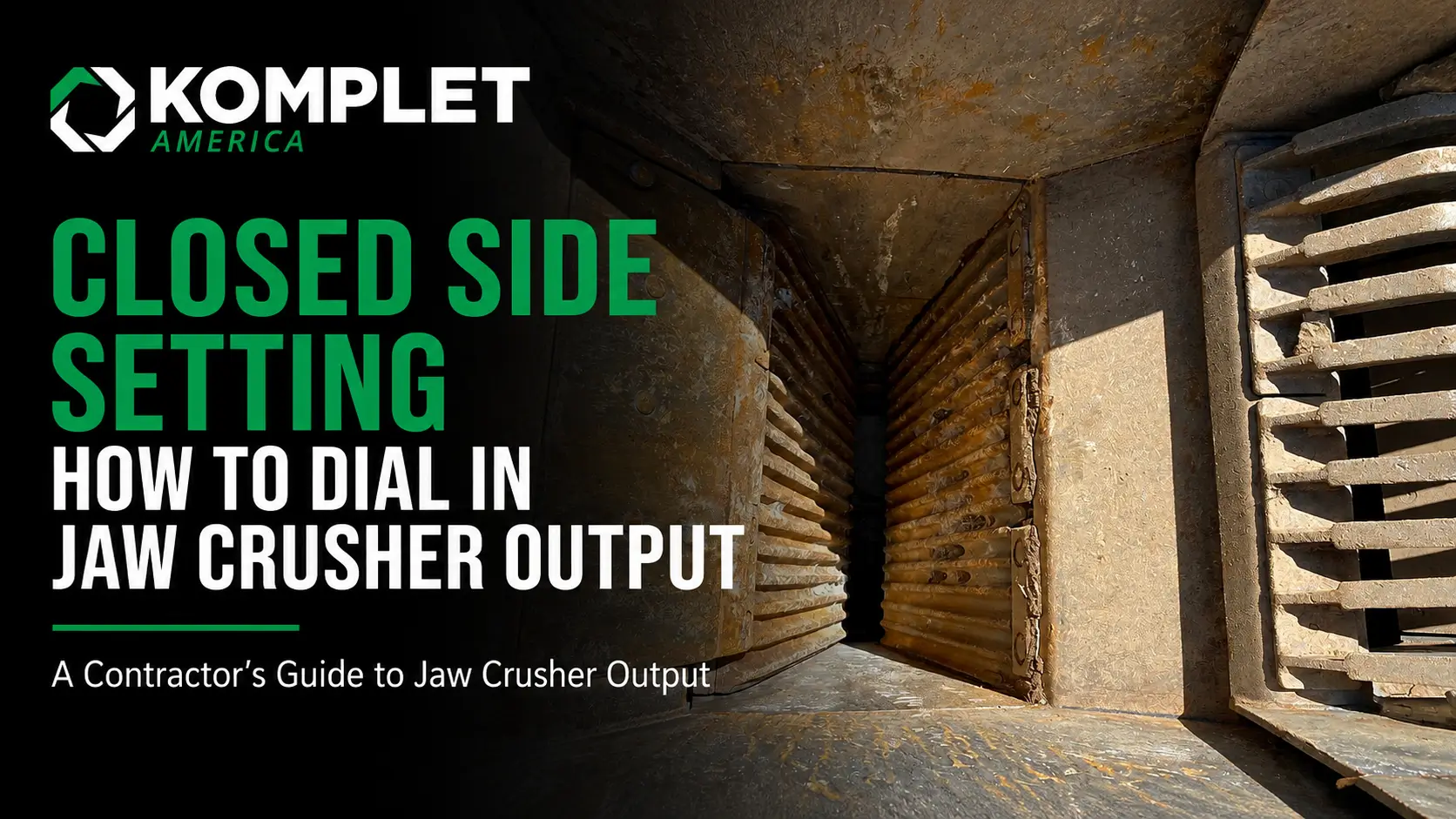
A jaw or impact crusher’s output is sized by the closed-side jaw setting (or rotor gap, for an impact crusher). That setting can be adjusted, but at any given moment the crusher produces aggregate in a single size range — say, 0 to 3″ minus. That output is usable, but it’s not yet a finished product.
A vibrating screener takes that single-size output and separates it into multiple sized fractions: oversize that needs to go back through the crusher, mid-size product that can serve as base or fill, and fines that can be sold or used as a finishing aggregate. The crusher reduces; the screener refines. The combination produces sellable, sized product instead of generic crusher run.
The economic implication: an operation running a crusher alone produces a single-grade product. The same operation pairing a crusher with a screener produces two or three grades from the same input material — meaning more saleable product per ton of demolition debris fed in, and more flexibility to match output to what each project actually needs.
The Throughput-Matching Principle
The most common mistake operators make when buying crusher-screener combinations is mismatching the production rates. A crusher producing 90 tph paired with a screener that maxes out at 50 tph means the crusher idles waiting for the screener; a crusher producing 90 tph paired with a screener rated at 280 tph means the screener idles waiting for the crusher. Either way, capital sits unused.
The right sizing principle: the screener should be rated equal to or slightly above the crusher’s typical operating throughput, not its peak rated number. A 90 tph crusher pairs cleanly with a screener rated 90–150 tph — enough headroom to absorb production peaks without bottlenecking, but not so much that screener capacity goes wasted.
Recommended Komplet Crusher-Screener Pairings
K-JC 503 + Kompatto 221
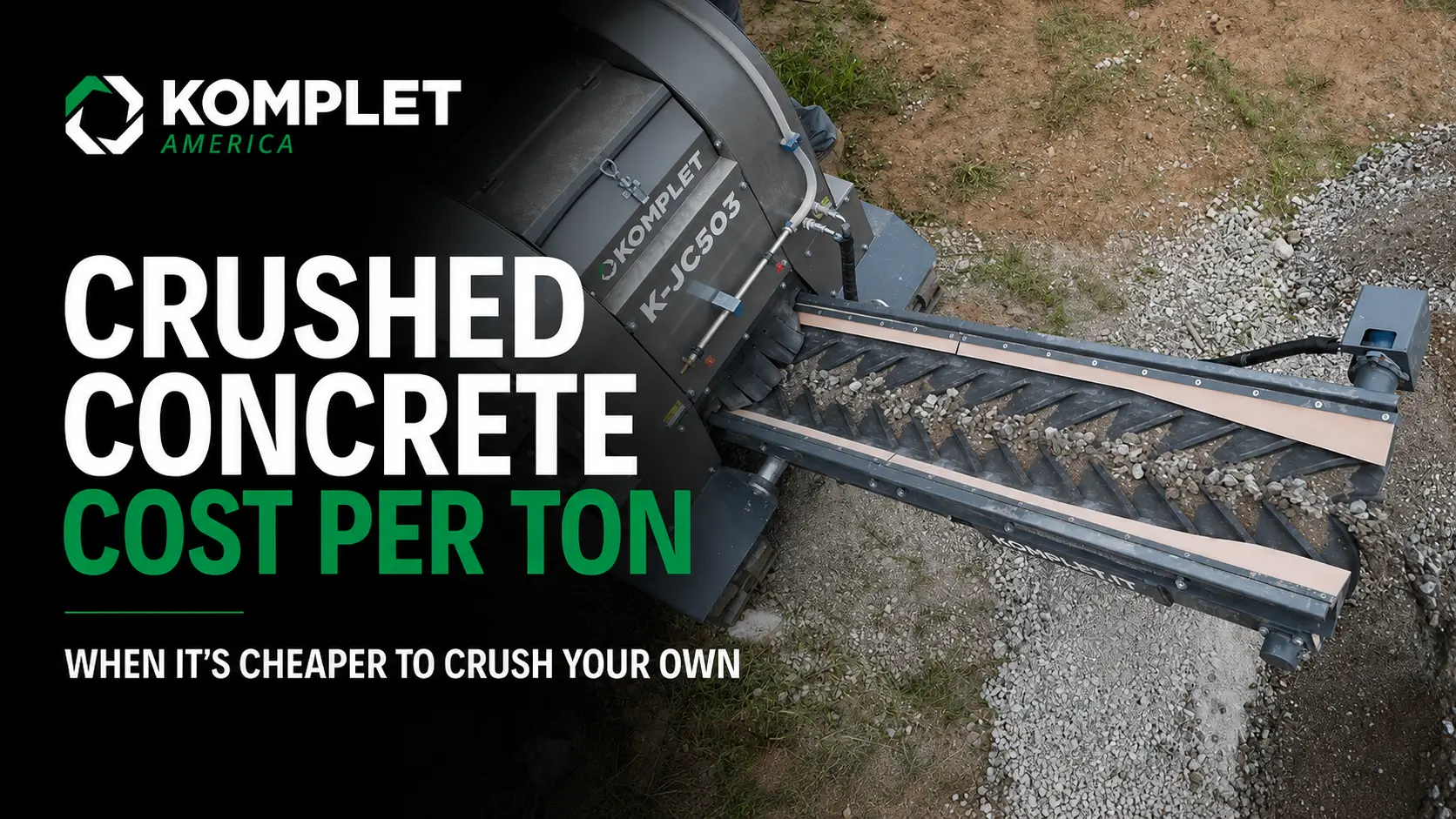
The smallest Komplet system. The K-JC 503 mini jaw crusher produces up to 34 US tph, well within the screening capacity of the Kompatto 221 vibrating screener. This combination is the entry point for paving contractors, small demolition operations, and rental fleets that want full crushing-and-screening capability without the footprint of larger equipment. Both units transport on standard equipment trailers.
K-JC 704 PLUS + Kompatto 5030
The volume-production sweet spot for most U.S. demolition contractors. The K-JC 704 PLUS portable jaw crusher produces up to 90 US tph; the Kompatto 5030 heavy-duty vibrating screener is rated for up to 280 tph at full load. The screener has substantial headroom over the crusher’s production, which means production peaks are absorbed without bottlenecking and the operator can run a 3-way split to produce three sized products from a single pass through the system.
K-JC 805 + Kompatto 5030
For high-volume demolition or quarry operations where the K-JC 805 mobile jaw crusher is producing aggregate at up to 160 US tph, the Kompatto 5030 still has the screening capacity to keep up while delivering sized output. This pairing is the right answer when daily production volumes justify the larger crusher and the screener needs to keep pace without becoming the bottleneck.
K-JC 805 + Kompatto 124
The largest Komplet portable system. The Kompatto 124 mobile screener is the largest screener in the Kompatto family, configured with two large screen decks for high-volume sorting. Paired with the K-JC 805, this system handles steady commercial demolition flow rates and produces multiple sized products at scale. Best fit for contractors with steady high-volume demolition work or rental fleets covering the largest jobs customers bring.
K-IC 70 + Kompatto 5030
A different combination for a different feed type. The K-IC 70 compact impact crusher is engineered for clean concrete and asphalt — it produces more cubical, well-shaped aggregate than a jaw crusher, which matters when the end product needs to meet specific aggregate specifications. Paired with the Kompatto 5030 screener, this system targets contractors and recyclers focused on producing spec-grade recycled concrete aggregate (RCA) and recycled asphalt product (RAP) for sale.
Adding a Shredder for Mixed C&D Operations
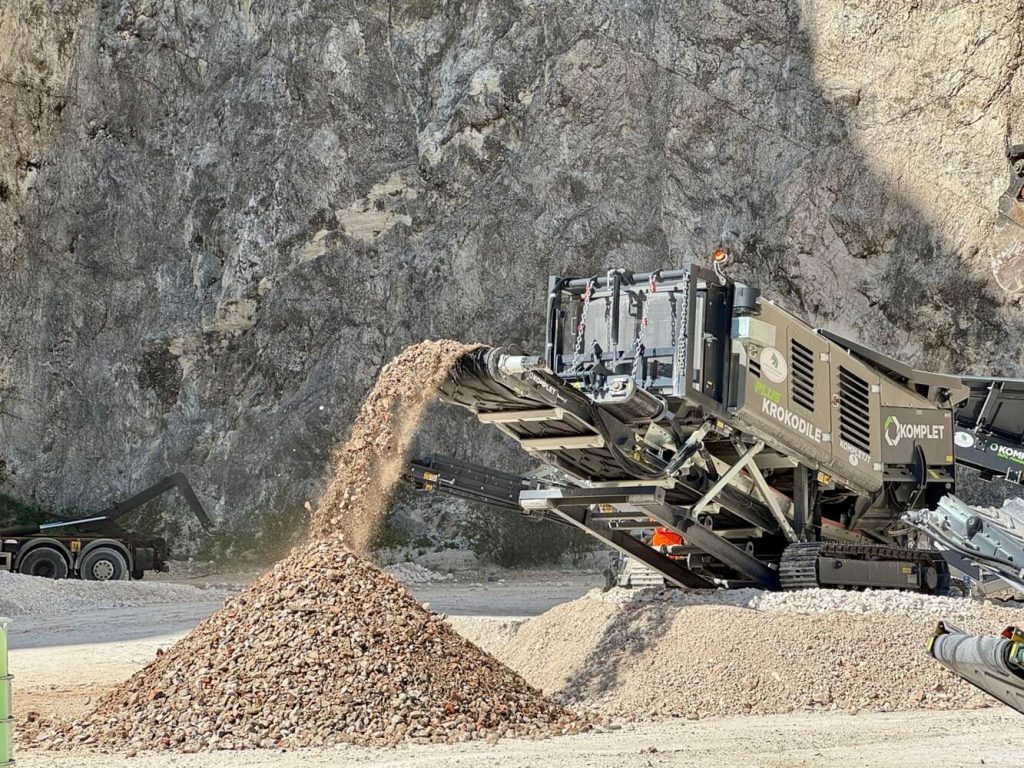
On demolition sites where feed material is heavily mixed — concrete with embedded wood, drywall, plastics, and bulky debris — a slow-speed shredder upstream of the crusher dramatically improves system efficiency. The Krokodile PLUS slow-speed shredder reduces bulky and contaminated material first, then the reduced output feeds into the crusher at sizes the crusher can process steadily.
A typical three-machine system: Krokodile PLUS shredder → K-JC 704 PLUS or K-JC 805 jaw crusher → Kompatto 5030 screener. The shredder absorbs the messy mixed feed; the crusher reduces the cleaner output; the screener sorts the crushed product into sized fractions. This handles the kind of demolition feed that single-machine setups struggle with.
Extending Discharge with the K-TC 460 Conveyor
Many operations add a portable conveyor downstream of the screener to extend stockpile reach without repositioning the screener itself. The K-TC 460 portable mobile conveyor fills this role: it takes screener output and extends discharge to a higher stockpile, a truck-loading position, or downstream equipment. For operations producing sized aggregate for sale, the conveyor often pays back through reduced material handling time alone.
Site Setup Considerations
Setting up a portable crushing-and-screening system on a real jobsite involves a few practical considerations:
- Position the crusher discharge to feed directly into the screener’s loading hopper. Each transfer point is a place where material can spill, contaminate, or stall.
- Allow stockpile clearance for the screener’s output belts. A 3-way split produces three separate piles; each needs space to grow without interfering with the others.
- Plan loader and excavator cycles around the crusher’s feed rate, not the screener’s output rate. The crusher is usually the production-rate bottleneck.
- Position oversize return path back into the crusher hopper. The screener’s top deck rejects material that needs another crushing pass.
- Account for site logistics — water source for dust suppression, power for any auxiliary lighting, and clear escape paths for operator and ground crew.
Operating and Maintenance Considerations
Operating any portable crushing-and-screening system responsibly starts with three universal practices: refer to the user manual for each machine model and serial number, ensure operators are properly trained on the controls and emergency stops for each unit, and maintain the OEM service intervals.
- Train operators on both the crusher and the screener controls. A single-operator system is the goal, but the operator needs full visibility into both machines.
- Inspect screen mesh daily. A small tear in the upper deck contaminates the lower deck within hours.
- Match jaw or rotor settings on the crusher to the screen media on the screener. A crusher producing 0–3″ minus paired with a screener configured for 1″ minus separation produces predictable, sellable output.
- Maintain hydraulic systems on both machines per OEM intervals. Hydraulics drive every adjustable function on these units.
Frequently Asked Questions
Do I need both a crusher and a screener, or can I run just one?
It depends on what you’re producing. A crusher alone produces single-grade crusher run, which is usable for some applications (rough fill, base under buildings) but not gradable enough for sale as spec aggregate. A screener alone can sort already-sized material but cannot reduce oversized material. Operations producing only rough fill can run a crusher alone; operations producing sellable graded product almost always benefit from the combination.
Which crusher-screener pairing fits a small contractor?
The K-JC 503 + Kompatto 221 combination is the smallest practical pairing in the Komplet lineup. Both units are tracked, mobile, and sized to transport on standard equipment trailers. This pairing fits paving contractors, small demolition operations, and rental fleets that want full crushing-and-screening capability without large-equipment overhead.
Can I run a Komplet crusher with a different brand of screener?
Mechanically, yes — any crusher can feed any screener as long as material flow paths align and production rates match. Practically, buying matched equipment from a single distributor with U.S.-based parts and service support reduces complexity in ways that show up in actual uptime. If you already own non-Komplet equipment, talk to Komplet America about how a Komplet crusher integrates into your existing setup.
What if my feed material is too big for the crusher?
Two options: break oversized material with a hydraulic breaker before it reaches the hopper, or add a slow-speed shredder upstream. The Krokodile PLUS slow-speed shredder is engineered exactly for that role on Komplet systems — reducing bulky and contaminated demolition feed to a size the crusher can process steadily.
How do I size a system to my jobsite production needs?
Start with daily production target (tons per day), maximum feed size (largest piece of typical demolition material), and number of output grades needed. The crusher is sized to handle the largest typical feed and meet daily production; the screener is sized to keep up with the crusher and produce the number of grades needed. Komplet America’s team can walk through your specific numbers and recommend a sizing.
What does a complete crusher-screener system cost?
Approximate U.S. list prices for matched pairings:
- K-JC 503 + Kompatto 221: roughly $213,000 combined
- K-JC 704 PLUS + Kompatto 5030: roughly $450,000 combined
- K-JC 805 + Kompatto 124: roughly $722,000 combined
Pricing varies by configuration, dealer location, and added features. Pre-owned options and financing structures can change the effective acquisition cost meaningfully. Contact Komplet America or your local dealer for current pricing.
Final Thoughts
A well-matched portable crushing-and-screening system is one of the highest-leverage investments a demolition or recycling operation makes. It turns demolition debris into sellable graded product on the same site that produced it, eliminates hauling and tipping fees on the material that would otherwise leave, and reduces dependence on third-party processors with their own schedules and pricing.
The right system is the one sized to your typical work — not your peak work, not your minimum work. If you’re evaluating crusher-screener combinations, the most useful next step is a conversation with someone who has placed similar systems into similar work. Komplet America’s team and dealer network can walk through your specific feed mix, daily production targets, and end-product grades to recommend a matched system.
Komplet America is the official U.S. distributor of Komplet SpA crushing, screening, and shredding equipment. Browse the full crusher lineup, screener lineup, shredder lineup, and conveyor lineup, or reach out via the contact page to start a conversation about the right combination for your operation.
Ready to Build Your Crushing-and-Screening System?
- Browse the full equipment lineup to compare crushers, screeners, and shredders
- Check pre-owned inventory for cost-effective entry options
- Explore financing structures that match your tax and balance-sheet position
- Contact Komplet America for a quote tailored to your operation
- Find your local Komplet dealer for rental availability and demo opportunities
Never enough — that’s how we approach service, support, and helping operations get the most from their compact crushing, screening, and shredding equipment.
Equipment prices are subject to change based on dealer location, availability, and any additional features or customizations. Prices do not include taxes, shipping, or installation fees, which may apply depending on your region. Contact Komplet America for current pricing.
Disclaimer: All operating, maintenance, and service guidance in this article is general in nature. Always refer to the official Komplet operator’s manual for the specific machine model and serial number, and follow OEM intervals and procedures. For warranty-protected work, contact Komplet America or your authorized Komplet dealer. Improper service or non-OEM parts may void warranty coverage and create safety hazards.