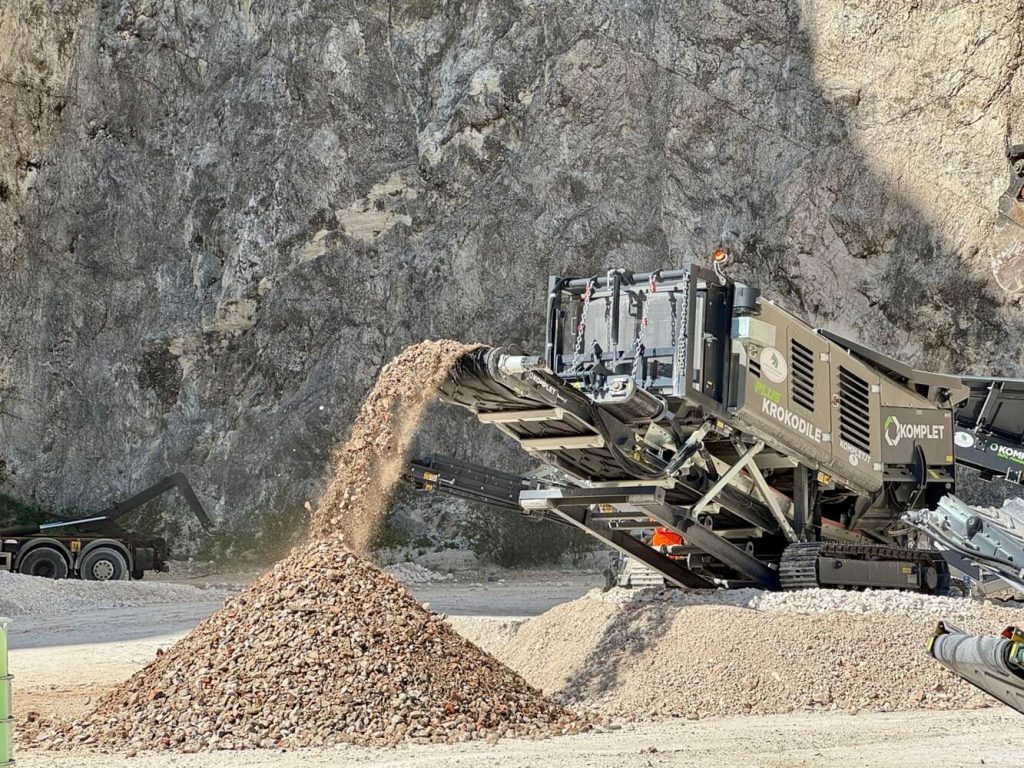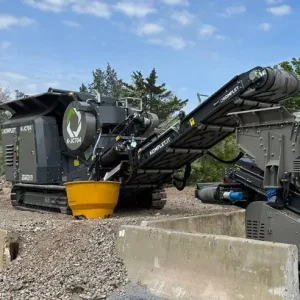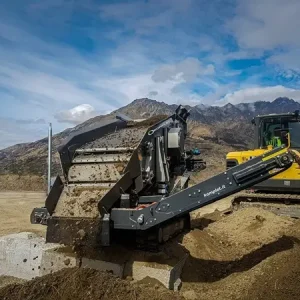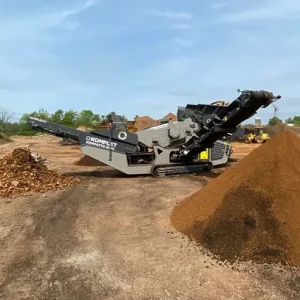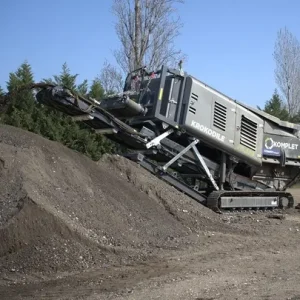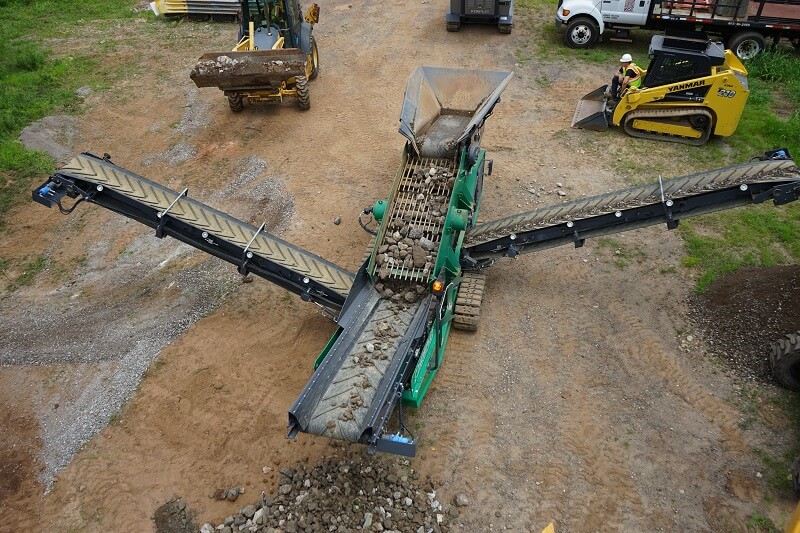

If you’re crushing rock, recycling concrete, producing topsoil, processing compost, or running any kind of aggregate operation, screening is what turns raw output into saleable product. A rock screener separates bulk material into spec-sized fractions — fines, mids, and oversize — so each pile is ready to sell, reuse, or send back through a crusher for further reduction.
This guide explains exactly how rock screeners work, the differences between the main types, how to size a screener for your operation, and where Komplet America’s full lineup of mobile screeners fits your material and volume. Whether you’re brand new to screening or looking to upgrade from an older plant, this is written to help you make a confident decision.
What Is Rock Screening, and Why Does It Matter?
Screening is the mechanical process of separating bulk material into different size fractions using a mesh, punch plate, or perforated deck. When crushed stone or excavated material passes over a screen, smaller particles fall through the holes while larger particles travel across the deck and discharge separately. The result is sorted piles, each at a specific spec size.
Screening matters because the market pays for specific sizes. A random pile of crushed concrete has limited value — but the same pile sorted into ¾″ base rock, #57 stone, and fines suddenly has three distinct revenue streams. Screening is what takes a crushing operation from cost-center to profit-engine.
It also matters for quality. Road base, drainage fill, landscape stone, pipe bedding, and concrete-mix aggregate all require specific gradations. Without a screener, you can’t meet spec. Without meeting spec, you can’t sell.
How a Rock Screener Actually Works
Every mobile rock screener — regardless of brand — operates on the same three-step principle:
- Material is loaded into a receiving hopper, either directly by an excavator or backhoe, or via a discharge belt from an upstream crusher. A vibrating feeder (or rotating drum, in the case of trommels) meters the material onto the screening deck at a controlled rate.
- The material moves across angled screen decks with specific mesh sizes. Smaller particles fall through the openings; larger particles travel across the surface. Multiple decks stacked vertically allow simultaneous separation into three or more size fractions.
- Each size fraction exits via its own discharge conveyor, building separate stockpiles of fines, mids, and oversize. Oversize material can be stockpiled, returned to the crusher for further reduction, or hauled off as reject.
The two things that determine how well a screener performs are (1) the screening media — mesh size, type, and condition — and (2) the deck action — angle, vibration stroke, and speed. A good screener gives you control over both.
The Screening Media: Mesh, Punch Plate, and Bars
The screen media is the working surface that actually makes the separation, and it is the single biggest variable you control. The same machine produces very different results depending on which media you install. There are four common types, each suited to different material and different cuts:
- Woven steel mesh — the general-purpose choice. It covers the widest range of apertures, gives a clean separation, and is cost-effective. It is the default for most dry aggregate and general contractor work. In heavy, abrasive material it wears faster than plate and needs periodic replacement.
- Punch plate (perforated steel) — a thick steel sheet with punched holes. It is far more durable than mesh and resists the pounding of heavy, abrasive, coarse material like crushed concrete and rubble. It is the right call for aggressive scalping and coarser cuts where mesh would wear out quickly.
- Harp wire (piano wire) — tensioned wires that flex and whip as the deck vibrates, actively shedding damp, sticky, and fine material that would otherwise clog. Run it on the bottom deck when fines are blinding your mesh. It is the first thing to reach for when moisture is fighting you on a vibrating screen.
- Reinforced / grizzly bars — heavy bars up top for scalping large rubble and oversize before it reaches finer decks below. Built to take impact from an excavator loading big, irregular material.
Komplet’s Kompatto vibrating screeners are configurable for steel mesh, punch plates, or reinforced bars, with anti-blinding options for damp material — so a single machine can be re-media’d to move between jobs and material types. Choose media by three things: your material, your target size, and your moisture. When in doubt, a Komplet specialist will help you match media to the job.
Deck Action: Angle, Stroke, and Speed
Media picks the size; deck action controls how efficiently material gets to it. Three settings interact. Deck angle governs how fast material travels across the surface — steeper is faster but gives each particle less time to find an opening and drop through. Stroke (how far the deck throws the material) lifts and turns the bed so buried fines can reach the surface. Speed sets how aggressively the whole bed is agitated. Get these right and material stratifies cleanly — fines work down to the deck, oversize rides across the top. Get them wrong and you either carry fines out with the product (too fast, too steep) or choke the deck with an over-deep bed (too slow for the feed rate).
The practical rule: change deck action before you change screens. A carryover or blinding problem is often a speed, angle, or feed-rate issue — not the wrong aperture. Komplet’s variable feeder speed lets you dial the bed depth to your material and target without swapping media.
Why a Screen Doesn’t Produce the Size You’d Expect
Here is the single most misunderstood thing about screening: a 1″ screen does not make 1″ product. The screen you install always runs larger than the size you want to produce, and understanding why saves you a lot of wasted screen changes.
Material meets an inclined deck at an angle, not square-on. A particle only drops through when it presents to the opening on-axis — so the effective opening is smaller than the hole you measure with a tape. That gap between measured aperture and effective aperture is why screens are always sized above the target product size.
How far above depends on your feed, which is why an experienced supplier gives you a range rather than a single number:
- Particle shape — angular, crusher-fresh material presents to the deck poorly and passes less readily than rounded gravel. Angular feed needs a larger aperture to make the same product. If your feed is fresh off the jaw, start at the larger end.
- Moisture — damp feed screens slower and tends to blind, which effectively shrinks the opening. Wetter material pushes you toward a larger aperture, harp wire, or a trommel.
- Feed rate and deck action — faster feed and steeper, faster decks give material less time to stratify and drop, so a given hole passes less than it would at ideal settings.
A ¾″ product might come off a 1″ screen on clean, dry, rounded gravel — but want a larger screen on wet, angular, crusher-fresh stone. Printing one number would be wrong for half the operators using it. Start above your target size and test-screen against your actual project specification before you commit to an aperture and order media.
Two Main Types of Rock Screeners: Vibrating vs. Trommel
Most rock screening in North America is done with one of two machine types. They work differently, handle different materials, and are built for different applications.
Vibrating Scalping Screens
A vibrating scalping screen uses inclined decks driven by a vibrator motor. The decks shake aggressively to stratify material by size: fines drop through the top deck first, mids through the second deck, and oversize travels off the end. Vibrating screens are fast, high-throughput, and well-suited for dry, hard materials like crushed concrete, rock, and aggregates.
Best for: Crushed stone, concrete recycling, aggregates, dry C&D material, heavy-duty production screening.
Komplet’s vibrating scalping screener lineup covers three size classes:
- Kompatto 221 — compact, up to 90 US tph, 7′ x 3.5′ two-deck. One of the smallest self-propelled mobile screening plants on the market. Ideal for tight-access sites and pairs directly with the K-JC 503 or K-JC 704 PLUS crushers.
- Kompatto 5030 — Komplet’s best-selling screener, up to 280 US tph. Heavy-duty 8′ x 3′2″ double-deck with 3-way split configuration. Produces three spec sizes simultaneously. The workhorse for C&D recyclers, small quarries, and soil processors.
- Kompatto 124 — Komplet America’s largest mobile scalping screen, up to 350 tph. 11.8′ x 3.7′ top deck, 75 HP Tier 4F diesel. Built for high-volume contractors, landscapers, recyclers, and rental fleets needing serious production in a still trailer-portable package.
Trommel Screens
A trommel screen uses a slowly rotating cylindrical drum with perforated walls. Material enters one end of the drum and tumbles gently as the drum rotates. Fines fall through the holes along the length of the drum; oversize exits out the far end. Trommels are gentler than vibrating screens, handle wet or sticky material much better, and are ideal for organics.
Best for: Compost, topsoil, mulch, green waste, wet or moist material, anywhere the gentler drum action outperforms aggressive vibration.
Komplet offers two trommel models:
- K-TS 30 — compact trommel, up to 60 mch. 5′6″ x 4′3″ or 8′6″ x 4′3″ drum configurations. Electric-drive with a 23 kW genset. Perfect for composting operations, landscape yards, and municipal organics programs.
- K-TS 40 — larger trommel, up to 120 tph. 10.5′ x 4.6′ or 14.3′ x 3.7′ drum configurations. Electric-drive with a 40 kW genset. Delivers three material fractions (fines, mids, overs) for high-volume compost and soil operations.
The Komplet Screener Lineup at a Glance
All five Komplet screeners are self-propelled on rubber tracks with wireless remote control. Production rates are maximums under ideal conditions; actual output depends on material, moisture, media, and feed consistency.
|
Model |
Type |
Engine |
Screen Size |
Max Production |
Weight |
|
Kompatto 221 |
Vibrating, 2-deck |
25 hp Tier 4F |
7′ × 3.5′ |
up to 90 US tph |
7,275 lb |
|
Kompatto 5030 |
Heavy-duty vibrating |
45 hp Tier 4F |
8′ × 3′2″ + 7′ × 3′2″ |
up to 280 US tph |
26,455 lb |
|
Kompatto 124 |
Mobile vibrating |
75 hp Tier 4F |
11.8′ × 3.7′ + 10.8′ × 3.7′ |
up to 350 tph |
37,038 lb |
|
K-TS 30 |
Compact trommel |
23 kW genset |
5′6″ × 4′3″ or 8′6″ × 4′3″ |
up to 60 mch |
8,818 lb |
|
K-TS 40 |
Portable trommel |
40 kW genset |
10.5′ × 4.6′ or 14.3′ × 3.7′ |
up to 120 tph |
25,353 lb |
Which Type Do You Need?
The rule of thumb: if your material is dry and abrasive (concrete, rock, aggregates), go vibrating. If your material is moist, sticky, or organic (compost, topsoil, mulch), go trommel. A lot of operations that only have a vibrating screen struggle with composting and green-waste work because sticky material plugs the decks. A trommel solves that problem.
Six Questions to Ask Before You Pick a Rock Screener
Before you spec a screener, answer these six questions. The answers determine which machine is right for you.
1. What material are you screening?
Material characteristics drive the decision. Crushed concrete, rock, and dry aggregates call for a vibrating scalping screen. Compost, topsoil, mulch, and green waste call for a trommel. Mixed C&D debris (concrete with wood, rebar, and wire) usually needs a vibrating screen plus a magnetic separator. If you’re processing multiple material types, you may need two machines — or a versatile vibrating screen like the Kompatto 5030 that can be configured for different screening media (steel mesh, punch plates, or reinforced bars).
2. What end product sizes do you need?
Screeners separate material based on mesh size. If you need three spec sizes (for example: fines, 3/4″ base, and 2″ oversize), you need a double-deck or triple-fraction machine. Komplet’s Kompatto screeners feature fast hydraulic conversion between 2-way and 3-way split configurations — change from producing two end sizes to three in minutes, not hours. The Kompatto 5030 screens from 1/4″ topsoil fines up to 5″ oversize, covering most contractor needs.
3. What production rate do you need?
Screener capacity is rated in tons per hour (tph) under ideal conditions. Real-world output depends on material moisture, feed consistency, screen media choice, and operator skill. Most contractors overestimate what they need — a Kompatto 221 at up to 90 US tph handles small-to-mid contractor operations. A Kompatto 5030 at up to 280 US tph handles most daily-production operations. The Kompatto 124 at up to 350 tph is for serious daily throughput or rental fleet use.
4. How will you feed the screener?
Komplet’s Kompatto screeners can be fed directly by an excavator, backhoe, processed material pile, or the discharge belt of an upstream crusher. The Kompatto 221 is specifically designed to be fed directly — no secondary equipment required. For higher-volume operations, a dedicated wheel loader keeping the feeder hopper supplied maximizes throughput.
One point contractors underestimate: consistent feed matters as much as the machine. A screener stratifies best with a steady, even bed across the deck. Dumping a full bucket in surges overloads the deck, then starves it — both hurt separation and throughput. Size your loading equipment to keep the hopper supplied without surging, and let the variable feeder meter material onto the deck at a rate the media can actually handle.
5. Where and how will you move the screener?
Every Komplet screener is self-propelled on rubber tracks, with hydraulically folding conveyors for transport and a wireless remote control for positioning. The Kompatto 221 at 7,275 lb is one of the most portable screeners on the market. The Kompatto 5030 at 26,455 lb and the Kompatto 124 at 37,038 lb are larger but still move on a standard heavy-duty trailer. If job-to-job mobility is your priority, start with the 221.
6. Is screening a standalone operation or part of a crushing circuit?
A Kompatto can operate as a standalone screener (excavator-fed piles) or as part of a crushing and screening circuit paired with a Komplet jaw crusher. The Krokodile PLUS shredder + Kompatto 5030 screener combo is our best-selling two-machine recycling system. For combined crushing and screening, the K-JC 704 PLUS + Kompatto 5030 is a proven high-output workflow for demolition and concrete recycling contractors.
Screen Blinding, Pegging, and Carryover: Common Problems and Fixes
Most screening problems come down to four failure modes. Knowing which one you’re looking at tells you what to change — and just as often, what not to change.
Blinding
Blinding is when apertures clog with damp or sticky fines, so material rides across the deck instead of dropping through. Throughput falls and your product comes off short. Check moisture first — wet feed will not screen cleanly at any aperture, and no screen change fixes water. From there: switch the bottom deck to harp wire, which flexes and sheds sticky fines; reduce the feed rate so the bed isn’t packed; and if the material is consistently moist, sticky, or organic, move it to a trommel, which is built for exactly this.
Pegging
Pegging is when near-size angular particles wedge into the openings and stick, slowly plugging the deck. It is most common with crusher-fresh, angular stone close to the aperture size. Punch plate resists pegging far better than mesh; correct deck action (enough stroke to shake lodged particles loose) helps; and sizing your media a bit larger relative to the target keeps near-size particles from jamming in the first place.
Carryover
Carryover is when fines ride out with the oversize or product instead of dropping through — material is leaving the deck before it has time to separate. Before you change screens, check deck angle, speed, and feed rate. An over-steep or over-fast deck and a surging feed are the usual culprits, and all three are adjustable without swapping a single screen.
Overloading
Overloading is a bed so deep the material can’t stratify — buried fines never reach the deck surface. The fix is feed control: use the variable feeder speed to match bed depth to your media and target size rather than burying the deck to chase throughput. A properly loaded deck out-produces an overloaded one.
Materials You’ll Screen — and Which Screener Handles Each Best
Here’s a quick matching guide by material type:
Construction & Demolition (C&D) Recycling
Asphalt, concrete, brick, reinforced concrete: Vibrating scalping screen. Kompatto 221, 5030, or 124 depending on volume. Pair with a magnetic separator if rebar is present.
Natural Stone & Aggregates
Granite, limestone, sandstone, bluestone, river gravel, sea gravel: Vibrating scalping screen, typically downstream of a jaw crusher. Kompatto 5030 or 124 for quarry-scale operations.
Topsoil, Compost, and Organics
Compost, topsoil, mulch, green waste: Trommel screen. K-TS 30 for smaller operations, K-TS 40 for high-volume composting or municipal organic waste programs.
Landscape Material
Decorative stone, gravel, screened soil: Either vibrating or trommel depending on moisture. For dry bagged-stone yards, Kompatto 221 or 5030. For wet topsoil blending, K-TS 30 or K-TS 40.
Waste and Industrial Streams
Ore, industrial waste, landfill reclaim: Vibrating scalping screen. Kompatto 5030 handles a wide range of industrial streams with steel mesh, punch plates, or reinforced bars as screening media.
Dust, Silica, and Site Compliance
Screening dry concrete, stone, and aggregate releases airborne dust, and that dust can contain respirable crystalline silica — a recognized workplace hazard that OSHA regulates on construction and industrial sites. If you screen dry material, dust control is not an afterthought; it’s part of running a compliant, safe operation.
The equipment-level control is dust suppression — a water-spray system that knocks airborne dust down at the deck and transfer points before it can drift. On Komplet’s Kompatto vibrating scalping screeners, dust suppression is an option specified at order time, not a standard fitting. If you’re screening dry, dusty material or working in a regulated environment, specify it when you configure the machine. (For reference, on Komplet’s crushers, dust suppression is standard on the K-JC 503 and K-IC 70 and optional on the others.)
Equipment is only part of the picture. Site-level controls, appropriate respiratory protection where required, and an exposure-control plan matter too. Treat this section as general guidance, not a compliance determination — verify the current requirements that apply to your operation and jurisdiction, and build your dust-control approach around them.
The Real Revenue Math: What a Screener Actually Earns You
Owning a screener doesn’t just save money — it creates revenue streams you didn’t have before. Every ton you sort into a spec size is a ton you can sell at market rate instead of giving away as unsorted reject.
Example: A C&D Recycler with a Kompatto 5030
A mid-volume concrete recycler processes 3,000 tons of mixed crushed material per month. Without a screener, this material sells for $8/ton as unsorted base fill. With a Kompatto 5030 sorting the same output into three fractions:
- Fines (25% = 750 tons): Sold as screened fine aggregate at $18/ton = $13,500/month
- #57 stone (50% = 1,500 tons): Sold at $22/ton = $33,000/month
- Oversize (25% = 750 tons): Sold as base rock at $15/ton or returned to the crusher for further reduction = $11,250/month
New total revenue: $57,750/month vs. $24,000/month unsorted. That’s $33,750/month in new revenue from the same material.
Against a Kompatto 5030 financed over 60 months (~$4,400/month at 9.9% APR via Komplet Capital), the screener pays for itself in about six months — and every month after is additional margin.
These numbers vary by market, material mix, and local aggregate pricing. Call (908) 369-3340 and we’ll run a payback calculation using your specific volume and your local aggregate prices.
Buy New, Rent, or Go Pre-Owned?
There’s more than one way into a screener, and the right path depends on how much you’ll run it.
- Buy new — the choice for steady production. You get the latest configuration, the full 1-year / 1,000-hour warranty, and Komplet Capital financing with 24-hour approval, 100% financing available, and 36-, 48-, 60-, or 72-month terms. New equipment is also Section 179 eligible — up to $1.22M of qualifying equipment deductible in the year of purchase (2024 limit) — which can meaningfully change the after-tax cost of a year-end purchase.
- Rent — the right move for a single job or to trial a machine class before you commit. Rentals run through Komplet’s authorized dealer network; find your local Komplet dealer for availability in your area.
- Pre-owned — Komplet America’s pre-owned equipment program typically saves 40–70% of capital versus new, which makes it a strong entry point for a first screener or a cost-effective way to add a second machine to a fleet.
Building a Crushing-and-Screening Circuit
A screener rarely works alone for long. As operations grow, the screener becomes one stage in a material-processing train, and Komplet’s single-brand ecosystem is built so the pieces work together.
- Crush, then screen — a jaw crusher such as the K-JC 704 PLUS reduces raw rock or broken concrete, and a Kompatto 5030 sizes the output into spec fractions. Oversize returns to the crusher, closing the loop and turning demolition debris into clean, saleable base and stone.
- Shred, then screen — the Krokodile PLUS slow-speed shredder paired with a Kompatto 5030 is Komplet’s best-selling two-machine recycling system, purpose-built for mixed C&D and bulky material.
- Add reach and stockpiling — a K-TC 460 tracked mobile conveyor takes screened product and builds a taller, cleaner stockpile (up to a 15′ pile height, up to 132 US tph), extending material reach and cutting loader trips. Because it’s self-propelled on rubber tracks, it repositions under its own power alongside the crusher and screener — no tow vehicle, no crane.
Every machine in the train is tracked, self-propelled, and wireless-remote-controlled, so a single operator can set up and reposition the whole circuit on site.
Why Compact? Why Komplet Screeners?
Compact mobile screeners are not smaller versions of quarry-scale stationary plants. They’re purpose-built for contractors, recyclers, rental houses, and small producers who need flexibility, mobility, and affordability that bigger equipment can’t offer.
Why Komplet specifically:
- Self-propelled on rubber tracks — move the screener anywhere on site with wireless remote control. No crane, no truck needed for repositioning.
- Quick setup under 15 minutes — from transport to production on most models.
- Hydraulically folding conveyors — fast transport setup, no manual assembly.
- Fast 3-way to 2-way split conversion — hydraulic, takes minutes (Kompatto 5030 and 124).
- Variable feeder speed — dial in the throughput to your material and end-product targets.
- 1-year / 1,000-hour warranty — on all new units.
- Parts forecasted 12 months in advance — when you’re down, we ship.
- Direct distributor model — Komplet America is the official exclusive distributor for North and Central America. Call our team at (908) 369-3340 and you talk to the people who know the machines.
- Full ecosystem in one brand — jaw crushers, impact crusher, vibrating scalping screens, trommel screens, shredder, and tracked conveyor. Room to grow your operation within a single relationship.
- Italian engineering, 25+ years — Komplet SpA has focused exclusively on compact recycling equipment since 2000, celebrated its 25th anniversary in 2025, and is the specialist in this segment.
- Industry memberships — AED, AEM, ARA, CDRA, NDA, USCC. Every major industry association.
- Komplet Capital financing — 24-hour credit approval, 100% financing, 3-6 year terms.
- Section 179 eligible — up to $1.22M of new equipment deductible in the year of purchase (2024 limit) for year-end tax planning.
Frequently Asked Questions
What’s the difference between a screener and a crusher?
A crusher reduces the size of material. A screener separates material into size fractions. Most operations use both in sequence: the crusher reduces raw rock or debris, and the screener sorts the output into saleable spec sizes. Learn more about Komplet’s full crusher lineup and how they pair with screeners.
Do I need a trommel screen or a vibrating screen?
If your material is dry and abrasive (concrete, rock, aggregates), use a vibrating scalping screen. If your material is moist, sticky, or organic (compost, topsoil, mulch), use a trommel. Trying to run compost through a vibrating screen results in constant mesh blockage. Trying to run dry rock through a trommel is slower than it needs to be. Use the right tool for the material.
Why doesn’t a 1-inch screen produce 1-inch material?
Because material meets the inclined deck at an angle, the effective opening is smaller than the hole you measure — so screens always run larger than the product size you want. Exactly how much larger depends on your feed: angular, wet, or fast-fed material needs the larger end of the range. Start above your target size and test-screen against your project spec before ordering media.
What screen media should I use?
Steel mesh for general-purpose separation across the widest range of apertures; punch plate for heavy, abrasive, coarse material like crushed concrete; harp (piano) wire on the bottom deck to fight blinding in damp or fine material; and reinforced bars for scalping large rubble. Komplet’s Kompatto screeners are configurable for steel mesh, punch plates, or reinforced bars.
Can I screen wet or sticky material?
Vibrating screens struggle with wet, sticky, or organic material because it blinds the decks. Running harp wire on the bottom deck and slowing the feed rate helps, but for consistently moist or cohesive material a trommel — the K-TS 30 or K-TS 40 — is the right tool, because the gentle tumbling drum action handles moisture that would plug a vibrating deck.
How much does a mobile rock screener cost?
Komplet’s Kompatto scalping screeners are priced on each product page and available by quote at (908) 369-3340. Komplet Capital financing is available with 24-hour approval and 3-6 year terms.
What production rate does a Komplet screener produce?
Kompatto 221: up to 90 US tph. Kompatto 5030: up to 280 US tph. Kompatto 124: up to 350 tph. K-TS 30 trommel: up to 60 mch. K-TS 40 trommel: up to 120 tph. All rates are maximums under ideal conditions — consistent feed, skilled operator, proper screen media, and dry material. Actual throughput depends on material moisture, feed consistency, and target spec size.
Can one screener produce multiple product sizes at once?
Yes. Komplet’s Kompatto 5030 and Kompatto 124 both feature fast hydraulic conversion between 2-way and 3-way split configurations. A 3-way split produces three end-product sizes simultaneously — for example, fines, mid-size, and oversize — from a single pass. The 2-way split is faster but produces only two sizes. Switching between the two takes minutes, not hours.
How often do screen media need replacing?
Screen media is a wear part, and its life depends on how abrasive your material is, your throughput, the aperture size, and the media type — punch plate outlasts mesh in heavy material, for instance. Komplet stocks screen media and forecasts parts 12 months in advance, so replacements ship fast. Inspect your decks regularly for wear and proper tension, and follow the intervals in your machine’s operator manual.
Does a Komplet rock screener have dust suppression?
Dust suppression on Komplet’s Kompatto vibrating scalping screeners is available as an option at order time — it is not standard. (Note: on Komplet’s crushers, dust suppression is standard on the K-JC 503 and K-IC 70, and optional on the others.) If you’re screening dusty material or operating in a regulated environment, specify dust suppression when you order your Kompatto. It’s a simple add-on that makes a significant difference on dry-material job sites.
Can a Komplet screener be used alone, or does it need a crusher?
A Komplet screener can operate as a standalone unit. The Kompatto 221, for example, is specifically designed to be fed directly by an excavator or backhoe — no crusher needed. Many landscape yards and topsoil processors operate screeners as standalone machines. Of course, screeners also pair seamlessly with Komplet crushers to create a complete crushing-and-screening circuit for C&D recycling operations.
How quickly can a Komplet screener be set up on a new job site?
Most Komplet screeners go from transport position to production in under 15 minutes. Tracked mobility, hydraulically folding conveyors, and wireless remote control make setup a one-operator job. Arrive on site, drop the tracks, unfold the conveyors, power up, and start feeding.
What makes Komplet the right choice for screening?
Five things set Komplet apart for screening operations. First, a full ecosystem in one brand — jaw crushers, impact crusher, vibrating scalping screens, trommel screens, shredder, and tracked conveyor. You can build and grow a complete recycling operation without changing suppliers. Second, Komplet America is the direct exclusive distributor for North and Central America, so when you need support you call (908) 369-3340 and reach our team — no dealer mediation, no call center. Third, parts inventory is forecasted 12 months in advance, so when you need a screen mesh or wear part, it ships fast. Fourth, Komplet Capital in-house financing offers 24-hour approval, 100% financing, and 3-6 year terms with bad credit not an automatic disqualifier. Fifth, 25+ years of Komplet SpA engineering focused exclusively on compact recycling equipment — the machines are specialized, refined, and built for the work. For contractors and recyclers who want a partner rather than a transaction, Komplet is the compact-segment specialist.
Final Thoughts
Screening isn’t a secondary step — it’s where unsorted output becomes multiple revenue streams. A contractor who crushes without screening leaves most of the margin on the table. A recycler who screens without the right machine fights moisture, mesh blockage, and inconsistent product. Getting the match right between your material (dry and abrasive vs. moist and organic), your target output sizes, and your throughput volume is what separates a screener that prints money from one that sits in the yard.
Komplet America offers the full range of compact mobile screeners — from the tight-access Kompatto 221 through the best-selling Kompatto 5030 up to the Kompatto 124 (our largest mobile scalping screen at up to 350 tph), plus the K-TS 30 and K-TS 40 trommels for compost and organics. Browse the full screener lineup to see specs and pair options, explore equipment financing, check out pre-owned equipment, find your local Komplet dealer, or contact us and we’ll help you figure out exactly which machine fits your material and your throughput goals. For wear parts and service, see parts and support.
Ready to Talk Screening?
- Call (908) 369-3340
- Email [email protected]
- Schedule a demo or request a quote
- Ask about our 1-year / 1,000-hour warranty and equipment financing options
- Find your local Komplet dealer for rental availability
Never enough — that’s how we approach service, support, and helping you turn raw material into spec-sized profit.
Disclaimer: All ROI, payback, and revenue figures in this article are illustrative examples based on sample assumptions about volume, local pricing, material mix, and operating conditions. Actual results vary significantly by region, market, material type, equipment utilization, operator skill, financing terms, and many other factors. Dump fees, aggregate pricing, fuel costs, hauling rates, and interest rates all change over time and by location. Komplet America makes no guarantee, warranty, or representation of specific financial performance or payback timelines for any particular operation. For a payback estimate based on your specific volume, material, and local market, contact us at (908) 369-3340 to speak with our team.
Disclaimer: All operating, maintenance, and service guidance in this article is general in nature. Always refer to the official Komplet operator’s manual for the specific machine model and serial number, and follow OEM intervals and procedures. For warranty-protected work, contact Komplet America at (908) 369-3340 or your authorized Komplet dealer. Improper service or non-OEM parts may void warranty coverage and create safety hazards.
Equipment prices are subject to change based on dealer location, availability, and any additional features or customizations. Prices do not include taxes, shipping, or installation fees, which may apply depending on your region. Contact Komplet America at (908) 369-3340 or visit kompletamerica.com for current pricing.