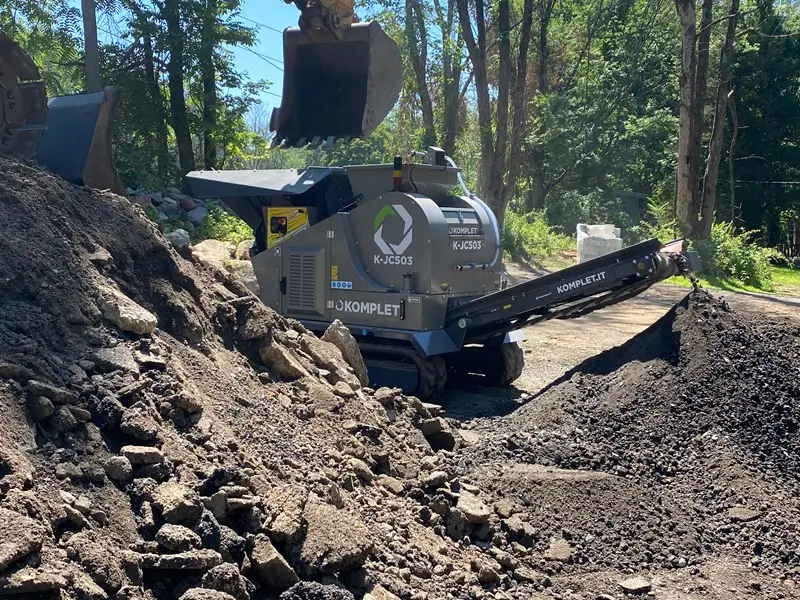

Asphalt is the most recycled material in the United States by tonnage, with reported recycling and reuse rates exceeding 99% per industry sources. Reclaimed asphalt pavement (RAP) — the material recovered from removed pavement during road rehabilitation, demolition, and reconstruction — feeds back into hot-mix asphalt plants, cold-mix asphalt operations, full-depth reclamation projects, and base aggregate markets. The asphalt recycling industry handles billions of tons of material annually, generating substantial cost savings and environmental benefits compared to virgin material alternatives.
This basic guide walks through asphalt pavement recycling techniques and benefits — the major recycling approaches (HMA recycling, cold-mix recycling, full-depth reclamation), economic and environmental benefits, equipment requirements at different stages of the recycling pathway, and Komplet America’s specific role at the compact mobile crushing, impact crushing, screening, and shredding end of the process. The Komplet America compact mobile equipment lineup handles primary jaw crushing of demolished pavement, secondary impact crushing for premium cubical RAP, vibrating scalping screening for spec-sized output, and slow-speed shredding for tear-off asphalt shingles destined for RAS-accepting HMA plants.
Honest scope note: this guide covers the broader asphalt recycling landscape including techniques and equipment that Komplet does NOT make. HMA plant operations, in-place recycling trains, asphalt milling machines, asphalt pavers, and full-depth reclamation specialty equipment all come from manufacturers focused on those segments. Komplet’s contribution is compact mobile primary and secondary crushing, vibrating scalping screening, and slow-speed shredding — converting demolished pavement and tear-off shingles into spec-sized RAP feedstock, premium cubical aggregate, or base aggregate output.
Major Asphalt Recycling Techniques
Hot-Mix Asphalt (HMA) Recycling
The most common asphalt recycling approach. RAP enters HMA plants as feedstock that’s combined with virgin aggregate, virgin asphalt cement, and additives to produce new hot-mix asphalt. Modern HMA plants commonly accept 15-30% RAP content in standard mixes, with some specialty mixes accepting higher percentages.
Two HMA Recycling Variants
- Recycled Hot Mix (RHM): RAP enters a fixed HMA plant as feedstock; new HMA delivered to paving sites
- Hot In-Place Recycling (HIR): Specialty equipment trains heat existing pavement in place, mill it, mix it with rejuvenators, and lay it back down — done in a single continuous operation. Requires specialty in-place recycling equipment from manufacturers focused on that segment.
Cold-Mix Asphalt Recycling
RAP combines with emulsified asphalt or foamed asphalt at ambient temperatures (no heating required). Used as base layer material for road construction or as cold-mix surface material for lower-traffic applications. Cold-mix recycling typically uses lower-cost virgin material additions and produces material more suited to base/binder courses than to surface courses.
Full-Depth Reclamation (FDR)
Full-depth reclamation pulverizes the existing asphalt pavement together with underlying base material and stabilizes the resulting mix with cement, lime, foamed asphalt, or other binders to create a new structural base for fresh asphalt surface course. FDR is performed in place using specialty FDR equipment trains. Komplet does not make FDR equipment.
Cold In-Place Recycling (CIR)
Similar to HIR but without heating — specialty equipment trains mill the existing pavement, mix it with cold-mix binders in place, and re-compact it. Used for surface course recycling where the underlying base remains structurally sound. Requires specialty CIR equipment from manufacturers focused on that segment.
Crush-and-Run Base Material from RAP
Demolished pavement crushed to base material specifications can serve as road base, parking lot base, structural fill, or drainage stone. This is the most direct application for compact mobile crushing of pavement debris — converting demolition material to immediate-use base aggregate without the additional processing required for HMA plant feedstock.
Where Komplet Equipment Fits in Asphalt Recycling
Komplet’s compact mobile crushers and screeners serve specific roles in the broader asphalt recycling landscape. Understanding these roles supports right-sized equipment selection for asphalt recycling operations.
Pavement Demolition to RAP Feedstock
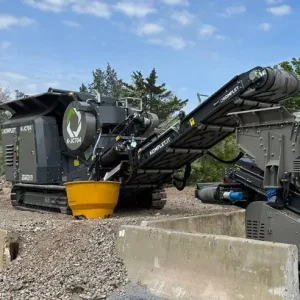
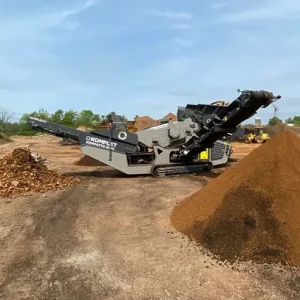
Demolition of asphalt pavement (parking lots, building pads, decommissioned road sections, full-depth pavement reconstruction) generates demolished asphalt pieces. Komplet jaw crushers convert this material into spec-sized RAP feedstock that HMA plants accept. The K-JC 704 PLUS — Komplet’s best-selling crusher at up to 90 US tph — fits the operational sweet spot for typical contractor pavement demolition work; the K-JC 805 handles higher-volume operations.
Why Jaw Crushers Handle Asphalt Well
The compression action of jaw crushing handles asphalt without wrapping the asphalt cement around moving parts (a problem with high-speed crusher types). The wide jaw opening accepts irregular pavement chunks; output gradation suits HMA plant feedstock or base material reuse. All Komplet jaw crushers feature hydraulically adjustable jaw setting via wireless remote — output size adjustment without manual tooling supports flexible production matching different RAP specification requirements.
Spec-Sized RAP Production with Screening
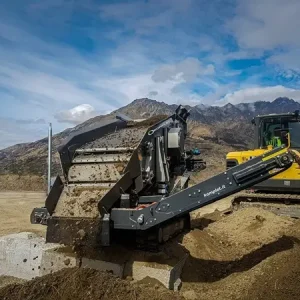
HMA plants accept RAP within specific size gradations — typically 1/2″ minus or 5/8″ minus depending on plant specifications. Operations producing premium RAP feedstock pair jaw crushing with vibrating scalping screening to deliver consistent sized material. The Kompatto 5030 — Komplet’s best-selling screener with hydraulic 2-way / 3-way conversion — produces 2 or 3 spec sizes simultaneously.
Base Material Production
Operations producing crush-and-run base material from demolished pavement use jaw crushing alone — no secondary screening required for typical base material specifications. Output goes directly to project base layer use, parking lot base, structural fill, or drainage applications.
Premium Cubical Aggregate via Secondary Impact Crushing
Operations producing premium RAP for high-end HMA mix designs benefit from secondary impact crushing after the primary jaw stage. Jaw crushers produce angular but somewhat elongated particles; impact crushers produce cubical particles that mix designers prefer for SuperPave specifications, surface course mixes, polymer-modified mixes, and high-performance pavement applications. The K-IC 70 compact impact crusher — up to 90 US tph, 25″ x 20″ inlet, 100 HP — handles secondary reduction of jaw-crushed RAP into premium cubical aggregate. Operations targeting high-spec HMA plants, state DOT surface course work, or polymer-modified mix designs typically need both jaw and impact stages to deliver mix-design-grade output.
Single-stage operations (jaw crushing only) produce RAP suitable for many applications: HMA plant feedstock for binder courses and base courses, cold-mix operations, base material applications, and most state DOT non-surface uses. Two-stage operations (jaw + impact) extend capability to surface course mixes and premium specifications. Match equipment configuration to target market specifications.
Asphalt Considerations for Cooler Conditions
Some operations process asphalt at slightly cooler ambient temperatures (early morning starts, fall/winter operations) to reduce material stickiness in the crusher chamber. The Komplet equipment handles asphalt across typical operating conditions throughout most of the year; very hot conditions may require modified approach (more frequent cleaning, faster material throughput) per OEM operator’s manual specifications.
Recycled Asphalt Shingles (RAS) as a Complementary Pathway
Recycled asphalt shingles (RAS) — both manufacturer waste shingles (post-industrial scrap) and tear-off shingles from roofing replacement projects (post-consumer waste) — represent a complementary recycling pathway adjacent to RAP. Tear-off shingles contain roughly 20-30% asphalt cement and high-quality mineral aggregate, making them valuable feedstock for HMA plants that accept RAS specifications (typically 1-5% RAS content in mix designs). Shingles are too pliable for compression-based jaw crushing; they require slow-speed shredding to reduce them to spec-sized RAS feedstock.
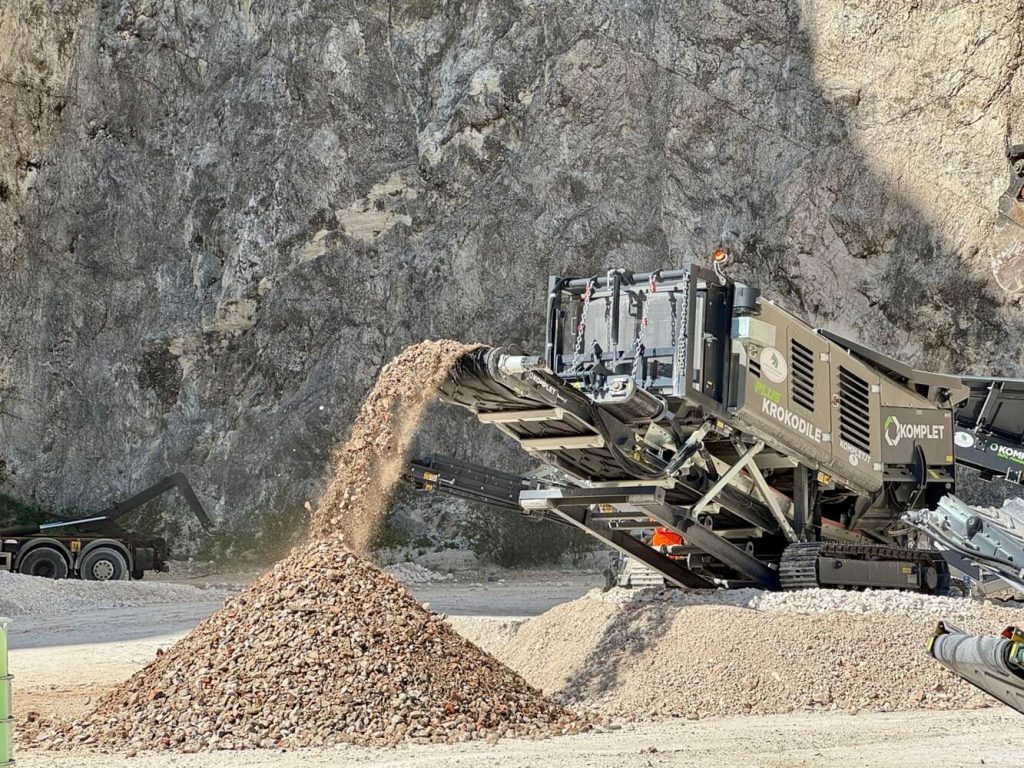
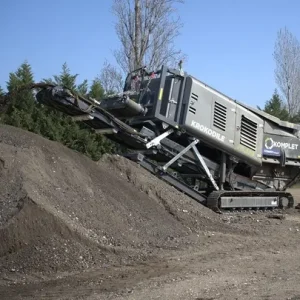
The Krokodile PLUS slow-speed shredder — single 60″ shaft, 220 HP Volvo Penta diesel, ~34,000 lb — handles tear-off shingle shredding for operations serving RAS-accepting HMA plant markets. Roofing contractors and demolition operations recovering tear-off shingles can convert disposal cost into RAS revenue when the local HMA plant market accepts shingle feedstock. Verify local plant acceptance before bidding RAS supply work — RAS market acceptance varies significantly by region and plant. The Krokodile PLUS handles tear-off shingles via slow-speed shredding, which is a different mechanical approach than the high-speed grinding used in some specialty RAS-specific production equipment.
Economic Benefits of Asphalt Recycling
Industry-Level Cost Savings
Asphalt recycling generates substantial cost savings compared to virgin material alternatives. Industry sources (NAPA, FHWA) report savings in billions of dollars annually across US infrastructure spending through RAP utilization in HMA, cold-mix, and base material applications. The savings come from reduced virgin aggregate consumption, reduced virgin asphalt cement consumption, reduced disposal costs, and reduced transportation distances when recycling occurs near pavement removal sites.
Project-Level Economics for Recycling Operators
For pavement removal operations and demolition contractors, recycling pavement on-site (vs. hauling out) typically delivers strong project economics:
- Avoided disposal cost — pavement disposal commonly runs $30-$80+/ton in major US metros depending on regional conditions
- Avoided hauling cost — hauling pavement to distant disposal sites adds significant per-ton cost
- RAP revenue — recovered RAP sells to HMA plants at $5-$15+/ton typical pricing depending on specifications and market
- Base material revenue — crush-and-run base material from RAP sells at $10-$25+/ton for direct customer sales
- Project schedule compression — eliminating haul truck cycles compresses project schedule
Equipment Capital and Operating Cost Considerations
Komplet Capital offers 24-hour approval, 100% financing, 3-6 year terms. New equipment qualifies for Section 179 tax deduction up to $1.22M (2024 limit). Operating costs include diesel fuel, wear parts (jaw plates, conveyor belts), routine maintenance per OEM specifications, and operator labor.
Environmental Benefits of Asphalt Recycling
Landfill Diversion
Industry sources estimate asphalt recycling preserves tens of millions of cubic yards of landfill space annually that would otherwise be consumed by demolished pavement disposal. Beyond the direct landfill capacity savings, diverting asphalt from disposal reduces transportation emissions associated with hauling demolition material to distant disposal sites.
Reduced Virgin Material Consumption
Each ton of RAP utilized in HMA, cold-mix, or base material applications displaces a ton of virgin material that would otherwise need to be quarried, transported, and processed. The cumulative effect across the industry’s billions of tons of recycling activity represents substantial reduction in virgin aggregate quarrying activity and associated environmental impact.
Reduced Energy Consumption
Producing RAP-content HMA typically consumes less energy than producing 100% virgin HMA — RAP arrives at the plant already containing aged asphalt cement and processed aggregate, requiring less heating and processing. Cold-mix recycling further reduces energy consumption by eliminating the heating step entirely. Base material applications using crushed RAP eliminate the HMA production step entirely.
On-Site Processing Reduces Transportation
On-site compact mobile crushing eliminates the disposal hauling cycle for pavement demolition, reducing diesel fuel consumption and transportation emissions associated with the recycling process itself. For projects where recycled material gets reused on the same project or nearby projects, the transportation reduction can be substantial.
Applications and Use Cases for Recycled Pavement
HMA Plant Feedstock
RAP enters HMA plants as feedstock for new asphalt mix production. Plant acceptance specifications vary by plant operator, mix design, and target use case. Operations producing RAP for HMA plants need consistent particle size, predictable composition, and minimal contamination — all supported by disciplined crushing and screening.
Cold-Mix Operations
Cold-mix asphalt operations use RAP combined with emulsified asphalt or foamed asphalt at ambient temperatures. Output goes to base/binder course applications, low-traffic surface courses, and patch material. Cold-mix typically accepts a wider range of RAP gradations than hot-mix, supporting more flexible RAP production specifications.
Road Base and Sub-Base
Crushed pavement directly applied as road base or sub-base — no further processing needed beyond initial crushing. Most state DOT specifications now allow recycled material in non-structural pavement layers, supporting strong demand for crushed pavement output. Specifications vary by state DOT and project type — verify before bidding.
Parking Lot and Industrial Base
Commercial parking lot construction, industrial pad construction, warehouse facility floors — all routinely use crushed pavement as base material. Less stringent specifications than state DOT roadway work; broader acceptance of recycled material across diverse project types.
Drainage and Structural Fill
Drainage stone, French drains, foundation drainage, septic field stone applications — all routinely use crushed pavement output. Lower spec requirements; supports operations producing variable-quality output that doesn’t always qualify for RAP specifications.
Equipment Requirements at Different Stages
Pavement Removal Equipment (Komplet doesn’t make)
Initial pavement removal uses asphalt milling machines (cold planers) for milling-style removal or excavator/loader operations for full-depth pavement breaking. Asphalt milling machines come from manufacturers focused on milling equipment (Wirtgen, Caterpillar, Roadtec, others). Komplet does not make asphalt milling equipment — different product category for different operational scope.
Pavement Crushing Equipment (Komplet’s role)
Demolished pavement requires crushing to convert it from raw demolition material into spec-sized output for downstream use. Komplet jaw crushers handle this role for compact mobile contractor operations:
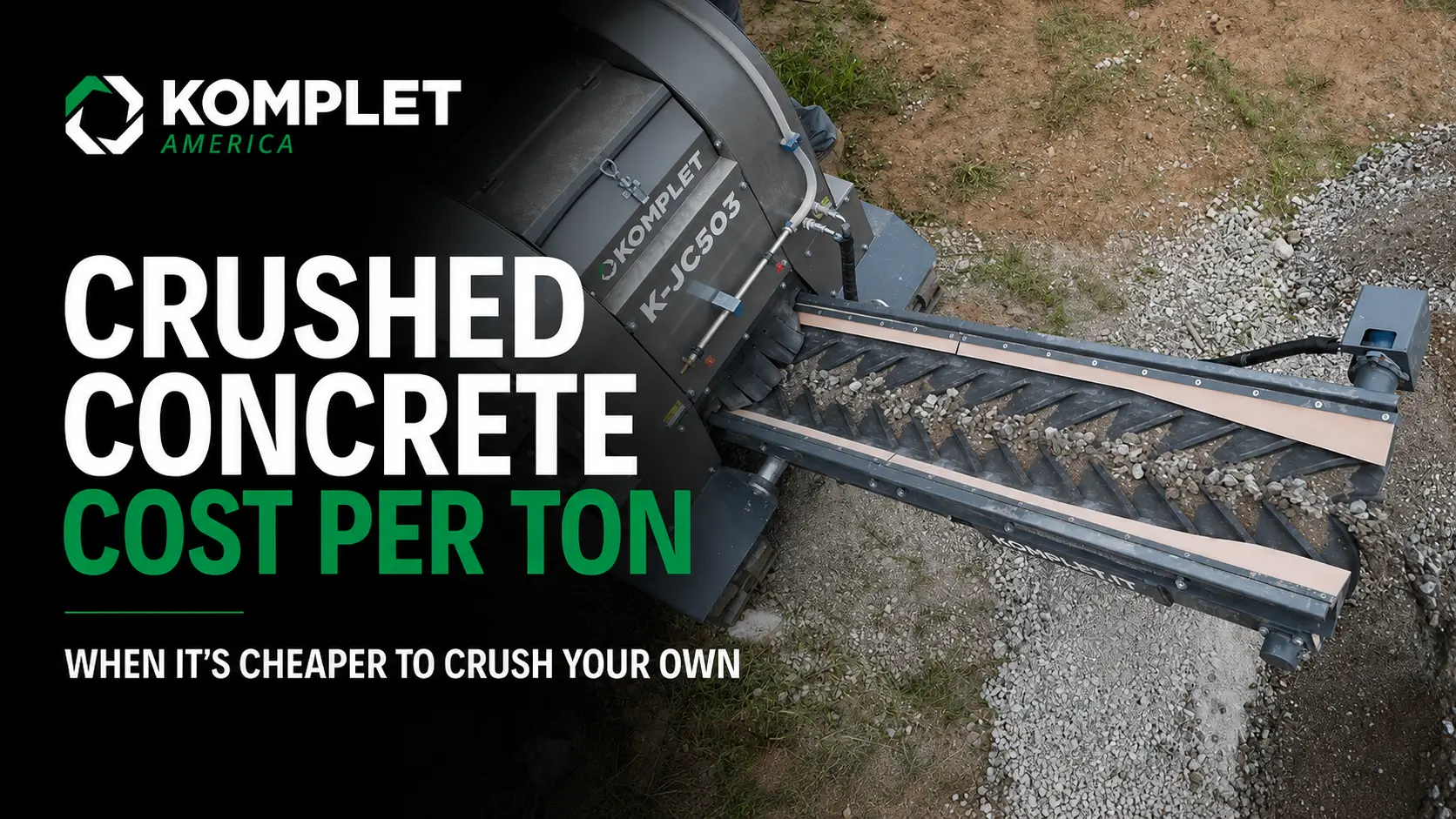
- K-JC 503 — up to 34 US tph, 19″ x 12″ jaw, 25 HP Tier 4 Final, ~7,496 lb. Tight-access urban work.
- K-JC 604 — up to 55 US tph, 23″ x 16″ jaw, 55 HP, ~19,400 lb. Mid-range pavement recycling.
- K-JC 704 PLUS — up to 90 US tph, 27″ x 16″ jaw, 74 HP, ~26,455 lb. Komplet’s best-selling crusher.
- K-JC 805 — up to 160 US tph, 31″ x 21″ jaw, 130 HP, ~49,600 lb. Largest jaw crusher in the lineup.
Secondary Impact Crushing for Premium Aggregate (Komplet’s role)
For operations producing cubical RAP for high-spec HMA mix designs (SuperPave, surface course, polymer-modified mixes), secondary impact crushing produces the cubical particle shape that mix designers prefer:
- K-IC 70 Compact Impact Crusher — up to 90 US tph, 25″ x 20″ inlet, 100 HP, ~28,600 lb. Premium cubical secondary aggregate. Note: Komplet impact crushers use blow bars (NOT hammers — hammers are hammer-mill terminology) and serve as secondary equipment after primary jaw crushing.
Slow-Speed Shredding for Asphalt Shingles (Komplet’s role)
Tear-off asphalt shingles from roofing replacement projects represent a complementary recycling stream where compression-based jaw crushing doesn’t work (shingles are too pliable). Slow-speed shredding reduces shingles to RAS feedstock:
- Krokodile PLUS slow-speed shredder — single 60″ shaft, 220 HP Volvo Penta diesel, ~34,000 lb. C&D throughput up to 175 US tph; specialty material throughput up to 18 US tph depending on material. The Krokodile PLUS uses teeth (not sharp blades) to tear material at low rotational speeds rather than high-speed grinding. Roofing contractors and demolition operations recovering tear-off shingles can serve RAS-accepting HMA plant markets where local plant acceptance allows.
Spec-Size Screening Equipment (Komplet’s role)
RAP destined for HMA plants typically requires consistent particle size — vibrating scalping screening separates crushed pavement into spec sizes:
- Kompatto 221 — up to 90 US tph.
- Kompatto 5030 — up to 280 US tph, hydraulic 2-way / 3-way conversion. Best-selling screener.
- Kompatto 124 — up to 350 tph. Largest mobile scalping screen.
Material Handling Equipment (Komplet’s role for some)
The K-TC 460 portable mobile conveyor — up to 132 US tph, 25″ Chevron 3-ply belt, 25 HP Tier 4 Final, ~7,000 lb — handles material transfer between processing stages and to stockpiles. Loaders, trucks, and other heavy material handling equipment come from other manufacturers focused on those product categories.
HMA Plant Equipment (Komplet doesn’t make)
HMA plants themselves — drum mixers, batch plants, silos, bulk material handling, plant control systems — come from manufacturers focused on HMA plant equipment. Operations operating at the HMA plant end of the recycling pathway need this specialty equipment from those manufacturers.
Quality Control Considerations
RAP Specification Compliance
HMA plants accept RAP within specific gradation, asphalt content, and contamination thresholds. Operations producing RAP for HMA plants need to verify that crushed and screened output meets target plant specifications. Pre-acceptance sampling and testing typically required before plants accept new RAP suppliers.
Contamination Management
Pavement debris may include contamination — concrete chunks from joint material, soil from sub-base, oversized aggregate from pavement repairs, foreign objects from road surface. Quality RAP production requires removing or limiting contamination. Pre-screening before crushing and post-crushing screening both contribute to contamination management.
State DOT Specifications
State Department of Transportation specifications for RAP utilization vary by jurisdiction. Some states allow up to 30%+ RAP content in surface mixes; others restrict RAP content more conservatively. Operations selling to state DOT projects must verify specific state requirements. Operations selling to private commercial work face different specifications typically more permissive of recycled material.
Documentation Requirements
Some markets (federal contracts, LEED-certified projects, state DOT work, certain commercial work) require documented diversion percentages, source documentation, and material flow records. On-site material processing supports compliance with measurable diversion documentation through weight tickets, transfer documentation, and material flow records.
Frequently Asked Questions
Can compact mobile crushers handle asphalt pavement?
Yes. The compression action of jaw crushing handles asphalt without wrapping the asphalt cement around moving parts. All Komplet jaw crushers (K-JC 503 through K-JC 805) handle asphalt pavement effectively. Match crusher size to operational throughput and feed size requirements.
What size RAP do HMA plants typically accept?
Specifications vary by plant operator, mix design, and target use case. Common acceptance specifications include 1/2″ minus or 5/8″ minus depending on plant capabilities and the plant’s mix design preferences. Verify specific target plant specifications before bidding RAP supply contracts.
Does asphalt require different crushing equipment than concrete?
Compact mobile jaw crushers handle both effectively. The same K-JC equipment that crushes demolition concrete also handles asphalt pavement. The differences: asphalt may benefit from cooler ambient operating conditions to reduce stickiness; concrete demolition typically has rebar requiring magnetic separation; jaw setting may differ slightly between materials. Operationally, the same equipment handles both materials.
Can I make money selling RAP to HMA plants?
Yes — RAP commonly sells to HMA plants at $5-$15+/ton typical pricing depending on specifications and market. The economic case for selling vs. using on-project depends on regional HMA plant demand, project-specific aggregate needs, and proximity of demolition site to HMA plants. Some operations sell RAP to plants; others use crushed pavement directly as base material on the same project; many do both based on project economics.
Does Komplet make milling equipment for asphalt removal?
No. Asphalt milling machines (cold planers) come from manufacturers focused on milling equipment. Komplet’s role in asphalt recycling is at the compact mobile crushing end — converting demolished pavement (whether from milling or full-depth removal) into spec-sized RAP feedstock or base aggregate. For milling equipment, consult manufacturers specializing in that product category.
Do I need both jaw and impact crushers for RAP production?
Depends on target market specifications. Single-stage operations (jaw crushing only) produce RAP suitable for HMA plant binder/base course feedstock, cold-mix operations, base material applications, and most state DOT non-surface course uses. Two-stage operations (jaw + K-IC 70 impact) produce premium cubical RAP suitable for surface course mixes, SuperPave specifications, polymer-modified mixes, and high-performance pavement applications. If your target market accepts angular RAP, jaw alone is sufficient; if your target market requires cubical RAP, plan for both stages.
Can the Krokodile PLUS shred tear-off asphalt shingles for RAS production?
Yes. The Krokodile PLUS slow-speed shredder reduces tear-off shingles to RAS feedstock for HMA plant acceptance. The slow-speed shredding approach (teeth, not blades; low rotational speed) handles pliable shingle material that compression-based jaw crushing cannot process effectively. Verify local HMA plant RAS acceptance before bidding RAS supply work — RAS market acceptance varies significantly by region. Some operations combine RAP and RAS production in a single facility serving regional HMA plants accepting both feedstocks.
What’s the largest pavement piece Komplet jaw crushers can handle?
Match feed size to jaw opening: K-JC 503 (19″ x 12″ jaw) handles material to approximately 9-1/2″ minus; K-JC 604 (23″ x 16″ jaw) handles material to approximately 12-3/4″; K-JC 704 PLUS (27″ x 16″ jaw) handles material to approximately 12-3/4″; K-JC 805 (31″ x 21″ jaw) handles material to approximately 16-3/4″. Pre-process oversized pavement chunks with excavator-mounted hydraulic breakers before feeding the crusher.
Should I rent or buy crushing equipment for asphalt recycling?
Renting is typically the right starting point for first-time operations and single-project work. For operations with recurring pavement recycling pipeline (multiple projects per year with significant pavement volumes), ownership economics typically justify purchase. Find your local Komplet dealer or call (908) 369-3340 to discuss rental availability and operational economics.
Does Komplet offer financing on equipment for asphalt recycling?
Komplet Capital offers 24-hour approval, 100% financing, 3-6 year terms on Komplet equipment. New equipment qualifies for Section 179 tax deduction up to $1.22M (2024 limit). For asphalt recycling operations evaluating equipment investment, financing structures matter — talk to the team about options that fit operational economics.
Final Thoughts
Asphalt pavement recycling delivers substantial economic and environmental benefits across the construction industry — billions in cost savings annually, tens of millions of cubic yards of landfill space preserved, reduced virgin material consumption, and improved project-level economics for operations executing recycling pathways effectively. The recycling landscape includes multiple techniques — HMA recycling, cold-mix, full-depth reclamation, in-place recycling — each requiring specialty equipment for different stages of the process. Komplet America’s compact mobile equipment serves specific roles at the construction-side end of the pathway: jaw crushers (K-JC 503 through K-JC 805) convert demolished pavement into RAP feedstock or base aggregate; the K-IC 70 impact crusher delivers premium cubical secondary aggregate for high-spec mix designs; the Krokodile PLUS slow-speed shredder handles tear-off shingles for RAS production where local plant acceptance allows; the Kompatto vibrating scalping screeners produce spec-sized output for HMA plant requirements. For operations at the construction-side compact mobile end of asphalt recycling, this combined lineup delivers the operational economics that make asphalt and shingle recycling work.
Browse Komplet America’s compact mobile crusher lineup or call us to discuss equipment selection for your specific asphalt recycling operation.
Ready to Talk Asphalt Recycling Equipment?
- Call (908) 369-3340
- Email [email protected]
- Schedule a demo or request a quote
- Find your local Komplet dealer for rental availability
- Ask about our 1-year / 1,000-hour warranty and equipment financing options
Never enough — that’s how we approach service, support, and helping operations execute asphalt recycling pathways that deliver strong project economics.
Disclaimer: All cost, ROI, payback, pricing, RAP market, dump fee, and savings figures in this article are illustrative examples based on sample assumptions about volume, regional pricing, material specifications, and market conditions. Actual results vary significantly by region, market, material type, equipment utilization, operator skill, financing terms, regulatory environment, and many other factors. Equipment pricing, RAP market pricing, fuel costs, labor rates, and tipping fees all change over time and by location. Industry-level statistics (recycling rates, cost savings, landfill diversion) cited from industry sources are subject to update; verify current data via NAPA, FHWA, or other authoritative sources. State DOT specifications for RAP utilization vary by jurisdiction and project type; verify specific requirements before bidding work. Komplet America makes no guarantee, warranty, or representation of specific financial performance, payback timelines, or business outcomes for any particular operation. For current pricing and a payback estimate based on your specific volume, material, and local market, contact us at (908) 369-3340 to speak with our team.