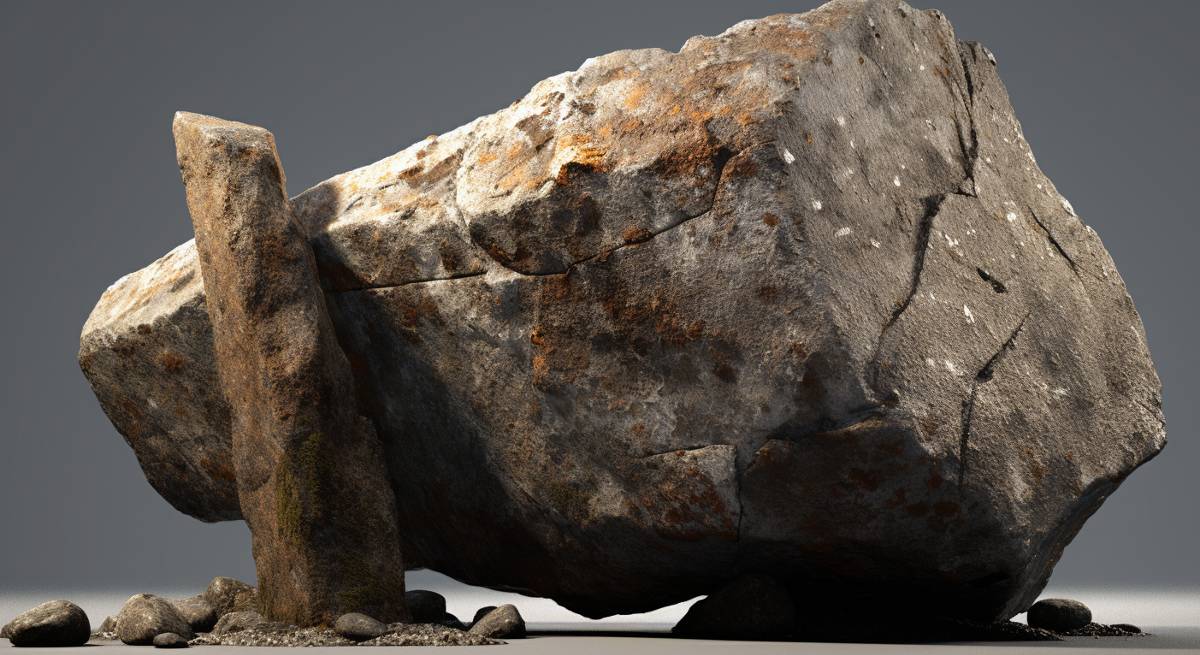

Stone crushers are the backbone of construction, mining, recycling, and aggregate operations across every developed economy. The choice of which type of stone crusher fits a specific project determines not just operational efficiency but the project’s actual economics — the right crusher produces spec-graded aggregate quickly, with low operating cost per ton, in a footprint the project site can accommodate. The wrong crusher creates bottlenecks, downtime, and capital tied up in equipment that can’t deliver rated production.
This guide walks through the five main types of stone crushers, the real-world applications each one is built for, the brief history of stone crushing technology, and where Komplet America’s compact mobile jaw and impact crushers fit into your operation. If you run a quarry, contracting business, demolition company, or aggregate yard — and you want crushed stone production without the cost and complexity of a full stationary plant — this is written for you.
A Brief History of Stone Crushing
With the help of a stone crusher, large rocks and stone pieces are broken down to a desired size, providing the raw material for construction, infrastructure, and industrial use. For thousands of years, civilizations used hand tools — pick axes, hammers, simple stone-on-stone reduction — to break rock for buildings, roads, and walls. After the Industrial Revolution, the demand for raw materials increased dramatically, and mechanical crushing became a structural necessity rather than a craft. The first US patent for a rock crusher was issued in the late 1800s, using a drop-hammer principle. Successive innovations across the 20th century produced the jaw crusher, the gyratory crusher, the cone crusher, the impact crusher, and the hammer mill — each addressing a specific need in primary, secondary, or tertiary stone reduction. Today’s compact mobile crushers continue that engineering trajectory, packaging the same crushing principles into mobile, contractor-scale equipment that can move between sites and process material on-demand.
How Stone Crushing Works: A Two-Stage Process
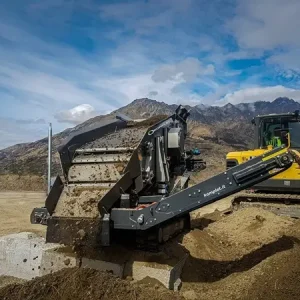
Stone crushing is fundamentally a two-step process. The first stage is size reduction — a crusher fractures large stone into smaller, manageable pieces. Depending on the machine, the first pass can bring large rock down to 1- to 3-inch product in a single stage. The second stage is sorting, where a screener separates the crushed output into spec sizes (fines, #57 stone, base course, riprap) so each pile is ready to sell or use.
Virgin stone (freshly quarried rock) is among the toughest material any crushing equipment will ever handle. Compressive strength of common quarry rock — granite, basalt, quartzite — runs from 100 MPa to 250+ MPa. The crusher selected for primary reduction must have the structural strength, the power, and the wear resistance to handle that material at production rates that justify the operation.
The Five Main Types of Stone Crushers
- Jaw Crushers
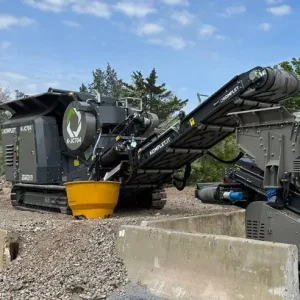
Jaw crushers use compression between two jaw plates — one stationary, one moving — to break stone. Best for: hard, abrasive rock and large feed material. Common applications: primary reduction in quarries, demolition concrete with rebar, hard virgin stone, large-feed recycling. Output range: feed up to about 80% of the jaw gape (about 16-3/4 inches on the K-JC 805) reduced to 1-3 inch product in a single pass. Strengths: handles hard and abrasive material that destroys other crusher types; tolerates wet, sticky, dirty feed; simple wear part replacement.
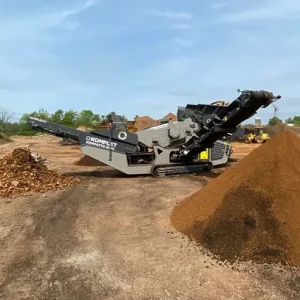
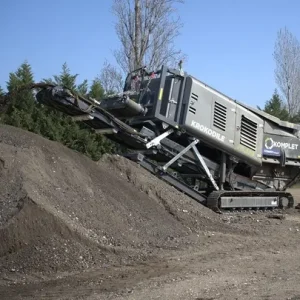
For Komplet’s lineup, the jaw crusher is the workhorse of the equipment range:
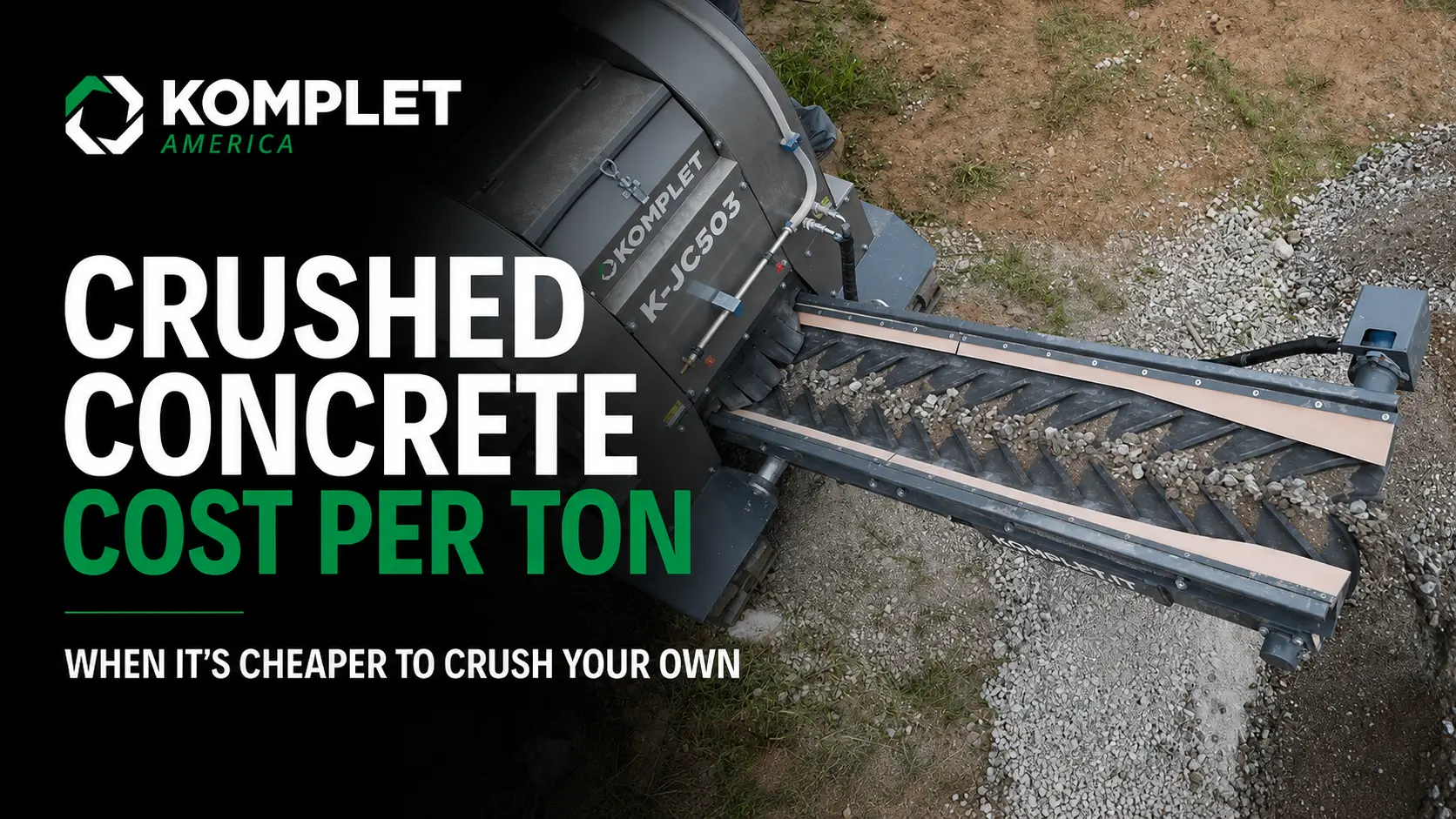
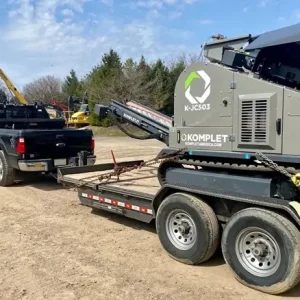
- K-JC 503 — up to 34 US tph; 19″ × 12″ jaw; 25 hp Tier 4 Final. Compact mini crusher; transports at 7,496 lb behind a standard pickup.
- K-JC 604 — up to 55 US tph; 23″ × 16″ jaw; 55 hp.
- K-JC 704 PLUS — up to 90 US tph; 27″ × 16″ jaw; 74 hp. Komplet’s best-selling crusher.
- K-JC 805 — up to 160 US tph; 31″ × 21″ jaw; 130 hp. Largest jaw in the lineup.
- Impact Crushers
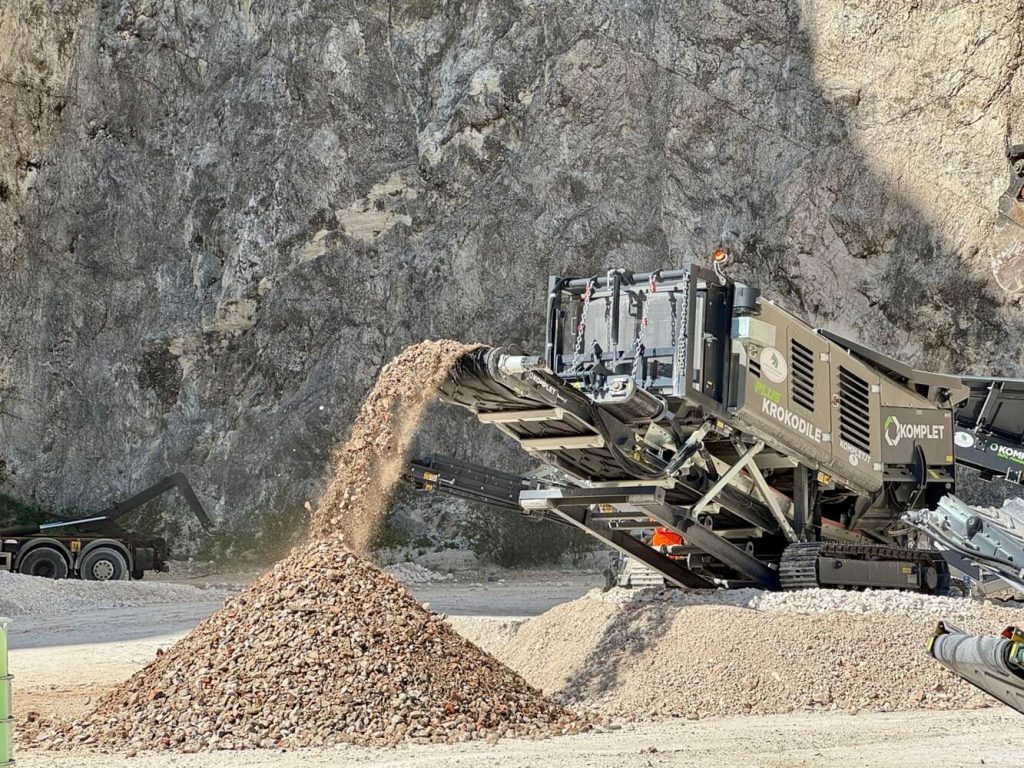
Impact crushers use high-speed rotating blow bars to shatter stone against fixed aprons inside the crushing chamber. Best for: softer-to-medium rock and producing cubical, well-shaped aggregate for asphalt and concrete mixes. Common applications: secondary reduction after a jaw crusher; recycled asphalt pavement (RAP) reduction; producing DOT-spec aggregate; crushing concrete and brick into cubical product. Output range: typically produces well-shaped cubical aggregate suitable for paving and concrete mix; struggles with very hard or abrasive virgin rock.
Many operations run a jaw crusher and an impact crusher in sequence — jaw doing primary reduction, impact doing secondary shaping. This produces both the throughput of a jaw crusher and the cubical product shape of an impact crusher.
In Komplet’s lineup, the impact crusher is the K-IC 70:
- K-IC 70 — up to 90 US tph; cubical aggregate output; RAP reduction; DOT-spec material. 100 hp Tier 4 Final. Compact mobile impact crusher for paving, recycling, and quality-aggregate applications.
- Cone Crushers
Cone crushers use a rotating cone-shaped mantle inside an outer concave bowl to crush stone via squeezing and shearing. Best for: tertiary reduction in large stationary plant operations producing fine aggregate. Common applications: high-volume aggregate plants, mining operations, large quarry settings producing finished spec product. Output range: produces finer output than jaw or impact crushers; well-suited to cubical fine aggregate production.
Note on terminology: cone crushers have ‘liners’ (the wear surfaces) — different from jaw crushers, which have ‘jaw plates.’ This is a common point of confusion in equipment specifications and inspection. Komplet does not currently offer cone crushers in the U.S. mobile compact equipment lineup; cone crushers are typically deployed in large stationary plant configurations rather than mobile contractor equipment.
- Gyratory Crushers
Gyratory crushers use a conical head that gyrates inside a fixed concave to compress stone in a continuous crushing action. Best for: very high-volume primary crushing in large mining operations. Common applications: massive open-pit mining; the largest aggregate operations; processing 1,000+ tph of hard rock continuously. Output range: handles enormous feed material; produces medium-to-coarse output. Strengths: continuous crushing action (vs. the reciprocating action of a jaw crusher) produces higher throughput at large scales. Limitations: only justified at very large operational scales; complex and expensive; not used in mobile compact applications.
- Hammer Mills
Hammer mills use rapidly rotating hammers to pulverize material into fine output. Best for: producing fine output from soft-to-medium materials. Common applications: agricultural feed grinding, glass and ceramic processing, certain specialty material reduction. Output range: produces very fine output; handles brittle and friable material well. Limitations: not suitable for hard abrasive virgin stone; high wear rate on hammers; high energy consumption per ton.
Jaw vs Impact: How to Choose Between Komplet’s Two Mobile Crusher Types
For most contractor and recycler operations, the choice comes down to jaw versus impact. Both Komplet jaw crushers and the K-IC 70 impact crusher are available in mobile, compact, contractor-scale configurations. The choice depends on what the operation is actually trying to produce.
Choose a Jaw Crusher When…
- Primary reduction is the goal (large feed → manageable output)
- Material is hard, abrasive, or includes rebar (concrete demolition, granite, basalt)
- Wet, sticky, or dirty feed conditions are common
- Throughput per dollar of equipment is the priority
- Operating cost per ton matters more than aggregate shape
Choose an Impact Crusher When…
- Cubical aggregate shape is required (asphalt mix, concrete mix, DOT spec)
- Material is medium-hard but not abrasive (recycled asphalt, sandstone, limestone)
- Output spec calls for well-shaped fines and small aggregate
- Secondary reduction after jaw crushing is the configuration
Run Both When…
Many operations run a jaw crusher first (primary reduction, throughput) and feed the output into an impact crusher (secondary reduction, shape). The combination produces both high throughput and well-shaped final aggregate. For Komplet customers, this typically means a K-JC 704 PLUS feeding a K-IC 70, often with a Kompatto vibrating screener and K-TC 460 conveyor completing the line.
How a Stone Crusher Makes You Money: The Profit Engine View
Running a stone crusher isn’t just a cost center — it’s a profit engine. Every ton of stone you crush on-site or in your yard is a ton you don’t have to buy elsewhere, plus potential revenue from selling excess production. The four ways a stone crusher generates economic return:
- Sell Crushed Aggregate Directly
Base rock, #57 stone, driveway gravel, landscape stone, riprap. Tipping fees and aggregate prices vary by region, but contractors across the US regularly sell screened aggregate at healthy margins to builders, landscapers, and municipalities. The market for crushed stone is large and growing — every road project, foundation, drainage system, and landscape installation needs aggregate.
- Eliminate Dump Fees and Hauling Costs on Demolition Work
On recycled concrete and asphalt jobs, the demolition material doesn’t need to be hauled to a landfill at $40-$100+/ton tipping fees. The avoided tipping plus avoided hauling, on a typical commercial demolition project, can easily exceed $30,000-$50,000 — capital that goes back to project margin.
- Replace Purchased Aggregate with Your Own Crushed Material
On projects that need both demolition AND new aggregate (very common in civil and infrastructure work), the crushed concrete from the demolition becomes the base course for the new construction. Often a 70-90% cost reduction per ton versus virgin aggregate. The same project pays for both the disposal cost AND the new aggregate cost — eliminating both with on-site crushing is the fastest payback equation in equipment economics.
- Add a New Service Line
Mobile on-site crushing for other contractors in your market. Once equipment is sized for a contractor’s own demolition volume, the same equipment often has unused capacity available to sell as a service to neighboring contractors who don’t own crushers. This adds a service revenue stream on top of the project economics.
Real-World Payback Math: K-JC 704 PLUS Example
Illustrative payback scenario for a K-JC 704 PLUS purchase, in a market with $75/ton concrete tipping and $25/ton aggregate purchase pricing, processing 4,000 tons per month of concrete demolition material. Assumptions are illustrative only; actual results depend on local market conditions and project mix.
- Avoided tipping fees: 4,000 tons × $75 = $300,000/month
- Avoided aggregate purchases: (displacement on own projects, ~50% of output) 2,000 tons × $25 = $50,000/month
- Sales of surplus RCA: (varies by market, ~$15-20/ton wholesale)
- Estimated gross monthly economic impact: approximately $350,000 (varies by market and project mix)
- Less finance payment (~$5,100/month on 60-month K-JC 704 PLUS financing) and operating costs (~$4,000/month for fuel, maintenance, operator)
- Net monthly benefit: approximately $185,000
Payback in this scenario: first month of operation. The machine pays for itself before the second monthly payment is due. In markets with tipping fees above $50/ton, the K-JC 704 PLUS typically pays back in 3 to 8 months of full-use operation. Want a payback calculation specific to your tons-per-month and local pricing? Call 908-369-3340 or request a quote.
Tax Treatment: Section 179 and Bonus Depreciation
Stone crushing equipment is tangible business property and generally qualifies for Section 179 deduction and bonus depreciation. For tax year 2026, the maximum Section 179 deduction is $2,560,000, with phase-out beginning at $4,090,000 in total qualifying purchases. The One Big Beautiful Bill Act of 2025 raised these limits substantially from prior years and restored 100% bonus depreciation for qualifying property placed in service after January 19, 2025.
For a typical Komplet equipment buyer well below the phase-out threshold, the practical effect is that the full purchase price of qualifying equipment can typically be deducted in the year placed in service, subject to all Section 179 program requirements. This dramatically improves the after-tax payback timeline on stone crusher purchases. More on this in the dedicated Section 179 guide. Specific eligibility and outcomes depend on your tax situation; confirm with your CPA before basing purchase decisions on tax treatment.
Demand Drivers: Why Stone Crusher Investment Pays Off
Demand for crushed stone keeps growing across every construction and infrastructure sector:
- Road base and pavement sub-base — crushed stone compacted under asphalt and concrete roads
- Concrete and asphalt mix aggregate — structural building material
- Drainage fields and French drains — clean #57 stone for water management
- Pipe bedding and trench backfill — utility infrastructure
- Landscape stone — decorative gravel, river rock, walkway material
- Riprap and shoreline protection — larger aggregate for erosion control
- Track ballast for railways — stable drainage layer under rail systems
Stone crushing equipment also revolutionizes construction processes by reducing manual labor, enhancing project efficiency, and producing on-site cost-effective solutions. Stone crushers are compact, powerful, versatile, and increasingly central to streamlined material processing in modern construction.
Frequently Asked Questions
What’s the difference between a jaw crusher and an impact crusher?
A jaw crusher uses compression between two plates to break stone — best for hard, abrasive rock and large feed material. An impact crusher uses high-speed rotating blow bars to shatter stone against aprons — best for softer-to-medium rock and producing cubical, well-shaped aggregate for asphalt and concrete mixes. Many operations run both in sequence, with the jaw crusher doing primary reduction and the impact crusher doing secondary shaping.
What’s the best primary stone crusher for hard rock?
A jaw crusher. The compressive crushing action of two jaw plates handles abrasive, high-strength material — granite, basalt, quartzite, reinforced concrete — better than an impact crusher. For Komplet’s lineup, the K-JC 704 PLUS (up to 90 US tph) and K-JC 805 (up to 160 US tph) are purpose-built for hard virgin stone.
What size stone crusher do I need?
Match throughput to project volume and feed size. For occasional small projects (residential demolition, small site work), the K-JC 503 (34 tph; 19″×12″ jaw) is typically right. For mid-size contractor work, the K-JC 704 PLUS (90 tph; 27″×16″ jaw). For larger civil and quarry work, the K-JC 805 (160 tph; 31″×21″ jaw). Right-sizing matters: too small and the crusher is a bottleneck; too large and the capital is underutilized.
How long does a stone crusher last?
Properly maintained jaw crushers and impact crushers can deliver 10-20+ years of service. Wear parts (jaw plates, blow bars, screens) replace periodically based on hours and material abrasiveness. Major components (hydraulic systems, frame, engine) typically run far longer with proper maintenance.
Does a stone crusher require an operator?
Yes, but minimal. Modern compact mobile crushers like the Komplet lineup are designed for single-operator operation, often with remote control for tracked movement and basic operational functions. The operator monitors feed, watches for issues, and clears any blockages — the machine does the actual crushing autonomously.
Can a stone crusher be financed?
Yes. Komplet Capital — Komplet America’s in-house financing — offers 100% financing for qualified buyers, 24-hour approvals, and 36/48/60/72-month term options on both new and certified pre-owned equipment. Details at Komplet Capital financing.
What’s the smallest stone crusher I can buy?
In the Komplet lineup, the K-JC 503 mini jaw crusher. 25 hp, 19″ × 12″ jaw, up to 34 US tph, 7,496 lb transport weight. Designed for small contractors, residential remodels, basement waterproofing, landscaping, and pool installation. Pre-owned units price below this for buyers wanting an even lower entry point.
Is Komplet equipment Tier 4 Final compliant?
Yes. All current Komplet equipment sold in the United States meets EPA Tier 4 Final emissions standards for non-road diesel engines.
Final Thoughts
Stone crushers have revolutionized construction processes for over a century, and modern compact mobile crushers continue that trajectory — packaging quarry-grade crushing capability into contractor-scale equipment that moves between sites and processes material on-demand. For most contractor, demolition, civil, and recycler operations, the right stone crusher choice is a jaw crusher (with an impact crusher added for cubical aggregate production where required), sized to the operation’s throughput and feed material, financed appropriately, and supported by parts and service across the operational life of the equipment.
The economics increasingly favor crushing on-site or in-yard rather than disposing-and-purchasing — avoided tipping fees, avoided hauling, avoided aggregate purchases, plus revenue from saleable RCA. Combined with Section 179 tax treatment under the 2026 limits ($2,560,000 maximum deduction), the after-tax payback timeline on a well-sized stone crusher purchase is among the strongest in heavy equipment categories. The variable separating profitable operations from break-even ones is rarely the equipment itself — it’s the discipline of right-sizing, deliberate process, and structured project economics that the operation either applies or doesn’t.
To explore Komplet’s mobile compact stone crushers, the full lineup is at Komplet crusher lineup. Pre-owned equipment is at Komplet’s pre-owned inventory. Equipment financing through Komplet Capital is at Komplet Capital financing. Or call Komplet America directly at 908-369-3340.
Ready to Run the Numbers on a Stone Crusher Purchase?
- Map your tons-per-month material flow — concrete demolition tonnage, current tipping rates, current aggregate purchase costs. The economic gap between disposal and recovery is often the largest addressable cost on the project P&L.
- Call Komplet America at 908-369-3340 for a payback calculation specific to your operation.
- Discuss financing structures at Komplet Capital financing — Komplet Capital offers 100% financing and standard term options.
- Talk to your CPA about Section 179 — for tax year 2026, the maximum deduction is $2,560,000.
- Find your local Komplet dealer at Find Your Komplet Dealer.
Never enough.
Disclaimer: ROI figures, payback timelines, and pricing examples shown above are illustrative only based on sample assumptions. Actual results depend on local market conditions, project mix, equipment utilization, financing terms, and other factors. Komplet America makes no guarantee of specific financial returns.
Disclaimer: Section 179 limits are 2026 figures based on the One Big Beautiful Bill Act of 2025 and adjust annually. Komplet America is an equipment distributor, not a tax advisor. Consult a qualified CPA before making purchase decisions based on tax treatment.
Equipment prices are subject to change based on dealer location, configuration, and additional features. Prices do not include taxes, shipping, or installation. Contact Komplet America at 908-369-3340 for current pricing.