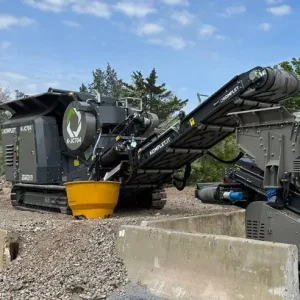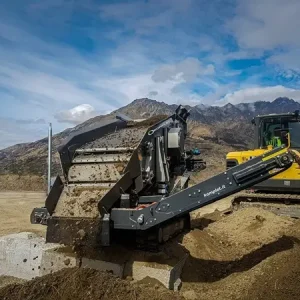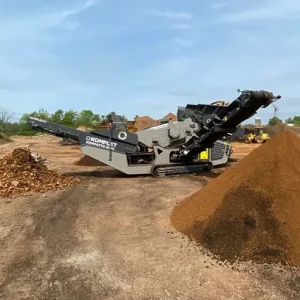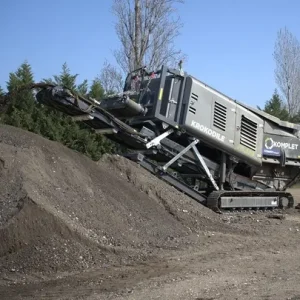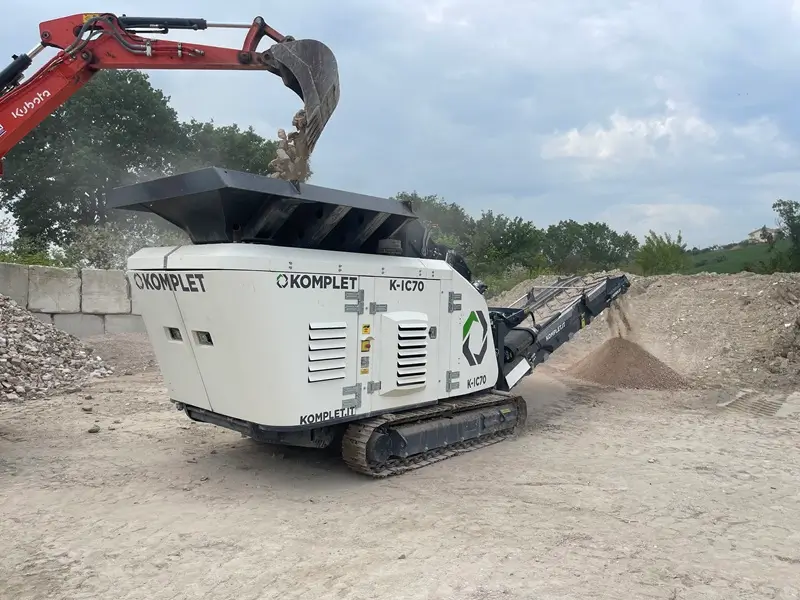

Sustainability in compact crushing and material processing comes from four concrete mechanisms, not from marketing language. First, on-site processing eliminates haul-truck miles between demolition sites and remote crushing facilities, reducing diesel burn and traffic congestion. Second, recycled concrete aggregate (RCA) and recycled asphalt pavement (RAP) displace virgin quarried material, reducing demand for new mineral extraction. Third, EPA Tier 4 Final emissions compliance across the Komplet lineup delivers measurable reductions in particulate, NOx, and other regulated emissions from the equipment itself. Fourth, factory-integrated dust suppression on Komplet crushers and the Krokodile PLUS slow-speed shredder controls fugitive silica dust at the source, protecting workers and neighbors. Each mechanism is measurable, supported by EPA data, and present in the equipment Komplet sells today.
This guide walks through each mechanism with the numbers behind it, names the specific Komplet equipment that delivers each one, and is honest about what compact mobile crushing equipment can and cannot do for an operation’s environmental footprint. The goal is to replace generic sustainability talk with operationally useful claims a contractor or recycler can actually act on.
The C&D Recycling Picture: What the EPA Data Actually Says
U.S. construction and demolition (C&D) debris is one of the largest waste streams in the country — and one of the most successful recycling stories. The U.S. Environmental Protection Agency (EPA) estimates that approximately 600 million tons of C&D debris were generated in the United States in 2018 — more than twice the volume of municipal solid waste (MSW).
Of that 600 million tons, the EPA reports that approximately 76 percent was recovered or recycled rather than landfilled. The two largest fractions — concrete and asphalt concrete — are recovered at over 95 percent. The recovered material’s largest “next use” category, per EPA terminology, is aggregate: the recycled concrete becomes road base, drainage stone, fill, and other aggregate-grade product, while recycled asphalt pavement (RAP) is reincorporated into asphalt mixtures.
That recycling rate did not happen by accident. It happened because demolition contractors, civil contractors, aggregate yards, and municipal recyclers built workflows — sorting, primary reduction, screening, stockpiling, sales — that turn waste streams into product streams. Compact mobile crushing, screening, shredding, and conveying equipment is the technical infrastructure that makes those workflows feasible at contractor- and recycler-scale operations. Understanding the EPA numbers anchors the sustainability conversation in real outcomes rather than aspirational language.
Mechanism 1: On-Site Processing Eliminates Hauling Miles
The most leveraged single sustainability mechanism in compact mobile crushing is the elimination of haul-truck miles. Without on-site processing, demolition concrete and other C&D debris must be loaded into haul trucks, driven to a remote crushing facility (often a stationary plant 20 to 60 miles from the project), processed there, and either disposed of or returned as recycled aggregate. Each load is a round trip; each round trip burns diesel, generates emissions, and adds wear to public roads.
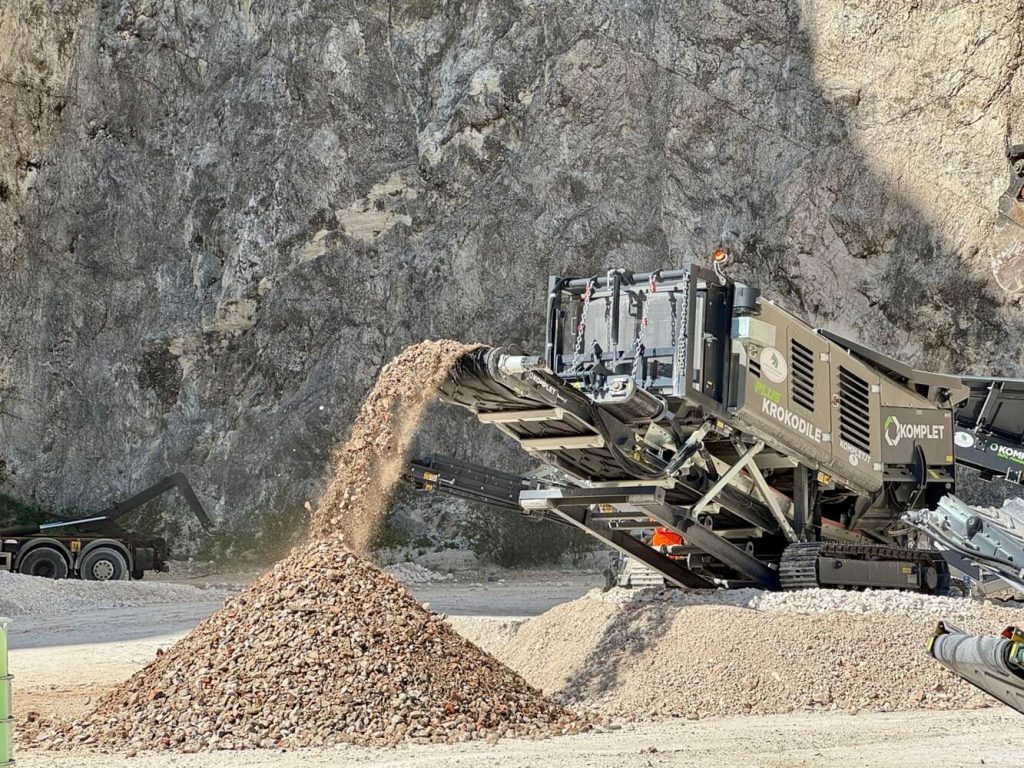
On-site processing collapses that chain. The Komplet jaw crusher (or impact crusher, or Krokodile PLUS shredder) crushes the material at the project site or yard. The screener separates it into product cuts. The conveyor stockpiles it. The recycled aggregate is reused on the same project (avoided cost on imported virgin material) or sold to local end users (revenue). The haul trucks that would have moved demolition debris off-site and recycled aggregate back on-site simply don’t run.
Operational Math
A typical mid-size demolition project may produce 5,000 to 10,000 tons of recoverable concrete. At standard end-dump or roll-off truck capacity (10 to 20 tons per load), that’s 250 to 1,000 truck round trips eliminated by on-site processing. At typical 50-mile round-trip distances and 6 mpg fuel economy on heavy haul trucks, the avoided diesel burn runs into thousands of gallons per project — not counting the emissions, road wear, and traffic congestion impact.
This is not a marketing claim; it’s basic logistics arithmetic. Compact mobile equipment that processes material at the source eliminates the trips that would otherwise happen. The K-JC 704 PLUS (Komplet’s best-selling crusher, up to 90 US tph), the K-JC 805 (the largest jaw at up to 160 US tph), and the K-IC 70 compact impact crusher (up to 90 US tph) all deliver this avoided-hauling benefit at contractor- and recycler-scale volume.
Mechanism 2: Recycled Aggregate Displaces Virgin Quarried Material
Every ton of recycled concrete aggregate (RCA) used in road base, drainage, fill, or non-structural concrete is a ton of virgin crushed stone that didn’t have to be quarried. Quarrying virgin aggregate involves blasting, primary crushing at the quarry, secondary and tertiary crushing for spec products, screening, transportation to point of sale, and eventually transportation to the project site. Every step has an environmental footprint — fuel burn, emissions, dust, habitat disruption, and the simple fact of removing rock from a finite resource base.
Recycled aggregate flows the other direction in the resource economy. The EPA’s 2018 data shows that aggregate was the dominant “next use” for recovered C&D materials. The over-95-percent recovery rate for concrete and asphalt concrete in 2018 means that the U.S. construction industry already substitutes recycled aggregate for virgin material at meaningful scale — and compact mobile crushing equipment is the technical infrastructure that makes that substitution feasible at contractor- and yard-scale volumes.
Komplet Equipment in the Aggregate Substitution Workflow
Komplet jaw crushers (K-JC 503, K-JC 604, K-JC 704 PLUS, K-JC 805) reduce demolition concrete, asphalt, brick, masonry, and rock to aggregate sizes. The K-IC 70 compact impact crusher produces cubical-shape aggregate suited for spec applications including hot-mix asphalt and concrete batch plant feed. Kompatto vibrating screeners separate the output into spec-graded product cuts. The K-TC 460 tracked mobile conveyor stockpiles the product. The recycled aggregate substitutes for virgin crushed stone in road base (where it is widely accepted), drainage and fill (where it performs equivalently to virgin material), and non-structural concrete (where applicable specifications permit substitution).
Mechanism 3: Tier 4 Final Emissions Across the Komplet Lineup
All current Komplet equipment sold in the United States meets EPA Tier 4 Final emissions standards for non-road diesel engines — the strictest current U.S. emissions standard for off-road equipment. This applies to:
- Every Komplet jaw crusher (K-JC 503 at 25 hp, K-JC 604 at 55 hp, K-JC 704 PLUS at 74 hp, K-JC 805 at 130 hp)
- K-IC 70 compact impact crusher at 100 hp
- All Kompatto and K-TS screeners
- Krokodile PLUS slow-speed shredder (220 hp Volvo Penta Tier 4 Final)
- K-TC 460 tracked mobile conveyor (25 hp)
What Tier 4 Final Actually Reduces
Tier 4 Final reduces particulate matter (PM) emissions by approximately 90 percent compared to pre-Tier-1 engines, and reduces oxides of nitrogen (NOx) by approximately 80 percent compared to Tier 3 — in both cases as measured at the engine certification level. The actual jobsite reduction depends on operating mode, load profile, and machine utilization, but the regulatory direction is unambiguous: each generation of EPA emissions standards has reduced the off-road equipment contribution to ambient air quality.
Practical Operating Consequences
- Lower fuel burn per hour at comparable production rates compared to Tier 3 predecessors.
- Reduced operating costs across the equipment’s life — fuel is a major variable operating cost.
- Acceptance on construction sites with emissions restrictions (some urban jurisdictions, some federal projects, some state-funded work).
- Appropriate for operations near residential and commercial areas where neighbor air quality matters.
- Diesel exhaust fluid (DEF) infrastructure required, but DEF is widely available and the engine integration is well-engineered.
Mechanism 4: Factory Dust Suppression on the Equipment That Generates Dust
Crushing and shredding generate respirable crystalline silica dust at the source. OSHA’s construction silica standard (29 CFR 1926.1153) sets a Permissible Exposure Limit of 50 µg/m³ as an 8-hour time-weighted average and an Action Level of 25 µg/m³. Most contractors comply through OSHA Table 1, which requires wet-method engineering controls on most crushing tasks.
Komplet engineers factory-integrated water-spray dust suppression into the equipment that generates primary fugitive dust:
Equipment with Standard Dust Suppression
- All Komplet jaw crushers: K-JC 503, K-JC 604, K-JC 704 PLUS, K-JC 805
- K-IC 70 compact impact crusher
- Krokodile PLUS slow-speed shredder
Equipment Without Standard Dust Suppression
Standard dust suppression is not included on Komplet screeners (Kompatto 221, 5030, 124, K-TS 30, K-TS 40) or the K-TC 460 conveyor — these machines move material rather than fracture it and don’t generate the same level of primary fugitive dust at the same intensity. On sites where the screening or conveying step produces meaningful airborne dust, site-level controls (water trucks, perimeter misting, enclosure of stockpile zones) supplement the equipment.
For deeper coverage, see the dust control guide for crushing equipment.
Where Efficiency Compounds Sustainability
Sustainability and efficiency aren’t separate goals on compact mobile equipment — they reinforce each other. Five operational efficiency features that compound the environmental benefits:
Single-Operator Wireless Control
Wireless remote operation across the Komplet lineup lets a single trained operator coordinate the full processing spread (crusher, conveyor, screener, shredder) from one position. Smaller crews mean less commuter traffic, less idling time at handoff points, and less coordination overhead. Labor efficiency translates directly to operating-cost efficiency, which makes the recycling work economically viable in the first place.
Hydraulic Closed-Side-Setting Adjustment
Komplet jaw crushers feature hydraulic CSS adjustment — the operator changes output sizes in seconds rather than the 30 to 60 minutes mechanical shimming requires. Operators actually adjust settings during the day to match changing project needs, which means each pass through the crusher produces the right-spec product the first time. Less rework, less re-running, less wasted energy and fuel.
Krokodile PLUS Quick-Change Shaft System
The Krokodile PLUS handles two distinct material streams (hard mineral C&D / asphalt and soft mixed waste) through quick-change shafts on one machine. Two material streams, one piece of capital equipment — that’s resource efficiency at the equipment level, not just at the operating level. Demolition contractors with mixed waste streams capture both fractions without buying two machines.
Komplet Connect Remote Monitoring
Komplet Connect (standard on K-JC 704 PLUS and Krokodile PLUS) streams real-time operating data to the operator and to Komplet America’s service team. Service intervals tracked automatically by actual operating hours; fault codes flagged immediately; emerging issues caught before they cause unplanned downtime. Equipment that runs as designed runs at design fuel efficiency. Equipment with unaddressed maintenance issues runs less efficiently and ultimately fails — both outcomes are environmentally and economically worse than predictive maintenance enabled by remote monitoring.
Compact Footprint and Transport Flexibility
Compact mobile equipment reaches jobsites that fixed plants and large industrial equipment cannot — residential demolition projects, urban sites with tight access, small and mid-size civil projects where the project’s debris volume doesn’t justify a fixed-plant operation. The Komplet K-JC 503 mini jaw crusher (7,496 lb pickup-towable transport weight) and the K-TC 460 tracked mobile conveyor (7,000 lb pickup-towable) both travel behind standard work trucks. That accessibility is what makes on-site recycling feasible at the smaller-project scale where most demolition actually happens — and small-project recycling is where the largest single fraction of C&D recovery comes from.
Honest Framing: What Compact Equipment Doesn’t Solve
Equipment marketing in sustainability contexts has a tendency toward overclaim. Honest framing about what compact mobile crushing equipment doesn’t do:
- It doesn’t make all material streams recyclable. Steel, drywall, plastics, mixed C&D, and other non-mineral debris streams have their own recycling pathways outside compact mobile crushers. The Krokodile PLUS handles soft mixed waste; the jaw crushers don’t. Hazardous fractions (asbestos, lead-painted material, refrigerants) require specialty contractors entirely.
- It doesn’t replace structural-concrete virgin aggregate in all applications. Recycled concrete aggregate substitutes for virgin material in many applications (road base, drainage, fill, and some non-structural concrete) but specifications for structural concrete, high-strength concrete, and certain DOT applications may limit RCA acceptance. Engineers should confirm RCA acceptability for any specific use.
- It’s not zero-impact equipment. Tier 4 Final compliance reduces emissions; it doesn’t eliminate them. The equipment burns diesel, generates dust at residual levels even with suppression, and uses water in ways that may matter in water-constrained regions. Sustainability claims should describe net effect — substituting recycled aggregate for virgin and avoiding hauling miles is a clear net gain, but it’s not zero.
- It doesn’t address building-design and material-selection upstream. The largest sustainability gains in the built environment come from design decisions made before construction starts — material selection, building longevity, adaptive reuse, deconstruction practices that allow material recovery. Equipment for processing material at end-of-life is part of the answer, not the whole answer.
Within its actual scope — turning C&D mineral, mixed-waste, and soil/compost streams into product or volume-reduced waste at contractor- and recycler-scale operations — Komplet equipment delivers measurable, honest sustainability gains. Outside that scope, the right answer is appropriate technical and policy resources, not stretching equipment claims past their substantiation.
Frequently Asked Questions
How does on-site crushing equipment reduce environmental impact?
Through four primary mechanisms: (1) on-site processing eliminates haul-truck miles between demolition sites and remote crushing facilities, reducing diesel burn and emissions; (2) recycled concrete aggregate (RCA) and recycled asphalt pavement (RAP) displace virgin quarried material, reducing demand for new mineral extraction; (3) EPA Tier 4 Final emissions compliance reduces particulate matter and NOx from the equipment itself; (4) factory-integrated water-spray dust suppression on Komplet crushers and the Krokodile PLUS shredder controls fugitive silica dust at the source.
How much C&D debris does the U.S. recycle?
The U.S. EPA estimated approximately 600 million tons of C&D debris generated in 2018 — more than twice the volume of municipal solid waste. Approximately 76 percent of that was recovered or recycled rather than landfilled, with concrete and asphalt concrete (the two largest fractions) recovered at over 95 percent. Aggregate is the dominant “next use” category for recovered C&D materials. These figures come from the EPA’s Construction and Demolition Debris: Material-Specific Data and Advancing Sustainable Materials Management 2018 Fact Sheet.
Is compact mobile equipment more efficient than fixed-plant crushing?
It depends on the operation’s scale. For contractor- and recycler-scale work — typical demolition projects, civil project on-site recycling, mid-size aggregate yards — compact mobile equipment is more efficient because it processes material where it’s generated, eliminating hauling miles between project and remote plant. For high-volume continuous operations (industrial mining, large quarry, fixed-plant aggregate production at million-ton-per-year scale), fixed-plant equipment is typically more efficient because the throughput justifies the infrastructure. The honest answer is that each equipment category fits its scale.
Is recycled concrete aggregate accepted in DOT specifications?
Acceptance varies by state DOT, by application, and by spec. Many state DOTs accept RCA in road base, sub-base, drainage, and similar non-structural applications, often subject to gradation requirements and material certification. Structural concrete, high-strength concrete, and certain specialty applications may have stricter specifications that limit RCA acceptance. Engineers and contractors should confirm RCA acceptability for any specific project specification before relying on substitution.
Are all current Komplet machines Tier 4 Final compliant?
Yes. All current Komplet equipment sold in the United States meets EPA Tier 4 Final emissions standards for non-road diesel engines. This applies to all jaw crushers (K-JC 503, K-JC 604, K-JC 704 PLUS, K-JC 805), the K-IC 70 compact impact crusher, all Kompatto and K-TS screeners, the Krokodile PLUS slow-speed shredder (220 hp Volvo Penta), and the K-TC 460 tracked mobile conveyor.
Does Komplet equipment include dust suppression as a standard feature?
Factory-integrated water-spray dust suppression is standard on every Komplet crusher (K-JC 503, K-JC 604, K-JC 704 PLUS, K-JC 805, K-IC 70) and on the Krokodile PLUS slow-speed shredder. It is not standard on Komplet screeners (Kompatto 221, 5030, 124, K-TS 30, K-TS 40) or the K-TC 460 conveyor. Site-level controls supplement the equipment where local conditions warrant. Standard suppression on the crushing and shredding equipment supports OSHA silica compliance under 29 CFR 1926.1153 and protects worker and neighbor air quality.
Can certified pre-owned Komplet equipment also support sustainability goals?
Yes. Buying certified pre-owned equipment extends the operating life of existing machines rather than driving demand for new manufacturing — a core circular-economy principle. Komplet’s pre-owned program delivers verified-history machines with OEM parts support and the same authorized dealer service network, typically at 40 to 70 percent capital savings versus new. The same engineered features — hydraulic CSS adjustment, wireless control, factory dust suppression on crushers and the Krokodile PLUS — apply to pre-owned units.
Does on-site recycling pay for itself?
On most contractor- and recycler-scale operations, yes — primarily through avoided tipping fees on landfill disposal, avoided cost of importing virgin aggregate, and revenue from selling recycled product. Specific payback depends on local hauling and tipping rates, virgin aggregate prices, project debris volume, equipment utilization, and financing terms. Komplet Capital provides financing structures (100 percent financing, 24-hour approvals, Section 179 eligibility on qualifying purchases) that align cash flow with the equipment’s payback profile. Customers should perform their own analysis based on local market conditions.
Final Thoughts
Sustainability in compact mobile crushing equipment is best understood as a set of measurable mechanisms, not as a marketing posture. Avoided hauling miles reduce diesel burn and emissions. Recycled aggregate displaces virgin quarried material. Tier 4 Final emissions compliance reduces particulate and NOx contributions from the equipment itself. Factory-integrated dust suppression on the crushers and Krokodile PLUS controls fugitive silica at the source. Each mechanism is concrete, measurable, supported by EPA data, and present in the equipment Komplet sells today — not aspirational language about a sustainable future, but engineered capabilities that contractors and recyclers use every shift.
The U.S. construction and demolition recycling story is a real one — 600 million tons generated, 76 percent recovered, over 95 percent on concrete and asphalt — and that recycling rate happened because the contractors, recyclers, civil engineers, and municipal yards built workflows that turn waste into product. Compact mobile crushing, screening, shredding, and conveying equipment is the technical infrastructure of those workflows at contractor- and recycler-scale operations. Equipment alone doesn’t deliver sustainability outcomes; equipment in the hands of operators running sound workflows does.
Komplet America builds compact crushers, screeners, the Krokodile PLUS slow-speed shredder, and the K-TC 460 tracked mobile conveyor for contractors who need real production in tight footprints — including the on-site recycling work that drives the sustainability outcomes described above. To see the full lineup, explore the crusher, screener, shredder, and conveyor categories. To talk financing or pricing, contact Komplet Capital, visit the contact page, or call (908) 369-3340.
Ready to put a sustainable processing spread on your jobsite?
- Browse Komplet crushers — Tier 4 Final emissions across the lineup, factory dust suppression as standard.
- Review the Krokodile PLUS slow-speed shredder — quick-change shafts handle two material streams from one machine.
- Talk to Komplet Capital about 100 percent financing, 24-hour approvals, and Section 179 tax deduction eligibility.
- Save 40–70 percent and extend equipment life with certified pre-owned Komplet equipment — circular-economy capital with the same OEM support.
- Find your local Komplet dealer for rental availability or pre-purchase inspection.
Never enough.
Disclaimer: All operating, maintenance, and service guidance in this article is general in nature. Always refer to the official Komplet operator’s manual for the specific machine model and serial number, and follow OEM intervals and procedures. For warranty-protected work, contact Komplet America at (908) 369-3340 or your authorized Komplet dealer. Improper service or non-OEM parts may void warranty coverage and create safety hazards.
Disclaimer: Sustainability data referenced above (600 million tons of C&D debris generated in the U.S. in 2018; 76 percent recovery rate; over 95 percent recovery rate on concrete and asphalt concrete) is from the U.S. Environmental Protection Agency’s Advancing Sustainable Materials Management 2018 Fact Sheet and Construction and Demolition Debris: Material-Specific Data. Tier 4 Final emissions reduction figures (~90 percent PM, ~80 percent NOx vs. earlier engine tiers) are general industry figures based on EPA non-road diesel engine emissions standards; actual emissions on any specific machine and operating profile depend on multiple factors. Hauling avoidance figures (truck loads, fuel burn) are illustrative based on standard heavy-haul truck capacities and typical project distances; actual figures vary by project. References to OSHA’s Respirable Crystalline Silica standard (29 CFR 1926.1153) and EPA Tier 4 Final standards are general; specific compliance depends on full implementation of all applicable controls and is the employer’s responsibility.
Disclaimer: Cost savings figures, financing rates, capital savings on pre-owned equipment, and ROI examples shown above are illustrative examples only. Actual results depend on jobsite material composition, local hauling and tipping rates, virgin aggregate prices, fuel and labor costs, equipment utilization, financing terms, regional regulatory requirements, and operator efficiency. Komplet America makes no guarantee of specific financial returns. The Komplet Capital financing calculator is for illustration purposes only and is not an approval or an offer to finance. Customers should perform their own analysis based on local market conditions and consult their tax advisor on Section 179 eligibility before making purchase decisions.
Equipment prices are subject to change based on dealer location, availability, and any additional features or customizations. Prices do not include taxes, shipping, or installation fees, which may apply depending on your region. Contact Komplet America at (908) 369-3340 or visit kompletamerica.com for current pricing.