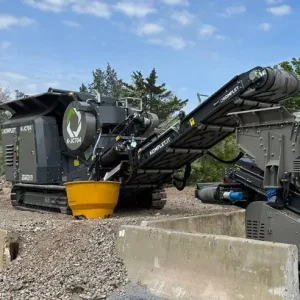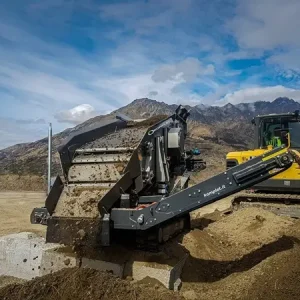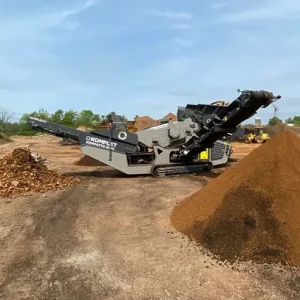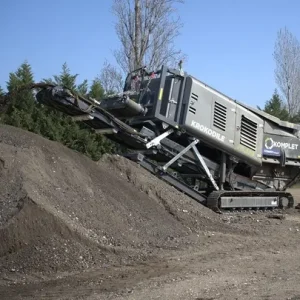

When a contractor or recycler asks what a stone crusher costs, the honest answer is that the sticker number is only the beginning of the story. Two machines in the same category can carry very different price tags, and two buyers can pay very different real costs for the same machine, depending on how it’s configured, supported, financed, and used over its life. This guide walks through the six factors that actually drive what you pay — in plain language, and without pinning numbers that go stale the moment a model is repriced.
Rather than quote specific list prices (which change with configuration, dealer location, and availability), this article explains the levers behind the price so you can evaluate any quote intelligently and compare equipment honestly — including the costs that never appear on the sticker but show up across the operating life. For current pricing on any Komplet model, the right move is always a direct quote: call Komplet America at 908-369-3340 or work through your authorized Komplet dealer.
The six factors: production capacity, included options and configuration, OEM warranty and dealer support, financing structure, total cost of ownership, and whether you buy new or certified pre-owned. Take them one at a time.
Factor 1: Production Capacity
The single biggest price driver is production capacity — how many tons per hour the machine processes. Within Komplet’s compact jaw crusher line, the smallest machine handles up to 34 US tph and the largest up to 160 US tph, and the larger machine costs several times more precisely because it produces several times more. The relationship isn’t strictly linear — engineering and supplier-cost economies of scale apply — but capacity is the dominant variable behind the price.
The right way to evaluate capacity is not “more is always better.” It’s “matched to the operation’s actual annual volume.” A small contractor processing a few thousand tons a year of demolition concrete is poorly served by the largest machine — it sits idle most days, the financed payment runs whether the machine works or not, and the operator never reaches the production rate the equipment was engineered for. A regional aggregate yard moving hundreds of thousands of tons a year is equally poorly served by the smallest machine, which runs flat-out and still can’t keep up. Matching the machine to the volume is the first and most important cost decision, because an oversized machine wastes capital and an undersized one bottlenecks the operation.
Komplet’s authorized dealer network typically provides capacity-sizing consultation as part of pre-purchase work. A dealer-side sizing review, grounded in your realistic annual tonnage, is the right starting point for choosing capacity — and it protects you from paying for throughput you’ll never use.
The Komplet Crusher Range at a Glance
The lineup spans a wide capacity range so the machine can be matched to the work. Capacities and best-fit applications, smallest to largest:
Model | Production | Best Fit |
K-JC 503 Mini Jaw | up to 34 US tph | Small contractors, tight-access urban work, hardscape, residential demolition; tows behind a heavy-duty pickup |
K-JC 604 Mobile Jaw | up to 55 US tph | Mid-size contractors, civil road and bridge work, mid-volume demolition recycling |
K-JC 704 PLUS Portable Jaw | up to 90 US tph | Best-selling model; contractor- and recycler-scale civil, road, demolition, and yard recycling |
K-JC 805 Mobile Jaw | up to 160 US tph | High-volume aggregate yards, large recycling operations, small-quarry work |
K-IC 70 Compact Impact | up to 90 US tph | Cubical spec aggregate for asphalt and concrete plant feed; engineered for RAP reduction |
Factor 2: Included Options and Configuration
Base machine pricing covers a standard configuration; optional features and configurations add to it. Understanding which options a given quote includes is essential to comparing two prices fairly — a lower number without a magnetic separator isn’t really cheaper than a higher number that includes one. The common configuration choices:
Magnetic Separator
A magnetic separator pulls ferrous material — rebar, embedded steel — out of crushed concrete, both protecting downstream equipment and producing cleaner recycled aggregate. It’s standard on some Komplet machines and configuration-dependent on others. On demolition-concrete recycling it matters enough that most operations spec it in even where it’s optional. Worth noting: the extraction hardware differs by model — a magnetic roller on the K-JC 503, and hydraulically adjustable crossband magnetic belts on the larger machines — so the configuration isn’t identical across the line.
Side Conveyor
A side discharge conveyor on the magnetic separator sends recovered ferrous material to its own pile rather than dropping it back into the discharge stream. It’s useful where an operation recovers scrap steel as a separate revenue stream, or simply needs clean aggregate free of contamination.
Remote Monitoring
Komplet Connect — remote monitoring and operating-data streaming — is standard on the K-JC 704 PLUS and the Krokodile PLUS shredder. On other machines, equivalent functionality is achievable through aftermarket telematics but isn’t factory-integrated. For fleet management and predictive-maintenance economics, the built-in system has real value, and its standard inclusion is one reason the K-JC 704 PLUS is the best-seller.
Track and Self-Propulsion
All current Komplet crushing equipment is tracked and self-propelled — it walks itself off a trailer and into position by wireless remote. This is baseline configuration, not an add-on, and the transport weight, hauling logistics, and on-site setup speed all follow from it. Because it’s standard, single-operator setup on a jobsite is realistic without extra equipment cost.
Factor 3: OEM Warranty and Dealer Support
Two crushers with similar specs from different manufacturers can carry very different total ownership costs because of what comes with the equipment beyond the machine itself: parts availability, service network, warranty coverage, and the manufacturer’s commitment to keeping the unit running through its life. This is a genuine price factor, even though it doesn’t show up as a line on the quote.
Komplet’s OEM Position
Komplet equipment is built in Italy by Komplet S.p.A., which has manufactured compact mobile crushing, screening, and shredding equipment since 2000. Komplet America is the U.S. distributor, supporting customers across North and Central America with parts inventory forecast twelve months in advance for current and prior-generation models. The authorized dealer network provides factory-certified service, warranty work, and operator training across the U.S.
Standard Warranty
Komplet’s standard new-equipment warranty is one year or 1,000 operating hours, whichever comes first, and coverage depends on documented adherence to OEM maintenance intervals using OEM parts. On a major piece of capital equipment, that warranty is meaningful capital insurance — and it’s a price factor in the sense that buying outside the OEM-and-dealer ecosystem (gray-market imports, used equipment without verified history, aftermarket parts on warranty-covered work) typically voids the protection. Understanding what preserves coverage is part of understanding the true cost; parts and support covers the maintenance and parts side.
Why Cheaper Equipment Often Costs More
Gray-market imports and lower-tier brands sometimes appear at much lower sticker prices than established OEM equipment. That gap at the point of purchase is often offset — or erased — by hidden costs over the operating life:
- Parts that aren’t in stock when needed — weeks of back-order while the machine sits idle.
- No authorized service network, so every repair becomes a freelance call.
- No warranty, or one that’s difficult to actually claim against.
- Substantially lower resale value — the next buyer inherits the same parts-availability problem.
- Consumable parts (jaw plates, belts, filters) that may not match OEM specs, accelerating wear.
At the contractor- and recycler-scale price points where Komplet competes, the OEM premium is usually a real value rather than a markup. The math can differ at the extreme low end and at industrial-mining scale, but in the middle — where most contractor capital decisions actually happen — paying for the established OEM ecosystem is typically the right call.
Factor 4: Financing Structure
On a major piece of capital equipment, the financing structure can change the effective cost more than the sticker price does. The key variables:
100 Percent Financing
Komplet Capital offers 100 percent financing on new and certified pre-owned Komplet equipment, with fast approvals and 36-, 48-, 60-, and 72-month term options. One hundred percent financing means no down payment — the equipment can be acquired without consuming working capital that’s needed for jobsite operations, parts inventory, and labor. Preserving that working capital is often worth more to an operation than a modest reduction in sticker price.
Term Length
Longer terms reduce the monthly payment and align cash flow with the equipment’s operating economics. Shorter terms reduce total interest and free the asset sooner for refinance, sale, or trade-in. The right term depends on the operation’s cash-flow profile and utilization plan — there’s no universally correct answer, which is why financing is a genuine cost factor rather than a fixed add-on.
Section 179 and Bonus Depreciation
Section 179 of the U.S. tax code lets a business deduct the full purchase price of qualifying equipment placed in service during the tax year, rather than depreciating it over several years. For most contractor- and recycler-scale purchases — single machines or complete spreads — the entire purchase price typically falls well under the annual deduction cap, allowing immediate first-year expensing. The practical effect is that the after-tax cost of the equipment can be meaningfully lower than the sticker price, depending on the buyer’s tax situation. Because the caps and bonus-depreciation rules change year to year, confirm the current figures and your eligibility with a tax advisor before counting on any specific treatment. Our equipment financing page covers the structure options.
Pre-Owned Capital Savings
Komplet’s certified pre-owned program delivers verified-history equipment with OEM parts support and the same authorized dealer service network, typically at meaningful capital savings versus new. For a contractor who doesn’t need new-from-the-factory equipment, pre-owned provides the same engineered features at a lower acquisition cost, and the same tax treatment applies to both new and used. It’s often the single biggest lever on the entry price.
Factor 5: Total Cost of Ownership
Sticker price is the smallest part of what the equipment costs over its life. Total cost of ownership (TCO) tracks every cost component across the expected service period — and it’s where the honest comparison between two machines is really made. The components:
- Acquisition cost. Sticker price plus options, taxes, and financing interest. Visible at purchase, but only the first line of the ledger.
- On a Tier 4 Final diesel engine, consumption depends on engine size, operating mode, and material conditions. Across a typical jaw crusher’s operating profile, fuel is usually the largest variable operating expense after labor — and when machines are correctly sized to their work, per-ton fuel costs are similar across the range.
- Wear parts and consumables. Jaw plates, V-belts, filters, hydraulic fluids, screen media, and DEF on Tier 4 systems. These wear on predictable operating-hour intervals; stocking ahead through Komplet’s forecast parts inventory is cheaper than back-order downtime.
- Maintenance labor. Operator-level daily inspection and routine service (oil, filters, lubrication) done in-house, plus periodic dealer service at OEM intervals to preserve warranty.
- Downtime and resale. Unplanned downtime costs production; strong parts availability and service minimize it. Resale value at the end recovers part of the acquisition cost — and OEM equipment with verified history holds value better.
The reason TCO matters to a “price” discussion is that a machine with a higher sticker price and lower operating costs can be cheaper over its life than a bargain machine that’s expensive to feed and keep running. Two of the biggest TCO levers — wear-part economics and the buy-versus-produce decision — are worth studying on their own; our guides on what it costs to produce your own aggregate and crushed concrete cost per ton work through that math.
Factor 6: New vs. Certified Pre-Owned
The final factor folds several of the others together: whether to buy new or certified pre-owned. New equipment carries the full factory warranty, the latest configuration, and zero operating history. Certified pre-owned carries verified history, OEM parts support, and the same dealer service network, at a meaningfully lower entry price. For an operation building utilization gradually, or one where preserving capital matters more than having the newest machine, pre-owned can be the smartest price decision available — and because Section 179 treatment applies to used equipment too, the tax advantage isn’t lost. The right answer depends on utilization, cash flow, and how long the operation plans to run the machine.
Frequently Asked Questions
What determines the price of a stone crusher machine?
Six factors drive it: production capacity (the biggest single driver), included options and configuration, OEM warranty and dealer support, financing structure, total cost of ownership over the machine’s life, and whether the buyer chooses new or certified pre-owned. The sticker price reflects capacity and configuration; the real cost is shaped by all six.
Why do two similar crushers cost different amounts?
Usually configuration and what’s included. A lower quote without a magnetic separator, side conveyor, or built-in remote monitoring isn’t truly cheaper than a higher quote that includes them. Beyond the machine, OEM warranty and parts availability affect the real cost even though they don’t appear as line items.
Is a compact crusher’s capacity worth paying more for?
Only if the operation’s volume justifies it. Capacity is the dominant price driver, so paying for a larger machine than your annual tonnage needs wastes capital and leaves the machine idle. Paying too little and undersizing bottlenecks the operation. The right move is to match capacity to realistic annual volume, ideally with a dealer sizing review.
How much can financing change the real cost?
Substantially. On a major equipment purchase, term length and structure can move the effective cost more than the sticker price. 100 percent financing preserves working capital by requiring no down payment; longer terms lower monthly payments while shorter terms cut total interest. Section 179 can also reduce the after-tax cost meaningfully — confirm current rules with a tax advisor.
Is used crushing equipment a good value?
Certified pre-owned equipment with verified history, OEM parts support, and dealer service typically delivers meaningful capital savings versus new, with the same engineered features. For buyers who don’t need a brand-new machine, it’s often the biggest single lever on the entry price, and Section 179 treatment applies to used equipment as well.
Why is total cost of ownership more important than sticker price?
Because the sticker is the smallest part of what the machine costs over its life. Fuel, wear parts, maintenance, downtime, and resale all accumulate over years of operation. A machine with a higher purchase price but lower operating costs can be cheaper overall than a bargain machine that’s expensive to run — which is why honest equipment comparisons are made on TCO, not sticker price.
Final Thoughts
The price of a stone crusher isn’t a single number — it’s the product of capacity, configuration, support, financing, lifetime operating costs, and the new-versus-used decision. A buyer who understands those six factors can read any quote clearly, compare machines honestly, and avoid the two classic mistakes: overpaying for capacity the operation won’t use, or chasing a low sticker price that turns expensive once parts availability, warranty, and operating costs are counted. Match the machine to your real volume, understand what’s included, and weigh the full cost of ownership — that’s how you arrive at the right equipment at the right price.
For current pricing on any Komplet crusher configured for your operation, talk through your material, volume, and jobsite mix with the team at 908-369-3340, or contact Komplet America. A dealer sizing review is the right first step.
Ready to Size the Right Machine?
- Explore the compact crusher lineup to match capacity to your annual tonnage.
- Review equipment financing options and see how term structure changes the real cost.
- Consider certified pre-owned for meaningful capital savings on verified-history equipment.
- Find your local Komplet dealer for a sizing review, demo, and current quote.
Never enough.
Disclaimer: Equipment prices are subject to change based on dealer location, availability, and any additional features or customizations, and do not include taxes, shipping, or installation fees, which may apply depending on your region. Any cost figures in this article are illustrative and vary by market. Contact Komplet America at 908-369-3340 or visit kompletamerica.com for current pricing.
Disclaimer: Tax treatment, including Section 179 and bonus depreciation, is subject to change and depends on your business’s specific circumstances. Consult a qualified tax advisor before relying on any tax treatment for an equipment purchase. All operating, maintenance, and warranty guidance is general; refer to the official Komplet operator’s manual for your specific model and serial number, and follow OEM intervals. Non-OEM parts or improper service may void warranty coverage.