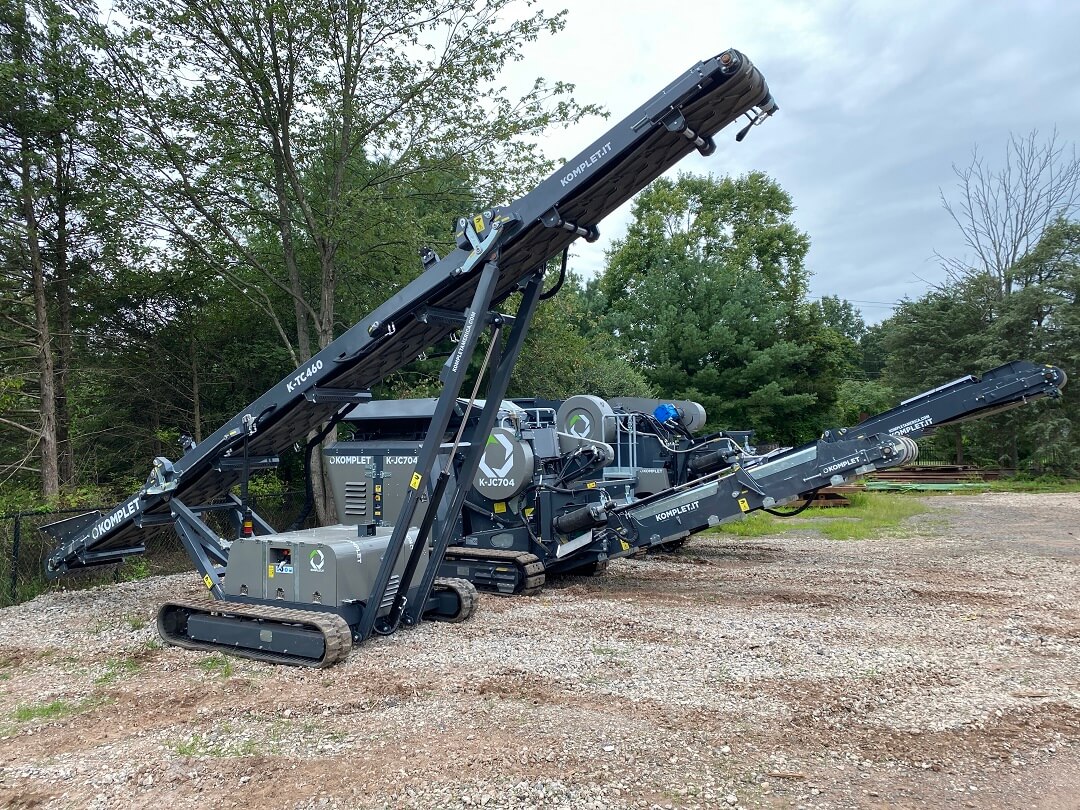

Tracked mobile conveyors are one of the most underappreciated pieces of equipment in compact mobile material processing. While crushers reduce material size and screeners separate it into spec-graded products, conveyors move material from where it’s processed to where it’s stockpiled, sold, or loaded. Without them, operations rely on wheel loaders shuttling material across the site — a workflow that consumes fuel, ties up labor, increases site traffic, and limits stockpile geometry. With them, material flows continuously from crusher to screener to stockpile in a single integrated process. The difference between operations that have invested in mobile conveying and operations that haven’t is rarely small — it shows up in fuel cost, labor utilization, stockpile capacity, and throughput.
This guide walks through the full role of tracked mobile conveyors in modern material processing — what they are and how they work, the environmental and operational benefits that justify their inclusion in processing lines, the specific applications across construction, demolition recycling, aggregate operations, mining, and quarry work, and where Komplet America’s K-TC 460 fits in the equipment lineup. The framing is practical and grounded in what produces good operational outcomes for compact mobile equipment owners.
What Is a Tracked Mobile Conveyor?
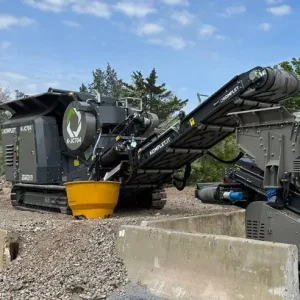
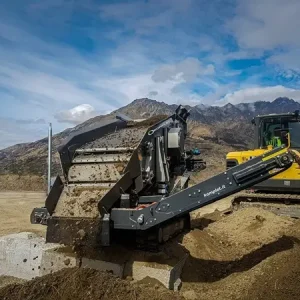
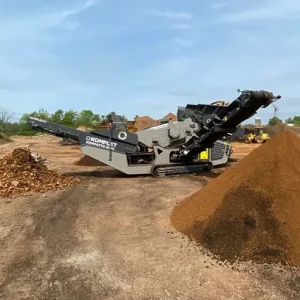
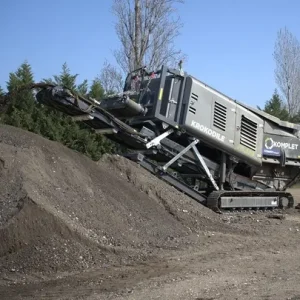
A tracked mobile conveyor is a self-propelled belt conveyor system mounted on a tracked chassis, designed to move material from a feed point to a discharge point on a job site. Material enters at the feed end (typically from a crusher discharge belt, screener output belt, or excavator dump), travels along an inclined belt, and discharges at the elevated end into a stockpile, truck, hopper, or downstream equipment.
The key operational characteristic is mobility. Unlike fixed conveyors that operate from a single location for the duration of a project, tracked mobile conveyors can be repositioned as needed — alongside a moving crusher face, between processing locations as the work progresses, or to optimize stockpile geometry as material accumulates. The tracked chassis allows the conveyor to traverse rough terrain without specialized transport, and the integrated power source (typically a small diesel engine) allows off-grid operation independent of site power infrastructure.
Tracked mobile conveyors handle the same material streams as the crushers and screeners they pair with — aggregates, sand, soil, demolition concrete, recycled asphalt, mineral ore, and similar bulk materials. The belt is typically a heavy-duty rubber compound (often three-ply Chevron pattern for grip on inclined sections), the conveyor frame is engineered for the dynamic loads of mobile operation, and the system is designed for single-operator setup and operation with remote-control capability.
How Tracked Mobile Conveyors Integrate with Crushers and Screeners
Tracked mobile conveyors rarely operate in isolation. The dominant use case is integration with a crusher and/or screener in a continuous processing line. The integration patterns:
Crusher Discharge Stacking
Crusher output discharges directly to a tracked mobile conveyor positioned at the crusher’s exit point. The conveyor moves the crushed material to a remote stockpile location, freeing the crusher’s discharge zone for continuous operation without manual material handling. This is the most common pairing — every Komplet jaw crusher (K-JC 503 through K-JC 805) and impact crusher (K-IC 70) integrates cleanly with the K-TC 460 in this configuration.
Screener Output Distribution
Screeners produce multiple output products simultaneously (typical 3-product split). Tracked mobile conveyors collect each output stream and move it to the appropriate stockpile, with conveyor positioning optimized for the geometry of each product pile. Operations producing multiple spec products often use multiple conveyors — one per output — to maintain stockpile separation without manual loader work.
Inter-Equipment Material Transfer
In multi-equipment processing lines, tracked mobile conveyors move material between processing stages — from primary crusher to screener, from screener oversize fraction back to crusher for further reduction, or from one equipment cluster to another for staged processing. The integration eliminates the wheel loader cycles that traditional setups require.
Stockpile Capacity Extension
Without conveyors, crusher discharge piles grow until they require manual relocation (loader work) before crushing can continue. With conveyors, piles can extend much further from the crusher discharge point — increasing stockpile capacity dramatically and reducing the frequency of stockpile-management interruptions to crushing operations.
Truck Loading and Off-Site Transfer
Conveyors can discharge directly into trucks for off-site transfer, eliminating the loader-bucket cycle for high-volume loading operations. This is particularly common at recycling yards and aggregate suppliers where trucks arrive on a regular schedule for material pickup.
Environmental Benefits of Tracked Mobile Conveyors
Tracked mobile conveyors are increasingly recognized as eco-friendly conveyor systems for modern material processing. Environmental regulations are getting stricter, industries face increasing pressure to reduce carbon footprints, and sustainability requirements are influencing equipment purchase decisions across the construction and mining sectors. The environmental benefits cluster around five primary categories:
Reduced Fuel Consumption and Emissions
Tracked mobile conveyors are engineered for efficient, low-emission material handling. When substituting for traditional wheel loaders or trucks shuttling material between processing stages, conveyors reduce fuel consumption substantially — energy-efficient electric motors moving belts use far less fuel per ton than diesel-powered loaders running constant cycles. Reduced fuel consumption directly translates to reduced greenhouse gas emissions and lower operating costs.
Reduced Dust Generation
Traditional material handling involves multiple transfer points — loader bucket dumps, truck loading, manual relocation — each generating dust as material falls and impacts. Tracked mobile conveyors provide direct, continuous transfer from one point to another, eliminating most of these transfer points and dramatically reducing dust generation. Lower dust supports operator safety, reduces respiratory exposure, and meets regulatory dust-control requirements at urban and environmentally sensitive sites.
Reduced Terrain Disruption
Tracked conveyor mobility is designed for minimal ground disturbance. Unlike loaders that compact and rut soft ground with each cycle, tracked conveyors move once into position and operate from a fixed location for extended periods. This reduces terrain disruption, ground damage, and the site restoration work required after operations conclude. Particularly valuable at sites with environmental sensitivity, soft ground conditions, or restoration requirements.
Reduced Labor and Manual Handling
Conveyor-equipped operations reduce manual material handling requirements compared to operations relying on loaders, wheelbarrows, or other manual systems. Workers focus on skilled tasks — operating crushers, managing stockpiles, coordinating logistics — rather than repetitive material movement. The reduced manual handling enhances worker safety, reduces musculoskeletal injury risk, and improves labor productivity per project.
Support for On-Site Recycling Operations
On-site recycling of demolition concrete, asphalt, and aggregate depends on efficient material handling at every stage. Tracked mobile conveyors support on-site recycling by enabling continuous material flow from feed to stockpile without intermediate handling. Operations with conveyors typically capture more recovery economics than operations relying on loaders for inter-equipment transfer — the throughput advantage compounds across project life.
Operational Benefits Beyond Environmental Impact
The environmental case for tracked mobile conveyors is well-documented, but the operational case is equally strong. Specific operational benefits:
Continuous Material Flow
Crushers work best when they receive a steady, uninterrupted flow of material. Conveyors eliminate the stop-start cycles caused by inconsistent feed or stockpile management interruptions. Material can be quickly stacked, moved, and transferred without operators stopping production to reposition stockpiles. The throughput improvement is structural — same equipment, same operator, more tons per day.
Stockpile Geometry Optimization
Conveyors stack material at heights and angles that loaders can’t easily achieve. Higher stockpiles per square foot of yard space mean more storage capacity in the same footprint — particularly valuable at urban or constrained sites where yard space is expensive. The K-TC 460 produces stockpiles up to approximately 15 feet high at the discharge point, providing substantially more capacity than direct crusher-discharge piles.
Reduced Equipment Cycle Time
Every minute counts in aggregate production. Conveyors eliminate the cycle time associated with loader-based material movement — the empty travel back to the pile, the bucket fill cycle, the loaded travel to the dump point, the bucket dump, and the empty return. For high-volume operations, eliminating loader cycles translates to substantial time savings and crew productivity improvement.
Site Safety Improvement
Loader cycling around a job site creates traffic patterns that introduce safety risk — pedestrian-vehicle interactions, sight-line obstructions, vehicle-on-vehicle collision potential. Conveyor-based material handling reduces site traffic substantially, improving overall site safety profile. Particularly valuable at sites with multiple crews, public proximity, or constrained working areas.
Reduced Loader Wear and Maintenance
Loaders used for stockpile management accumulate hours and wear that translate to maintenance cost and equipment depreciation. Operations that shift material handling from loaders to conveyors extend loader service life and reduce loader maintenance cost — a secondary economic benefit that often exceeds expectations.
The Komplet K-TC 460 Tracked Mobile Conveyor
Komplet’s tracked mobile conveyor offering is the K-TC 460 — a high-performance, compact tracked mobile conveyor designed to integrate with Komplet crushers and screeners while maintaining the compact footprint that defines the Komplet equipment philosophy. Verified specifications:
- Throughput: up to 132 US tph
- Belt width: approximately 25″ (3-ply Chevron rubber compound)
- Engine: approximately 25 hp Tier 4 Final compliant diesel
- Transport weight: approximately 7,000 lb
- Stockpile height (discharge): approximately 15 feet
- Operation: wireless remote control for setup, repositioning, and basic operation
The K-TC 460 is engineered specifically to integrate with Komplet crushers (K-JC series, K-IC 70) and screeners (Kompatto and K-TS series) — discharge belt height, belt width, and feed geometry match the Komplet equipment lineup. The compact design allows fast setup and easy repositioning, while increased stockpile capacity helps reduce loader dependency and improve workflow.
Full specifications and configuration options for the K-TC 460 conveyor are available on the product page. Typically the first or second piece of equipment owners add to expand a basic crusher into a full processing line.
Application-Specific Use Cases
Construction and Demolition Recycling
Demolition contractors processing concrete, asphalt, and mixed C&D material on-site benefit substantially from K-TC 460 integration. The conveyor moves crushed RCA from the crusher discharge to a stockpile location, freeing the crusher for continuous operation, increasing stockpile capacity, and supporting LEED-credit-friendly diversion documentation. Typical pairing: K-JC 704 PLUS jaw crusher with K-TC 460 conveyor.
Aggregate Yards and Sand & Gravel Operations
Aggregate operations producing multiple spec products typically run multiple conveyors — one per output product. The K-TC 460 handles individual product streams cleanly, and multiple K-TC 460 units allow product separation without manual loader intervention. Particularly common pairing: Kompatto 5030 screener with two or three K-TC 460 conveyors for 3-product split.
Quarry and Mining Operations
Compact-scale quarry operations benefit from conveyor mobility — the conveyor follows the working face as the quarry advances, minimizing material transfer distances and reducing loader dependence. Tracked conveyors help in the continuous movement of extracted materials, reducing the need for trucks, decreasing fuel consumption, and reducing emissions in mining operations.
Recycling Yards and Material Recovery Facilities
Recycling yards processing daily inbound material flows depend on continuous material handling. K-TC 460 conveyors enable inbound material transfer from receiving area to processing equipment, between equipment stages, and from processed product to truck loading. The continuous-flow architecture supports the throughput requirements of high-volume recycling operations.
Urban Construction Sites
Urban sites with constrained footprints particularly benefit from conveyor-based material handling. Where loader traffic is impractical due to site congestion, conveyors provide material movement capability without the traffic patterns or footprint requirements. The compact K-TC 460 footprint fits where larger conveyor systems can’t physically operate.
Disaster Recovery and Emergency Response
Tracked mobility makes the K-TC 460 valuable in disaster recovery operations where conventional infrastructure is unavailable. The integrated diesel power source operates off-grid, the tracked chassis traverses damaged terrain, and the single-operator design works in conditions where larger crews aren’t available.
Komplet Equipment Pairing Patterns
The K-TC 460 integrates with the full Komplet lineup. Common pairing configurations:
- K-JC 503 + K-TC 460: Compact processing line for limited-access sites and small-volume contractor operations. Combined transport weight remains well within standard trailer capacity.
- K-JC 704 PLUS + K-TC 460: Komplet’s most common processing line. Mid-volume crushing with continuous discharge to extended stockpile.
- K-JC 805 + K-TC 460 (multiple): Higher-volume operations sometimes run multiple conveyors with the K-JC 805 to handle the larger throughput.
- K-IC 70 + K-TC 460: Cubical aggregate or RAP processing with continuous discharge to product stockpile.
- Kompatto 5030 + multiple K-TC 460: Multi-product screening operation with separate conveyor per output product.
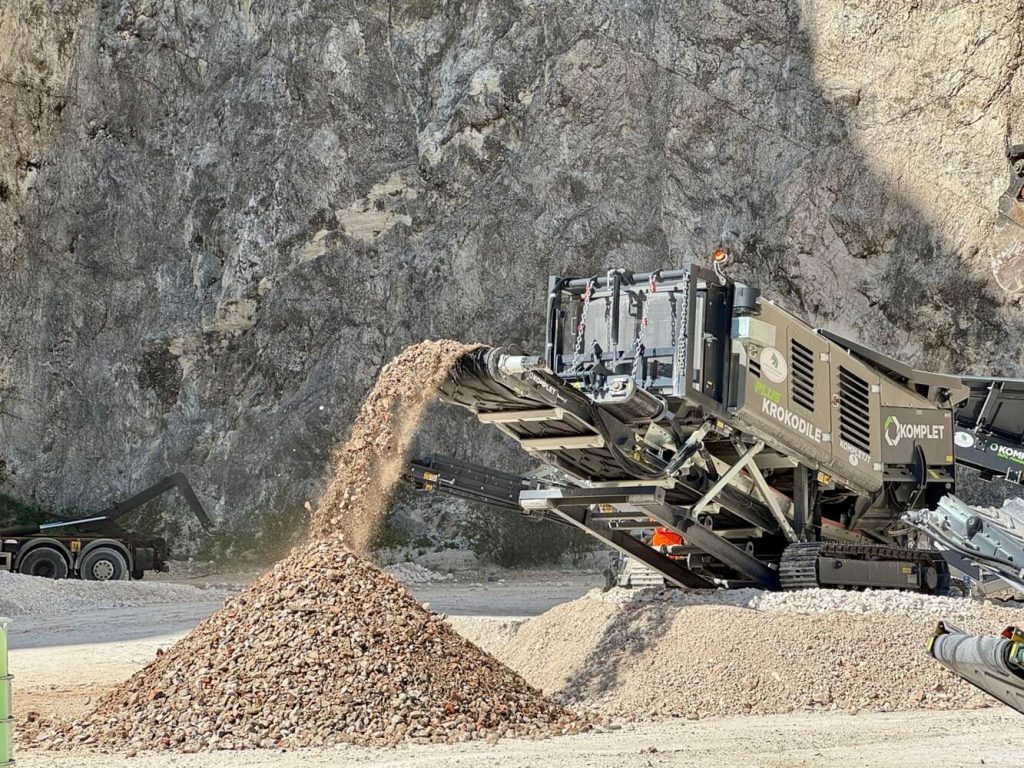
- Krokodile PLUS + K-TC 460: Slow-speed shredding operations with continuous shredded-material discharge to stockpile or further processing.
The pairing flexibility means that the K-TC 460 is rarely a stranded investment — once an operation owns one, the conveyor adapts to whatever crusher, screener, or shredder configuration the operation runs.
Frequently Asked Questions
How much does a tracked mobile conveyor cost?
The Komplet K-TC 460 price is found on the product page. Used certified pre-owned conveyors typically price 30-50 percent below new equivalents. Conveyors are typically the most accessible piece of capital equipment in a compact mobile processing lineup — often the first add-on to an existing crusher purchase.
Does Komplet sell the K-TC 460 separately or only with other equipment?
Both. The K-TC 460 is sold standalone for operations that already have a crusher and want to add conveying capability, and bundled with Komplet crushers and screeners for buyers building a complete processing line from scratch. Komplet authorized dealers can configure the appropriate package for the specific operation.
How long does it take to set up a K-TC 460 on site?
Setup is typically 15-30 minutes for a trained operator. The tracked chassis moves the conveyor to the operating position, the conveyor unfolds via wireless remote control, and feed/discharge geometry is adjusted to match the upstream and downstream equipment. Compared to fixed conveyor installations (hours to days), tracked mobile conveyors are dramatically faster to deploy.
Can the K-TC 460 operate independently or only with a crusher?
Either. The K-TC 460 has its own integrated diesel power source and operates independently of upstream equipment. Operations sometimes use the K-TC 460 for material relocation tasks unrelated to crushing — moving stockpiles, transferring material between yard locations, or loading trucks from existing stockpiles.
What about Section 179 tax treatment?
The K-TC 460 qualifies as eligible Section 179 property the same as crushers and screeners. For tax year 2026, the maximum Section 179 deduction is $2,560,000, with phase-out beginning at $4,090,000. The full purchase price of qualifying equipment can typically be deducted in the year placed in service, subject to all program requirements. Confirm specific eligibility with a qualified CPA.
Is the K-TC 460 Tier 4 Final compliant?
Yes. The K-TC 460 features a Tier 4 Final compliant diesel engine, meeting current EPA emissions standards for non-road diesel engines. Required for operation in regulated jurisdictions, government procurement, and urban project work.
How does conveyor financing work?
Komplet Capital offers financing on the K-TC 460 the same as other Komplet equipment — 100 percent financing for qualified buyers, 24-hour approvals, and standard term options. Details at Komplet Capital financing. The relatively low capital cost of the K-TC 460 produces correspondingly low monthly payments, often below the value of avoided loader operating cost.
How do I know if I need a conveyor in addition to my crusher?
If your operation runs the crusher more than approximately 4 hours per day on average, manages multiple product stockpiles, operates in constrained yard space, or experiences regular crusher-discharge stockpile-management interruptions, a conveyor is likely already paying for itself in opportunity cost. Operations producing 50+ tons per day on a recurring basis typically benefit from conveyor integration; operations producing less may be fine with loader-based material handling.
Final Thoughts
Tracked mobile conveyors are the connective tissue of modern compact mobile material processing. Crushers reduce material; screeners separate it; conveyors move it from where it’s processed to where it’s used or sold. Without conveyors, processing lines depend on loader cycles for inter-equipment material transfer — a workflow that consumes fuel, ties up labor, increases site traffic, and limits stockpile geometry. With conveyors, material flows continuously through the processing line, freeing crews and equipment for higher-value tasks. The structural advantage compounds across project life — operations equipped with conveyors typically capture more recovery economics, produce more material per operating day, and operate with smaller overall crew sizes than operations that don’t.
The Conti family construction legacy that informs Komplet America’s approach to equipment dates to 1906, and the equipment-integration lesson from that lineage is straightforward: don’t let inefficient material handling consume the value that good crushing and screening produces. The crusher and screener determine product quality; the conveyor determines how much of that quality production actually flows to revenue. Done well, the integrated processing line — crusher, screener, conveyor — produces operational economics substantially better than the sum of any individual piece. Done with gaps in the integration, the same equipment captures only a fraction of its potential. The K-TC 460 closes the integration gap at the lowest capital cost in the Komplet lineup, making it one of the highest-ROI additions an existing crusher owner can make.
To explore the K-TC 460 and full conveyor configuration options, see the K-TC 460 conveyor product page. The full Komplet equipment lineup includes the crushers, screeners, and shredders the conveyor integrates with. Komplet’s pre-owned inventory sometimes includes conveyors at lower capital deployment than new. For Komplet Capital financing options, including 100 percent financing for qualified buyers. Or call Komplet America directly at (908) 369-3340.
Ready to Add Continuous Material Flow to Your Processing Line?
- Map your current material handling workflow. The loader cycles between crusher discharge and stockpile typically consume more fuel and labor than operators expect.
- Call Komplet America at (908) 369-3340 to discuss conveyor integration with your existing equipment, or for full processing line configuration including the K-TC 460.
- Discuss financing through Komplet Capital financing — 100% financing, 24-hour approvals, no down payment options.
- Talk to your CPA about Section 179 — for tax year 2026, the maximum deduction is $2,560,000.
- Find your local Find Your Komplet Dealer for in-person K-TC 460 demonstration alongside crushers and screeners.
Never enough.
Disclaimer: ROI figures, payback timelines, project economics examples, and operational benefit illustrations shown above are illustrative only based on sample assumptions about volume, utilization, and operating conditions. Actual results vary by region, project, equipment configuration, and other factors. Komplet America makes no guarantee of specific financial returns.
Disclaimer: K-TC 460 specifications and pricing are 2026 figures and subject to change based on configuration, dealer location, and additional features. Prices do not include taxes, shipping, or installation. Contact Komplet America at (908) 369-3340 for current pricing and specifications.
Disclaimer: Section 179 limits are 2026 figures based on the One Big Beautiful Bill Act of 2025 and adjust annually. Komplet America is an equipment distributor, not a tax advisor. Consult a qualified CPA before making decisions based on tax treatment.
All operating, maintenance, and service guidance is general in nature. Always refer to the official Komplet operator’s manual for the specific machine model and serial number, and follow OEM intervals and procedures.