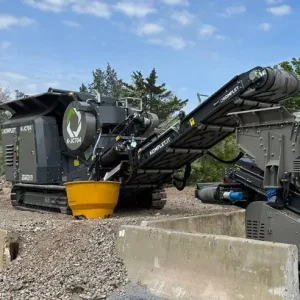
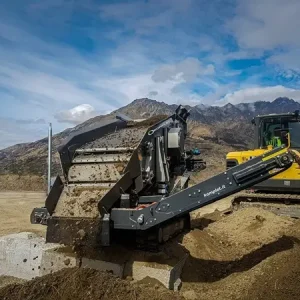
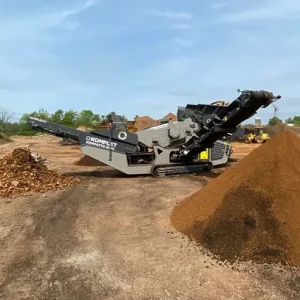
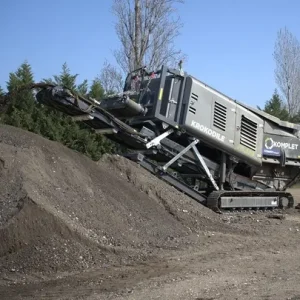
Most compact-crusher downtime traces back to a small set of preventable operator mistakes — feeding oversized material, skipping the pre-shift inspection, ignoring wear-pattern tracking, running the wrong machine for the volume, and a handful of others. The crushers themselves are well-engineered for contractor and recycling work; they reward correct operation and they get expensive fast when corners are cut. This guide walks through the most common operator mistakes across Komplet America’s compact mobile crusher lineup — the K-JC 503, K-JC 604, K-JC 704 PLUS, K-JC 805, and K-IC 70 — and explains how to avoid each one.
None of this is theoretical. The mistakes below are the ones that show up most often on operator-error service calls, the ones that turn a productive crushing day into an unplanned downtime day, and the ones that are easiest to prevent with disciplined operating practice.
Mistake 1: Feeding Oversized Material
The single most common operator mistake is feeding material too large for the crusher’s jaw opening. Oversized material bridges in the chamber, causes jams, breaks jaw plates, and creates the unplanned downtime the rest of the workflow has to wait through.
The 20 Percent Feed-Size Rule
As a practical operating rule, maximum feed size should run approximately 80% of the jaw gape opening. Material at or near the smallest jaw dimension causes bridging and premature wear; staying meaningfully under it keeps the crusher feeding cleanly. Applied to the Komplet jaw lineup, that produces these guideline maximum feed sizes:
- K-JC 503 — 19″ × 12″ jaw → guideline max feed ~9-1/2″
- K-JC 604 — 23″ × 16″ jaw → guideline max feed ~12-3/4″
- K-JC 704 PLUS — 27″ × 16″ jaw → guideline max feed ~12-3/4″
- K-JC 805 — 31″ × 21″ jaw → guideline max feed ~16-3/4″
These are general guidelines, not absolute limits. Actual feed tolerance depends on material shape, hardness, embedded reinforcement, and operator practice — always refer to the operator’s manual for the specific machine and follow OEM feed guidance.
Pre-Process the Oversize
Demolition concrete, blasted rock, and bulky structural pieces typically need pre-processing before they reach the crusher. Excavator-mounted hydraulic breakers and pulverizers are the right tools for breaking oversized material to a feed size the crusher can accept. Pre-processing is part of the workflow, not a workaround — operations that consistently feed within the recommended max feed size run faster, wear slower, and have fewer downtime hours than operations that try to force oversized material through.
Mistake 2: Running the Wrong-Sized Machine for the Volume
Buying too small forces the crusher to run flat-out and never catch up — overheating, frequent jams, accelerated wear, and a machine that fails at the worst possible time. Buying too big leaves financed capital sitting idle for portions of the year, paying monthly without producing matching tonnage. Both directions are expensive in different ways.
As a starting point for sizing the Komplet jaw lineup against typical contractor and recycling volume:
- Under 5,000 tons annually → K-JC 503 or K-JC 604
- 5,000 to 30,000 tons annually → K-JC 604 or K-JC 704 PLUS
- 30,000 to 80,000 tons annually → K-JC 704 PLUS
- 80,000+ tons annually → K-JC 805
Apply 30 to 50 percent headroom for peak demand and growth. Operations consistently above what the K-JC 805 can deliver typically belong on fixed-plant industrial equipment outside Komplet’s compact-mobile category — be honest about your scale before specifying equipment.
Mistake 3: Skipping the Pre-Shift Inspection
The pre-shift inspection is a 10-minute routine that prevents most of the big-ticket problems — hydraulic leaks discovered before fluid loss damages the system, loose fasteners caught before they cause secondary damage, jaw plate wear noticed before failure, magnetic separator condition verified before rebar contaminates the discharge stream. Operators who skip the inspection eventually pay for it in unplanned downtime.
Per OEM operator’s manual specifications, a pre-shift inspection typically covers:
- Hydraulic system — fluid levels, hose condition, no visible leaks
- Tracks and undercarriage — tension, wear, fasteners
- Jaw plates — wear pattern, fastener torque, no cracks
- Conveyor belts — alignment, tracking, no damage
- Magnetic separator — operational, conveyor functional
- Engine — fluid levels, air filter condition, exhaust system
- Safety guards and emergency-stop circuits — in place and functional
- Wireless remote — paired, charged, all functions responsive
Always refer to the operator’s manual for the specific machine and serial number — pre-shift inspection items vary across the lineup and update with model revisions.
Mistake 4: Ignoring the Magnetic Separator Workflow
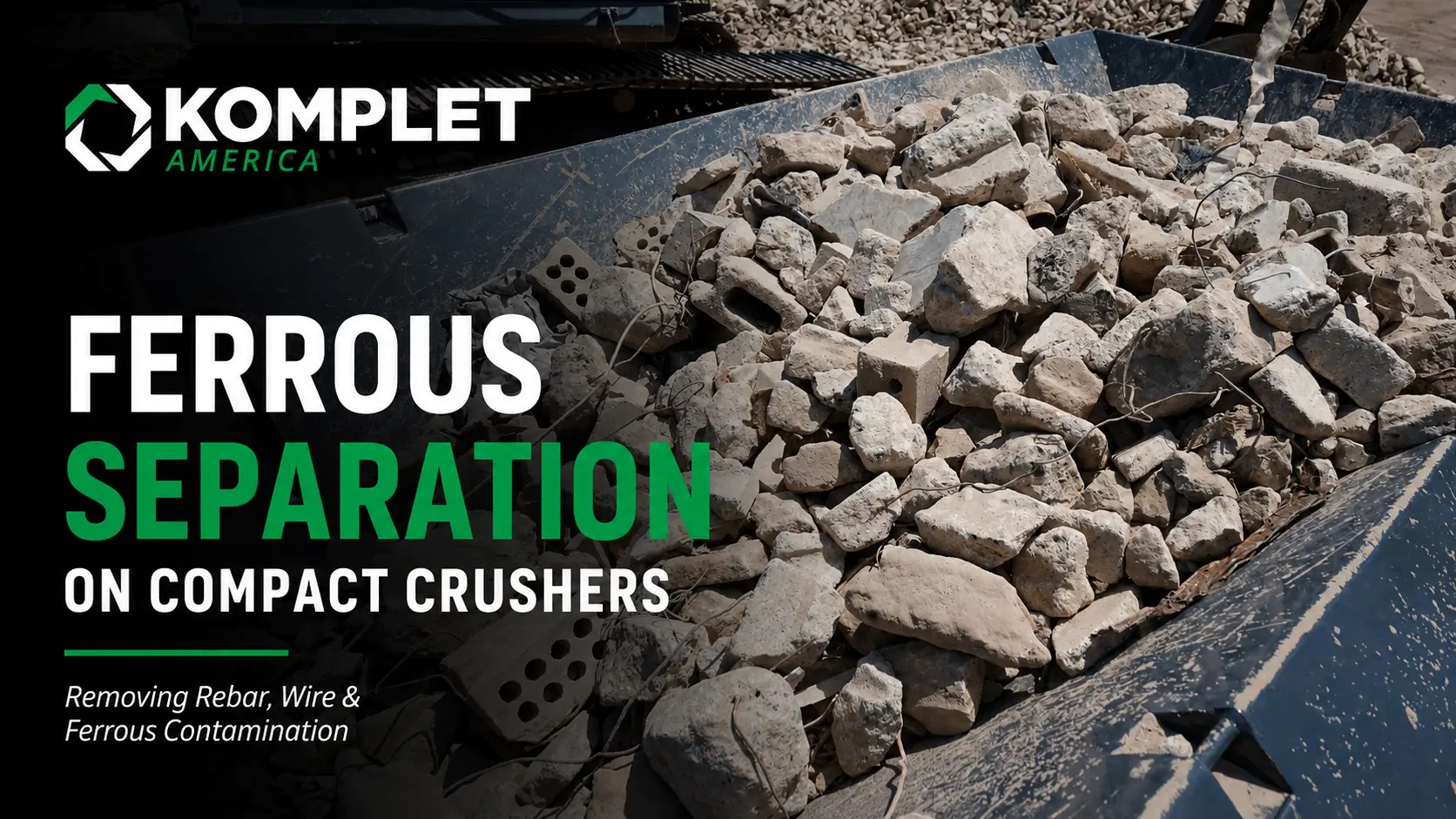
Magnetic separation is standard on every crusher in the Komplet lineup — the K-JC 503 (its base price displayed includes the magnetic attachment), K-JC 604, K-JC 704 PLUS, K-JC 805, and the K-IC 70 impact crusher. The integrated magnetic system lifts ferrous metal off the discharge stream during crushing, separating rebar, ties, fasteners, and embedded steel from the RCA output and routing it to a clean ferrous stockpile.
Operators who do not engage the magnetic separator workflow — or who route discharge around it because the magnet stockpile is in the wrong place, or who do not check the magnet during pre-shift inspection — end up with contaminated RCA that customers will not accept and lost ferrous-scrap revenue that should have offset operating cost. The magnet is part of the crusher; it should be part of every operating shift.
Mistake 5: Forcing Uncrushable Material Through the Chamber
Construction-side feed inevitably includes occasional uncrushable items — oversized rebar bundles, embedded structural steel, foreign metal objects, drilling debris with hardened tooling fragments. Operators who try to force these items through the chamber by repeatedly closing the jaws on them break jaw plates, twist the toggle, and damage the hydraulic system.
The right move is to use the reverse-jaw function. Komplet jaw crushers include a reverse-jaw function operated from the wireless remote that helps clear uncrushable obstructions without requiring chamber entry. Following the OEM procedure, the operator reverses the jaws to open the chamber and discharge the obstruction, removes it manually with the equipment in lockout/tagout per the operator’s manual, and resumes crushing. A 60-second reverse-and-clear is always cheaper than a broken jaw plate.
Mistake 6: Setting the Jaw Wrong for the Output Spec
Komplet jaw crushers feature hydraulically adjustable jaw setting (closed-side setting, or CSS) operated from the wireless remote — output size adjustment without manual tooling. The mistake operators make is leaving the jaw at one setting all day regardless of what the project actually needs, or producing one size and trying to sell what they have rather than what the customer specified.
Match the jaw setting to the target output spec for the end market:
- Crusher run / dense-graded base (0 to 1-1/2″ mix) — moderate jaw setting; the highest-volume RCA application
- 3/4″ minus base — tighter jaw setting; supports state DOT base material applications
- 1-1/2″ drainage — wider jaw setting; supports French drains and foundation drainage
- Riprap (oversize) — widest jaw setting or single-pass primary crushing
Across most of the Komplet jaw lineup, output size adjusts from 3/4″ to 3-1/4″ through hydraulic adjustment; the K-JC 805 covers approximately 1.2″ to 4.7″ output. Match the output to customer spec rather than producing what is convenient and trying to sell it.
Mistake 7: Not Tracking Jaw Plate Wear Patterns
Manganese steel jaw plates are designed to wear and be replaced — but tracked correctly, total plate life can be meaningfully extended through rotation. Most Komplet jaw crushers allow plate rotation (end-over-end) at the OEM-specified wear point, doubling the productive life of each plate set.
Operators who do not track wear patterns miss the rotation window, run plates through past the rotation point, and replace plates earlier than necessary. Pair the pre-shift inspection with periodic plate measurement; rotate at the OEM-specified wear point; and replace at end of life. The cost difference between disciplined plate management and ad-hoc replacement on a high-utilization crusher runs into real money over the equipment’s productive life.
Mistake 8: Running Without a Screener (Single-Pass-Only Workflow)
A jaw crusher running standalone produces a single output stream. Customers usually want multiple spec sizes — a 3/4″ base, a 1-1/2″ drainage, fines for one application, oversize for another. Operations that try to produce different specs by re-running the same material through the crusher multiple times burn fuel, waste hours, and accelerate wear without producing the spec quality customers expect.
The right workflow is integrated: the crusher feeds a vibrating scalping screener — the Kompatto 221 (Komplet’s smallest self-propelled scalper, up to 90 US tph), the Kompatto 5030 (Komplet’s best-selling screener, up to 280 US tph), or the Kompatto 124 (Komplet’s largest scalping screen, up to 350 tph) — which separates crusher output into multiple cuts in a single pass. Oversize returns to the crusher for additional reduction; spec sizes go to dedicated stockpiles. Add a K-TC 460 tracked mobile conveyor to extend reach and build clean stockpiles. The integrated workflow runs as a continuous production line rather than a batch operation.
Mistake 9: Treating Operator Training as Optional
All new Komplet equipment ships with comprehensive operator training as part of equipment delivery through authorized dealers. Training covers pre-shift inspection, safe operational practices (including wireless remote operation, lockout/tagout, and emergency procedures), hydraulic adjustment procedures, material feed best practices, routine maintenance per OEM specifications, wear-part replacement procedures, and troubleshooting common operational issues.
Operations that send untrained operators into the seat — typically because of staff turnover, a temporary fill-in, or an attempt to save training time — are the operations most likely to produce the mistakes covered above. Authorized dealers also provide refresher training, training for new operators joining established operations, and cross-training when fleets expand. Training is part of safe and productive crushing, not an extra step.
Mistake 10: Using Non-OEM Parts and Skipping OEM Service
Wear parts (jaw plates, blow bars on impact crushers, conveyor belts, hoses, filters) and service consumables are engineered to specific Komplet specifications. Aftermarket substitutes that look similar may not match the metallurgy, the geometry, or the fit tolerances the equipment was designed around. The result: faster wear, fit problems, downstream damage, and warranty exposure.
Komplet America’s parts inventory is forecasted approximately 12 months in advance, supporting fast wear-part availability when service items are needed. Genuine Komplet parts are available through Komplet America and the authorized dealer network. For crusher and screener parts and support questions, call Komplet America at 908-369-3340 — a single line covers both sales and service across the lineup. Improper service or non-OEM parts may void warranty coverage and create safety hazards; do not let cost-cutting shortcuts drive parts decisions on safety-critical equipment.
Frequently Asked Questions
What is the most common cause of crusher downtime?
In our experience supporting Komplet operators across North and Central America, the most common cause of unplanned downtime is feeding oversized material — material at or above the smallest jaw dimension that causes bridging, jams, and broken jaw plates. The 20 percent feed-size rule (max feed approximately 80 percent of jaw gape) prevents most of these incidents.
Do I need to remove rebar before feeding the crusher?
Generally no, for normal embedded rebar in demolition concrete. Magnetic separation is standard on every Komplet jaw crusher (K-JC 503, K-JC 604, K-JC 704 PLUS, K-JC 805) and the K-IC 70 impact crusher. The integrated magnetic system separates rebar from the crushed output during crushing, producing clean RCA and a separate ferrous-scrap stockpile. Oversized rebar bundles, intact structural steel, and other large ferrous items should still be removed manually before feeding — they are uncrushable feed, not normal contamination.
What do I do when the crusher hits an uncrushable object?
Use the reverse-jaw function. Komplet jaw crushers include a reverse-jaw function operated from the wireless remote that opens the chamber to discharge uncrushable obstructions without requiring chamber entry. Follow the OEM operator’s manual procedure for your specific machine. After the obstruction is clear, lock out and tag out the equipment per OEM procedure to remove the object manually if needed, then resume crushing. Do not repeatedly close the jaws on an uncrushable object — that is how jaw plates and toggles get broken.
How often should I rotate or replace jaw plates?
Per OEM specifications. Jaw plate service life depends on rock hardness, abrasivity, throughput, and operating practice — soft limestone deliver substantially more hours per plate set than hard granite or basalt. Most Komplet jaw crushers allow plate rotation (end-over-end) at the OEM-specified wear point. Track wear patterns during pre-shift inspection, rotate at the wear point, and replace at end of life. Refer to the operator’s manual for your specific machine.
Is operator training included with new equipment?
Yes. All new Komplet equipment ships with comprehensive operator training as part of equipment delivery through authorized dealers. Training covers pre-shift inspection, safe operational practices, hydraulic adjustment procedures, material feed best practices, routine maintenance per OEM specifications, and troubleshooting. Refresher training and training for new operators is available on request through your authorized Komplet dealer.
Can I operate a Komplet crusher without prior crusher experience?
With proper training and within the operator’s skill development curve, yes — Komplet crushers are designed for contractor-level operators rather than dedicated plant staff, and the wireless remote control simplifies operation meaningfully. New operators should complete the dealer-provided training, work alongside an experienced operator initially, and reference the operator’s manual for any procedure not yet familiar. Operations that put completely untrained operators in the seat — particularly on temporary fill-ins — are the operations most likely to produce expensive operator-error incidents.
What warranty applies to Komplet crushers?
All new Komplet equipment, including the full crusher lineup, comes with a 1-year / 1,000-hour warranty (whichever is earlier). Improper service, non-OEM parts, and operating practices outside OEM specifications may void warranty coverage. For warranty-protected work, contact Komplet America at 908-369-3340 or your authorized Komplet dealer.
Where do I get genuine Komplet parts?
Through Komplet America and the authorized dealer network. Komplet America’s parts inventory is forecasted approximately 12 months in advance, supporting fast wear-part availability when service items are needed. Call 908-369-3340 for parts orders, technical questions, or dealer connections — a single phone line handles both sales and service across the lineup.
Final Thoughts
Compact crushers reward disciplined operating practice. The mistakes above — oversized feed, wrong-size machine for the volume, skipped pre-shift inspections, ignored magnetic separator workflow, forced uncrushable material, careless jaw setting, untracked plate wear, single-pass-only workflow, untrained operators, and non-OEM shortcuts — are the mistakes that turn a productive operation into a downtime operation. None of them require special expertise to avoid; they require attention, training, and a workflow that respects the equipment.
Operators who run their machines per OEM specifications, follow the 20 percent feed-size rule, engage the magnetic separator on every shift, use the reverse-jaw function instead of forcing uncrushable material, match jaw setting to customer spec, track plate wear patterns, integrate a screener into the workflow, complete dealer-provided training, and use genuine Komplet parts get the productive service life the equipment is engineered to deliver. Operators who do not, do not.
Browse Komplet America’s compact mobile crusher lineup, screener pairings, and the K-TC 460 tracked mobile conveyor. Review Komplet Capital financing options, check certified pre-owned inventory, or contact Komplet America directly for operator training scheduling, parts, service, or application-specific guidance.
Ready to Run Your Crusher Right?
- Call Komplet America at 908-369-3340 — sales and service on a single line, with factory-trained dealer support across North and Central America
- Email [email protected] for operator training scheduling, parts orders, or technical questions
- Visit our crusher and screener parts and support page for genuine Komplet parts and authorized dealer service
- Explore Komplet Capital financing and our 1-year / 1,000-hour factory warranty
- Find your local Komplet dealer for rental availability
Never enough.
Disclaimer: All operating, maintenance, feed-size, jaw setting, pre-shift inspection, plate-wear, reverse-jaw, lockout/tagout, and service guidance in this article is general in nature. The 80 percent maximum feed rule (max feed about 80 percent of the jaw gape) and the per-model feed sizes shown are general operating guidelines, not absolute equipment limits — actual feed tolerance depends on material shape, hardness, embedded reinforcement, and operator practice. Always refer to the official Komplet operator’s manual for the specific machine model and serial number, and follow OEM intervals and procedures. For warranty-protected work, contact Komplet America at 908-369-3340 or your authorized Komplet dealer. Improper service or non-OEM parts may void warranty coverage and create safety hazards. Operator training, lockout/tagout procedures, PPE requirements, and emergency response practices vary by machine model and jurisdiction — confirm with your authorized Komplet dealer and applicable safety regulators before operation.