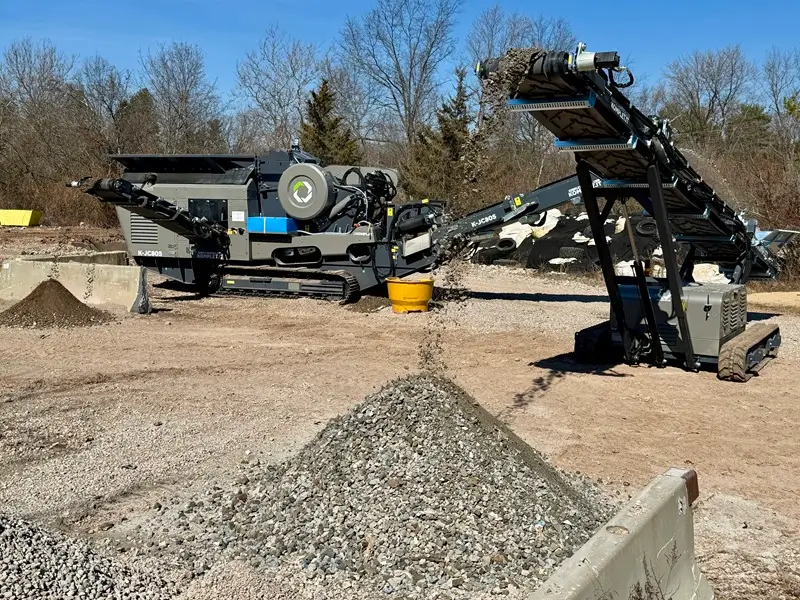

“Where can I buy crushed stone?” gets searched by two very different audiences. Small-volume buyers (homeowners, small landscape projects, single-job needs) are best served by local quarries and landscape supply yards delivering by the cubic yard. Commercial-volume buyers — contractors, aggregate producers, road builders, demolition firms, excavation contractors processing large amounts of project material — face a different question: at what point does it make economic sense to produce crushed stone instead of buying it?
This guide is written for the second audience. It walks through where to buy crushed stone for commercial volumes, typical pricing, the operational realities of buying vs. producing, the project volume thresholds where producing makes economic sense, and how Komplet America’s compact mobile crushing and screening lineup supports on-site crushed stone production for contractors and aggregate operations.
What Crushed Stone Is and What It’s Used For
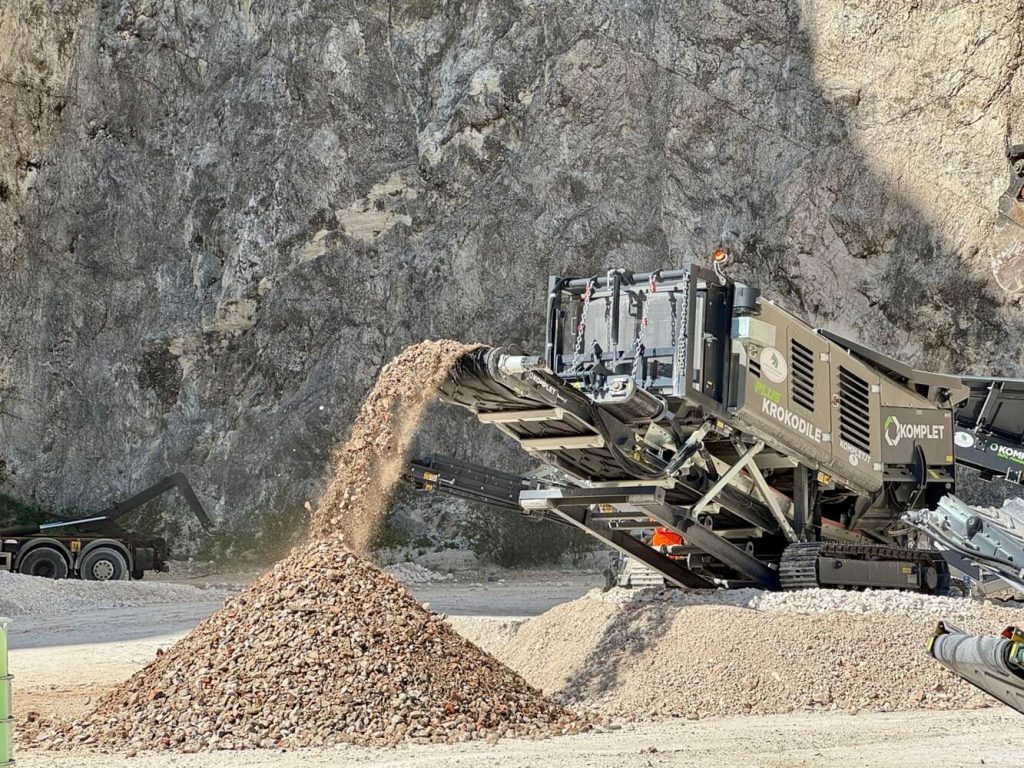
Crushed stone is a construction aggregate produced by mechanically reducing larger rocks (limestone, granite, basalt, sandstone, dolomite, traprock, and other suitable parent rocks) into spec-sized smaller pieces via jaw crushers, impact crushers, or cone crushers, then screening into multiple output sizes for different end uses.
Common Crushed Stone Spec Sizes and Applications
- Crusher run / dense-graded base (0 to 1-1/2″ mix) — road and parking lot base, the highest-volume application
- #57 stone (3/4″ to 1″) — drainage, decorative aggregate, septic systems, French drains
- #67 stone (3/4″ minus) — concrete mix aggregate, asphalt mix aggregate, base material
- 3/4″ minus — general base aggregate, driveway top dressing
- 1-1/2″ drainage — foundation drainage, French drains, large drainage applications
- Riprap (2″-12″ or larger) — erosion control, shoreline protection, large drainage
- Screenings / fines (under 1/4″) — paver bedding, low-cost fill, compacted base material
Crushed Stone Pricing: What to Expect in 2026
Crushed stone pricing varies dramatically by region, spec size, source rock type, and quantity. The numbers below are illustrative ranges based on typical 2025-2026 commercial markets — actual pricing in your specific region and timeframe may differ significantly.
Typical Per-Ton Pricing
- Crusher run / dense-graded base: $15-$30/ton FOB the quarry
- 3/4″ minus base: $15-$30/ton
- #57 stone: $20-$40/ton
- #67 stone (concrete-grade): $25-$45/ton
- 1-1/2″ drainage: $20-$40/ton
- Decorative or specialty stone: $30-$60+/ton
- Recycled concrete aggregate (RCA): $15-$30/ton — typically priced below virgin stone
Delivery and Hauling Costs
Crushed stone is heavy and bulky. Hauling costs commonly add $5-$15/ton for short hauls (under 25 miles) and $10-$30+/ton for longer hauls. For large project volumes, hauling costs can exceed the material cost itself — which is why crushed stone markets are highly localized and why on-site production becomes economic for projects above certain volumes.
Volume Discounts
Most quarries and aggregate suppliers offer volume discounts for commercial buyers. Single-cubic-yard retail prices may run $40-$75/yd; bulk per-ton commercial pricing is typically 30-50% lower. For large recurring contracts, additional negotiated pricing applies.
Where Commercial Buyers Source Crushed Stone
For commercial-volume buyers, the typical sourcing options are:
Local Quarries
Direct from the quarry pit is the lowest-cost source for commercial volumes. Quarries operate in every U.S. state — the largest crushed stone producing states include Pennsylvania, Texas, Florida, Missouri, Georgia, Ohio, Virginia, Illinois, North Carolina, and Kentucky. Search ‘crushed stone quarry near me’ or ‘aggregate suppliers’ to identify local sources. Quarries typically require minimum order volumes and may have specific delivery scheduling requirements.
Aggregate Suppliers and Material Yards
Aggregate suppliers and bulk material yards stock multiple stone types, multiple spec sizes, and typically offer delivery to job sites. Higher per-ton pricing than direct-from-quarry but more flexibility on order size and material type.
Concrete Recyclers (RCA)
Concrete recyclers produce recycled concrete aggregate (RCA) from demolished concrete. RCA serves many of the same applications as virgin crushed stone (base aggregate, drainage, fill) at typically lower prices and with environmental benefits (waste diversion, reduced quarry demand). For applications where RCA is acceptable, recyclers often offer the best value per ton.
Construction Material Brokers
Material brokers and aggregate brokers serve operations needing flexible sourcing across multiple suppliers — useful for large projects requiring more material than a single quarry can deliver. Higher pricing than direct sourcing but logistical convenience for complex projects.
Should You Buy or Produce Crushed Stone?
This is the question that often gets overlooked when commercial buyers default to purchasing. For many operations, on-site crushed stone production makes more economic sense than purchasing — particularly when source material is already on the project site as excavated rock, demolition concrete, or recycled aggregate from previous projects.
Buy When…
- Project volume is small (under approximately 200-500 tons total)
- Source material isn’t on-site (no excavated rock, no demolition concrete, no available feed stock)
- Specific stone type is required that you can’t produce locally (decorative aggregate, specialty colored stone)
- Premium spec consistency matters (some concrete and asphalt mix designs require specific source rock characteristics)
- One-off project with no recurring volume justification for equipment investment
Produce When…
- Project volume is large (typically 1,000+ tons across the project or regularly recurring projects)
- Source material is on-site (excavated rock, ledge rock from site preparation, demolition concrete)
- Demolition concrete is being processed (RCA production avoids tipping fees AND produces saleable aggregate simultaneously)
- Recurring aggregate demand across multiple projects (production equipment amortizes across many projects)
- Hauling distances to suppliers are long (remote sites where delivered stone costs $40+/ton including transport)
- Operating in high-tipping-fee markets (major US metros with $50-$100+/ton dump fees)
Combined Strategy: Buy + Produce
Many commercial operations use both strategies. They produce crushed stone from on-site sources when feasible (excavated rock, demolition concrete) and buy specialty material or fill volume gaps from local suppliers. The combined strategy captures the economics of on-site production where it works while maintaining sourcing flexibility for materials production can’t cover.
The Economics of On-Site Crushed Stone Production
Avoided Purchase Cost
For a contractor using 2,000 tons of base aggregate annually at $25/ton delivered, total annual purchase cost is $50,000. On-site production from project-generated source material eliminates most of this cost. For operations using 5,000-10,000+ tons annually, avoided purchase costs reach $125,000-$300,000+.
Avoided Tipping Fees (For Demolition Operations)
Demolition contractors processing concrete face $50-$100+/ton tipping fees in major metros. A 1,000-ton demolition project pays $50,000-$100,000+ in dump fees if hauled out. On-site crushing eliminates most of this cost while producing saleable RCA — turning the disposal cost into recovered revenue.
Production Revenue (For Aggregate Producers)
Operations producing crushed stone for sale generate $15-$30+/ton revenue. Aggregate producers running 10,000+ tons annually generate $150,000-$300,000+ in revenue from on-site crushing operations.
Equipment Investment
Komplet Capital offers 24-hour approval, 100% financing, 3-6 year terms. Section 179 tax deduction up to $1.22M (2024 limit) on new equipment. Many operations structure equipment financing so monthly payments are fully covered by avoided purchase costs and recovered material revenue.
Komplet America’s Crushed Stone Production Lineup
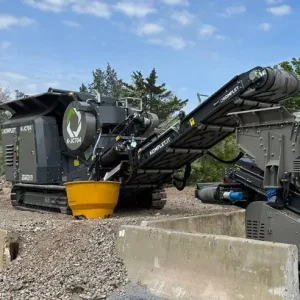
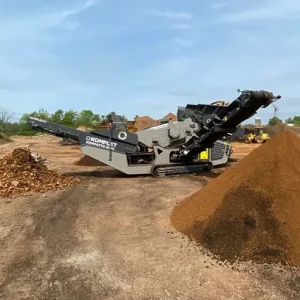
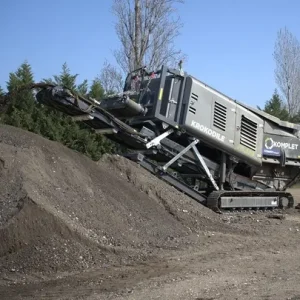
Compact Mobile Jaw Crushers
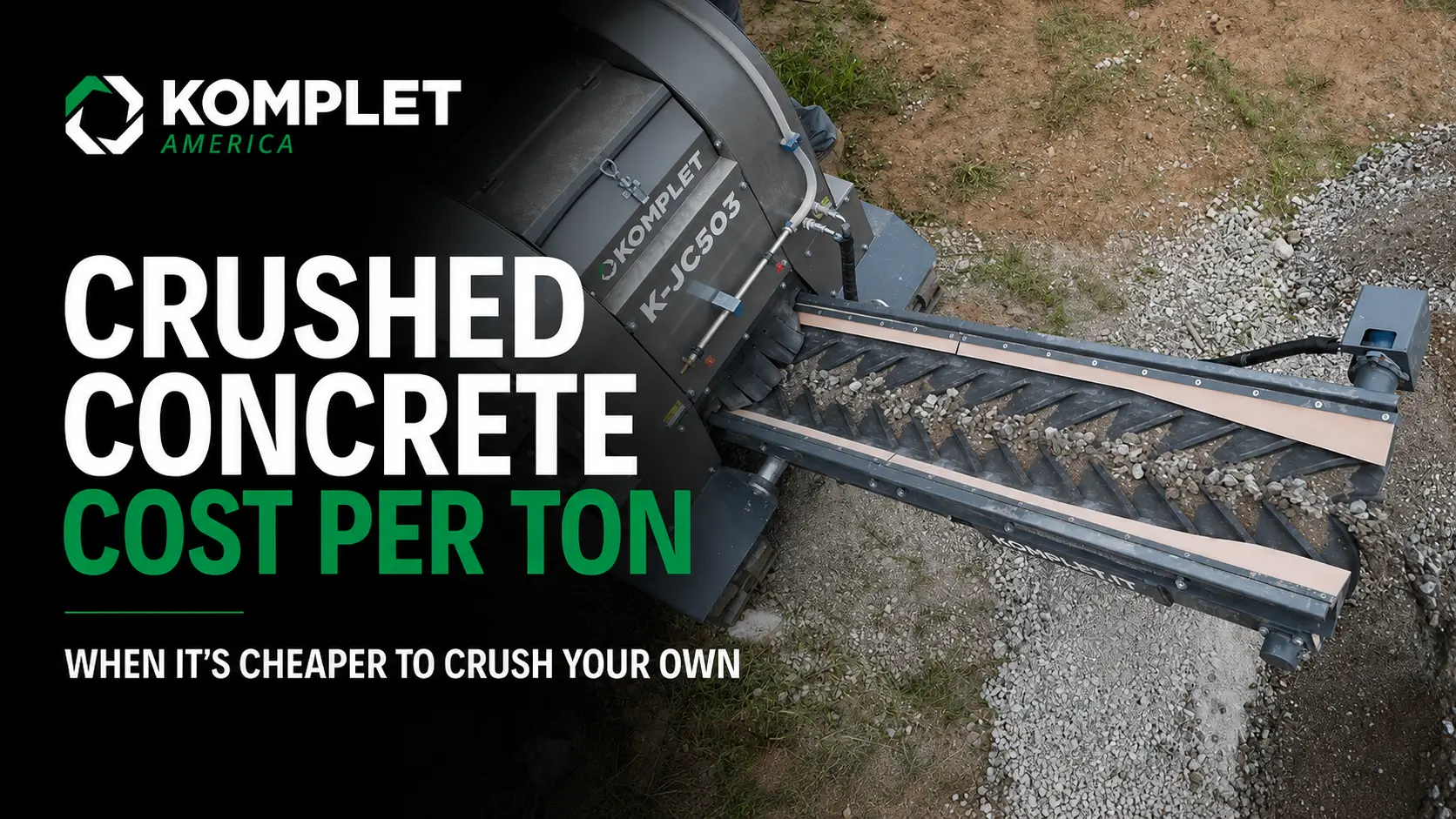
- K-JC 503 — up to 34 US tph, 19″ x 12″ jaw, ~7,496 lb. Tight-access urban demolition and small-project crushed stone production.
- K-JC 604 — up to 55 US tph, 23″ x 16″ jaw, ~19,400 lb. Mid-range mobile crusher.
- K-JC 704 PLUS — up to 90 US tph, 27″ x 16″ jaw, ~26,455 lb. Komplet’s best-selling crusher — the workhorse for typical contractor and aggregate operations.
- K-JC 805 — up to 160 US tph, 31″ x 21″ jaw, ~49,600 lb. Largest jaw crusher in the lineup, for high-volume aggregate production.
Compact Mobile Impact Crusher (Premium Cubical Output)
- K-IC 70 — up to 90 US tph, 25″ x 20″ inlet, 100 HP. For premium cubical aggregate (concrete and asphalt mix designs).
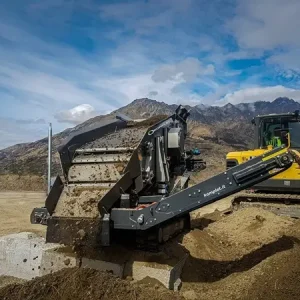
Vibrating Scalping Screeners (Spec Size Production)
- Kompatto 221 — up to 90 US tph, two-deck.
- Kompatto 5030 — up to 280 US tph, hydraulic 2-way / 3-way conversion. Komplet’s best-selling screener.
- Kompatto 124 — up to 350 tph. Largest mobile scalping screen.
Frequently Asked Questions
How much does crushed stone cost in 2026?
Pricing varies dramatically by region and spec size. Typical commercial bulk pricing FOB the quarry: crusher run / base $15-$30/ton; #57 stone $20-$40/ton; concrete-grade #67 stone $25-$45/ton; specialty/decorative $30-$60+/ton; RCA (recycled concrete aggregate) $15-$30/ton. Hauling commonly adds $5-$30/ton depending on distance. Single-cubic-yard retail pricing runs significantly higher than bulk commercial. For current pricing in your specific region, contact local quarries and aggregate suppliers directly.
Where do I find local crushed stone suppliers?
Search ‘crushed stone quarry near me,’ ‘aggregate suppliers [your city],’ or ‘crushed stone for sale [your state].’ Most state DOT websites list certified aggregate suppliers serving public construction projects. Local construction supply yards and concrete recyclers also stock crushed stone. The largest crushed-stone-producing states (Pennsylvania, Texas, Florida, Missouri, Georgia, Ohio, Virginia, Illinois, North Carolina, Kentucky) typically have the most options.
At what project volume does on-site production make sense?
Highly variable based on regional pricing, source material availability, and project specifics. As a rough guideline: projects above 1,000 tons of single-project material, or operations using 5,000+ tons annually across multiple projects, typically reach the threshold where on-site production economics outperform purchasing — particularly when source material is already on-site as excavated rock or demolition concrete. Operations in high-tipping-fee markets (major US metros) often reach the threshold at much lower volumes due to dump-fee avoidance.
Can I produce my own crushed stone from on-site rock or demolition concrete?
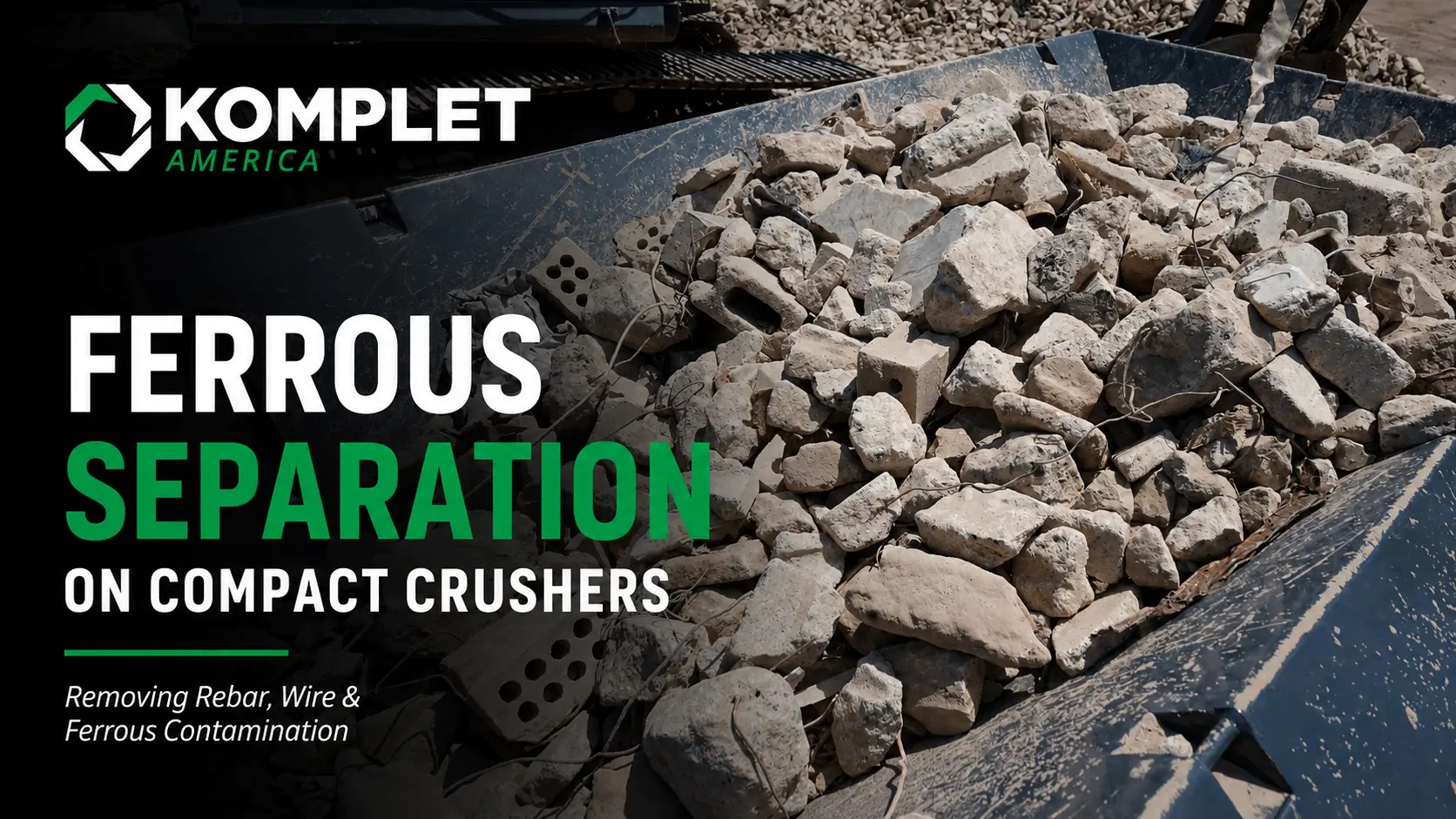
Yes — this is exactly what compact mobile crushing equipment is designed for. Komplet’s compact mobile jaw crushers handle excavated rock, demolition concrete (with rebar), brick and masonry, asphalt, and natural stone. Paired with Kompatto vibrating scalping screens for spec-size separation, the combination produces multiple grades of crushed stone from a single integrated workflow.
Is recycled concrete aggregate (RCA) as good as virgin crushed stone?
For most aggregate applications — base material, drainage, fill, riprap — RCA performs comparably to virgin crushed stone at typically lower prices. Many state DOT specifications now allow RCA for non-structural applications. For premium concrete or asphalt mix-design aggregate, virgin spec-controlled stone may still be preferred. For most commercial-volume base and drainage applications, RCA is a fully acceptable substitute that typically costs less.
How long does on-site crushed stone production take to set up?
Under 30 minutes for a typical Komplet jaw crusher + Kompatto screener combination. Both machines are self-propelled tracked, hydraulically folding, and operated by wireless remote control. One operator drives each machine into position, deploys conveyors, runs brief warm-ups, and connects the integrated workflow.
Can I rent the equipment for a single project before committing to purchase?
Yes. Komplet works through a dealer and rental network across North and Central America. Find your local Komplet dealer or call (908) 369-3340. Many partners offer rent-to-own arrangements where rental payments credit toward eventual purchase. Rental is typically the right starting point for contractors testing the on-site production economics on real projects before committing to ownership.
What’s the difference between crushed stone and gravel?
Crushed stone is mechanically reduced from larger source rocks — angular shapes, controlled spec sizes, produced at quarries or by mobile crushers. Gravel is naturally rounded stone from glacial, alluvial, or other geological deposits — rounded shapes, variable spec, mined from gravel pits. For most aggregate applications, the spec size matters more than the crushed-vs-gravel distinction. Crushed stone interlocks better for compacted base; rounded gravel drains better.
Final Thoughts
Where to buy crushed stone depends fundamentally on whether buying is the right answer. For small-volume buyers with no on-site source material, purchasing from local quarries, aggregate suppliers, or concrete recyclers is the right approach — using the regional pricing and supplier landscape to find the best combination of cost, spec, and delivery convenience. For commercial-volume buyers with project-generated source material (excavated rock, demolition concrete, recurring aggregate demand), on-site production with compact mobile equipment often delivers significantly better economics — turning purchase costs and dump fees into recovered revenue. The question for most commercial operations isn’t where to buy crushed stone, but whether to buy it at all.
Komplet America’s compact mobile crushing and screening lineup — jaw crushers from K-JC 503 through K-JC 805, the K-IC 70 impact crusher, and the Kompatto 221, 5030, and 124 vibrating scalping screens — covers the full spectrum of contractor and aggregate-producer scale crushed stone production. Browse the complete equipment lineup or call us to discuss whether on-site production makes economic sense for your specific operation.
Ready to Talk Crushed Stone Production?
- Call (908) 369-3340
- Email [email protected]
- Schedule a demo or request a quote
- Find your local Komplet dealer for rental availability
- Ask about our 1-year / 1,000-hour warranty and equipment financing options
Never enough — that’s how we approach service, support, and helping operations evaluate whether buying or producing crushed stone is the right answer for their business.
Disclaimer: All cost, ROI, payback, pricing, dump fee, and revenue figures in this article are illustrative examples based on sample assumptions about volume, regional pricing, material specifications, and market conditions. Actual results vary significantly by region, market, material type, equipment utilization, operator skill, financing terms, regulatory environment, and many other factors. Crushed stone pricing, hauling rates, tipping fees, RCA pricing, fuel costs, and interest rates all change over time and by location. Komplet America makes no guarantee, warranty, or representation of specific financial performance, payback timelines, or business outcomes for any particular operation. For current pricing and a payback estimate based on your specific volume, material, and local market, contact us at (908) 369-3340 to speak with our team.