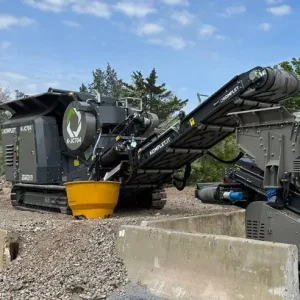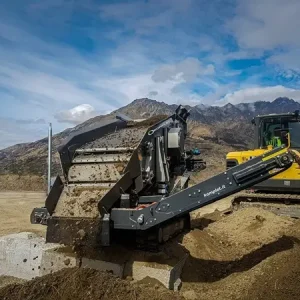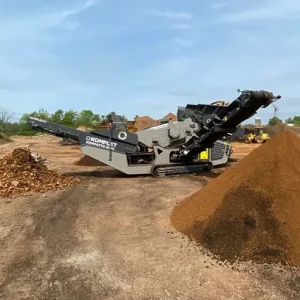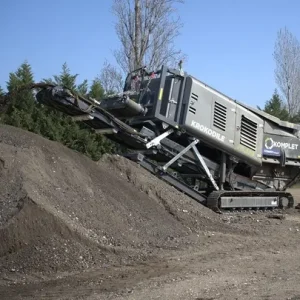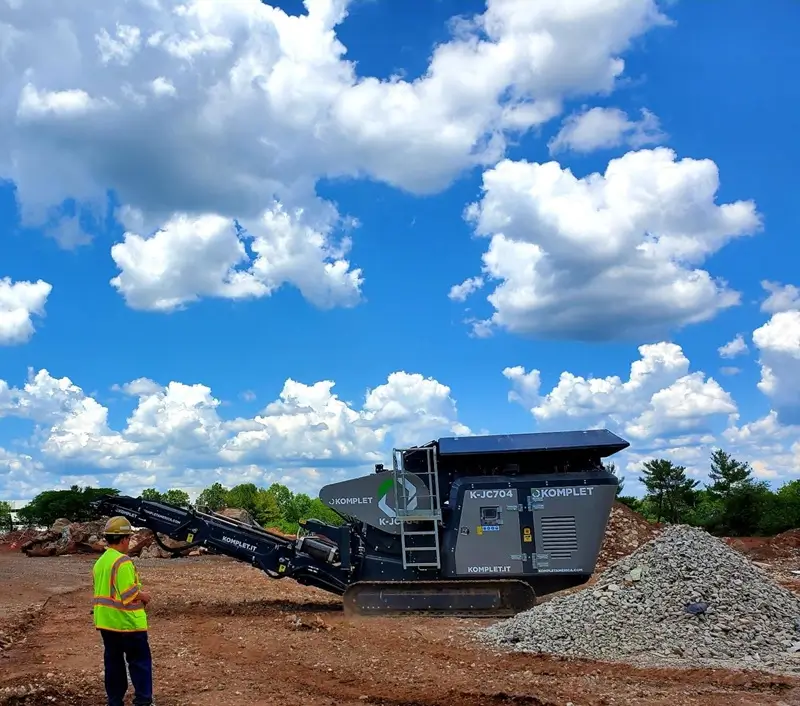

Understanding how crushers work isn’t just technical curiosity. For operators, it’s the difference between steady production and constant jams. For buyers, it’s the difference between a machine that fits the material and one that chews through wear parts too fast. Whether you’re crushing concrete, asphalt, or natural stone, knowing what happens inside the crushing chamber helps you get more tons per hour out of the machine you already have — or pick the right one for your next purchase.
This guide breaks down the crushing process in plain language: the forces at work, what happens step-by-step inside jaw and impact crushers, how concrete crushing differs from virgin rock crushing, what operator decisions move the needle on production, and what buyers should look at when matching a crusher to specific material. The framing throughout is practical and operator-focused, with specific reference to Komplet America’s compact mobile crusher lineup.
The Two Forces That Break Rock
Every crusher reduces material size using one of two primary forces — or a combination of both:
Compression Crushing
Compression crushing squeezes material between two surfaces until it fractures. The action is slow, mechanical, and high-force. Compression handles hard, abrasive material — granite, basalt, quartzite, reinforced concrete — better than impact crushing because the force concentrates on the material’s structural weak points without depending on the material’s brittleness. Compression crushers include jaw crushers, cone crushers, and gyratory crushers.
Impact Crushing
Impact crushing uses high-velocity collision to shatter material. Rotating blow bars strike the material at high speed, causing it to fracture against fixed aprons inside the crushing chamber. Impact crushing produces cubical, well-shaped aggregate — the shape preferred for asphalt mix and concrete mix — but it doesn’t handle hard abrasive material well. The high-speed action that produces good shape also produces high wear when the material is harder or more abrasive than the impact crusher was designed for. Impact crushers include horizontal-shaft impactors and vertical-shaft impactors.
Matching the crushing force to the material is the single most important decision when picking a crusher. The wrong pairing — like feeding hard granite to an impact crusher — creates rapid wear, high operating cost, and frequent downtime. The right pairing produces predictable production at reasonable wear cost.
How a Jaw Crusher Works (Step-by-Step)
Jaw crusher mechanics are straightforward, which is exactly why they’re the most popular choice for contractors, demolition crews, and recyclers. The crushing chamber consists of two jaw plates forming a V shape — one fixed (the stationary jaw plate), one movable (the swing jaw plate). Here’s what happens step-by-step as material moves through the machine:
Step 1: Material Entry
Rock, concrete, or demolition debris feeds into the top of the V-shaped crushing chamber through the hopper. Gravity pulls material downward between the two jaw plates. On most Komplet jaw crushers (K-JC 503, K-JC 604, K-JC 704 PLUS, K-JC 805), an integrated vibrating feeder regulates feed flow, smooths out variations in feed rate, and helps prevent overfeeding the crushing chamber.
Step 2: Compression Cycle
The movable jaw swings toward the fixed jaw on each stroke, compressing material caught between them. The compressive force is concentrated on whatever portion of the material is wedged between the plates at that instant. As the material’s compressive strength is exceeded, it fractures. The cycle repeats — typically several hundred times per minute on compact mobile jaw crushers — and material progressively fractures into smaller pieces.
Step 3: Material Migration Down the Chamber
As material fractures, smaller pieces fall further into the V-shaped chamber, where the gap between the jaw plates is narrower. Each fracture cycle reduces the material to a smaller size; each migration step moves the material into a tighter compression zone. The material progressively gets smaller as it works its way down the chamber.
Step 4: Output Discharge
At the bottom of the chamber, the gap between the jaw plates determines the maximum output size — the closed-side setting (CSS). Material smaller than the CSS falls through and onto the discharge conveyor; material larger than the CSS continues to be compressed until it fractures small enough to pass. Most Komplet jaw crushers feature hydraulically adjustable CSS, allowing operators to fine-tune output size without stopping production. The K-JC 704 PLUS, for example, produces output ranging from 3/4″ to 3-1/4″, hydraulically adjustable using the remote controller.
Step 5: Magnetic Separation (Optional but Standard on Most Komplet Units)
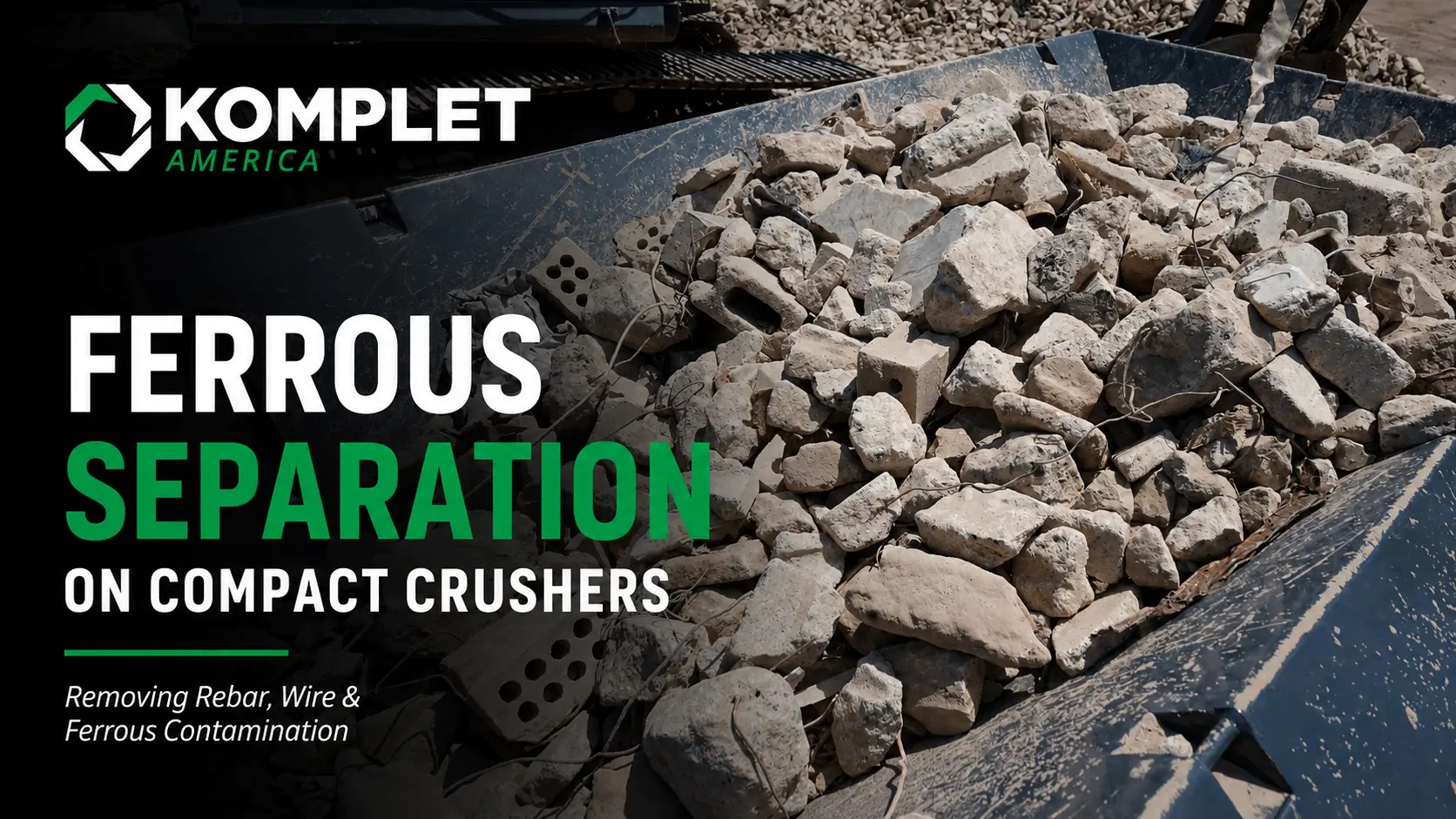
On most Komplet jaw crushers, a magnetic separator above the discharge conveyor automatically captures rebar and other ferrous content from the crushed output. The captured metal is diverted to a side stockpile or container, and the cleaned aggregate continues to the main output stockpile. This is critical for demolition concrete recycling — the rebar and ferrous content has scrap-metal value, and removing it improves the quality of the recovered aggregate.
Step 6: Discharge to Stockpile or Screener
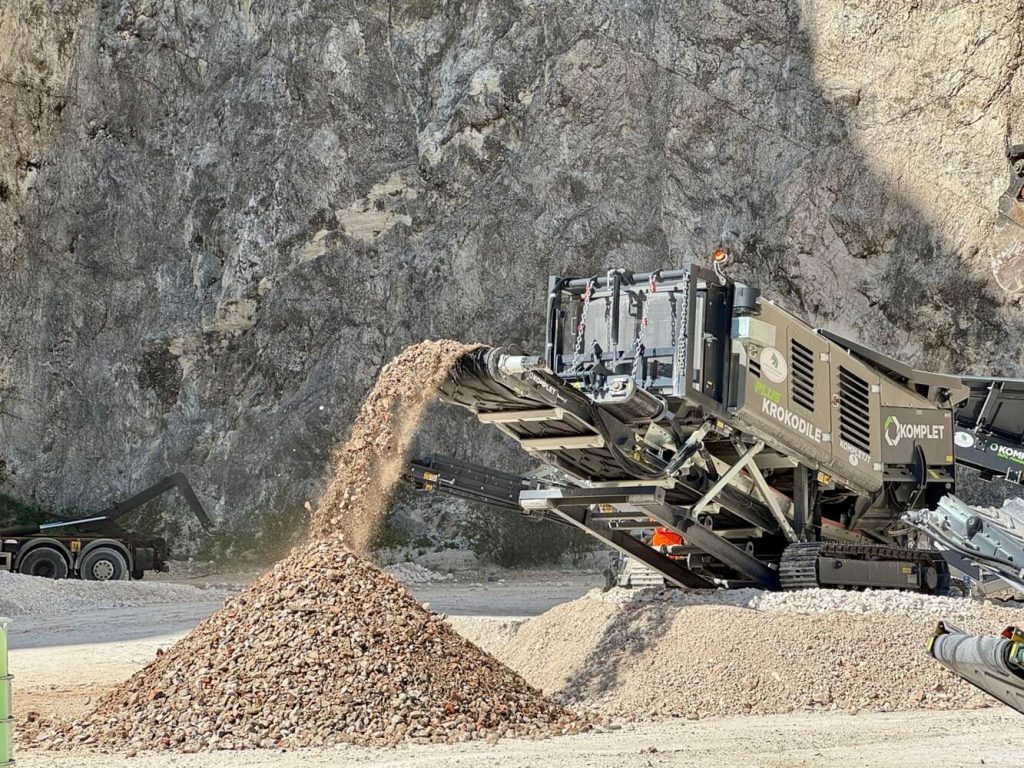
Crushed output discharges from the side or rear conveyor onto a stockpile, into a truck, or onto a feeder belt headed to a vibrating screener for sizing into multiple spec products. For operations producing multiple grades (fines, ¾” minus, 1½” minus, riprap), a Kompatto vibrating screener pairs naturally with the jaw crusher to produce sized output piles in a single processing run.
How an Impact Crusher Works
Impact crushers use a different mechanical principle than jaw crushers. The crushing chamber contains a high-speed rotor with attached blow bars (large, replaceable wear parts) that strike incoming material at high velocity. The struck material is propelled against fixed impact aprons inside the chamber, where it shatters on impact. Multiple aprons, often hydraulically adjustable, allow the operator to fine-tune output size and crushing intensity.
Material flow through an impact crusher:
- Feed entry: Material enters through the top of the crushing chamber via a feed conveyor or hopper.
- Initial impact: Rotating blow bars at high speed strike the material as it falls into the chamber, propelling it toward the first apron.
- Apron impact: Material strikes the first apron at high velocity, fracturing along its weakest planes.
- Re-strike: Fractured material falls back into the rotor zone for additional impacts and further size reduction.
- Output discharge: Material reduced below the apron-set output size falls out of the chamber onto the discharge conveyor.
The Komplet K-IC 70 — Komplet’s compact tracked impact crusher — delivers this technology in a mobile package purpose-built for asphalt recycling, concrete recycling, and softer-rock applications on tight job sites. Unlike most impact crushers in the U.S. market that are sized for stationary plant operation, the K-IC 70 is engineered for compact contractor-scale work.
How Concrete Crushing Differs from Virgin Rock Crushing
Concrete and demolition debris present specific challenges that virgin rock doesn’t. Understanding these differences is essential for operators and buyers choosing equipment for concrete-focused work:
Embedded Rebar and Wire Mesh
Reinforced concrete contains steel rebar and often wire mesh that must pass through the crushing chamber. Jaw crushers handle this naturally — the compression action breaks the concrete away from the metal reinforcement rather than wrapping or jamming around it. The metal exits the chamber along with the crushed aggregate and is captured by the magnetic separator. Impact crushers, by contrast, can have problems with rebar — the high-speed rotor can wrap or bind on long rebar pieces. For demolition concrete with substantial rebar content, a jaw crusher is generally the better primary reduction choice.
Variable Density and Composition
Demolition concrete varies in age, composition, mix design, and condition. Some pieces are old hand-mixed concrete that fractures easily; others are modern high-strength concrete that resists crushing. The crusher operator can’t control feed composition the way a quarry operator can — the material is whatever the demolition produces. Equipment with adjustable settings (hydraulic CSS, adjustable apron position) handles this variability better than fixed-setting equipment.
Contamination from Demolition
Demolition concrete arrives with contamination — wood scraps, drywall fragments, dirt, plastic, miscellaneous building debris. Source-separated demolition produces cleaner feed material; mixed-stream demolition produces dirtier feed. Crusher equipment with magnetic separation handles ferrous contamination automatically; non-ferrous contamination (wood, plastic, drywall) typically requires upstream sorting or downstream visual quality control to remove.
Wet, Sticky Material
Demolition concrete on the job site is often wet — rain exposure, groundwater, weather. Wet sticky material can bind up a jaw crusher chamber, slowing throughput and increasing wear. Strategies to handle wet feed: run with drier material when possible, add a scalper or vibrating feeder to remove fines (which carry the most moisture), and adjust feed rate downward when material is unusually wet. Tracked mobile crushers can also be repositioned to allow material to dry partially before crushing.
Operator Best Practices: Getting More Tons Per Hour
Understanding the mechanics is step one. Operating the machine well is where the tons per hour actually come from. The variables that move the needle most:
Feed Rate Control: Choke-Feed the Chamber
Consistent, controlled feed keeps the crushing chamber working at optimal capacity. Overfeeding causes jams, excessive wear, and lost time. Underfeeding wastes capacity and drives up per-ton operating cost. Most experienced operators aim for a 70-85% choke-fed chamber for compression crushers — full enough to use the machine, not so full that it jams.
Material Conditioning
Moisture content, hardness, and abrasiveness all affect performance. Wet sticky material can bind up a jaw crusher — running with dryer material or adding a scalper to remove fines helps. Excessively hard material increases wear; excessively soft material may not benefit from a jaw crusher’s compression action and may run better through an impact crusher. Match the material to the equipment, not the other way around.
CSS (Closed-Side Setting) Tuning
The closed-side setting determines maximum output size. Tighter CSS produces smaller output but reduces throughput and increases wear; looser CSS increases throughput but produces larger output. Find the CSS that matches the actual project specification — don’t crush smaller than the project needs (wastes capacity) and don’t crush larger than the project accepts (rework).
Pre-Screening Off Fines
Material that’s already at or below the target output size doesn’t need to enter the crusher — running it through wastes capacity that could be used for material that actually needs reduction. A vibrating scalper or screener upstream of the crusher removes fines, allowing the crusher’s full capacity to focus on oversized material.
Reverse Jaw Operation for Blockage Clearing
When a jaw crusher chamber blockage occurs (typically from oversized feed or sticky material), Komplet jaw crushers feature reverse jaw operation — running the swing jaw in reverse to break up the blockage and allow normal forward operation to resume. Used appropriately, this clears most blockages in seconds and avoids manual chamber clearing.
Wear Part Monitoring
Jaw plates, blow bars, and other wear parts have predictable wear lives. Monitor wear during operation (visible wear indicators, output size drift, throughput decline) and replace wear parts proactively rather than reactively. A worn jaw plate produces inconsistent output, increased fines generation, and elevated operating cost per ton — the savings from running worn parts to failure are typically less than the cost of the resulting downtime and rework.
What Buyers Should Look at in the Crushing Chamber
For prospective buyers evaluating crusher options, the crushing chamber design tells you most of what you need to know about operational economics. Specific design elements to evaluate:
Jaw Plate Design and Replacement Access
Jaw plates are the highest-wear, most-frequently-replaced parts. Easy access for replacement (front-mounted bolts, hydraulic lift assist, single-operator replacement capability) dramatically reduces maintenance time over the life of the equipment. Difficult access translates to longer downtime per replacement and higher labor cost.
Hydraulic CSS Adjustment
Hydraulically adjustable closed-side setting allows the operator to dial in output size from the remote controller without stopping production. This is significantly more efficient than mechanically adjustable CSS systems that require chamber access. All current Komplet jaw crushers feature hydraulic CSS adjustment.
Feed Hopper Design and Capacity
A larger feed hopper with steeper-sided design feeds the chamber more consistently and accommodates larger feed material. Look at the maximum feed size specifications and confirm they match the material the operation actually handles.
Magnetic Separator Standard or Optional
For concrete recycling work, a magnetic separator is essential. Confirm whether the unit comes with magnetic separation standard, optional, or aftermarket. Most Komplet jaw crushers include magnetic separators standard or as a near-universal option.
Discharge Conveyor Length and Height
Output discharge conveyor length determines stockpile size before relocation is required. Longer conveyors enable larger stockpiles and less frequent repositioning. Discharge height determines whether the output stockpile is large enough for direct loading by a wheel loader or requires a separate feeder.
Engine Power and Tier 4 Final Compliance
Engine power determines maximum throughput; Tier 4 Final compliance is required for operation in regulated jurisdictions and for government procurement. All current Komplet equipment sold in the U.S. meets Tier 4 Final.
Tracked Mobility and Transport Dimensions
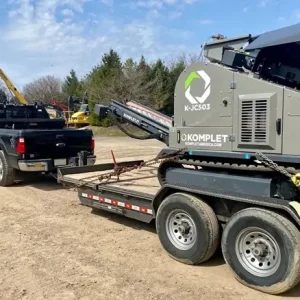
For mobile applications, transport dimensions and weight determine what trailer is required and whether oversized-load permits are needed. The K-JC 503 transports at 7,496 lb behind a standard pickup. Larger Komplet jaw crushers up to the K-JC 805 transport on standard heavy trailers without oversized permits.
Frequently Asked Questions
How does a jaw crusher actually break rock?
Through compression. Two jaw plates form a V-shaped chamber. The movable jaw swings toward the fixed jaw, compressing material caught between them. As compressive force exceeds the material’s structural strength, it fractures. The cycle repeats hundreds of times per minute, progressively reducing material size as it migrates down the V-shaped chamber.
What’s the difference between compression and impact crushing?
Compression crushing squeezes material between two surfaces until it fractures — slow, mechanical, high-force action. Impact crushing uses high-velocity collision (rotating blow bars) to shatter material against fixed aprons. Compression handles hard abrasive material better; impact produces cubical aggregate shape better. Most operations use compression for primary reduction (jaw crusher) and impact for secondary shaping (impact crusher) when both are needed.
Why do operators talk about choke-feeding the chamber?
Choke feeding means keeping the crushing chamber 70-85% full at all times. This produces optimal compressive crushing — material crushes other material in the chamber, not just the jaw plates against material. Underfed chambers waste capacity; overfed chambers jam. Operators who consistently choke-feed produce the highest tons per hour and the lowest wear costs.
Can a jaw crusher handle rebar in concrete?
Yes. Compression action breaks the concrete away from the rebar rather than wrapping or jamming around it. The rebar exits the chamber along with the crushed aggregate and is captured by the magnetic separator (standard on most Komplet jaw crushers). Impact crushers, by contrast, can have problems with long rebar pieces — the high-speed rotor can wrap or bind. For demolition concrete with substantial rebar content, a jaw crusher is the better primary reduction choice.
What’s the closed-side setting (CSS)?
The minimum gap between the jaw plates at the bottom of the crushing chamber. The CSS determines maximum output size — material smaller than CSS exits the chamber; material larger than CSS continues to be compressed until it fractures small enough to pass. CSS is hydraulically adjustable on all current Komplet jaw crushers, allowing the operator to dial in target output size remotely.
How long do jaw plates last?
Highly variable based on material abrasiveness, throughput, operator practices, and operating environment. As a rough range, jaw plates in compact mobile crushers typically last 500-3,000+ operating hours, with hard abrasive virgin rock at the lower end and clean recycled concrete at the upper end. Monitor wear during operation and replace before significant performance degradation.
What’s the maximum size material a Komplet K-JC 704 PLUS can take?
The K-JC 704 PLUS feed opening is 27″ × 16″ with a maximum feed size of about 12-3/4″. Material larger than this needs to be pre-broken (typically with a hydraulic breaker on a demolition machine) before feeding into the crusher. The K-JC 503 feed takes up to about 9-1/2″; the K-JC 805 feed takes up to 16-3/4″.
Why do some crushers produce more cubical aggregate than others?
Crushing mechanism. Compression crushers (jaw, cone, gyratory) produce variable shape — some elongated, some cubical, depending on how the material fractures under compression. Impact crushers produce more uniformly cubical aggregate because the high-velocity impact shatters material along its weakest planes, which tend to produce more equiaxial (cubical) fragments. For applications where aggregate shape matters (asphalt mix, structural concrete mix, DOT-spec material), impact crushing or a jaw-then-impact combination produces better shape than jaw crushing alone.
Final Thoughts
The crushing chamber is where the operational economics of any crusher are actually determined. Jaw crushers compress material between two plates; impact crushers shatter material against fixed aprons. Both processes work, both have their applications, and both reward operator understanding of the underlying mechanics. The contractors who understand what’s happening inside the crusher consistently produce more tons per hour, lower wear costs, and better operational consistency than contractors who treat the crusher as a black box.
For buyers, the same understanding informs equipment selection. The crushing mechanism that fits the material — compression for hard abrasive material with rebar; impact for cubical aggregate output and softer recycled material — produces predictable production at reasonable wear cost. The wrong mechanism, regardless of brand or price, produces rapid wear, high operating cost, and frequent downtime. Done well, crusher selection is informed by the actual material and the actual specification; done poorly, it’s informed by spec sheet superficial features. The variable separating profitable operations from break-even ones is rarely the equipment brand — it’s the discipline of matching equipment to material to specification, and operating the equipment well across its life.
To explore Komplet’s compact mobile crushers, the full lineup is at Komplet crusher lineup. Pre-owned equipment is at Komplet’s pre-owned inventory. Equipment financing through Komplet Capital is at Komplet Capital financing. Or call Komplet America directly at 908-369-3340.
Ready to See a Crusher Run on Your Material?
- Call Komplet America at 908-369-3340 to discuss your specific material, throughput, and output requirements. Komplet’s team can match equipment to your application before quoting.
- Browse the Komplet equipment lineup at Komplet equipment lineup to compare models and specifications.
- Discuss financing through Komplet Capital at Komplet Capital financing — 100% financing, 24-hour approvals.
- Find your local Komplet dealer at Find Your Komplet Dealer for in-person equipment evaluation.
- Talk to your CPA about Section 179 — for tax year 2026, the maximum deduction is $2,560,000.
Never enough.
Disclaimer: This article provides general guidance on crusher operation, mechanics, and wear-part management. All operators should refer to the Komplet operator’s manual specific to their make, model, and serial number for complete maintenance schedules, service intervals, lubrication specifications, torque values, fluid types, safety procedures, and manufacturer-recommended practices. Operating outside the specifications in the operator’s manual may void warranty coverage.
Disclaimer: Throughput figures (tons per hour), wear-part service lives, and operational performance examples shown are illustrative and depend on material, operator skill, equipment condition, and environmental factors. The ‘up to’ production rating refers to maximum potential output under ideal conditions and is not a guaranteed or average output.
Disclaimer: Section 179 limits are 2026 figures. Komplet America is an equipment distributor, not a tax advisor. Consult a qualified CPA before making decisions based on tax treatment.
Equipment prices and specifications subject to change. Contact Komplet America at 908-369-3340 for current information.