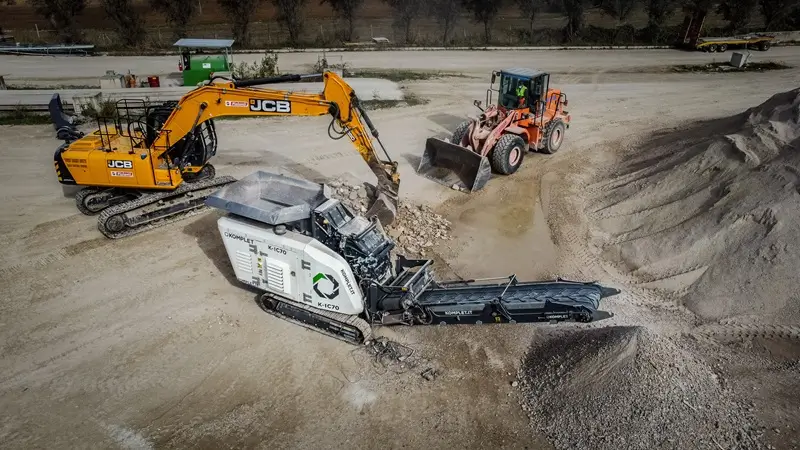

Choosing the right demolition crusher isn’t about finding the biggest machine available — it’s about matching equipment capacity to your actual project volume, crew size, site access constraints, and workflow demands. Get sizing wrong and you either waste capital on unused capacity (oversized equipment running at 30% utilization with high cost per ton) or create bottlenecks that slow your entire operation (undersized equipment running at 110% capacity, jamming, overheating, and bottlenecking the crew). Right-sizing means the equipment delivers its rated economics rather than its theoretical capacity.
This basic guide walks through the practical methodology for sizing a demolition crusher — calculating your real throughput requirements, factoring crew capacity into the equation, accounting for the workflow factors that drive equipment selection, and matching Komplet America’s compact mobile jaw crusher lineup to your specific operational profile.
Step 1: Calculate Your Real Throughput Requirements
Sizing starts with honest assessment of your actual processing needs — not theoretical maximums or marketing claims. Real-world productivity typically runs at 60-70% of rated capacity once operational reality (loading time, repositioning, breaks, weather delays, material variations) is factored in.
Calculate Average Daily Throughput
Work through the math:
- Total project tonnage ÷ project working days = average daily throughput needed
- Average daily throughput ÷ working hours per day = average hourly throughput needed
- Average hourly throughput ÷ 0.65 (real-world utilization factor) = required rated capacity
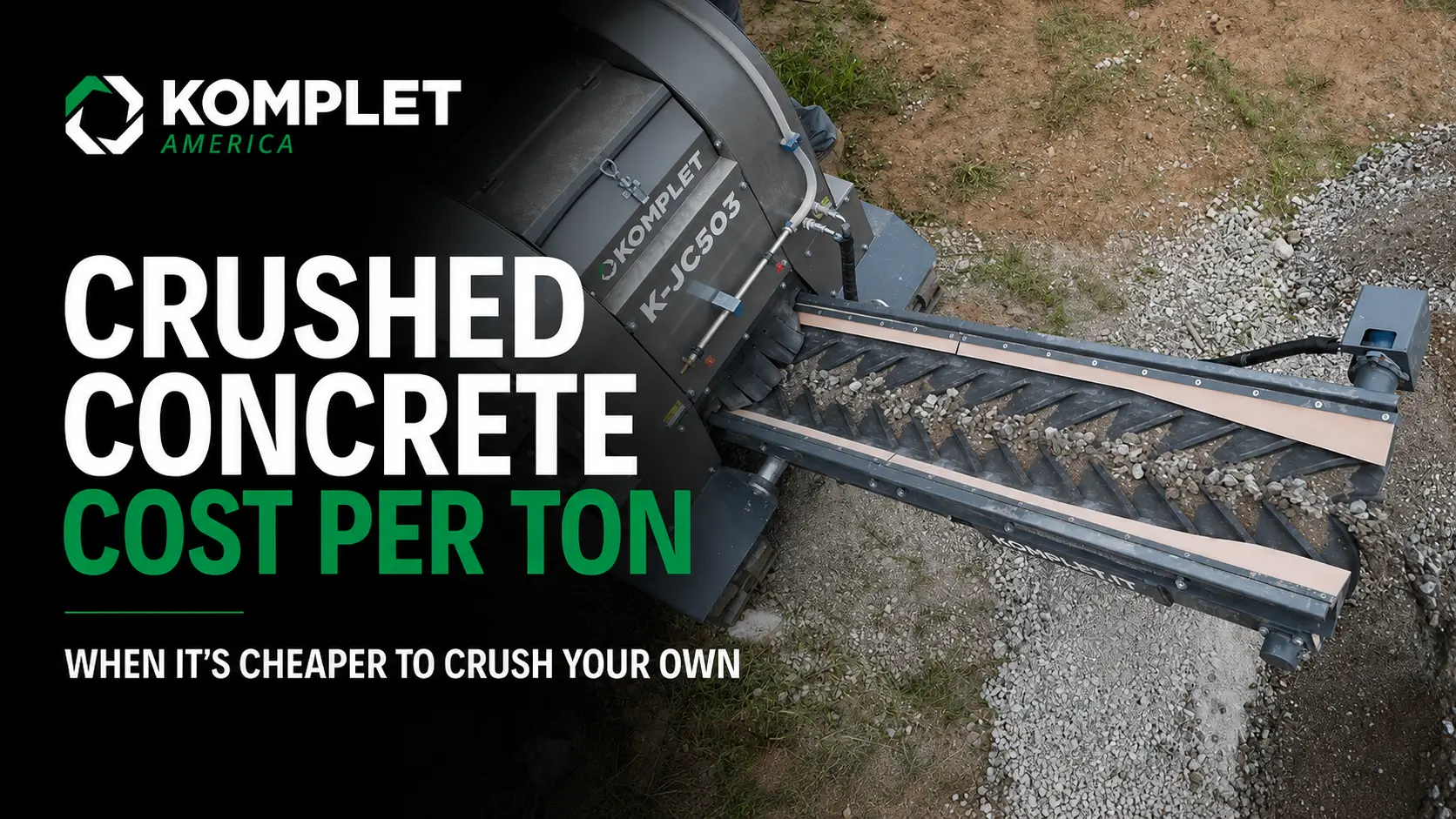
Example: a 3,000-ton commercial demolition over 30 working days = 100 tons/day. Over 8-hour shifts = 12.5 tons/hour real average. Divided by 0.65 utilization = 19 tons/hour rated capacity needed. That sizing math fits the K-JC 503 (up to 34 US tph) comfortably with significant headroom.
Factor in Peak Demand
Average sizing doesn’t account for peak demand days when material accumulates faster than average. Add 30-50% headroom over average requirements to handle:
- Peak demolition days when material accumulates faster than steady-state average
- Schedule compression scenarios where weather or other delays force catch-up periods
- Future project pipeline growth — operations sized exactly to current demand often hit capacity ceilings within 18-24 months as business expands
- Higher-volume projects that may enter the project pipeline as your operation grows
Multi-Project Annual Volume
For contractors with recurring demolition pipeline (rather than single projects), calculate from annual volume rather than single-project volume. Approximate annual sizing guide:
- Under 5,000 tons annually: K-JC 503
- 5,000-30,000 tons annually: K-JC 604
- 30,000-100,000 tons annually: K-JC 704 PLUS (best-selling crusher for typical contractor operations)
- 100,000+ tons annually: K-JC 805 (largest jaw crusher in the lineup)
Step 2: Match Crusher Capacity to Crew Size and Capability
Crew size determines how much material can realistically feed and manage the crusher. Equipment capacity exceeding crew loading capacity creates idle equipment cost; equipment capacity below crew loading capacity creates a bottleneck.
Loading Capacity Match
A typical excavator + loader operator pairing can sustain 30-50 tons/hour of material delivery to a crusher. Larger crews with multiple loaders can sustain higher rates. Match crusher rated capacity (with 30-50% headroom) to crew loading capacity:
- Single loader operator (2-4 person crew): crusher capacity 30-50 tph fits — K-JC 503 or K-JC 604 typically
- Single excavator + loader (3-5 person crew): crusher capacity 50-90 tph fits — K-JC 604 or K-JC 704 PLUS
- Multiple loaders (5-8 person crew): crusher capacity 90-160 tph fits — K-JC 704 PLUS or K-JC 805
- Larger crews with dedicated material handling: K-JC 805 at upper end of compact mobile lineup
Operator Allocation
Crusher operation typically uses one dedicated operator. Komplet’s wireless remote control supports single-operator equipment management — operator handles deployment, operation, jaw setting adjustment, conveyor positioning, and reverse jaw function from a safe position. Loader operators feed material; the crusher operator manages crushing and stockpile management. Match equipment selection to crew structure rather than expecting one person to do multiple roles.
Crew Workflow Bottleneck Analysis
The slowest stage in the workflow determines overall throughput. Identify the bottleneck stage:
- If demolition is the bottleneck: smaller crusher works because the crew can’t feed faster anyway
- If loading is the bottleneck: smaller crusher; larger equipment would idle
- If crusher is the bottleneck: upgrade crusher capacity; current crew can feed more material than equipment can process
- If hauling/stockpile is the bottleneck: crusher size doesn’t matter; address material handling instead
Step 3: Account for Material Type and Variability
Demolition sites rarely produce uniform material. The specific feed composition affects equipment selection beyond simple throughput calculations:
Feed Material Hardness
Concrete, brick, and masonry are well-suited to compact mobile jaw crushers. Hard rock (granite, basalt, traprock) accelerates jaw plate wear. Mixed C&D debris with foreign objects (lumber, plastic, metal beyond rebar) requires the reverse jaw function (standard on all Komplet jaw crushers) to handle uncrushable obstructions. Match the equipment to actual feed material, not theoretical material specs.
Feed Size and Pre-Processing
Match jaw opening to typical feed pieces with appropriate pre-processing:
- K-JC 503 (19″ x 12″ jaw): recommended max feed 9-1/2″ minus
- K-JC 604 (23″ x 16″ jaw): max feed approximately 12-3/4″
- K-JC 704 PLUS (27″ x 16″ jaw): max feed approximately 12-3/4″
- K-JC 805 (31″ x 21″ jaw): max feed approximately 16-3/4″
Forcing oversized material through a crusher with insufficient jaw opening causes jams, broken jaw plates, and downtime — costs that easily exceed the time spent on proper pre-processing with excavator-mounted hydraulic breakers.
Reinforcement and Magnetic Separation
Demolition concrete typically contains rebar, conduit, embedded plumbing, and other ferrous metal. Komplet jaw crushers (K-JC 604, K-JC 704 PLUS, K-JC 805) include integrated hydraulic magnetic belts that automatically lift ferrous metal from the discharge conveyor. The K-JC 503 includes magnetic attachment as an option (included in base price). Match these features to your actual feed: heavily reinforced concrete demands magnetic separation; clean stone feed doesn’t need it.
Output Spec Requirements
What spec sizes do your end customers actually buy? Most aggregate operations need multiple spec sizes simultaneously (3/4″ base + 1-1/2″ drainage + fines). For these operations, pairing the crusher with a vibrating scalping screen with hydraulic 2-way / 3-way conversion (Kompatto 5030 — Komplet’s best-selling screener — or the larger Kompatto 124) supports the full spec range from a single integrated workflow.
Premium Cubical Output
If your operation serves concrete batch plants or hot-mix asphalt plants requiring premium cubical particle shape, add a K-IC 70 compact impact crusher as a secondary stage after primary jaw crushing. The K-IC 70 produces cubical aggregate suitable for premium mix-design applications. It is not intended as a primary crusher for raw demolition material — that’s the jaw crusher’s role.
Step 4: Factor Site Access and Mobility
Tight-Access Urban Sites
Tight urban demolition, residential renovation, indoor work, basement demolition, narrow industrial sites: K-JC 503 (5′ transport width) fits where larger machines can’t physically deploy. The smaller machine accepting tight access is more valuable than larger equipment that can’t enter the site at all.
Standard Contractor Sites
Most commercial demolition sites accommodate K-JC 604, K-JC 704 PLUS, or K-JC 805 without specialized rigging. Self-propelled tracked mobility means the crusher drives onto a transport trailer for road movement and drives off at the new site. Match equipment weight to your transport capacity — larger crushers may require specialized transport equipment your fleet doesn’t already operate.
Multi-Site Project Schedules
For contractors moving between projects multiple times per year, mobility isn’t optional — it’s foundational. Self-propelled tracked, hydraulically folding, wireless remote: these features enable same-day deployment at new sites. Equipment requiring multi-hour setup or specialized assembly crews doesn’t fit project-based construction economics.
Transport Logistics
Komplet jaw crusher weights:
- K-JC 503: approximately 7,496 lb
- K-JC 604: approximately 19,400 lb
- K-JC 704 PLUS: approximately 26,455 lb
- K-JC 805: approximately 49,600 lb
Compact models under 30,000 pounds transport easily on standard trailers without special permits or escort vehicles. Larger machines may require specialized transport for road movement — factor this into operational economics.
Step 5: Plan for Multi-Shift and Continuous Operation
Running multiple shifts changes the equipment selection equation. Extended hours mean reliability and fuel efficiency become more important than peak throughput specs.
Engine and Component Selection
All Komplet jaw crushers are built for sustained continuous duty — not just specific models. The Tier 4 Final diesel engines, hardened jaw plates, and integrated hydraulic systems support extended operation. For multi-shift operation, the larger crushers (K-JC 704 PLUS, K-JC 805) typically have lower wear-rate-per-ton than smaller crushers handling the same total volume, supporting better long-term economics.
Service Interval Planning
Multi-shift operations accumulate service hours faster than single-shift operations. Plan service intervals per OEM-specified schedules (referring to the operator’s manual specific to your machine model). Komplet America’s parts inventory is forecasted 12 months in advance, supporting scheduled service without parts delays.
Operator Coverage
Multi-shift operations need operator coverage across all shifts. The wireless remote control standard on all Komplet jaw crushers supports operator transitions efficiently — incoming operators take over wireless remote control without complex handoff procedures.
Sample Sizing Scenarios
Scenario 1: Urban Multi-Story Commercial Demolition
A six-person crew tackling a three-story commercial building generates approximately 50-60 tons of concrete and brick daily over a 20-day project (~1,100 tons total). Site access constrained — narrow urban access points limit equipment width. Recommended crusher: K-JC 604 (up to 55 US tph, 23″ x 16″ jaw, ~19,400 lb). Capacity matches crew loading rate; transport width fits urban access.
Scenario 2: Parking Lot Removal and Recycling
An eight-person crew removing 1,200 tons of asphalt and concrete over three weeks (~80 tons/day). Open site, no access constraints. Recommended crusher: K-JC 704 PLUS (up to 90 US tph, 27″ x 16″ jaw, ~26,455 lb). Capacity provides headroom for peak production days; output supports immediate aggregate use as base for replacement pavement.
Scenario 3: Mixed-Material Demolition with RCA Sales
A ten-person crew handling varied demolition waste with RCA sales target of multiple spec sizes. Recommended setup: K-JC 704 PLUS + Kompatto 5030 + K-IC 70. K-JC 704 PLUS handles primary reduction; Kompatto 5030 (up to 280 US tph, hydraulic 2-way / 3-way conversion) produces multiple spec sizes; K-IC 70 (up to 90 US tph) provides premium cubical secondary output for batch-plant aggregate sales.
Scenario 4: High-Volume Aggregate Operation
An aggregate-producer-scale operation processing 100,000+ tons annually across multiple projects. Recommended setup: K-JC 805 + Kompatto 124. K-JC 805 (up to 160 US tph, 31″ x 21″ jaw, ~49,600 lb, largest jaw crusher in the lineup) handles high-volume primary reduction; Kompatto 124 (up to 350 tph, largest mobile scalping screen) supports the production rate.
Scenario 5: Tight-Access Specialty Work
A four-person crew on residential renovation, basement demolition, indoor work — total project volume 200-400 tons. Recommended crusher: K-JC 503 (up to 34 US tph, 19″ x 12″ jaw, ~7,496 lb). 5′ transport width fits where larger machines can’t deploy; capacity matches small-crew operational economics.
Common Sizing Mistakes to Avoid
Mistake 1: Buying for Peak Demand
Sizing equipment for the busiest day of the year produces oversized, underutilized equipment 90% of the time. Higher capital cost + lower utilization = higher cost per ton. Better approach: size for typical projects and rent additional capacity for exceptional situations.
Mistake 2: Ignoring Crew Capacity
Buying a 90 tph crusher when your crew can only sustainably feed 40 tph creates a 50 tph capacity gap that’s pure waste — equipment idling, fuel burning, capital tied up. Match the crusher to the slowest stage in the workflow.
Mistake 3: Ignoring Site Access
Powerful crushers don’t help if they can’t physically deploy at the work site. Verify transport width, weight, and access requirements before purchase. K-JC 503’s 5′ width matters when standard contractor sites have access constraints.
Mistake 4: Forgetting Pre-Processing
Buying a crusher with insufficient jaw opening for typical feed material guarantees jams, broken parts, and downtime. Match jaw opening to actual feed sizes, accounting for excavator-mounted hydraulic breaker pre-processing capability if available.
Mistake 5: Mismatching K-IC 70 to Primary Role
The K-IC 70 impact crusher is engineered for SECONDARY cubical reduction — adding to a workflow after primary jaw crushing for premium aggregate production. Using it as a primary crusher for raw demolition material with rebar wraps the steel around the rotor and creates jams. Match the right equipment to the right role: jaws for primary, K-IC 70 for premium secondary cubical output.
Mistake 6: Overlooking Output Spec Production
Crushers produce undifferentiated output. Operations selling spec-sized aggregate need vibrating scalping screens to produce multiple spec sizes simultaneously. Skipping the screening investment forces the operation to produce one size at a time, eliminating most of the production efficiency the crusher delivers.
Frequently Asked Questions
How do I calculate the crusher capacity I actually need?
Three-step calculation: (1) Total project tonnage ÷ project working days = average daily throughput; (2) Average daily throughput ÷ working hours per day = average hourly throughput; (3) Average hourly throughput ÷ 0.65 (real-world utilization factor) = required rated capacity. Add 30-50% headroom for peak demand. Example: 3,000-ton project over 30 days × 8 hours = 12.5 tons/hour real, divided by 0.65 = 19 tons/hour rated capacity needed (fits K-JC 503 with significant headroom).
What’s the most popular Komplet crusher for typical demolition operations?
The K-JC 704 PLUS — Komplet’s best-selling crusher. Up to 90 US tph throughput, 27″ x 16″ jaw, integrated rebar separation, reverse jaw function, dust suppression, wireless remote. Workhorse for typical contractor demolition operations across construction, demolition, recycling, and aggregate markets.
Can I use the K-IC 70 impact crusher for demolition concrete?
The K-IC 70 is engineered for SECONDARY cubical reduction — added to a workflow after primary jaw crushing for premium aggregate output. Using it as a primary crusher for raw demolition concrete with rebar can wrap the steel around the rotor and create jams. For demolition concrete primary reduction, use a K-JC jaw crusher; add the K-IC 70 as a secondary stage if your operation serves premium aggregate markets requiring cubical particle shape.
How do I know if my crew can keep a crusher fed?
Estimate sustainable loading rate: a typical excavator + loader operator pairing sustains 30-50 tons/hour of material delivery. Larger crews with multiple loaders sustain higher rates. Match crusher rated capacity to crew loading capacity with 30-50% headroom on the crew side. If crew loading is 40 tph, look for crushers in the 25-55 tph range — K-JC 503 (up to 34 tph) at the bottom or K-JC 604 (up to 55 tph) at the top.
Should I buy the largest crusher I can afford for future growth?
Generally no — match equipment to current and projected near-term operational needs (next 18-24 months) plus 30-50% headroom. Oversized equipment wastes fuel during low utilization, accelerates wear without producing proportional revenue, and ties up capital that could fund other operational priorities. As the business grows, equipment can be upgraded; rental and pre-owned options support transitional periods. The Komplet lineup supports growth — many operations start with K-JC 503 or K-JC 604 and upgrade to K-JC 704 PLUS or K-JC 805 as volume justifies.
Can I rent before committing to a specific crusher size?
Yes — through Komplet’s authorized dealer and rental network. Find your local Komplet dealer or call (908) 369-3340. Many partners offer rent-to-own arrangements where rental payments credit toward eventual purchase. Renting is the right starting point for first-time buyers — it validates equipment fit on real projects before committing capital and helps confirm the right size choice.
How does financing affect crusher sizing decisions?
Komplet Capital offers 24-hour approval, 100% financing, 3-6 year terms. Section 179 tax deduction up to $1.22M (2024 limit) on new equipment. Many operations structure equipment financing so monthly payments are fully covered by avoided dump fees and recovered material revenue. The right-sized crusher producing the right amount of material delivers monthly economic benefit that exceeds monthly financing payments.
What’s the warranty on Komplet equipment?
All new Komplet equipment ships with a 1-year / 1,000-hour warranty (whichever comes first). Komplet America’s parts inventory is forecasted 12 months in advance, supporting fast wear-part availability when service items are needed. Authorized dealers across North and Central America provide local service support — call (908) 369-3340 for parts, service, or technical questions.
Final Thoughts
Sizing a demolition crusher correctly means balancing project volume, crew capacity, site access, material variability, and workflow demands. The methodology above — calculating real throughput requirements with utilization factor, matching to crew loading capacity, factoring material type and pre-processing, considering site access and transport, and planning for multi-shift operation — produces equipment selection that fits operational reality rather than theoretical specs. Operations that work through this methodology before purchase end up with equipment that produces the rated economics; operations that skip it pay for the lesson through suboptimal economics for years.
Komplet America’s compact mobile jaw crusher lineup — K-JC 503 through K-JC 805 plus the K-IC 70 impact crusher for premium cubical secondary output — covers the full spectrum of demolition operations from tight-access urban work through high-volume aggregate-producer scale. Browse the complete equipment lineup or call us to work through the sizing methodology for your specific operation.
Ready to Talk Demolition Crusher Sizing?
- Call (908) 369-3340
- Email [email protected]
- Schedule a demo or request a quote
- Find your local Komplet dealer for rental availability
- Ask about our 1-year / 1,000-hour warranty and equipment financing options
Never enough — that’s how we approach service, support, and helping operations get equipment sizing right from the start.
Disclaimer: All cost, ROI, payback, pricing, throughput, and operational figures in this article are illustrative examples based on sample assumptions about volume, regional pricing, material specifications, crew capability, and market conditions. Actual results vary significantly by region, market, material type, equipment utilization, operator skill, financing terms, regulatory environment, and many other factors. Equipment pricing, fuel costs, labor rates, wear-part costs, and interest rates all change over time and by location. Komplet America makes no guarantee, warranty, or representation of specific financial performance, payback timelines, or business outcomes for any particular operation. For current pricing and a sizing recommendation based on your specific volume, material, crew, and local market, contact us at (908) 369-3340 to speak with our team.