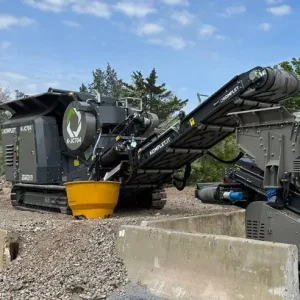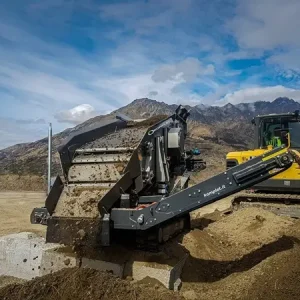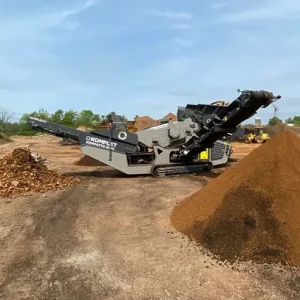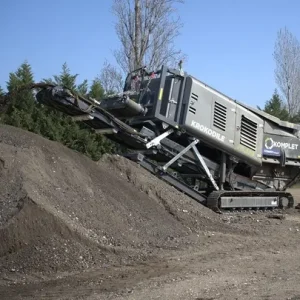

Compact mobile rock crushers have become one of the highest-leverage equipment categories in modern construction, demolition, and recycling operations. The economic case is well-documented — eliminated tipping fees, eliminated hauling costs, recovered material revenue, after-tax payback timelines often inside 12 months. But the equipment isn’t right for every operation, and the timing of the decision matters as much as the decision itself. Operations that buy too early absorb capital before the project pipeline justifies it; operations that buy too late leave compounding margin on the table for years.
This guide walks through five clear signals that your business has crossed the threshold where a compact mobile rock crusher purchase makes economic sense — rising disposal costs, recurring aggregate purchases, sustained demolition or recycling pipeline, competitive pressure from operators already running on-site processing, and operational schedule pressure from disposal logistics. If two or more of these signals describe your operation, the equipment is likely already paying for itself in opportunity cost; the question is when, not whether, to capture that economics.
Sign 1: Tipping Fees Are Eating Your Project Margins
The single clearest signal that your business needs a rock crusher is sustained, growing exposure to tipping fees on demolition concrete and asphalt. Concrete tipping fees in major U.S. metros typically run $50-$100+/ton. Asphalt tipping similar ranges. Mixed C&D tipping commonly $40-$80+/ton. For an operation processing 1,000 tons of demolition concrete annually in a $75/ton tipping market, tipping fees alone consume $75,000 — direct dollars paid to dispose of material that, processed differently, would produce revenue or displace cost elsewhere on the project.
Tipping fees aren’t getting cheaper. Available landfill capacity has been declining for decades, particularly in densely populated regions. Tipping fees rise year over year in most U.S. metros, and the trend is consistently upward. Operations exposed to this cost category face a structural cost growth pattern that on-site processing eliminates. The break-even math:
- At 500 tons/year of demolition concrete in a $50/ton tipping market: $25,000/year tipping cost. Equipment payback typically 8-12 months on entry-level K-JC 503.
- At 1,000 tons/year in a $75/ton tipping market: $75,000/year tipping cost. Equipment payback typically 3-6 months on K-JC 704 PLUS.
- At 4,000+ tons/year in a $75/ton tipping market: $300,000+/year tipping cost. Equipment payback typically inside the first month of operation.
If your operation pays tipping fees on demolition concrete or asphalt monthly, and the tipping rate exceeds $40/ton, the rock crusher purchase decision is almost certainly economically positive. The variables are which equipment configuration fits your specific tonnage and material mix.
Sign 2: You’re Buying Aggregate Every Month
The second signal compounds with the first. Operations that pay to dispose of demolition concrete AND pay to purchase replacement aggregate are exposed to both cost categories on the same projects. Aggregate purchases typically run $20-$40/ton for base course, fill, and drainage stone, plus delivery and handling costs. For operations regularly purchasing aggregate, on-site recovery captures both the avoided disposal cost AND the avoided aggregate purchase cost on the same project — the fastest payback equation in equipment economics.
If your monthly aggregate purchase line is meaningful — even a few hundred tons per month — and your operation produces demolition concrete that could be processed into recycled concrete aggregate (RCA), the structural cost differential is substantial. Indicative math for an operation buying 2,000 tons of base course annually at $25/ton AND disposing of 2,000 tons of demolition concrete at $75/ton tipping:
- Annual aggregate purchase cost: $50,000
- Annual tipping fees: $150,000
- Annual hauling costs (round trip, both directions): approximately $40,000-$80,000
- Total annual addressable cost: $240,000-$280,000
- Equipment producing displaced cost on product page: payback approximately 12 months
Operations that buy aggregate AND dispose of concrete on a recurring basis are the highest-priority candidates for compact mobile crushing equipment. The structural cost differential isn’t a marginal optimization — it’s a fundamental rearrangement of project economics.
Sign 3: Demolition or Recycling Is a Recurring Part of Your Work
Equipment ROI math depends on utilization, and utilization depends on a recurring pipeline. Operations with one-time or rare crushing needs come out ahead with rental from a Komplet authorized rental house; operations with sustained recurring needs come out ahead with ownership. The threshold:
- Less than 30 operating days per year: The equipment cost per operating day for ownership is too high to justify capital deployment.
- 30-90 operating days per year: Often renting is still better unless project mix favors ownership.
- 90-180 operating days per year: Buy or finance. Rental rates accumulate to exceed financing payments.
- 180+ operating days per year: Equipment running 6+ months per year is structurally cheaper to own than rent, regardless of financing path.
Recurring pipelines that justify ownership: demolition contractors with sustained project flow, civil contractors handling regular concrete recycling, recycling yards processing daily inbound material, aggregate suppliers producing for sale, landscape contractors with regular fill and base course needs, and government/public-works operations with sustained infrastructure work. If your operation produces demolition concrete or processes aggregate predictably across the year — not just occasionally — the ownership economics work.
Sign 4: Your Competitors Are Already Running On-Site Processing
Competitive pressure is a real signal that the equipment economics have crossed a threshold in your market. When competing demolition contractors, civil contractors, or recyclers in your region are already running on-site processing, they’re capturing margin that your operation isn’t. The competitive impact:
- Lower bid pricing: On-site processing competitors can bid lower on disposal cost without sacrificing project margin. They win bids your operation loses.
- Faster project schedules: Eliminating disposal logistics removes one of the most common sources of demolition project delay. Their projects close faster, freeing crews for additional work.
- Diversification revenue: Surplus crushed material becomes saleable RCA. Their P&L gains a service revenue line that yours doesn’t have.
- Sustainability positioning: On-site processing produces documented diversion that supports LEED credits and corporate sustainability claims. They win bids requiring diversion documentation that your operation can’t easily produce.
The competitive gap compounds. Each year a competitor runs on-site processing while your operation continues disposal-based workflow widens the structural cost differential between the two operations. The decision to invest in compact mobile crushing equipment isn’t just a one-time capital decision — it’s a positioning decision against the competitive set in your market.
Sign 5: Disposal Logistics Are Slowing Your Projects
Container scheduling, hauling delays, landfill availability, and cross-site coordination produce real schedule risk on demolition projects. On large or multi-site operations, disposal logistics are routinely the single most common source of project schedule slippage — containers fill faster than the hauler can swap them, landfill operating hours don’t match crew schedules, weather affects hauling availability, and cross-site coordination consumes project management time.
On-site processing eliminates most of this. Material reduction happens at the project’s own pace, on the project’s own schedule, with equipment that’s on-site and operating. The schedule impact is sometimes more valuable than the direct cost savings — projects that finish earlier capture margin from faster turnover, lower carrying costs, and earlier crew deployment to subsequent work. Operations that have experienced repeated project slippage attributable to disposal logistics often find that the schedule certainty alone justifies the equipment purchase, before the direct cost savings are even calculated.
Why Compact Mobile Crushers Specifically
If your operation matches two or more of the five signals above, the equipment economics support a purchase decision. The next question is which type of equipment — and for most contractor-scale, recycler-scale, and specialty operations, the answer is compact mobile equipment specifically (rather than larger stationary plant or smaller manual processing). The structural advantages:
Mobility Across Project Sites
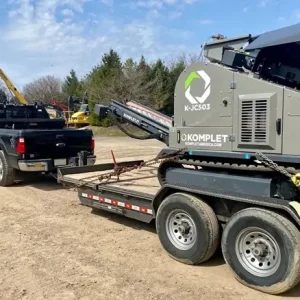
Compact mobile equipment moves between sites on standard trailers behind standard trucks, without specialized transportation, route permits, or oversized-load escorts. For contractors operating multiple project sites, multi-site coordination is impossible without site-mobile equipment. The K-JC 503 transports at 7,496 lb behind a standard pickup. Larger Komplet jaw crushers up to the K-JC 805 transport on standard heavy trailers.
Single-Operator Design
Modern compact mobile crushers — including all current Komplet equipment — are designed for single-operator operation. Track movement, hopper feed, output discharge, and basic safety controls are operable by one trained operator with remote-control capability. This dramatically reduces operating cost per ton compared to crew-intensive stationary plant operations.
Tier 4 Final Emissions Compliance
All current Komplet equipment sold in the United States meets EPA Tier 4 Final emissions standards for non-road diesel engines. This matters for regulated jurisdictions, government procurement, urban project work, and corporate sustainability reporting requirements. Older equipment without Tier 4 Final compliance is increasingly restricted from work in regulated markets.
Compact Footprint for Tight Sites
Compact mobile equipment fits in confined spaces — basement demolitions, urban renovations, residential lots, parking garages, alleyways. Where traditional crusher plants couldn’t physically operate, compact mobile equipment fits and produces. This expands the addressable market for equipment owners — projects that wouldn’t justify a larger crusher’s mobilization can use compact mobile equipment economically.
Reduced Hauling and Disposal Cost
On-site processing eliminates the round-trip hauling miles to a distant landfill or recycling facility, eliminates tipping fees on processed material, and eliminates the cost of buying replacement aggregate. The economic impact compounds across project life — for typical commercial operations, the avoided cost categories often exceed the equipment cost on an annualized basis.
Matching Komplet Equipment to Your Operational Profile
Once the decision to purchase is made, equipment selection follows from operational profile. Komplet’s compact mobile lineup spans the contractor-scale to mid-quarry range:
- K-JC 503 (25 hp; 19″×12″ jaw; 34 tph): Entry-level mini crusher. Limited-access sites, residential remodels, basement demolitions, small-volume contractor work.
- K-JC 604 (55 hp; 23″×16″ jaw; 55 tph): Mid-size for site contractors and municipal yards.
- K-JC 704 PLUS (74 hp; 27″×16″ jaw; 90 tph): Komplet’s best-selling jaw crusher. General contractor, civil, road, bridge, and recycling work.
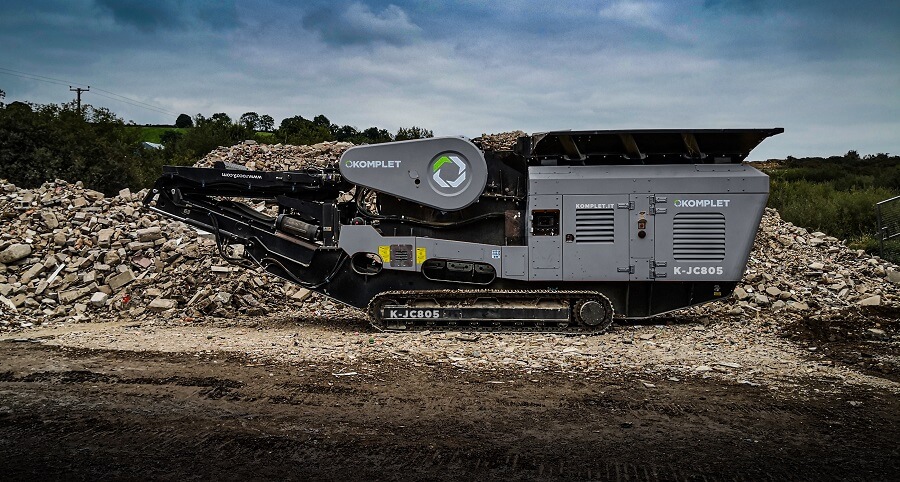
- K-JC 805 (130 hp; 31″×21″ jaw; 160 tph): Largest jaw in the lineup. Compact-scale quarry, large civil, and high-volume recycling.
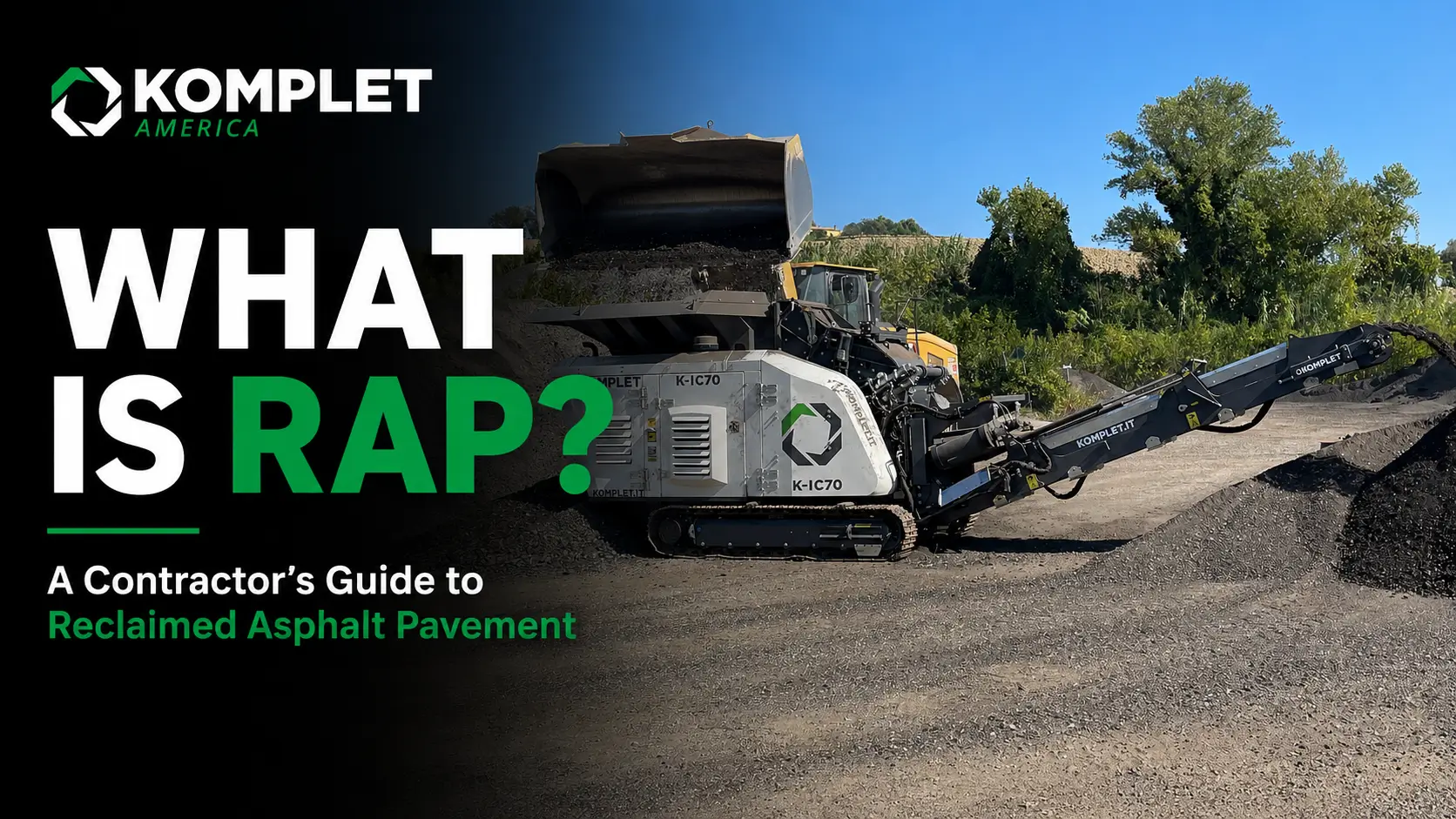
- K-IC 70 (100 hp; 90 tph): Compact mobile impact crusher for cubical aggregate output, RAP reduction, DOT-spec material.
For operations with substantial demolition tonnage and multi-site mobility requirements, the K-JC 704 PLUS is the dominant choice — it sits at the productivity-versus-capital sweet spot for most contractor operations. Larger and smaller models fit specific operational profiles. The Komplet equipment lineup page documents the full range with detailed specifications for each model.
The Tax Treatment That Shortens After-Tax Payback
The Section 179 tax deduction structure for tax year 2026 dramatically improves the after-tax economics of compact mobile crushing equipment purchases. The maximum Section 179 deduction is $2,560,000, with phase-out beginning at $4,090,000. The One Big Beautiful Bill Act of 2025 substantially raised these limits and restored 100 percent bonus depreciation for qualifying property placed in service after January 19, 2025. For a typical Komplet equipment buyer well below the phase-out threshold, the practical effect is that the full purchase price of qualifying equipment can typically be deducted in the year placed in service, subject to all program requirements. Combined with the operational economics described above, the after-tax payback timeline on a well-sized equipment purchase is among the strongest in heavy equipment categories.
Section 179 applies to both new and used equipment that is new to the buyer’s business. Confirm specific eligibility with a qualified CPA before basing purchase decisions on tax treatment.
Frequently Asked Questions
How do I know if my operation has enough volume to justify a crusher?
As a rough rule, operations producing 30+ operating days per year of demolition concrete or aggregate processing typically support owned equipment economics. Operations with 1,000+ tons/year of demolition concrete in $50+/ton tipping markets typically reach payback inside 12 months on entry-level equipment. Below those thresholds, renting from a Komplet authorized rental house often produces better economics than buying.
What’s the smallest viable rock crusher purchase?
The K-JC 503 mini jaw crusher at 25 hp, 19″×12″ jaw, up to 34 US tph, 7,496 lb transport weight. Designed for small contractors, residential remodels, basement waterproofing, landscaping, and pool installation. Pre-owned units price below this for buyers wanting an even lower entry point.
How long does payback take?
Highly operation-specific. For a mid-size demolition contractor processing 4,000 tons/month of concrete demolition material in a $75/ton tipping market, payback on a K-JC 704 PLUS typically lands inside the first month of operation. For smaller operations or lower-tipping markets, payback typically lands in the 6-12 month range. Below 30 operating days per year, ownership economics generally don’t work — rent from a Komplet authorized rental house instead.
Can I finance with no money down?
Yes — Komplet Capital offers 100 percent financing for qualified buyers, no down payment required, 24-hour approvals, and 36/48/60/72-month term options. Details at Komplet Capital financing.
Does Section 179 really apply to crushing equipment?
Yes. Section 179 of the Internal Revenue Code allows businesses to deduct the full purchase price of qualifying equipment in the year placed in service. For tax year 2026, the maximum deduction is $2,560,000, with phase-out beginning at $4,090,000. Compact mobile crushing equipment qualifies. Confirm specific eligibility with a qualified CPA.
What about pre-owned equipment?
Pre-owned equipment from Komplet’s Komplet’s pre-owned inventory prices 30-50 percent below comparable new equipment, with documented inspection, refurbishment, and service history. Section 179 applies to pre-owned equipment new to the buyer’s business the same as new equipment. Pre-owned is often the right entry point for operations crossing the threshold from rental to ownership.
Should I rent or buy?
Match procurement strategy to actual utilization. Operations with 30+ operating days per year typically come out ahead with ownership; operations below that threshold typically benefit from renting through a Komplet authorized rental house. Operations in the middle ground (30-90 operating days) often benefit from financing-to-own through Komplet Capital, which captures equity buildup the renter never gains.
How long does compact mobile crushing equipment last?
Properly maintained Komplet equipment typically delivers 10,000+ operating hours of useful life, with major components running longer with proper maintenance. Wear parts (jaw plates, blow bars, screens) replace periodically based on hours and material abrasiveness. Documented maintenance compliance directly affects equipment longevity and resale value.
Final Thoughts
Five clear signals indicate that a business has crossed the threshold where a compact mobile rock crusher purchase makes economic sense: rising tipping fees, recurring aggregate purchases, sustained demolition or recycling pipeline, competitive pressure from on-site-processing operators, and disposal logistics consuming project schedule. Operations matching two or more of these signals are typically already losing margin to disposal-based workflows that on-site processing would capture. The question isn’t whether the equipment economics work — it’s when to capture them, and which equipment configuration fits the specific operation.
The Conti family construction legacy that informs Komplet America’s approach to equipment dates to 1906, and the equipment-timing lesson from that lineage is straightforward: don’t haul something to a landfill that has positive recovery value, and don’t pay tipping fees on material that has saleable product value. The longer an operation defers the equipment purchase decision once the signals are clear, the more compounding margin accumulates as missed economic opportunity. Done well, the equipment becomes a structural source of project margin that pays back in months and continues producing operational economics across years of reliable service. Done late, the same opportunity continues being captured by competitors instead.
To explore Komplet equipment for purchase, the full Komplet equipment lineup is at the website, with Komplet’s pre-owned inventory available for buyers wanting lower capital deployment. For Komplet Capital financing structures, including 100 percent financing options. To find a Find Your Komplet Dealer in your territory. Or call Komplet America directly at (908) 369-3340.
Ready to Stop Paying Disposal Costs You Could Be Eliminating?
- Calculate your annual tipping fees, hauling costs, and aggregate purchases. The combined number is typically larger than contractors expect.
- Call Komplet America at (908) 369-3340 to discuss equipment configurations matched to your specific tonnage and project pipeline. The team can run payback math with actual numbers for your operation.
- Discuss financing through Komplet Capital financing — 100% financing, 24-hour approvals, no down payment options.
- Talk to your CPA about Section 179 — for tax year 2026, the maximum deduction is $2,560,000.
- Find your local Find Your Komplet Dealer for in-person equipment evaluation, or browse Komplet’s pre-owned inventory for lower-capital entry points.
Never enough.
Disclaimer: ROI figures, payback timelines, project economics examples, tipping fee references, and savings illustrations shown above are illustrative only based on sample assumptions. Actual results vary by region, project, equipment utilization, financing terms, and other factors. Komplet America makes no guarantee of specific financial returns.
Disclaimer: Equipment pricing is subject to change based on dealer location, configuration, and additional features. Prices do not include taxes, shipping, or installation fees. Contact Komplet America at (908) 369-3340 for current pricing.
Disclaimer: Section 179 limits are 2026 figures based on the One Big Beautiful Bill Act of 2025 and adjust annually. Komplet America is an equipment distributor, not a tax advisor. Consult a qualified CPA before making decisions based on tax treatment.
All operating, maintenance, and service guidance is general in nature. Always refer to the official Komplet operator’s manual for the specific machine model and serial number, and follow OEM intervals and procedures.