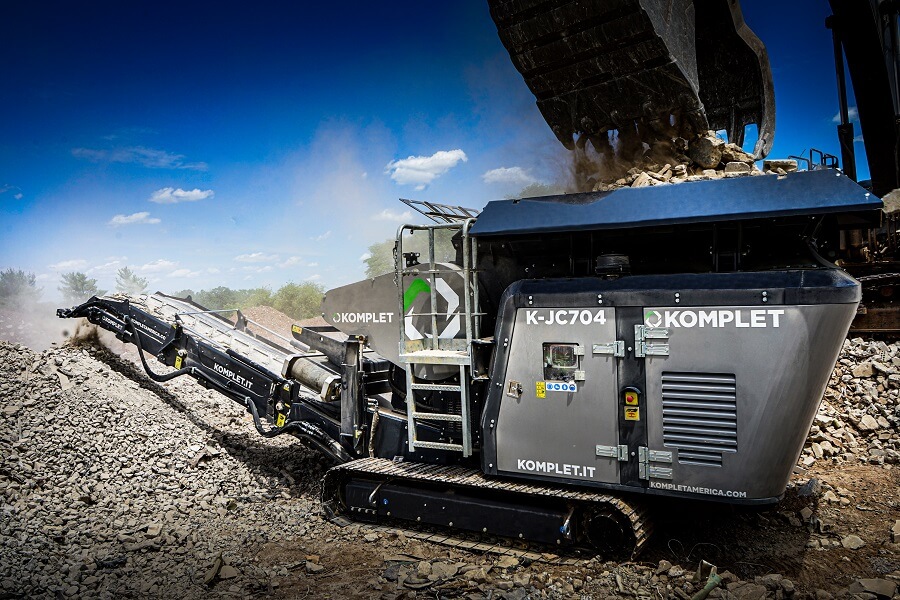

Aggregate quality drives construction project outcomes. Poor gradation produces weak concrete and unstable road base; inconsistent sizing creates compaction problems; contamination triggers specification failures and rejected loads; non-cubical particle shape limits aggregate suitability for premium applications. Contractors managing aggregate quality on construction projects face a foundational decision: rely on off-site aggregate suppliers and accept their quality control standards, or take direct quality control through on-site crushing equipment. For demolition contractors, recyclers, excavators, and general contractors processing meaningful project volumes, on-site crushing puts quality control directly in operational hands — supporting tighter specifications, faster adjustments, real-time verification, and superior project outcomes.
This basic guide walks through how contractors use jaw crushers (paired with vibrating scalping screening) for on-site aggregate quality control — gradation control through hydraulic jaw setting, contamination management through pre-screening and magnetic separation, secondary cubical shape production through impact crushing, state DOT specification compliance, and how Komplet America’s compact mobile crusher and screener lineup supports the full quality control workflow.
Why On-Site Aggregate Quality Control Matters
Off-Site Quality Control Limitations
Operations relying on off-site aggregate suppliers face several quality control limitations:
- Inherited specifications — buyers accept supplier-determined gradations rather than project-specific specifications
- Variable batch quality — different batches from the same supplier can vary in gradation, contamination, and characteristics
- Delayed quality verification — quality issues discovered after delivery require rejected loads and rework
- Limited adjustment capability — specification changes require new orders rather than equipment adjustments
- Transportation degradation — multiple handling and transport cycles can affect particle shape, gradation, and contamination
On-Site Quality Control Advantages
On-site crushing transforms quality control from a passive supplier-driven process into an active operational process:
- Source material verification — inspect material before crushing
- Real-time gradation adjustment — modify output specifications in real-time as project requirements change
- Immediate quality verification — gradation testing during production rather than after delivery
- Contamination management — pre-screen oversized debris, magnetic separation for rebar, controlled feed presentation
- Project-specific specifications — produce material to project-specific specifications rather than supplier-driven generic specifications
- Documentation control — maintain complete records of source materials, crushing parameters, and output for regulatory compliance and project documentation
Gradation Control Through Hydraulic Jaw Setting
How Jaw Crushers Control Particle Size
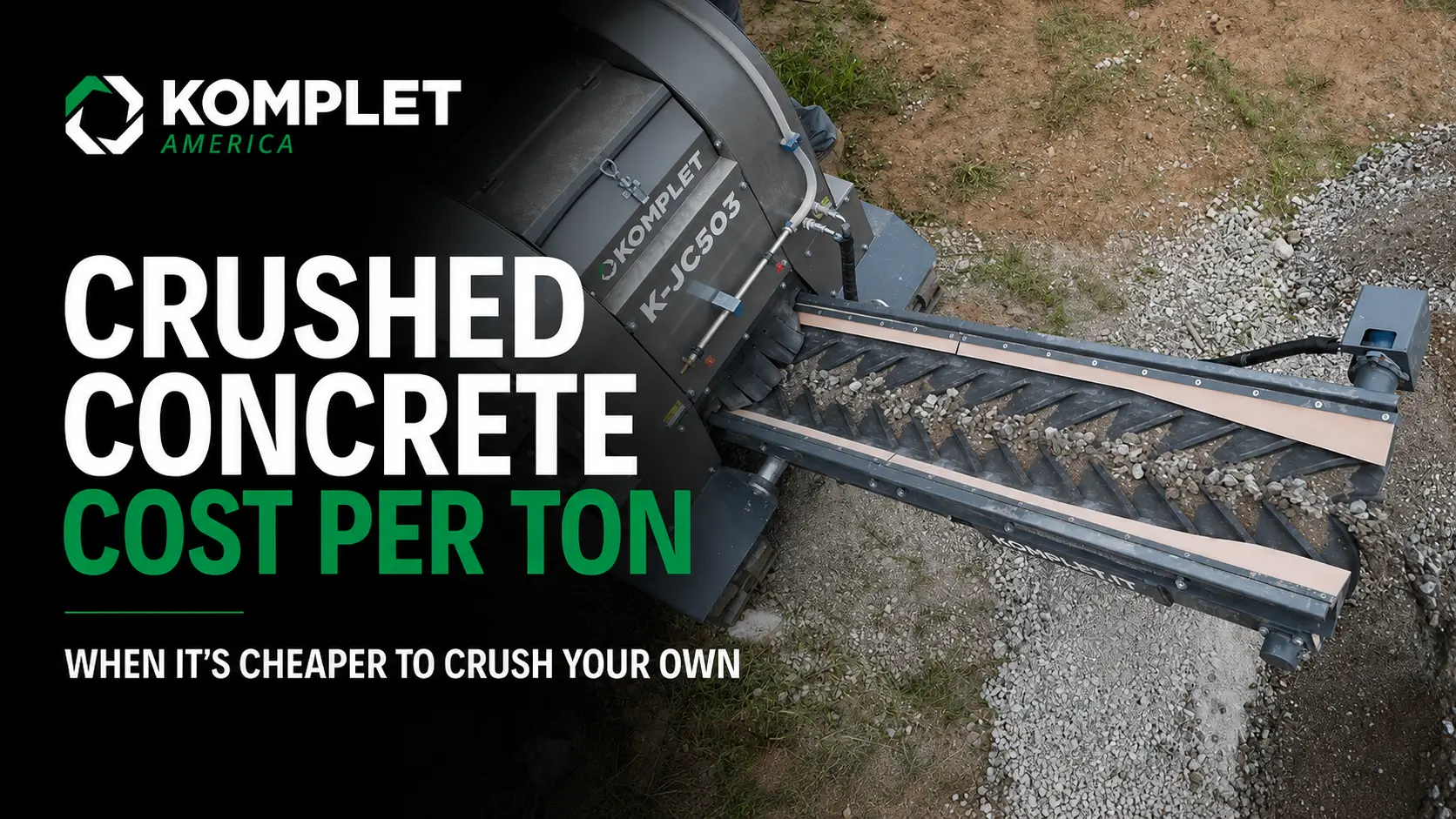
Compression-based jaw crushing breaks material between fixed and moving jaw plates. The closed-side setting (CSS) — the gap between the jaws at their closest position — determines the smallest particle size that exits the crusher. Smaller closed-side settings produce smaller output gradations; larger settings produce larger output gradations. Modern compact mobile jaw crushers feature hydraulic jaw setting adjustment via wireless remote control, enabling output size changes without manual tooling or production stops.
Practical Gradation Adjustment
Komplet’s K-JC 503 produces output ranging from 3/4″ to 3-1/4″ through hydraulic adjustment. Larger crushers in the lineup support proportional ranges. Operators adjust output based on:
- Project specification requirements — different project applications need different gradations
- Material characteristics — harder material may benefit from smaller settings to ensure complete fracture
- Production targets — smaller settings reduce throughput; larger settings increase throughput
- Downstream processing — material destined for screening can crush larger; final-product material crushes to spec
Closed-Side Setting and Production Trade-Offs
Smaller closed-side settings produce more uniform output but reduce throughput. Larger settings increase throughput but produce broader gradation requiring downstream screening for spec compliance. Match crusher settings to operational requirements — there’s no universal optimal setting.
Reverse Jaw for Blockage Clearing
All Komplet jaw crushers feature reverse jaw function — the moving jaw can reverse direction to clear blockages from sticky material, oversized debris, or unbreakable contamination. Reverse jaw operation maintains consistent production through the workday without requiring extended shutdown to clear blockages manually.
Contamination Management
Pre-Crushing Material Inspection
Demolition material may include contamination — wood, plastic, soil, oversized debris, foreign objects from demolition processes. Pre-crushing inspection and manual removal of large contamination items prevents equipment damage and improves output quality. Operators with experience identify problematic material before it reaches the crusher chamber.
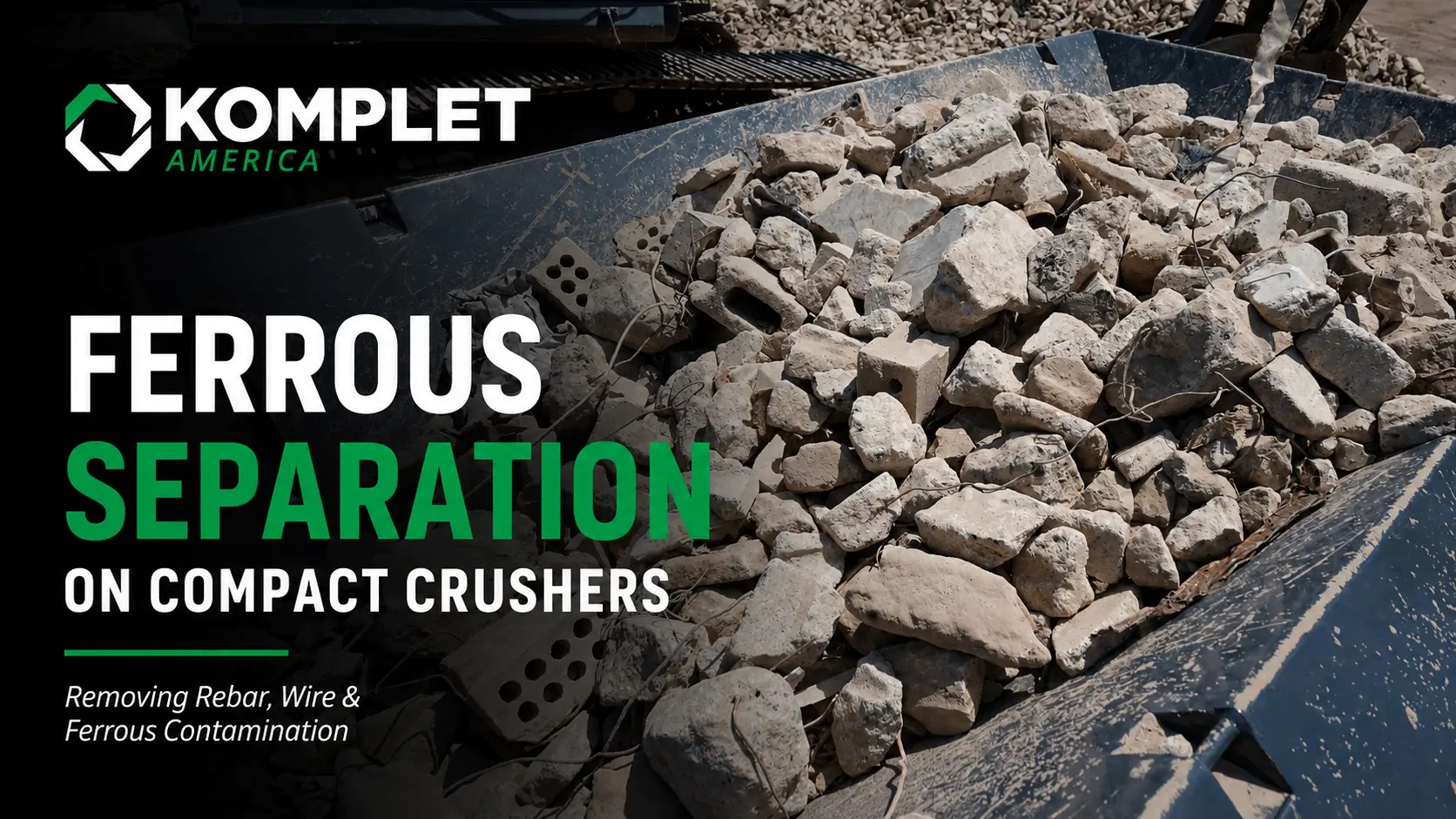
Magnetic Separation for Rebar Recovery
Reinforced concrete contains rebar that needs separation from crushed output. Komplet jaw crushers handle this through:
- K-JC 503: Optional magnetic attachment (included in base price) for rebar separation
- K-JC 604, K-JC 704 PLUS, K-JC 805: Standard hydraulic magnetic belt for rebar separation
Recovered rebar typically sells as scrap metal at $100-$300+/ton depending on market, adding revenue while keeping crushed RCA output clean. Magnetic separation supports both quality control (clean RCA without metal contamination) and economic outcomes (scrap metal revenue).
Pre-Screening for Oversized Debris
Some operations add a pre-screening stage before crushing to remove material outside the crusher’s effective feed range. This protects equipment from oversized contamination and improves overall throughput. The decision depends on incoming material characteristics — clean demolition material may not require pre-screening, while mixed demolition with significant oversized debris benefits from pre-screen.
Wood and Soft Material Considerations
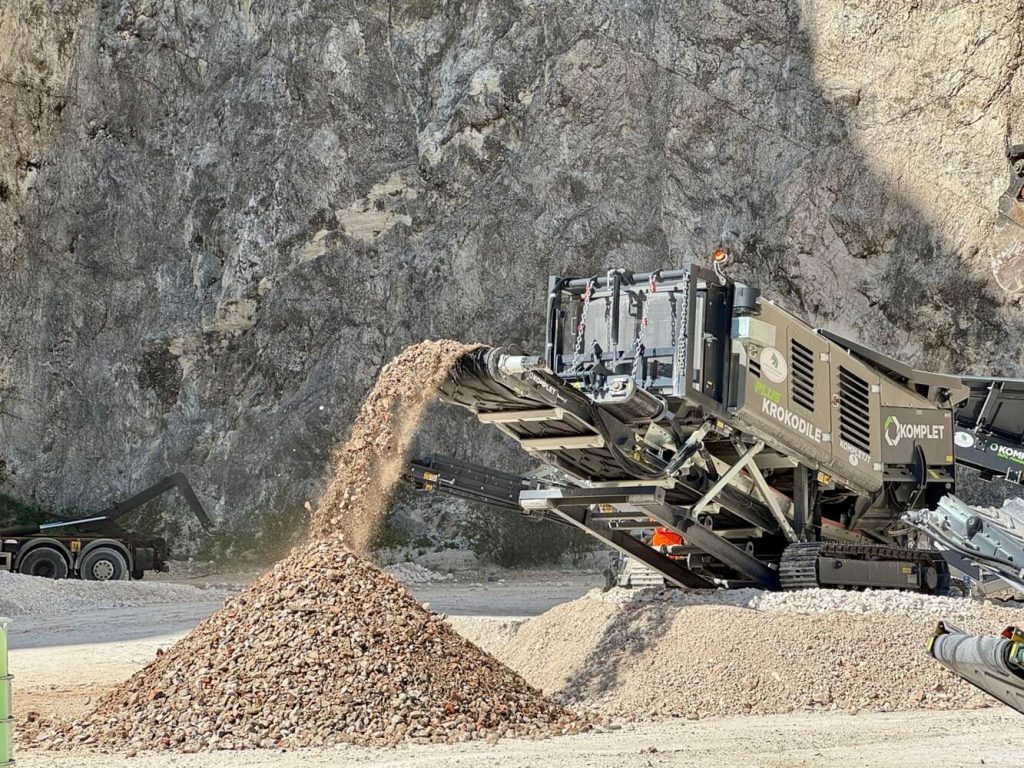
Wood, drywall, plastics, and other soft materials don’t belong in a jaw crusher — they wrap around moving parts and produce unusable output. Demolition material with significant soft contamination should be processed through Komplet’s Krokodile PLUS slow-speed shredder before or in parallel with jaw crushing of the hard mineral fraction. Match equipment to material — operations handling mixed C&D need both equipment types.
Vibrating Scalping Screening for Spec-Sized Output
Why Screening Matters for Quality Control
Jaw crushing produces a gradation range — output includes particles smaller than the closed-side setting and approximate fines content. Operations producing premium spec-sized aggregate (for HMA plant feedstock, concrete batch plants, decorative aggregate, premium base material) typically pair jaw crushing with vibrating scalping screening to deliver consistent gradations matching specifications.
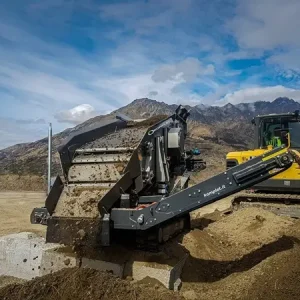
Komplet Vibrating Scalping Screener Options
- Kompatto 221 — up to 90 US tph. Pairs well with K-JC 604 and K-JC 704 PLUS jaw crushers.
- Kompatto 5030 — up to 280 US tph, hydraulic 2-way / 3-way conversion. Komplet’s best-selling screener. Pairs well with K-JC 704 PLUS and K-JC 805.
- Kompatto 124 — up to 350 tph. Largest mobile scalping screen. Pairs with K-JC 805 for high-volume operations.
Screen Mesh Selection
Different finished aggregate specifications require different screen mesh configurations. Kompatto 5030’s hydraulic 2-way / 3-way conversion supports producing 2 or 3 finished product sizes simultaneously, supporting operations producing multiple specifications from the same crushed feed. Mesh changes (typically 30-60 minute service operations) support specification flexibility based on project demand.
Cubical Particle Shape Through Secondary Impact Crushing
Particle Shape Reality
Honest framing: jaw crushing produces predominantly elongated and flaky particle shapes due to the compression action. While jaw crusher output works well for many applications (road base, structural fill, drainage stone, parking lot base), some applications require cubical-shape aggregate:
- Concrete batch plants — cubical aggregate produces stronger concrete with better workability
- Hot-mix asphalt plants — cubical aggregate provides better interlock and stability in HMA
- Premium decorative aggregate — landscape, architectural, and specialty markets prefer cubical shape
- Premium specifications — some state DOT specifications require maximum flakiness and elongation indices
K-IC 70 Impact Crusher for Cubical Output
Operations targeting cubical aggregate add the K-IC 70 compact impact crusher as a secondary crushing stage after primary jaw crushing. Specifications: up to 90 US tph, 25″ x 20″ inlet, 100 HP, ~28,600 lb. Impact crushing breaks material through high-velocity impact rather than compression, producing more cubical particle shape. The two-stage workflow (jaw → impact) delivers the production volume of jaw crushing with the particle shape benefits of impact crushing.
When Cubical Shape Isn’t Required
Most non-structural aggregate applications (road base, structural fill, parking lot base, drainage stone, rip-rap) accept jaw crusher output without secondary impact crushing. The decision to add K-IC 70 secondary stage depends on target market — operations selling exclusively to base material applications can skip the impact stage; operations targeting concrete or HMA plants typically need it.
State DOT Specifications and Industry Standards
Common Aggregate Specifications
State Departments of Transportation maintain specifications for aggregates used in public infrastructure projects. Common specifications include #57 stone (commonly 1″ to #4 sieve), #67 stone (commonly 3/4″ to #4), #8 stone (commonly 3/8″ to #8), #21A base (graded blend with fines), and others. Specifications vary by state DOT — verify current requirements for project locations.
Compliance Through Crushing + Screening
Producing state DOT-compliant aggregate from on-site demolition material typically requires:
- Primary crushing — jaw crusher reduces material to size that screening can effectively process
- Vibrating scalping screening — produces spec-sized fractions matching specification gradations
- Multi-stage screening (when needed) — Kompatto 5030’s 3-way configuration produces multiple sizes simultaneously
- Secondary impact crushing (when needed) — K-IC 70 produces cubical shape for premium specifications
- Quality verification — gradation testing throughout production
RCA Acceptance for Public Projects
State DOT acceptance of recycled concrete aggregate (RCA) for public projects has expanded significantly — most state DOTs now accept RCA for non-structural applications (base material, structural fill, drainage), with some accepting RCA for structural applications under specific qualification testing. Specific acceptance varies by state DOT and application — verify current requirements before bidding work that includes RCA utilization.
Documentation Requirements
Some markets (federal contracts, LEED-certified projects, state DOT work, certain commercial work) require documented diversion percentages, source documentation, and material flow records. On-site material processing supports compliance with measurable documentation through weight tickets, transfer documentation, and material flow records.
Komplet America’s Compact Mobile Jaw Crusher Lineup
Match crusher size to operational throughput requirements:
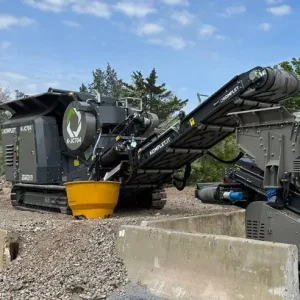
- K-JC 503 — up to 34 US tph, 19″ x 12″ jaw, 25 HP Tier 4 Final, ~7,496 lb. Tight-access urban work.
- K-JC 604 — up to 55 US tph, 23″ x 16″ jaw, 55 HP, ~19,400 lb. Mid-range demolition.
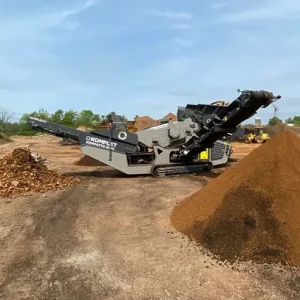
- K-JC 704 PLUS — up to 90 US tph, 27″ x 16″ jaw, 74 HP, ~26,455 lb. Komplet’s best-selling crusher.
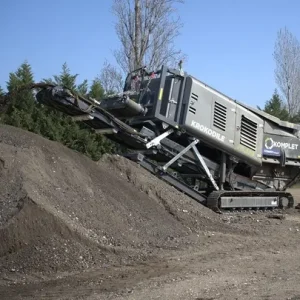
- K-JC 805 — up to 160 US tph, 31″ x 21″ jaw, 130 HP, ~49,600 lb. Largest jaw crusher in the lineup.
All Komplet Jaw Crushers Include
- Tier 4 Final emissions-compliant diesel engines
- Self-propelled tracked mobility for site-to-site movement
- Wireless remote control for safe operator distance
- Hydraulic jaw setting adjustment for output size flexibility
- Reverse jaw function for blockage clearing
- Integrated dust suppression standard on all models
- Magnetic separation for rebar recovery (standard on K-JC 604+; optional on K-JC 503 included in base price)
Economic Considerations for Quality-Controlled On-Site Crushing
Off-Site vs. On-Site Cost Components
On-site crushing economics typically dominate for project-based operations through:
- Avoided disposal tipping fees — commonly $30-$200+/ton for concrete in major US metros depending on regional market
- Avoided hauling cost — $5-$30+/ton typical depending on distance to disposal site
- Avoided aggregate purchase — virgin aggregate commonly runs $15-$40+/ton; project base material can come from project’s own crushed material
- Recovered RCA value — $10-$25+/ton for RCA base material; recovered rebar at $100-$300+/ton scrap value
- Schedule compression — elimination of disposal hauling cycles compresses project schedule
Quality Premium Pricing
Higher-quality aggregate commands premium pricing across markets — concrete batch plant feedstock, HMA plant feedstock, premium decorative aggregate, specification-compliant base material. Operations producing quality-controlled output can target premium markets that lower-quality aggregate can’t access. The quality premium typically more than offsets the additional equipment investment for screening and secondary impact crushing.
Komplet Capital Financing
Komplet Capital offers 24-hour approval, 100% financing, 3-6 year terms on Komplet equipment. New equipment qualifies for Section 179 tax deduction up to $1.22M (2024 limit). For operations evaluating quality-controlled on-site crushing investment, financing structures matter — talk to the team about options that fit operational economics.
Frequently Asked Questions
Can a jaw crusher alone produce specification-grade aggregate?
Depends on the specification. Jaw crushers alone can produce material acceptable for many non-structural applications (road base, structural fill, drainage). For specification-grade aggregate matching specific gradations (state DOT specs, premium markets), pairing jaw crushing with vibrating scalping screening is typically required to deliver consistent spec-sized output. For premium cubical-shape aggregate (concrete batch plants, HMA plants), adding K-IC 70 secondary impact crushing is typically required.
How much can I adjust the output size on a Komplet jaw crusher?
Komplet’s K-JC 503 produces output ranging from 3/4″ to 3-1/4″ through hydraulic adjustment via wireless remote control. Larger crushers in the lineup (K-JC 604, K-JC 704 PLUS, K-JC 805) support proportional ranges per their respective specifications. All Komplet jaw crushers feature hydraulic jaw setting adjustment without manual tooling.
Do I need a separate screener for on-site quality control?
Depends on target output specifications. Operations producing material for non-structural applications (road base, fill, drainage) can often work with crusher output alone. Operations producing spec-sized aggregate for premium markets typically need vibrating scalping screening (Kompatto lineup) for spec gradation. Operations producing cubical aggregate for concrete or HMA plants typically also need K-IC 70 secondary impact crushing.
How does on-site crushing compare cost-wise to buying aggregate?
Highly variable based on regional pricing and operational profile. On-site crushing typically delivers cost savings through avoided disposal fees ($30-$200+/ton in major US metros for concrete), avoided hauling, and avoided aggregate purchase ($15-$40+/ton for virgin aggregate). Plus recovered material revenue (RCA, scrap rebar). For operations with consistent project pipeline, on-site crushing typically wins economically. Run specific numbers for your operation rather than relying on generic claims.
Can I produce aggregate for state DOT projects with on-site crushing?
Yes, where state DOT specifications accept the equipment configuration’s output. State DOT acceptance of RCA has expanded significantly — most state DOTs now accept RCA for non-structural applications. Producing state DOT-compliant aggregate typically requires crushing + screening for spec gradation, plus quality verification per applicable testing requirements. Specific requirements vary by state DOT — verify current requirements before bidding work.
What about contamination from rebar in demolition concrete?
Komplet jaw crushers handle reinforced concrete through compression-based crushing that breaks the concrete around the embedded rebar. Magnetic separation (standard on K-JC 604, K-JC 704 PLUS, K-JC 805; optional on K-JC 503 included in base price) recovers the liberated rebar from the crushed output. Recovered rebar typically sells as scrap metal at $100-$300+/ton depending on market.
Should I rent or buy crushing equipment for on-site quality control?
Renting is typically the right starting point for first-time operations and single-project work. For operations with recurring project pipeline (multiple projects per year with significant crushing volume), ownership economics typically justify purchase. Find your local Komplet dealer or call (908) 369-3340 to discuss rental availability and operational economics.
Does on-site crushing support LEED documentation?
Yes — on-site processing supports LEED Construction Waste Management documentation through measurable material flow records (weight tickets, transfer documentation, processing records). Specific LEED credit requirements vary by version and project type — verify current requirements for specific projects with the project’s sustainability consultant or LEED accredited professional.
Final Thoughts
On-site aggregate quality control transforms construction projects from passive aggregate consumers into active aggregate producers — supporting tighter specifications, faster adjustments, real-time verification, and superior project outcomes. The right equipment configuration depends on target output specifications: jaw crushing alone supports non-structural applications; jaw + vibrating scalping screening supports spec-sized aggregate; jaw + screening + impact crushing supports premium cubical-shape aggregate for concrete batch plants and HMA plants. Komplet America’s compact mobile jaw crusher lineup (K-JC 503 through K-JC 805) paired with Kompatto vibrating scalping screeners and the K-IC 70 impact crusher delivers the full quality control workflow for on-site operations across N&C America.
Browse Komplet America’s compact mobile crusher and screener lineup or call us to discuss equipment selection for your specific aggregate quality control requirements.
Ready to Talk On-Site Aggregate Quality Control?
- Call (908) 369-3340
- Email [email protected]
- Schedule a demo or request a quote
- Find your local Komplet dealer for rental availability
- Ask about our 1-year / 1,000-hour warranty and equipment financing options
Never enough — that’s how we approach service, support, and helping operations deliver specification-grade aggregate from on-site crushing.
Disclaimer: All cost, ROI, payback, pricing, tipping fee, and revenue figures in this article are illustrative examples based on sample assumptions about volume, regional pricing, material specifications, and market conditions. Actual results vary significantly by region, market, material type, equipment utilization, operator skill, financing terms, regulatory environment, and many other factors. Equipment pricing, tipping fees, RCA pricing, scrap metal pricing, fuel costs, and labor rates all change over time and by location. Komplet America makes no guarantee, warranty, or representation of specific financial performance, payback timelines, or business outcomes for any particular operation. State DOT specifications for aggregate utilization vary by jurisdiction and project type; verify specific requirements before bidding work. LEED credit requirements are subject to update; consult applicable sustainability professionals for current guidance specific to your projects. For current pricing and a payback estimate based on your specific volume, material, and local market, contact us at (908) 369-3340 to speak with our team.