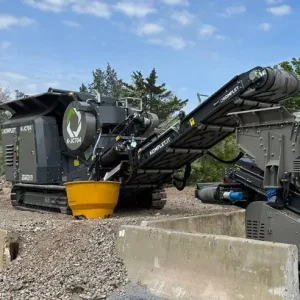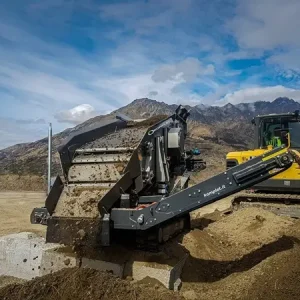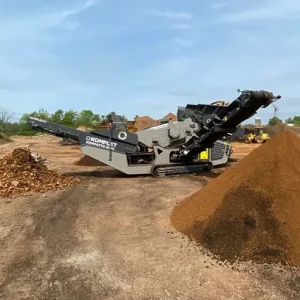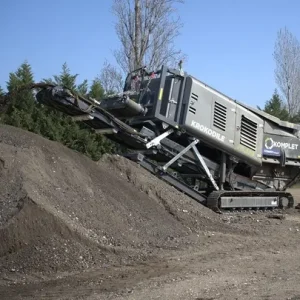

Primary crushing — the first crushing stage that takes raw material directly from blasting, excavation, or demolition and reduces it to manageable size for downstream processing — sets the foundation for every material processing operation. The equipment choice at this stage determines throughput, downtime, and total cost per ton across the entire production line. Jaw crushers have become the dominant primary crushing equipment across construction, demolition, recycling, and aggregate operations because their mechanical principles align uniquely well with the demands of primary reduction work.
This guide walks through why jaw crushers are ideal for primary crushing — the mechanical principles that make compression-based reduction the right approach for primary work, the specific applications where jaw crushers excel, the technology alternatives and where each fits, and how Komplet America’s compact mobile jaw crusher lineup delivers primary crushing performance for construction, demolition, recycling, and small-to-mid-volume aggregate operations.
What Primary Crushing Actually Is
Primary crushing is the first reduction stage in any crushing workflow. It receives raw material directly from upstream operations — excavated rock from a quarry, demolition concrete from a building teardown, blasted stone from pit operations, ledge rock from excavation work — and reduces it to a manageable size for downstream handling. Typical primary output sizes run 3-12 inches depending on application; downstream secondary or tertiary crushing handles further reduction to spec sizes.
Primary Crushing Demands
Primary crushers face the largest, hardest, most variable, and most contaminated material in the entire crushing circuit. The feed includes irregular shapes from blasting or demolition, embedded reinforcement (rebar in concrete), foreign objects (wood, plastic, metal fragments in mixed C&D debris), and variable moisture content. The crusher must handle this variability without stopping production, reduce material consistently to a target size range, and deliver throughput rates that don’t bottleneck downstream operations.
Primary vs. Secondary Crushing
Secondary crushing (the next stage) takes primary output and refines it further — typically reducing material from 3-12 inches down to 1-3 inches with more controlled output shape. Secondary crushers prioritize particle shape, gradation, and uniformity over raw reduction power. Primary crushers prioritize raw reduction power and feed-handling capability over output refinement. Different stages need fundamentally different equipment.
Why Jaw Crushers Excel at Primary Crushing
The jaw crusher’s mechanical principles align uniquely well with primary crushing demands. Five characteristics define the fit:
Compression-Based Reduction
Jaw crushers reduce material through compression between fixed and moving jaw plates. The moving jaw approaches the fixed jaw, compressing material against the fixed surface until the material fractures along its weak planes. Compression efficiently breaks hard rock (granite, basalt, traprock), reinforced concrete (with the steel separating from the concrete during compression rather than wrapping around moving parts), and irregular feed shapes that other crusher types struggle with.
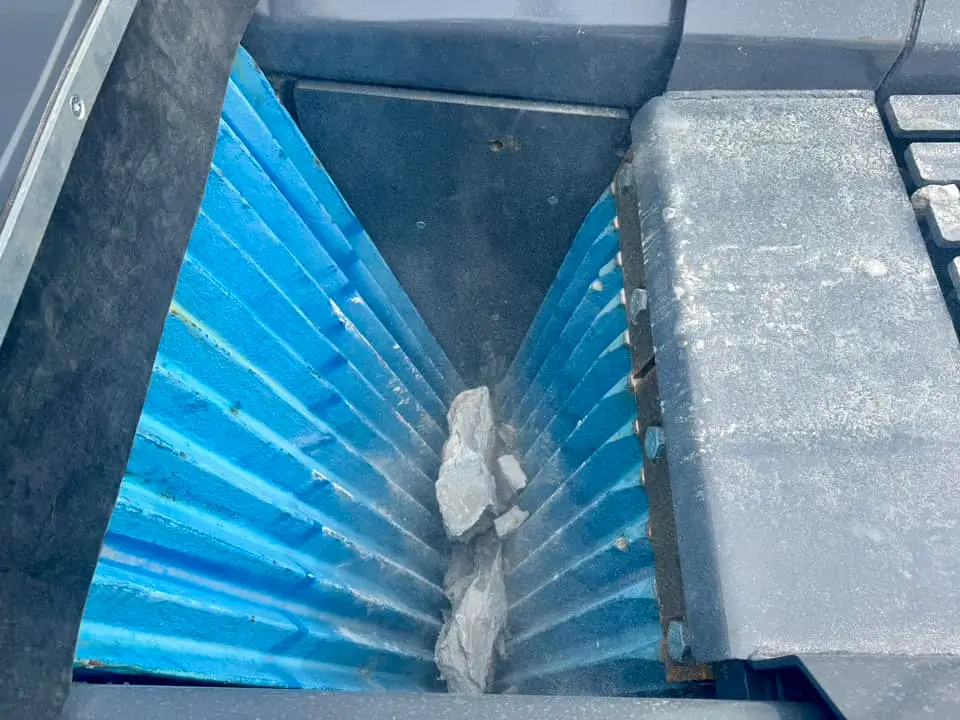
V-Shaped Crushing Chamber
The angle between fixed and moving jaws creates a tapered V-shaped crushing chamber wider at the top (feed) and narrower at the bottom (discharge). Material enters at the top, falls toward the bottom under gravity, and gets progressively reduced as it moves through the chamber. Each cycle of the moving jaw reduces material further; pieces small enough to fall through the bottom opening discharge as crushed product. Pieces still too large remain in the chamber for additional cycles. This naturally self-regulating geometry eliminates the need for active size sorting during crushing.
Wide Feed Opening Acceptance
Compact mobile jaw crushers in Komplet’s lineup have feed openings ranging from 19″ x 12″ (K-JC 503) to 31″ x 21″ (K-JC 805). These openings accept large irregular pieces up to about 80% of the jaw gape directly from excavation or demolition, so only true oversize needs pre-processing. Operators can feed straight from a loader bucket or excavator into the crusher hopper.
Tolerance for Contaminated Feed
Demolition concrete with embedded rebar, mixed C&D debris with foreign objects, and pit-run material with variable composition all feed into jaw crushers without requiring pre-screening. The compression action separates rebar from concrete during reduction; downstream magnetic separation captures the recovered metal. The reverse jaw function (clearing uncrushable obstructions in seconds) handles the occasional foreign object that enters the chamber.
Mechanical Simplicity and Reliability
Jaw crushers have fewer moving parts than other crusher types — primarily the moving jaw assembly and its drive components. Fewer parts mean fewer potential failure points, simpler maintenance, faster diagnostic processes, and shorter downtime when service is required. Wear parts (jaw plates, side liners) are accessible and replaceable as scheduled service rather than emergency repairs.
Primary Crushing Applications: Where Jaw Crushers Excel
Concrete and Demolition Recycling
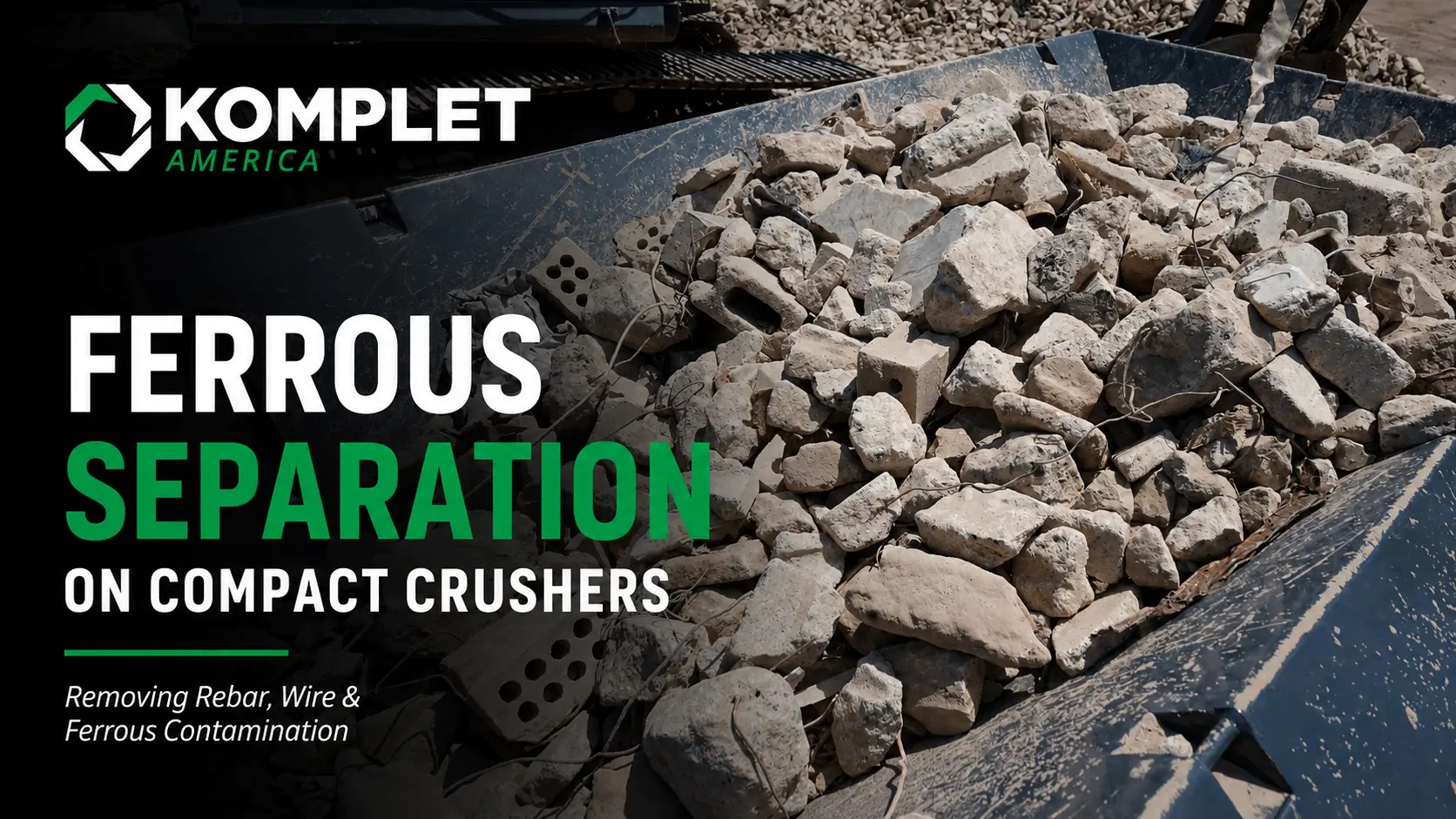
Demolition contractors processing reinforced concrete (slabs, foundations, walls, structural elements) rely on jaw crushers for primary reduction. The compression action breaks concrete around embedded rebar without wrapping the steel around moving parts that would jam other crusher types. Komplet jaw crushers (K-JC 604, K-JC 704 PLUS, K-JC 805) include integrated hydraulic magnetic belts that automatically lift recovered ferrous metal off the discharge conveyor — turning the rebar into recoverable scrap revenue while keeping the recycled concrete aggregate (RCA) output clean.
Asphalt and Pavement Recycling
Recycled asphalt pavement (RAP) production requires primary crushing of removed pavement chunks down to specifications suitable for hot-mix asphalt or road base reuse. Jaw crushers handle the variable composition of pavement material (asphalt cement, aggregate, surface contamination) reliably while producing consistent gradation for downstream processing.
Aggregate Production from Excavated Rock
Excavation contractors hitting ledge rock during site preparation use jaw crushers to convert that rock into useful base aggregate for the project. On-site crushing eliminates aggregate purchases for foundation work while diverting excavated material from disposal. The K-JC lineup handles the variable feed sizes (3 inches up to about 16-3/4 inches on the K-JC 805) that excavation work typically produces.
Small-to-Mid-Volume Quarry Operations
Quarry operations producing up to 160 US tph use Komplet’s compact mobile jaw crushers as primary reduction equipment — particularly satellite quarries, specialty stone producers, and mid-volume aggregate operations. Larger quarries (500,000+ tons annually with sustained operation at fixed installations) typically use mining-scale fixed-plant equipment from manufacturers specializing in that segment. Match the equipment scale to the actual operational scale.
Pit-Run Material Processing
Pit operations producing pit-run gravel and crushed stone use jaw crushers as primary reduction stages. Variable feed composition (mix of stone sizes, occasional foreign material, varying moisture) suits the jaw crusher’s tolerant feed handling.
Mixed C&D Waste Recycling
C&D recyclers processing mixed demolition debris (concrete + brick + masonry + asphalt + miscellaneous building materials) use jaw crushers as primary reduction. The mixed feed composition that other equipment types would struggle with is exactly what jaw crusher mechanics handle well.
Primary Crushing Technology Alternatives
Across the broader equipment landscape, multiple crusher technologies serve primary crushing roles in different operational contexts. Understanding the alternatives clarifies why jaw crushers dominate compact mobile primary crushing while other technologies dominate other operational categories.
Jaw Crushers (Compact Mobile and Industrial Primary)
The dominant compact mobile primary crusher technology, used across construction, demolition, recycling, and small-to-mid-volume aggregate operations. Also used as primary equipment in larger fixed-plant installations. Strengths: handles variable feed, wide jaw opening accepts large pieces, mechanical simplicity, tolerates contaminated feed. Limitations: output is irregular/angular (premium cubical output requires secondary impact or cone crushing).
Gyratory Crushers (Mining-Scale Primary)
Gyratory crushers compress material between a rotating mantle and a fixed concave bowl. They excel as primary crushers in very large mining and quarry operations processing thousands of tons per hour at fixed installations. Gyratory crushers are typically large fixed-plant equipment — the engineering doesn’t fit compact mobile design. For mining-scale operations and very large fixed-plant quarries, gyratory primaries from manufacturers specializing in that segment serve those operations better than compact mobile equipment can.
Impact Crushers (Sometimes Used as Primary)
Impact crushers use high-speed rotating blow bars striking material against impact plates. Sometimes used as primary crushers in operations where output cubical shape is critical and feed material is relatively clean (limestone quarries with predictable feed). For mixed-material operations (demolition concrete with rebar, pit-run with variable composition, mixed C&D), jaw crushers typically perform better as primary because impact crushers can wrap rebar around the rotor and require cleaner feed. Komplet’s K-IC 70 compact impact crusher is designed for secondary cubical reduction in compact mobile workflows rather than primary crushing of contaminated feed.
Cone Crushers (Secondary, Not Primary)
Cone crushers compress material between a rotating mantle inside a concave bowl. They excel as secondary and tertiary crushers in larger fixed-plant operations producing premium-spec aggregate for concrete and asphalt mix designs. Cone crushers don’t typically serve as primary crushers — their feed opening is smaller than jaw or gyratory primaries, and they’re optimized for refining pre-reduced material rather than handling raw feed. Cone crushers from manufacturers specializing in that segment serve mid-to-large fixed-plant secondary crushing roles; for compact mobile workflows, secondary cubical reduction is handled by impact crushers like Komplet’s K-IC 70.
Komplet America’s Primary Crushing Lineup
Compact Mobile Jaw Crushers
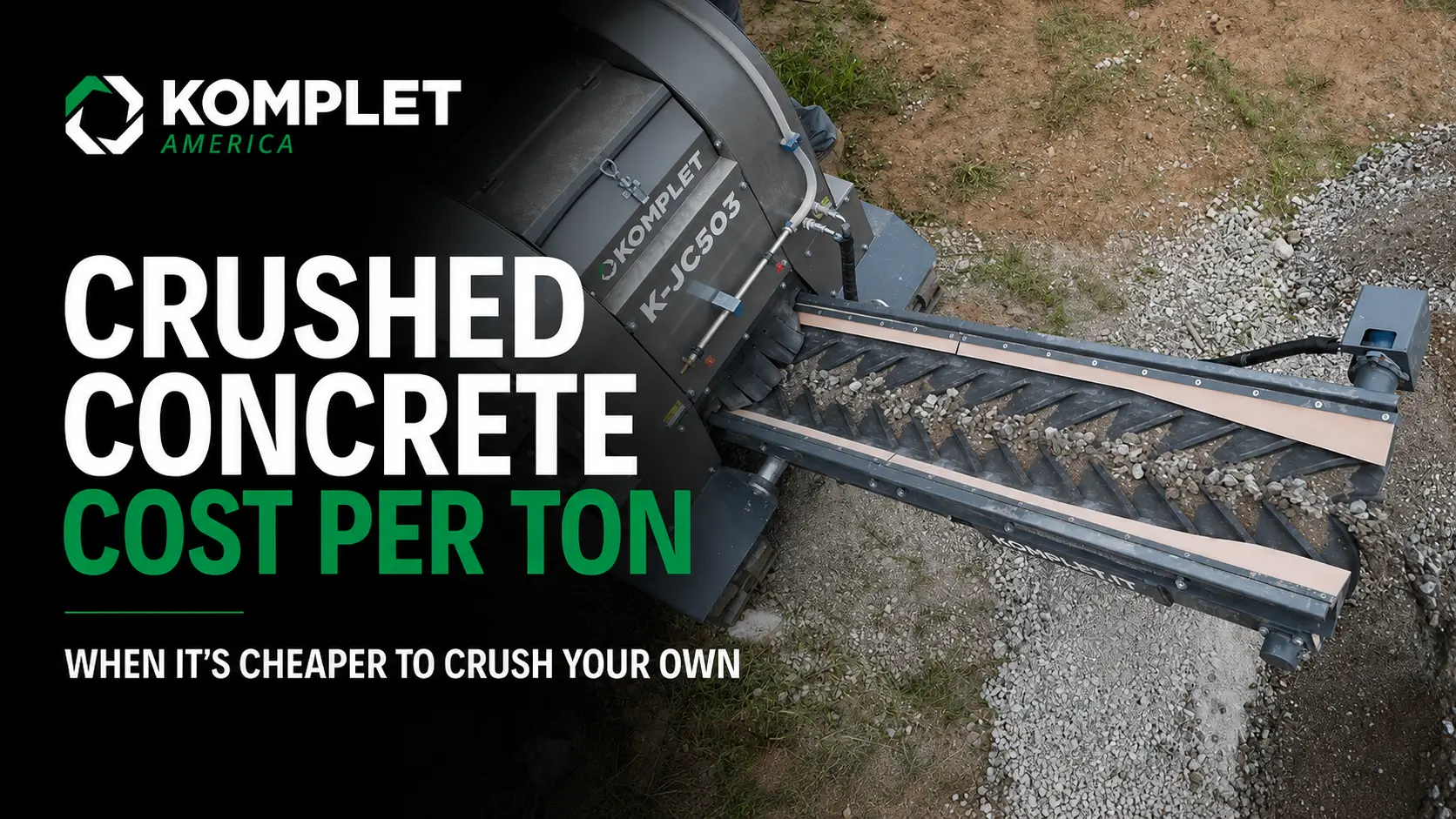
- K-JC 503 — up to 34 US tph, 19″ x 12″ jaw, 25 HP Tier 4 Final, ~7,496 lb. Tight-access urban demolition, small-scale primary crushing operations.
- K-JC 604 — up to 55 US tph, 23″ x 16″ jaw, 55 HP, ~19,400 lb. Mid-range primary crushing for typical demolition and aggregate operations.
- K-JC 704 PLUS — up to 90 US tph, 27″ x 16″ jaw, 74 HP, ~26,455 lb. Komplet’s best-selling crusher — the workhorse primary crusher for typical contractor and aggregate operations.
- K-JC 805 — up to 160 US tph, 31″ x 21″ jaw, 130 HP, ~49,600 lb. Largest jaw crusher in the lineup, for high-volume primary crushing in serious mid-volume aggregate operations.
Standard Primary-Crushing Productivity Features
Every Komplet jaw crusher ships with features specifically engineered for primary crushing demands:
- Hydraulic magnetic belt (K-JC 604, K-JC 704 PLUS, K-JC 805) — automatic ferrous metal separation from demolition concrete feed
- Reverse jaw function — clears uncrushable jams in seconds via wireless remote (essential for variable contaminated feed)
- Standard dust suppression — water-spray system for OSHA crystalline silica compliance (PEL of 50 ug/m3 over 8 hours)
- Wireless remote control — single-operator deployment and operation; operator stays clear of the crushing chamber
- Hydraulically adjustable jaw setting — output size adjustment from cab without manual tooling
- Self-propelled tracked mobility — deploys between job sites without specialized rigging
- Tier 4 Final emissions compliance — current emissions standard for construction operations
- Ultrasonic feed sensor (K-JC 503) — automatic feed regulation to prevent overfeeding
Pairing with Secondary and Screening Equipment
Primary crushing produces undifferentiated output requiring downstream processing for spec-size production. Komplet jaw crushers pair naturally with Kompatto vibrating scalping screeners (Kompatto 221, 5030, or 124) for spec-size separation, and with the K-IC 70 impact crusher for premium cubical secondary output when concrete or asphalt mix-design markets are the target.
Frequently Asked Questions
What’s the difference between primary and secondary crushing?
Primary crushing is the first reduction stage — taking raw material (excavated rock, demolition concrete, blasted stone) and reducing it to 3-12 inch output. Primary crushers prioritize raw reduction power and feed-handling capability over output refinement. Secondary crushing takes primary output and refines it further — typically to 1-3 inches with more controlled particle shape and gradation. Different stages need fundamentally different equipment; jaw crushers dominate primary work, impact and cone crushers serve secondary work.
Why do jaw crushers handle reinforced concrete better than other crusher types?
The compression action of jaw crushing breaks concrete around embedded rebar without wrapping the steel through moving parts. After reduction, the rebar separates from the concrete cleanly — and Komplet’s integrated hydraulic magnetic belt automatically lifts the recovered metal off the discharge conveyor. Impact crushers (high-speed rotating rotors) can wrap rebar around the rotor, causing jams and damage. Cone crushers (smaller feed openings) struggle with the irregular sizes typical of demolition concrete. Jaw crusher mechanics specifically suit the contaminated, irregular feed of demolition work.
How does primary crushing capacity translate to project economics?
Primary crushing capacity bottlenecks the entire production line — downstream secondary crushing, screening, and material handling can only process what primary delivers. Sizing primary capacity correctly (typical project demand + 30-50% headroom for peak periods and growth) prevents the operation from being capacity-constrained at the primary stage. Most operations end up either underbuying (constrained throughput) or overbuying (low utilization with high cost per ton). Honest demand assessment is the foundation of correct sizing.
Can compact mobile jaw crushers really handle primary crushing demands?
Yes — for construction, demolition, recycling, and small-to-mid-volume aggregate operations. Komplet’s K-JC lineup spans up to 160 US tph (K-JC 805), handling the throughput typical of these markets. For very large mining-scale primary crushing (thousands of tons per hour at fixed installations), compact mobile equipment isn’t the right tool — manufacturers specializing in mining-scale gyratory primaries serve those operations better. Match the equipment scale to the actual operational scale.
What’s Komplet’s most popular primary crusher?
The K-JC 704 PLUS — Komplet’s best-selling crusher. Up to 90 US tph throughput, 27″ x 16″ jaw, integrated rebar separation, reverse jaw function, dust suppression, wireless remote. Workhorse primary crusher for typical contractor and aggregate operations across construction, demolition, recycling, and quarry markets.
Why doesn’t Komplet make a gyratory primary crusher?
Gyratory crushers excel as primary equipment in very large mining-scale operations processing thousands of tons per hour at fixed installations. The engineering required for gyratory crusher design doesn’t fit compact mobile equipment philosophy — gyratory crushers are typically massive stationary installations. Komplet specializes in compact mobile equipment for the construction, demolition, recycling, and small-to-mid-volume aggregate markets. For operations needing mining-scale gyratory primary crushing, manufacturers specializing in that segment serve the application better than compromise products trying to span both markets.
How do I match jaw crusher size to my primary crushing target?
Calculate your typical project profile — average tons of material per project, project frequency, working days per project. Divide annual tonnage by typical operating days, then by typical operating hours per day, to get average required throughput. Add 30-50% headroom for peak demand. Approximate sizing guide: under 34 tph average → K-JC 503; up to 55 tph → K-JC 604; up to 90 tph → K-JC 704 PLUS; 90+ tph → K-JC 805. For specific application sizing, contact us at (908) 369-3340.
Can I rent a primary jaw crusher before buying?
Yes — through Komplet’s authorized dealer and rental network. Find your local Komplet dealer or call (908) 369-3340. Many partners offer rent-to-own arrangements where rental payments credit toward eventual purchase. Renting is typically the right starting point for first-time primary crushing operations — it demonstrates equipment fit on real projects before committing capital.
Final Thoughts
Jaw crushers dominate primary crushing across construction, demolition, recycling, and small-to-mid-volume aggregate operations because their mechanical principles align uniquely well with primary crushing demands — compression-based reduction handles hard materials and reinforced concrete; the V-shaped chamber self-regulates output without active sorting; wide feed openings accept large irregular pieces; tolerance for contaminated feed handles the reality of mixed-material work; and mechanical simplicity supports the maintenance economics that determine long-term operating cost. Different equipment categories (gyratory primaries for mining-scale operations, cone secondaries for refined output) serve other operational contexts well — but for the markets Komplet America serves, jaw crushers are the right primary crushing tool.
Komplet America’s compact mobile jaw crusher lineup — K-JC 503 through K-JC 805 — covers primary crushing operations from tight-access urban demolition through high-volume mid-size aggregate work. Browse the complete crusher lineup or call us to discuss whether Komplet’s primary crushing equipment fits your specific operation.
Ready to Talk Primary Crushing?
- Call (908) 369-3340
- Email [email protected]
- Schedule a demo or request a quote
- Find your local Komplet dealer for rental availability
- Ask about our 1-year / 1,000-hour warranty and equipment financing options
Never enough — that’s how we approach service, support, and helping operations get primary crushing right from the foundation up.
Disclaimer: All cost, ROI, payback, and pricing figures in this article are illustrative examples based on sample assumptions about volume, regional pricing, material specifications, and market conditions. Actual results vary significantly by region, market, material type, equipment utilization, operator skill, financing terms, regulatory environment, and many other factors. Equipment pricing, fuel costs, labor rates, and wear-part costs all change over time and by location. Komplet America makes no guarantee, warranty, or representation of specific financial performance, payback timelines, or business outcomes for any particular operation. For current pricing and a payback estimate based on your specific volume, material, and local market, contact us at (908) 369-3340 to speak with our team.